

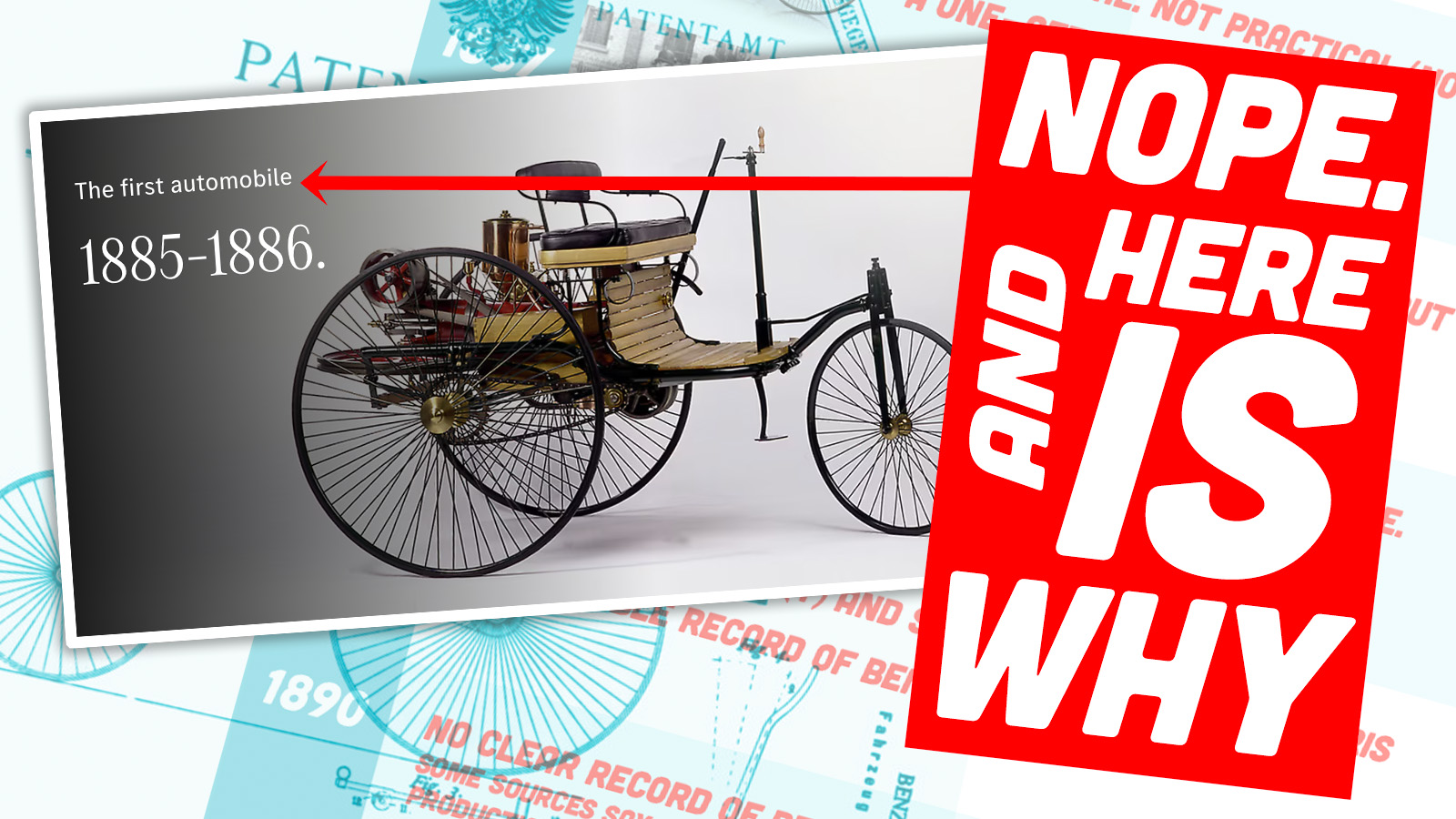
I know I’m a bit consumed by a crusade to push back on the maddeningly pervasive notion that the automobile was invented in 1886 by Carl Benz, because it very clearly wasn’t. I know that’s what Mercedes-Benz likes to say, but as I have covered extensively before, there was over a century of automobile development, production, and use between Nicholas-Joseph Cugnot’s 1769 steam drag and Carl Benz’s 1886 Patent-Motorwagen. And yet, despite there being a wealth of evidence to suggest that the 1886 Benz car, while undoubtedly a significant milestone in the history of the automobile, was not the “birth of the automobile” or the first automobile or anything of that sort, Mercedes-Benz still stands by its brash claim.
Even with all the evidence available, the myth of the Benz Patent-Motorwagen as the first car continues, sometimes tempered with qualifications like the first gasoline-powered, internal-combustion automobile, or the first production automobile, or the first patented automobile, or the first “practical” automobile.


I’m here to tell you that, even with all those qualifications, none of those statements are actually true – my last article covers the (primarily) the steam era of automobiles that includes the actual first patented automobile, the actual first series-produced automobile, and earlier internal-combustion automobiles.
The truth is much muddier, as it always is. It’s my opinion that Mercedes-Benz knows this, and benefits from not investigating this claim closely. The whole reason the Benz vehicle gets as much “first car” recognition as it does stems from a very specific plan and agreement between Mercedes-Benz and the former Reich-era government of Germany, which we’ll get into more soon. Right now, though, I want to walk through some of the early years of the internal-combustion automobile industry, and how the Benz Patent-Motorwagen fits into it.
Specifically, I want to address a qualified “first automobile” statement made by a curator of a well-known automotive museum, with whom I was speaking about this idea. He said the 1886 Patent-Motorwagen was the first “practical” automobile, and I’ve spoken with other historians who feel comfortable calling the Benz Patent-Motorwagen the first “production” automobile, or production automobile in the modern sense, or the first that was actually available for sale.
I’m not comfortable with any of those statements, even with their qualifiers, and I’ll explain why.
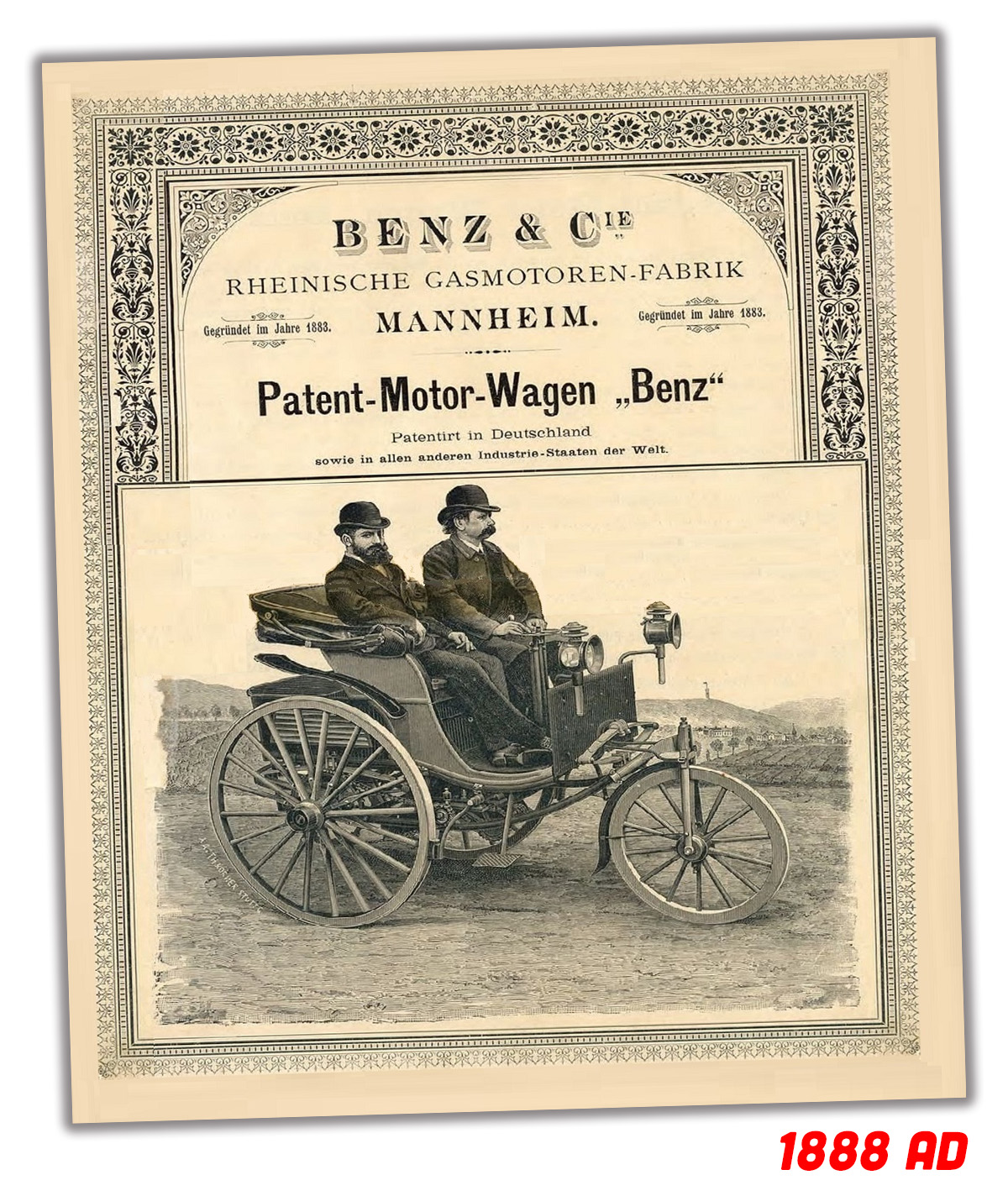
I think the way we talk about the 1886 Patent-Motorwagen as a “practical” car or the first car people could buy is strangely vague and even misleading. Most sources say that “about 25” Patent-Motorwagens were sold between 1886 and 1894, but this is not only misleading, but incredibly hard to confirm. My first issue is that even if we accept that 25 early Benzes were sold, these were not the same car as the one that was built in 1886.
The 1886 car was not a practical vehicle one could drive; it didn’t have a fuel tank, relying on just the 1.5 liters of legroin (a petroleum distillate) in its crude carburetor for fuel, which was not enough to travel any practical distances. The original 1886 car couldn’t get up most hills, either. This was an experimental one-off machine, not a practical or production vehicle by any stretch.
The next Benz car, built in 1887, was a completely different design, albeit built on the same basic principles as the first one. It fixed some issues, but was not practical, either. The next attempt, the 1888 car, is famous for being the machine that Bertha Benz used for her famous drive; it was also experimental, and while Bertha managed the trip, she was making repairs and improvements along the way, and still needed some help up some hills. The 1888 car, different than the two cars that preceded it, was still not really ready for sale to the general public.
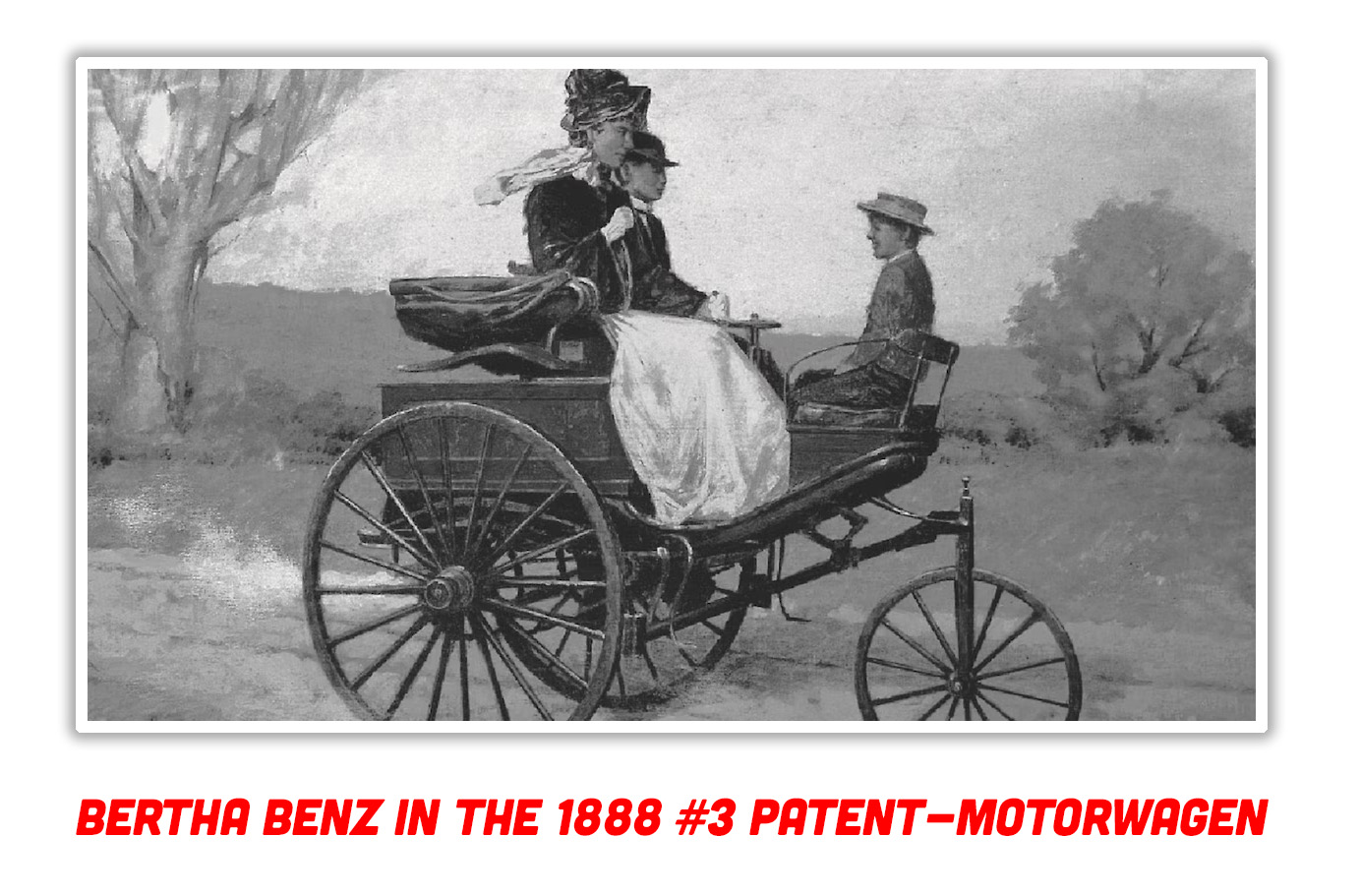
It’s also confusing because many recreations or depictions of Bertha’s drive use replicas of the 1886 car, which was not the car she actually used. The car she used, the 1888 car, is shown above. This video reenactment uses a replica of the 1886 car, which is inaccurate:
So, of these alleged about 25 cars, three were one-off experiments; while at least one car had been shown at exhibition in 1887, it wasn’t until 1890 that sources suggest Benz was taking orders for cars, and even then, I have yet to find much evidence or numbers that any cars were actually ordered. So far, I haven’t been able to find solid numbers about how many Patent-Motorwagens were sold, or even what the “production” Patent-Motorwagen would have been like. At the earliest, such a production version of the car couldn’t have existed before 1889.
Benz did have someone doing sales, Émile Roger, who had a license to produce vehicles and engines under license in France, and he may have purchased the 1888 one-off car. It’s not exactly clear, and the best sales information I’ve found is that Roger is said to have sold “almost a dozen” by 1892. I’ve tried to reach out to Mercedes-Benz for this early sales information, but so far I’ve received no response.
What does “almost a dozen” mean? Nine? Eleven? Ten? Who knows. These almost-a-dozen alleged sales could only have happened in the four-year span between 1889 and 1892. And it’s worth noting that during that same span of time, Peugeot and Panhard et Levassor were building and selling cars as well, cars that have much more readily available sales information, and genuine examples of which actually exist in museum collections.
Let’s put this in chart form, just to get some idea of what I’m talking about:
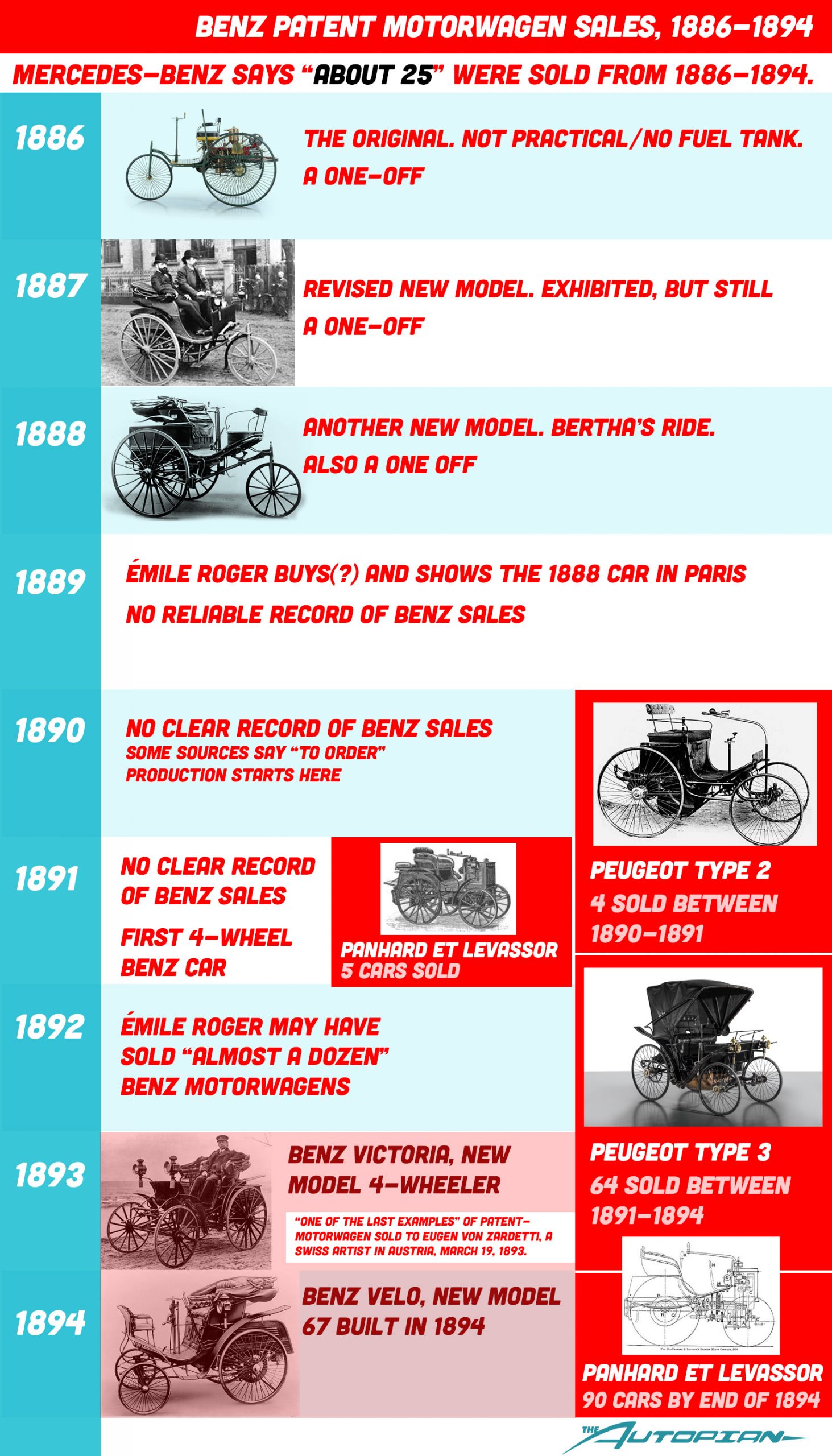
This chart shows car production for three companies between 1886 and 1894: Benz, Peugeot, and Panhard et Levassor. Both Peugeot and Panhard et Levassor were using engines from Daimler, which would eventually merge with Benz in 1926. Benz’s production numbers for whatever they considered to be their production model (which seems to be an 1890-ish revision before the four-wheel version was developed in 1891) are, as you likely have figured out, maddeningly vague.
In fact, the only confirmed example of a Patent-Motorwagen sold I have been able to find, at least so far, was what is considered to be the first car sold in Austria, on March 19, 1893, to a Swiss artist named Eugen Zardetti. This is stated to be one of the last Patent-Motorwagens sold.

Zardetti’s 1893 Benz started out as a three-wheeler and was later modified to be a four-wheeler, which may suggest that the four-wheeler Benz was derived from the three-wheeler enough that such a modification was possible. This four-wheeled version of the Patent-Motorwagen then developed into what is considered a new model in 1893, the Benz Victoria, which sold in greater numbers, and then in 1894, an all-new model, the Benz Velo, was released, and would eventually become Benz’s first genuinely successful model, selling around 1,200 cars by 1902, with 67 of those sold in 1894.
But neither the Victoria nor the Velo was the same car as the 1886 Patent-Motorwagen. And by the time sales were picking up for those later Benz models, cars from Peugeot and Panhard et Levassor were already in production as well.
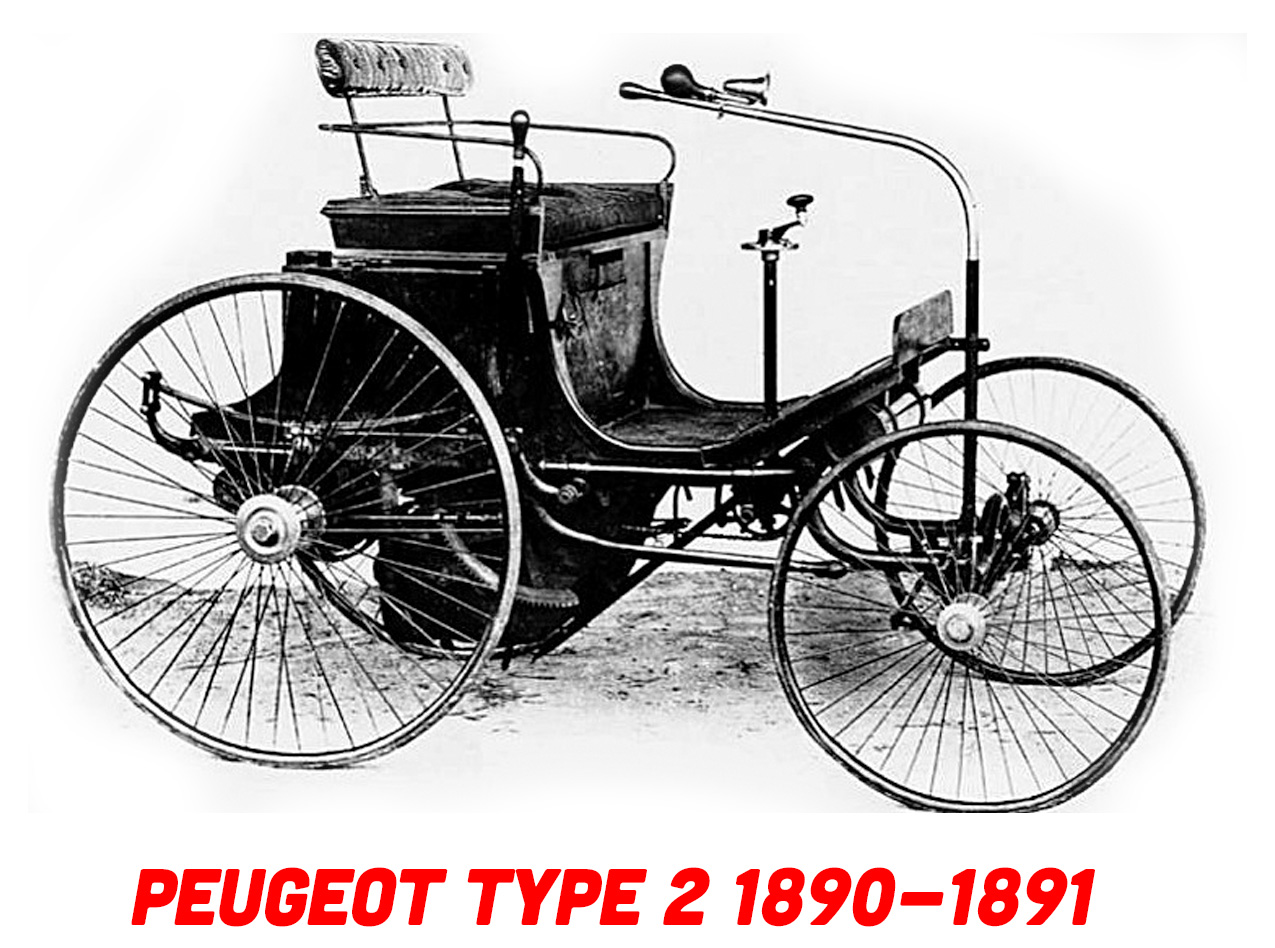
And this is sort of the crux of the issue; Benz claiming that the 1886 Patent-Motorwagen represents the “birth of the automobile” or the first production car for sale just doesn’t bear any real scrutiny. First, there’s the fact that the cars that Benz did sell were not the same as the 1886 car. The cars that were sold, based on the meager information available, seem to start in 1890, and by then Peugeot had started to sell their Type 2 (four units built), and then the next year came the Type 3, of which 64 cars were built and sold by 1894.
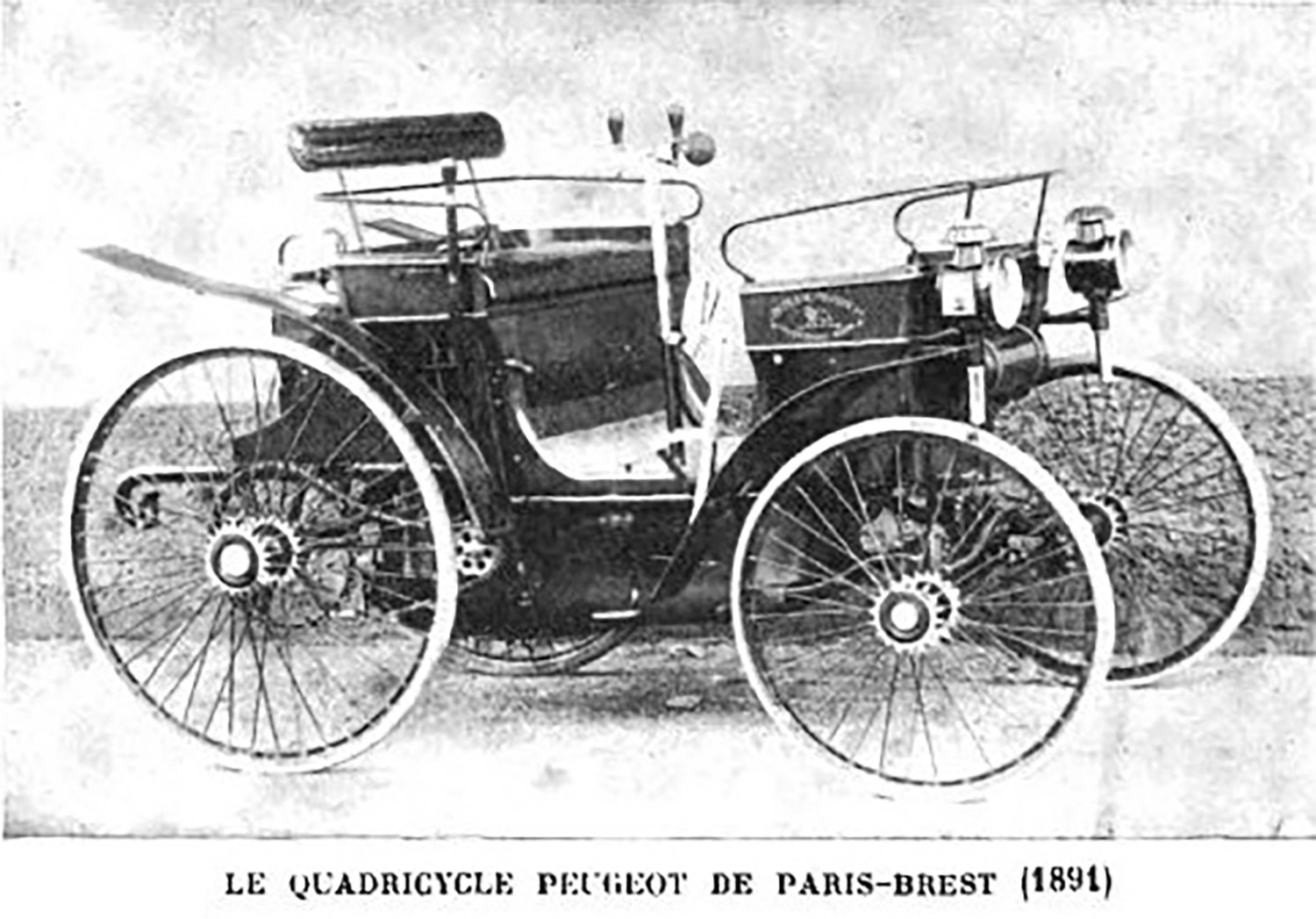
So what does this all mean? It means that the Benz Patent-Motorwagen, allegedly the “first automobile” to be sold, was, at the very least, tied for that honor with the Peugeot Type 2 in 1890, even though no verifiable numbers for how many, if any, Benz Patent-Motorwagens were sold in 1890.
And, by 1891, the Peugeot Type 3 was on sale, and the production number for that car – 64 examples – is over double the claims of the Benz car in the same period of time.
So why do we keep insisting that the Benz Patent-Motorwagen was first?
Let’s now address the claim that somehow the Benz Patent-Motorwagen represented the start of the “modern production” automobile. While it was certainly advanced for its time, if we’re really being honest, we have to compare it with another contemporary car being built and sold at the same time as the Benz car before we can bestow this honor on it: the Panhard et Levassor.

In 1891, Panhard et Levassor built their first car with a design all their own, using a Daimler engine mounted up front, driving the rear wheels, a setup that would come to be known as the Système Panhard, a layout and design that would define the vast majority of automobile mechanical design until the rise of transverse front-wheel drive cars in the late 1970s.
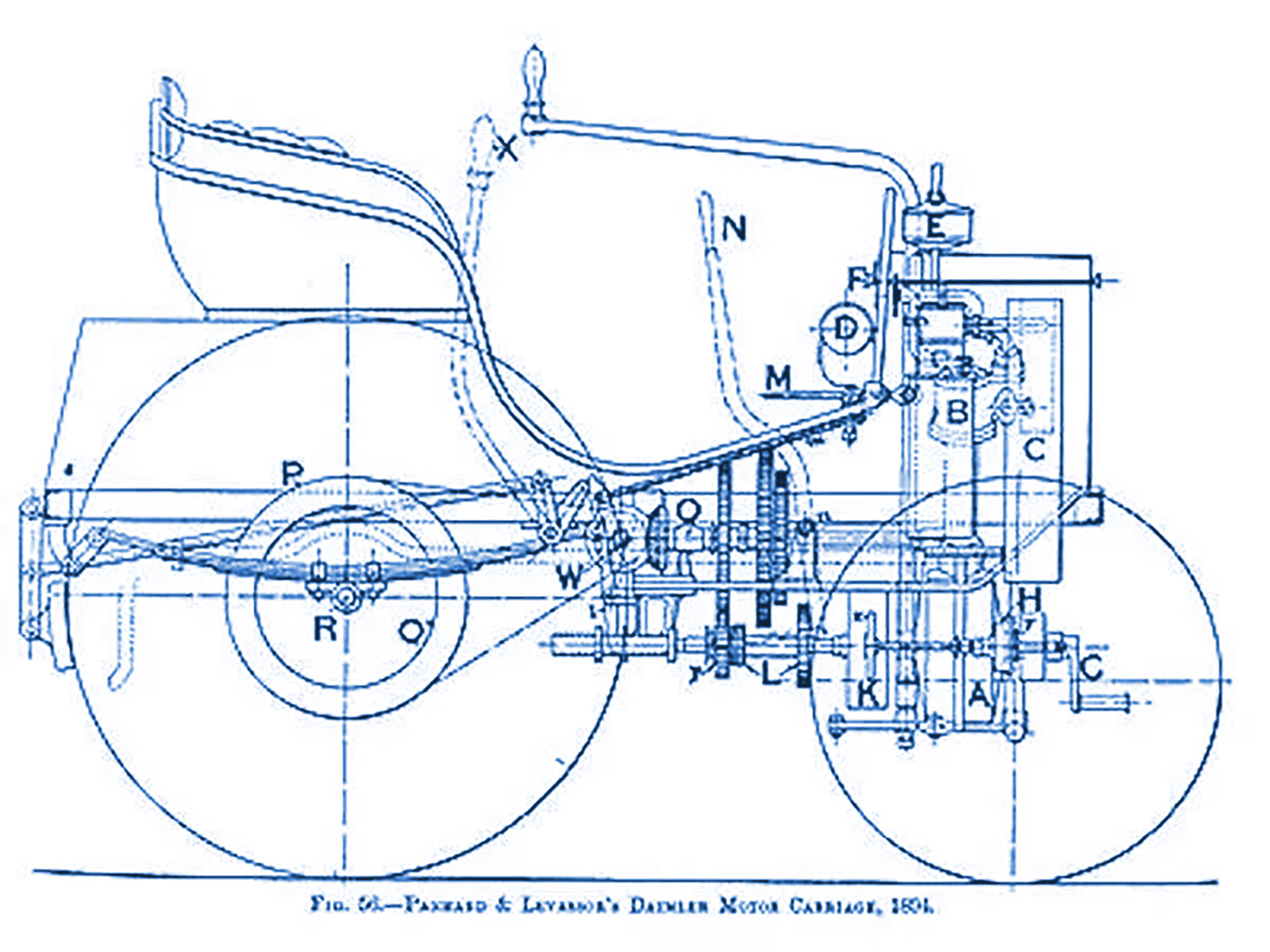
A 1965 Ford Mustang? It used this same layout. A Chevy Chevette? This layout. A Lamborghini 350 GT, a Jensen Interceptor, a Pontiac GTO, Lincoln Continental – all Système Panhard. If any car of this era can be said to be the “first modern production car,” it has to be the Panhard et Levassor, no question. The Benz Patent-Motorwagen was a three-wheeled car with a horizontal flywheel and the engine under the seats. That’s not the path that cars took in the following century.

That image above is from an 1892 Panhard et Levassor brochure, so you can see they had a full lineup of cars and were pretty serious about all of this. They had sold 90 cars by the end of 1894, which is more than the Benz Velo sold that year.
I think it’s pretty clear that the 1886 Benz Patent-Motorwagen was not the first automobile, not the first internal-combustion automobile, not the first production automobile, and not the first modern production automobile. At best, we can maybe consider the start of modern car production a sort of three-way tie between Benz, Peugeot, and Panhard et Levassor, but even in doing that, Benz would have the lowest production numbers and a production start date that, at best, ties with Peugeot and is extremely murky and hard to prove.
So, again, we have to ask, why the hell have we been letting Mercedes-Benz get away with the claim of “inventing the Automobile” for so many decades? It seems to have started with a letter dated May 30, 1940.
The letter was from the Board of Directors of Daimler-Benz A.G to the Reich Ministry for Public Enlightenment and Propaganda; I’ve never seen the text of that letter, and likely never will, if it still exists, but the response from the Nazi’s propaganda ministry does exist (translated from German):
Reich Ministry for Public Enlightenment and Propaganda Reference No.: S 8100/4.7.4.0/7 1 Berlin W8, July 4, 1940 Wilhelmplatz 8–9 To the Board of Directors of Daimler-Benz A.G., Stuttgart-Untertürkheim Subject: The True Inventor of the Automobile Re: Your letter dated May 30, 1940 (Dr.Wo/Fa) The Bibliographisches Institut and the publishing house F.A. Brockhaus have been instructed that, henceforth, in *Meyer’s Konversations-Lexikon* and the *Großer Brockhaus*, the two German engineers Gottlieb Daimler and Carl Benz—rather than Siegfried Marcus—are to be designated as the creators of the modern automobile.”
The letter seems to have been a request that all references to the creation of the modern automobile no longer reference Siegfried Marcus – an Austrian inventor who happened to be a Jew – and instead should refer to Daimler and Benz.
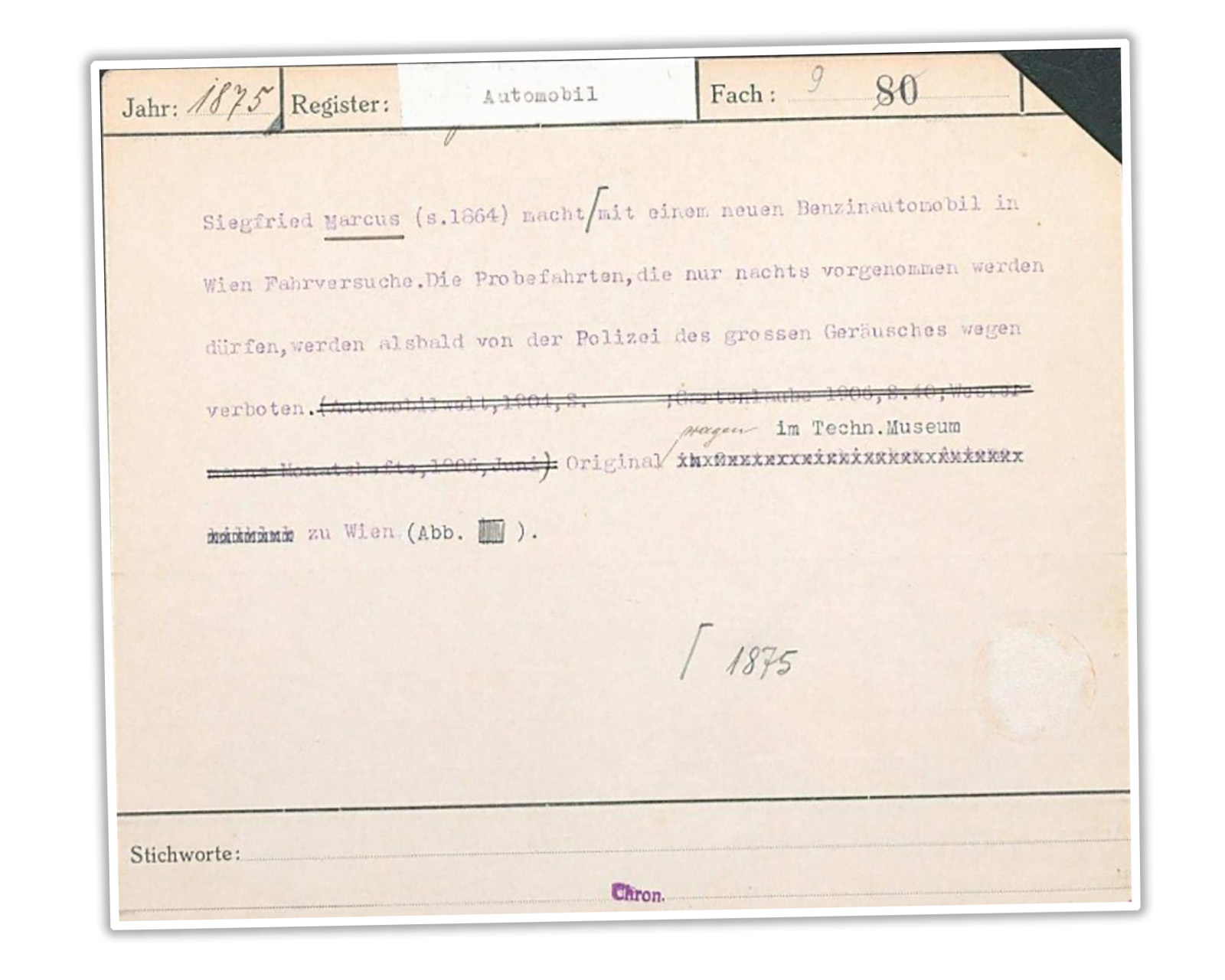
I’ve talked a bit about Marcus before. He had built at least two internal-combustion-engined cars, with the first in 1870 or 1875, and another later one that is often dated to 1888 (and is preserved at the Vienna Technical Museum to this day), though all of these dates are contested, and, honestly, I’m not sure what the exact dates are. What does seem certain is that Marcus had some manner of gasoline-powered cars before Benz, and there’s even a reference to a noise complaint Marcus got in his “Benzinautomobil” in 1875:
Prior to WWII, Marcus was often referenced as one of the key figures in the invention of the automobile. He was taught in schools and was commonly referenced in textbooks and reference works, as you can see in this 1908 encyclopedia entry about the automobile:
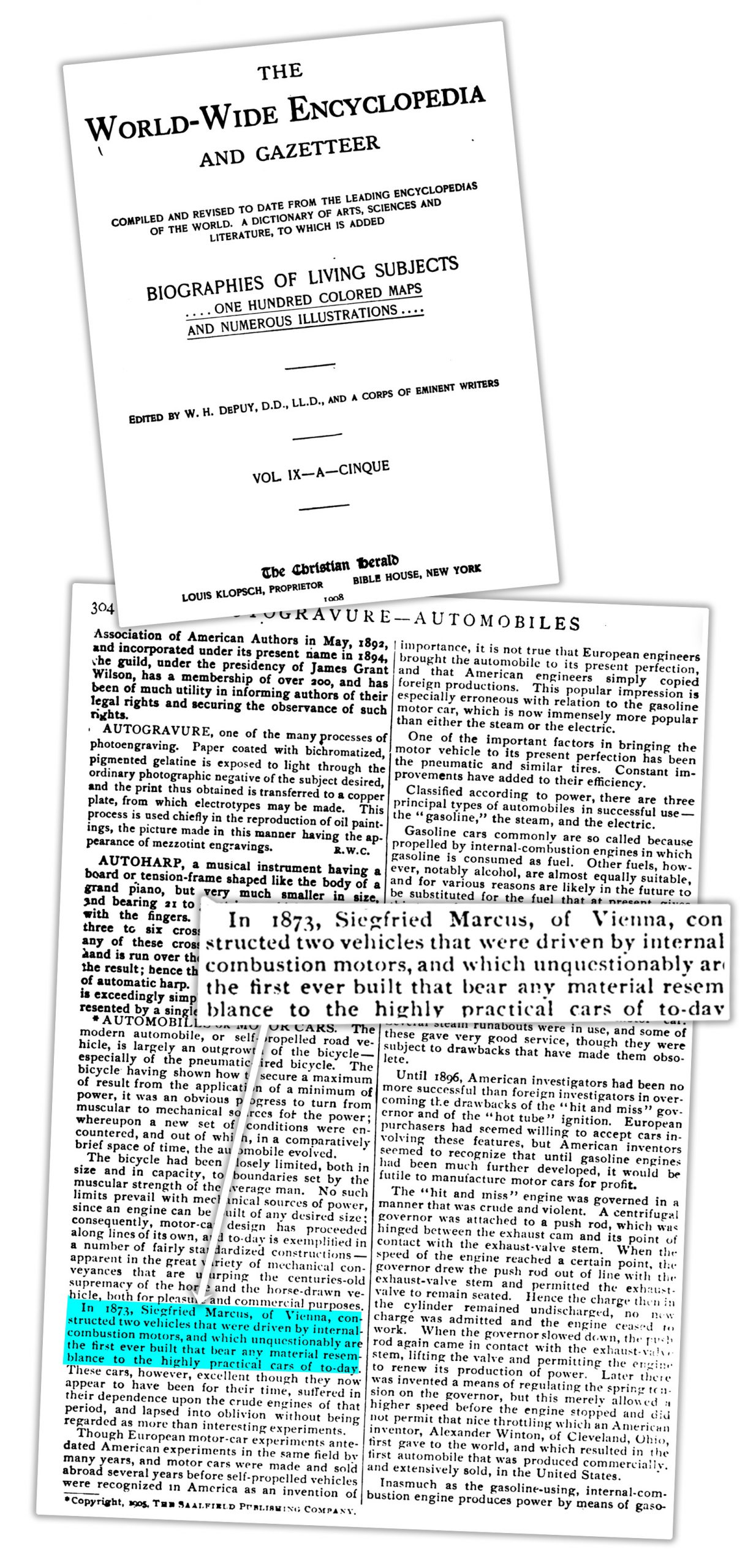
Carl Benz is not mentioned in this article, written a mere 22 years after he built his Patent-Motorwagen, but Marcus’ contributions are. Under the Nazi regime, a Jew getting this sort of acknowledgment simply wouldn’t stand, so the request from Mercedes-Benz to do a little rewriting of history was something the Reich Ministry for Public Enlightenment and Propaganda was happy to do.
And ever since then, even after the Nazis’ defeat in WWII, this narrative has stuck. Carl Benz as the inventor of the automobile has been accepted without question for over 80 years now, and Mercedes-Benz as a company has absolutely benefitted from this association, in terms of prestige and marketing and advertising and more.
Anyone could have really looked into this at any time in all those decades, and many have, and yet this Nazi-constructed narrative has remained intact. It’s time we just end this, not just because it’s a lingering bit of Nazi bullshit still polluting our culture, but because it’s just wrong.
This isn’t Carl Benz’ fault; he was just a brilliant inventor and engineer working on an incredible project. I don’t want to diminish his considerable and important contributions to the automobile. But it’s long past time we put those contributions into their proper place and context, and Mercedes-Benz needs to officially set the record straight.
If there’s some information I haven’t seen, and there absolutely could be, I’m happy to consider it. If there’s evidence of earlier sales or anything like that, I’d love to factor all that in. But until then, I’m going to keep banging this drum until Mercedes-Benz formally admits the truth and finally lets go of this Nazi-era bit of pandering.
Top graphic image: Mercedes-Benz


I too have been banging on about this for a long time – even before the Jalopnik days when many of us first interacted.
There is a great LJK Setright bit from the start of one of Drive On!, where he talks about the futility of trying to claim a single inventor for something like the motorcar, which was developed over time — and then says that if one does have to pick a single inventor, it obviously has to be Marcus.
Anyway, despite the Benz thing unquestionably being nothing more than Nazi propaganda, at least Mercedes have obvious marketing reasons to brush that part under the carpet and keep making the claim. Benz himself had nothing to do with the Nazis
What is far more disturbing is Audi’s recent attempt to burnish their reputation by recreating a car that was never anything other than a Nazi state-funded propaganda piece.
“I’ve tried to reach out to Mercedes-Benz for this early sales information, but so far I’ve received no response.”
Well Jason…. Sound like the Autopian staff and self selected important readers such as myself should plan a factory tour in Stuttgart followed by a guided tour of the Mercedes-Benz museum to demand answers to these questions and more! I recommend going during Oktoberfest should we find it necessary to participate in certain libations should we fail to obtain these important answers.
Stuttgart happens to have its own popular beer festival, the Cannstatter Volksfest. Would be fitting since Cannstatt is the birthplace of Gottlieb Daimler 🙂
Oh wow! That is very interesting! I had gone to the museum on a day drip down from Berlin late Sept of last year and mistook the festivities for “Oktoberfest.” Had no idea Stuttgart had its own festival! Makes me want to go back just for Wasen!
It is common knowledge that the car was invented a lot sooner. By a bunge of dudes around a fire inside a cave, mesmerising over the newly invented wheel:
The Flintstones
You get paid to write this stuff over and over again? This is why I ignore your articles. It’s just schlock. Valueless text.
Just find something of importance to write about every once and a while please.
That’s funny, this is why I ignore your comments! But, like you said, I get paid to write mine.
Hey Jason, I am also a bit jealous you get paid doing what you love.
Keep going. I promise I will read your next article about the invention of the automobile.
BURN!!!!!
Buddy, you got some nerve to lecture other people about “valueless text without importance.”
And yet, here you are!
Yeah, investigating automotive history on a car blog?!?! The gall of that Jason Torchinsky!!
If you think this is valueless, you should see what he writes in the Rich Corinthian Leather Members only section.
Yeah, he gets paid to write his “valueless text” and you’re here doing the same thing for free. So who’s really winning?
I think you need to understand that history is acceptable lies written by the winners. Fortunately, in this case, the Nazi’s didn’t win, but their lingering lies still abound.
What I’m more curious about is why you still read the articles if you find them useless? The tedium and deep dives into automotive history, details, and things that make you go hmmm are all reasons we’re here. If you don’t like Jason’s writing, stop reading his articles.
I hope whatever has damaged you in your life goes away or gets better. I might even be able to find some anti-troll cream you can rub on those wounds…
If you can’t say something nice: say nothing at all.
PS. Without Jason, there is no Autopian
Just a small correction Jason, when you refer to the “Reich-era” government, you mean the Nazi-era government (which you refer to several times in the article). Reich-era could refer to any German Government between 1871 and 1945. You could specify it as “Third Reich-era”, I guess ????
As an 80’s kid that grew up watching any car themed movie that my parents would let me, one such movie was the time travelling, computer hacker adventure caper “Top Kids” where 2 boys muck around with a video game sending one back in time to the dawn of the automobile.
As such, I had always believed that the “Motorwagen” was the original personal wheeled transport solution. However, now that I think about it – I have a vague memory that the movie was financed my Mercedes Benz and that’s how come Nikki Lauda makes a cameo appearance. Oh no, hang on, don’t tell me that one of my favourite movies as a kid is nothing more than a self-indulgent puff piece trying to control the narrative?
You’re describing a lot of kids movies and content with “self-indulgent puff piece trying to control the narrative”, really.
Not just kids shows, either. News, movies, shows, books, schools…
After reading this through a second time, I’m wondering what other sources from the 1930s/40s said about the invention of the automobile? By 1940 (when the response from the propaganda ministry was written), automobiles were significant enough that presumably some historians were writing about it.
It would be interesting to see what contemporary historians/writers/smart people/nerds outside of Germany were saying about the early history of the automobile. I still think Benz’s motorwagen was one of the more significant steps in the development of the automobile, but I wonder if even that is true? Are there contemporaries of the motorwagen that were equally significant but left out of history books because no one benefitted from promoting them? I presume a big part of the reason credit goes to Benz is that Mercedes-Benz still exists when most (all?) other early automobile manufacturers are long gone.
Like almost all other inventions, though, the real answer is that the automobile wasn’t created by one individual and anyone claiming otherwise is misinformed or biased. Again, I’m surprised that M-B claims in no uncertain terms that the first automobile was the Benz motorwagen.
Torch, you have convinced me that this quixotic quest is actually a worthy endeavor.
You can read the 1911 edition of the Encyclopedia Britannica here. They give it to the Panhard & Levassor, and don’t mention Benz at all.
ETA It should be noted that this is a British encyclopedia, giving credit to the French for an invention (after a whole long paragraph discussing various early British steam cars), so they must have felt pretty sure about the evidence at the time.
Bums won their court case:
https://youtu.be/ZTT1qUswYL0?si=UcTCtr2hIoVfRfsU
Seems appropriate. Imma go play Wolfenstein.
You go Torch! Sock it to Mercedes Benz! About time they stopped getting a free pass!
Can someone go edit Wikipedia? Alot of sources point to Wikipedia as the source for who invented the car.
Wait. Let me get this straight. Mercedes didn’t invent the automobile? /s/
You make a pretty good argument for Panhard, so that’s what I’m going with from now on.
“And so, as a Jew I was like, ‘Crap.'”
-Nathan Fielder
It’s disturbing how many things are like this. Either through propaganda, marketing / false self serving statements. Or the Victorians favorite past time of just making things up of they didn’t know.
Thomas Crapper has a similar over stated notability with the flush toilet mainly because his name sounds better relating to toilets then George Jennings or other earlier innovators.
Well we all clearly know who “invented the internet” at least. There is no question there! /s
Darpa can’t trust those the sneakernet hippies
So maybe the first internal combustion engine car not designed by a Jewish person?
I e been saying this for years! Being a French car fan and a history nerd. Thank you for this information and maybe one day someone will care as much as me and others
Thanks for this.
The struggle continues.
See also: You think carrots help your vision because the English wanted to fool the Nazis about the existence of radar; You think eggs are (good/bad/unknown) depending on how old you were when Richard Nixon declared them to be (good/bad) for your cholesterol.
I just looked up Benzinwagen in the 1893 Brockhaus (after failing to find Automobil). The article translates roughly as follows:
“Gasoline car, a vehicle powered by a gasoline engine for transporting passengers on non-railed roads. The vehicle is constructed in the manner of a tricycle; the engine is located beneath the seat, and the front wheel serves for steering. One liter of gasoline is sufficient to transport two persons over a distance of 16 km. Achievable speed: 16 km in one hour.”
Nothing about the history or the inventors is mentioned, even though the author seems to have Benz in mind. And I can imagine a circle of elderly gentlemen discussing if it is worth sacrificing seven valuable lines in their encyclopedia of 16 volumes to a passing fad like the Benzinwagen. The article Berlin, history of fills several pages, by the way.
“One liter of gasoline is sufficient to transport two persons over a distance of 16 km.”
38 mpg for us ‘Muricans.
Hmm, per my elementary history books Henry Ford invented the car and the production line (yes, I know he invented neither).
Probably for the exact same reason that MB wanted all references to Siegfried Marcus removed.
Well he WAS a bit of a Nazi….
I vaguely remember seeing the same in my own elementary school books!
This is great! And seems worth pointing out that the block quote of the Nazi letter should be fixed – it repeats the same text twice.
Jason, why do you keep on rehashing the same tired old argument about the Benz Patent-Motorwagen? Sounds like my previous comment (which was probably deleted) in this article rubbed you badly…
If the Benz Patent-Motorwagen was patented, purpose-built, publicly demonstrated, commercially sold, and directly inspired the entire gasoline automobile industry, then insisting it wasn’t a ‘real car’ is just semantic contrarianism.
Jason, you can argue the Patent-Motorwagen wasn’t the first self-propelled vehicle, but pretending it wasn’t the first practical modern automobile ignores virtually all mainstream automotive history.
Debunking ‘Benz invented every car concept in history’ is fair; pretending the Patent-Motorwagen wasn’t a real automobile is revisionism.
But where the argument starts feeling strained is when this article appears to move the goalposts:
At some point that clashes with why historians still center the Motorwagen in automotive history:
That’s a pretty serious stack of evidence in favour of calling it a “real vehicle.”
“Karl Benz created the first practical modern automobile.” That’s a much more defensible mainstream position, and one supported by a lot of historians and museums.
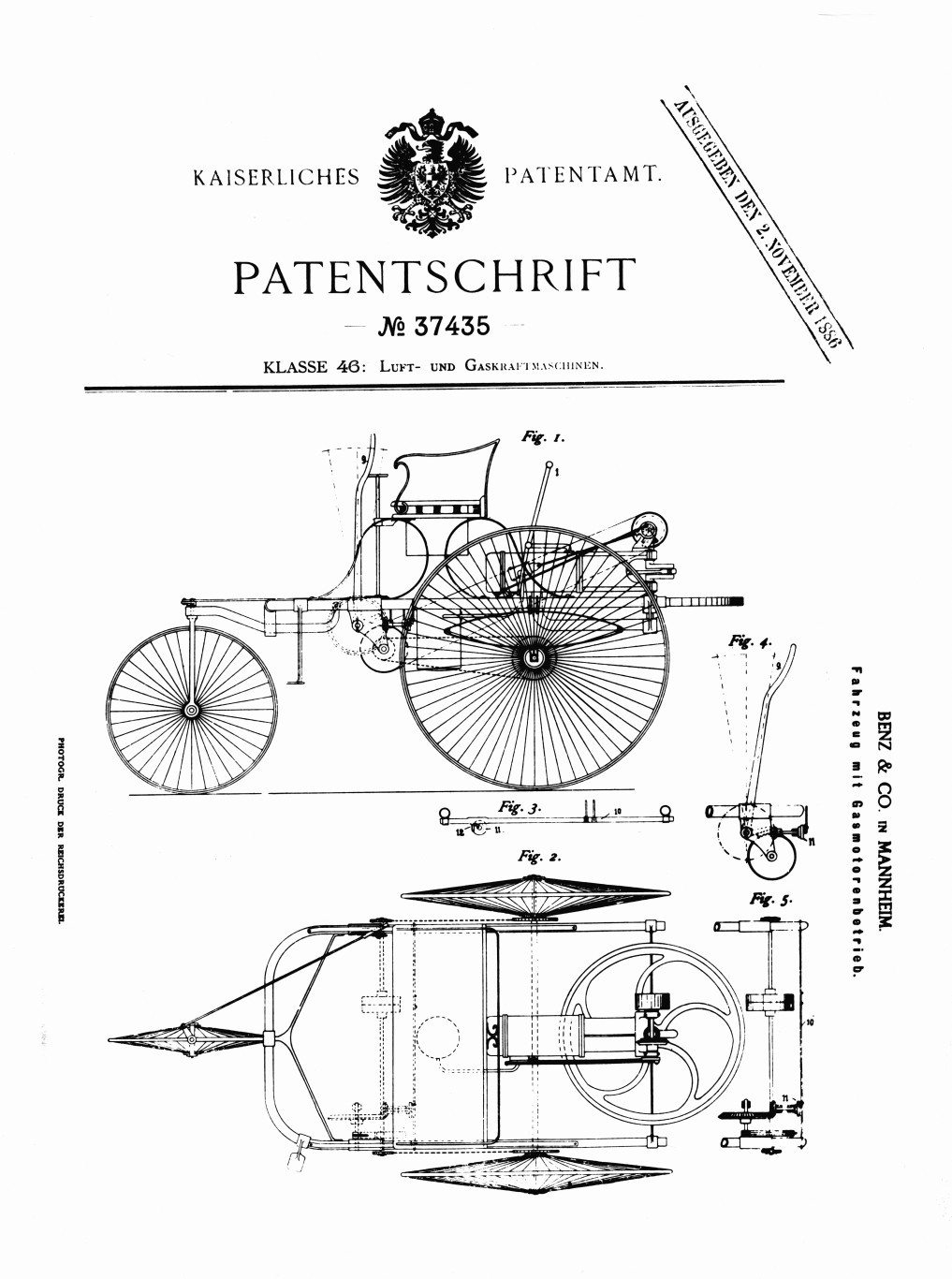
The 1886 patent for the Benz Patent-Motorwagen established the core architecture:
The later versions that Bertha Benz drove and that Benz improved for sale were evolutionary refinements of the same machine, not unrelated vehicles. By that standard, almost no historically important invention would count:
A patent protects the invention’s essential design and operating principles, not a permanently frozen production specimen, so improvements made after the 1886 Patent-Motorwagen patent don’t make it a different invention.
By that standard, half of 19th-century industrial history would cease to exist simply because routine business paperwork wasn’t preserved for 140 years. The absence of surviving retail paperwork from the 1880s is not evidence that the Patent-Motorwagen wasn’t sold; it’s evidence that ordinary commercial records from 140 years ago rarely survive. It’s odd to apply courtroom-level evidentiary standards to Benz sales records while accepting a questionable secondary-source Nazi-era document as historically decisive.
Marcus did experiment with gasoline-powered vehicles earlier than Benz in some form, and that’s why he often appears in “who really invented the car?” arguments. The problem is that the evidence around the famous “Marcus car” is fragmentary, disputed, and heavily tangled with later nationalist politics. Historians still debate:
Ironically, that makes it a strange thing to lean on if one is demanding ultra-rigorous proof against Benz. The historical difference is that the Benz Patent-Motorwagen has:
Marcus’s work is historically interesting and deserves recognition, but it does not have the same continuous evidentiary chain or industrial impact.
So, the contradiction I’m noticing from you, Jason, is basically:
The whole thing is tiresome click-bait at this stage.
Move along, there’s nothing to see here.
It’s about a company claiming a huge automotive first – the biggest first – and that claim is not just wrong, but the direct result of a Nazi-era policy! It’s not click bait. It’s something I care about. There’s plenty to see! But you don’t have to see it if you don’t want to. We have plenty of other articles!
I hope that he was talking about the viking guy. I think this is one of the best articles that I have read on this site. Thanks for the lesson Jason!
It doesn’t seem like you actually read what I was saying; this isn’t a Benz vs. Marcus thing, that’s just at the root of why we all have been told to accept Benz as the first. I never said Benz’ Patent-Motorwagen wasn’t a ‘real car’ – of course it is. It just was not the first of anything, as Mercedes-Benz like to claim.
Put Marcus aside for the moment; consider what Peugeot and Panhard et Levassor were doing at the same time or even slightly before Benz: building and selling cars, often even more cars, and in the case of P+L, far more influential.
I’m not saying Benz was nothing, I’m just saying that there needs to be a revision in the vastly overstated role the Benz car had.
And I’m not moving any goalposts: I’m just addressing the various qualifiers that are applied to the Benz car, since it is provably not the first automobile, not the first patented automobile, not the first purpose-built automobile (as in not a converted carriage), not the first car to be produced in some numbers and sold, and so on.
Looking at your own criteria about the Benz car:
… the Benz car falls short on a number of these. The dated patent? Trevithick’s 1803 London Motor Carriage had one of those. And documentation. And public demonstrations. As for commercial follow-through? Unless some records suddenly come to light, Peugeot and P+L have more recorded sales, earlier. And influence? P+L, as I mentioned, had far more, and prior to the Nazi-inspired PR blitz, Benz’s influence wasn’t considered nearly as significant.
I’m treating the Benz claims with vigorous rigor because Benz has had the benefit of 80 years of default acceptance. I’m not going easier on any claims about other cars, either.
I think, objectively, given the overall environment the Benz car was in, it deserves a place of respect, buy does not deserve to be centered. It was placed there for reasons beyond the actual evidence, and it’s just time to stop. Let it just be one of a few key pioneers, and let Mercedes-Benz stop flogging it for ill-gotten and inaccurate status purposes.
MB was just the original Elon Musk, making false claims, taking credit for other people’s work, and trying to take over the world if anyone disagreed with him. And I’ll take semantic contrarionism over antisemitic lies any day
Jason! Jason! Jason!
This could be in the Wikipedia article about the “straw man argument.” Torch is specifically critiquing the various claims of “first” and the sometimes attached qualifiers. This wall of text contains no content relevant to that argument, but critiques the relative weight given to various historical sources in Torch’s well constructed argument.
As an MB employee you don’t have anything better to do? Really?
Jason, why do you keep on rehashing the same tired old argument about the Benz Patent-Motorwagen? Sounds like my previous comment from a few months ago (which was mostly deleted as I cannot locate it now) rubbed you badly…
If the Benz Patent-Motorwagen was patented, purpose-built, publicly demonstrated, commercially sold, and directly inspired the entire gasoline automobile industry, then insisting it wasn’t a ‘real car’ is just semantic contrarianism.
Jason, you can argue the Patent-Motorwagen wasn’t the first self-propelled vehicle, but pretending it wasn’t the first practical modern automobile ignores virtually all mainstream automotive history.
Debunking ‘Benz invented every car concept in history’ is fair; pretending the Patent-Motorwagen wasn’t a real automobile is revisionism.
But where the argument starts feeling strained is when this article appears to move the goalposts:
At some point that clashes with why historians still center the Motorwagen in automotive history:
That’s a pretty serious stack of evidence in favour of calling it a “real vehicle.”
“Karl Benz created the first practical modern automobile.” That’s a much more defensible mainstream position, and one supported by a lot of historians and museums.
The 1886 patent for the Benz Patent-Motorwagen established the core architecture:
The later versions that Bertha Benz drove and that Benz improved for sale were evolutionary refinements of the same machine, not unrelated vehicles. By that standard, almost no historically important invention would count:
A patent protects the invention’s essential design and operating principles, not a permanently frozen production specimen, so improvements made after the 1886 Patent-Motorwagen patent don’t make it a different invention.
Sales
By that standard, half of 19th-century industrial history would cease to exist simply because routine business paperwork wasn’t preserved for 140 years. The absence of surviving retail paperwork from the 1880s is not evidence that the Patent-Motorwagen wasn’t sold; it’s evidence that ordinary commercial records from 140 years ago rarely survive. It’s odd to apply courtroom-level evidentiary standards to Benz sales records while accepting a questionable secondary-source Nazi-era document as historically decisive.
Marcus
Marcus did experiment with gasoline-powered vehicles earlier than Benz in some form, and that’s why he often appears in “who really invented the car?” arguments. The problem is that the evidence around the famous “Marcus car” is fragmentary, disputed, and heavily tangled with later nationalist politics. Historians still debate:
Ironically, that makes it a strange thing to lean on if one is demanding ultra-rigorous proof against Benz. The historical difference is that the Benz Patent-Motorwagen has:
Marcus’s work is historically interesting and deserves recognition, but it does not have the same continuous evidentiary chain or industrial impact.
So, the contradiction I’m noticing from you, Jason, is basically:
lol theres a reason we are here to read Jason and not Eric.
Oops copy paste x2. That’s a new debate technique I guess
Eric’s comments frequently get rejected by the spam filter, either due to their length, or because the comments contain trigger words deemed by the filter to be political insults. Usage of “woke,” for example, can cause the filter to reject a comment. A third way to get nabbed by the filter is to add a lot of links to a comment.
I check the filter daily, except on weekends. I usually approve anything that doesn’t attack our authors, marginalized groups, or other readers.
In this case, the first comment was likely rejected due to its very long length (an issue that also happens to Nsane’s comments sometimes). The second comment was equally as long, and it was rejected, too. I approved both so Jason could respond to one of them.
Amusingly, this particular article made the spam filter work overtime as it blocked every comment mentioning “Nazi” or “Reich,” even though the usage of both is fine in this context.
Ah! I didn’t realize length was a filter! Good to know!
Sadly, a lot of spammers/scammers write super-long comments about how some sort of wizard or whatever saved their marriage/cured their cancer/resurrected their loved one/cured their debt. So the filter assumes that a comment that’s ridiculously long might be spam. It also helps when someone accidentally uploads an image into a comment, which usually results in a million characters displaying on the screen and basically breaking the comments.
I go in there and approve the vast majority of comments, though, so if you get caught by the filter, fear not, for I will free ya. 🙂
Interesting to see bts how much work it is to have an actual normal online conversation. Thanks Autopian crew.
Or maybe blocked due to references to the Maximals. The filters are probably from the G1 era.
Gt it. We’ll kp it shrt.
Adds “lack of vowels” to the spam filter. lol 🙂
Nazis. Why is it always Nazis?
I hate those guys.
Because a lot of people worked very hard on hiding these guys and pretending they were gone instead of finding them and making sure they were.
I don’t even think they need to make a big deal about it. Just quietly remove the text and then everyone can move on
I’d kind of like them to make an actual statement. I think it’s important enough.
Realistically, not gonna happen. Backtracking on museum exhibits, decades worth of marketing material etc will require Dieselgate levels of proof. Whats with these companies man.
Rene Panhard: Who disturbs my hellish purgatory?
Emile Levassor: Who has interrupted our eternal torment?
Edouard Sarazin: It’s Torchinsky again. He’s trying to set the record straight on Benz.
Rene Panhard: Then the name of “Panhard” will finally receive the glory it deserves and we can rest in peace?
Emile Levassor: If only the Levassor name would be remembered…
Edouard Sarazin: First of all, I don’t think you guys even remember I was your lawyer. Second of all, Benz still hasn’t caved. For some reason they just don’t take Mr. Torchinsky seriously enough, in spite of his lust for tail lights.
Rene Panhard: Well… shit.
Former Stellantis CEO Carlos Tavares (shown above): Yeah, if we’re going to bring back any nameplates it’ll be ones that weren’t somebody’s name. Plymouth, Rambler, Wartburg…
I submit the reason Panhard isn’t remembered as much as it deserves to be is that nobody knows how to pronounce it.
Panar