

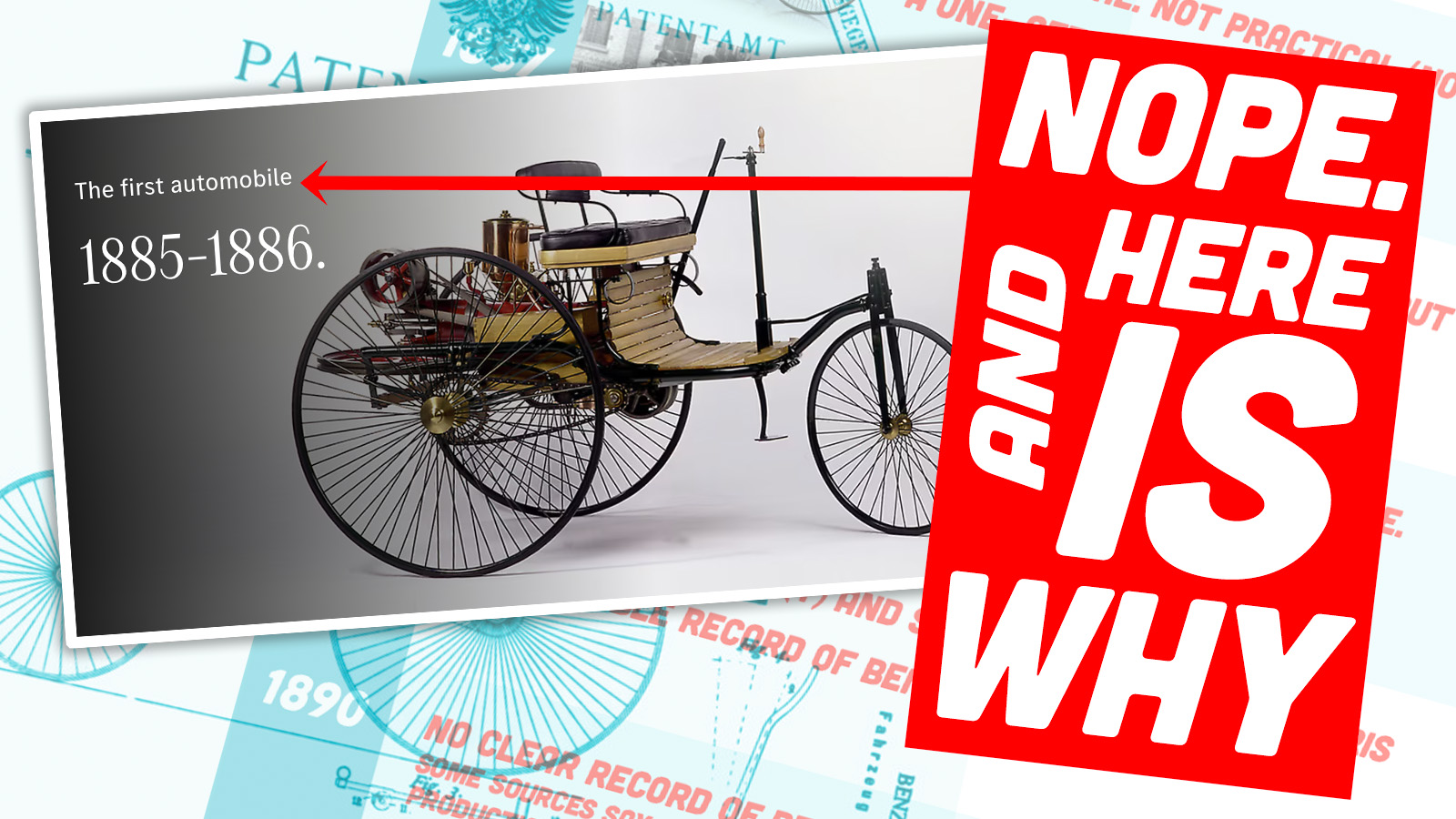
I know I’m a bit consumed by a crusade to push back on the maddeningly pervasive notion that the automobile was invented in 1886 by Carl Benz, because it very clearly wasn’t. I know that’s what Mercedes-Benz likes to say, but as I have covered extensively before, there was over a century of automobile development, production, and use between Nicholas-Joseph Cugnot’s 1769 steam drag and Carl Benz’s 1886 Patent-Motorwagen. And yet, despite there being a wealth of evidence to suggest that the 1886 Benz car, while undoubtedly a significant milestone in the history of the automobile, was not the “birth of the automobile” or the first automobile or anything of that sort, Mercedes-Benz still stands by its brash claim.
Even with all the evidence available, the myth of the Benz Patent-Motorwagen as the first car continues, sometimes tempered with qualifications like the first gasoline-powered, internal-combustion automobile, or the first production automobile, or the first patented automobile, or the first “practical” automobile.


I’m here to tell you that, even with all those qualifications, none of those statements are actually true – my last article covers the (primarily) the steam era of automobiles that includes the actual first patented automobile, the actual first series-produced automobile, and earlier internal-combustion automobiles.
The truth is much muddier, as it always is. It’s my opinion that Mercedes-Benz knows this, and benefits from not investigating this claim closely. The whole reason the Benz vehicle gets as much “first car” recognition as it does stems from a very specific plan and agreement between Mercedes-Benz and the former Reich-era government of Germany, which we’ll get into more soon. Right now, though, I want to walk through some of the early years of the internal-combustion automobile industry, and how the Benz Patent-Motorwagen fits into it.
Specifically, I want to address a qualified “first automobile” statement made by a curator of a well-known automotive museum, with whom I was speaking about this idea. He said the 1886 Patent-Motorwagen was the first “practical” automobile, and I’ve spoken with other historians who feel comfortable calling the Benz Patent-Motorwagen the first “production” automobile, or production automobile in the modern sense, or the first that was actually available for sale.
I’m not comfortable with any of those statements, even with their qualifiers, and I’ll explain why.
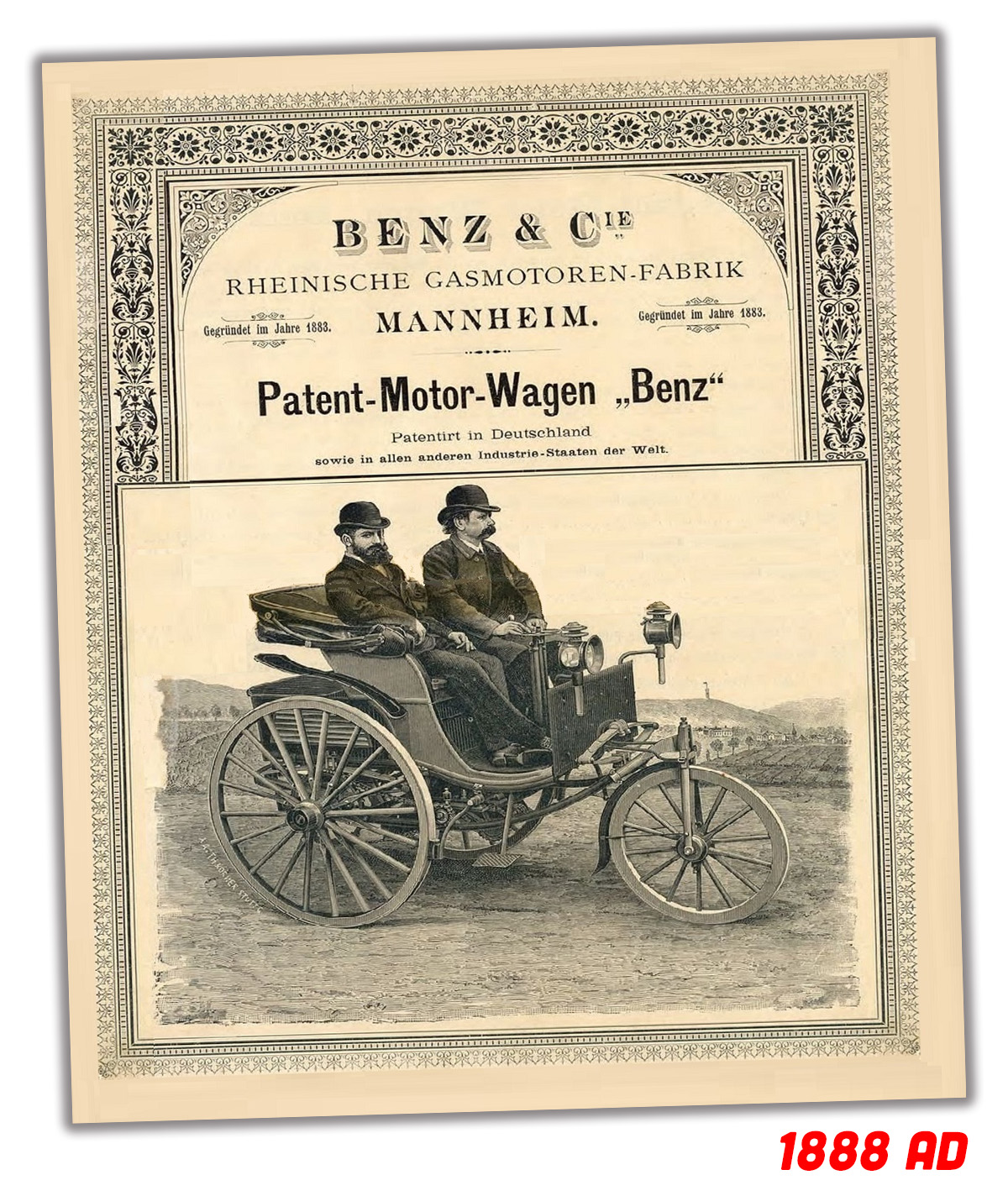
I think the way we talk about the 1886 Patent-Motorwagen as a “practical” car or the first car people could buy is strangely vague and even misleading. Most sources say that “about 25” Patent-Motorwagens were sold between 1886 and 1894, but this is not only misleading, but incredibly hard to confirm. My first issue is that even if we accept that 25 early Benzes were sold, these were not the same car as the one that was built in 1886.
The 1886 car was not a practical vehicle one could drive; it didn’t have a fuel tank, relying on just the 1.5 liters of legroin (a petroleum distillate) in its crude carburetor for fuel, which was not enough to travel any practical distances. The original 1886 car couldn’t get up most hills, either. This was an experimental one-off machine, not a practical or production vehicle by any stretch.
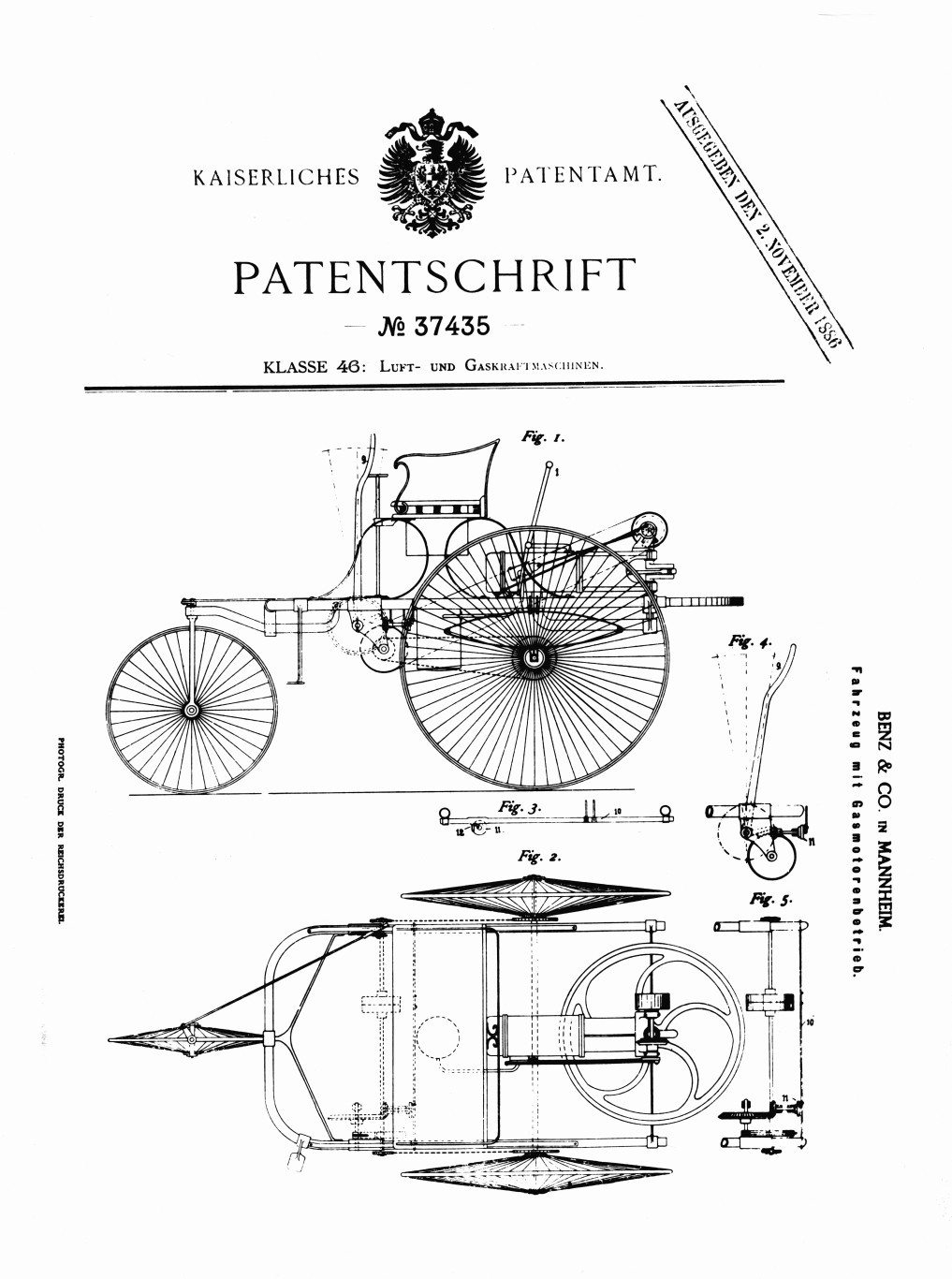
The next Benz car, built in 1887, was a completely different design, albeit built on the same basic principles as the first one. It fixed some issues, but was not practical, either. The next attempt, the 1888 car, is famous for being the machine that Bertha Benz used for her famous drive; it was also experimental, and while Bertha managed the trip, she was making repairs and improvements along the way, and still needed some help up some hills. The 1888 car, different than the two cars that preceded it, was still not really ready for sale to the general public.
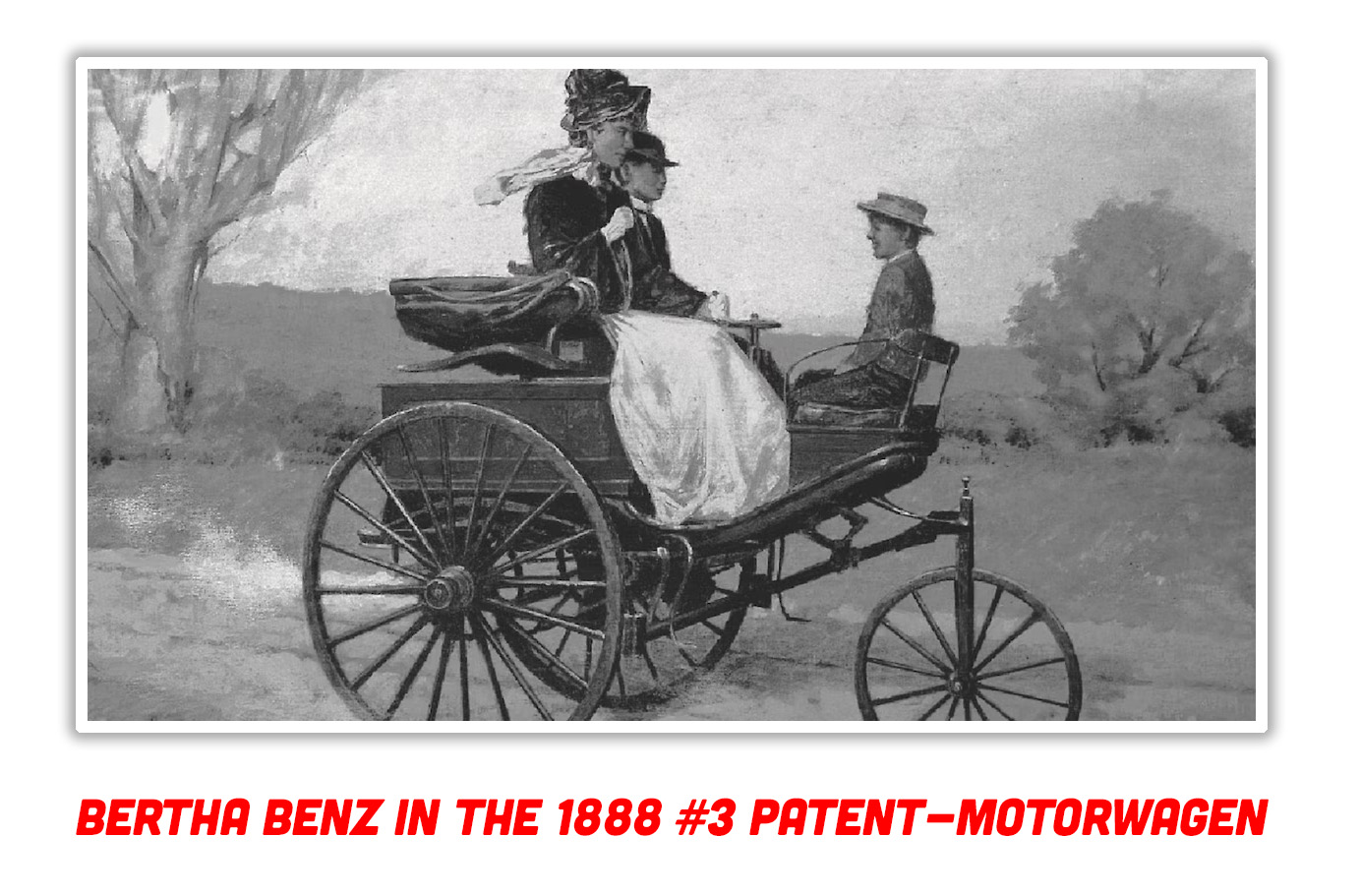
It’s also confusing because many recreations or depictions of Bertha’s drive use replicas of the 1886 car, which was not the car she actually used. The car she used, the 1888 car, is shown above. This video reenactment uses a replica of the 1886 car, which is inaccurate:
So, of these alleged about 25 cars, three were one-off experiments; while at least one car had been shown at exhibition in 1887, it wasn’t until 1890 that sources suggest Benz was taking orders for cars, and even then, I have yet to find much evidence or numbers that any cars were actually ordered. So far, I haven’t been able to find solid numbers about how many Patent-Motorwagens were sold, or even what the “production” Patent-Motorwagen would have been like. At the earliest, such a production version of the car couldn’t have existed before 1889.
Benz did have someone doing sales, Émile Roger, who had a license to produce vehicles and engines under license in France, and he may have purchased the 1888 one-off car. It’s not exactly clear, and the best sales information I’ve found is that Roger is said to have sold “almost a dozen” by 1892. I’ve tried to reach out to Mercedes-Benz for this early sales information, but so far I’ve received no response.
What does “almost a dozen” mean? Nine? Eleven? Ten? Who knows. These almost-a-dozen alleged sales could only have happened in the four-year span between 1889 and 1892. And it’s worth noting that during that same span of time, Peugeot and Panhard et Levassor were building and selling cars as well, cars that have much more readily available sales information, and genuine examples of which actually exist in museum collections.
Let’s put this in chart form, just to get some idea of what I’m talking about:
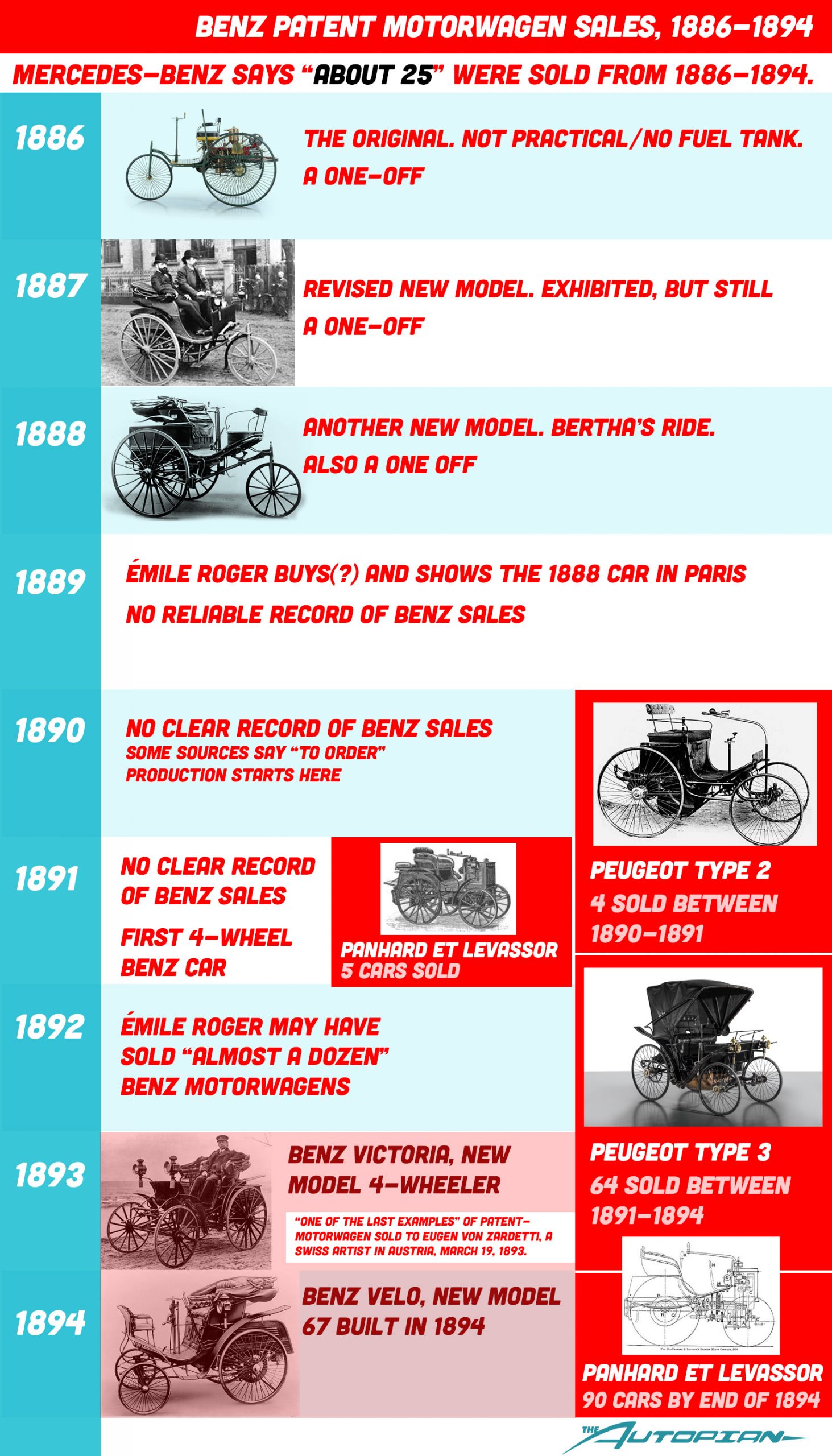
This chart shows car production for three companies between 1886 and 1894: Benz, Peugeot, and Panhard et Levassor. Both Peugeot and Panhard et Levassor were using engines from Daimler, which would eventually merge with Benz in 1926. Benz’s production numbers for whatever they considered to be their production model (which seems to be an 1890-ish revision before the four-wheel version was developed in 1891) are, as you likely have figured out, maddeningly vague.
In fact, the only confirmed example of a Patent-Motorwagen sold I have been able to find, at least so far, was what is considered to be the first car sold in Austria, on March 19, 1893, to a Swiss artist named Eugen Zardetti. This is stated to be one of the last Patent-Motorwagens sold.

Zardetti’s 1893 Benz started out as a three-wheeler and was later modified to be a four-wheeler, which may suggest that the four-wheeler Benz was derived from the three-wheeler enough that such a modification was possible. This four-wheeled version of the Patent-Motorwagen then developed into what is considered a new model in 1893, the Benz Victoria, which sold in greater numbers, and then in 1894, an all-new model, the Benz Velo, was released, and would eventually become Benz’s first genuinely successful model, selling around 1,200 cars by 1902, with 67 of those sold in 1894.
But neither the Victoria nor the Velo was the same car as the 1886 Patent-Motorwagen. And by the time sales were picking up for those later Benz models, cars from Peugeot and Panhard et Levassor were already in production as well.
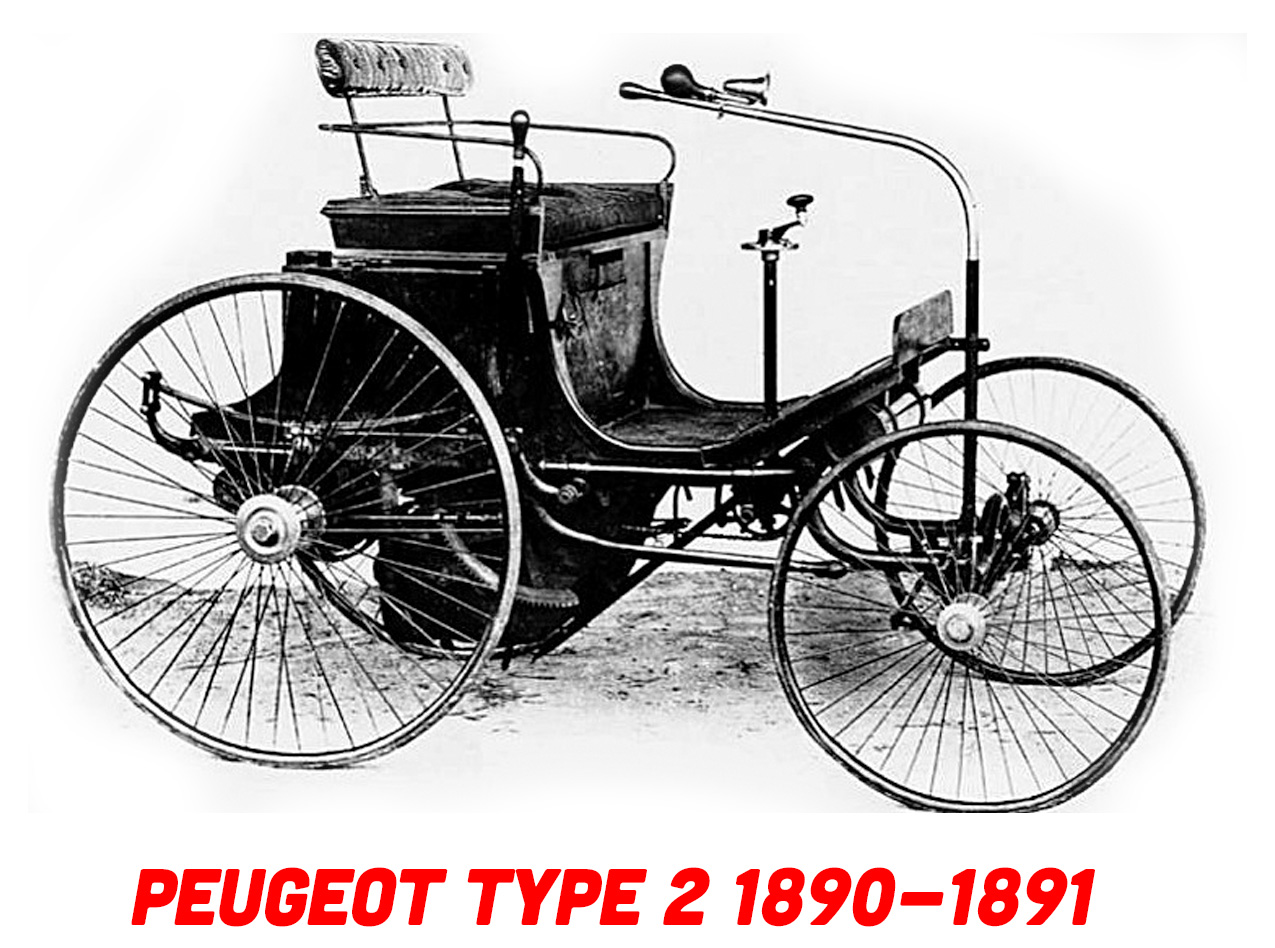
And this is sort of the crux of the issue; Benz claiming that the 1886 Patent-Motorwagen represents the “birth of the automobile” or the first production car for sale just doesn’t bear any real scrutiny. First, there’s the fact that the cars that Benz did sell were not the same as the 1886 car. The cars that were sold, based on the meager information available, seem to start in 1890, and by then Peugeot had started to sell their Type 2 (four units built), and then the next year came the Type 3, of which 64 cars were built and sold by 1894.
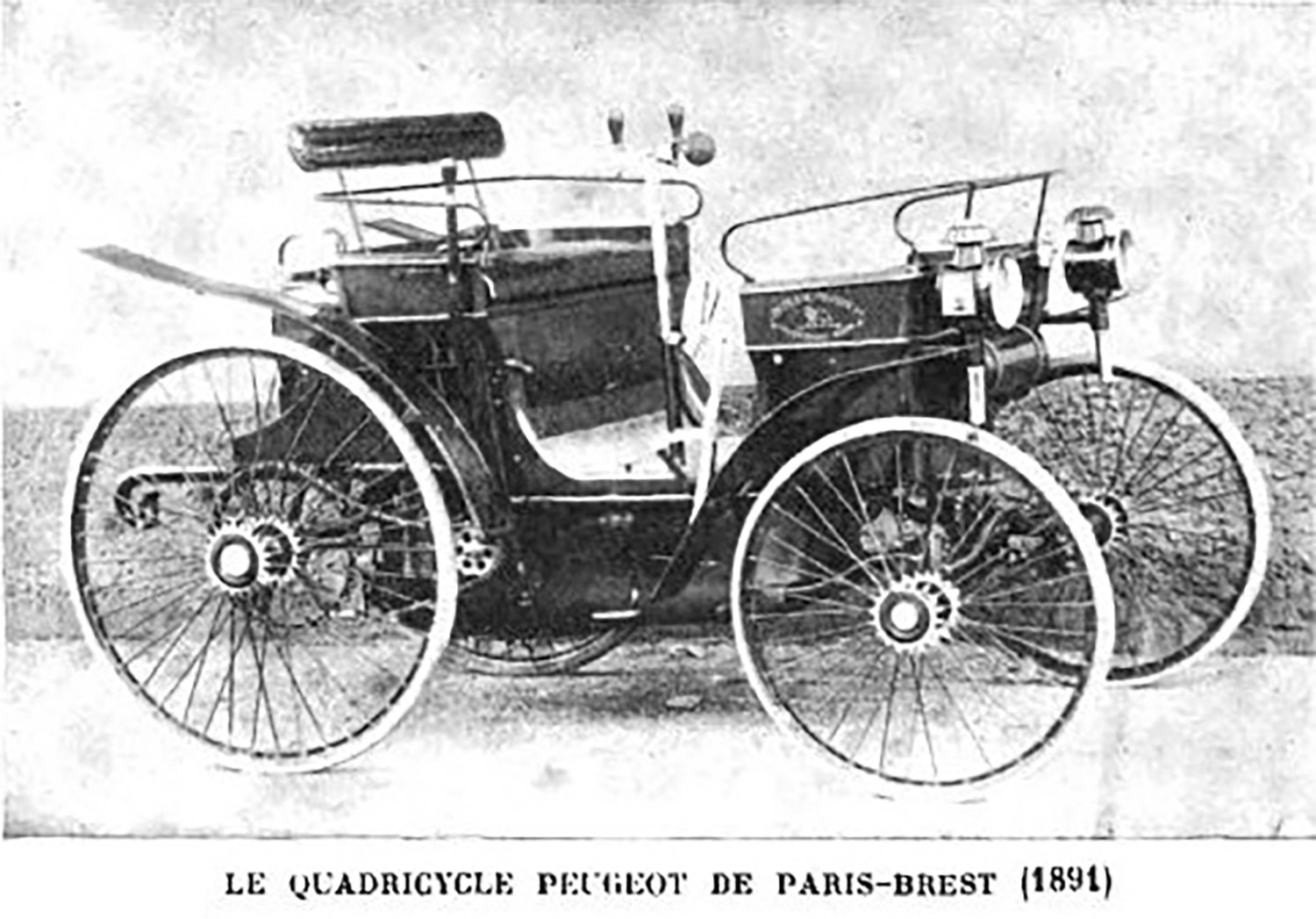
So what does this all mean? It means that the Benz Patent-Motorwagen, allegedly the “first automobile” to be sold, was, at the very least, tied for that honor with the Peugeot Type 2 in 1890, even though no verifiable numbers for how many, if any, Benz Patent-Motorwagens were sold in 1890.
And, by 1891, the Peugeot Type 3 was on sale, and the production number for that car – 64 examples – is over double the claims of the Benz car in the same period of time.
So why do we keep insisting that the Benz Patent-Motorwagen was first?
Let’s now address the claim that somehow the Benz Patent-Motorwagen represented the start of the “modern production” automobile. While it was certainly advanced for its time, if we’re really being honest, we have to compare it with another contemporary car being built and sold at the same time as the Benz car before we can bestow this honor on it: the Panhard et Levassor.

In 1891, Panhard et Levassor built their first car with a design all their own, using a Daimler engine mounted up front, driving the rear wheels, a setup that would come to be known as the Système Panhard, a layout and design that would define the vast majority of automobile mechanical design until the rise of transverse front-wheel drive cars in the late 1970s.
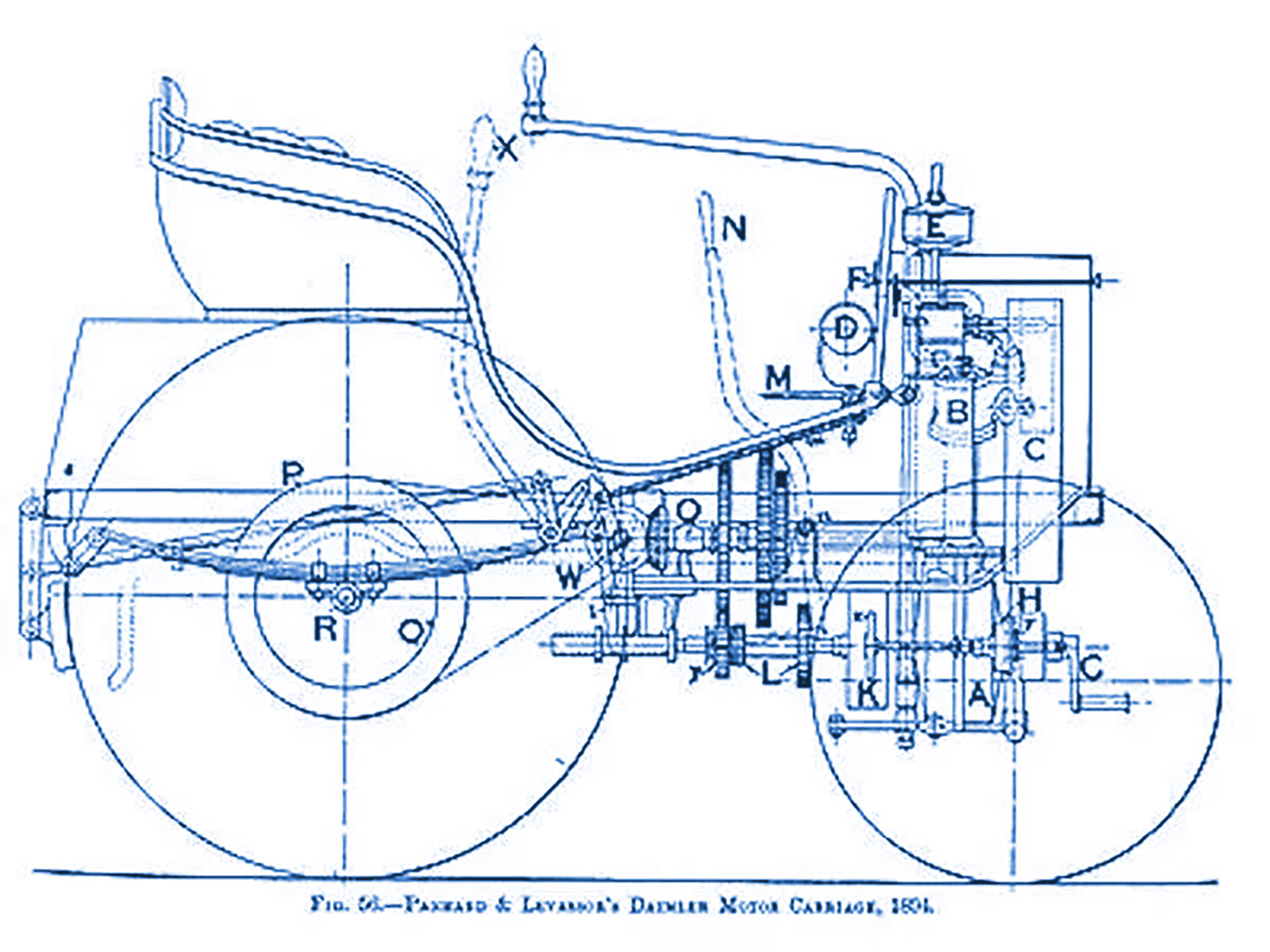
A 1965 Ford Mustang? It used this same layout. A Chevy Chevette? This layout. A Lamborghini 350 GT, a Jensen Interceptor, a Pontiac GTO, Lincoln Continental – all Système Panhard. If any car of this era can be said to be the “first modern production car,” it has to be the Panhard et Levassor, no question. The Benz Patent-Motorwagen was a three-wheeled car with a horizontal flywheel and the engine under the seats. That’s not the path that cars took in the following century.

That image above is from an 1892 Panhard et Levassor brochure, so you can see they had a full lineup of cars and were pretty serious about all of this. They had sold 90 cars by the end of 1894, which is more than the Benz Velo sold that year.
I think it’s pretty clear that the 1886 Benz Patent-Motorwagen was not the first automobile, not the first internal-combustion automobile, not the first production automobile, and not the first modern production automobile. At best, we can maybe consider the start of modern car production a sort of three-way tie between Benz, Peugeot, and Panhard et Levassor, but even in doing that, Benz would have the lowest production numbers and a production start date that, at best, ties with Peugeot and is extremely murky and hard to prove.
So, again, we have to ask, why the hell have we been letting Mercedes-Benz get away with the claim of “inventing the Automobile” for so many decades? It seems to have started with a letter dated May 30, 1940.
The letter was from the Board of Directors of Daimler-Benz A.G to the Reich Ministry for Public Enlightenment and Propaganda; I’ve never seen the text of that letter, and likely never will, if it still exists, but the response from the Nazi’s propaganda ministry does exist (translated from German):
Reich Ministry for Public Enlightenment and Propaganda Reference No.: S 8100/4.7.4.0/7 1 Berlin W8, July 4, 1940 Wilhelmplatz 8–9 To the Board of Directors of Daimler-Benz A.G., Stuttgart-Untertürkheim Subject: The True Inventor of the Automobile Re: Your letter dated May 30, 1940 (Dr.Wo/Fa) The Bibliographisches Institut and the publishing house F.A. Brockhaus have been instructed that, henceforth, in *Meyer’s Konversations-Lexikon* and the *Großer Brockhaus*, the two German engineers Gottlieb Daimler and Carl Benz—rather than Siegfried Marcus—are to be designated as the creators of the modern automobile.”
The letter seems to have been a request that all references to the creation of the modern automobile no longer reference Siegfried Marcus – an Austrian inventor who happened to be a Jew – and instead should refer to Daimler and Benz.
I’ve talked a bit about Marcus before. He had built at least two internal-combustion-engined cars, with the first in 1870 or 1875, and another later one that is often dated to 1888 (and is preserved at the Vienna Technical Museum to this day), though all of these dates are contested, and, honestly, I’m not sure what the exact dates are. What does seem certain is that Marcus had some manner of gasoline-powered cars before Benz, and there’s even a reference to a noise complaint Marcus got in his “Benzinautomobil” in 1875:
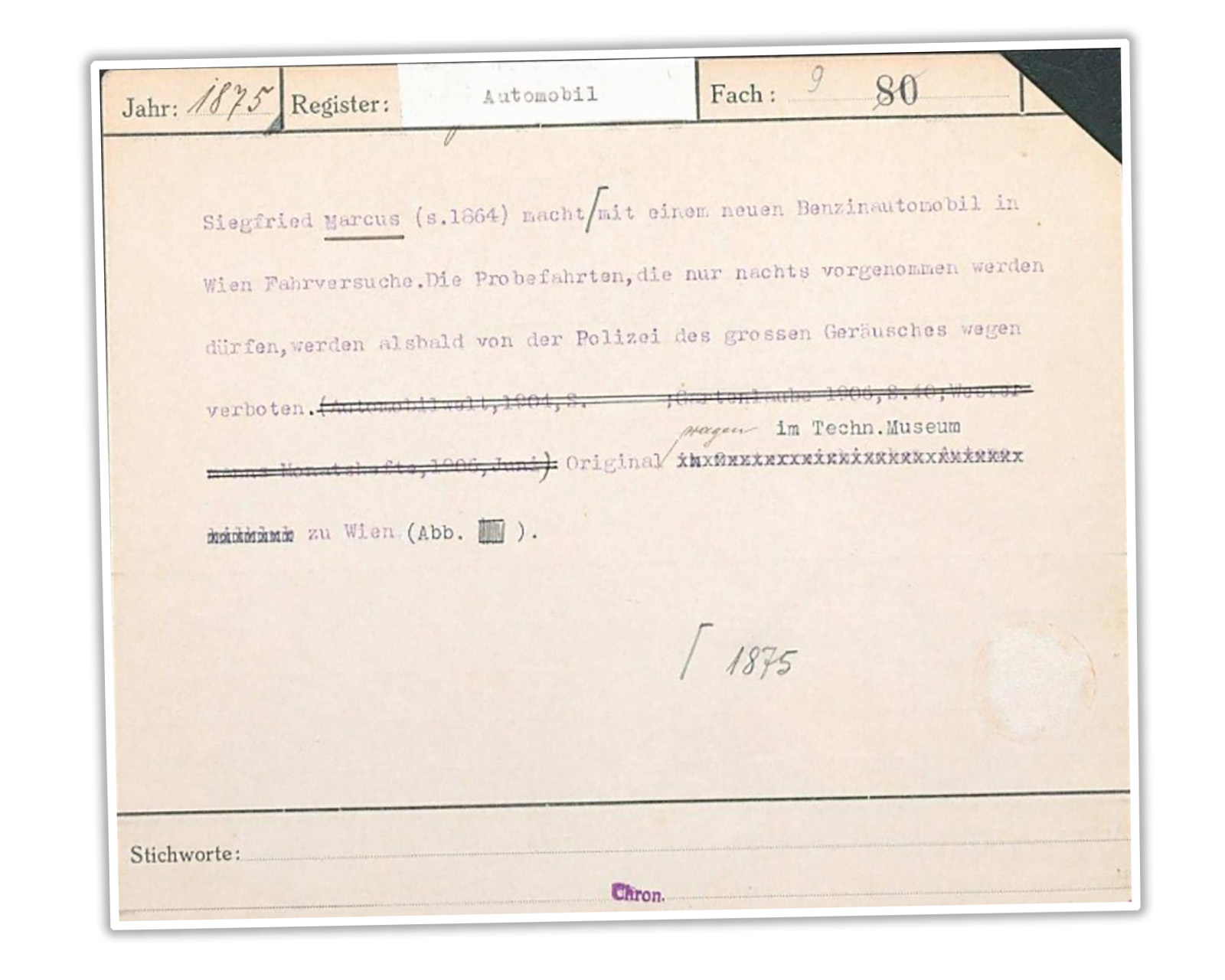
Prior to WWII, Marcus was often referenced as one of the key figures in the invention of the automobile. He was taught in schools and was commonly referenced in textbooks and reference works, as you can see in this 1908 encyclopedia entry about the automobile:
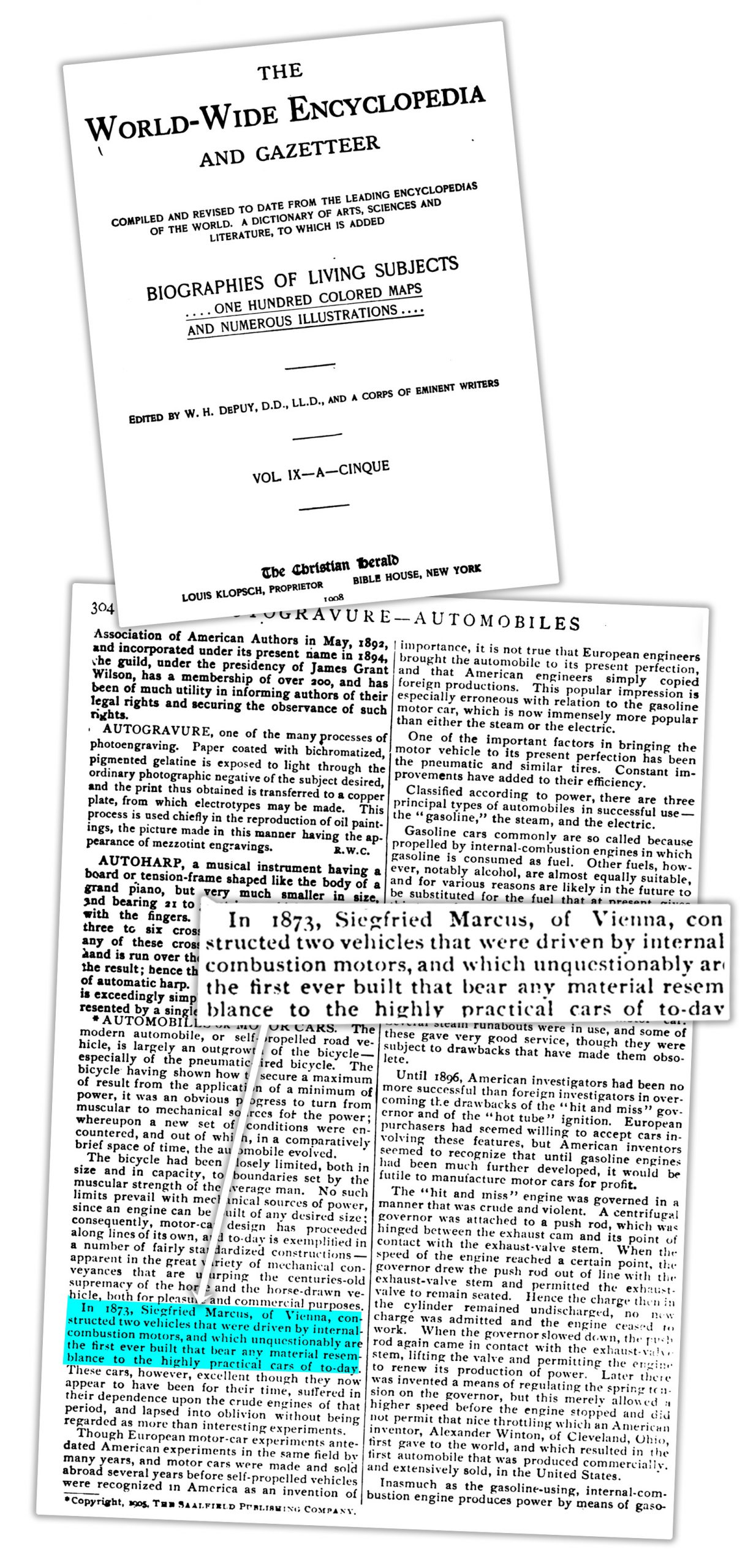
Carl Benz is not mentioned in this article, written a mere 22 years after he built his Patent-Motorwagen, but Marcus’ contributions are. Under the Nazi regime, a Jew getting this sort of acknowledgment simply wouldn’t stand, so the request from Mercedes-Benz to do a little rewriting of history was something the Reich Ministry for Public Enlightenment and Propaganda was happy to do.
And ever since then, even after the Nazis’ defeat in WWII, this narrative has stuck. Carl Benz as the inventor of the automobile has been accepted without question for over 80 years now, and Mercedes-Benz as a company has absolutely benefitted from this association, in terms of prestige and marketing and advertising and more.
Anyone could have really looked into this at any time in all those decades, and many have, and yet this Nazi-constructed narrative has remained intact. It’s time we just end this, not just because it’s a lingering bit of Nazi bullshit still polluting our culture, but because it’s just wrong.
This isn’t Carl Benz’ fault; he was just a brilliant inventor and engineer working on an incredible project. I don’t want to diminish his considerable and important contributions to the automobile. But it’s long past time we put those contributions into their proper place and context, and Mercedes-Benz needs to officially set the record straight.
If there’s some information I haven’t seen, and there absolutely could be, I’m happy to consider it. If there’s evidence of earlier sales or anything like that, I’d love to factor all that in. But until then, I’m going to keep banging this drum until Mercedes-Benz formally admits the truth and finally lets go of this Nazi-era bit of pandering.
Top graphic image: Mercedes-Benz


Im as big a benz fan as they come, but that claim of first has always been riddled with holes just by simply looking over at steam engines cars.
With how many caveats they need, its much like how the Arizona Cardinals claim to be the oldest nfl team. Which is claiming history from a different city, with a different mascot, prior to the team suspending operations.
Theyre blowing steam up their own ass because they have a piece of paper with a date and somehow have found a way to keep some semblance of the same company for longer than anyone has been alive.
I’m commenting to drive engagment and push TRUTH over corporate propaganda that benefits said corporation. Jason, I just want to say this is my favorite article you’ve ever written; you made a bold statement that challenged the mainstream accepted history of an entire industry, and dove deep into the facts, data, and information, created easy to understand visual graphics, and backed up your statement in an incredible manner. BRAVO.
At this time, I’d also like to point you to a video I created, that is VERY similar in scope: BRP did NOT invent the first snowmobile.
It really is great branding; SkiDoo has crushed the competition over the past few years, and they would just LOVE to pretend they invented the snowmobile, and maybe they did invent the “Modern” snowmobile, but it’s not the first snowmobile.
I am using definitions of the words in dictionaries, and basically the entire world/internet is wrong, and I am right, but nobody knows this because corporate propaganda.
Thank you Jason, for pushing TRUTH over corporate LIES.
I wish to upvote this take. Well done!
Thank you. I find it very irritating when companies with big pockets make up history.
Sign me up for your newsletter!
https://www.youtube.com/watch?v=ZTT1qUswYL0
(NSFW, but funny as hell)
Has David watch the Blues Brothers yet?? Maybe we can put together a membership drive that gets him to watch this classic movie.
Well, the new Buicks should be in shortly
Excellent piece of journalism here!! Any opportunity to expose Nazi lies makes the effort worthwhile. (Sorry for triggering the filter.) And we all got to learn something!
I don’t recall anything from elementary school about the first car, but I do remember being taught about Henry Ford ‘introducing’ mass production. I also vividly remember being taught all sorts of glowing things about Columbus; this was a Catholic school.
of course it was a Catholic school. They did seem to forget that there were many Jews on that first crossing getting the F out of Spain/Portugal, but I digress. As a victim of the catechism and 12 years of nuns, quite a lot of what we were taught is beyond suspect and lands in cult grooming. I thank you Jason for this article and now as a MOtT, appreciate any and all corrections of a rewritten history to exclude Jews and other minorities from important inventions and contributions. Also F the not sees