

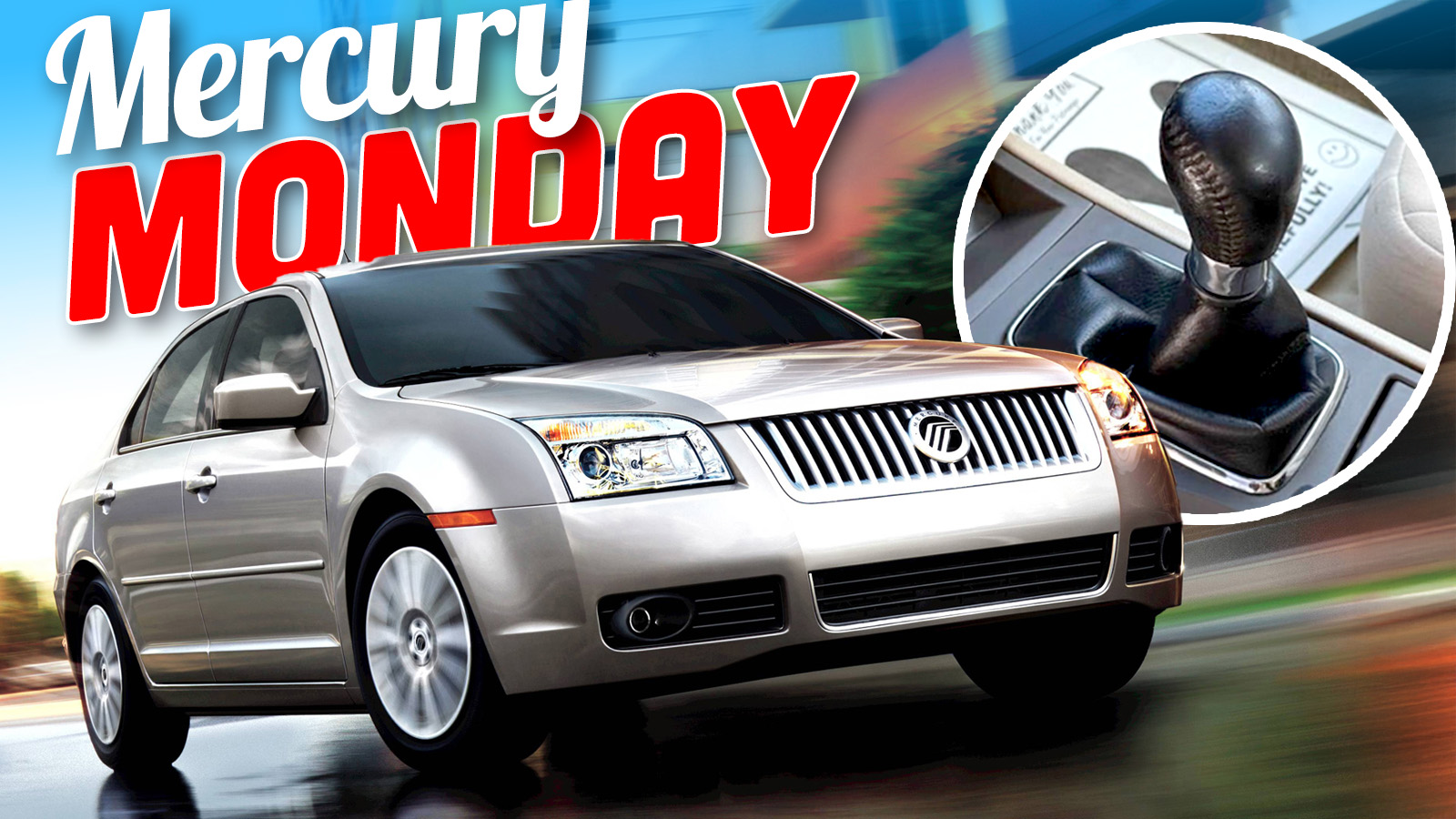
For 72 years, Ford had a brand for buyers who wanted something a little nicer than a car that had a Blue Oval, but was cheaper than a car with a Lincoln badge. Mercury hasn’t been with us since 2011, and its fall from grace was a sad one, as Mercury struggled to find an identity in its final years. Yet, there was one bright spot. On the surface, the Mercury Milan might have seemed like a lazy rebadge of the Ford Fusion. But under the familiar bodywork was not just a fine commuter car, but Mercury’s last car to ever come with a manual transmission.
Back in 2018, Ford shook the car world when it announced that it was discontinuing every four-door car in its lineup. Sure enough, Ford followed through on its threats. The Focus bowed out in 2018, and was followed closely by the discontinuations of the Fiesta and the Taurus. The last sedan standing was the Fusion, which soldiered on to 2020. It’s been six years since the Ford car-pocalypse, and much of America has seemingly gotten used to the Ford lineup being full of crossovers, SUVs, and trucks. Only the Mustang holds down the car fort at Ford nowadays.


The Fusion was one of the real gems that America lost in this process. Sure, the Honda and Toyota competition sold more copies at the end, but the Fusion looked sharp, was beloved by many of its owners, and even had an honest 325 horsepower sport version that was a bit of a sleeper. The Fusion also reeled in quite a few awards when the first generation launched in 2006. That honesty, I think, was one of the defining traits of the Fusion. It didn’t try to be anything it wasn’t, and what you saw on the tin is what you got.

If you’re a fan of rowing your own gears, the best Fusion was perhaps the one that didn’t call itself a Ford. The Mercury Milan split the difference between the Ford Fusion and the Lincoln Zephyr. The Milan was nicer inside than a regular Fusion, but also came with something that the Lincoln did not: a manual transmission. What buyers got was a classy car that was easy to drive, had an excellent engine, and was somewhat frugal at the pump, but still had something for the enthusiast.
Ford’s First ‘Digital’ Cars
The heart of the Ford Fusion and its siblings is the CD3 platform, an architecture developed by Mazda, in which Ford had a controlling 33.4 percent stake in back then. The platform’s life kicked off in 2002 as the underpinnings of the Mazda 6. But Ford had big plans for the CD3 platform. It spent $1 billion on the CD3 program, cooking it up into what it hoped to be the bones of models to be sold around the whole world. But there was more, as the Ford models developed on the CD3 platform would be hailed as the Blue Oval’s first truly “digital” cars.

Milan is built on the new global CD3 architecture developed by Ford Motor Company. Eventually, this architecture will serve as the basis for as many as ten unique vehicles in North America, with combined sales up to 800,000 units annually.
Ford developed the CD3 as its first fully “digital” car, allowing the company to cut months of development time, saving money and bringing the vehicles to market more quickly. Supercomputing power let engineers build an entire car in an exact duplicate of the assembly plant without stamping a single piece of sheet metal. During this “virtual build,” engineers identified and implemented more than 300 ways to improve such things as vehicle fit and finish, tool clearances and ergonomics on the production line.
“This really made us focus on the way the car would be built,” says Pat Villerot, supervisor, final assembly engineering, Ford Vehicle Operations. “We were able to check clearances in the vehicle, verify the build sequence and prove out ergonomics for the plant workers. For example, we could simulate building the car at a certain height on the assembly line, and use virtual people who are representative of our plant workers to make sure this was the proper height.”

Before Ford adopted this digital technology, designers and engineers often iterated through physical prototyping. As WardsAuto wrote in 2005, some issues weren’t tackled until later on in development. Now, engineers were able to build and test out their designs in a virtual environment before committing the time and resources to building test mules and prototypes. Since the various departments involved in the development of a model were all hooked into the same software, it also meant that problems could be solved sooner.
Clay models and physical demonstrators were still built, of course, but Ford’s teams were able to collaborate and hone in on their designs before putting them into flesh. A Ford press release from 2008 explains how the company leveraged what it called the Virtual Build Arena:
Ford employs advanced motion capture technology – commonly used in animated movies and digital games – with human modeling software to design jobs that are less physically stressful on workers. “The benefits are fewer injuries, lower cost of tooling changes, higher quality and faster time to market. We’re seeing improvement in every one of those metrics, and our virtual technology is a factor,” said Allison Stephens, Ford ergonomics technical specialist with Vehicle Operations Manufacturing Engineering. Stephens demonstrated to media today the ergo technology in a virtual assembly plant. An engineer outfitted in a digitized harness, gloves and head gear installed a virtual center console exactly as a plant operator would.

The engineer’s size and movements were captured and loaded into a computer program, redrawn as a digital employee, an avatar called Jack, and displayed on a large screen. The human modeling software then determines the ergonomic and quality impact on the assembly-line work. Changes can be made quickly and efficiently to the vehicle or part design to avoid adverse impact. Ford has integrated ergonomic requirements into product design specifications and customer quality checks. “With this technology, our digital employees – Jack and Jill – are helping us predict the ergonomic affect of long-term repetitive motions,” said Stephens. “The impact on health and safety metrics as well as on quality has been tremendous.” Ford has been advancing its approach to digital ergonomics work since it began using virtual tools to improve ergonomics in 2000. The company is collaborating with the University of Michigan as part of a technology consortium as well as participating in the Virtual Soldier Research program with the Department of Defense and the University of Iowa.
As a part of the company’s product development, the ergonomic data are handed off to the Virtual Build Arena, where the program team – designers, engineers, suppliers and line operators – assemble the vehicle part by part, virtually. This happens long before the first physical parts are produced and a prototype vehicle is built. In fact, the virtual build event takes place before Ford and its suppliers install tooling and set up workstations. In the virtual build event, Jack and Jill assemble the vehicle part by part on a wall-sized computer screen as the program team scrutinizes the vehicle’s manufacturing feasibility, i.e., how well the parts go together in the assigned sequence and at the specific plant where the vehicle is to be produced. “The impact on cost-savings and quality improvement is significant,” said Cheryl Bruins-Rozier, Virtual Build manager. Bruins-Rozier said the technology contributed to high quality early builds of the Ford Flex and Lincoln MKS, both launching this summer. In each case, the vehicle reached the prototype build stage with 80 percent fewer manufacturing feasibility issues. “Thanks to the virtual tools, parts compatibility on both vehicles was extremely high,” she said. “These products are on track to launch at world-class levels.

In 2005, Ford’s designers estimated that the Fusion program would span only 38 months compared to the 45 months that a typical Ford took to develop back then. To further illustrate just how helpful virtual build techniques were, Ford told WardsAuto that development on the Lincoln Zephyr began 13 months after the Ford Fusion. Yet, they were still able to launch at around the same time.
The Gen-X Mercury

The Ford Fusion, Mercury Milan, and Lincoln Zephyr each launched in 2005. As CNET wrote in 2006, to create the trio, Ford took the Mazda 6’s CD3 platform and stretched it, widened it, and strengthened it, creating the CD338. Sadly, as Autoweek reported in 2005, Ford’s plan to morph the CD3 into a global platform stalled out when its European brands concluded that CD3 didn’t meet their performance requirements. Instead, they would build models out of the CD1 and EUCD platforms.
But here in America, the CD3 was a big deal, as it was a major component in Ford’s rejuvenation plan, which, as Autoweek reported, was a bet on selling lots of different family cars. The Fusion — which was originally called the Futura before Pep Boys sued — was supposed to carry the family car torch after buyers started scooping up Hondas and Toyotas rather than the Ford Taurus. The Fusion was to be the value-oriented model, with the Zephyr (later called the MKZ) as the upper-crust luxury model. Right in the middle was the Milan.

While the Fusion was Ford’s draw to get people from buying a Toyota or Honda, the Milan and Zephyr were supposed to help breathe new life into Lincoln-Mercury, which was then an entity of Ford’s Premier Automotive Group. Allegedly, the average Mercury Grand Marquis buyer was over 60 years old, and the brand had gotten a reputation for being the automaker your parents bought from. Meanwhile, Lincoln Town Car buyers were either pushing 70 or were drivers taking people to the airport.
The Milan, along with the likes of a new Mariner, Marauder, and Monterey, was supposed to get younger people into the new hip and fresh Mercury. From Mercury:
The Milan is critical in attracting a new, younger demographic to Mercury showrooms. These new consumers, between the ages of 25-36 and broadly defined as Generation Xers, are the youngest of a group of increasingly younger Mercury customers. They also express some of the same unique, trend-defying traits that underpin Mercury’s renaissance. In general, Gen Xers are savvy consumers looking for stylish, functional products that match their unique lifestyle. Mercury research shows that 81 percent believe in strong self-expression through fashion and that 61 percent claim unique, personal styles drive their purchase decisions. “First and foremost, the new Mercury customer wants something that stands apart from the crowd,” says Darryl Hazel. “They don’t want something they will also see in their neighbor’s driveway, but they also don’t want a car that’s brash or showy. They want premium features, but without the luxury price tag.”

The range of new products at Mercury requires a new method of communication to reach an expanded set of consumers. “Our new products give us the opportunity to redefine our brand,” says John Fitzpatrick, Lincoln Mercury general marketing manager. “Thus, we set out to relaunch the Mercury brand with a fully integrated marketing communications campaign, called ‘New Doors Opened.'” “New Doors Opened is Mercury’s fully integrated marketing communications campaign that features the vitality of the Mercury brand woven into the everyday discoveries of modern life. A record 25 percent of the total marketing budget for ‘New Doors Opened’ is dedicated to Internet communication initiatives. “The Internet has changed how people shop,” says Fitzpatrick. “We know that more than two-thirds of new car purchases are researched on the Internet. Mercury understands it’s an essential channel to communicate with our target customers.”
Another component of the Internet communications strategy was a breakthrough undertaking for Mercury – or any other major automotive brand – because its vehicles were not the main focus of the project. “Meet the Lucky Ones” was a story written and produced with an independent-film sensibility about the often-comic misadventures of a quirky, slightly dysfunctional family and unfolded over a five-week period last fall. “Meet the Lucky Ones” helped attract nearly 1.9 million unique visitors to www.mercuryvehicles.com. During the five-week program, www.meettheluckyones.com had more than 472,000 unique visitors, almost 181,000 of whom then elected to visit the Mercury Mariner section of the Web site to learn more about the vehicle. Finally, more than 33,000 unique opt-in e-mail addresses were collected from individuals seeking more information about the Mercury Mariner, exceeding the campaign’s target by 32 percent.
In addition to spreading the word on the Internet and through clever marketing, Lincoln-Mercury dealers also updated their designs to look more like art galleries than car dealers. Per Lincoln-Mercury’s data, gallery dealers outperformed non-gallery dealers in every metric.
It Came With A Manual!

The Milan, like its two direct siblings, had solid bones. It rode on a 107.4-inch wheelbase with a modest 191.4 inches of length. Power came from a Mazda 2.3-liter dual overhead cam, 16-valve four with 160-horsepower and 150 pound-feet of torque on deck. In Ford form, this engine was called the Duratec 23. Optional was Ford’s 3.0-liter dual-cam Duratec V6 with 221 horsepower and 205 pound-feet of twist. The four-cylinder had a choice of either a five-speed automatic or a five-speed manual, while the V6 came paired with a six-speed automatic.
Backing it up was what sounded like a cushy ride. Here’s what John Davis of MotorWeek said:
Within a year Mercury will add all-wheel-drive to the Milan, and in 2008 a gasoline-electric hybrid will appear. But even now EPA fuel economy estimates are quite acceptable for the Milan V6 at 21 city/29 highway. Our mixed driving loop of 25 miles-per-gallon was just as expected. So was performance. Our Milan will hit 60 in 7.0 seconds, and cover the quarter mile in 15.4 seconds at 93 miles-per-hour. The V6 has plenty of grunt, pulling hard from idle to mid-range. It revs quickly, but with a fair bit of mechanical noise. The 6-speed automatic is sharp and positive.
Handling hardware consists of a short/long arm front and multi-link rear suspension. But tuning felt different than Fusion, a little softer. Turn in is quick, and steering weight is good, although there is never enough feel for us. While a very safe car with good grip, if you drive through the front push you can throttle steer the rear end quite nicely. Milan is easily the most sporting sedan from Mercury in recent memory. The up side of this softer setup is a very quiet and compliant street ride, fitting nicely between Fusion and Zephyr.
Braking is by 4-wheel discs with our car’s optional ABS, which produced longish stops of 135 feet. Nothing dramatic here, but we did have to apply a few more steering corrections than in either Fusion or Zephyr. Mercury has traditionally favored comfort over performance, but we think Ford should tighten up Milan’s overall feel so it completely lives up to its Euro-trendy look.
A Fusion, But Fancier

Of course, the whole reason to get a Mercury back then was to get something a bit nicer than a Ford. A base Milan sported cloth seats with six-way power adjustment on the driver side, a tilt and telescopic steering wheel with built-in cruise and audio controls, a six-speaker stereo with MP3 capability, a one-touch down driver window, LED taillights, and a few other bits.
Moving up to the Premier trim got you into what we’d call “premium” car territory. Standard was leather seating, and the dashboard was lined with real satin-aluminum trim. Optional was genuine Mahogany wood. Other luxuries in the Premier included automatic climate control, 17-inch machined aluminum wheels, traction assist, seat heating, a sunroof, an eight-speaker sound system, and more. In 2010, the Fusion, Milan, and MKZ also got Carlite SoundScreen, which was acoustic glass with a sheet of polyvinyl butyral in the middle to cut down on noise and vibration.

All of this was wrapped up in a body that chief designer Darrell Behmer said was supposed to attract youthful customers like “a fine Italian suit.” Even the name, Milan, is supposed to make you think of Italy. The Milan had a starting price of $18,995 in 2006. Moving up to the Premier was $20,890. Getting a base V6 was $21,995 while the Premier V6 was $23,495.
The Milan’s manual transmission was actively marketed throughout its run, with Mercury calling the five-speed “for spirited driving pleasure” and saying that getting the manual was the way to squeeze the best out of the Duratec 23. Yet, despite that, the period reviews I’ve read were all for automatics. The good news is that, since the Milan is pretty much just a fancy Fusion, we can refer to reviews of the manual Fusion. MotorWeek described the Fusion’s manual as “felt a lot like the MX-5,” which is pretty high praise.

Having that same manual in a Milan just means getting that same Mazda shift feel, but with slick metal, Mahogany, and leather around you. A more recent retrospective from Hagerty calls the Milan with a manual a “Goldilocks commuter car,” and that Camry and Accord buyers would have been perfectly happy with a Milan, if not happier.
The Milan got even better in 2010, too, with the four-cylinder powertrain upgrading to the coveted 2.5-liter Duratec four with 175 HP and 172 pounds of twist on hand. That’s the year the manual got an extra gear, too. According to Mercury, the 2010 Milan 2.5-liter four had a best-in-class 60 mph acceleration time of about 8 seconds. While not particularly impressive, that’s not bad for a family car from 2010. This is also the same powertrain that people keep snatching out of Fords to put into their Miatas!
While I have never driven a Milan, I have ridden in its Ford Fusion sibling. It was fine. It was neither bad, nor the best car ever. It was, as I said in the opener, honest. It wasn’t loaded down with gizmos and gimmicks, but it wasn’t spartan, either. It was sort of where many cars from the 2000s were, where there was just enough technology to feel modern and to take away some of the pain points of the past. It didn’t need jumbotron screens, logos all over the place, “connected” anything, or hardware that costs more than a dinner at Five Guys to replace after a minor parking lot oopsie.

I imagine the Milan is a lot like that, but with some nice leather and such thrown in.
Mercury’s Last Manual Survived Until The End
Sadly, it wasn’t enough, because while the Milan eventually became Mercury’s best-selling car, the brand still lost its footing, identity, and sales. Ford canned the whole brand, and since then, Mercury is but a distant memory. It’s sort of wild to think about because, in recent times, I can remember when I last saw a Milan, a Grand Marquis, and a Marauder, but I would draw a blank on any other model. Don’t even ask me when I last saw a Milan in good condition. I’m willing to bet that many people weren’t even aware that the Milan was even available with a manual.

While it’s probably safe to assume that a Milan with a manual transmission is rare, there are no production numbers, so it’s really anyone’s guess. Regardless, the Milan itself is about as remembered as Mercury is, and if you find one for sale, don’t be surprised to see that it has a ton of miles and maybe a crash or a few in its records. None have graced the pages of enthusiast auction sites, and the one I found for sale is going for under $5,000.
I think the world needs more cars like the old Milan. For the modern equivalent of $32,087, buyers got a sedan with a slightly nicer interior, a manual transmission, and a peppy engine. It was a normal car that didn’t try to promise you the world; it was just a little bit more fun than usual.
But I also acknowledge that the Milan was built for another car market, one that was more receptive to mid-size sedans that didn’t have a Toyota, Mazda, or Honda badge on it. Heck, the Milan was built for a world where Mercury was still around. Of course, the Milan was also a part of an era where manuals were more common. Still, there’s something that seems neat about an average, everyday car with some luxury touches and a dash of fun sprinkled in. I guess I really can imagine myself in a Mercury.


The whole death of Ford’s cars makes me sad.
They were decent vehicles.
But the best CD3 was the Mazda6 imho.
At least it has real turn signals in the back, unlike the Fusion.
Fun fact: the Milan, Fusion, and Zephyr/MKZ were made in Mexico, while the Mazda6 was made in the US (alongside the Mustang). I still think that’s funny making the foreign nameplates here and not the domestic names. They should’ve made the American names in the US and just given us the 6 from Japan.
Of course the transmission felt like a Mazda, because it *is* from Mazda, as is the MZR I4 (though the V6 is from Ford). The suspension and brakes are identical to the 06+ 6 (which is also when the Fusion came out). That means you can use Bilstein shocks and other aftermarket shit offered for the 6, even if not listed for the Fusion/Milan/MKZ.
The Milan is still silly, though. They should’ve just offered the I4 and manual on the Zephyr, and of course the Fusion should’ve gotten amber turn signals. Cadillac had recently brought back the manual in the CTS (and not just for the V, either).
The best part is how the Euro Mondeo of the time looks just like the Fusion/Milan but shares no parts with it. Mexico got the Euro Mondeo until the Fusion came out, when they switched.
What Mercury should’ve done is just import Euro Fords and some Mazdas that might be too expensive to sell as a Ford over here (like that Mondeo, just call it a Mercury), also the real Mk2 Focus (which we never got, just a rebodied enshittified MK1), the C-Max, Galaxy, etc. Kind of like what GM was trying to do in the bailout era, Opel/Saturn–>Buick, Holden–>Pontiac)
To stick up for the USDM ’08- ’11 Focus (I own one and love it), if it’s not the Euro model, it is the Mk1 with all its bugs completely worked out. There’s a lot to be said for that.
This almost made me laugh out loud:
> Xers are savvy consumers looking for stylish, functional products that match their unique lifestyle. Mercury research shows that 81 percent believe in strong self-expression through fashion and that 61 percent claim unique, personal styles drive their purchase decisions
I get it, market research happens, and everyone likes to think they’re more unique than they are, but something about this quote teed up a Simpsons-esque nonsense line, I’m feeling like it’s coming from Kent Brockman, who dutifully reports that “81 percent of Gen Xers believe that they are, on average, 75 percent more unique than their peers,” before looking off-camera and asking just what on earth that’s supposed to mean.
I’m not picking generation fights or anything; it’s that that juxtaposition of soft, qualitative statements butted up against expressions of fact, especially statistics, will always tickles my cynical funny bone.
More on topic, the death of Ford’s cars still frustrates the shit out of me. They were still having massive quality issues (Powershift, everything else) but they were at least handsome, the STs were beloved, and the glorious, ridiculous Focus RS is always the first car I try to get my digital mitts on in a racing game.
Edit: bahaha, I went to close the tab where I was checking that I was in fact thinking of the Powershift and had typed “Powershit”. Yep, that about sums it up.
The best part is that after Ford stopped selling the Focus and Fiesta here, they chucked the PowerShit and immediately went back to regular automatics, including on the ST. An automatic Focus ST would’ve been very successful for them.
I really think they sabotaged their small cars on purpose so they can say “see, small cars don’t sell here”
The good, everyday car still kind of exists, but given the capitalistic view of the world with maximising profits, trinkets, features, etc it is a much harder sell.
Or I’m just a luddite and the everyday car has just gotten much better equipped so feels less “honest”.