

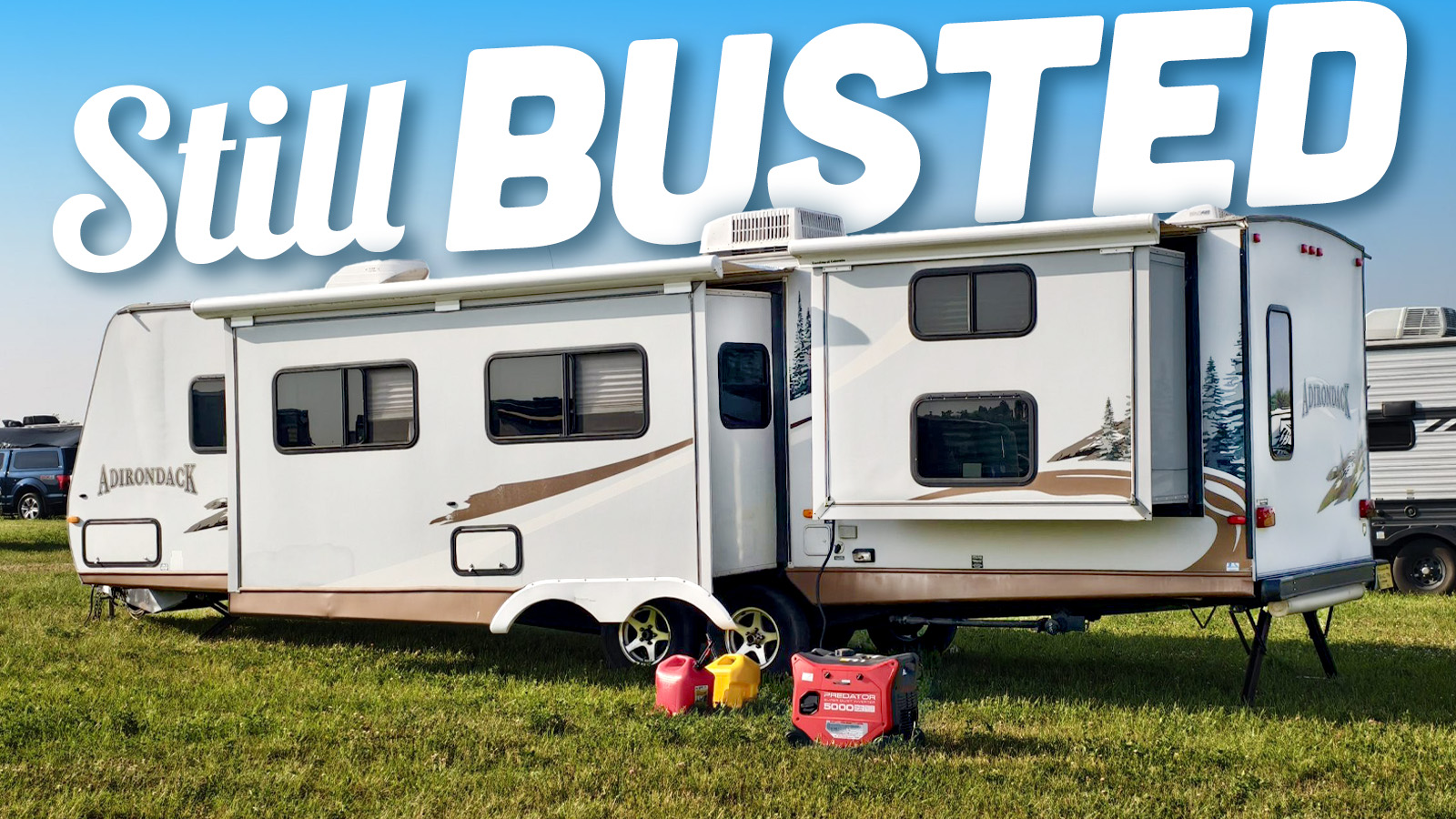
One of the most accessible ways to get into RVing is buying a used camper. RVs depreciate like luxury cars, and units that aren’t even that old can be a bargain on the used market. But buying used is always a risk in that the price you pay may just be a down payment to future pain. In 2016, my family bought a 2007 Adirondack 31BH, and my parents have since spent so much money keeping it alive that they could have bought an entire second camper. Most recently, structural and electrical repairs sidelined the camper for a year. Yet, despite all that time and $7,500 zapped from existence, the trailer is still broken.
Every year, Sheryl and I descend into Oshkosh, Wisconsin, to enjoy the EAA AirVenture Fly-In for a whole week. To us, one of the greatest parts of the experience is camping. It’s dramatically cheaper than going to any local hotel – even cockroach specials are charging nearly $400 a night right now – and Camp Scholler is simply an amazing place. I feel like going to AirVenture without going camping is missing out on much of the fun.


Thankfully, I come from a family of lifelong RVers, so I always have access to one of two travel trailers that my parents own and maintain. My usual pick is the 2007 Adirondack 31BH, which was originally built by Thor Industries. This trailer is smaller and lighter than the family’s 2022 Mallard M33, and I also like its features a whole lot more. Sadly, the newer trailer is also much more unreliable. Seriously, my parents recently looked up how many trips the Mallard’s been able to go on since they bought it new, and they calculated that it’s been on no more than seven or eight trips total. That matches my math. To put it into other words, on average, the Mallard is able to go on two trips a year before having to be sidelined for months for repairs.

Both the Adirondack and Mallard are very traditional builds. The Adirondack is an old-school wood-frame construction with a rubberized roof and fiberglass skin slapped onto the sides. It was built during a time when the RV industry seemingly forgot how to bond fiberglass to plywood, leading to panel delamination, water leaks, and rot.
The Mallard features newfangled Azdel composite walls supported by an aluminum structure. This is great because even if water gets in, the Mallard’s structure should hold up as there’s no structural wood in the design. Instead, in the Mallard’s case, it’s everything else around the structure that’s been falling apart. Shoot, the frame had concerning rust on it when the trailer was delivered new.
But don’t let my assertion that the Adirondack is more reliable fool you. This trailer is still built like crap, just crap that can actually be slept in for a long time between required repairs. When my parents bought this trailer in 2016, the signs of water damage were already there. The fiberglass siding was already delaminating, and one part of the floor seemed a bit softer than the rest. It’s kept breaking ever since, and my parents have ignited another $7,500 to keep the trailer alive.

Why Stick-Built Campers Break
Traditional RV walls are built like sandwiches; they feature aluminum or fiberglass siding that’s bonded to a tropical lauan plywood backer, insulation, the structural wood, and then the interior panels. Water has a nasty way of getting into these sandwiches, breaking up the bonds and causing delamination. By the time you notice it, the damage has likely already been occurring for years.

In 2022, the Adirondack burst at the seams, literally. The water damage had gotten so bad that the bathroom wall rotted out and buckled, forcing the outer fiberglass panel to break open. The floor had become so soft and rotted out that it splintered under your feet. My parents paid $7,500 to rebuild the bathroom wall, repair the bathroom wall leak, stabilize the rotting floor, seal it, and cover it with new wood.
Then, we started using the trailer again. Little by little, it began falling apart some more. Signs of water damage began appearing in the primary bedroom, namely the warping of the wardrobe and delamination of the interior wall panel. The floor near the entry door went soft. The awning rotted out and detached from the trailer. The awnings above the slides began getting jammed after their retractor mechanisms failed. The trailer’s suspension and bearings got worn out, the battery cut-off switch stopped working, a slide opener switch shorted out, and the air-conditioner started blowing warm air.

The issue that made my parents decide to get the trailer repaired was the water damage to the rear slide. Water had gotten its way into the structure of the slide and rotted it out. Water then traveled along the damaged slide, entered into the trailer, and rotted out wood inside, too. To call this a disaster would be an understatement. The slide was losing structural integrity and, had it been left alone, the new floor that was installed just three years earlier would have been destroyed.
So, the Adirondack spent all of 2025 at a Camping World shop to get as many of these items addressed as possible.
It’s Slightly Less Broken Now!
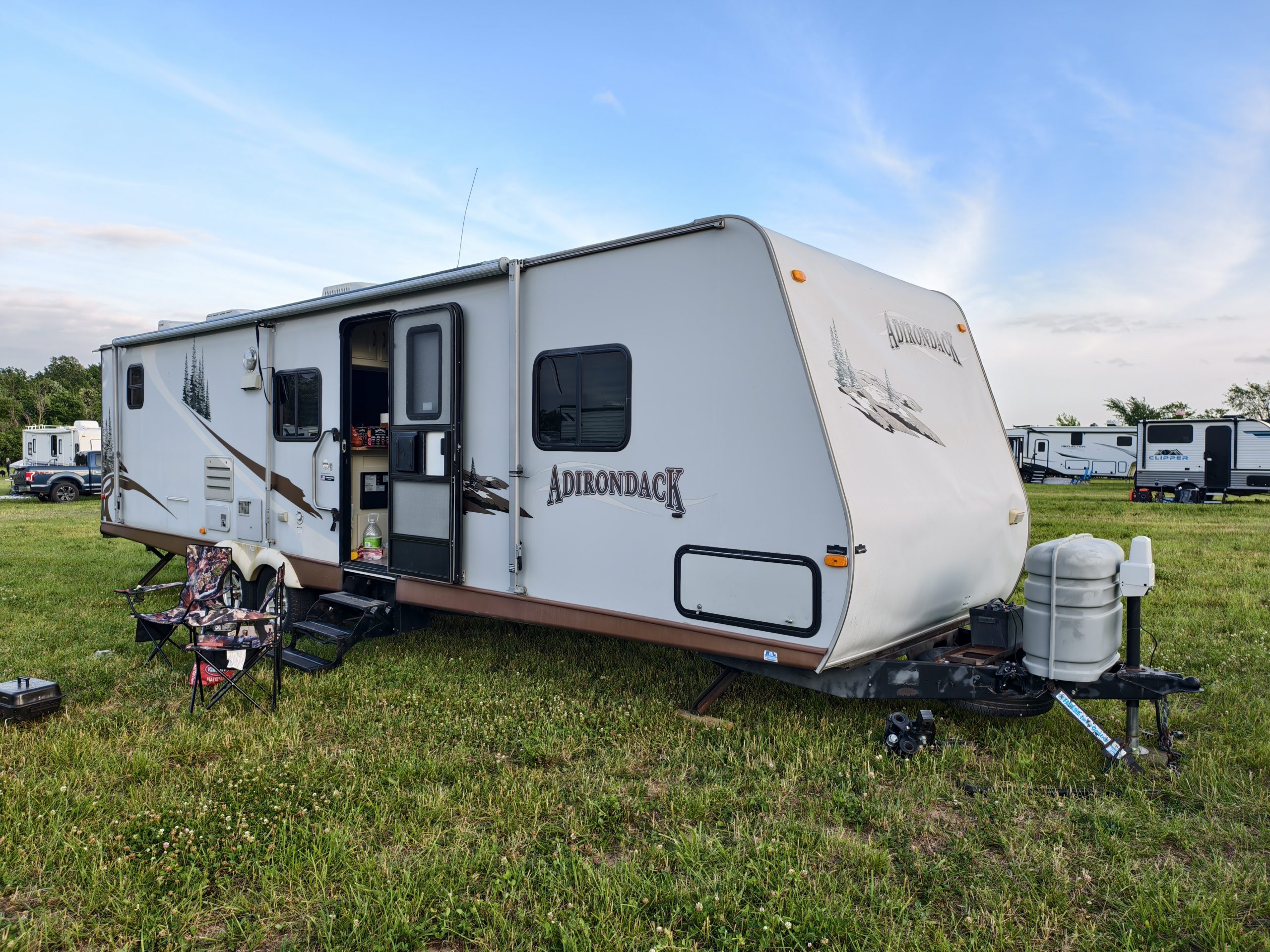
The camper has finally emerged from its multiple surgeries, and there’s a lot of good news and some bad news. The shop easily knocked out a lot of the little stuff. The slide switch had gone bad, so it was replaced, as was the battery cut-off switch. The trailer’s suspension and bearings were replaced as normal wear items. The air-conditioner is blowing cold again after the removal of years of built-up grime.

Even some of the bigger items weren’t as big of a deal as anticipated. The slide awnings are operational once again after their retractor mechanisms were replaced.

Unfortunately, the awnings themselves are getting threadbare, so it’s likely that they will fail soon. The trailer’s main awning was not replaced during its time in the shop, so that still needs to be done one day.

The big item on this repair visit was the slide’s water damage. To repair the slide, technicians had to rip the lower structure out of the slide, rebuild it, and reseal it. Check out the wood framing:

I’m not the biggest fan of this repair job. It doesn’t look factory, and unlike the intact front slide, the repaired slide makes no effort to protect its structure anymore. When the slide is open, that wood is sitting there, exposed to the environment.
Here’s what the other slide looks like:

To fix the leaks inside, both slides got entirely new seals. My folks were told the roof and seams were serviced and resealed, too.

The techs performing the restoration work gave my parents the option of skipping the floor repairs. In their opinion, the floor still has some years left in it before the soft spots actually need to be addressed. So, my parents elected to pass on fixing the floor for now.

For a finishing touch, the techs reattached the headboard in the primary bedroom, which had fallen off the wall after water damage weakened it. The cosmetic interior water damage was not repaired at all, so even if the water itself is not coming in anymore, you can clearly see where it was getting in.

That brings us to today, where I’m already writing a list of things that should be replaced in the near future.
My first concern is the floor. I get that the techs say that it doesn’t need to be replaced right away, but its condition is rapidly getting worse. In 2024, only the approach to the door was soft. This year, nearly the entire floor next to and in front of the door has many soft spots. No cracking yet, but the damage is clearly spreading pretty fast. A shocking amount of floor is going to need to be replaced in the near future.

Then there’s the tongue jack. In the past, this jack was fast and strong. It lowered and raised the trailer three times as fast as the newer jack on the Mallard. This year, however, it’s slow, and it sounds like the electric motor is on the verge of failing. Thankfully, there is a manual override crank, so I’m not worried about getting stuck somewhere. But it’s going on the future repair list.
Also going on the list is the water pump. In the past, the pump quietly purred in the background. Now, it’s louder than a generator! Seriously, the trailer sort of shakes when it runs. Sheryl says it sounds like a dying targ.

The trailer also needs new propane tanks, as the ones that are on the trailer were made in 2006 and expired back in 2016. The tires also need to be swapped out. They have great tread, but the oldest tire is getting a bit too old for my comfort. All of them are getting old as it is.
Finally, if my parents choose to do so, I also recommend fixing the visible water damage inside the camper. This would purely be for cosmetics, but I also know how much they love this camper. I know I’d be bothered by looking at warped boards everywhere. Amusingly, I was right on the money when, in 2024, I guessed that my parents would spend another $7,500 on the structural damage in 2025.

Truth be told, everything I’ve listed here is either a time-of-life failure, a consequence of owning a stick-built camper, or maintenance that was unintentionally deferred. Still, it just goes to show that whatever price you pay for a used camper is really just the start. My parents say that they paid either $7,000 or $27,000 for this camper back in 2016. I’m more inclined to believe the lower number because campers just don’t hold onto value unless they’re something like an Airstream.

But regardless of what they spent to buy it, they have put some $15,000 into structural repairs alone, and the camper is still broken. They have spent more on other parts over time, including a new kitchen sink, a new water heater, a new electrical panel, and more. I started tracking repair costs in 2022, so there is a whole six years of repairs that I’m not even accounting for.
Still Fun
Still, every time I kick back and watch a sunset from the camper, I smile. For everything that sucks about RVing, it’s still great fun. Yes, I still prefer this madness over any Holiday Inn. Just don’t do it as my parents did it. Don’t just buy the pretty one with cool features. Try to find one that’s built well. Used Airstreams and fiberglass campers remain my recommended picks.

This is why I never write about the countless old stick-built campers for sale on the Internet right now. You can score one of these campers for a few grand if you look hard enough, but don’t let the low price of entry fool you. If you want to use it for more than a couple of years, you’ll need to put money into it, and a lot of it. But if you do have the money, I suppose you can make one of these things last. You’ll just be opening your wallet so much that you’ll eventually be spending multiples of your original purchase cost. I don’t recommend that, unless you really want that specific camper for some reason.
That said, I do think those old campers have some great uses. A few years ago, I saw a real beater of a motorhome roll up to my favorite local campground. Once it parked, some six or so college friends stumbled out of it. All of them pitched in some cash, bought the motorhome, decorated it, and went on a cross-country summer road trip. That was awesome. Who cares if they only get a year or two out of it when the memories they’re creating with it will hopefully last forever? One of our readers, Shop-Teacher, used an old and tired pop-up tent camper for years.
So, the crazy cheap campers out there do have their place, but temper your expectations. If you plan on keeping it for a while, expect to cough up some heavy dough. But whatever you camp in, have a great time! I sure am.
All photos: Mercedes Streeter



RVs are just like boats and airplanes. No matter how much you pay, it’s merely the down payment. So if it floats, flies, f*cks, or you can move it around and live in it – RENT IT! Though IMHO, if you have to do it, buy a converted coach with a “toad”. Better the house tow a car than the car tow a house. Put the money you would have spent on a stupid pickup to tow the RV into buying a better bus, and tow a cheap car.
My family had a succession of ever-larger Airstreams 40 years ago (the alleged glory days). They were hot garbage too, just slightly better but a LOT more expensive hot garbage. Which is why my idea of camping is no room service.
> So if it floats, flies, f*cks […] RENT IT!
I know it’s an expression, but I’m not sure about one of those.
Your final photo looks like it could be illustrating the flaming remains of the trailer after it’s burned to the ground.
There’s a lot of room on this trailer to add an appropriate name in vinyl lettering, like the way people name their boats. I suggest “Sunk Cost Fallacy.”
That’s an excellent name, but still probably better for a boat thanks to the sinking reference.
I love your stories, but these rolling chemical toilets sound awful. Let us know when we can participate in the first Autopian bonfire since you already have the kindling. I hope I hope I don’t sound like a jerk. We all have our addictions.
And this is why I bought an outpost 6.5. From reading all of your articles and doing additional research, I hope that this thing lasts for a very long time. Yea, I know its only a cabover slide in. But I wanted to buy something that would last. Fingers crossed!
*always love reading about RVs*
I bought my Bullet camping trailer brand new back in 2021. I noticed water dripping out from the cover that goes all along the bottom of the trailer when I went to flush the black water tank the last time I used it. I’m not sure where the water is coming from as the underside is completely sealed up and not easily accessible. The inside plumbing looks ok. I suspect one of the water jets is leaking on the outside. Not sure what I’m going to do about it yet.
Forgoing the typical hotel vs. trailer argument:
Regular maintenance costs of a trailer appears higher than the costs to rent one?
I want to thank the state of Indiana for their poor labor laws, and rapidly consolidating camper business chasing quick bucks on this terrible ‘investment’ idea
I think this only works if you’re renting for an extended period and not road tripping. Every time I looked at renting for a short term the numbers were silly. They want anywhere between 40-60 cents per mile, often have one shot prep and/or cleaning fees, etc. The “daily” rate seems great, but that’s not what it actually costs.
But yeah, if you drive to a national park once a year and park it for a week, absolutely renting is the thing to do.
I want a trailer until I read one of Mercedes’ articles on her family’s trailers.
Just get one that isn’t built like garbage, you may have to accept not having 6 slide outs, 2 kitchens, and granite countertops, but, depends what’s more important to you
Someone needs to write a story about Liz Amazing on Youtube. She has been covering all of the RV problems on everything sold since Covid. Its shocking how bad new RV’s are, mostly owned by 1 company now. It also shocking how badly they treat their customers who have problems.
I think the market’s something like 50% Thor, 35% Forest River, 10% Winnebago/GrandDesign, 5% everyone else combined. Basically with the quality inversely proportional to market share with a very few exceptions (Airstream is Thor, but somewhere in the range of Winnebago or “everyone else” for quality. And priced accordingly.)
A question, how are these things stored when not in use? Would it be practical or feasible to store them with a cover to protect them from the weather? My parents do this for their caravan – though theirs is much smaller than these American monsters.
They sell covers. They’re a massive pain to put on and take off and if you live in a high wind area like I do. They don’t last long.
Many RV’s are stored on surface lots year round and are exposed to the elements. I see some with covers. In the northern US some people pay to store them indoors during the winter months, local fairgrounds rent out their space from Autumn to Spring for this purpose. If you can find year round indoor storage that’s not stupidly expensive it really does remove many of these issues.
I’ve always found it interesting how rvs follow marine design and materials to a point. Many rvs use vacuum formed panels during production. The fix is often not vacuum formed. Often times repairs to vacuum formed fiberglass boats aren’t vacuum formed but the materials have come a long way and tie in existing core and fiberglass and fair it back.
Most RV repairs it’s just the panel you don’t tie in to the next panel and you lose that seal. The silicone or adhesive bond they often use works to a point then fails. It’s probably not as high of quality product as used in the marine industry either.
It seems like many people who refoof their rv have to do it again in just a few years then you get into panels and are always chasing a problem.
Vacuum formed fiberglass boats? huh?
Composite sandwich under vacuum using a mold. Many of the newer production fiberglass boats are built that way. Think like ocean cats and sailboats.
The smaller bass boats like they build in the south are often chopped fiberglass using a gun.
Smaller boat but typically how they do it for the larger boats:
https://www.youtube.com/watch?v=7RjaJAeu5WY
I understand you now, I thought for a second there was a new process I wasn’t aware of.
In the industry that process is called vacuum bagging.Vacuum forming typically means thermoforming, where you have a sheet of thermoplastic heated up, draped over a form, and then suctioned downwards.There’s also pressure forming, where you do the inverse and keep the A side towards the tooling.
I get what you mean about repairs tho. It seems never ending. I have a pop up A-frame camper, and it would be junk if I hadn’t put a roof over it. I have an old skoolie, and I’m not worried about that at all. Thing is built so nice.
The Asian and European manufacturers that are building the production cats and sailboats all call it vacuum forming. I’ve only ever heard flat panels without a buck or mold called vacuum bagged. Maybe different industries and countries different lexicon.
Chinese are building some interesting thermoformed plastic composite trailers and structures. They are super lightweight.
It’s called a composite system for a reason. Just too many corners screws and sealed together in the rvs they are building. If they tabbed them used glass and epoxy they would be a lot better off. Those pod style fiberglass trailers don’t have nearly as many problems. Because they have about 1 seam.
Thanks for the insight! It’s all clearer/muddier now lol
Yeah, the pod trailers seem like the only way to build them, but then you have tooling costs, and all the resulting chaos/mess from working with resins and trimming composites. Current system is all done with flat panels for ease of construction but it is definitely an inferior product.
It’s a slower process. But if you look at how they build bass boats it’s might be a good compromise. Chopped fiber gun on a mold. 3d printers are good and big enough they could use them to build the mold. They are doing some of that in China. Then just spray the chipped fiber in. You could do it again with a smaller unit to account insulation and conduit. Or use a thermoformed plastic for the inside.
As a resident of the Adirondacks I am deeply offended by this camper.
For the money involved in buying and maintaining one of these POS, you could fly where you want, rent a car, and stay where you want for basically the same amount.
The math maths, every time.
The more I read about RVs from Mercedes, the more I am completely convinced that RVs are the red-headed stepchild of boats…
…and boats are absolutely terrible with regards to ownership costs!
This is what I don’t understand about RV life. Statements like this are patently false: “ It’s dramatically cheaper than going to any local hotel…”
The lede itself mentions 7500 in repairs. That’s many, many nights in lodging and still ignores the purchase price.
The only time I’ve seen it make anything close to financial sense is living in it while traveling. But that’s never a permanent thing more often then not they end up buying land and building a small house somewhere or buying a park model or modular on some land or some sort of resort type thing.
For the people that use it a few times a year it’s sort of like time shares “pre paid vacation” but is it really. Still have to get where you are going and are limited to where you are going.
I know a couple my age who retired early, sold their house, and then spent the next 4-5 years living in an RV all over the country. Eventually they bought a house in Colorado, but only lived in that for a couple years and they are back living in an RV again. I think they’re in San Diego at the moment, I dunno they’re hard to keep track of.
I hate them. I kid, they’re sweet people, but man it sure does feel like they won at life.
In any case, yeah, buy a good one and live in it, that’s the way.
The repeat full time RVers tend to be a thing. Or going in-between your wides of trailer in an RV. I know several people that did it then bought land as a home base and aren’t on the road as much as they used to be. Typically will build a cabin or small house and might downsize the RV or get a different type. They say it a huge cost savings. Where in the RV full time it’s about the same as whatever you were spending on a house.
I know a few older couple who keeps buying single wide trailers with land mostly adjoining. One had several in Wyoming and Florida. The other several in Florida a few in Virginia and house on 50 ac or so in Montana. Both have a class a RV they travel in between their wides of trailers.
You aren’t wrong. Similar material probably lower quality and used in a less then optimal way. One reason airstream is such an icon has more in common with aircraft then boats. The pod style rvs with just a few seams fair ok. They are basically a life boat on a trailer.
Boats are not that bad at all, IF you buy the right boat.
I put this boat together for ~ $5,000, and it’s been reliable and easy to maintain, I just change the fluids and that’s it.
https://www.youtube.com/watch?v=L6JTMxqMhhw
So you’re telling me that a 30′ Morgan sailboat, followed by a 36′ Morgan sailboat, then a 43′ Selene Trawler (that cost $2k to fill with diesel in 2013) were poor financial decisions?
</sarcasm>
I really feel like we need a summary of all of the costs involved with the camper(s), from purchase to maintenance to insurance to tow vehicle costs, divided by the number of nights used. It would be quite interesting to see the data.
If you own a camper, you DO NOT want to see that info.
I have zero plans to ever own a camper, so I really, really want to see it…
It’s not really a cost thing so much as an option to go where you want. If you’re looking to fly, rent, and stay in a hotel, you’re tied to places that have acceptable hotels (in my old age, I simply refuse to accept Motel 6 accommodations). Having your own RV-esque vehicle means being able to set up sleeping quarters basically anywhere and pull over to sleep anytime. Especially a big advantage when traveling with smaller kids.
…of course I’m talking more about camper vans. The big trailers have their own logistic and parking challenges.
There is absolutely nowhere I want to go that doesn’t have nice hotels. Because if there are no nice hotels there, why would I want to go there?
I mean if it works for you that’s great. I like being out in remote places.
Which is to say, this entire sleeping in your car thing is not for everyone. But some people like it and some people (like my parents) absolutely do not see the point in it. And that’s okay.
Thing is, if you want to get away from it all, a tent is a WHOLE lot cheaper and much more reliable. And there are some pretty damned nice tents. I have stayed in one with A/C, a toilet and shower – and room service. 🙂
But I agree, different strokes for different folks. I just reserve the right to laugh at your strokes.
Was that last sentence truly necessary?
I believe in full disclosure.
Having stayed in an Airstream in places like the Arizona desert and Acadia National Park, I can absolutely say that there are places that there aren’t hotels or the hotels aren’t don’t have the experience that I want.
Leaky walls, moldy floors, a broken sink, and no electricity… Motel 6 is sounding pretty nice in comparison.
Oshkosh is kind of the perfect counterexample though. You are 1000% not getting a commercial flight into OSH, hotels are extremely limited, parking and traffic is a disaster. The costs are higher than you think, but the logistics are even worse. Anyone who’s having a good time is either flying in and has a tent (and usually shower) setup under their wings or pulled an RV to the camper party.
Dad has had his Wellcraft since 1991 and I’m confident Mercedes’ parent’s tow trailers have had more problems each since they’ve owned them than his boat has had in 35 years.
Summer slip fees and winter storage for boats aren’t cheap either but these repair bills just to repair flaws in the build of the RV are ridiculous. Mercedes doesn’t even mention what they pay to store these things and I think that’s by design.
The heck is a Targ?… oh, there’s a link.
…the heck is Memory Alpha?!…
Ohhhhh, it’s a Trek thing, rightriiiiight…
Hope you’re enjoying the show in spite of the camper, sounds like you are. I personally enjoy the Twin Beech aerobatics. Love the smoke and noise acts.
never ever ever ever buy an RV
seen a lot of janky stuff on my drive west this summer, towed by likely equally spendy pickups
Every time I begin entertaining the idea of an RV, I read one of your camping posts, and cure myself of the thought.
Just get a fiberglass egg one, you’ll be fine
2007 Airstream here. I’ve done 6-7 trips a year for the last 5 years (about 30 nights a year). Never in the shop in my ownership, but I’m pretty handy. Nothing has really broken other than the converter. I have done a lot of upgrades though…just to modernize some things. I do carry things like a spare water pump just as insurance. It’s still probably worth about 75-80 percent of what I paid for it at the height of Covid. As fancy as Airstreams are, there’s less stuff to break. The awning is all manual. There’s no slide-outs. It’s smaller (I have a 23′) and easier to tow. There’s seams that you need to reseal, but the roof is aluminum. I have way less problems than my friends that have Airstreams that were made in the last 5 years. It’s still another thing to maintain, but we do use it a lot and I vacation way more than I would if I didn’t have it.
I’d also say a well-restored Vintage Trailer is also a really good way to camp. They are also simple and easy to DIY the systems, but you likely won’t have things like AC or maybe even tanks or a bathroom. But they hold their value and are a lot of fun. We started with a 1966 Canned Ham and had it for 10 years. I sold it for more than I paid for it. But there are a lot of rotten ones out there, so you really have to be careful and buy one that has been properly rebuilt with no signs of previous water damage.
I have family with an Airstream that they live in all summer. They’ll tow it places, sometimes, but usually it’s parked. They’re in it the majority of days from May to October; things that they’ve had to do to is is small: they re-did the water supply hoses (mostly because they wanted to upgrade and add filtration inside), electrics because they added roof-mount solar, and that’s about it.
Sure the door sometimes sticks a little after they’ve driven it around, but it’s otherwise solid and anything that’s come up has been very minor.
Besides the fact that Airstreams hold their value regardless of the interior condition speaks for the structure (or, at least, the perception of it).
OK, Mercedes’ folks have spent $15K on repairs in 10 years, bought another trailer that is also broken, and staying at a hotel is somehow more expensive?
That math, as they say, ain’t mathin’.
Agreed. I get the social aspect of it all. That is why I visit my friends while they are camping. And I think the only reason they have one is to go on social trips with their extended family. So, it’s a cult, in a way.
Only way I’d ever consider purchasing one is to live in it permamnently, and that would require my not having enough money to live in my house.
She makes it pretty clear that they enjoy camping, not hoteling, and choose to spend their money there.
You can rent a trailer.
My folks used to RV and as a kid I would scoff at the rentals at the campsites, but that was the immaturity of a child. It’s honestly a smart play to rent if you don’t have covered storage and/or you’re only using them occasionally.
Would you rather be perceived as “a poor” for driving a rental RV/trailer or would you rather actually be poor because you own a terrible, awful, no good, very bad trailer that is bleeding you dry at every turn? To add insult to injury, at almost 20-years-old, it’s no longer a flex to own anyway! It’s a millstone around your neck.
I hope Mercedes’ folks will stop throwing good money after bad. They are setting their money on fire with this thing.
https://therangevtr.com/vintage-trailer-rentals/
Certainly not the only place to rent a campsite that includes the trailer.
I get that, and it’s cheaper at the time in question for Mercedes and Cheryl, but the cost to Mercedes’ parents for buying and repairing two trailers is criminal.
I used to have a cottage. Yes, it was an appreciating asset, but I enjoy it more now that I rent someone else’s cottage.
It’s definitely not cheaper than a hotel, but there are times when having an RV is the best possible way to attend an event. Staying at a hotel for a massive event like Oshkosh means paying loads to get a grimy hotel room in the rough part of town, then driving and waiting in traffic on the way in and out, finding parking, etc. It’s not cheap but if you want to light money on fire to avoid all that stuff I can’t say I don’t understand.
NASCAR events are the same way. I visited someone staying onsite with a big ole’ 5th wheel, and if I ever had huge amounts of disposable cash I’d do it the same way. The experience was so vastly superior to the standard NASCAR fare it wasn’t even funny.
I agree, but at the same time, vacations are supposed ro relieve stress. These trailers seem to exist to cause it.
This story would be even better if you published it in Smell-O-Vision©. Then again some of those pictures pretty much negate the need. You must have a very patient family to continue putting up with and paying for this.
They say the greatest feeling in the world is when you have been banging your head against the wall…and you stop.
I don’t share this devotion to campers, but I can’t point the finger on irrational financial decisions when I have a Eurovan, LR4, and Chevy Volt in my driveway.
I have a 92 Itasca Class A- only leak is when the skylight over the shower broke, Every year I put the batteries in start it up and go – I’m scared to get a newer unit
note to self, never buy a trailer
I’m convinced!
Out in the rockies, lots of people live in trailers year round, but pretty much every single one built some sort of frame, with some metal roofing panels to keep moisture off from it, myself included. Keeping the moisture from sitting on the roof, ESPECIALLY snow as it pressurizes into any minute crack, is a huge game changer.
Does your trailer molt a new roof as it ages?
Very confused rn. ?
So the RVs grow protective shells, like crabs. Get it? I was too stoned to stick the landing. Or not stoned enough.
Are these campers parked outdoors and uncovered year round? I’ve had drastically different experiences with my motorhomes that are parked under a structure (basically none of the big issues you’ve mentioned).
Exactly what I came here to type. If stored outside in 4 season climate then not surprised at the exterior stuff. Of course, paying for year ’round storage adds to the list of maintaining but if it prevents thousands in rot repair……..
I totally get this, but also find myself gagging at the idea of a house for your mobile house that isn’t even your full time house.
You can get one of those steel carports big enough built for $1500 or so. Maybe another $500 of sp2. But obviously need a place to put it and most people don’t have that.
We have a pop-up that fits in our garage bay, but are looking at somethign larger as the family grows up. As nice as a bigger trailer would be, it’s datapoints like this that push me toward just renting one a couple weeks a year – you can do a LOT of rentals before you’re getting anywhere close to the cost of a niceish used trailer.
You lose the convenience of having it packed with your stuff and ready to roll out, but you gain a lot of “well, that roof leak is NOT my issue” peace-of-mind.
Any pop-up with a one-piece fiberglass roof (without an A/C unit) can live outdoors almost indefinitely.
Most tow-behind campers parked outdoors in otherwise identical weather will start leaking 3 years in.
Side seams and a roof vent make it a waiting game, IMO. Plus there are more mice outside than in my garage (and, statistically speaking, more hail. I just epoxied over a crack in the (shockingly thin) fiberglass from a tree branch that got its flex on during a storm in Moab earlier this season. No reason to leave such a juicy target sitting outside).
The real joy of it fitting in the garage bay is I don’t have to pay for storage somewhere. Anything larger has to find a home-away-from-home which (around here) adds about $1K/yr onto your ownership experience. That’s about equal to a week of renting a 23′ trailer. Makes renting even a BETTER idea over buying unless you are COMMITTED to getting out there every weekend you can.
My ’94 Coleman lived outside starting in 1994, and didn’t leak a drop when I shifted it on in 2013. It did not have a roof vent; to me – one less complication (read: roof piercing) to fail.
Seems like the best investment would be covered storage. A large enclosed garage bay if possible, but at least a metal building with top and at least half sides to keep most of the weather and sunlight off.
Were these just parked out in the elements?
Good,luck and sounds,like a, great event. Glad you’re having a good time. I appreciate the honest real world RV info as always.
Best advice for anyone considering an RV. I would not even consider owning one if I couldn’t keep it under a structure like you mentioned.
Absolutely. The issue wasn’t originally the quality of the new trailer – but that the new trailer was definitely NOT designed to be left outside in the elements indefinitely.
How many months of climate-controlled, winter/off-season indoor parking does $15,000 worth of otherwise unnecessary trailer repairs buy?
Just checked the covered RV storage place near me. $550 a month and there is a wait list.
I put up a 420 sq ft galvanized carport for $3500, I’m guessing half the width and 1.5x the height would cover a camper like this, so the cost would be roughly the same. Doing that up front would save a lot of costly water intrusion repairs down the road