

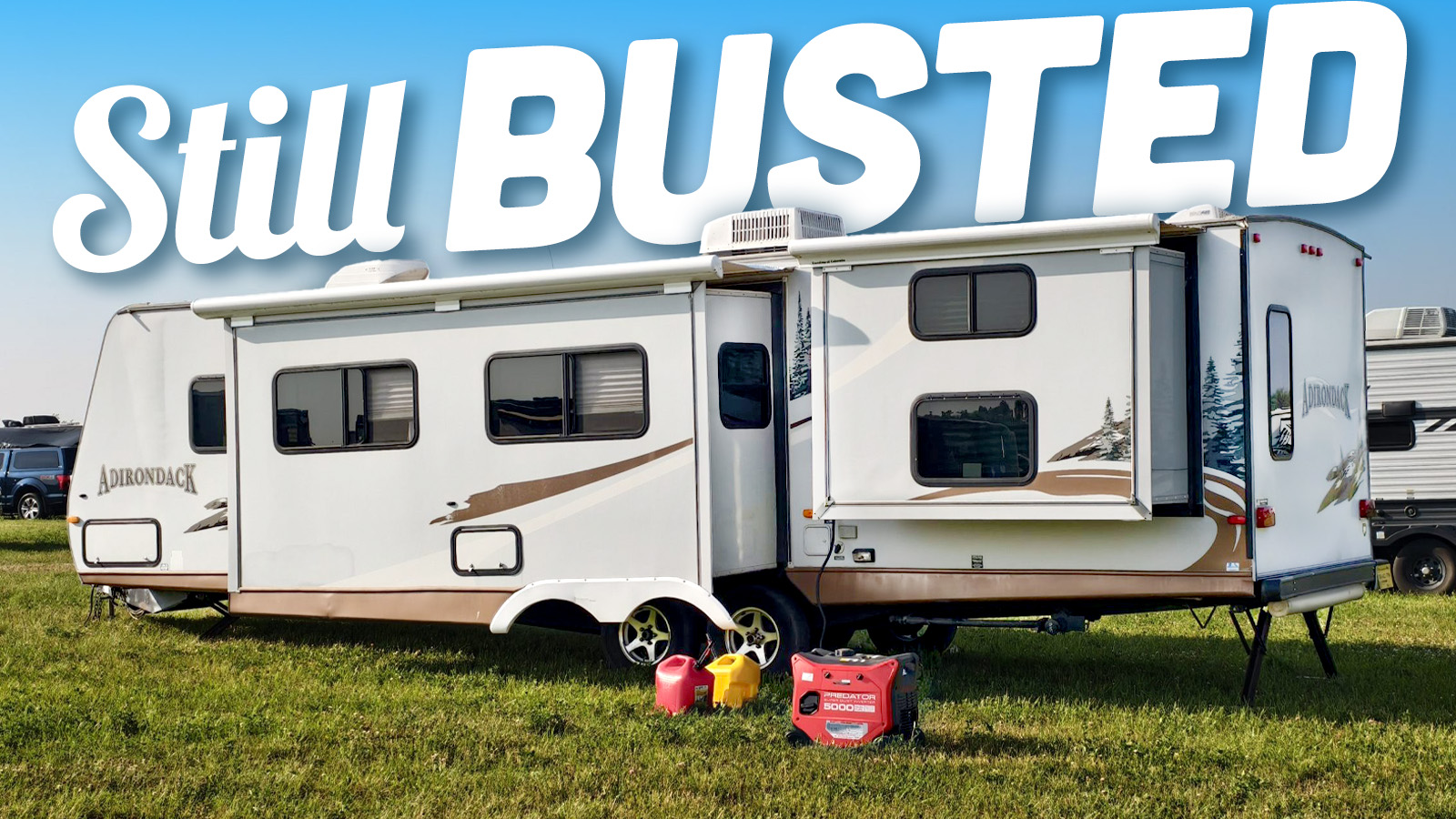
One of the most accessible ways to get into RVing is buying a used camper. RVs depreciate like luxury cars, and units that aren’t even that old can be a bargain on the used market. But buying used is always a risk in that the price you pay may just be a down payment to future pain. In 2016, my family bought a 2007 Adirondack 31BH, and my parents have since spent so much money keeping it alive that they could have bought an entire second camper. Most recently, structural and electrical repairs sidelined the camper for a year. Yet, despite all that time and $7,500 zapped from existence, the trailer is still broken.
Every year, Sheryl and I descend into Oshkosh, Wisconsin, to enjoy the EAA AirVenture Fly-In for a whole week. To us, one of the greatest parts of the experience is camping. It’s dramatically cheaper than going to any local hotel – even cockroach specials are charging nearly $400 a night right now – and Camp Scholler is simply an amazing place. I feel like going to AirVenture without going camping is missing out on much of the fun.


Thankfully, I come from a family of lifelong RVers, so I always have access to one of two travel trailers that my parents own and maintain. My usual pick is the 2007 Adirondack 31BH, which was originally built by Thor Industries. This trailer is smaller and lighter than the family’s 2022 Mallard M33, and I also like its features a whole lot more. Sadly, the newer trailer is also much more unreliable. Seriously, my parents recently looked up how many trips the Mallard’s been able to go on since they bought it new, and they calculated that it’s been on no more than seven or eight trips total. That matches my math. To put it into other words, on average, the Mallard is able to go on two trips a year before having to be sidelined for months for repairs.

Both the Adirondack and Mallard are very traditional builds. The Adirondack is an old-school wood-frame construction with a rubberized roof and fiberglass skin slapped onto the sides. It was built during a time when the RV industry seemingly forgot how to bond fiberglass to plywood, leading to panel delamination, water leaks, and rot.
The Mallard features newfangled Azdel composite walls supported by an aluminum structure. This is great because even if water gets in, the Mallard’s structure should hold up as there’s no structural wood in the design. Instead, in the Mallard’s case, it’s everything else around the structure that’s been falling apart. Shoot, the frame had concerning rust on it when the trailer was delivered new.
But don’t let my assertion that the Adirondack is more reliable fool you. This trailer is still built like crap, just crap that can actually be slept in for a long time between required repairs. When my parents bought this trailer in 2016, the signs of water damage were already there. The fiberglass siding was already delaminating, and one part of the floor seemed a bit softer than the rest. It’s kept breaking ever since, and my parents have ignited another $7,500 to keep the trailer alive.

Why Stick-Built Campers Break
Traditional RV walls are built like sandwiches; they feature aluminum or fiberglass siding that’s bonded to a tropical lauan plywood backer, insulation, the structural wood, and then the interior panels. Water has a nasty way of getting into these sandwiches, breaking up the bonds and causing delamination. By the time you notice it, the damage has likely already been occurring for years.

In 2022, the Adirondack burst at the seams, literally. The water damage had gotten so bad that the bathroom wall rotted out and buckled, forcing the outer fiberglass panel to break open. The floor had become so soft and rotted out that it splintered under your feet. My parents paid $7,500 to rebuild the bathroom wall, repair the bathroom wall leak, stabilize the rotting floor, seal it, and cover it with new wood.
Then, we started using the trailer again. Little by little, it began falling apart some more. Signs of water damage began appearing in the primary bedroom, namely the warping of the wardrobe and delamination of the interior wall panel. The floor near the entry door went soft. The awning rotted out and detached from the trailer. The awnings above the slides began getting jammed after their retractor mechanisms failed. The trailer’s suspension and bearings got worn out, the battery cut-off switch stopped working, a slide opener switch shorted out, and the air-conditioner started blowing warm air.

The issue that made my parents decide to get the trailer repaired was the water damage to the rear slide. Water had gotten its way into the structure of the slide and rotted it out. Water then traveled along the damaged slide, entered into the trailer, and rotted out wood inside, too. To call this a disaster would be an understatement. The slide was losing structural integrity and, had it been left alone, the new floor that was installed just three years earlier would have been destroyed.
So, the Adirondack spent all of 2025 at a Camping World shop to get as many of these items addressed as possible.
It’s Slightly Less Broken Now!
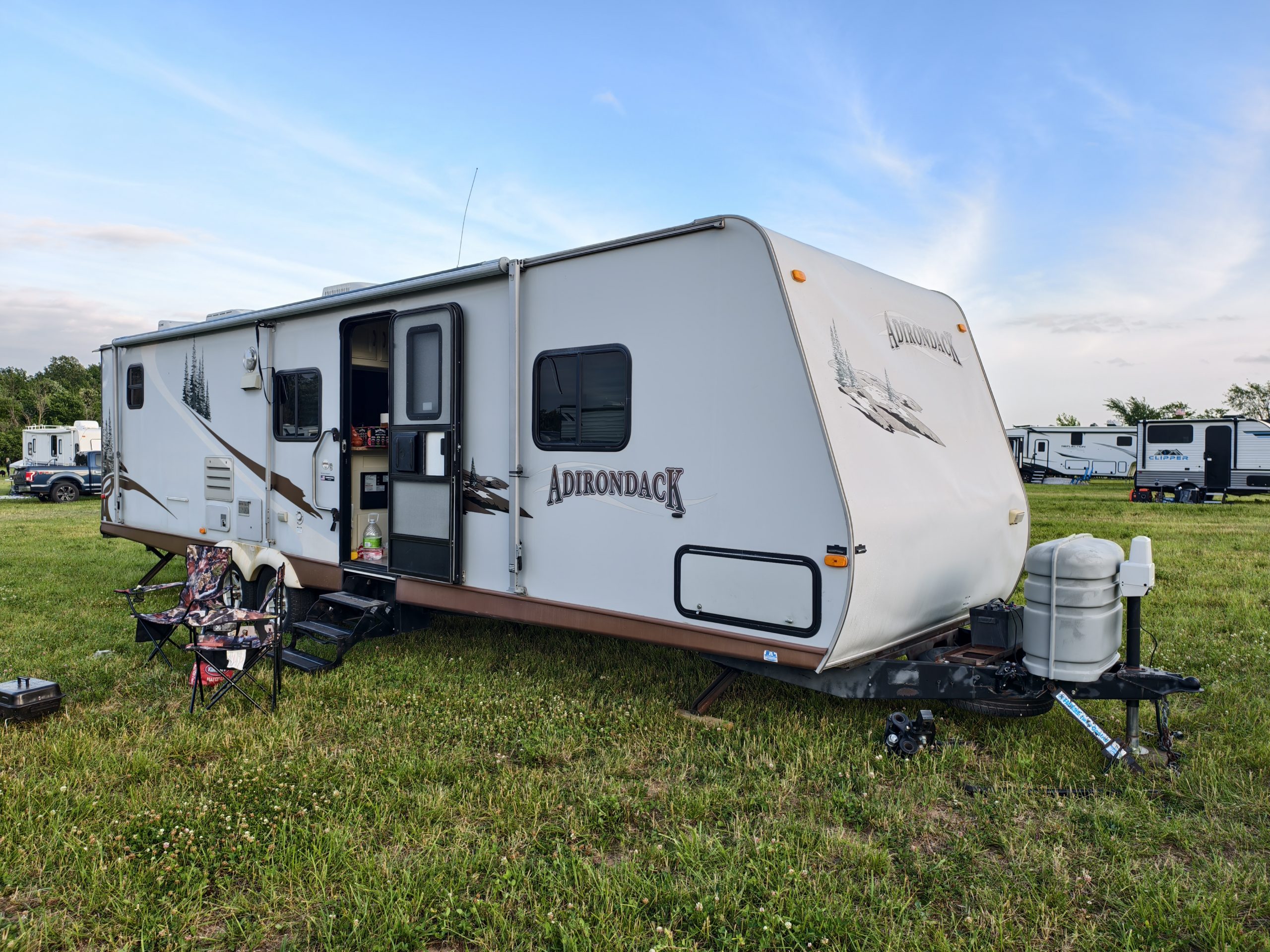
The camper has finally emerged from its multiple surgeries, and there’s a lot of good news and some bad news. The shop easily knocked out a lot of the little stuff. The slide switch had gone bad, so it was replaced, as was the battery cut-off switch. The trailer’s suspension and bearings were replaced as normal wear items. The air-conditioner is blowing cold again after the removal of years of built-up grime.

Even some of the bigger items weren’t as big of a deal as anticipated. The slide awnings are operational once again after their retractor mechanisms were replaced.

Unfortunately, the awnings themselves are getting threadbare, so it’s likely that they will fail soon. The trailer’s main awning was not replaced during its time in the shop, so that still needs to be done one day.

The big item on this repair visit was the slide’s water damage. To repair the slide, technicians had to rip the lower structure out of the slide, rebuild it, and reseal it. Check out the wood framing:

I’m not the biggest fan of this repair job. It doesn’t look factory, and unlike the intact front slide, the repaired slide makes no effort to protect its structure anymore. When the slide is open, that wood is sitting there, exposed to the environment.
Here’s what the other slide looks like:

To fix the leaks inside, both slides got entirely new seals. My folks were told the roof and seams were serviced and resealed, too.

The techs performing the restoration work gave my parents the option of skipping the floor repairs. In their opinion, the floor still has some years left in it before the soft spots actually need to be addressed. So, my parents elected to pass on fixing the floor for now.

For a finishing touch, the techs reattached the headboard in the primary bedroom, which had fallen off the wall after water damage weakened it. The cosmetic interior water damage was not repaired at all, so even if the water itself is not coming in anymore, you can clearly see where it was getting in.

That brings us to today, where I’m already writing a list of things that should be replaced in the near future.
My first concern is the floor. I get that the techs say that it doesn’t need to be replaced right away, but its condition is rapidly getting worse. In 2024, only the approach to the door was soft. This year, nearly the entire floor next to and in front of the door has many soft spots. No cracking yet, but the damage is clearly spreading pretty fast. A shocking amount of floor is going to need to be replaced in the near future.

Then there’s the tongue jack. In the past, this jack was fast and strong. It lowered and raised the trailer three times as fast as the newer jack on the Mallard. This year, however, it’s slow, and it sounds like the electric motor is on the verge of failing. Thankfully, there is a manual override crank, so I’m not worried about getting stuck somewhere. But it’s going on the future repair list.
Also going on the list is the water pump. In the past, the pump quietly purred in the background. Now, it’s louder than a generator! Seriously, the trailer sort of shakes when it runs. Sheryl says it sounds like a dying targ.

The trailer also needs new propane tanks, as the ones that are on the trailer were made in 2006 and expired back in 2016. The tires also need to be swapped out. They have great tread, but the oldest tire is getting a bit too old for my comfort. All of them are getting old as it is.
Finally, if my parents choose to do so, I also recommend fixing the visible water damage inside the camper. This would purely be for cosmetics, but I also know how much they love this camper. I know I’d be bothered by looking at warped boards everywhere. Amusingly, I was right on the money when, in 2024, I guessed that my parents would spend another $7,500 on the structural damage in 2025.

Truth be told, everything I’ve listed here is either a time-of-life failure, a consequence of owning a stick-built camper, or maintenance that was unintentionally deferred. Still, it just goes to show that whatever price you pay for a used camper is really just the start. My parents say that they paid either $7,000 or $27,000 for this camper back in 2016. I’m more inclined to believe the lower number because campers just don’t hold onto value unless they’re something like an Airstream.

But regardless of what they spent to buy it, they have put some $15,000 into structural repairs alone, and the camper is still broken. They have spent more on other parts over time, including a new kitchen sink, a new water heater, a new electrical panel, and more. I started tracking repair costs in 2022, so there is a whole six years of repairs that I’m not even accounting for.
Still Fun
Still, every time I kick back and watch a sunset from the camper, I smile. For everything that sucks about RVing, it’s still great fun. Yes, I still prefer this madness over any Holiday Inn. Just don’t do it as my parents did it. Don’t just buy the pretty one with cool features. Try to find one that’s built well. Used Airstreams and fiberglass campers remain my recommended picks.

This is why I never write about the countless old stick-built campers for sale on the Internet right now. You can score one of these campers for a few grand if you look hard enough, but don’t let the low price of entry fool you. If you want to use it for more than a couple of years, you’ll need to put money into it, and a lot of it. But if you do have the money, I suppose you can make one of these things last. You’ll just be opening your wallet so much that you’ll eventually be spending multiples of your original purchase cost. I don’t recommend that, unless you really want that specific camper for some reason.
That said, I do think those old campers have some great uses. A few years ago, I saw a real beater of a motorhome roll up to my favorite local campground. Once it parked, some six or so college friends stumbled out of it. All of them pitched in some cash, bought the motorhome, decorated it, and went on a cross-country summer road trip. That was awesome. Who cares if they only get a year or two out of it when the memories they’re creating with it will hopefully last forever? One of our readers, Shop-Teacher, used an old and tired pop-up tent camper for years.
So, the crazy cheap campers out there do have their place, but temper your expectations. If you plan on keeping it for a while, expect to cough up some heavy dough. But whatever you camp in, have a great time! I sure am.
All photos: Mercedes Streeter



I know I’m a few days late, but at these repair costs you’d think renting would be the cheapest option. And it’s not out of commission for a year. Sure, having your own stuff is nice, but so is not blowing thousands of dollars every year just to make a piece of shit slightly less shit.
These articles on RVs have definitely convinced me that I never want to own one. Seems like they are expensive, built like crap, if I did own one I would have to forgo any fun on the road to and from vacation, drive some vehicle I have no interest in as a tow vehicle, and end up spending more money than if I’d just stayed in hotels.
You do reference the camping experience as making this worth it. What exactly is that? I honestly don’t know what you are talking about, never having been camping other than in tents in the military, if that counts, which is not an experience I’m in a hurry to duplicate again.
Meanwhile my SIL/BIL just bought a new camper…after having just bought a new one a couple of years back (but they had another kid and it became too tight, despite being fairly large, so I’m sure that was financially positive), and my MIL/FIL just bought one as well because it’s too tight being in the first one with the two kids.
All I think of is these articles. SIL/BIL’s first one (A Transcend Xplor 24BHX) seemed built well, but they didn’t have it for long enough to truly tell. Not a clue what they bought now.
Mercedes, I grew up vacationing usually via rv, my parents used to have a decent class c rv and us kids got to travel to 49 of the 50 states (no road to HI 🙂 )…
So I am familiar with the joys of rv vacationing and of course some of their limitations…
I’m genuinely curious. What is preventing your parents from dumping both of these compromised trailers and getter 1 or 2 known to be well built camp trailers instead like an Oliver, the Scamp 5th wheel or 1 (or 2), used Airstream(s)?
You’ve almost certainly got that backward. Delamination is typically caused by water leaks that break down the bond. Given the terrible build quality and lack of maintenance of this trailer, I’d be more surprised if it didn’t have water leaks.
If you’re parking a trailer outside 365 days a year, you need to periodically inspect and re-seal the exterior. If you don’t, it leaks and everything falls apart. Sound familiar?
Even my garaged RV needs to be re-caulked occasionally. Old age and a flexy chassis do not make for watertight caulk. It’s less serious if I defer it since it only gets rained on when I’m camping, but I still do it to avoid stuff like in this article.
Ah, I think I see the problem…
Seriously, a quick google for “Camping World service” would tell you to not ever have them work on your trailer. Admittedly, some of the independent shops may not be much better, but at least there’s a chance they don’t suck.
The shitty slideout repair and recommendation to leave the soft floor alone (and failure to fix whatever leak was causing the soft floor in the first place – they don’t just happen on their own) are just reinforcing my bad opinion of Camping World.
So there was a period of the mid-2000s where the fiberglass quality was extra bad. Just search for something like “Outback camper delamination” and grab your popcorn. It seemed like the RV industry just sort of forgot how to do fiberglass siding for a while, which is impressive because it’s not like they were particularly good at it before then…
That doesn’t surprise me at all, but it sure sounds like the trailer is still leaking somewhere. If you’re going to keep it, that needs to be fixed. Even if they replaced the soft floor, it’s just going to rot again if it’s still getting wet.
Any chance you can get the Autopian to buy this off your family so you can keep it around for the entertainment value and they can get out from under the financial burden. 😉
And I thought boats were a PITA.
2 happiest days in a RV owner life…
Your parents seem to be living a sunk-cost fallacy.
Soon to be Sunk-Floor.
Thank you for another great RV misery story. Honestly, these are some of the most entertaining articles I read, always keeping me on the edge of my seat.
My family had a nice Jayco pop up in the 90s.
It was awesome, and served us well for close to 20 years. For the last 7 years or so,
We would cover it with a tarp for the winter. Eventually, the tarp wasn’t doing it’s job perfectly, and water started to infiltrate the camper.
Within 2 or 3 years, it turned into a pile of scrap. Once the water came in, it’s fate was sealed.
I think the overall lesson here is to understand that once water has infiltrated a wood framed camper, the end is inevitable. You can’t properly fix it, and repairs will only keep it going for a short while longer.
I presume that no one is really trained to properly repair these, and dealership techs are just performing a handyman fixup to make a quick buck.
Mercedes, despite your professed love for camping, all these articles do is reinforce my stance that you can buy a metric ass-ton of hotel rooms for the price of an RV, and when you check out, they’re someone else’s problem.
Or VRBO cabins if you don’t want to stay in a hotel.
There is nothing I’ve observed about the ownership experience of RV’s that makes me want one. I have friends and family that own or have owned towables, Class B and C RV’s.
Unless we are talking Airstream the construction and material quality seems to highly suspect industry wide.
I’ve seen nothing to convince that renting these isn’t a better option to owning.
Also, what hotels are you looking at that cost $400 a night? Unless that is surge pricing for the airshow it seems to me the writer might be really bad at finding decent hotels.
It’s the surge pricing of hotel rooms due to the air show.
“…it seems to me the writer might be really bad at finding decent hotels.”
Is that your way of saying she should have tried Trivago?
Thank you. That literally just triggered the audio of their commercial in my head.
I’m at an event where over 700,000 people are all trying to be in the same place for multiple days. It’s surge pricing. Basically every major hotel does it before a major event.
I’m not afraid of staying in a $50 motel, but those pretty much don’t exist this week. Besides, I can just grab one of the piles of junk that my parents own for free!
From reading the ongoing train wreck of your poor parents RV experiences, I’m convinced that the only RV options I’m willing to consider are a tent or a hotel. My wife has clearly and firmly informed me that camping in a tent is a non-starter so hotel it is.
You’re missing some possibly great experiences in between.
AirB&B / VRBO can turn up some really neat lodging experiences, like some well done tree houses set up specifically for lodging or renting a small cabin.
Or Glamping in a yurt set up with a beautiful view and with ac.
Summer family vacation we stayed in a cabin a few miles from Mamouth Cave National Park via AirB&B. It was a really nice cabin.
Secondly we went SW and spent time in the Smoky mountains staying near Pigeon Forge minutes from the Smoky Mountains National Park in a town home set up as an AirB&B, this wasn’t quite as nice as the cabin, still better than a hotel with a full kitchen, 2 bathrooms & 2 bedrooms
I hear you. Those are our usual first choices, hotels, air/vrbo and private homes. Tent camping was fine when I was young, but age, arthritis and unwilling wife put paid to that. We are planning a trip to Spain and Portugal this fall and are going that route.
I realize the numbers are not the main factor for everyone, but to me when you game out what’s spent on the RV and all the expensive ancillary needs, you could do some seriously luxurious vacationing for the same cash. Or retire quite a bit earlier.
Sunk cost fallacy in play here. With only 7 or 8 trips in their “new” camper, wouldn’t it be better to just rent at this point? Honest question. These things are hot garbage.
The two best days of an RV owners life. They day they buy it, and the day they sell it. Have owned a brand new one recently and will never do it again. Was so glad to see that thing go. Everything said in this article is true. They are never-ending maintenance issues and money pits.
> One of the most accessible ways to get into RVing is buying a used camper.
What about the $80k truck to tow it, and 10 mpg?
> To us, one of the greatest parts of the experience is camping. It’s dramatically cheaper than going to any local hotel – even cockroach specials are charging nearly $400 a night right now
$2800 for a week is still $4700 less than these incomplete repairs + monthly car note + storage.
Plywood for walls means the edge grain and end grain of each ply gets exposed to water, with the ideal vertical path for water to seep between the individual plies, weakening the glue, and making the plies swell. It works as sheathing on a house because there’s z flashing protecting the edges, per building codes. I assume there’s no such requirements for RVs?
I get the love for camping (who am I kidding, I don’t, but you do you) but it’s not a good financial move, it’s about the experience. IMO. 🙂
Nobody who is buying a cheap old camper like this is also going to buy an 80k truck, they’ll have a cheap old truck to match.
AFAIK Mercedes’s family has a big ol’ fairly new truck to two their beast. It might be the Silverado in one of the pictures.
More like $60k, not $80k.
My parents bought a 2016 Ford F-350 XL gasser to tow their new trailer. The Silverado is a press vehicle.
Oh! I sit corrected.
Your parents are actually like five steps ahead of all of us. You see, they can cancel their storage lease for the trailer. Bring it into the dealer with some issues and let the dealer store it while it’s being repaired. Bring it home from the dealer and take it on a trip. Then when they’re done using it, they make a new complaint and bring it back to the dealer. Last year, they basically spent $7500 for storage, and they got some free repairs out of it too.
Genius
My former brother-in-law used to work for Thor Industries. That might explain a lot. In fairness, his time with them was long before this one was built.
Your parents are absolutely nuts for dumping money into a trailer that is more than a few years old.
All trailers are garbage, especially bumper pull trailers. Add in slide outs, made of wood, 20 years old or so, made around the financial s**t show of 2007-2008. Gooooood luck.
All RVs, even very expensive ones, are garbage.
(my chops are 6+ years running an RV related business, working on these all day every day).
That trailer needs to get pushed off a cliff. It will bleed you dry. It will never ever ever be “right”.
Side note, a $500 a night hotel is way better than hemorrhaging $$ into this. Renting someone else’s RV is better than hemorrhaging $$ into this. The ONLY time a trailer like this makes sense is if you use the ever loving piss out of it for a few years until it is trash and then throw it out, going into it knowing after a few years (whether you use it or not), it will be junk.
Hate to be crude! Do not dump another dime into this thing. Cut your losses, get rid of it.
(FWIW, most airstreams, especially newer ones, are junk too)
For the most part I agree with you, but Scamps are not garbage which is why 40 year old ones still command a surprisingly high price on the used market. It and Casita are the only trailers I’d buy new today. (Oliver is also really well-built but unless you really want to camp in the winter, the price premium isn’t worth it).
There are also some bus conversions out there that are definitely not garbage, but they’ll also run you close to and often more than $1 million.
I think most people would be best served getting a 20-30 year old camper, preferably one that spent most of its time in the desert so the inevitable roof leak didn’t actually leak.
I have an old Fleetwood motor home and it’s definitely showing its age, but it’s also better built than just about anything new I look at when I go to RV shows.
You only save money vs a hotel room if you are using another person’s units, both the towed and the towing. Sure an RV spot is cheaper than a hotel room but by the time you figure out that actually getting there cost 3-4-5 times more than it would driving a regular vehicle w/o any extra drag and you eat away more of that savings. Then once you factor in the cost of the rigs and maintenance and repairs and that 5 star hotel is looking like a bargain.
Much of the problems you’ve shown over the years are due to improper storage and the poor choice of buying a unit with a slide. That said if you don’t have covered storage then it should get wrapped at the end of every season. No I don’t mean to make it look like the Fruit Stripe Slate, I’m talking “Boat” wrap. https://www.uline.com/BL_2414/Marine-Industrial-Shrink-Film There are places out there that will do it for you. No it won’t be cheap, but you could have it wrapped several years before spending $7500.
At a show like EAA, you save money even if you spend a ton to get there. She’s dead on – any hotel/motel within a couple hours of the show prices through the roof during EAA week. You will spend enough for a week at a fleabag motel to cover an average mortgage payment.
By comparison, camping at the EAA grounds is a bargain. 40-ish bucks a night if you don’t need hookups, and around 100 if you do, and there are non-hookup sites that let you run generators 24/7 so you don’t *really* need to spend the extra.
The trick is, you really want to be there in a camper of some sort, because it almost always rains like hell at least one day of EAA and turns the campground into a mudmire. Really sucks when you’re in a tent and have to walk back from the showers getting muddy again right away.
It is only a bargain when you get to use the trailer and truck to pull it for free.
Or if you go to things like this more than once.
I’ve been to EAA probably 10 times. That’s $20,000 worth of hotel stays.
You can get $5,000 motorhomes all day long. They aren’t *nice,* but they’re functional. Sure, you’ll spend several hundred getting to the campground, but even if you only use it to go to EAA 3 times, you come out financially ahead.
Especially if you stock the kitchen and cook breakfast/dinner in the camper instead of going out to eat like you’d have to in a motel.
All that aside, as RVers are constantly having to explain, we don’t get RVs because we want to save money. If I were that focused on saving money, I’d stay home every year and watch the air show on YouTube. We get RVs because we like RVs.
It always kind of amazes me that on a site dedicated to one of the most expensive hobbies on the planet, people get downright offended that a guy with a camper is spending more than he would to stay in a Motel 6.
“All that aside, as RVers are constantly having to explain, we don’t get RVs because we want to save money.”
Well actually Mercedes did say she takes it to save money in the article and time and time again I hear other RV’ers say it is cheaper than a hotel….rather than saying we do it because we like it.
I have no problem with how one spends their money so yeah do what you will and have fun, just don’t lie to me or yourself.
And in Mercedes’ case, even if it were her own camper and truck, she would save money in this context because she goes every year. I camp in the same place she is almost every year, even when I did it in a tent, and it wasn’t because I like sloshing around in mud puddles.
You’ll pay almost $200 per night to stay in a dorm room at the university. That more than doubles if you want an actual hotel. 3500 per year adds up fairly quickly. You can get an old camper and a tow vehicle for 10 grand easily, so 3 years of going to EAA and you break even.
And that’s not taking into account that people who bought campers to camp in at other times now have the camper as an opportunity to save money at EAA vs. overpaying for a hotel.
Writing with affection and not an ounce of malice: It’s time to sell this trailer. It will not get better, and by that I mean it will not get any cheaper to remain functional. Advertise it as the perfect Burning Man trailer now and you will see people lining up out the door to buy.
Your RV stories are great and it reminds me why I will never buy a new RV. Ever. I feel like I can make just as good (or better) memories camping in tents and staying in hotels. Dragging a massive, low quality, outrageously expensive (especially per use) “home” along to use just isn’t for me. These stories are a public service.
Keep in mind that smaller, simpler fiberglass campers, like Scamps, literally have none of these problems and retain like 60% of their value after 30 or 40 years
RV: a house built by the lowest bidder, without any standards, permits, or regard for repairability, that will then be subjected to severe earthquakes and minor hurricanes for dozens if not hundreds of hours.
And this is how people stay poor. “Oh, but the memories we’re making!” they say. Yeah, good luck with that.
Several years ago, when I fleetingly had business-grade money, I looked into investment opportunities that would suit someone as lazy and morally ambiguous as myself. The overwhelming answer was “charge dumb people to store stuff they thought they wanted but really have no use for yet won’t get rid of.” It was a slumlord’s wet dream: Tenants who, mainly out of shame over regrettable decisions, are never around. You’re just housing their junk, and they hide from it YET PAY FOR IT.
You’re saying I can collect rent without the hassle of dealing with actual fleshly beings living on-site and all the headaches that entails? This is the way! The business models ranged from urban micro-storage (too much infrastructure) to rural RV parking lots. The RV lots looked super promising. But then came the crackdown.
Several RV storage lots popped up in the areas I was considering. Fifty-foot gooseneck campers, untold numbers of “toy haulers,” struggling old motorhomes that weren’t worth three months’ rent, boats of every impractical flavor… these places were flooded with abandoned reality traps.
Until the neighbors complained.
The relevant jurisdictions clamped down with a vengeance. It honestly surprised me. Who cares if the lot down the street is covered in gravel and crummy RVs instead of tumbleweeds and star thistle? Well, the neighbors did. So many of those places disappeared. Where are those disposable RVs and boats now? Disposed of, but, inevitably, in a lot of instances, replaced.
Humans are here for a good time, if not a sustainable one.
I’m surprised you went this far down this line of reasoning and didn’t even consider a buy-here-pay-here lot. Sure, you’d have to talk to your salesman, maybe even sell a car yourself every once in a while, but think of the sweet nectar of repossessing a $7000, 2005 Toyota Corolla that left with the odo maxed out, made $1800 on four months of payments, and got back at the same (wink wink) mileage! Why, that car is still worth seven large if it’s worth a dime.
… Which is good, you know, because in a literal “what is the value of this car” sort of way, it’s more decimal places than commas.
Way, way too much wet work. Set aside having to go to auctions and deciding which $1800 retired rental Corolla is better than the next one. Forget even the hassle of employing someone to find a sucker who thinks that thing is worth $7000. The prospect of getting shanked with a gas station pocketknife while trying to repossess a used econobox is the exact opposite of my aspirations as a social parasite. I might as well buy a brand new toy hauler, a $120K diesel pickup to drag it around, and revel in the circular economy of visiting places full of other travel trailers and Duramax duallys. I’ve met these people. Ouroboros rolls coal and has a 50-state sticker map on its Dometic fridge. If that’s what you want, cool… but don’t try to make it sound logical.
Honestly, I’m just pleased to have baited you into breaking down the reasons why not. Well said.
In my community college days, a dear late friend decided that an ideal Christmas gift would be to give everyone a 40 of whatever malt liquor best suited our personalities. I got King Cobra. Cheers! Don’t drink it. I didn’t.
Your late friend is a goddamn genius, and the world is lesser for their passing. Thanks for the laugh.
I was expecting you to say the downside was “people just stopping sending you checks and then being stuck with something that costs more to get rid of than you ever made providing rental space”….
Good point. Even a “ran when parked” car is mostly metal and has a baseline scrap value. Over-the-hill RVs might actually be worth a lot less than the stuff they’re made of.
You could make them all into a giant pile, charge admission, and have the World’s Greatest Bonfire.
Mmm, formaldehyde fumes.
I learned the hard way to only store stuff you want because you’ll probably end up owning it anyway. Sitting on a sailboat and couple of trailers left by a bankrupt lawyer.
I think the secret is don’t buy these huge plywood campers that have multiple slide-outs.
Either get a simple <20ft unit without any fancy stuff that you have a place to store dry.
Or, if you don’t have a garage or barn, (I don’t have one either), find a fiberglass or aluminum camper ideally, those stand up much better to the elements.
Although they can be much more expensive upfront.
We went the cheap popup way, but I consider this more of a tent rather than a camper. Still, it’s enjoyable in the summer months.
Whenever it eventually gets too moldy for comfort, we’ll let it go – it cost less than even one of the cited repairs above.
I look at slides and all I see is places it can leak. I have the same opinion of sunroof / moonroofs
I’ve had a number of cars with sun/moonroofs and none of them have ever leaked. That includes a 2001 Jetta for 16 years. Maybe I’ve been lucky. I haven’t done anything other than check every year to make sure the drains are actually draining.
Almost the same. The only moonroof I’ve had leak was in a 20 year old Saab. And after 20 years, it was a rusty POS anyways, so kinda hard to blame the moonroof here.
That being said, I wouldn’t ever pay more/extra for one. I just don’t use them much other than cracking it open on hot days while parked.
I had a 2001 BMW 3-series with a sunroof. I made the mistake to taking it through an automated carwash. The thing never leaked during regular rain, but water and soap was pouring out of the sunroof switch area during this carwash. I was panicking and my daughter thought it was the funniest thing ever.
I’ve had 4 and 2 leaked and 1 had to have all the seals replaced which was a 3 day operation that would have cost thousands without the CPO warranty.
#1: 1987 S15 Jimmy with simply aftermarket pop up sunroof. It was already leaking when I purchased the truck in 1992
#2: 2003 Jetta Wagon. Started leaking at about 200K miles. This was after the factory recall for leaking sunroofs. I blew out the drains every service
#3: 2014 Jetta Sportwagen. This was the panoramic roof that had to come out for all new seals.
#4: 2011 Acura TSX wagon. Not leaking ….. YET
So… get a Time Machine?
There are still any number of basic, durable campers for sale that don’t have these issues, they’re just usually built by smaller, independent companies