

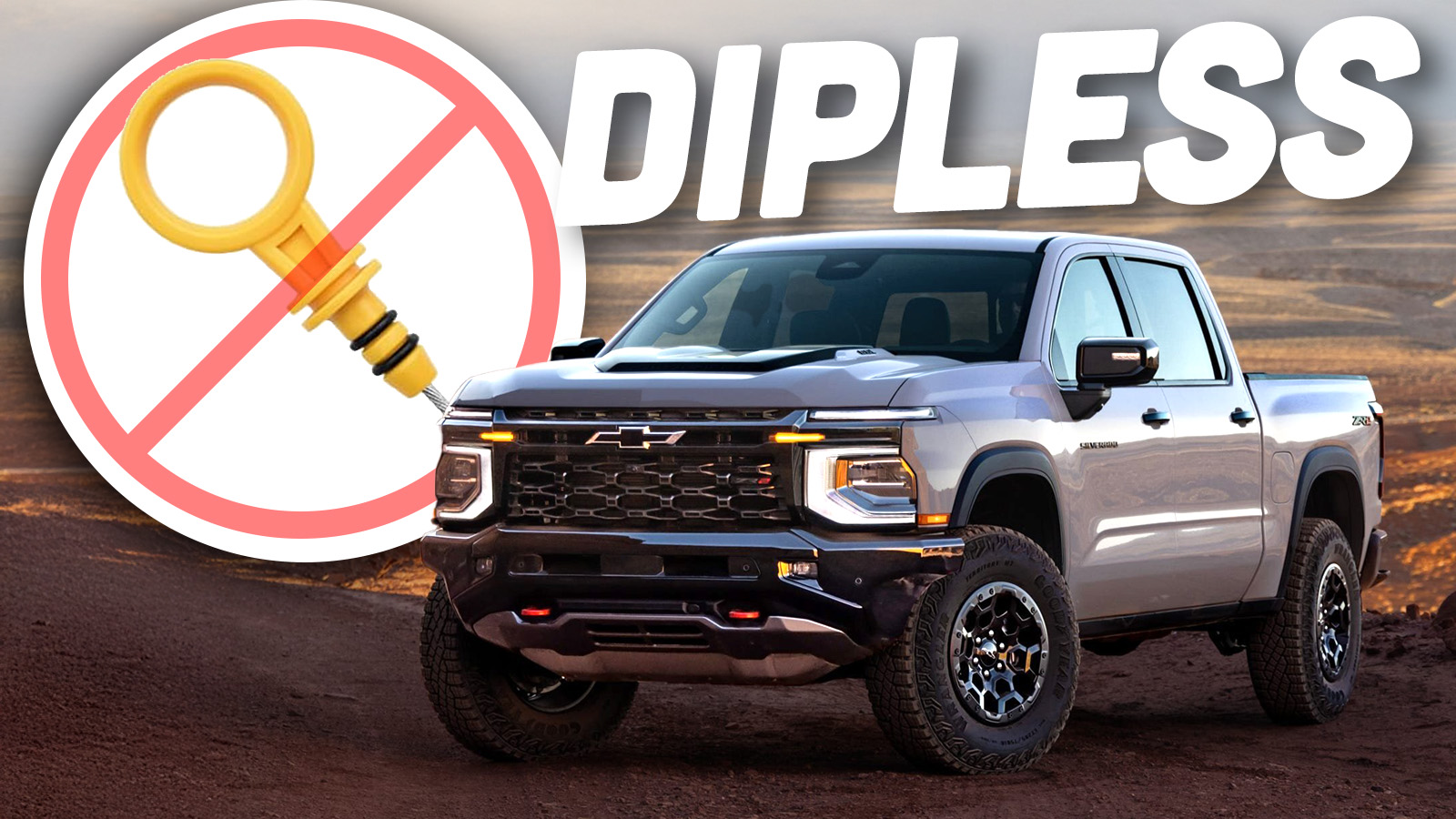
Oil is the lifeblood of your car or truck’s engine; too little of it, and your engine will not be long for this world. For longer than a century, drivers have been able to physically check their own oil levels, but times are changing. An increasing number of models are trading dipsticks for digital gauges, and the V8s in the new 2027 Chevrolet Silverado and the GMC Sierra are joining the trend.
The Chevrolet Silverado and its GMC Sierra twin are getting a whole new generation for 2027, and General Motors says that truck buyers are going to get the most advanced and powerful pickups it has ever produced. Along with a new, more aggressive look, GM’s bread-and-butter trucks are getting a whole host of technology upgrades, new off-road kit, and luxury accoutrements across seven trim levels.


Some of it might not hit with some buyers. General Motors is introducing a front passenger screen to its trucks after its competition has already learned that most people might not actually care about such a feature. Some folks also might not enjoy the fact that, as GM introduces new engines to its half-ton trucks, those engines will come without an easy way to manually check oil levels. Instead, they will have to trust a digital gauge.

More Power, Baby
There’s a lot of good news about the heart of the new Silverados and Sierras.
The LZ0 3.0-liter Duramax straight-six diesel, an engine that I thoroughly enjoyed and that allows GM’s twins to be the only half-ton diesels in America, will be returning. Output in the 2027 version will remain the same as the 2026 model at 305 horsepower and 495 pound-feet of torque. That’s excellent! Currently, the only way to get a GM half-ton to reach the highest advertised tow rating of 13,300 pounds would be to equip it with the diesel.

Another engine that will carry over to the new generation is the 2.7-liter TurboMax turbocharged four-cylinder gasoline engine. As GM Authority reports, this engine is expected to see a power upgrade in addition to trading its eight-speed automatic for a 10-speed transmission. The Silverado HD and Sierra HD trucks are also getting new firepower in the form of the new 6.6-liter L8S V8 and a new big Duramax called the L6P. Details about the L6P have not been released yet, but it will be succeeding the 6.6-liter L5P Duramax V8 diesel.
Not returning for 2027 are the two V8s from the 2026 model year half-ton trucks. The GM small-block V8-based 5.3-liter L84 and the 6.2-liter L87 will be retired. This could be a sign of relief for many, considering that L87 engine failures are the subject of an ongoing NHTSA investigation and class action lawsuit.
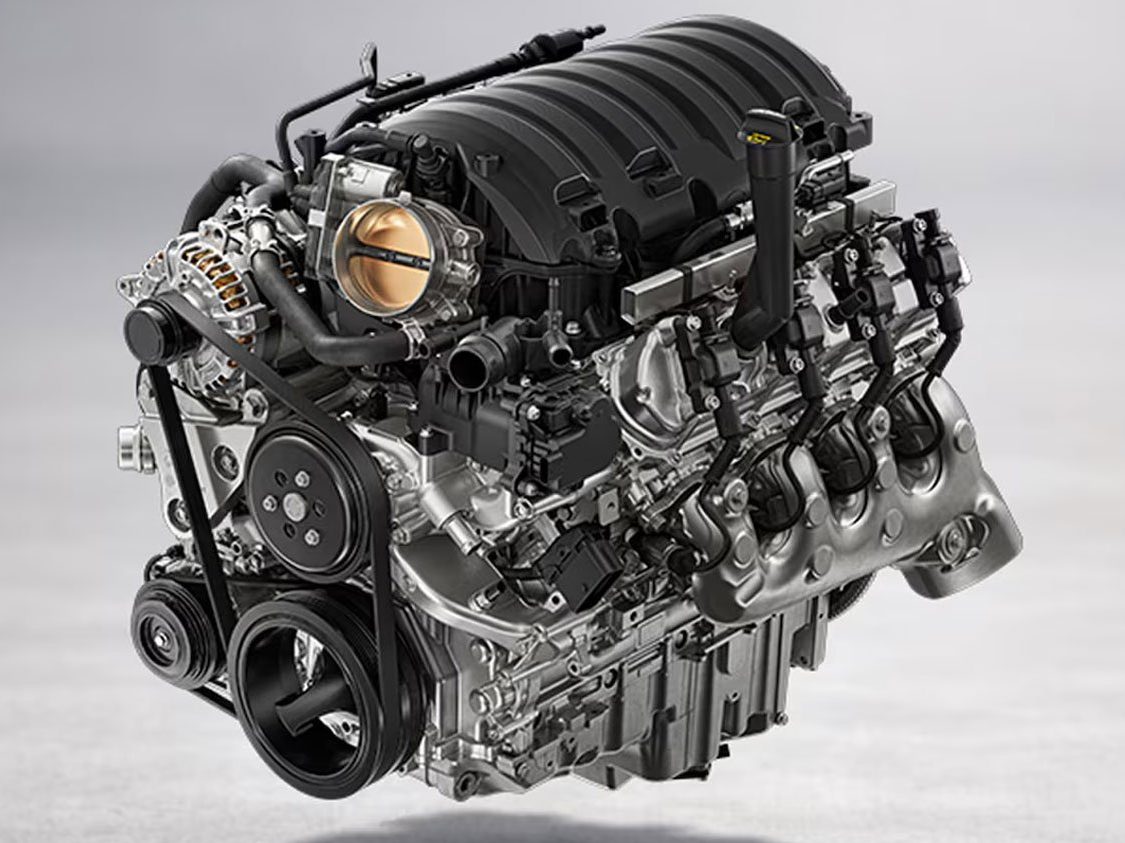
In their place will be the 5.7-liter L76 and the 6.6-liter L78, mills built around GM’s new Generation Six small-block V8 engine technology. As GM Authority writes, the Gen 6 range includes the Gemini family of dual overhead cam V8s that live in the Chevrolet Corvette Z06, ZR1, and ZR1X. The rest of the engines are overhead valve pushrod engines. The Geminis are hand-built in the Performance Build Center at the Bowling Green Assembly Plant, while the pushrod models will be assembled at GM’s Flint Engine Operations and Tonawanda Powertrain engine plants.
GM Joins The List Of Carmakers Getting Rid Of Dipsticks
GM hasn’t said much about the spec sheets of the new engines. The 5.7-liter L76 is expected to make more than the 355 horsepower and 383 pound-feet of torque found in the L84. Meanwhile, GM is saying that the 6.6-liter L78 will be the most powerful naturally aspirated engine in the half-ton segment, which means that it has to pump out more than 475 horsepower.

Something we do know is that, in a departure from the past, these new V8s will not come with an oil dipstick. The Verge reported this:
The oil dipstick, for example, is now a virtual measurement that exists on the truck’s status screen.
GM has since confirmed this detail to our friends over at The Drive.
Now, owners will have to rely on a digital gauge in the instrument cluster or the infotainment screen. If oil levels become too low, the system will tell the driver to add oil.
This isn’t anything new. Back in 2024, David Tracy wrote about how the Ram 1500’s 3.0-liter “Hurricane” inline-six also doesn’t have a dipstick, and instead relies on a sensor to measure oil levels. Here’s what the Ram 1500’s owner’s manual says:
The 3.0L engine does not have a traditional “dipstick” and there is no need to manually check the oil level. If it is desired to check engine oil level, it can be seen on the instrument cluster display by navigating to the appropriate screen under “Vehicle Info”. Use the up or down arrow buttons within the steering wheel controls to find the “Vehicle Info” menu. Then use the right or left arrow buttons until you reach the “Oil Level” submenu.
There is a bar on the gauge that shows the oil level. As long as the oil level is between the minimum and the maximum, it is safe to operate the vehicle. If the oil level is either too high or too low, a red bar will be illuminated.
When the engine is in need of more oil, the Oil Level Warning Light will illuminate. This warning will appear for five seconds. Within the next 300 miles (500 km) you should add 1 quart of manufacturer specified motor oil to the engine.

BMW owners have been used to not having a dipstick since 2005. Seriously, even my 2007 BMW E61 doesn’t have a dipstick. While they are not without occasional faults, the BMW sensors generally work fine. The car tells you when you need to add oil and how much oil you should add, then you do it. It’s pretty simple. The oil sensor still works in my BMW, too, even though it’s about two decades old and has close to 200,000 miles. If BMW can figure this out, General Motors can. The Hurricane also seems to be surviving fine enough without a dipstick.
For most people, who aren’t car enthusiasts and probably don’t even open the hood unless something is wrong, I suspect that not having a dipstick is mostly a non-issue. It might even be a benefit for the people who don’t know anything about their cars and think GM’s oil life percentage meter actually counts how much oil is left. I could see this system preventing someone from running their V8 low on oil. The fact that there’s been more than two decades of development into these sensors is also pretty comforting.

However, as someone who is also deeply into the aviation world, not having a physical backup at all does concern me at least a little. Planes are full of brilliant, reliable computers and digital parts, but have multiple layers of redundancy, including mechanical backups. Granted, a car is lower stakes than flying, but I still like the idea of being able to check my oil level and condition with my own eyes. Not being able to check my oil is the biggest thing I don’t like about my BMW, really.
But maybe, like David Tracy, I’m just stuck in my old ways. Maybe it’s not that big of a deal as some might think it is. Time will tell. I have reached out to General Motors for an explanation of this move. Until then, how do you feel about this?
Update: Here’s GM’s statement on the matter:
For the new light-duty 5.7L and 6.6L V8 engines, GM’s decision to move to electronic oil-level monitoring was intended to simplify the ownership experience. The system allows customers to check their engine-oil level from the vehicle cabin through an on-screen readout, without opening the hood or using a traditional dipstick.
Top graphic images: GM


This is one of those vehicles that’s going to be reviewed well by the automotive press that absolutely no genuine truck user should buy.
The acid test is going to be whether these things get bought by fleet managers. I’m guessing not, but then again I don’t do fleet management so what do I know.
All you have to do is check the sales numbers of the Ram hurricane for fleets.
the gauge on the dash is nice in theory, but I honestly don’t have confidence on how good or long it would keep working… physical backup should have been kept.
They’ve been using digital oil level gauges on commercial aircraft for decades. It’s fine.
If anything this will improve reliability for used cars – owners almost never check the dipstick but if there’s a flashing “add oil, stupid” light maybe they won’t run low as often.
GM loves data. Expect calls for extended warranty’s and if you don’t get them then better sell the truck to a non GM dealer quick.
I think for most people this will probably be a benefit as they never check their dipstick anyways and at least they will have more warning if their engine is getting low on oil. But as someone who works on my own car it is nice to be able to see the color of the oil to make sure there are not other problems besides just the level. Probably less of a concern for the people buying a car new though and more a concern for those that own it when its over 100k miles. Ideally you would have both a sensor and a dipstick but we know the bean-counters wont allow that.
Only if they scroll through the menus to check the oil level. For some drivers, that is not likely to happen.
Straight to the comments?
“ Now, owners will have to rely on a digital gauge in the instrument cluster or the infotainment screen.”
Also.
“ When the engine is in need of more oil, the Oil Level Warning Light will illuminate.”
Only illuminate at a quart low.
Which might be ok running without 16% of your reccomended oil level.
My natural reaction is to dislike this, especially if this is like some engines where they still have a casting for a dipstick tube and just block it off.
That said…if this works in a sane way I’m okay with it. It’s not like I love popping the hood to check oil. If I could do it through the EVIC that would be good with me. However, if it requires you to run the engine for some minutes before the oil level will read then that’s stupid. I’ve heard BMW’s system works that way, and that seems kind of terrible. I don’t want to find out the oil is low only after the engine has run for 5 minutes.
Honestly, for the first few years the 2.7 is the engine to get on these anyway. By all accounts it’s very reliable, fuel efficient, and plenty powerful for what you should be doing with a half-ton.
Any word on whether dipsticks are included with these engines?
No news on that front, yet!
The existing 6.6’s have a known issue with sipping on oil. Perhaps this is to better track this since most people assume the oil is not going to be going away between 10,000 mile intervals on a new truck. so since they need a step ladder to check it, they just assume a warning light might come on if it gets low?
You would think that engines going into the HD models would still have dipsticks to make fleet buyers and tradespeople happy, but I can also see GM wagering that they won’t lose any sales over it.
As others have said, fleets may want to cross a maintenance item off their list, and be actively rooting for this.
When coming up with all this newfangled “progress,” did the designers / bean counters realize that at some point in the future today’s tiny tots won’t know that being called a dipstick is an insult?
Maybe you’re on to something – maybe somebody at GM got called a dipstick and decided to ban them.
So you can only check (or know, I guess) the oil level while it’s running? No more checking before you head out?
What are new trucks going for these days? I need a good laugh.
Whatever the price, it’s cheaper than last year’s model by the cost of a dipstick.
Perhaps, but more expensive by the cost of an electronic oil sensor. My guess is the dipstick is cheaper than that sensor, plus it never needs replacing. The sensor will fail and need to replaced eventually – at great expense I’m sure.
A comment elsewhere mentioned the reason behind the move to digital could enable GM to void warrantees if it detects low oil. There’s a ring of truth to that, sadly.
You think any possible savings will be passed to the consumer? That’s funny…
Poor wording on my part. I share your cynicism.
I guessed we’d be in agreement. I just couldn’t pass on the opportunity for the quip, you tee’d it up so well…
Nothing in the article indicates that. This amazing thing called a battery lets you power your vehicles electronics without the engine running.
Nothing in the article indicates the oil level comes on without the truck running either. (How many other gauges work before starting?)
We will find out. It Depends on how they implemented the sensor. On a dipstick check you perform with the engine off since the oil is partially displaced through engine and splashing around in the pan.
In my experience most sensors can be read with the engine off. Coolant/Oil temp, fuel level, rpm, battery voltage, etc.
In the BMW implementation of this, the engine has to be both warmed up and the car in a perfectly level spot to check the oil level. So if you didn’t start with enough oil, guess you’re screwed
BMW was the first to move in such a direction awhile ago and I am curious as to how they’ve been for reliability.
Admittedly, we’ve been moving towards a closed-hood style automotive ecosystem for a long time now, so not exactly surprised at this. In a sense, it might work better for those who never crack the hood or know what a dipstick is, because the idiot light will trigger a reaction (just like a low tire pressure light) long before the average person thinks to even check the oil level via dipstick (or check tire pressure).
I do change my own oil, so I guess I’ll miss them just from a quick check perspective after filling. But I also do some light wrenching/maintenance and keep cars until they’re well into their second decade, so I suppose I’m not the average new-car owner.
Honestly, at this point you might as well go to an EV. The manufacturers are actively trying to prevent the owner from doing any routine maintenance, might as well just eliminate the need for the routine maintenance.
GM is eliminating dipsticks from those vehicles due to a shortage. They used up all of their dipstick stock while appointing their Board of Directors, management team and various other advisory boards.
(Edited for television version of dips****s)
COTD!
Sounds like a certain Cabinet.
My former MGB had a Smiths Oil Check system which consisted of a small tube inserted into the dipstick tube and a line connecting this to a dash-mounted plunger. If there was enough oil to cover the lower end of the tube then pulling the plunger would reveal a green indicator. If the oil level was below the end of the tube then the plunger would suck air and a red indicator would be revealed. I, ah, didn’t trust it.
https://guedesemiranda.com.br/wp-content/uploads/2024/04/MEDIDOR-DE-OLEO-50301-SMITHS-600×740.png
I believe my wife’s 1976 Fiat 131 Miarafori had an oil level gauge in the instrument cluster.
Is there an app and subscription for this?
If it make the motor more waterproof when doing water crossings…. but I doubt it.
Super glad GM hasn’t been battling an oil burning issue for the last 5 years or anything. Cool cool cool.
Considering I just went for a wiring harness (not rodent related) in my 10 year old Ford truck, im super excited that automakers are moving to an electronically controlled sensor based architecture. One step closer to disposable vehicles i guess.
Already there. . .I won’t keep a modern vehicle for more than 5yr/150k
Is there some engineering advantage to deleting the dipstick? Or is it just saving them $0.35 to not include one?
Multiply by the annual volume = $$$$$$$
Surely the sensor + wiring costs more to make and install than just having a hole in the drain pan with a metal stick and some o-rings. On that subject though, why not have both like my 04 Mazda does? Dipstick lets me check the quality of the oil and know exactly how much is in there, but the sensor also warns me as soon as it’s a quart low as well. The dipstick hole is also useful to suck out oil if you’re at a track day and want to over-fill it while on track by a quart, but then go back to normal for the drive back.
I believe all GM V8s have had an oil level sensor since the late ’90s or early aughts.
I know my 2002 does, but it’s only a on/off low-level switch.
My snarky answer is that GM can remotely monitor oil use across the fleet and hire recall lawyers accordingly.
My product design answer is it’s easier to package a sensor/gage than a physical dipstick. On my F150 I have to stand on a milkcrate to get my arm down far enough to reach the dipstick.
I’d vote to keep the dipstick regardless.
They could just, you know, build the whole truck a foot lower….
“Engineering says no problem but Sales and Marketing threw such a huge hissyfit it’ll take a week to clean all the ketchup off the walls”
Hang on, my ego requires a hood that’s too tall for me to see over.
I’m sure you’re onto something about logging the data to deny a warranty claim
Oooh! I didn’t think of that! You nailed it.
Hmm, the milk crate solution does sound a lot easier than my plan to befriend Shaq and ask him to check the truck’s oil.
Try drywall stilts.
Have you ever walked with those. That first fall hurts so effing much.
You tend to fall a lot less after one fall.
Face plant from 3 feet higher is not awesome.
Is funny for everyone around you though. So way to be a team player I guess.
this is likely to track information via data collectors in the software, basically to try to pass the buck on engine failures.
My first thought: they’ll manipulate this to deny warranty claims when their shitty engines fail, especially on a vehicle that will potentially have heavy use that will consume more oil.
Tech: “Did you check the oil level display?”
Customer with engine making funny knocking sound: “The what?”
Tech nonchalantly hits a button to change data for the oil sensor using the scanner as instructed by management in order to receive their 1/500th share of the manufacturer EOY bonus awarded to dealers for skirting warranty claims, then calls up the display on the dash. “Oh, look, you were out of oil. Yeah, I can try, but I don’t think GM is going to pick this up under warranty. You really gotta check the oil.”
“There’s no dipstick!”
“You don’t need one, the computer tells you,” nodding to the display with apparent restrained annoyance.
“It only has 6k miles!”
“It’s perfectly normal for a modern engine to use over 1 qt. every 1k miles. Manufacturer specification is to look out for anything over 4 qts.”
I mean, there are worse things, I guess. The dipstick tube in my 1968 Olds is right near the starter. I discovered the hard way that it has a habit of coming out, and when I tried to stick it back in I touched the wrong pieces of the starter and sent a bunch of sparks flying.
Still, gimme that dipstick.
That under hood photo looks more cramped than what’s tucked under the hood of my Prius.
I stopped and stared at that too. It looks like the under hood shot of a van, not a truck. Is the hood really that short?
The hood isn’t short, but the header panel ahead of the engine is pretty big!
BMW did have problems with the low oil light, though. People ended up adding oil when they shouldn’t have. BMW specifically said they did it because they don’t want people fucking around under the hood. But then again, they proudly say they don’t make any commercial vehicles (except that old Clubvan, of course), and their cars have always been expensive to maintain.
The GM trucks, on the other hand, are more likely to be fleet trucks. So it’s more of a problem.
California should require a real dipstick. They have the clout to do it.
It being more likely to be a fleet truck has me thinking the exact opposite. My guess is fleet managers will depend more on remote monitoring and such to track oil level from a central location, rather than wasting time and money having real people needlessly check it. Sure, there’s possibility that there’s some sort of failure with the system and it doesn’t something goes wrong, but that seems the less likely thing here.
Reducing needless PMs is huge when it comes to fleets. If they can get away without checking oil because it’s automatically reported on a dash or sent over the airwaves to central position, even better.
It depends on what “fleet” means.
In some cases, that means there is a central garage where maintenance is done alongside other vehicles/equipment and everything is kept in top-top shape.
In some cases, that means that the people driving the vehicle daily don’t do anything about maintenance until a light comes on and then they report it to some admin in finance who has to schedule a service call for a vehicle they’ve never physically seen before.
So yeah….YMMV
The wife’s 2015 Cruze has an oil dipstick, but no transmission fluid dipstick. It turned 90,000 miles last month so next week it’s going in to a trusted local shop for a transmission fluid change. Without a dipstick, and with no lift at home, I’ll just pay someone else to do it.
Exact same issue in the 2010 Cobalt I got for my kids to learn on. No transmission fluid dipstick and the transmission is a little sketchy. I looked up how to get to the fluid and decided it was better handled at a shop. I don’t think it’s gonna be good news, though.
The 2013 Altima we have has no transmission dipstick. Probably don’t need it, as the Jatco CVT is built to last generations.
Especially the USDM versions those junky Japanese versions don’t include lifetime fluid they want you to actually change it. How wasteful and inconsiderate.
The NERVE!
Actually, mine has the dipstick tube but it is capped off. When I flush the lifetime fluid and then fill again with lifetime fluid I’ll pop the cap off and insert the dipstick that is now sitting on my workbench.
At least with the Nissians most have the tube and the Chinese will sell you a new cap with a dipstick built in for $7 on Amazon. The Subarus it’s all done from the bottom. But you can get a lower unit oil pump and pump all the fluid you need from under.
Those Chinese dipsticks are not always the same as the original equipment parts. They supposedly fit a huge number of models, but in reality do not. You would be better getting one off of the same engine from a junkyard, or at least checking carefully that it fits right and accurately indicates the engine oil level.
It’s just like anything you have to do your due diligence. Even if you an oem part from a dealer still better check it’s right. I’ve had wrong parts in boxes that should have been right.
That particular trans dipstick cap are fine for Altimas from what I’ve seen. I used one once for a a ’15 and it worked fine. I would bet some sellers are selling it for other models that might need a slightly different one.
Some the parts houses used to sell some kind of universal Chrome deal. I’ve found them in various various trucks. People seem to just put them in and not adjust them.
where is he right now? 😛
Until then, how do you feel about this?
I couldn’t care less. We rely on a gauge for temperature – overheating is also bad for engines, but I don’t know anyone that has a mercury thermometer sticking through the hood as a backup.
Also, I have literally never checked the oil in any of my modern vehicles. I mean literally literally. I have not independently confirmed that my Wrangler or 2021 F250 even have a dipstick. I likewise never confirmed that my JKU or Civic (both of which I drove for well over 100k miles and kept in great condition) had dipsticks.
For most people, who aren’t car enthusiasts and probably don’t even open the hood unless something is wrong…
Why else would you open the hood?
The engine compartment of a modern vehicle is usually not aesthetically pleasing. I think I would qualify as a car enthusiast, but I leave maintenance/repairs to someone else.
I did. Well it used ether rather than mercury but it was an actual fluid pressure based gauge with an actual capillary tube running from the thermostat to the gauge instead of a wire.
It was a total PITA. Do not recommend.
Sounds like an old MG to me. Buddy had an MGA that was that way.
It was a real Triumph of British engineering.
I opened mine up to add some washer fluid. I’m not mechanically inclined but I can do simple things. I did the air filter on my NC Miata; how hard could it be right? Yeah we won’t go there. I think if I had to do it again I do it in the 60 seconds like the YouTube video’s show but it’s not drop in friendly like my older cars have been.
Was yours not the civic with the oil dilution problem? And Stellantis/Chrysler/Cerebrus/whatever-they-were-called said the JKUs with the 3.6 Pentastars were in spec if they consumed one quart of oil every 2000 or miles. Or every 750 miles for higher mileage engines.
If I knew my car had oil issues, new or not, I would want to be able to keep a close eye on it. Different kind of enthusiast I suppose.
Huh. If either of my vehicles had those problems, no one ever told me!
Ironically, I’m actually a bit obsessive when it comes to maintenance – I just don’t do it myself. I take my vehicle to the dealer for everything, usually well before the vehicle’s maintenance indicators tell me to. I guess it is possible my vehicles were always down on oil and they never told me, but I think they would have let me know.
The problem that some people have is not with the existence of the gauge; it’s that there’s no option to check it yourself. When your car overheats, you can usually pop the hood and at least check for the presence of coolant in the reservoir or radiator. This would be like if the gauge is the only way of knowing if coolant is in the car.
I don’t think the lack of an oil dipstick is the end of the world, but I get why people are upset about it. Personally, what annoys me more is when automakers started taking away easy means to perform transmission fluid checks and maintenance.
Also, there are reasons to pop the hood that don’t involve broken things. Cabin/engine air filter replacements, battery replacements, washer fluid refills, and changing your own oil are a few. 🙂 Granted, as I acknowledge in the article, not everyone cares about opening the hood, even for stuff like that.
Cabin/engine air filter replacements, battery replacements, washer fluid refills, and changing your own oil are a few.
All of those to me count as maintenance. I let the dealer take care of that (except washer fluid – that I’m willing to do myself).
I find working on cars very stressful, even if I enjoy it on some level. Even simple stuff like oil changes can make me nervous. I am good at understanding how mechanical devices work, but I am not good at fixing them.
My compromise is that I am willing to try things on my old vehicles where the stakes seem lower. I also do a lot of the routine maintenance on my motorcycles. Breaking my toys would suck, but its not the same as breaking my daily transportation.
I can sorta understand why people would want a dipstick in addition to a gauge, but to me, it seems unnecessary. As long as the gauge is mostly reliable, the dipstick seems redundant at best.
Add checking the brake fluid level and condition, the engine belt condition, coolant level and color, power steering fluid level, looking for oil leaks, replacing the spark plugs as needed.
Anyone who never opens the hood on their vehicle can not really be a car guy. Sitting in the waiting room for hours every few months and then swiping your credit card to pay triple or more what it should cost to do basic maintenance does not qualify you as a car enthusiast.
Strictly speaking it’s usually an alcohol thermometer sticking up in front of the hood and it’s typically not really a backup so much as it is the only water temperature indicator but quite a few cars are like this. My Model T, for example:
https://live.staticflickr.com/65535/55369439461_ac766f27d9_c.jpg
Did you drive the yellow Volvo to work today? I saw a flash of an unusual yellow car.
I did indeed so that may very well have been my car.
I’m team dipstick, two spaces after the end of a sentence, and productive outs that advance the baserunners. I know that c.c. means carbon copy, N.B. means nota bene and BMW means big mechanical worries.
tl:dr I’m old and cranky.
I’m pretty sure that the comment section here turns two spaces after a period into only one space, but I might be confusing this with something like JIRA. Let’s see what happens.
Yup, it stripped away the second space after the period… sigh. (even trying 4 spaces after the period gets turned into 1 space)
Generally agree, but the pitch clock and auto balls/strikes have worked out pretty well.
Bunting moves runners along too. Red Sox fan here. They haven’t had enough productive outs recently
Full-stop: one space.
Early days: there were variable sizes of spaces available: 2-em, 3-em, 4-em (implying 1/2, 1/3, or 1/4 of an em – with an ’em’ being one character’s width). You could pick whatever printing block size you wanted – so this led to various different styles, so a common convention was to use an ‘am’ space or (effectively a space-and-a-half). By the time typewriters rolled out, people tried to mimic older typesets, but had only the single ’em’ spacebar so pushed it to two spaces (and typewriters were purely monospace.
In 1993 CMS went to a single-space in the Chicago Manual of Style (it’s previous version, published in 1982 did, in fact, have two but didn’t call it out) It took until 2003 that they actually called out how many spaces to use (one). That’s the better part of 33 years that singlespace was used and 23 years since they made it clear.
While I’m old enough to have used a typewriter, and do manual CAD drafting with rulers & pencil on paper: doublespace makes no sense with modern fonts.
So they changed it right after I left college…damn kids. I disagree on your last point though. With most modern fonts being a variable width, it looks much clearer and better to my brain if there are 2 spaces between sentences to make it clear it’s the start of a new “thought” instead of just continuing the last one like you would after a comma or semicolon which should have 1 space.
As someone who changes oil for a living, these “digital dipsticks” are the stupidest idea ever because it’s usually buried in a sub menu and conditions have to be ABSOLUTELY PERFECT for it to properly read the level or else you’re just sitting there waiting on the computer to decide to check the level.
“Now, owners will have to rely on a digital gauge in the instrument cluster or the infotainment screen.”
Based on the article it’s available in the instrument cluster, not just the infotainment screen.
We have one car with this and a not so level driveway. I have to find that ONE perfect spot in the driveway that is level to check the oil level. After the car is warm of course.
This’ll disproportionately affect the second or third owner.
The person buying it new doesn’t care as much.
Came to post this, thanks!
It’s just more stuff to break, and a dip stick does the job just fine.
Funny enough, my Mitsu van has an “electronic dipstick” (it was advertised as such) as well, from 1989. Since the oil is inconvenient to check, being a cab-over and all and having to flip up the driver’s seat, there is a toilet bowl float looking thing on the side of the oil pan that just illuminates a light if the average level is too low for a while. At that point, the oil is about 1 to 1.5 quarts short, out of 5, as shown on the physical dipstick.
When it’s borderline, it’ll trigger if I park at a slight list away from the sensor. Usually my indicator to check and add is “Oil level light comes on from cold and level overnight parking”. Since it’s a 270,000 mile engine hastily “rebuilt” at 190,000 by myself, it needs the check and add 😀