

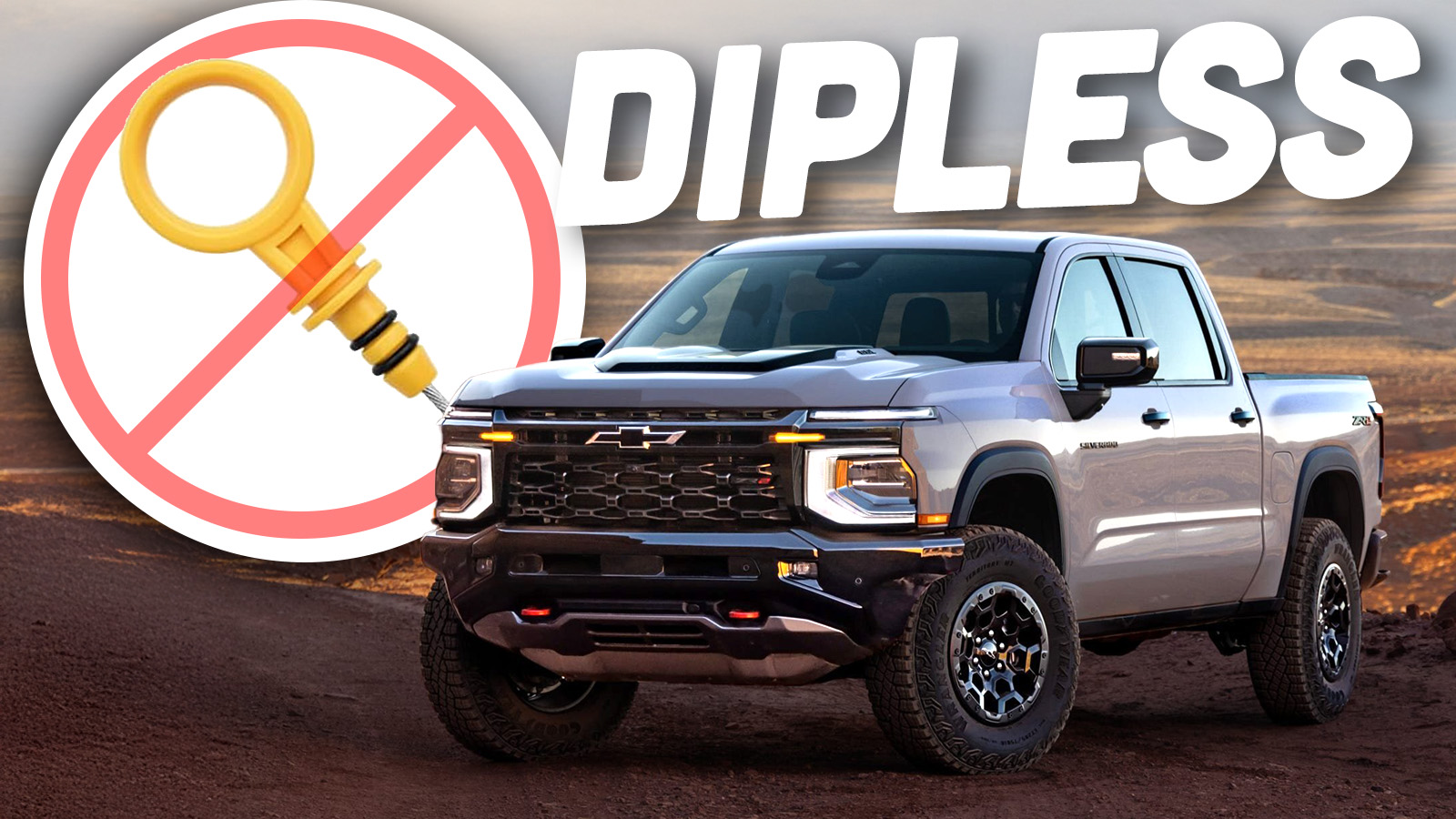
Oil is the lifeblood of your car or truck’s engine; too little of it, and your engine will not be long for this world. For longer than a century, drivers have been able to physically check their own oil levels, but times are changing. An increasing number of models are trading dipsticks for digital gauges, and the V8s in the new 2027 Chevrolet Silverado and the GMC Sierra are joining the trend.
The Chevrolet Silverado and its GMC Sierra twin are getting a whole new generation for 2027, and General Motors says that truck buyers are going to get the most advanced and powerful pickups it has ever produced. Along with a new, more aggressive look, GM’s bread-and-butter trucks are getting a whole host of technology upgrades, new off-road kit, and luxury accoutrements across seven trim levels.


Some of it might not hit with some buyers. General Motors is introducing a front passenger screen to its trucks after its competition has already learned that most people might not actually care about such a feature. Some folks also might not enjoy the fact that, as GM introduces new engines to its half-ton trucks, those engines will come without an easy way to manually check oil levels. Instead, they will have to trust a digital gauge.

More Power, Baby
There’s a lot of good news about the heart of the new Silverados and Sierras.
The LZ0 3.0-liter Duramax straight-six diesel, an engine that I thoroughly enjoyed and that allows GM’s twins to be the only half-ton diesels in America, will be returning. Output in the 2027 version will remain the same as the 2026 model at 305 horsepower and 495 pound-feet of torque. That’s excellent! Currently, the only way to get a GM half-ton to reach the highest advertised tow rating of 13,300 pounds would be to equip it with the diesel.

Another engine that will carry over to the new generation is the 2.7-liter TurboMax turbocharged four-cylinder gasoline engine. As GM Authority reports, this engine is expected to see a power upgrade in addition to trading its eight-speed automatic for a 10-speed transmission. The Silverado HD and Sierra HD trucks are also getting new firepower in the form of the new 6.6-liter L8S V8 and a new big Duramax called the L6P. Details about the L6P have not been released yet, but it will be succeeding the 6.6-liter L5P Duramax V8 diesel.
Not returning for 2027 are the two V8s from the 2026 model year half-ton trucks. The GM small-block V8-based 5.3-liter L84 and the 6.2-liter L87 will be retired. This could be a sign of relief for many, considering that L87 engine failures are the subject of an ongoing NHTSA investigation and class action lawsuit.
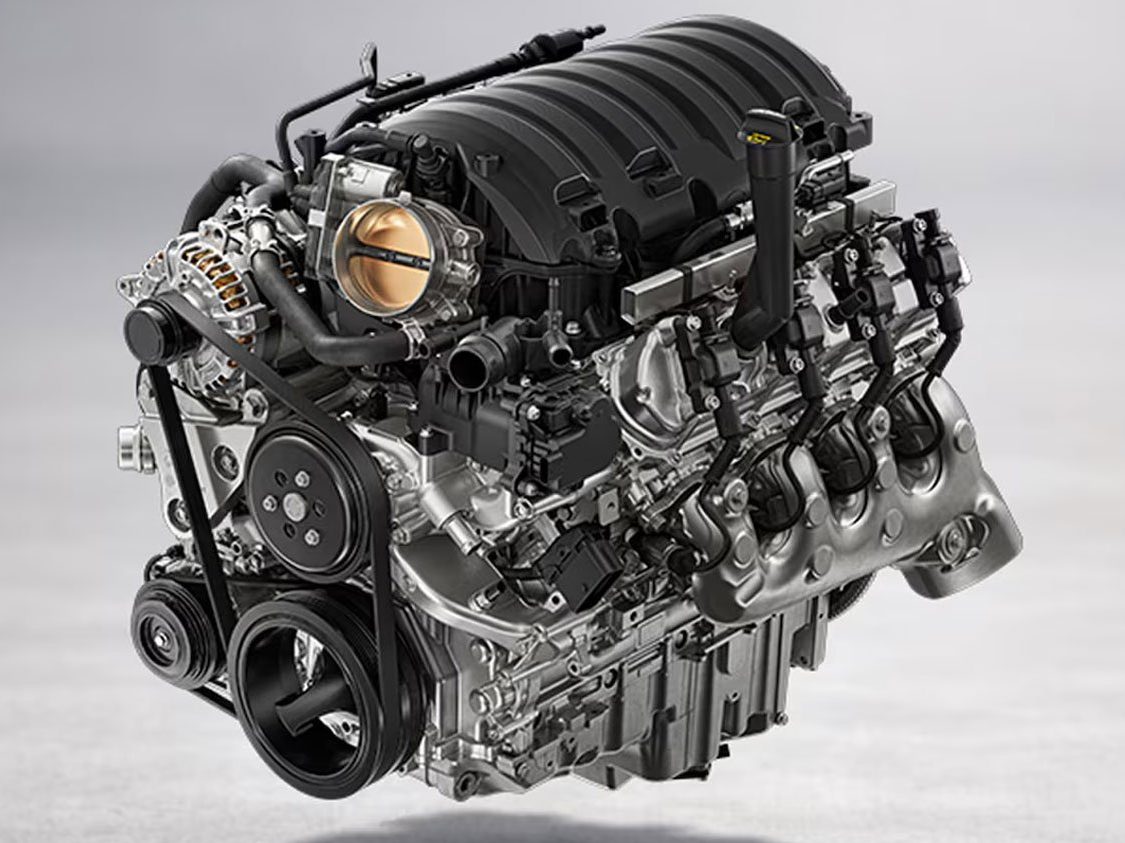
In their place will be the 5.7-liter L76 and the 6.6-liter L78, mills built around GM’s new Generation Six small-block V8 engine technology. As GM Authority writes, the Gen 6 range includes the Gemini family of dual overhead cam V8s that live in the Chevrolet Corvette Z06, ZR1, and ZR1X. The rest of the engines are overhead valve pushrod engines. The Geminis are hand-built in the Performance Build Center at the Bowling Green Assembly Plant, while the pushrod models will be assembled at GM’s Flint Engine Operations and Tonawanda Powertrain engine plants.
GM Joins The List Of Carmakers Getting Rid Of Dipsticks
GM hasn’t said much about the spec sheets of the new engines. The 5.7-liter L76 is expected to make more than the 355 horsepower and 383 pound-feet of torque found in the L84. Meanwhile, GM is saying that the 6.6-liter L78 will be the most powerful naturally aspirated engine in the half-ton segment, which means that it has to pump out more than 475 horsepower.

Something we do know is that, in a departure from the past, these new V8s will not come with an oil dipstick. The Verge reported this:
The oil dipstick, for example, is now a virtual measurement that exists on the truck’s status screen.
GM has since confirmed this detail to our friends over at The Drive.
Now, owners will have to rely on a digital gauge in the instrument cluster or the infotainment screen. If oil levels become too low, the system will tell the driver to add oil.
This isn’t anything new. Back in 2024, David Tracy wrote about how the Ram 1500’s 3.0-liter “Hurricane” inline-six also doesn’t have a dipstick, and instead relies on a sensor to measure oil levels. Here’s what the Ram 1500’s owner’s manual says:
The 3.0L engine does not have a traditional “dipstick” and there is no need to manually check the oil level. If it is desired to check engine oil level, it can be seen on the instrument cluster display by navigating to the appropriate screen under “Vehicle Info”. Use the up or down arrow buttons within the steering wheel controls to find the “Vehicle Info” menu. Then use the right or left arrow buttons until you reach the “Oil Level” submenu.
There is a bar on the gauge that shows the oil level. As long as the oil level is between the minimum and the maximum, it is safe to operate the vehicle. If the oil level is either too high or too low, a red bar will be illuminated.
When the engine is in need of more oil, the Oil Level Warning Light will illuminate. This warning will appear for five seconds. Within the next 300 miles (500 km) you should add 1 quart of manufacturer specified motor oil to the engine.

BMW owners have been used to not having a dipstick since 2005. Seriously, even my 2007 BMW E61 doesn’t have a dipstick. While they are not without occasional faults, the BMW sensors generally work fine. The car tells you when you need to add oil and how much oil you should add, then you do it. It’s pretty simple. The oil sensor still works in my BMW, too, even though it’s about two decades old and has close to 200,000 miles. If BMW can figure this out, General Motors can. The Hurricane also seems to be surviving fine enough without a dipstick.
For most people, who aren’t car enthusiasts and probably don’t even open the hood unless something is wrong, I suspect that not having a dipstick is mostly a non-issue. It might even be a benefit for the people who don’t know anything about their cars and think GM’s oil life percentage meter actually counts how much oil is left. I could see this system preventing someone from running their V8 low on oil. The fact that there’s been more than two decades of development into these sensors is also pretty comforting.

However, as someone who is also deeply into the aviation world, not having a physical backup at all does concern me at least a little. Planes are full of brilliant, reliable computers and digital parts, but have multiple layers of redundancy, including mechanical backups. Granted, a car is lower stakes than flying, but I still like the idea of being able to check my oil level and condition with my own eyes. Not being able to check my oil is the biggest thing I don’t like about my BMW, really.
But maybe, like David Tracy, I’m just stuck in my old ways. Maybe it’s not that big of a deal as some might think it is. Time will tell. I have reached out to General Motors for an explanation of this move. Until then, how do you feel about this?
Update: Here’s GM’s statement on the matter:
For the new light-duty 5.7L and 6.6L V8 engines, GM’s decision to move to electronic oil-level monitoring was intended to simplify the ownership experience. The system allows customers to check their engine-oil level from the vehicle cabin through an on-screen readout, without opening the hood or using a traditional dipstick.
Top graphic images: GM


This is a no-starter for me. I want to see, smell, and taste my motor oil. A gauge tells you nothing about the condition of the oil, like if you have metal bits floating around in it, or if you have water contamination.
There’s no reason they couldn’t have the gauge AND a dipstick.
I’m really not anti-tech, but it is balanced with a strong belief in simple and reliable. The dipstick works. It lets me also see the state of the oil to an extent. I would be fine if it was a situation of “in addition to” as opposed to “instead of.”
Of course, I’m also a fan of hood props over gas struts. I’ve never had to replace a hood prop.
I would love this. My driveway isn’t flat, so I have to move my car out next to the street or over to a parking lot to check the oil. Annoying for a Raptor since I need a stepstool to do it too. .
Depends on where the sensor(s) are, you might still get a false reading on a slope.
Probably better to have a sensor on GM trucks. That hood is so tall that you need to set up a ladder or scissor lift to reach the dipstick anyways.
Most truck owners probably don’t or don’t know how to check their oil anyway.
I used to work at a full serve fuel station when I was a kid in the late 90’s, there was a guy who came in every single week and asked us to check the oil in his 305 powered Caprice. We used to joke that the only reason it ever needed any was to replace all the oil we’d wiped off the stick.
Yeah, being able to visually see the condition of the oil is nice, but other than that I don’t care.
My 4Runner had a dipstick, they only time I used it was after the oil change, to verify level, which I stopped doing after a while. I know it holds 6.5 quarts, and I know I put in 6.5 Quarts. No need to check.
I have a dipstick-less Ram. I change the oil every 5K, and it doesn’t leak or burn any. No reason to check it between changes.
Wow, the title of this article is incredible misleading. I’d go so far as to say it’s an outright lie, and clearly intended as clickbait.
The first few sentences make it clear that owners can still check their own oil. They just check it in the cluster instead of with a dipstick. I had a Mercedes from 2003 that worked that way. This is nothing new. I mean you’re still pressing buttons or a touchscreen, so I don’t see how anyone can claim that isn’t a “physical” process.
I was thinking the oil level was literally not available for the consumer to check and required diagnostic tools to access.
I am very disappointed in this kind of clickbait, which I wouldn’t expect from this site.
The headline is perfectly clear to me. “Physical” means you’re using your own eyes to check the oil level instead of relying on sensors.
Someone else may have already pointed this out, but the headline I see is:
“New Chevrolet Silverado And GMC Sierra V8 Pickup Truck Owners Will No Longer Be Able To Check Their Own Oil”.
Add this to the list of “things we didn’t ask for.”
Just did my first brake job on a car with electric parking brake.
Fiddled around and actually started the car on jack stands before I googled it and found out I needed to disconnect the motors and manually retract the pistons.
How long will I be able to avoid this silliness in my own cars?
Fucking stupid.
I’ve engineered and released dipsticks and dipstick tubes. Just because a measurement tool (dipstick) is available, does not mean that it is telling you what you think it is
Engines are filled with oil from the plant by mass. Engine oil changes are dictated by volume. Dipstick is an emotional support rod.
There is variation in:
-dipstick tube geometry
-dipstick geometry
-dipstick tube mounting position
-oil pan volume
-engine installation angle
-vehicle angle
Oil level sensors share many of these challenges
The result is, in my opinion, a dipstick that serves as a “is there oil in this thing and what color is it” sensor
Moving from dipstick to oil level sensor is a cost increase for a more useful too.
Having the right amount of oil is nice. Low risk of losing oil pressure, and your oil service life should fall within the acceptable range.
Yes, dipsticks can be useful. Oil level sensors are also useful, with some advantages to the OEM.
COTD for “Dipstick is an emotional support rod.”
You want to outline the ways it’s advantageous for oems? I have my list, but it sounds like you have been in those meetings.
Why not both? There is value in being able to see the condition of your oil, not just the level.
I guess I’ve been possessed by the ghost of Tom Magliozzi, because I feel a rant coming on…
The problem here isn’t with the technology, as many have said. The problem is, as people in advertising seem to call it nowadays, Optics. Or Image for us regular people. GM, I am certain, has been developing this system for some time, and usually this wouldn’t even be news. The reason it is, is because of the debacles involving the 6.2, in particular, the oiling system. And people are like, “You can’t even keep one of those engines together for 10,000 miles, and now you won’t even let us check the Oil! Screw this, I’m buying a Dodge!” See what you did there, GM? You made them so mad, they forgot Dodge doesn’t even sell trucks anymore!
All this gives people the impression, or reinforces the stereotype, that GM can’t be trusted, and therefore, it’s the timing of this change that matters. If they held off until 6.2s stopped popping, they’d get away with it Scot free. But because GM, as usual, has done things with the worst possible timing, people will clamor for dipsticks, and they’ll have to walk back the change, if politicians don’t make them do it first, by requiring dipstick tubes for everyone.
Now,if you’ll excuse me, I’m going to browse Craigslist and Marketplace for a ’63 Dart.
I’d say this is why the self-serviceable ethos of the Slate Truck is so important, but you actually can’t check the engine oil on that, either.
Yeah, you just have to trust that the magic smoke stays inside where it belongs.
Anyone who purchases any of these trucks needs to have their head examined.
Nobody is tall enough to reach the dipstick on it anyway, so fine…
Yeah no shit. Neighbor of mine bought some giant Chevy somethingoranother and the hood is more or less the same height as my head
On my last road trip, I pulled into a rest area to find several young men precariously balancing on the tires and front bumper of a GMC pickup in an attempt to reach some problem under the hood.
It’s cost-cutting on something that they print money on. It also feels like an ineffectual push towards going to the dealer instead of DIY, and 1. those people still won’t go to the dealer and 2. how many of them are there, really?
Also, that seems like a thing where redundancy could only be helpful.
I don’t respect it. It’s petty.
Adding an oil sensor and taking away a dipstick only saves money if the dipstick is badly designed and needs external tubes and brackets.
This is about reducing engine failures from poor maintenance. Too many people just don’t check their oil, and this bullshit is just for them.
All the other powertrain engineers I know also hate this feature.
I have driven cars that had both the sensor and a dipstick. I like that idea. My sensor for the folks who might otherwise rely on the low oil pressure light to indicate they were low on oil, and a dipstick for the rest of us.
I’m surprised they haven’t sealed the engine too, such that only GM dealers can service it.
Software-controlled hood release. That way only the dealership can ‘install’ Delco branded windshield washer fluid.
Volvo had a concept car many years ago (very offensively presented as a car for women) that featured a sealed hood.
This prevents owners from noticing coolant mixing with the oil, if that were to happen, as well as being able to see the color of the oil. If it’s turning black within a thousand miles, then it should probably not be there for the next 6,500.
GM is doing this for a reason, which is probably because it is cheaper to put sensors in than actual dipsticks, and the computer will probably keep track of the oil level over time. If this were to cost more, GM would not do it.
“When America needs a worse idea, GM puts it on wheels!”
Hate it. Keep the dipstick so you can see what your oil looks like. My Mazda’s is through the valve cover, right next to the filler cap. For the first few months I had it, I was checking the oil every time I got gas to make sure mine wasn’t cursed with the leak that had a recall on it. I’d actually opened the hood and checked the timing cover and dipstick before I test drove it. Salesman was confused until I mentioned it was a hit or miss issue on that year.
That said, where I went to college was mostly nerdy rich kids who had never so much as opened the hood on a vehicle, much less knew how to check their oil, and that was 2008. I was friends with the head of the ME department and would volunteer my time helping him run some of the labs, because they used the same Chevy 350 as my daily and most of them were clueless. They’d probably love this.
Oil level is one critical factor, but so is oil condition (color, looking for evidence of coolant, metal, etc.). This is an awful idea.
This is not for consumer convenience, it is for litigation protection as the data stored will be used to deny warranty claims. Sorry Mr Jones but you drive your vehicle while the “Oil Level Low” warning was presented for 10 miles.
It also ensures future visits to the parts counter and service area. I have never had a dipstick fail but have replaced more sensors than I can count over the last 50 years.
It will reduce warranty claims, but mostly by preventing owners running the engine low on oil, rather than denying claim after the engine has been damaged. So it’s good news for idiots.
Although there is nothing morally wrong with denying a warranty claim for engine damage caused by some idiot running their engine low on oil.
Part of my job used to be making decisions about engine warranty claims based on ECU data. Mostly money shifts, but also modified engines returned to stock after engine damage.