

Are you okay with yet another Citroën 2CV update? I don’t want to oversaturate you with 2CV stuff, and I wonder if I’m in danger of doing that, but at the same time, I like sharing all the details of life with this tin snail with you, because I’m excited about it, and what’s the point of being excited about something if you can’t spread that excitement around, like an STD?
This time I think I may have learned a lesson or two, much like one would when viewing a Very Special episode of Webster, but about the Importance of Fuel Gauges and the Power of Gravity. I’ll explain.


Keep in mind this is all coming right on the heels of a nice thorough shakedown cruise in the 2Cv when I drove it three-plus hours to the Lemons race in Lesser Carolina. It did great! And, I think I mentioned that my fuel gauge was not actually “working.” To compensate for this, I’ve been carrying a spare can of gas in the car.
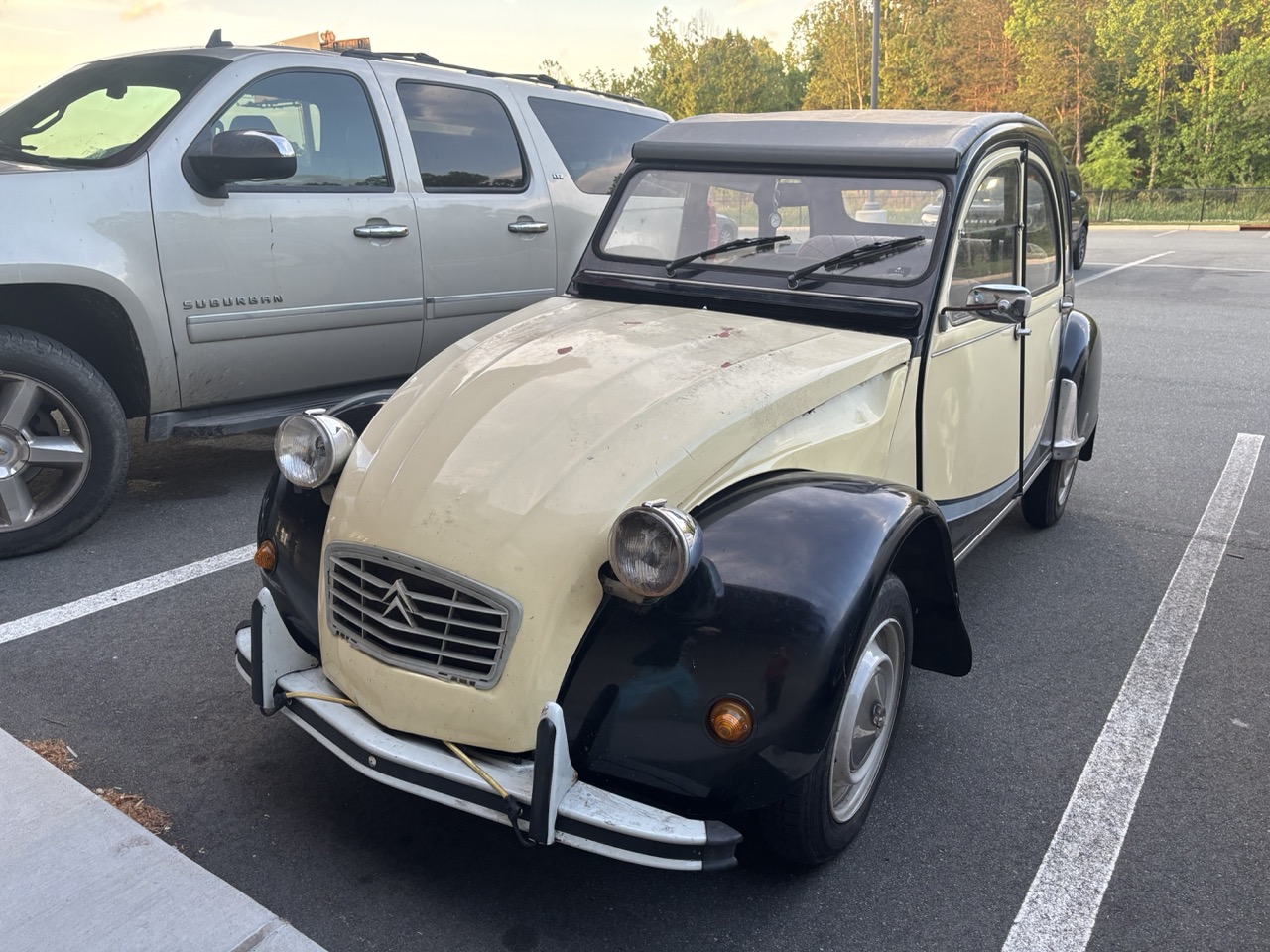
The lesson happened as I drove my kid about 20 miles to a great used book/music/video game place that we like to go to sometimes. Otto has been doing pretty well in school lately – not exactly his default pattern – so to celebrate we decided to get a used Playstation 2, something he’d been wanting. Also, here’s a parenting tip: get your kid into obsolete stuff! He genuinely likes older games and consoles, and compared to modern stuff, they’re dirt cheap!
The 2CV made the trip out there just fine, being loud and happy and making people who saw it smile, as French Car Dieu intended. On the way home, though, the car started to sputter a bit, and I realized it was likely running out of gas. Okay, fine, that’s why I have the gas can in the car.
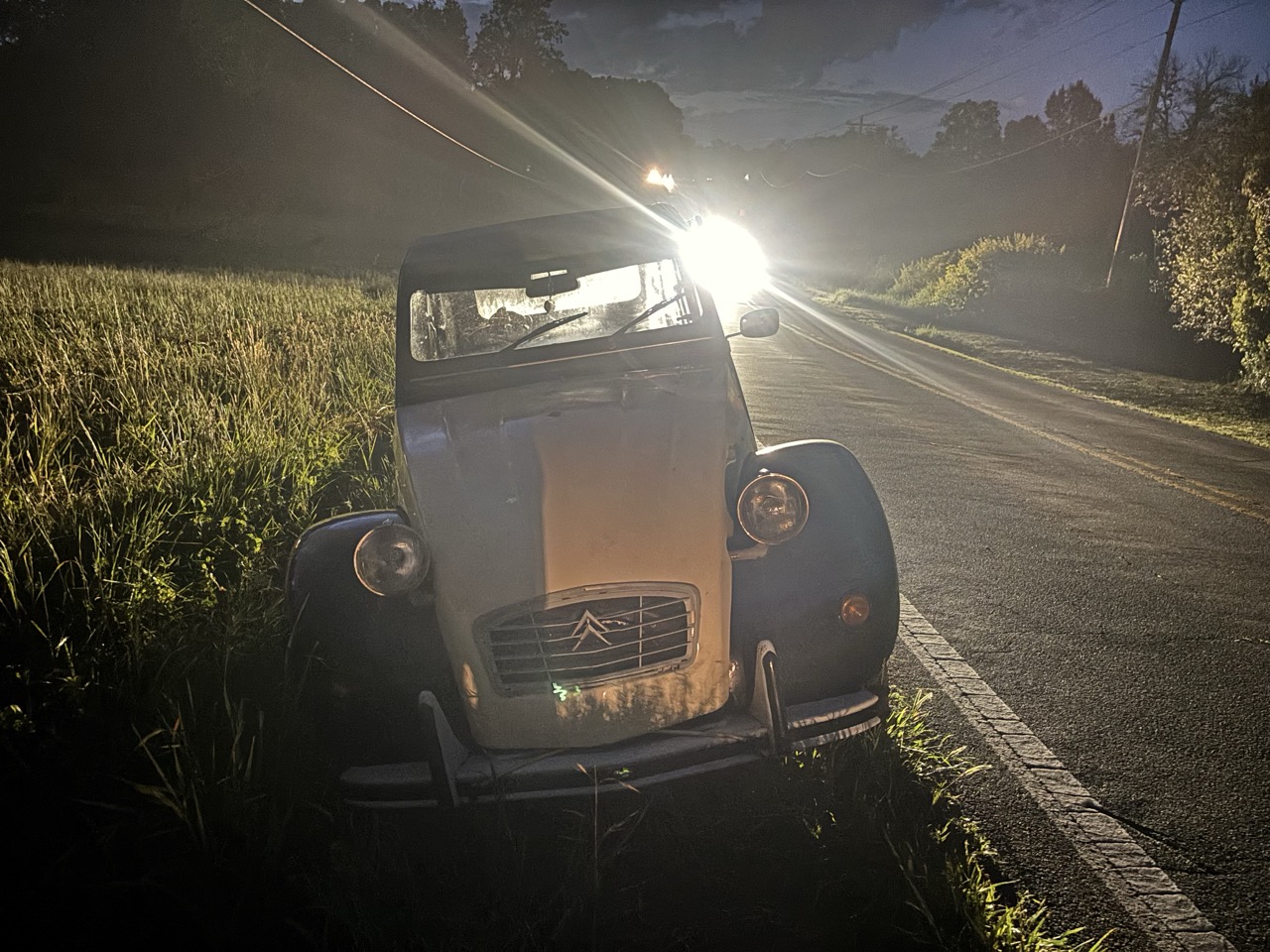
But I made a grave miscalculation, though I didn’t realize it at the time. I pulled off the road onto the grassy shoulder, but uphill, at a fairly steep angle.
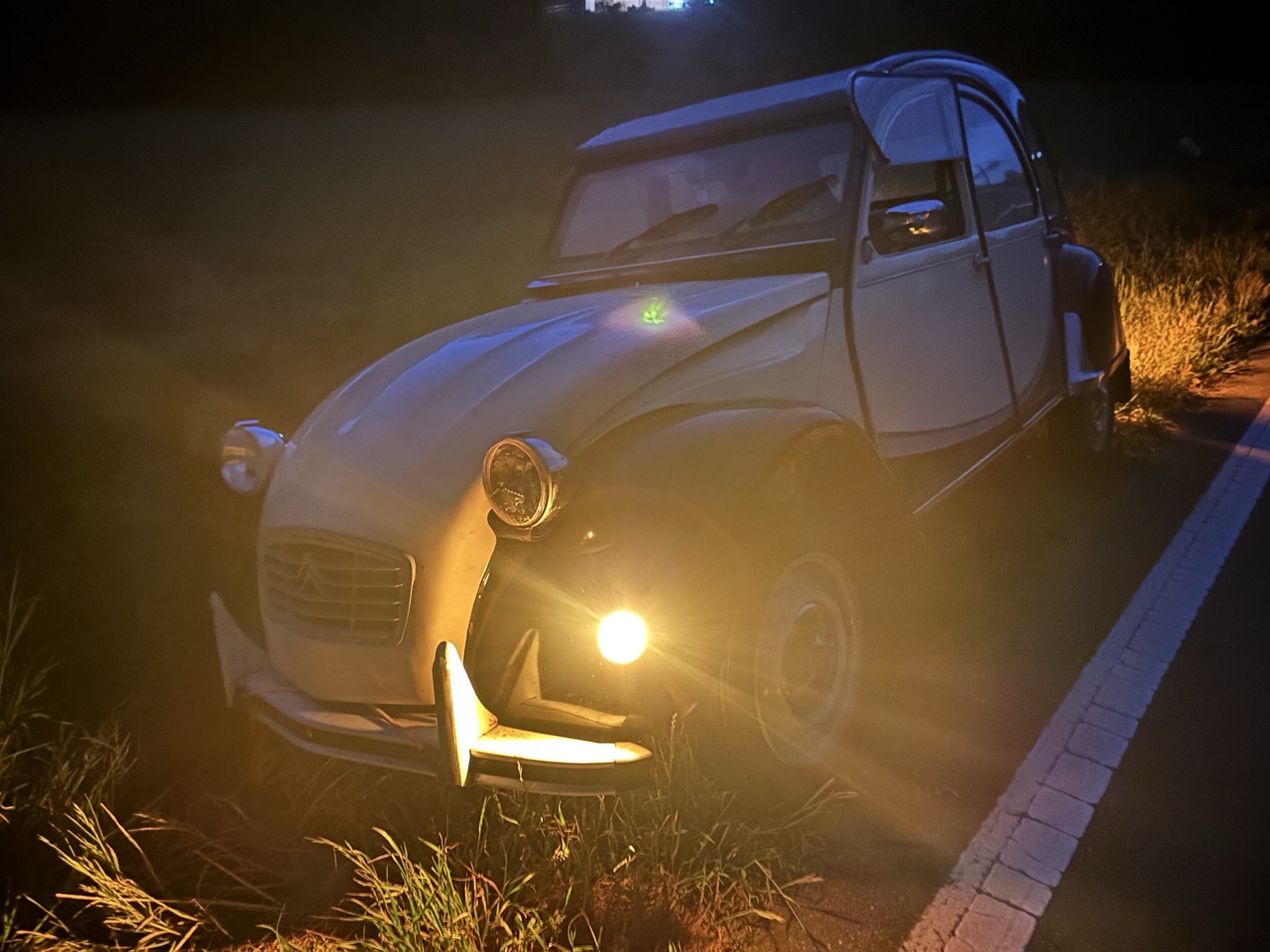
You can’t really tell in these pictures, but I was on an incline. I went and got the gas can out, filled the tank, and tried to start it. It was taking a while, but that’s expected when you run out of gas – the fuel pump needs to drag that fuel all the way from the tank to the carb.
But it didn’t turn over.
Crank crank crank crank, but no satisfying catching as the engine roars to life. What’s going on?
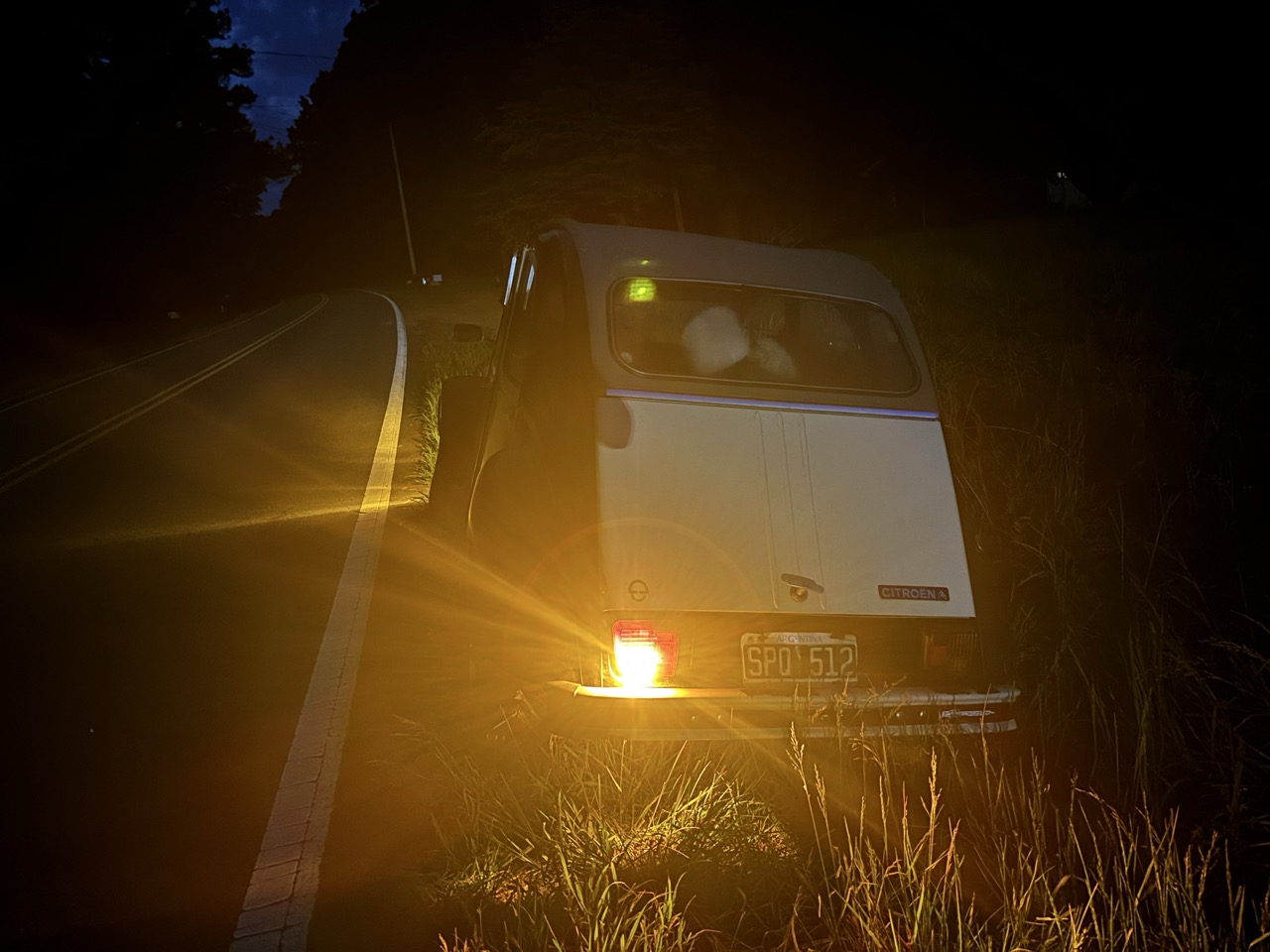
I tried over and over again, letting it sit between cranks, until I eventually figured something else had to be up. I looked under the hood for loose coil wires, leaky hoses, anything, but saw nothing wrong. And yet still, when I cranked, no joy.
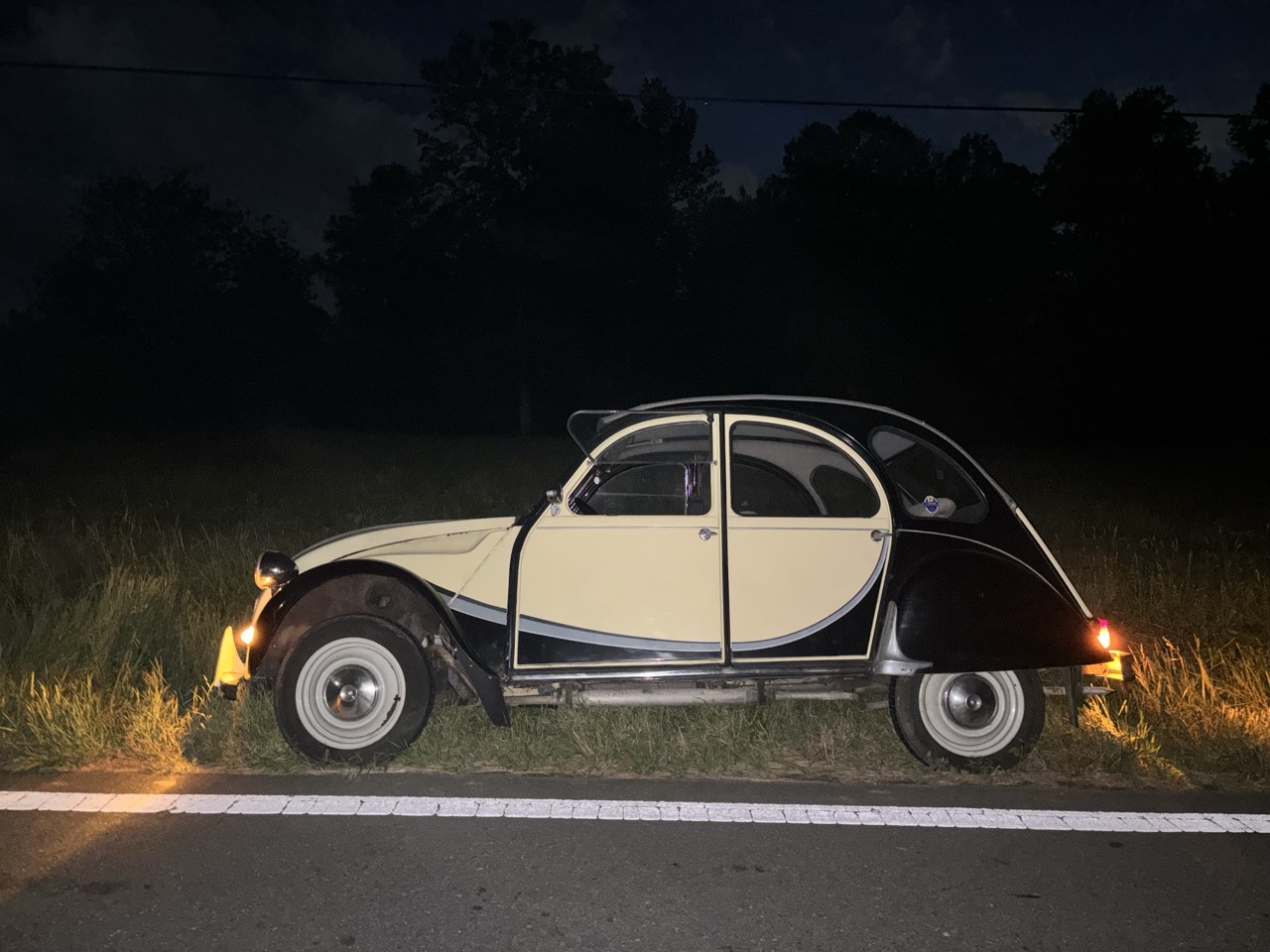
I eventually called my wife to get Otto, and called a tow. I was frustrated! How could this be, when it was trundling along so happily not minutes before?
I mentioned my predicament in our Autopian Slack channel, and David suggested something I’m embarrassed I didn’t think to do right away: pour some gas right in the carb. I even lamented I didn’t have my can of starter fluid with me, not even thinking that I had gas with me right there I could dump into the carb!
So, I got out, decanted some petroleum into the hungry maw of the carb, then climbed back into the car to try again.
Grunnggrunggrunggrungbrunggrunggruuuuuuuuungbrapgrungbrapbrapbrapgrunggrunggrungbrapbrapbrapsepsepsepsepsepbrapsepsepsepsepsep and there it was, running.
So, what happened? My theory is that the incline I was on was enough to prevent the fuel pump from getting the gas from the tank to the carb? Is that possible? It was an incline but not, like, a mountain? So if I run out of gas again, I should try to do so on a downhill slope?
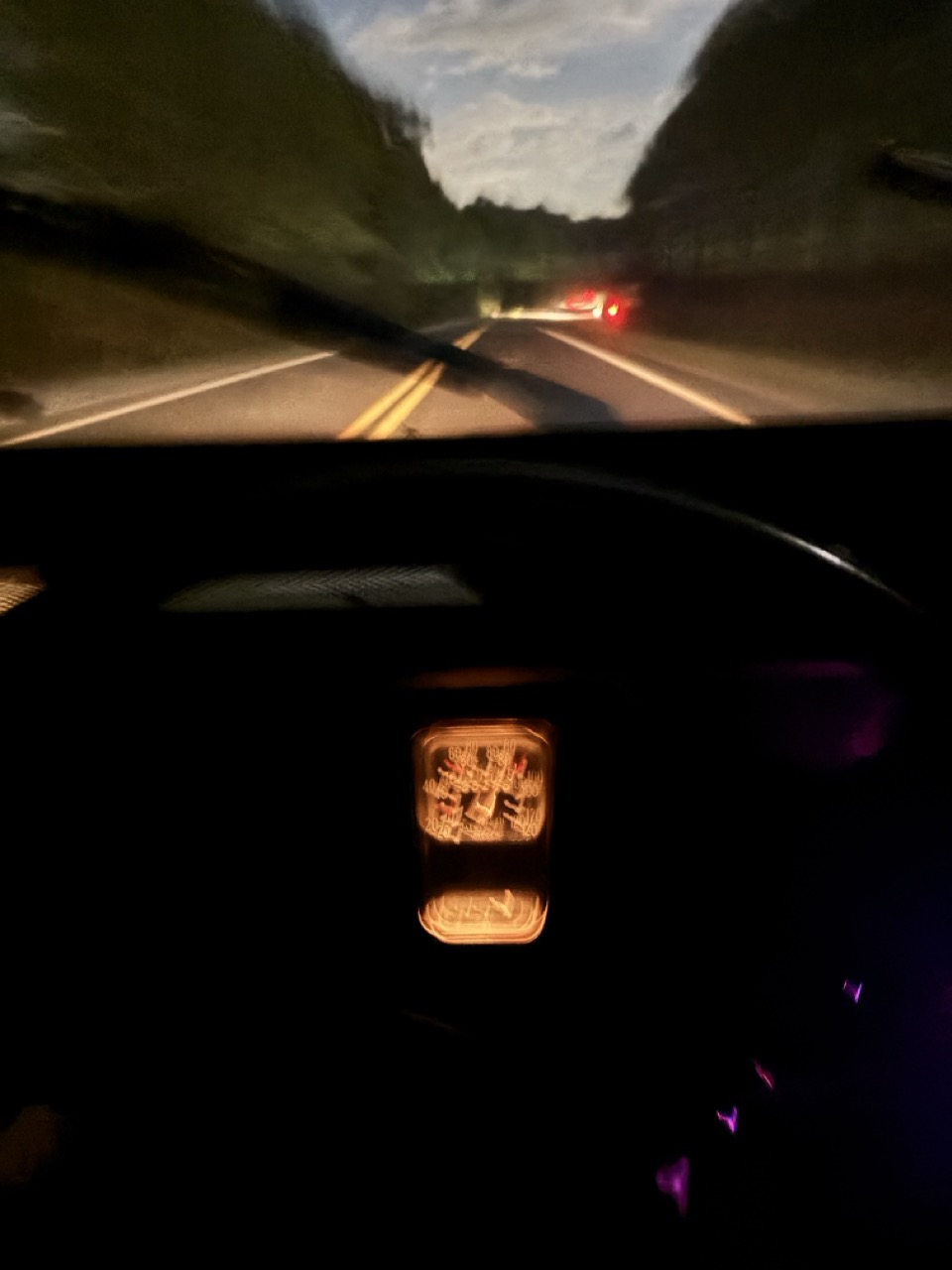
I’m not sure. I was just so thrilled it was going again I took that low-light shaky picture above to commemorate it, and I kind of like the impressionistic feeling it has. Also, my instrument lights do not look that bright in person; I need to upgrade them with some LEDs to make them more legible.
About 30 minutes after I got home we had a massive surprise hailstorm, so I think overall I got pretty lucky. But, I really should get that fuel gauge working. This is just silly. And solvable.


I kinda-sorta had this happen with my Spitfire. I badly needed gas, but was running late to meet a friend downtown for lunch. Figured I’d just get it after, there’s a station just down the hill. Made it to the parking garage, shut the car off, had lunch. Wouldn’t start when I got back. Just enough incline to keep the gas from feeding – I could hear the pump free running, assume the gas drained back into the tank. I must have been sooo close to not making it. But putting more in fixed it, no need to do more than dump gallons in – which is 2/3rds of a tank in a Spitfire. My friend worked right near there, just borrowed his car to run home for a jerry can and gas.
As for inop fuel gauges, I had a close call with a cheap Volvo 945 I bought. Purchased on eBay in RI from a little used car lot. Took the bus/train down from Maine to pick it up. Headed back to Maine, had a half tank of gas, more than enough to make it home. But decided I would fill up and check the fuel mileage. Turns out, it was all but empty. I would have run out somewhere on Rt 128! Instrument cluster needed resoldering – very common Volvo problem. Once I did that, the gauge worked fine, and as it turns out, a bunch of the warning lights weren’t working either until I did that.
Keep the 2CV updates coming – love them!
Considering the Spitfire has a glide ratio of 13:1, it’s brave of you to run the fuel so low. What airborne did you serve?
ROFL – First Oil Leaking Battalion. Our motto – “If it ain’t leaking, you need to add more oil”.
Simple mechanical and vacuum fuel pumps are bad a priming the fuel line to get enough to the carburetor bowl. So filling the carb with a bit may definitely help to get things working — although you (and the car…) may have the uncomfortable bit of sputtering while the bowl mostly empties and the fuel line still has a lot of air bubbles in it while the pump is still (weakly) pulling more fuel up to the carb.
I run into this all the time with my old garden tractor. It’s a design that once used gravity feed from a tank under the hood, but was modernized to use a tank under the seat/rear fenders and a vacuum fuel pump to feed the bigger, thirstier (and rather 2CV-like) opposed-twin engine. Trouble is, with no check valve in the line, the fuel tends to drain down to the lowest point in the line and get some air bubbles because the fuel line is gravity-fed from the bottom of the tank which is higher than the pump but significantly lower than the carb, and the fuel line is routed lower than the pump for most of its path.
All of this means that if it sits for more than a day, it’s largely in the state as if it had run out of fuel. There’s a simple trick to starting it, though, that lets physics lend a hand. Give it full choke and full throttle, and crank for 15 seconds or so. Vacuum will start pulling fuel through the line, but there will never be enough to start with — yet. Wait another 15 seconds or so, and, depending on how cold the ambient temperature is, start lowering the choke to half. It still probably won’t start, but it might sputter once or twice, which is good. Wait another 10-15 seconds to let residual vaccum pull more fuel. Try starting again — with more choke depending on the weather but only about half throttle, and it should start — at which time you’ll probably have to slap the choke to 1/4 or so right away, and feather the throttle until it evens out at about half so the engine can warm up.
The 2CV will probably respond fairly well to a similar starting procedure. There’s a very good chance it’s tricky to start cold even with a full tank for similar reasons. Unless there’s a check valve in the fuel system, it will drain fuel back to the lowest point in the fuel line and you’ll always have to get it pumped back up to the carb while at the same time not flooding the engine when fuel suddenly appears with too much choke and throttle.
When I worked at an armored car company in the 90s, most of our gas-engine trucks still had manual chokes and suffered from similar fuel-draining behavior. There were several particularly pesky ones that nobody but I and the handful of semi-retired older guys could start. I was absolutely the youngest guy who knew how to do it. Even most of the mechanics couldn’t.
If you’re comfortable getting old engines with mechanical/vacuum fuel pumps to prime and start when cold, then getting them going from having run dry is mostly just a matter of more iterations of choke, crank, wait after giving the carb a sip of gas to get some into the bowl and the near end of the fuel line.
The entire armored-car business model needs to be flipped. First off, armored cars should be cars, not Class 4-6 trucks. Secondly, any armoring needs to be invisible and lightweight enough to make the smallest cars feasible. Fleets should be made of “gray mice”, no two alike, avoid models used by law enforcement. Hondas are great because it’s fairly well known they don’t do fleet deals. Spend money on trim and accessories, not size or power – those have obvious “tells”.
Everything else too. No company logos, no uniforms, no visible weaponry. Park in regular customer parking. Leverage the fact it’s now normalized to bring your shopping bags into the store with you.
That’s great for ATM work and some commercial pick-ups. Unfortunately, bank runs and coin deliveries and pick-ups need big vehicles to do the work.
Imagine a 35-foot straight truck with the box filled front-to-back with pallets of bags/boxes of coins. Or bags/bales of bills. Or a combination of both. It happens every day on at least two or three routes in a major city. And “regular” city runs have bank deliveries/pickups with significant coin and cash deliveries that fill up the small 15-20 foot trucks.
I used to run “holdovers” of everything that came into the vault after closeout time at the main downtown banks which had to be delivered the following morning at opening. The truck was 40 feet long, and often full front-to-back. And sometimes that was just for one of three main banks. I had to go back and do it again two more times. Other times, all three main banks’ holdovers fit, but there was so much in value that we needed an escort car with two more guards, all dictated by insurance requirements. A lot of what goes on is dictated by insurance.
Even ATM runs can fill up a van or small cutaway cube van with pre-filled cannisters or cash bags.
Until we go cashless, cash takes up a lot of space and weight capacity, and manpower to deal with it all.
Thanks for the update. I can’t get enough of the 2CV. Keep Torch’n!
No you don’t understand. My car is on E.
https://www.youtube.com/watch?v=VDwi5SmQ_gU
This is brilliant. I miss the old internet that was more of this kind of low budget simple humour.
Yeah this is very much dawn of the internet sketch comedy. For whatever reason this simple sketch has stuck with me and every time someone says their car is on E, it comes to mind.
Once, I got onto an unfamiliar stretch of highway, badly needing gas but expecting to find it in a mile or two.
It was one of those highways where the first four or six miles are uninterrupted, and I rapidly realized I was getting farther up shit creek every foot I kept moving. I managed to turn around and make it back to a station. I was clenching so hard I could have held the bike upright at a standstill without touching the ground.
It’s a queasy feeling to fit four gallons in a 3.7-gallon nominal tank.
Spring 2006? – Little brother got married on a Cruise Ship in Miami. After the short reception prior to sail, I was in charge of driving our parents and grandma up to Tampa. Rental Lincoln Town Car was at 1/4 tank or so, I topped off just to be safe. Did not realize that we hit the absolute last filling station before Alligator Alley, and the last gas until Naples! Ahh the fun of pre-GPS.
I’ve had a truck for the last 12 years with a broken fuel gauge. I just use the trip odometer.
I always recommend everyone learn roughly how many miles to a tank their vehicle gets.
I did this for years on an old F150 from the 80s.
Later on, the Cummins-Dodge I had came to me with a broken fuel gauge sender. It had the simple trip computer that measured MPG. I could drive by the odometer and the average MPG display to accurately calculate distance to empty. It was practically a luxury. 🙂
Trip odometer is often the only option on a motorcycle.
I’m one of those weirdos who fills up at a half tank. Started one winter to “keep water out of the lines” and just never stopped. It’s habit. Besides, with my cars and commute, it usually ends up being once a week and under $40, even now with the dummy in chief screwing up everything.
so the bmw R12 GS does not come with a gas gauge. A premium bike with heated grips, and cruise control does not have a gas gauge in the year 2026.
What the what
What?
Does it at least have a reserve tank ala old VW Beetles??
My 2025 Honda CBR600RR has anti-wheel, anti-rear wheel lift, ABS and a six axis accelerometer.
No fuel gauge. There is only a low fuel warning light, which I suspect cost nearly the same as fitting a sodding level gauge.
I just fill up every 150 miles. It’s annoying.
I’ve run out of fuel a few times (Citroens mostly, also my Silvia was suddenly doing 12mpg at one point), and always thought I was lucky to have done it two of three miles from a petrol station. That’s a short but embarrassing walk.
My wife has run out just once, and coasted her RVF400 to a halt beside a pump at a Shell station. This was before she married me, so I assume she used up all her luck that day.
Ha, the same almost happened to me the one time I ran out of gas. I ran out and the car died half a block from the station at the bottom of the hill.
$0.99/gal gas. Wild times.
Look at Jason’s fancy 2CV with hazard flashers. Mine doesn’t have them. I wonder if they skipped them on the Spanish models because the laws there didn’t require them in 1980?
My dad was a cool guy. As a child in the 80s, nearly every weekend, I would ask if I could go to the mall, hang out with friends and dad would throw me the keys to one of the cars and give me something like $20-30.
And off I would go. On the way to the mall, there was a small hill. Most of the time, the car would start sputtering as I crested the hill. At the bottom of the hill was a Hess gas Station. It was the last one in town that was full service and they refused to do any less than a full fill up.
So, I would get to the mall with just enough money for lunch and maybe a couple quarters to blow at the arcade. Around dinner time, I would get hungry and head home.
So dad got to be the cool dad that didn’t argue with his kids about hanging out at the mall, a dad that got his kid to not hang out at the mall all day, AND a guy that got his kid to coast the car into the gas station for a fill up so he wouldn’t have to.
I remember pushing one of his cars into that Hess at least twice and rolling into the lot in neutral with one stop with power brakes almost weekly.
FIFY.
The gas gauge on my truck is broken. 26gal tank, assume worst case 10mpg, so I reset the trip meter at every fill up and go for another 250 miles.
Though right now it’s my secondary vehicle so mostly just gets idled in the driveway or a quick drive around the block. I’ve put 5 or 10 gallons in it a couple times. The key is to just always under assume your actual gas mileage. I’d rather end up surprised that I need way less gas to fill it completely than run out.
Back in 2010 I bought myself a 1994 Trans Am that I found in Pennsylvania, so I road-tripped out there with a friend and drove it home. The gas gauge was at 3/4 of a tank when I drove it off the lot, and it stayed there for a very long time before it took a big nose-dive and started to sputter. I barely made it to a gas station and literally coasted up to the pump only to discover I was on the wrong side of the pump and had to get help because the hose didn’t reach across. I was pretty sheepish. And I still despise that gas gauge to this day.
My Indian Scout (2017) not only did not have a fuel gauge at all, the design/shape of the tank was also….poorly optimized so it’d run out of gas….when there was still plenty left.
A lot of motorcycle tanks are sort of upside down U shaped, with a frame rail in the middle. The Scout was no different, but most of the time, that U tapers off toward the back, so fuel easily can move between sides and won’t get “trapped” in one side or the other, since most of the time, there is only one outlet of the tank, and it’s usually on the left/”low” side of the bike when on the kickstand. Most of the time there’s a slight dish around the outlet, and it’s at the lowest point, so you can use pretty much every drop. Even EFI bikes with a big cartridge pump usually have a little “pool” around the pump intake to collect the last few dribbles and allow it to be used.
The Scout’s tank had a deep cutout in the middle for the airbox. Like at the gas cap in the center, it was only 1″ deep, all the capacity was off to the sides. The fuel pump was in the center since it was too big to fit in the side, but it’s actual intake was on a flexible hose that “dipped” into the left/low side “saddle” of the tank, but it also had a big screen on it, so it really was sucking from probably 2″ off the bottom. There was also no crossover or taper, so once it dropped below about 1/2 tank and the middle section went “dry”, the fuel in the right saddle was sort of stuck there until you leaned the bike left to slosh some over. The sensor for the low-fuel idiot light was in the center, toward the back. This was also a terrible design. If the tank was perfectly level and stationary, it probably would go dry (and trigger the light) with about a gallon remaining. In practice, there was always a little fuel splashing around….even when nearly empty, and it’d never actually light. If it did, it meant you had literally seconds-to-minutes before the pump ran dry. A couple times I ran out and the light never once came on.
I also discovered after running out of gas on the damn thing for like the 4th time that if you sharply leaned the bike to the left- like almost laid it down on it’s side (to slosh all the trapped fuel in the right side of the tank over), then stood it back up, you’d hear the pump re-prime and it’d start up and you could drive another 5-6 miles, at which point you could do it again and get another few miles. Even then, it was quite aggravating to be able to see and hear a considerable amount of fuel still sloshing around in there, you couldn’t actually use. The capacity was claimed to be 3.1 gallons, but even after doing the “drop it on it’s side” trick, twice, filling it up at a pump it only took 2.5 to brim it. So the already way under-sized fuel tank (this was an 1100cc, 100hp v-twin, not a little fuel sipping tiddler, it only did mid-40s for MPG), was even smaller since the last 20% was unusable. That meant you needed to fill up every 80-90 miles at most, and I was back to just resetting the trip meter and guesstimating how hard I was riding for the MPGs.
One of many annoying design traits of that bike that led me to get rid of it after only about a year.
Too many wonky fuel gauges to have any faith in them. Reset the trip meter every fill-up. Did you say your odometer is out also? I’d make that the first fix.
Odometer works! Once I figure out roughly what MPG I’m getting, I can do that!
Hey, did that AI Gonzo I sent to Tips come through?
hm maybe I missed it?
I don’t have instafaceredit crap, but sent from Gmail to sites “tips” and I think it worked?
“Also, here’s a parenting tip: get your kid into obsolete stuff! He genuinely likes older games and consoles, and compared to modern stuff, they’re dirt cheap!”
Agreed, older games can be amazing and the hardware quite affordable despite the RAMpocalypse. I just bought 16 GB of used DDR3 RAM on eBay identical to the 16 GB of used DDR3 RAM that were already there for half what I paid over a decade ago when I built the system. That wouldn’t be possible with a newer DDR4 or 5 system. Same with the video card, I upgraded that as well and found a card 2x as fast for about what I paid for the old card over a decade ago.
Also some public libraries carry console games for loaning out. Its a great way to play an older game for free and without the clutter of having it around when not being used.
I have had 2-3 vehicles without gas gauges. I used the odometer or a watch to gas up every 150 miles or 2 hrs depending. I am glad I am not as poor as I was, now my gas gauges work. Also I did have the jeepster commando at angles that would keep the gas from getting to the carb.
This is how it’s done on a motorcycle.
When I forget to reset the trip odometer, I’ll get twitchy and usually do a slosh-check or peer into the tank.
Yes, I have only done the reserve switch once or twice.
The reserve switch got used many times on my Honda CT70 as a kid.
I was amazed the first time I saw a gas gauge on a motorcycle. 😀
You just knew your range and kept an eye on the odometer. Looking in the tank before the first start of the day was a good habit to be in, too.
Also, for the longest time most municipal and long-distance buses didn’t have fuel gauges. They just started each day’s run with a full tank, and topped-up at intervals based on time or distance.
Still in the habit of resetting the trip on fill up.
The Kramer Maneuver only works when the gas gauge is working. And yes, more 2CV content, please!
I want more 2CV content, and less dystopian over-reaching car “Safety Mandates” thankyouverymuch. Can we get this pushed through congress?
Such a unique car! And a hailstorm in a car with a fabric roof doesn’t sound fun.
My project truck doesn’t have a working fuel gauge. Therefore I record miles to keep track. Ran out of gas once, and luckily my brother came to my rescue. My wife and I were stuck on the side of the road (in a nice rural area) as we waited. It wasn’t too bad.
I for one enjoy the 2CV content, especially as entertainingly as you present it.
Good luck fixing the gauge.
I learned when I was a new driver not to let the fuel tank get below 1/3 or more, up to about 1/2 depending on the vehicle and usage. Fuel keeps the pump cool, which increases its lifespan. Plus it lessens the chance of an emergency, and if on a road trip promotes frequent enough stops to reduce road-fatigue.
The guage on my Scout was a bit on the inaccurate side. It showed about 1/8th of a tank left, but that really meant “empty”. Only let it get me once, and fortunately I was right in front of the house of someone I knew form hight school who was kind enough to give me a couple gallons so I could get to the gas station and fill up. Never let it get below 1/2 after that.
I’m way too paranoid about running out of gas to not have a working gauge. I always fill up around 1/4 or so because I ran out twice in my life.
Trading in the 1st car on my 2nd and trying to eek out every last drop on the way there, and it died. But right across the street from a gas station.
Other time was picking up my boss’s boss from the airport in company truck. I planned to get gas after acquiring said boss-boss but boss-boss who had been drinking the entire flight said “ah these things run forever, let’s go!”
Guess what happened? Yeah, boss had to rescue us with a gas can, he was not pleased.
I once had a Grand Am for a rental car in Georgia. As I was heading to my hotel near Hartsfield the night before my flight home, the ‘low fuel’ light came on the dash. As I was only a mile or two from the airport hotel district, I figured it was perfect timing – I would fill the tank that night, and not have to stop for fuel on the way to my early-morning flight the next day.
Well, about a minute after the ‘low fuel’ light came on, the car just died. I was going 70 mph on the interstate at the time. Luckily, there was an exit coming up so I took it. At the bottom, I coasted through a red light, turned right, (downhill!) saw a gas station ahead, coasted through a stop-sign, into the gas station, and was able to stop right at the fuel pump.
I got lucky that day. Who knew the car would run out of fuel one minute after the light came on the dash?
Had a similar escapade coasting into a filling station in my 1999 Grand Cherokee, E meant E on that tank.
I remember once in Detroit helping David move I was driving the J10 as David was in the U-Haul or something else and I noticed his gauge was pretty low, so I asked if I should put gas in it. He told me, no, it’s FINE.
I ended up running out of gas in the middle of a four-lane freeway.
Compared to sorting out old David’s house/life, dealing with cold, sharp, random rusty pieces of metal (er, his valuable car parts) and loading up vehicles that would just end up back in Michigan or sold, running out of gas really is just small potatoes.
The J10 just wanted to stay in Michigan.
It turns out that David did not, in fact, “know his car”.