

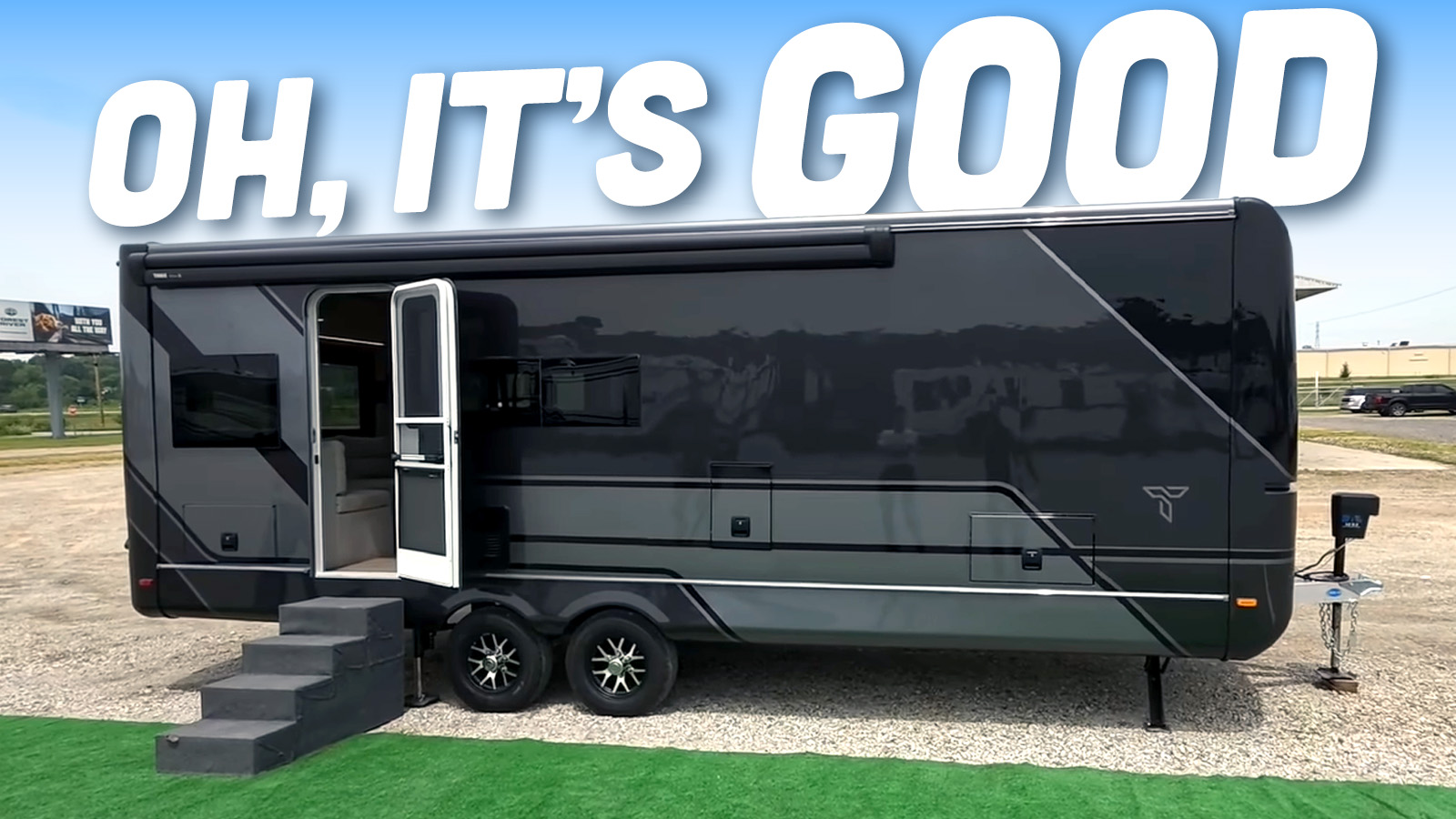
America’s biggest RV conglomerates, Forest River and Thor Industries, have struggled with a public perception of building recreational vehicles that aren’t held together particularly well. The standard blueprint behind the travel trailer hasn’t changed a whole lot in the past several decades, either. Forest River is launching what it thinks is a great reset on how American travel trailers look and are built. This is the Teleos, and it’s supposed to be the camper that’s unlike other American campers, and perhaps a unit from a big brand that you might want to buy.
Much of America’s recent RV innovations have been coming from startup companies. Lightship and Pebble have both created self-propelled travel trailers built out of sturdy composites and metals, then actually put them into production. Awaken RV took one of the best materials to make a camper out of, fiberglass, and used it to create a roomy, luxurious travel trailer. Then there’s Evotrex, which wants to make the first extended-range electric vehicle travel trailer. There are even startup companies that just build RVs differently, like the thermoplastic units of Lightweight Innovative Vehicle.


The big names in American RVing have sometimes had great ideas that went nowhere. Airstream actually beat both Lightship and Pebble to the concept of a self-propelled travel trailer with the eStream, and then didn’t put it into production. Jayco infused European style and high build quality into its quirky Jay Feather Volare, just to scrap the whole thing. Coachmen designed one of the best all-electric motorhomes, just for General Motors to cancel the BrightDrop van.

To be fair to the big RV brands, they have been taking some big swings that are very exciting. Entegra, a subsidiary of Jayco, which is owned by Thor Industries, created the first extended-range electric motorhome (above) with the Embark. So far as I’m aware, that one is still on track to reach production, which is awesome! Keystone, another Thor brand, has a line of trailers that have no wood in their structure and automotive-grade finishes for a price that’s affordable.
Forest River hasn’t exactly sat on its laurels, either. A couple of years ago, I praised the No Boundaries RV Suite RVS1 for its funky design and decent build quality. Now, Forest River is stepping up to the plate and swinging hard. The new Teleos isn’t just a new trailer, but it’s a whole new brand that’s supposed to be unlike anything Forest River and its subsidiaries have ever built before.
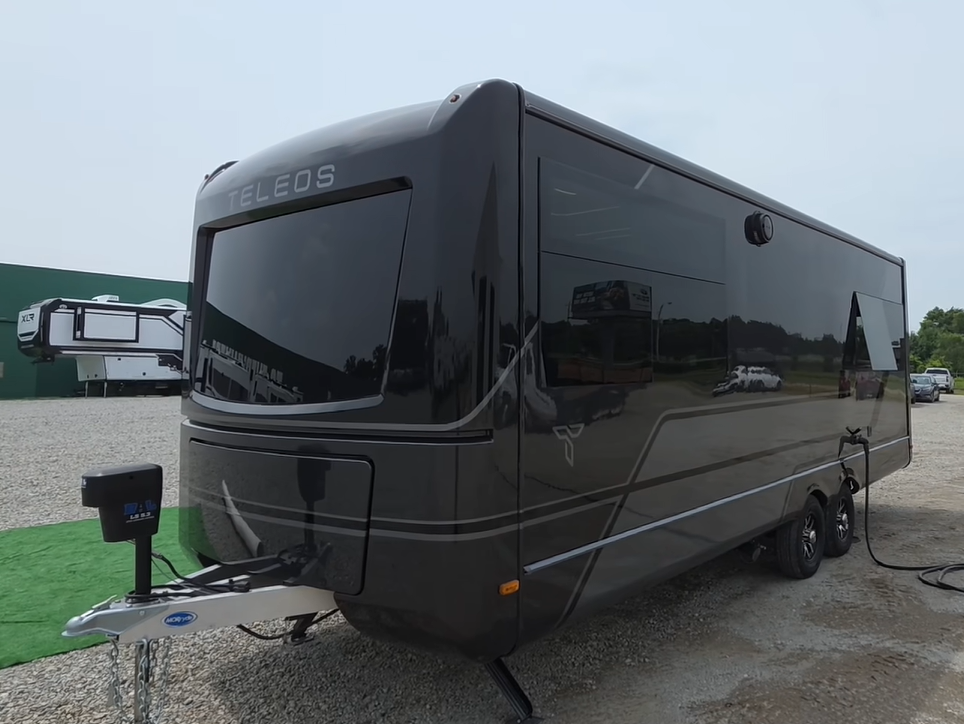
The Teleos
The Forest River Teleos has had a strange product debut cycle.
On July 22, RVBusiness published an exclusive story about the trailer. What made this story weird and a little funny is that Forest River itself didn’t announce a new trailer or brand, and then still didn’t for several days following the story. Forest River then published a teaser video on July 31 and then started publishing darkened renders about a week ago. The continued secrecy is fascinating, given that RVBusiness, as well as several RV influencers, have published videos about the new camper after visiting a Forest River Sneak Peek dealer preview event.

For full transparency, I am no longer invited to dealer shows, potentially because of how I write about the RV industry. Forest River has never invited me to an event of any kind. As such, the images here are not from me, even though I would have loved to see this trailer up close.
To be clear, I never set out to beat up any RV company, nor do I dislike any RV company. As a lifelong RVer, I just want these companies to produce units that people can be proud of spending their hard-earned dollars on. It looks like Forest River is doing just that with the Teleos. This video from Big Truck Big RV is a great overview:
According to RVBusiness, the Teleos came about after Forest River realized it had a hole in its lineup:
General Manager Mike Gaeddert said the Teleos came about after recognizing Forest River didn’t have an entry in the premium travel trailer market. With guidance from Todd Lozier, Forest River’s corporate engineer, Gaeddert and Coachmen Engineer Joey Gould set about designing something unlike anything else in the RV industry.
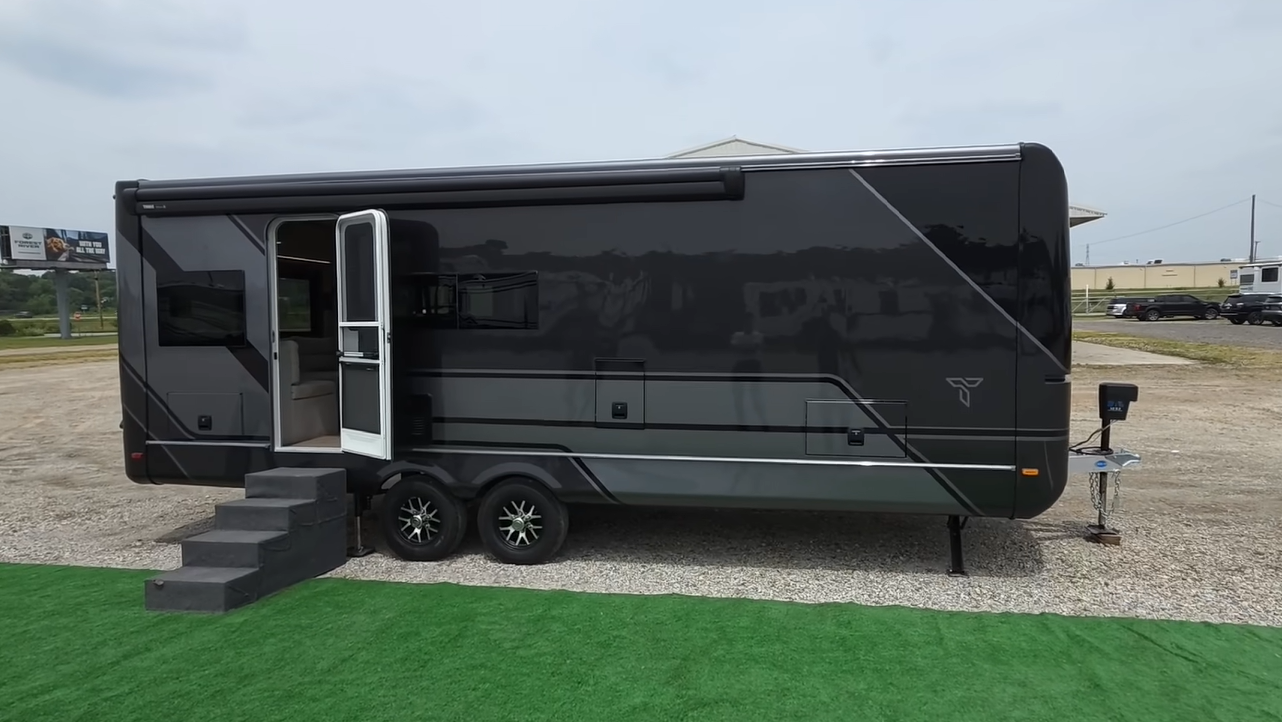
In concept, it’s not too hard to make a “premium travel trailer.” An RV manufacturer could start with one of its standard white boxes, paint it black, give it knobby tires, and load it down the interior with fancy-looking fittings. Maybe they’ll give it a trick feature or two. The box will usually be built with nicer materials than typical, but at its heart, it isn’t much different than a cheaper camper.
That’s what makes the Teleos — a Greek word that roughly translates to “fulfillment” — interesting. It isn’t just a nicer white box, but something far outside the norm for American travel trailers.
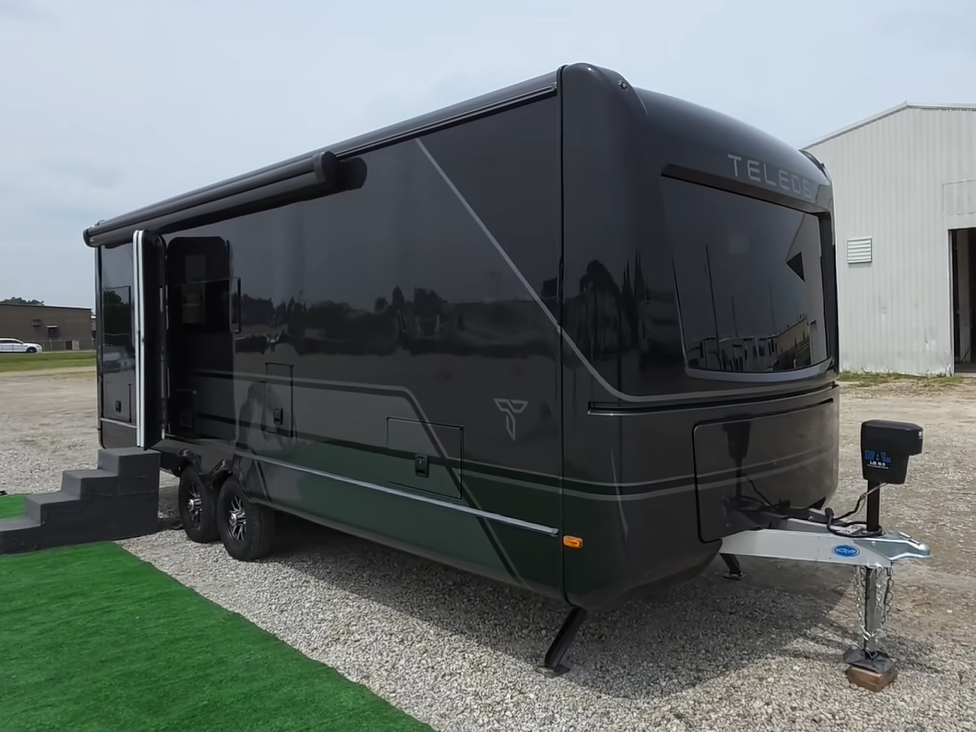
The Teleos is different right from the jump. The roof, sidewalls, and floor are all built out of three-pound foam polyfiber composite that Forest River says is 100 percent waterproof. This material is a sort of sandwich with composite on the outside, foam in the middle, and composite on the inside. Forest River says that this material is non-porous and effectively prevents mold, mildew, and rot.
The roof is more than strong enough to walk on, the walls have superior insulation compared to a typical travel trailer and, per Forest River, the floor alone has three to four times better insulation than a typical trailer. Also notable that the only holes in the roof are for the holding tank vents. The body comes in at 24 feet, 8 inches.

The prototype Teleos trailers ride on a MORryde aluminum frame, but the production version will have a BAL frame, as that is cheaper, weighs less, and will ride on a coil-spring independent suspension. Also present will be a BAL auto-leveling system. The weirdest part about the exterior is the presence of reverse lights, which aren’t typical on an American travel trailer.
Like A Motorhome Inside
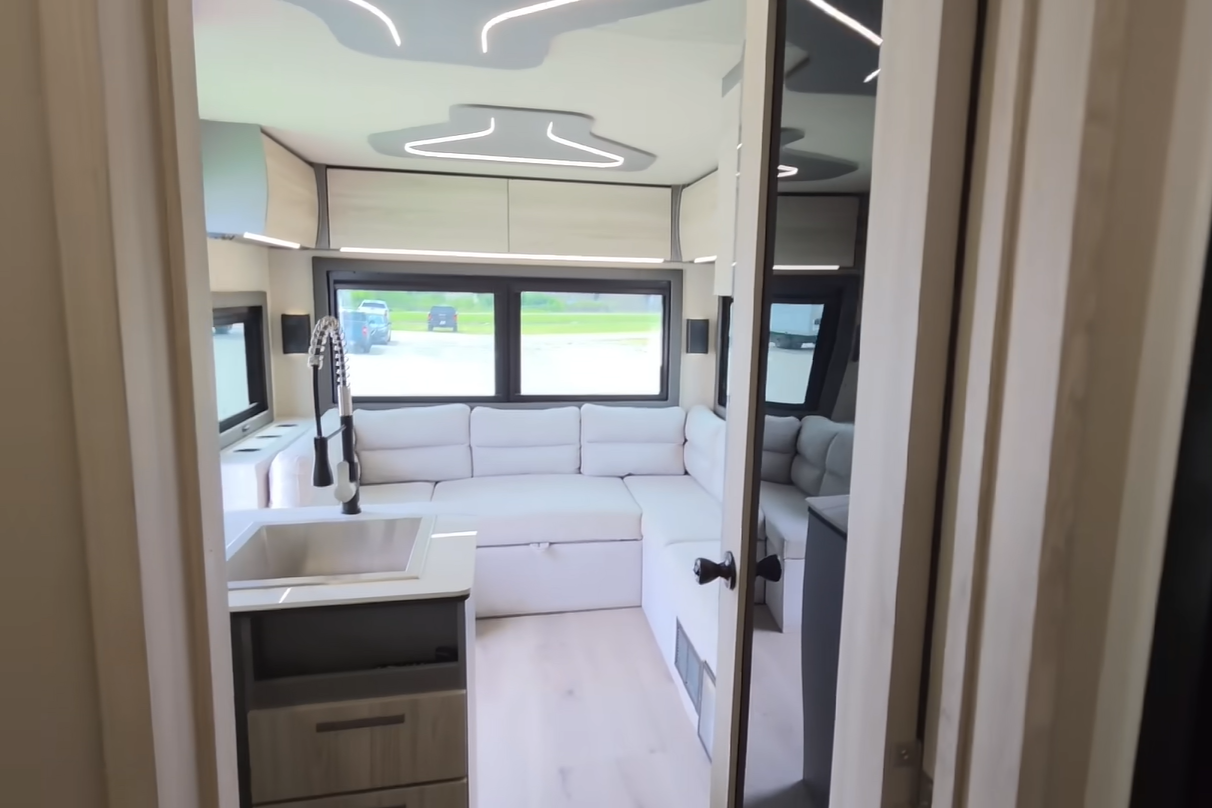
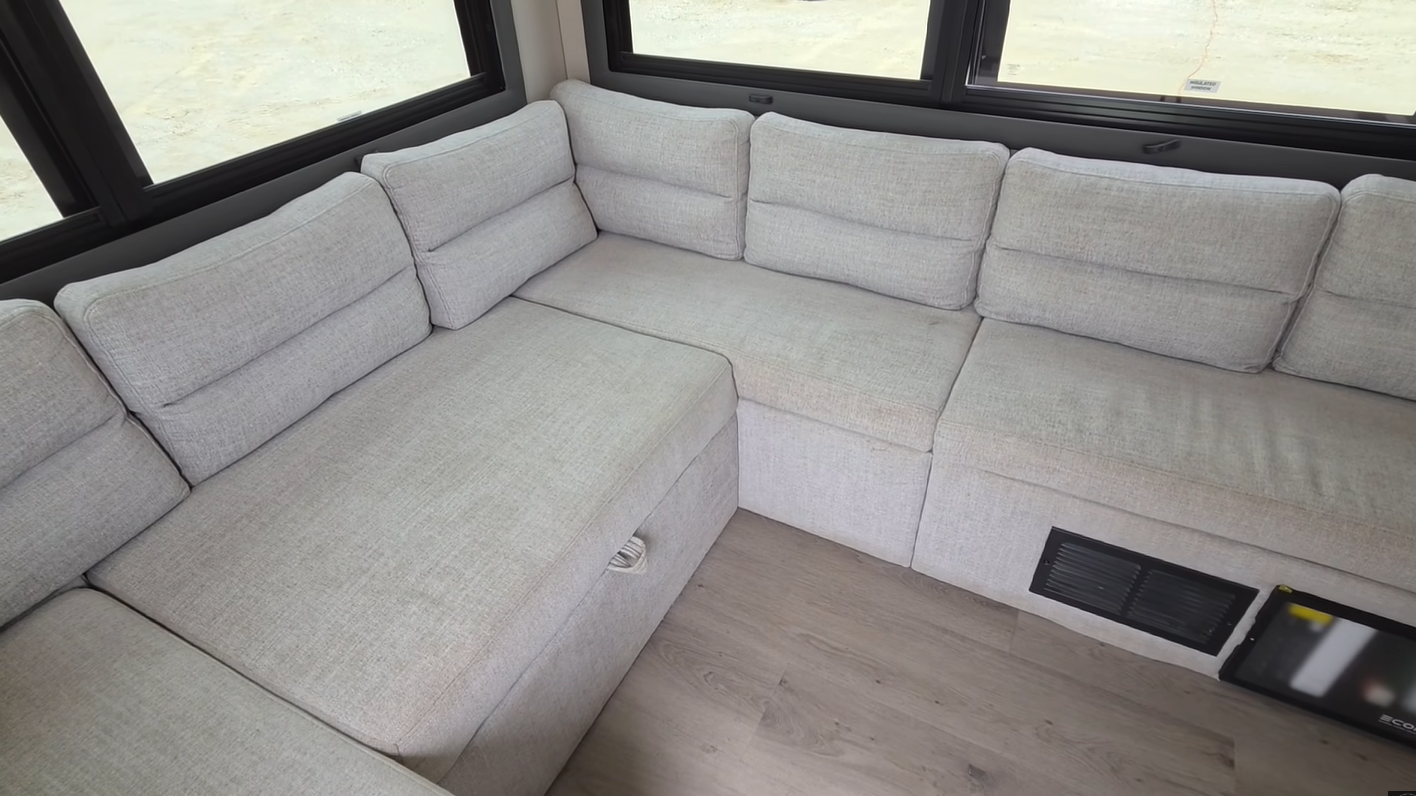
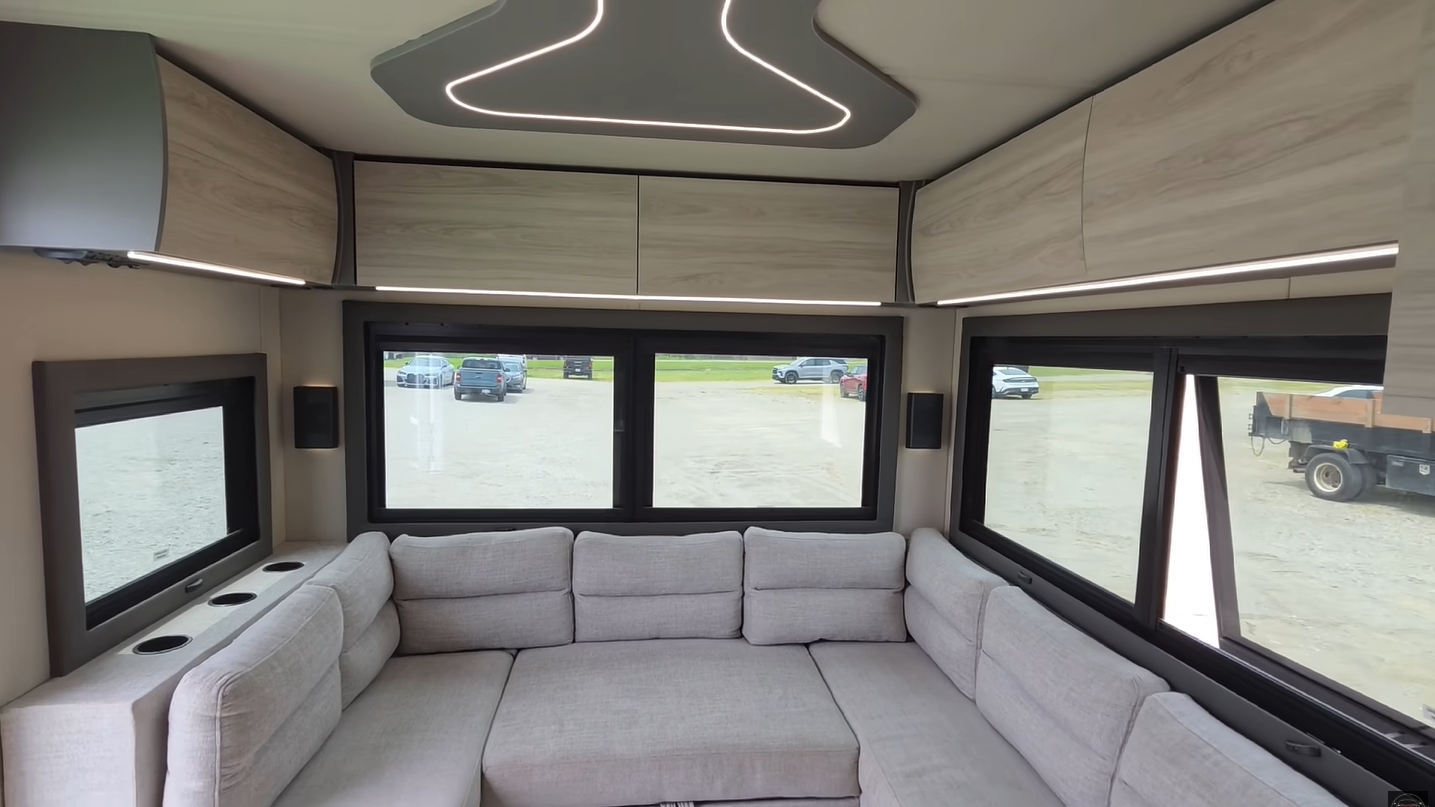
The interior looks pretty neat. Entry is through a rear door, which leads into a sort of living room where there’s so much going on. In just that room alone, there’s a Harmon Kardon 500-watt sound system with two eight-inch subwoofers in the couch and black wall speakers that also double as light sconces. A part of the couch pulls out to turn into a large bed.
The couch area is also where the RV’s EcoFlow Power Kit Gen 2 is housed. The 10 kWh (800 Ah at 12 V) system consists of two large modules that are stored under the couch. This system is expandable to 24 volts or 48 volts, and one of its inputs is two solar panel hookups outside, which support up to 7.2 kW of solar.
Forest River claims that the batteries alone are good for two days on DC power, or 12 hours of running the air conditioner non-stop.
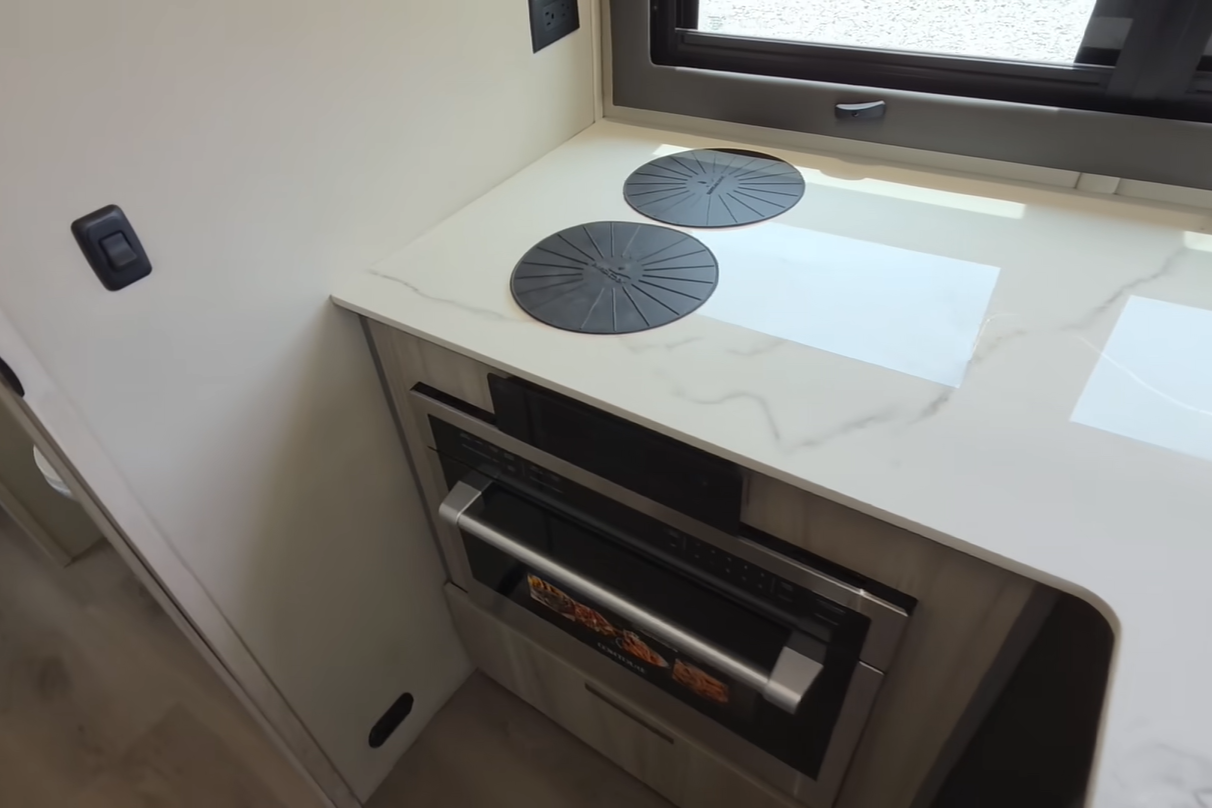
The kitchen has some tricks of its own. An area that looks to be just unused counter space just above the convection oven is actually an Invisacook dual “burner” induction cooktop. Weirdly, there’s no backsplash around either cooking surface, but there is a glass bottom under the cabinet in case your cooking causes grease to fly up. The countertops are Triple M porcelain.
The cabinetry in the kitchen has locking handles so that even the roughest roads won’t cause your plates and silverware to eject. The style of the cabinetry is inspired by European RVs and features five-ply hardwoods. Drawers feature dovetail wood construction.
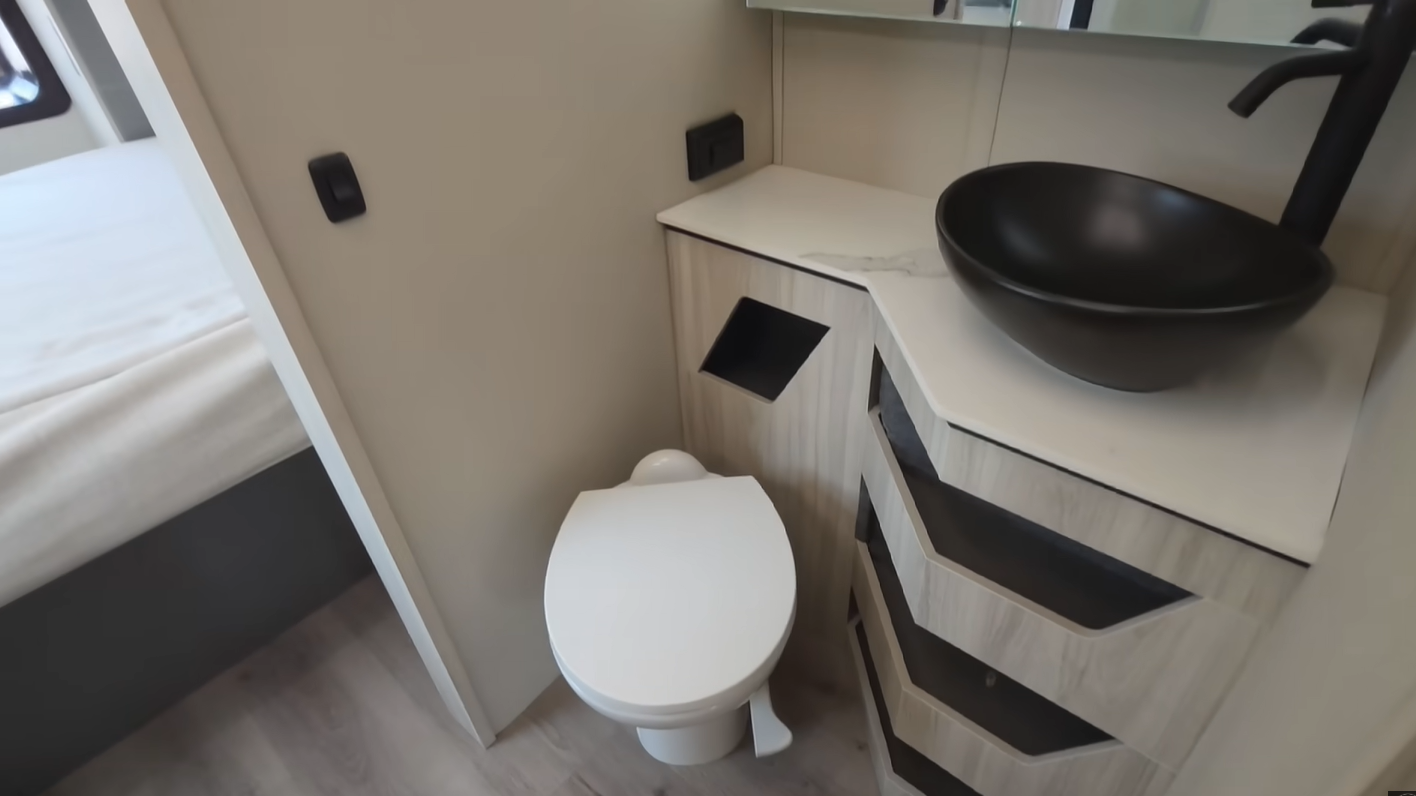
The bathroom is pretty neat, featuring a black bowl sink and a mirror with built-in lighting. The toilet is said to be made of porcelain, and the shower, which has a one-piece liner, appears to be large enough for the average American to use in comfort.
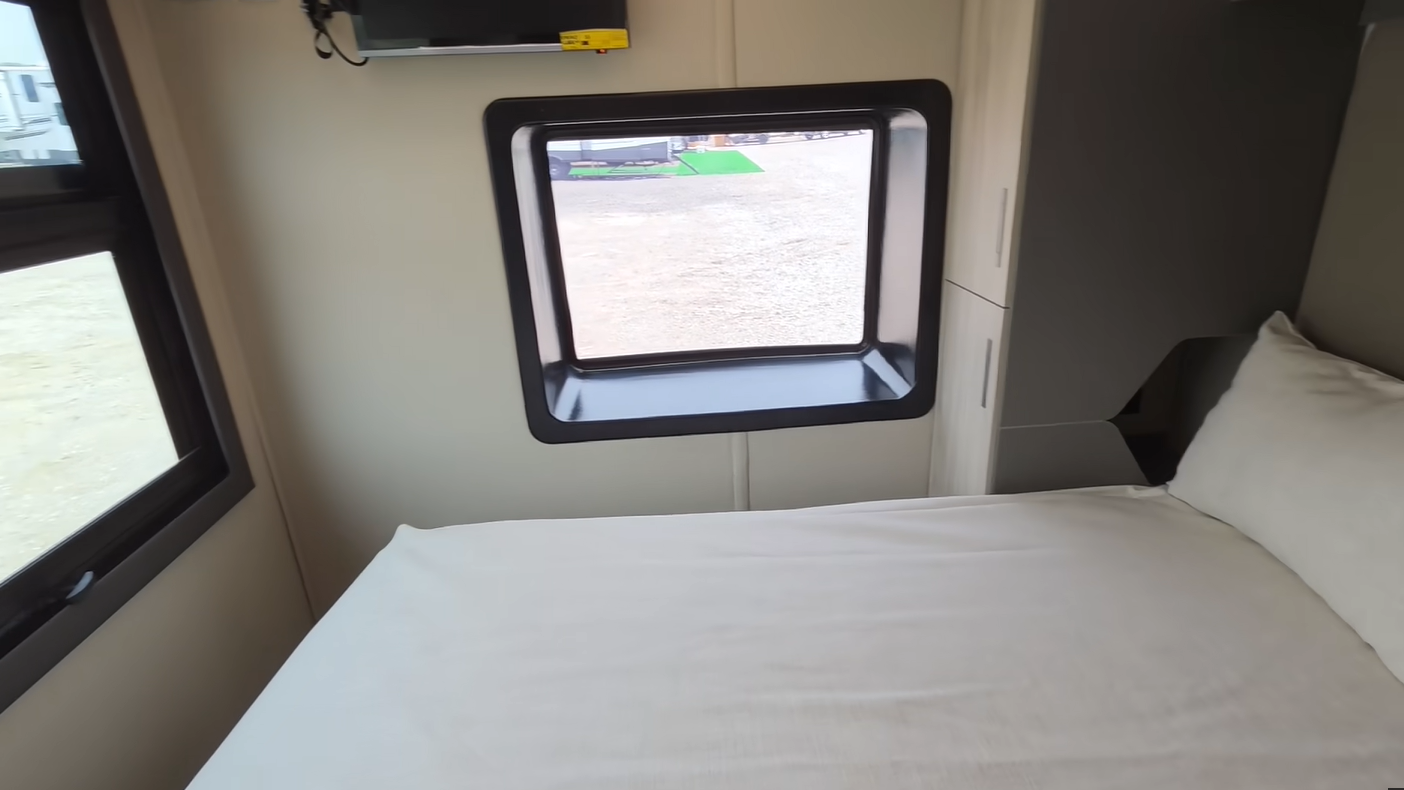
Finally, the primary bedroom is in the rear. Its highlight features are a queen bed and large windows. All of this is supposed to emulate a sort of small European motorhome, but in a towable form. The trailer doesn’t even have slides, which is a new trend that I like. An increasing number of buyers just don’t want to deal with the extra maintenance of slides, and so companies are coming out with RVs that don’t have them.
A couple of nice comfort features include padded walls and ceiling, a Truma instant water heater, GE Profile appliances, and dual-pane frameless windows that better battle summer heat and winter cold than typical RV windows. I like how the trailer’s propane tanks are hidden behind a hatch on the trailer’s nose, too. The plumbing system is also noteworthy. Instead of the industry-standard PEX pipe, this trailer has expandable reinforced woven line. The idea is that the lines expand and contract with temperature. Each piece also has a part number and is owner-replaceable.
The Targeted Price Isn’t Surprising
Some expected changes from the prototype to production include flush-mounted baggage doors, motorized steps, an entry door that’s black on the inside, and an awning that’s more flush with the unit. But for the most part, the production unit should look like what you see. RVBusiness reports that the price is expected to land between $75,000 and $90,000, depending on options.
Forest River itself hasn’t revealed many details at all. But the influencers pretty much filled in most of the gaps. At this point, the biggest number left to reveal is the unit’s weight.
Reportedly, Forest River is targeting experienced, well-researched RV buyers who want a quality unit. The Teleos will also be built to order rather than actually being stocked at dealer lots. By doing this, Forest River hopes to avoid accidentally building more units than there is production for. To read that another way, it seems that Forest River does not expect the Teleos to be a mass-market RV, even though the company seems to think that the Teleos will redefine what an American RV is.
There’s a little bit of a wait before we might get those final figures. Forest River is not officially launching the Teleos until the America’s Largest RV Show, which takes place from September 16 to September 20 in Hershey, Pennsylvania.

While the expected price is pretty high, I do love a bunch of the ideas at work here. I like that this trailer is made out of composites, uses real wood in its furnishings, and is built with end-user repairability in mind. I like that it’s not another basic white box with swoops all over it and that it appears that some thought was put into longevity. I also like how the Teleos isn’t a million feet long and doesn’t have a bunch of useless gimmicks. It just seems like a travel trailer that’s built a bit better.
Click here to watch the full video from Big Truck Big RV to get a better look at the trailer.
Honestly, it’s sad that we even have to praise a trailer for having a build that probably won’t start rotting in under 10 years, yet here we are. If anything, a sturdy trailer should be the industry default. But until that day comes, I suppose I’ll continue to highlight when a company does try to go above industry standards. It sounds like the Teleos has good bones, and it doesn’t look like something that came from one of the biggest names in RVing. Hopefully, Forest River sticks the landing, and the Teleos goes into production as something new and different for the American RVer.
Top graphic image: YouTube/Big Truck Big RV


Stupid question, why does the window on the front of the RV look huge on the outside, but when inside it is much smaller? Some kind of opposite Tardis thing happening here?
Mercedes, I appreciate what you’re doing with your reporting on the RV industry. However, I’m struggling with the idea of you still reporting on an industry that’s apparently blackballed you. What makes those manufacturers deserving of space in The Autopian if they won’t allow you an objective review of their products?
*Edited to fix an autocorrect error.
One of the issues with RVs is that they are built really fast- based on that years demand and the workers are generally paid piecework so the faster they build the more they get paid, I saw somebody who was inside a major manufacturer and videoed them- looked like a bunch of tweakers almost running around
100%
From what I hear, that’s exactly what they are. I’m told drug use is rampant in Elkhart.
I saw the pretty pictures, then the name in the subheading and read it as “Perfection”, as in the ultimate realization of the form. “Lofty words”, I think to myself. Then I saw your explainer, which is rather more modest than I’d given them credit for.
But I ain’t no linguist, so I’m sure the translation is context dependent. I’m curious, did they actually expressly state the meaning of the name in PR somewhere? Seems a bit gauche to give it that name and then explain it, especially if they were going big with the naming, but it would clarify their intent.
Since they’re built to order, the name simply means fulfillment, as in, they fulfilled your order. High aspirations, indeed.
lol
I stand corrected.
Where’s the HVAC? Nothing on the roof, not mentioned in the article or shown in the video. Are they hiding the AC unit somewhere other than the roof?
Probably a basement unit very common now
The price surprised me. Am I out of line for thinking that $75-90k is actually a pretty good deal for something like this? I was expecting to hear this would start at $150k.
Given the construction, features, and upgraded interior, I was thinking around $100 to $120 myself. So yeah, seems like the pricing is very fair.
4 x 0 = 0
I would consider buying it if I was in the market, except that it looks a little too “tech bro” on the outside for my taste. I know I’ll be seeing the inside more, but I’d feel like everyone was watching and judging me like I drove a Cybertruck.
I bet they have a light colored option at the very least (if for not other reason than black is a bad choice in the south) and if they are building to order maybe even a couple of colors.
I’m with you on the looks after I stare at it for a bit, but my first through when I saw it was “black utility trailer”.
Why in the world would you care what other people think of what you drive? You might need some meds.
Bass Boat Red loaded with metalflake would be awesome
Seeing RV’s like this just makes me think of how I could DIY one for a fraction of the price. The other thought is…”if I decide to be a traveling nomad”.
Eh.
I’m not a fan of the color. These things spend a lot of their time in the sun; fading is one concern, and solar heating is another. In either case I would be very unwilling to accept a black RV.
Just because you’ve taken a product that exists and made it a radically different color from the rest of the market, doesn’t make it luxurious or even materially different. Any RV could be black, it just takes a couple of gallons of Rustoleum and a carefree disregard for practical considerations. The other so-called “luxury” appointments in this thing strike me as eyewash.
I think I’m becoming very jaded toward RVs in general, and indeed luxury. Luxury is BS, I just want things to work and last. Unfortunately that lets out RVs in general, since the common denominator I have detected among RVs is that they lose value at a rate far exceeding the rest of the automotive industry.
To be clear, I don’t care about the color one bit and generally agree that black is played out. It’s the fact that, in theory, it isn’t built like most RVs.
It doesn’t sound that different though. Stressed skin foam panels are nothing new, not even in RVs. It’s just new in the US in this market and size segment.
I mean, it’s pretty much just a really big foamie.
Call me jaded too, but for me Luxury is not having to use a warranty, not calling tech support and not requiring wrenching on a product I buy for many decades. Very few products meet those criteria these days no matter what the price point.
Luxury = meaningless justification to charge more.
It’s not a clearly defined term so they can throw it around with relative impunity.
If you’re taking your trailer to go camping, not sleeping on the ground is luxury. Everything about the camper is luxury. But you could say that about a utility trailer with an inflatable mattress inside it.
“luxury apartments” sprouting like weeds…
That RV companies build such crap products that they try to silence a reporter is a pretty stinging indictment, but in 2026, it’s not like they can’t look to other places in the public sphere and see similar conduct from others.
“Now, observe the power of this fully functional Imperial Death Trailer!”
I like a lot of the ideas here, but not the styling. Yeesh. It’s a literal black box.
Also, I used to own a 1967 Winnebago trailer with a composite shell. The core was styrofoam, exterior was aluminum, and interior was thin plywood, glued together in a stiff structural sandwich. At 50 years old it was holding up fine. The Teleos has updated the materials, but same concept.
https://itisgood.org/auto-biography/#67Winnebago
Your compendium of vehicular pursuits was just the read I needed over my morning coffee. Life’s too short to drive boring cars, eh? Cheers!
Thanks!
Thor products, even once great Airstream, are legendary disasters. YouTube is full of horror stories that this company fails to address. Run away.
Mercedes, is there another already-released trailer that looks similar to this? I ask because last week I was stuck two cars back behind a trailer very similar (though my hazy memory can’t say identical) to the one in this article.
Same thought here.
It reminds me of the intech aucta magnolia. But I’ve only seen that shown in white. Brinkley ix also looks kind of similar.
They can add all the recessed LED lighting they want. I know a paper box on wheels when I see one.
But this one is a non-porous foam box on wheels. Very different.
Interesting that it’s almost the same floorplan as an Airstream 25FB, at about 3/4 the price depending on trim and equipment – so in that light it isn’t too bad.
However painting something black and calling it “Luxury” – Get outta here with that.
There’s nothing luxurious about being a solar sink, requiring more energy to cool than if it were white.
I’m sorry that you’re blackballed from the RV world – They clearly can’t handle accountability.
Also requiring more energy to heat. Black is the best radiator as well as the best absorber.
Ahhhh – This part I did not know!
Thank you for sharing that nugget of knowledge!
Glad to be of service.
A factoid that stuck in my brain from secondary school physics. Thank you for giving me the opening to deploy it after about 50 years!
Seems like the Autopian needs a person to be some sort of “mole” to go to RV dealer shows so Mercedes can get more inside info and pictures.
Unless we can shame them into inviting Mercedes again but I’m not holding by breath on that happening.
We’d do better to shame them into making better product and improving working conditions.
But Indiana.
Exactly!
These articles do reinforce my desire to only ever rent an RV. Which we have done a couple times. Also, a lack of lots of extra money and parking plays into that, as well as having grown up with tent camping. But I can see something of the appeal of an RV. But having to deal with owning one is not for me. If like some folks I know, you have a place to park it on your own property, have the time and money for upkeep, and take it out for vacations fairly often, it pencils out differently.
The Autopian’s new motorhoming aficionado, Cadillac Boulevard, a mustachioed fellow who always wears a cowboy hat, may be able to get us the answers we need!
You’d have to get credentialed via a different site entirely and then post fluff articles that the manufacturers want, too. The problem isn’t that Mercedes can’t go to public RV shows, it’s that she doesn’t get invited to the industry-only ones anymore where the new stuff gets announced.
The whole industry is smoke and mirrors… “Record numbers…”, “Shipments up”, etc. It’s all bogus numbers to fit a narrative… No shipments, no massive pay bonuses to GM’s and Product managers. The old saying of “Follow the money” is very much alive in the RV industry, from purchasers getting bonuses from how much money they save the company using cheaper components, to sales managers trying to shove even more inventory on already full lots to make sure they hit their numbers so they don’t get fired… This is the formula that is in place that produces the quality issues the industry is now been branded with.
I’m sure I would have loved your story, but I just had to FF to the price. Yeah, no. Not paying the price for this innovation. Insanity.
You know, it’s actually possible to love the article, but at the same time not like the price…
It has that very Chinese black box on the outside very Chinese lighter monochromatic box house on the inside. I guess that’s modern style. He did a video on the new intech aucta magnolia a while ago that seemed very interesting and not so Indiana in quality.
For what it is, it looks pretty nice. The build quality described here should be baseline for the industry. It’s sad that you have to go upmarket to get it.
While I know it makes your job more difficult, I’d say it’s a badge of honor that you got yourself banned!
My husband and I just (for the first time) went and looked at new trailers and of the brands carried at this particular lot, I was absolutely SHOCKED at how low the build quality was, except for a “Little Guy” (or “little buddy”?) and of course the Airstream.
Your wishes are interfering with the companies’ goal of ripping off their customers. This will not do.
And, there it is.
*Doubt*
Though given I’m the fly/drive somewhere, plan later kind of person, I’m not exactly the RV target market. You can buy heaps of those holidays for $90k and see so much more of the world.
Ha! I had a line in my original draft about how about half of our readers like RVs and half like hotels. Regardless of whatever line you’re on, I feel that if you’re spending thousands of dollars, you shouldn’t feel like you’re getting ripped off. 🙂
Dont forget the half of us that like tents. 🙂
That’s the third half.
Also don’t forget the half of us that like hammocks
My other trailer is a hammock.
As someone said: “the great thing about camping is that it’s optional”. The same I say about campers. I appreciate the content but to me it’s like reading “The Housetopian”. Furniture doesn’t interest me at all, and it’s already awful to take out the trash so I can’t imagine how it’d be to take out my own shit.
I like the idea of RVs but the reality of hotels.
I’ve yet to see an RV that doesn’t feel like someone is getting ripped off haha. An Airstream goes closest but that’s kind of like comparing a 911 to a Miata, except the Miata won’t be rusty and leaky on arrival with all functions being questionable.
Sorry, my grudge against caravan/RV manufacturers for high priced rubbish is showing again. Just don’t misconstrue it as ill will towards people who buy them 🙂
The sad thing is why these premium-level RVs and campers are doing so well in the market right now. Earthroamers can go for north of $300,000 but continue to sell despite the downturn in the economy. The reason is because people aren’t buying premium RVs and campers as toys, they’re being purchased instead of a home. With home prices soaring and rent through the roof, a $100,000-$300,000 RV is being cross-shopped against real estate, not other lifestyle toys.
For a ton of people this isn’t a luxury camper, it’s luxury homelessness.
I cannot put into words how depressing that is.
Eh, I’m sure this happens some, but I don’t think it’s material. The reality is that the top 10% income households (around $220k and up) in the USA take in about 30% of the total income and annually expend around 20% of total expenditures in the country. There’s a market for these things for people using them recreationally, even as things start to feel desperate for three quarters of the population.
(source: BLS consumer expenditures report, which is a couple years old as the survey data lags)
I’m sure luxury homelessness is component but I’m not sure it’s a new phenomena nor the whole market. The whole tiny house and tiny house on wheels as well as the skooly things caught on like wild fire because of housing unaffordability. None were really new ideas. Certain parts of the country have been using pre fab sheds for housing and businesses for decades. There were groups doing similar things in the 60s and 70s with rvs, busses and small houses. It just was socially less respectable by most of society. Someone told me it’s same as tattoos. Increasing social acceptance but have been around a very long time.
It’s also common for older people to retire to luxury rvs as their house then eventually find land in places they like. As people are working remote people seemed to do that earlier then later. I know some rural real estate started bringing stupid amount of money part of that was remote work and leo internet like starlink coming online. As those prices stabilize we are starting to see those younger people buying land for their rv and some kind of homestead type situation.
You also see it with boats. People living on boats some dont even leave the marina. It’s the whole “alternative living” thing.
“Luxury homelessness” is the most dystopian thing I’ve heard in a long time.
It’s normally called “alternative living” by the people doing it they seem happy enough. “Stealth camping” it’s basically luxury homelessness. That’s where it gets super dystopian and depressing. Most think they are beating the system but also appear to be stressed about being caught or bad things happening.
People stealth camp in vans and cars not luxury RVs. Vehicles like the 1990’s hightop Econoline van I see in my neighborhood several times a week.
Box trucks and cargo trailers are popular. Alternative living / luxury homelessness. Luxury has no meaning anymore.
Yes, they are. They also aren’t $100K to $300K RVs.
Can’t say I’ve every seen an luxury RV when boondocking on BLM land or staying in cheap forest service campgrounds. Those types of rigs gravitate campgrounds with power and showers instead of at best a pit toilet and water spigot.
(I looked hard at a box truck conversion before I decided to do an ambulance instead)
Hard to beat ambulance build quality especially something like a Horton.
They are probably $30k to $60k in most of the completed builds. There were some areas of the country just a few years ago you could buy a brand new house for $60k. Who knows maybe they have a $5k former uhaul and and air mattress. But likey working to improve it if they are living like that..
I’m sure someone with an earth roamer type RV has gone all over blm land. Im not sure there really “luxury” it’s expensive. But does luxury = expensive. Maybe? Probably not. It could mean anything. It might be the most over used word that has no meaning. There is the “quiet luxury” that has zero meaning but was everywhere. So many “luxury” brands that aren’t. Lvhc brands are viewed by some as “luxury” but by real rich people they are looked as trashy.
The “luxury coach” or “luxury RV” isn’t going to boondock much of at all. The sort of middle of the road might especially when they are older.
Yes, ambulance build quality is second to none. The entire box is welded aluminum.
It’s not new, but it is growing. Companies making high end campers and RVs do their own market research and that data is showing an increase in the number of people saving up for a camper or RV who don’t own or rent real property. The industry’s own metrics are showing this is an increasing market segment; it may have always been there, especially for retirees, but young working professionals are now using vehicles as their full time home because they can’t afford real property.
There’s a big difference between “I could buy a house, but I love living on a boat” and “I live in a van because I can’t afford anything more”. Housing data shows the number of adult children living at home with their parents is at an all time high, with children continuing to live at home into their 30s despite working full time.
The median home price in the US is now $429,500, about 34.4% higher than 2019. The majority of young adults living at home with parents are working full time and have a college education but still can’t afford to move out or save for a down payment while paying rent. Median monthly rent in the US is $1,686 a month, up nearly 20% from 2019. We are about 4 million homes short of meeting demand for rental or purchase, resulting in higher costs. The typical first-time homebuyer in the US today is 40 years old.
We’ve gone from “If you don’t get it together you’ll be living in a van down by the river eating government cheese” to “if you work really hard and save every penny you too will someday be able to afford living in a van down by the river”. People who can’t afford a lease or a mortgage but also don’t have family support (or toxic home environments) are turning to sustained homelessness, it might be a luxury van, but it’s still homelessness.
There are a lot of things happening. Some of them have happened in other countries. Some seem unique to both the us and this time. I recently heard someone say I can’t afford the housing market. But I can afford land and to build a house. I think that hits the nail on the head. They bought land and are currently working on building a house. So it’s not just talk. It’s how housing used to be built.
Developers buying a large tract of land then charging insane amounts pieces of that land. Then making money on the house sometimes a developer and a builder. Has extracted alot of money out of alot of people and has significantly increased housing unaffordability especially over the past decade. But it’s only really been a thing for 75 years. Before that it was find land build house. More control and can make it fit your budget.
The US has an increasingly transient population. In other countries its mainly going to the big cities maybe a close suburb. For 50 maybe 60 years people were leaving the cities for suburbs in the US. Over the last 15 years you had people going back into cities and looking for a deal in 2nd and 3rd tier cities. Look at what has happened to Buffalo. It went from a great deal to unaffordable because people kept saying look it’s affordable and a decent place. Supply and demand went the other way. Developers noticed and brought their broken model that extracts more money that is affordable in the market. Now affordability is in smaller cities in non metro areas. Maybe a few 3rd tier cities metro areas.
The whole rural land thing has been cooling down. It was a crazy situation caused by lots of people wanting to be away from everyone and everything but could still work remotely. Alot of those people weren’t doing a whole lot but being paid very well. They lost their jobs as tech companies tightened their belts. The market is healing from it. I suspect they also got tired of living in the middle of nowhere. There is a real estate agent in Idaho that says everyone he meets is looking for a 5 bed 5 bath house on 5 acres 7 minute walk from Starbucks.
You can almost always find someone that says “I’ve escaped the housing market” because they are doing something other then buying a pre built house.
In a similar way emigration is way up. People are moving to different countries because they fit their lifestyles better and are generally more affordable. That’s causing some problems in some countries. In other countries its a mixed bag. Japan for instance needs population in their country side. They have a lot of abandoned cheap sometimes free houses. But have started to put more restrictions in place while trying to figure out a sustainable solution. Similarly to the various European rural villages that offered low cost or free houses that needed to be fixed up.
On the flip side places like Mexico City, Madrid, Bali, had enough of the situation with digital nomad and the unaffordability it was causing and have started reforms.
The USA is not increasingly transient. We actually have a problem of decreased mobility. People used to move to opportunity and today that is becoming increasingly rare. In the 1960’s 20% of US households moved in any given year and 3.5% moved to another state. Today that is 9% and 1.5% which is the lowest it has been since the US Census Bureau started tracking it in 1949.
People used to have to get a fresh license plate every year too. Along with a new land land in the area. Younger people are moving around they just aren’t telling the government.
I’ve never lived anywhere that requires new plate every year but registration stickers have been required in every state I’ve live. Here in Oregon it every 2 years instead of 1.
Anyone doing the nomad thing in a $300K RV is making enough to leave a trail.
It was the way until the 70s. All those antique plates with the year stamped in them.
These people aren’t living in a $300k RV maybe not even an RV. They might be in the gig economy. Might have a remote job. On paper they live with their parents and they might some times. Other times they are other places. It’s very common in the 22 to 35ish group.
Sorry but I’m not seeing the local homeless population in $100K to $300K luxury RVs. More like 30 year old broken down RVs that often don’t even move anymore. Likewise in the man camps and RV camps where people are living full time. Those RVs are still mobile but are overwhelmingly cheap and old. It is all about minimizing cost.
Someone that can afford a $300K RV and lot rent in an RV park can own a single family home. Maybe not in LA but certainly in “fly-over country”. People are doing the digital nomad thing because they want to travel not because they can’t afford a house or rent.
A 3 bed / 2 bath house can be easily found in my Michigan hometown for $150K.
Yes, congratulations, you understand that national averages are *averages* and that in a normal distribution half the numbers will be less than the mean. Broken down old RVs are certainly common, however, there’s a new type of homelessness. Fairly high earning professionals are going this route due to cost but also because extremely long term auto loans are now common, with institutions regularly offering 96 month loans and even 108 month loans That’s an 8 or nine *year* auto loan on a vehicle.
In major cities the cost of rent or a mortgage is out of reach and people are not willing to put down roots in a small town for numerous reasons, but lack of services or cultural differences are usually cited. The cost of living in many small towns may be less than living in a major metro area, but it’s often not worth it. I’ve been looking at property in the my region (meaning within about 6 hours drive from my current home). Small and remote towns in my state still have 60-70 year old starter homes in the $400,000+ range and nicer homes can easily top $600,000 with new builds being $800,000 simply because contractors don’t want to travel out to the sticks to build and that’s reflected in the price. Sometimes you can find a house for $300,000, but it’s often got some serious problems. I recently looked at one that was over 100 years old in a small town with an asking price in the $300,000 that had been on the market for over a year and clearly had major structural deficits. At the end of it, you still have an old home in an underfunded school district with limited services in the middle of the desert – that’s just not a life many people are willing to pay a half a million dollars for.
The data doesn’t lie. The RV industry’s own market research indicates a rise in people buying RVs and campers instead of real estate; you can frame this as a choice to do that rather than buy an old house out in the sticks, but the fact that your choice is to completely change your way of life and move to a flyover state that no one wants to live in to afford a home is already a problem. Correlate that with the rising home prices across the US and even faster housing cost increases in markets with any kind of desirability and a more comprehensive picture starts to take shape. Wages have not grown with parity to inflation, private equity is buying up the home inventory to turn us into a rental nation where you own nothing – and that in turn is driving up prices by artificially inflating demand. This is such a problem that some cities and states have passed laws limiting how many units corporations are allowed to purchase.
In Texas a developer built hundreds of new homes with the intent to sell the entire neighborhood to private equity, none of those homes ever entered the market for sale; they were sold as an entire investment and will only be used as rentals.
While the “van life” is a choice, it’s one that many are embracing as the least-bad option. The inability to purchase a home and the fact that rents are as much as a mortgage (or sometimes more), means living in a van now looks like a viable option – and as long as we’re in a van we might as well go nomad and make the best of it. Reducing this to a simple “lifestyle choice” is simplistic and doesn’t come close to capturing the social and economic factors that created the phenomenon.
I live in an expensive west coast metro. We have plenty of homeless. What we don’t have is homeless in $300K RVs. We have fancy RVs too but the people in them are generally retirees or high income earners that have the money to use them a few weekends and pay to store them the rent of the year. (RV storage is $600 a month in my city)
Anyone that can live a nomad lifestyle and work from anywhere can in fact buy a house in the USA if they can afford a $300K RV.
A $300K RV is also going to cost someone way more than a $300K house – even a fixer upper.. An RV requires someplace to park it every night – either a long term park or bouncing from one campground to another. Campground fees are not cheap. Then there is gas and maintenance which if you have been following any of Mercedes’ RV articles is massive for RVs. There is also massive depreciation which makes luxury EV depreciation look good.
The factors for home prices are pretty clear. We have expenses places that have more people than available homes and various factors have restricted home building. (A lot of that is NIMBY policies from current homeowners that don’t want for density or more people in their town) We have people that can’t afford to live there but still want to live there and won’t move to someplace they can afford. (I work with plenty of 20 and 30 year olds that complain they will never be able to afford a house but also won’t transfer to one of our other locations where they could easily buy one)
We are also starting to see the housing bubble start to reverse. Home prices are falling in places like Seattle, Denver, Tampa, Dallas…. Time will tell if the bubble deflates slowly or pops like in 2008/2009. (Austin’s home prices peaked in 2022 and the median price has dropped more than $100K since)
“Wages have not grown with parity to inflation”
Correct, median household wages have exceeded inflation
Living in a large west coast metro area doesn’t tend to generalize well to the rest of the country. You seem to have difficulty with the difference between “this is a thing that happens and is starting to happen more often” and “this is the norm that you see everywhere”. No one living a “van life” lifestyle, regardless of the reason, is going to want to park up for the night in the middle LA, San Diego, or the Bay Area.
Are you using the Congressional Budget Office study for that assertion about household income vs inflation? The one looking specifically at 1979 to 2011? I ask because the Wiki article that typically comes up when searching for those types of terms primarily uses that study as the source. (Meaning if you asked AI to do this for you, guess where it looks?)
Here’s a couple problems with that study – it’s looking at household income, not wages. In the post-war era up until the early 1970s you could live a comfortable middle-class lifestyle with a family and own a home on one minimum-wage income. When you start to look at household income the numbers get skewed by multiple-income families. So the lifestyle that was possible in the 1960s with one entry-level minimum wage job now requires two people to work. The other problem with the study is that it’s weighted by household size; and we also know that economic and social factors (including both parents needing to work) has resulted in lower fertility rates – people have fewer children and have them later in life. So the higher earning of middle-age is being offset by adding children, but the entire datapool is being confounded by the social changes predicated on wages not keeping pace with expenses. Finally, the study period is from 1973 to 2011; 1973 also saw a major economic downturn due to the energy crisis, the 1970s and 1980s also saw increasingly pronounced income inequality and regressive tax changes (especially in the 1980s). By cutting out the 1950s and 1960s, the era that saw the greatest economic boom of the nation’s history, the study eliminates the best baseline we have for future policy. You could hardly create a more biased study model if you tried.
Living in a large west coast metro gives me an excellent view of rapidly increasing housing prices. It also gives me an excellent view of homelessness as I see people living in vans, trailers, and tents daily. I also have a campervan and spend several weeks a year on extended trips which gives me a pretty good view of what is happening in campsites. Especially the low end as we spend most of our time either dispersed camping on federal land or staying in cheap forest service or state campgrounds. We do an occasional night stealth camping as well. As I said above I see a lot of homeless in old cars, RVs and trailers. What I don’t see out among the homeless is $100K to $300K rigs. Not very many EarthRoamers in the homeless camps. (I’ve also lived in the Midwest, East, and South.)
The reason I’m not buying the idea that people that are actually economically priced out the housing market are buying luxury RVs is because the math doesn’t work. The typical RV loan term is 10 to 15 years. A $250,000 RV with a 15 year loan @ 8.5% has a $2,462 a month payment. In a 30 year mortgage that same $2,462 payment buys a $373,823 house at 6.9%. (Rates from my local credit union). $374K will buy the median home in 28 states and a digital nomad can live anywhere they want and an entry level home buyer should not be shopping for a median home any more than a first time car buyer should be shopping for a average car. There are lower priced options available.
I use FRED (Federal Reserve Economic Data) for most of my economic data. Below is the Real Median Household Income which is adjusted for inflation – including housing costs. We get 2025 data in less than a month. Household income includes every household including single people. If you just want 2 or more related people living together that is median Family Income which is also available.
Household: Real Median Household Income in the United States (MEHOINUSA672N) | FRED | St. Louis Fed
Family: Real Median Family Income in the United States (MEFAINUSA672N) | FRED | St. Louis Fed
The average household’s buying power is up 38% in the last 40 years
The average family’s buying power is up 48% in the last 40 years and 2.7x since 1954.
You are correct that there was a big boom in the 50’s and 60’s. You are incorrect that an entry level worker could support a family and buy a house on one income. Even way back in 1950 the prime age labor force participation rate was 65% so almost 2/3rd of all people that age worked It peaked in the 1990’s at 84%
Labor Force Participation Rate – 25-54 Yrs. (LNS11300060) | FRED | St. Louis Fed