

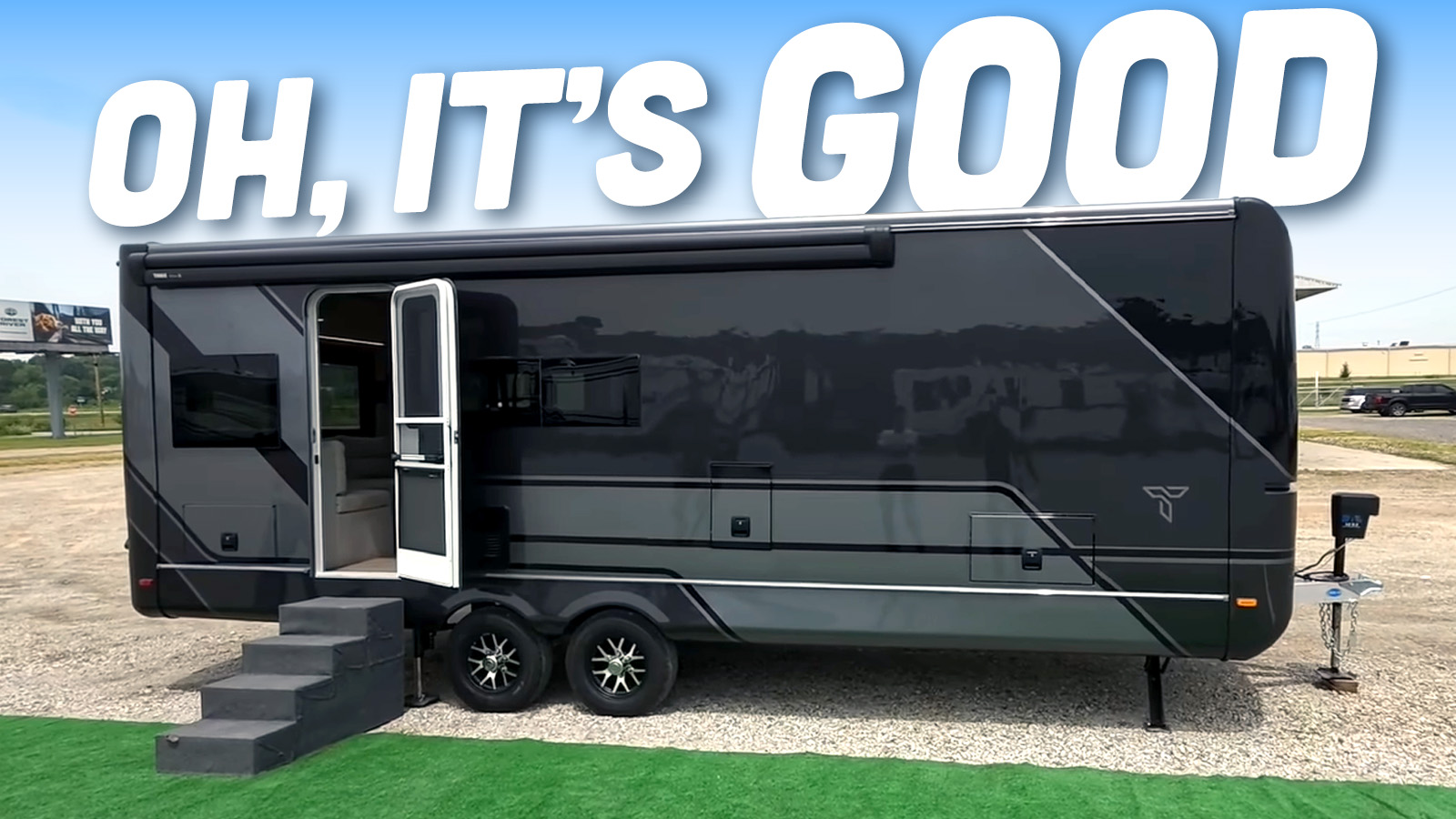
America’s biggest RV conglomerates, Forest River and Thor Industries, have struggled with a public perception of building recreational vehicles that aren’t held together particularly well. The standard blueprint behind the travel trailer hasn’t changed a whole lot in the past several decades, either. Forest River is launching what it thinks is a great reset on how American travel trailers look and are built. This is the Teleos, and it’s supposed to be the camper that’s unlike other American campers, and perhaps a unit from a big brand that you might want to buy.
Much of America’s recent RV innovations have been coming from startup companies. Lightship and Pebble have both created self-propelled travel trailers built out of sturdy composites and metals, then actually put them into production. Awaken RV took one of the best materials to make a camper out of, fiberglass, and used it to create a roomy, luxurious travel trailer. Then there’s Evotrex, which wants to make the first extended-range electric vehicle travel trailer. There are even startup companies that just build RVs differently, like the thermoplastic units of Lightweight Innovative Vehicle.


The big names in American RVing have sometimes had great ideas that went nowhere. Airstream actually beat both Lightship and Pebble to the concept of a self-propelled travel trailer with the eStream, and then didn’t put it into production. Jayco infused European style and high build quality into its quirky Jay Feather Volare, just to scrap the whole thing. Coachmen designed one of the best all-electric motorhomes, just for General Motors to cancel the BrightDrop van.

To be fair to the big RV brands, they have been taking some big swings that are very exciting. Entegra, a subsidiary of Jayco, which is owned by Thor Industries, created the first extended-range electric motorhome (above) with the Embark. So far as I’m aware, that one is still on track to reach production, which is awesome! Keystone, another Thor brand, has a line of trailers that have no wood in their structure and automotive-grade finishes for a price that’s affordable.
Forest River hasn’t exactly sat on its laurels, either. A couple of years ago, I praised the No Boundaries RV Suite RVS1 for its funky design and decent build quality. Now, Forest River is stepping up to the plate and swinging hard. The new Teleos isn’t just a new trailer, but it’s a whole new brand that’s supposed to be unlike anything Forest River and its subsidiaries have ever built before.
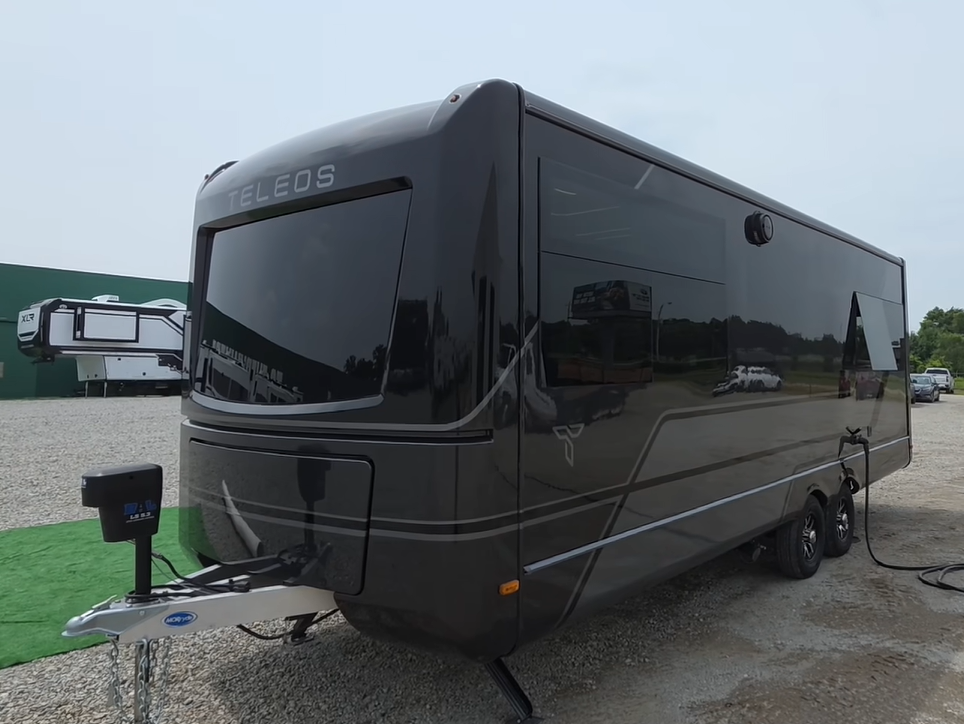
The Teleos
The Forest River Teleos has had a strange product debut cycle.
On July 22, RVBusiness published an exclusive story about the trailer. What made this story weird and a little funny is that Forest River itself didn’t announce a new trailer or brand, and then still didn’t for several days following the story. Forest River then published a teaser video on July 31 and then started publishing darkened renders about a week ago. The continued secrecy is fascinating, given that RVBusiness, as well as several RV influencers, have published videos about the new camper after visiting a Forest River Sneak Peek dealer preview event.
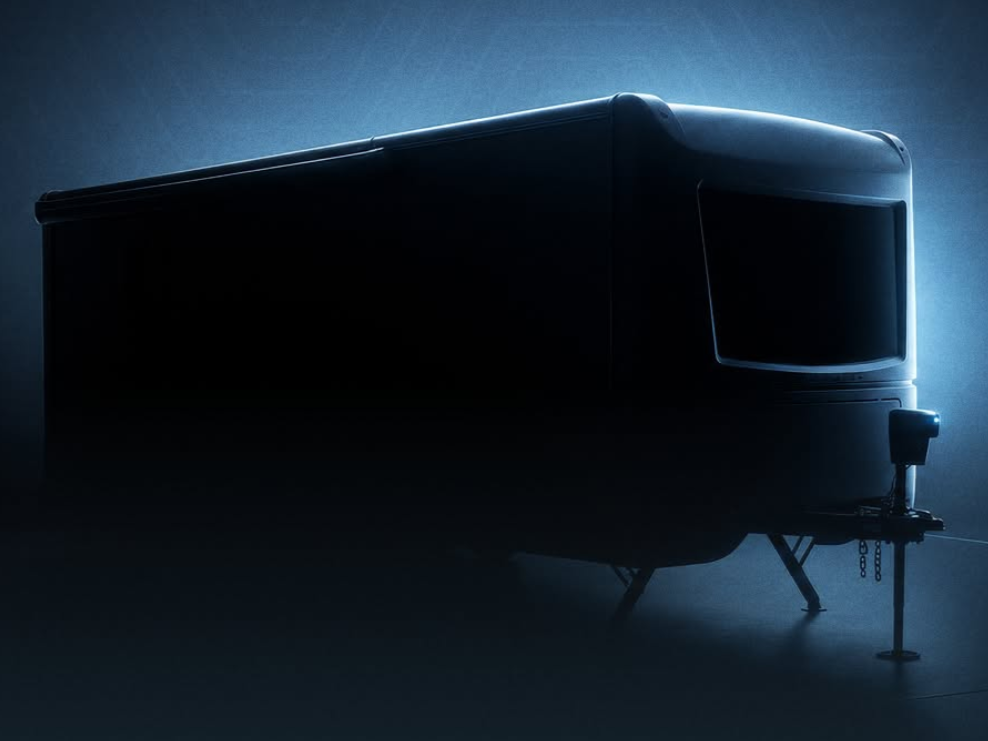
For full transparency, I am no longer invited to dealer shows, potentially because of how I write about the RV industry. Forest River has never invited me to an event of any kind. As such, the images here are not from me, even though I would have loved to see this trailer up close.
To be clear, I never set out to beat up any RV company, nor do I dislike any RV company. As a lifelong RVer, I just want these companies to produce units that people can be proud of spending their hard-earned dollars on. It looks like Forest River is doing just that with the Teleos. This video from Big Truck Big RV is a great overview:
According to RVBusiness, the Teleos came about after Forest River realized it had a hole in its lineup:
General Manager Mike Gaeddert said the Teleos came about after recognizing Forest River didn’t have an entry in the premium travel trailer market. With guidance from Todd Lozier, Forest River’s corporate engineer, Gaeddert and Coachmen Engineer Joey Gould set about designing something unlike anything else in the RV industry.
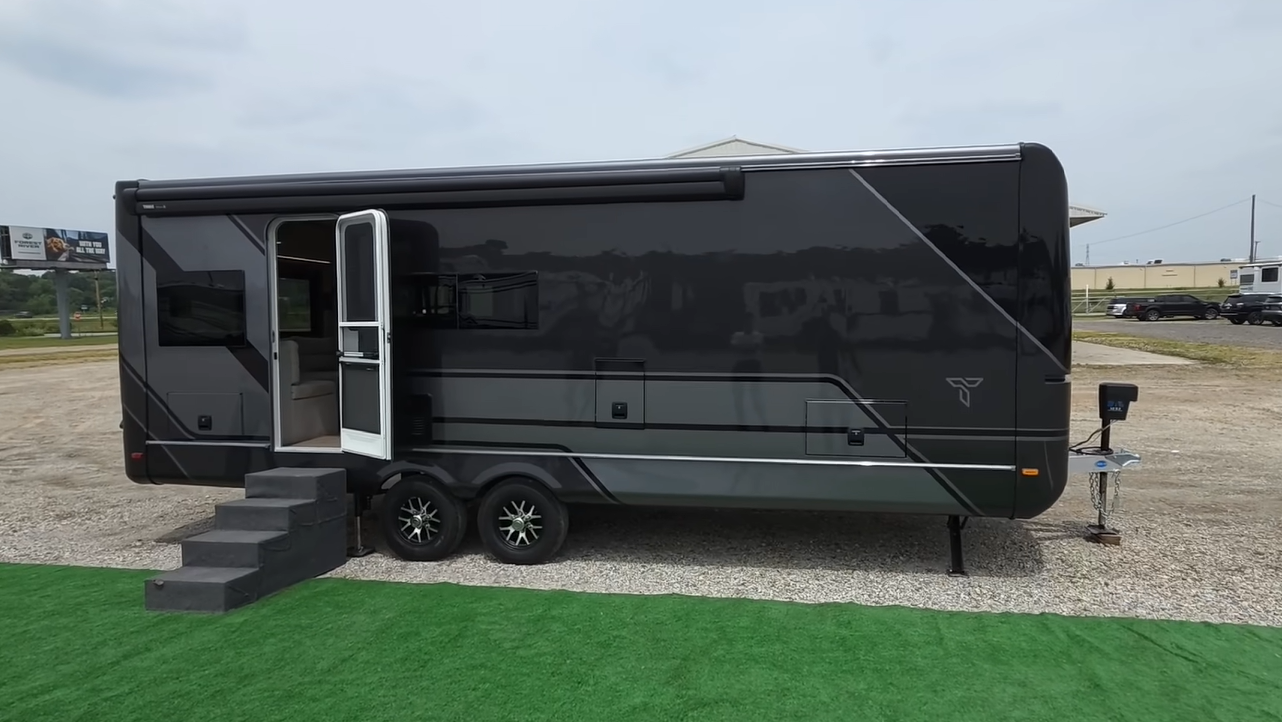
In concept, it’s not too hard to make a “premium travel trailer.” An RV manufacturer could start with one of its standard white boxes, paint it black, give it knobby tires, and load it down the interior with fancy-looking fittings. Maybe they’ll give it a trick feature or two. The box will usually be built with nicer materials than typical, but at its heart, it isn’t much different than a cheaper camper.
That’s what makes the Teleos — a Greek word that roughly translates to “fulfillment” — interesting. It isn’t just a nicer white box, but something far outside the norm for American travel trailers.
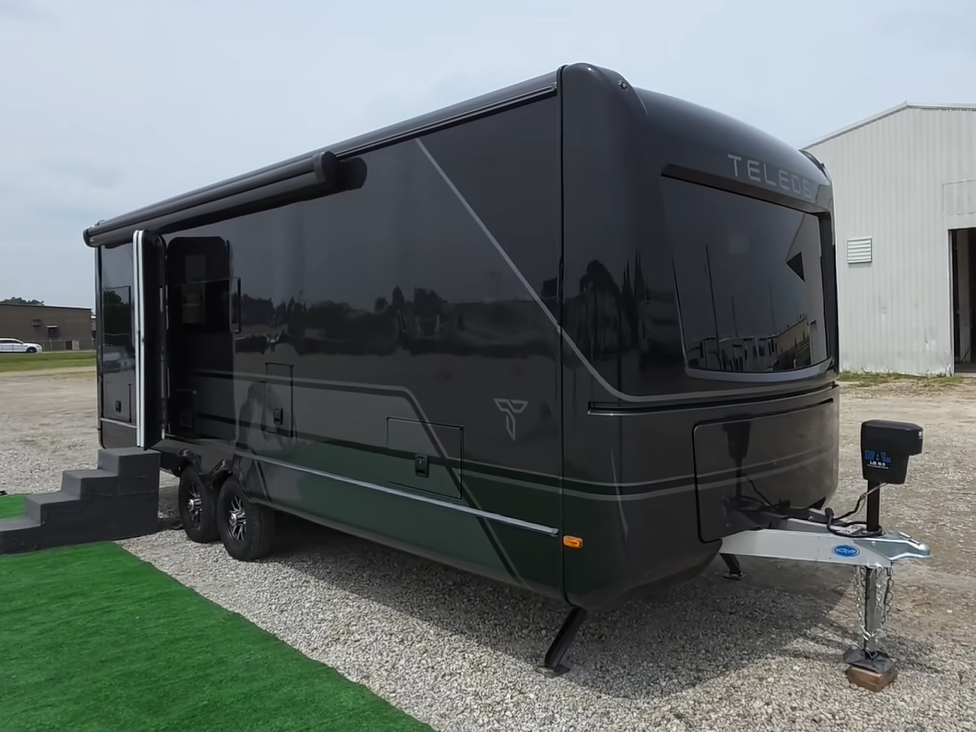
The Teleos is different right from the jump. The roof, sidewalls, and floor are all built out of three-pound foam polyfiber composite that Forest River says is 100 percent waterproof. This material is a sort of sandwich with composite on the outside, foam in the middle, and composite on the inside. Forest River says that this material is non-porous and effectively prevents mold, mildew, and rot.
The roof is more than strong enough to walk on, the walls have superior insulation compared to a typical travel trailer and, per Forest River, the floor alone has three to four times better insulation than a typical trailer. Also notable that the only holes in the roof are for the holding tank vents. The body comes in at 24 feet, 8 inches.
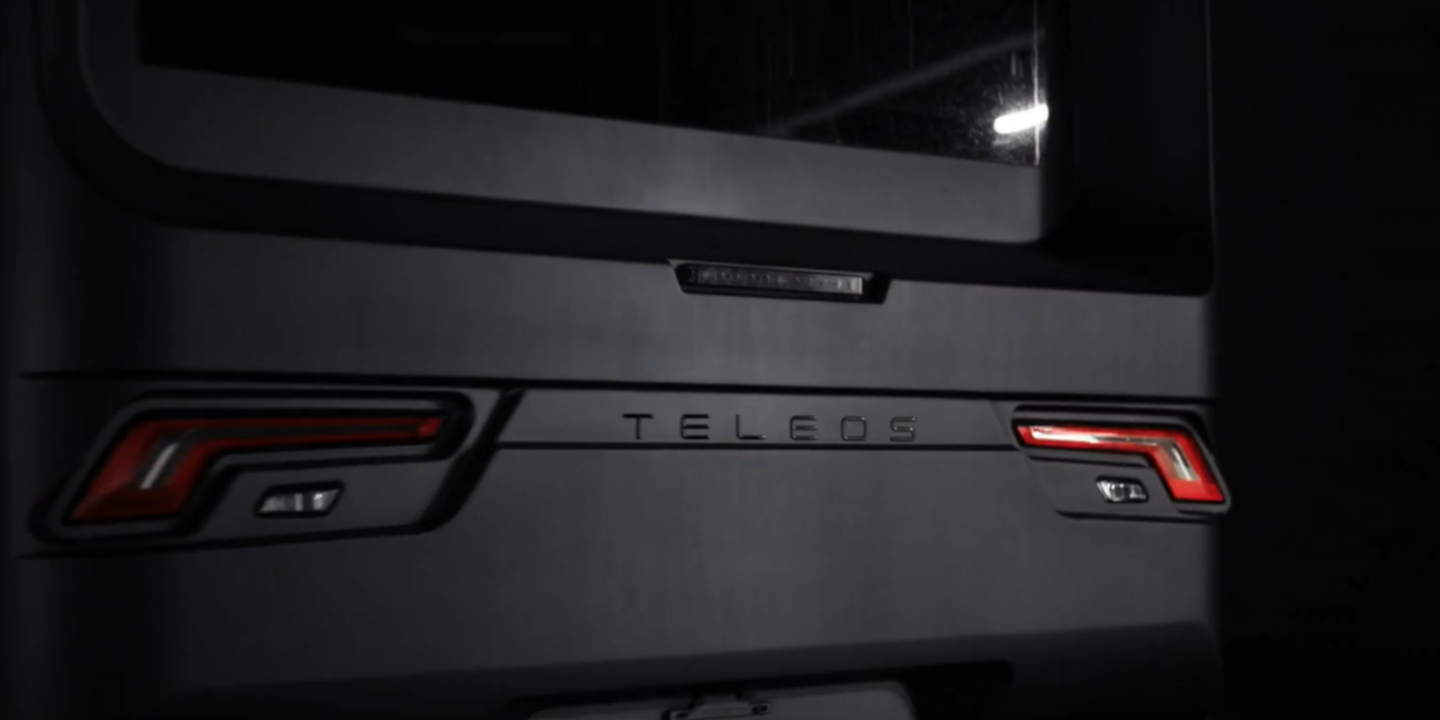
The prototype Teleos trailers ride on a MORryde aluminum frame, but the production version will have a BAL frame, as that is cheaper, weighs less, and will ride on a coil-spring independent suspension. Also present will be a BAL auto-leveling system. The weirdest part about the exterior is the presence of reverse lights, which aren’t typical on an American travel trailer.
Like A Motorhome Inside
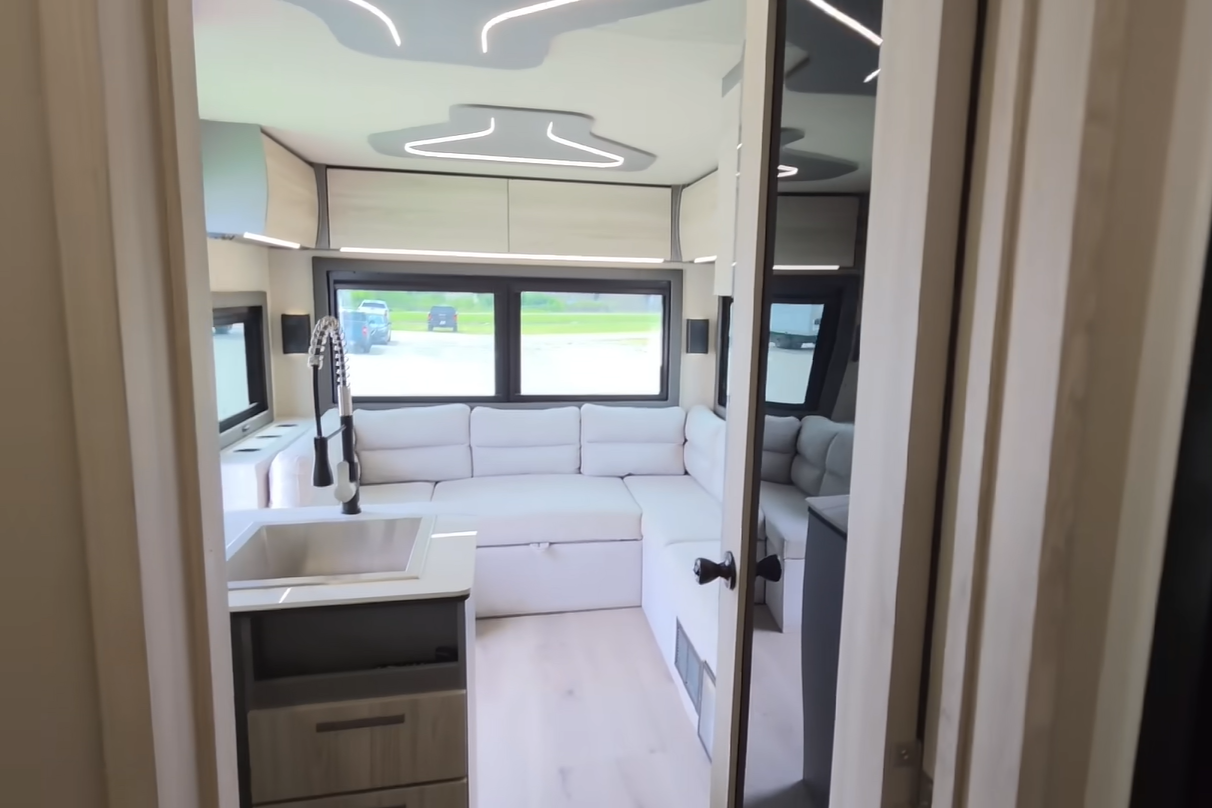
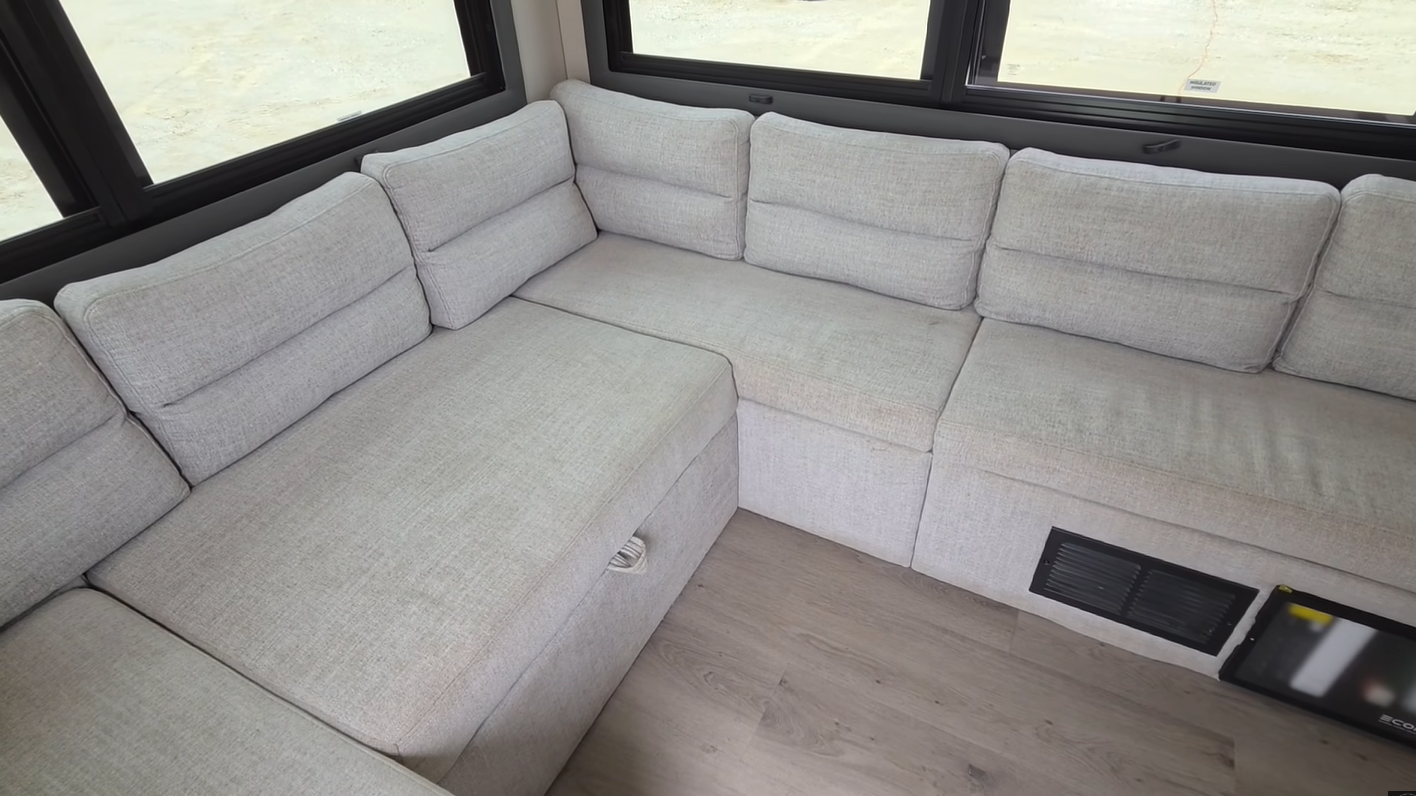
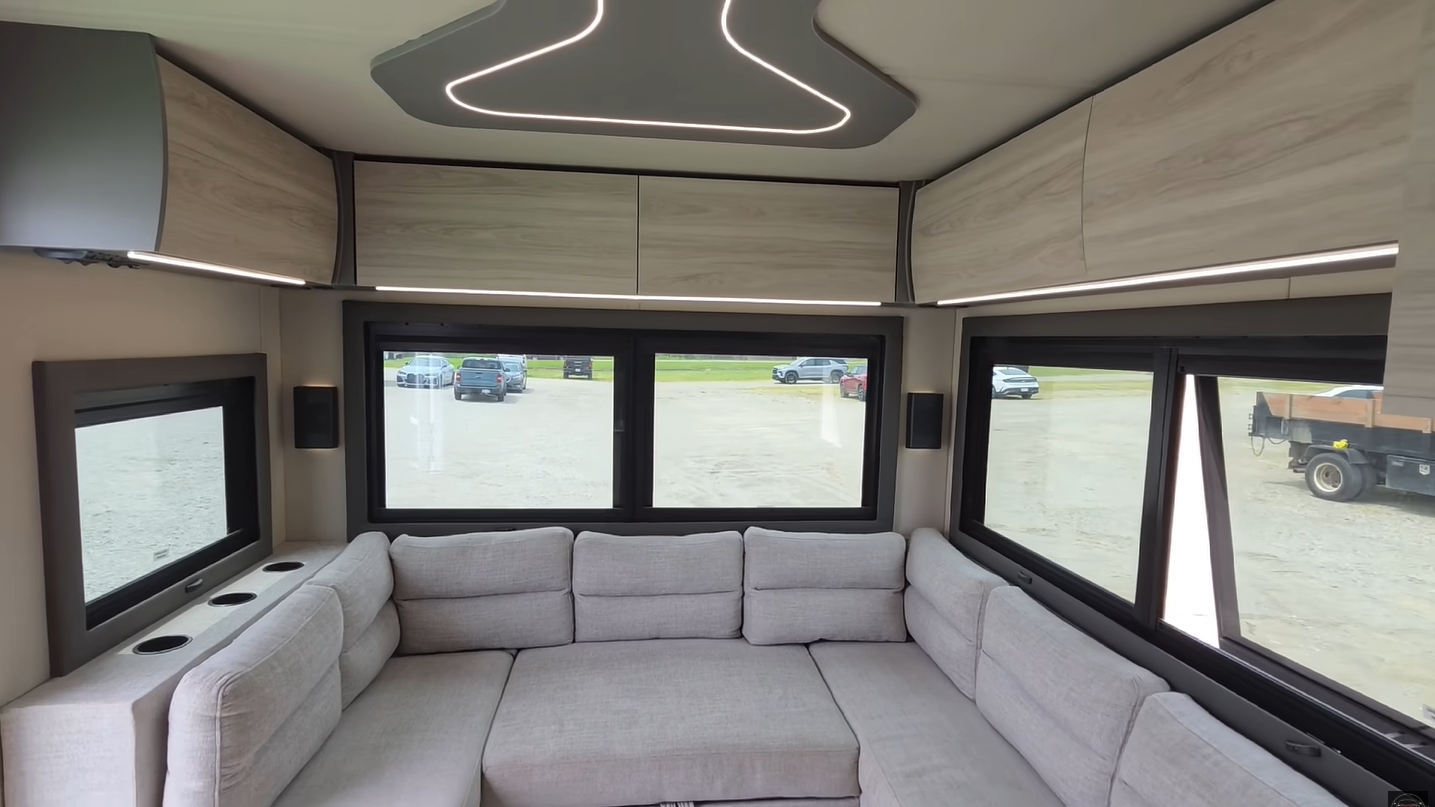
The interior looks pretty neat. Entry is through a rear door, which leads into a sort of living room where there’s so much going on. In just that room alone, there’s a Harmon Kardon 500-watt sound system with two eight-inch subwoofers in the couch and black wall speakers that also double as light sconces. A part of the couch pulls out to turn into a large bed.
The couch area is also where the RV’s EcoFlow Power Kit Gen 2 is housed. The 10 kWh (800 Ah at 12 V) system consists of two large modules that are stored under the couch. This system is expandable to 24 volts or 48 volts, and one of its inputs is two solar panel hookups outside, which support up to 7.2 kW of solar.
Forest River claims that the batteries alone are good for two days on DC power, or 12 hours of running the air conditioner non-stop.
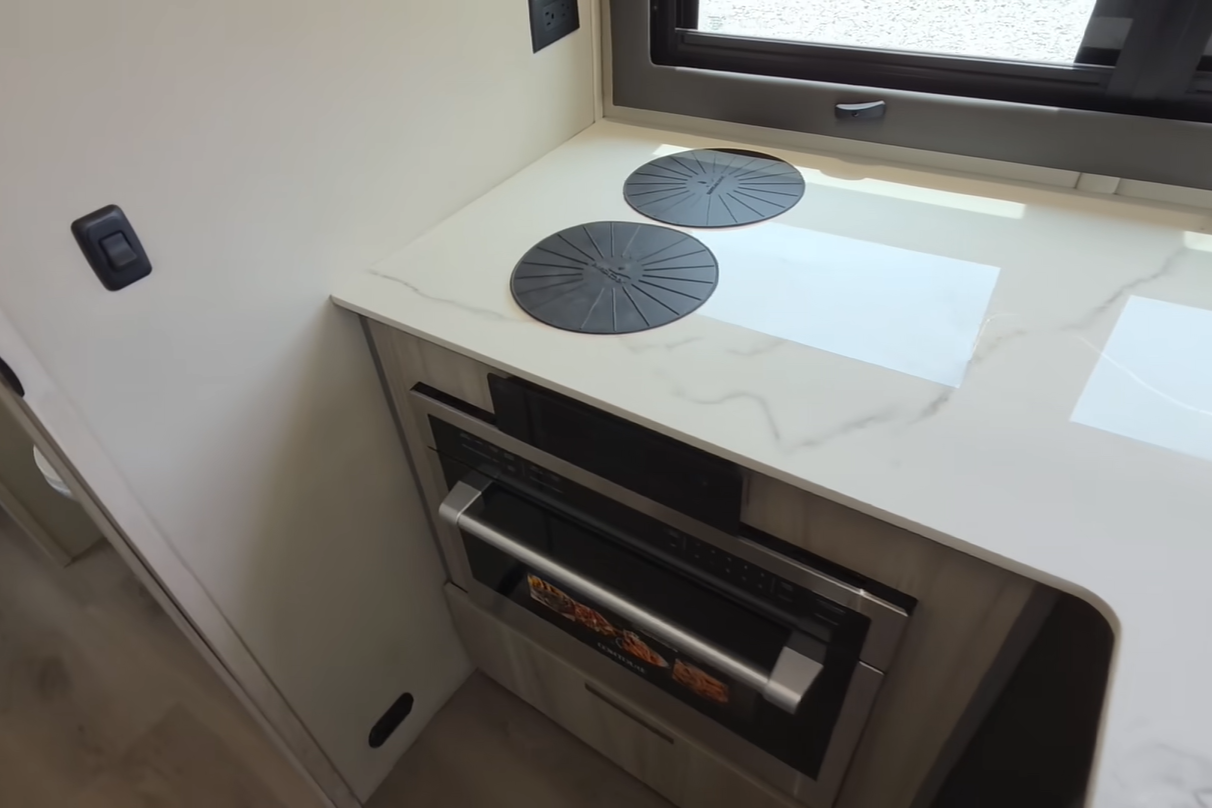
The kitchen has some tricks of its own. An area that looks to be just unused counter space just above the convection oven is actually an Invisacook dual “burner” induction cooktop. Weirdly, there’s no backsplash around either cooking surface, but there is a glass bottom under the cabinet in case your cooking causes grease to fly up. The countertops are Triple M porcelain.
The cabinetry in the kitchen has locking handles so that even the roughest roads won’t cause your plates and silverware to eject. The style of the cabinetry is inspired by European RVs and features five-ply hardwoods. Drawers feature dovetail wood construction.
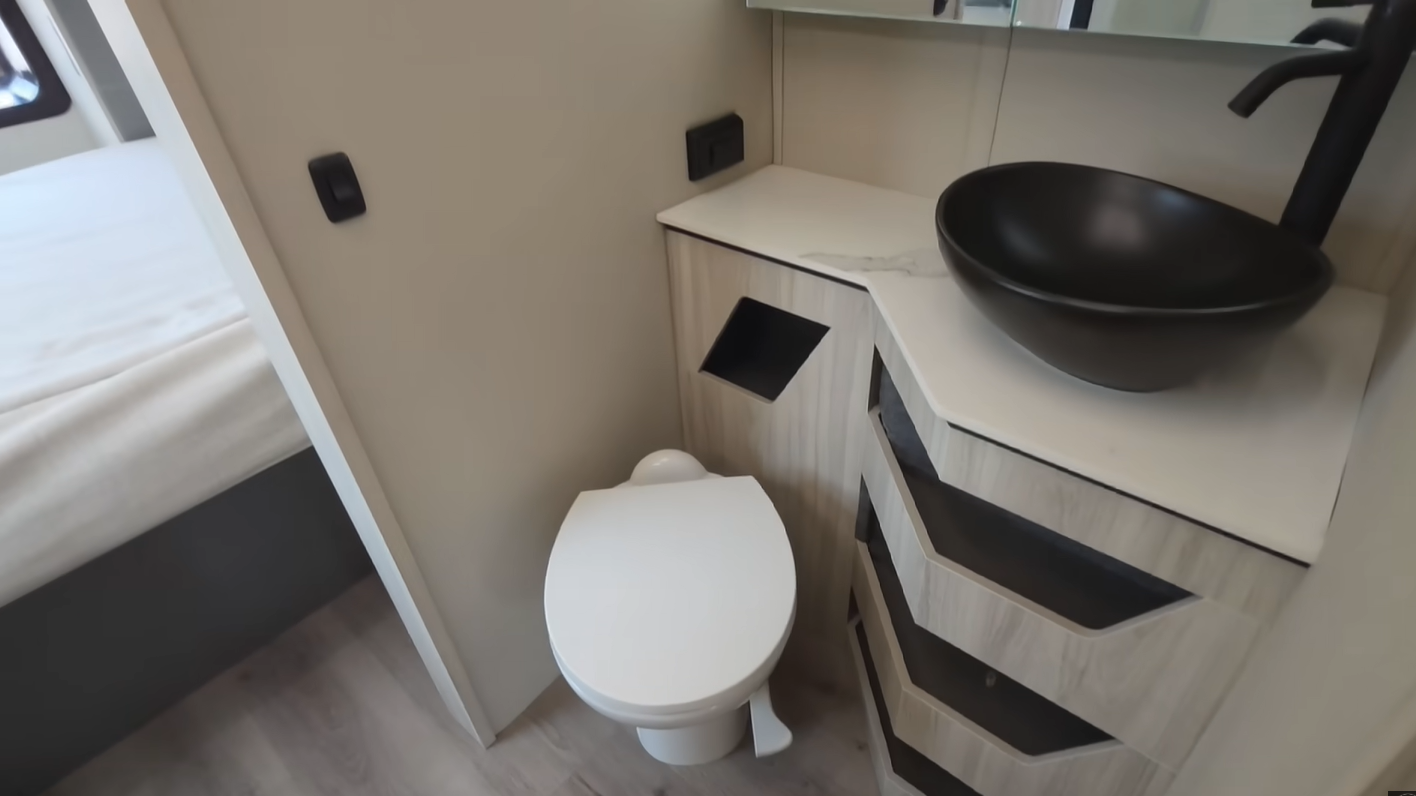
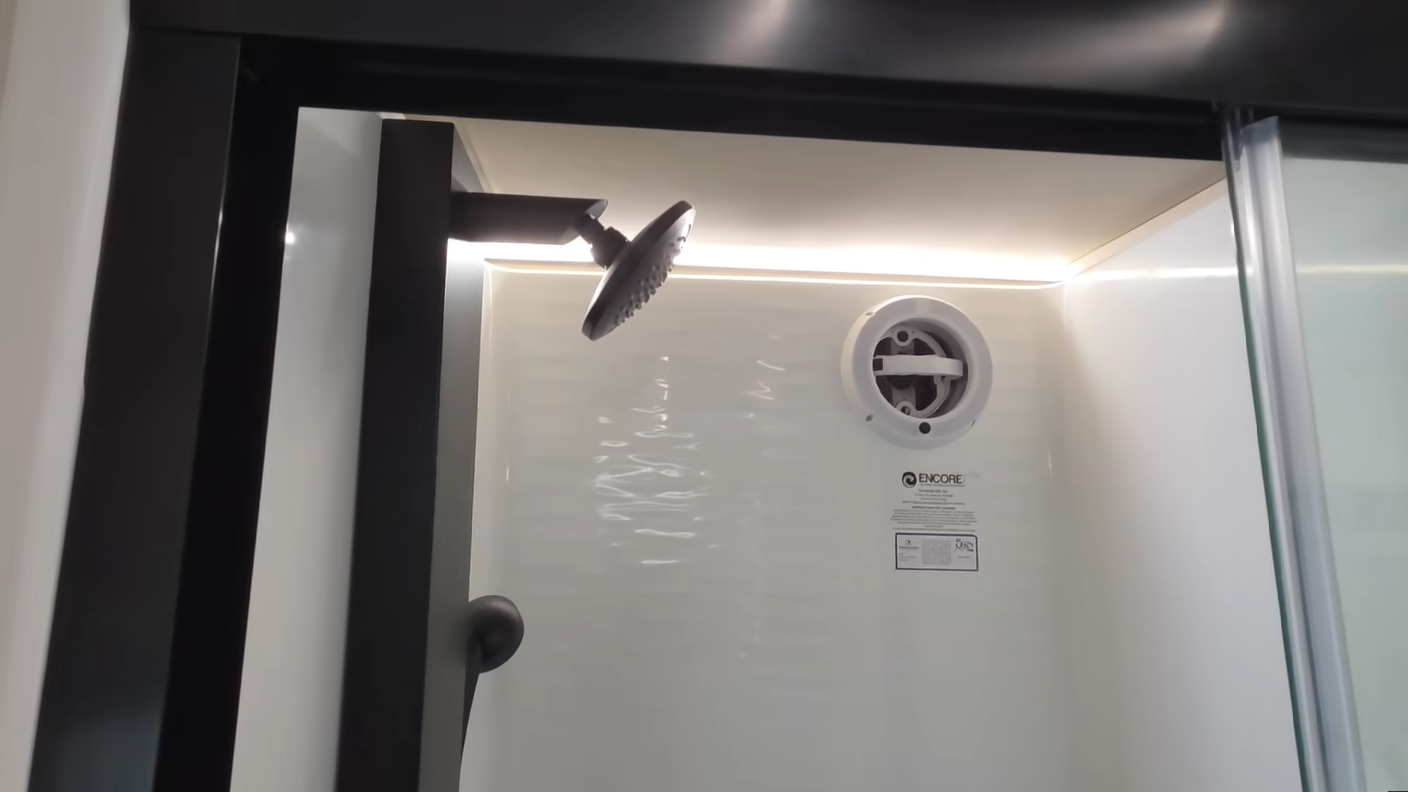
The bathroom is pretty neat, featuring a black bowl sink and a mirror with built-in lighting. The toilet is said to be made of porcelain, and the shower, which has a one-piece liner, appears to be large enough for the average American to use in comfort.
Finally, the primary bedroom is in the rear. Its highlight features are a queen bed and large windows. All of this is supposed to emulate a sort of small European motorhome, but in a towable form. The trailer doesn’t even have slides, which is a new trend that I like. An increasing number of buyers just don’t want to deal with the extra maintenance of slides, and so companies are coming out with RVs that don’t have them.
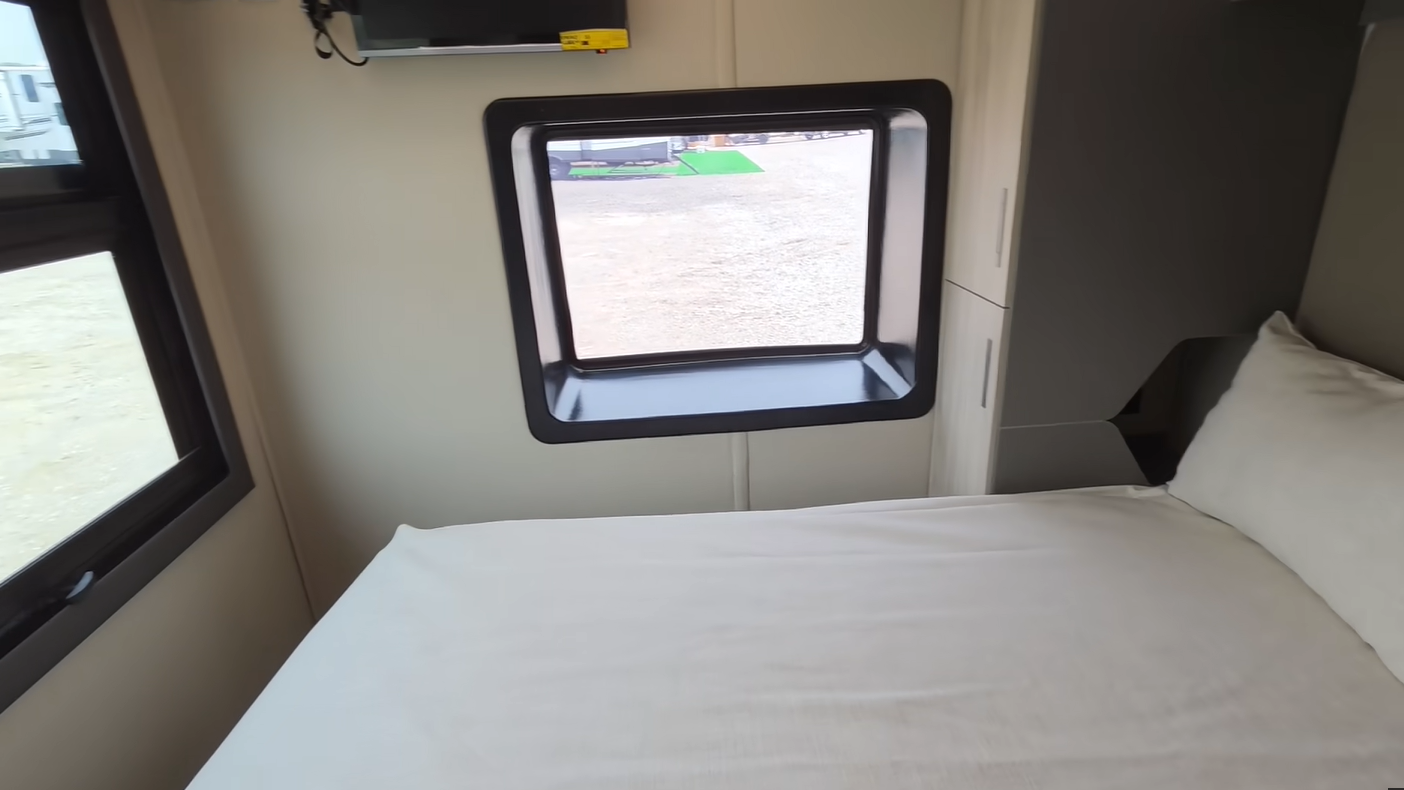
A couple of nice comfort features include padded walls and ceiling, a Truma instant water heater, GE Profile appliances, and dual-pane frameless windows that better battle summer heat and winter cold than typical RV windows. I like how the trailer’s propane tanks are hidden behind a hatch on the trailer’s nose, too. The plumbing system is also noteworthy. Instead of the industry-standard PEX pipe, this trailer has expandable reinforced woven line. The idea is that the lines expand and contract with temperature. Each piece also has a part number and is owner-replaceable.
The Targeted Price Isn’t Surprising
Some expected changes from the prototype to production include flush-mounted baggage doors, motorized steps, an entry door that’s black on the inside, and an awning that’s more flush with the unit. But for the most part, the production unit should look like what you see. RVBusiness reports that the price is expected to land between $75,000 and $90,000, depending on options.
Forest River itself hasn’t revealed many details at all. But the influencers pretty much filled in most of the gaps. At this point, the biggest number left to reveal is the unit’s weight.
Reportedly, Forest River is targeting experienced, well-researched RV buyers who want a quality unit. The Teleos will also be built to order rather than actually being stocked at dealer lots. By doing this, Forest River hopes to avoid accidentally building more units than there is production for. To read that another way, it seems that Forest River does not expect the Teleos to be a mass-market RV, even though the company seems to think that the Teleos will redefine what an American RV is.
There’s a little bit of a wait before we might get those final figures. Forest River is not officially launching the Teleos until the America’s Largest RV Show, which takes place from September 16 to September 20 in Hershey, Pennsylvania.
While the expected price is pretty high, I do love a bunch of the ideas at work here. I like that this trailer is made out of composites, uses real wood in its furnishings, and is built with end-user repairability in mind. I like that it’s not another basic white box with swoops all over it and that it appears that some thought was put into longevity. I also like how the Teleos isn’t a million feet long and doesn’t have a bunch of useless gimmicks. It just seems like a travel trailer that’s built a bit better.
Click here to watch the full video from Big Truck Big RV to get a better look at the trailer.
Honestly, it’s sad that we even have to praise a trailer for having a build that probably won’t start rotting in under 10 years, yet here we are. If anything, a sturdy trailer should be the industry default. But until that day comes, I suppose I’ll continue to highlight when a company does try to go above industry standards. It sounds like the Teleos has good bones, and it doesn’t look like something that came from one of the biggest names in RVing. Hopefully, Forest River sticks the landing, and the Teleos goes into production as something new and different for the American RVer.
Top graphic image: YouTube/Big Truck Big RV


I would be blissfully unaware of the industry-wide quality problems with RVs if not for the articles written by Mercedes; they really make for compelling reading, even for someone who’s not interested in camping. (I am fascinated by the types of things owners and manufacturers manage to stuff into these vehicles.) I find it even more distrubing that the industry response to those articles was to shut off access to industry events…as if that would keep a proper journalist from reporting!
The Thor and Forest River dominance in the RV industry is certainly part of the problem with quality issues and lack of any real underlying variety. (And I’ve always seen most of Thor’s badge-engineered brands as the larger share of the problem.) But there’s also another one that’s frustrating the other smaller conglomerates and individual independent brands — the consolidation of components used by all of them under Lippert.
Lippert used to be one of several competing brand groups that were OEM suppliers to the RV industry; everything including vents, ladders, doors, awnings, axles, etc. came from the OEMs. Lippert has been on a tear, buying up their competition and lots of the smaller OEMs not just in Indiana but around the country. In the Elkhart area alone, you can’t drive a couple of miles without seeing Thor, Forest River, and now Lippert signage on buildings that used to house individual companies.
There’s a lot of concern that as Lippert consolidates, it will mean that supplies of some OEM parts lines will dry up in favor of Lippert’s chosen lines — leaving “holes” of harder-to-find replacement parts or “equivalents” that may not be as well-made in some cases. That can be a problem for repairing older, higher-end RVs, when new replacement parts aren’t as good or long-lived as old ones.
For new RVs, it means that non-Forest River/Thor brands are still stuck with much of the same range of supply-chain parts. If the quality of the parts isn’t there because Lippert has chosen to shave quality in favor of profit, it hurts everybody’s products industry-wide.
Lippert is also a potential problem for the cottage industry of reproduction parts for older RVs. While some manufacturers have gone by the wayside and no one has asserted rights over some designs, reproduction parts may often operate in a gray area. Somebody often has the rights, at least on paper, to those designs. As Lippert swallows and phases out entire manufacturer’s parts designs in favor of consolidation, there will be Lippert-owned designs put out of production — and Lippert isn’t afraid of litigation, not by a long shot. The chances are poor for reproduction parts of anything that was absorbed by Lippert, unless Lippert themselves wishes to keep up limited production for OEM replacements of parts lines that Lippert has discontinued.
And while Lippert initially had been eating up the supply chain for parts used in towables primarily, for the past several years they’ve moved into the supply chain for the heavier-duty parts typically used on motorhomes (Think hydraulic levelers, big awnings, large and heavy slide-out mechanisms, extensive electronic monitor systems), and it’s causing heartburn and discontent in that segment now, too. I know there’s some elitism between motorhome and trailer/5th-wheel crowds sometimes, but that’s not the issue here. Motorhomes do often have heavier-duty parts simply because self-propelled chassis generally have better power-to-weight ratios and saving weight with light-duty parts isn’t as essential, along with higher-end brands choosing to opt for building-in longevity which typically means costlier, more complex, and heavier-duty high-quality parts. Lippert’s priorities aren’t always aligning with that. It makes it a hard sell when a higher-end, non-Forest River/Thor motorhome brand is selling a unit that’s full of the same or closely related parts as the cheaper brands.
That public perception issue you mention at the start has taken them DECADES to earn, dammit! They put in the hard work of continually producing crap, even in the face of competition and consumer complaints.
nowhere near an Airstream and with Forest River branding it will list for 20-25% less than they are asking. It depends on the configuration though as to whether its for me. Still need that bunkhouse.
The problem here is the price is starting to bump up against Airstream.
Will be interested to see how the floor holds up.
I have been in RVs with a sandwiched foam flooring after a few years. Works ok for walls and roof structure that are not often walked on…..but for a floor….they all eventually have soft spots. The foam is repeatedly compressed when folks walk and stand in the same place. That foam eventually ages and the floor starts to give and feel soft. Especially if not supported very well….and we are talking about RVs here…..so more floor supports equal more cost and weight.
Picked our current RV because it has 5/8″ tongue and groove plywood flooring. Not the standard OSB. At least the floor doesn’t give when we walk on it.
Same crap as Disney influencers. They have to breathlessly praise everything the company does or they get uninvited from launch events.
FWIW, I wouldn’t read your articles if they were just rehashing the press releases.
I wish they were though. When backing into sites at night, sometimes I have to ride the brakes just so there’s enough light to see what’s back there.
And then they painted the whole thing black. 😛
Is the intent that you won’t have to winterize this? Otherwise this sounds like a very questionable decision. PEX is pretty well established at this point, and doesn’t require its own part number for each section of pipe (which will definitely not be available anymore 15 years from now when a piece fails).
I hope they have them available at a lot of RV shows. No way I’m spending this kind of dough on a trailer without seeing one in person.
I mean, I’m probably not buying one of these anyway, but in a hypothetical world where I would, I’m definitely seeing it in person first.
why I trust Mercedes over other RV reviewers.
Mercedes headline: hey, this new camper seems nice.
Influencer headline: WOW THIS IS THE BEST FUCKING THING EVER BUILT IN AMERICA!
The floor could be a problem as you say unless it’s decked over with plywood or something similar to spread weight. As a backer between the subfloor and the frame/exterior, it could work, although I’d still have concerns about how it performs where it’s stressed across the cross-supports and main frame rails. Torsional rigidity is a concern in trailers, and a sandwich material with a foam core, to me, could have issues with the holes where fasteners go through eventually enlarging and leaking since they’re stress points and the weaker material will fail first. Or just general delamination in between the layers of the sandwich could happen due to torsional flex over time.
The rest of it above the floor seems like they’re trying to figure out how to build walls and a roof more like larger Class A motorhomes, complete with double-pane windows. There will have to be a lot of trade-offs to keep weight down, though. Keeping A/C units off the roof can help, since the roof can be engineered to spread weight but not have to deal with holding up very heavy A/C units not only while parked, but under stress from road vibration and shock. Getting those off the roof is helpful. On the other hand, while getting rid of roof penetrations is always good, I’m not sure if eliminating roof vents is a good idea. You still need a way to vent heat and moisture out of an RV. Most of it is heat-adjacent, so letting convection help is always a good idea. If the roof is both lightweight and rigid, and doesn’t have heavy A/C units getting bounced around and overstressing the entire roof, there should be fewer problems with seals opening up around lightweight vents.
There have been so many “better idea” RVs over the years. Some of them have been really interesting. We’ll have to wait and see how this one turns out.
RVs are probably the only product where the extended warranty makes sense.
A) trying to hide crap quality by banning reporters is gonna have the Streisand effect.
B) please feature more reviews from afar and keep mentioning you’ve been banned. they’ll be pretty high up in the search results when prospective buyers search for model names.