

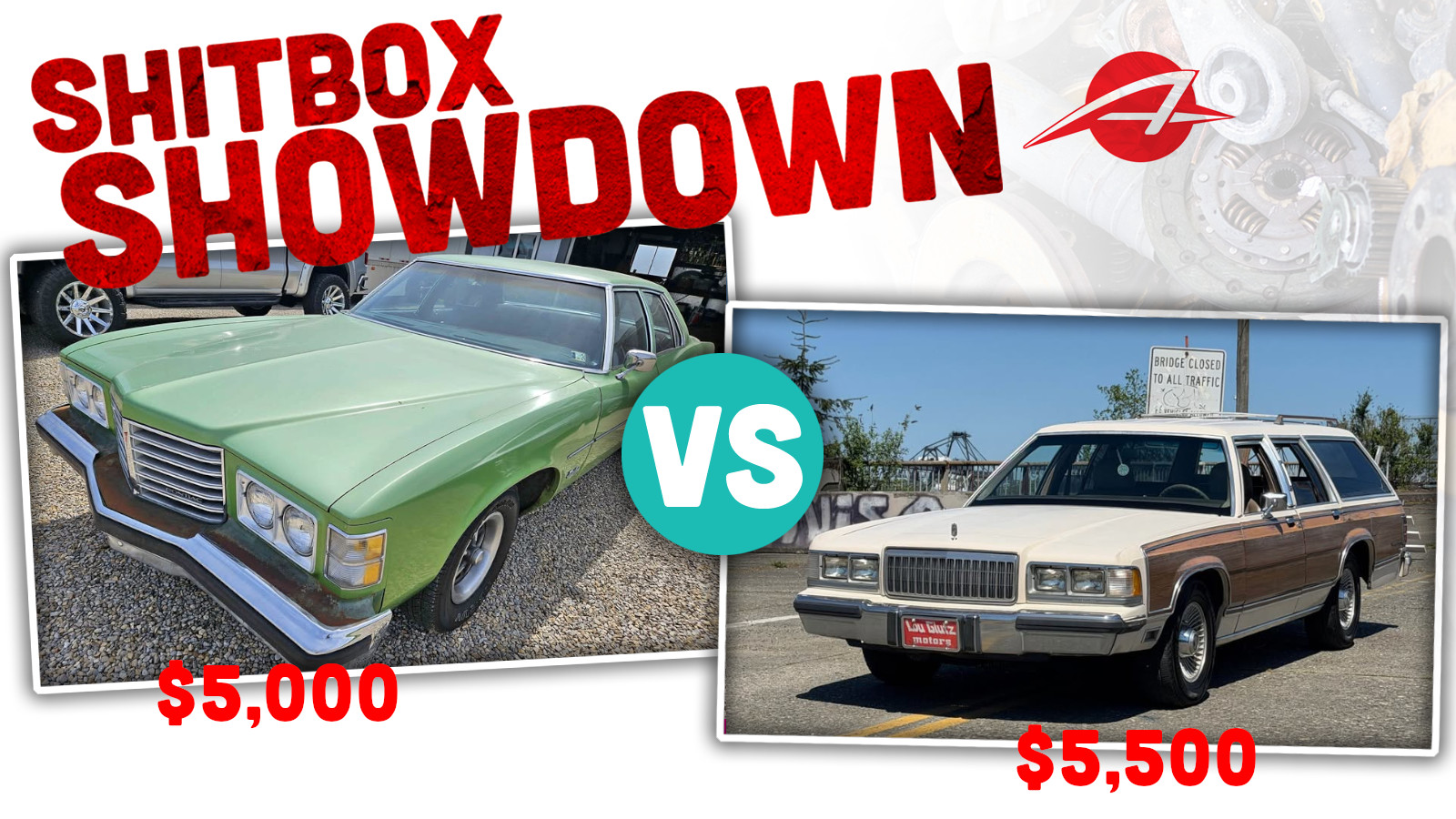
Good morning! We’re starting the week off with a couple of big old American rides with low miles. What they lack in fuel economy and handling, they make up for in comfort and presence. And just to keep things interesting, I’ve picked two from less-common brands.
We finished up last week with two super-clean Japanese sedans. I thought the Mitsubishi Galant’s higher price might hurt it, and a few of you did comment on it, but its higher specification made it seem worth it to the majority of you. The Mazda 323 had its fans, but the lack of air conditioning hurt it.


Despite the low spec, I think the Mazda would be my choice. I am a big fan of the brand, and that 323 is the great-grandmother of the Protege that I liked so much. The three-speed auto is a bummer, but I could live with it.

For decades, nearly all full-sized American cars followed the same basic pattern: a big V8 up front, a solid axle in the rear, and a pair of bench seats in between. If you have a sedan, you have a huge trunk hanging out behind the rear axle, and if you have a wagon, you got some extra seats in the back. The sedans are long gone, and the wagons morphed into SUVs long ago. Today, we’re going to look at one sedan and one wagon, from different eras, but cut from the same cloth.
1976 Pontiac Catalina – $5,000

Engine/drivetrain: 350 cubic inch OHV V8, three-speed automatic, RWD
Location: Glenford, OH
Odometer reading: 22,000 miles
Operational status: Runs and drives well
The 1970s were hard on traditional American cars. Between gas shortages, new environmental regulations, and changing tastes, cars like this Pontiac Catalina were a hard sell. This was the last year before GM’s full-sized B-body shrunk by more than a foot and lost several hundred pounds. It represents the end of an era; whether that’s a good thing or not depends on what you think of these old dinosaurs.

The Catalina was Pontiac’s entry-level full-size sedan, sitting below the Bonneville in the model lineup, similar to the Impala in Chevy’s lineup. It’s powered by Pontiac’s own V8, displacing 350 cubic inches, and a Turbo-Hydramatic 400 automatic transmission. The seller says it runs great. It includes a new set of shocks that need to be installed, which is a fairly easy job on these cars, as long as the bolts aren’t too rusty.

The interior isn’t as fancy as a Bonneville, but it looks plenty comfortable. It’s in good condition, too; all I see wrong with it is a crack in the dashboard. The floor mats are a little grubby, but you could just throw those out and get new ones.

It’s in good but not great condition outside. There isn’t any rust showing, except for some surface rust on the rear bumper. The paint is shiny, but unevenly faded. It’s a great color, though.
1991 Mercury Colony Park GS – $5,500

Engine/drivetrain: 302 cubic inch OHV V8, four-speed automatic, RWD
Location: Tacoma, WA
Odometer reading: 37,000 miles
Operational status: Runs and drives well
Ford’s Panther platform underwent a serious downsizing in the late 1970s as well. This car’s basic design dates back to 1979, with a styling refresh in 1988 that rounded off some of the sharp edges. This 1991 model was one of the last Grand Marquis Colony Park wagons; the next generation of Grand Marquis didn’t include a wagon variant.

Like most Panthers of this era, it’s powered by a five-liter V8 backed by an AOD overdrive automatic. By 1991, it had multi-port fuel injection and was more or less bulletproof. It runs and drives well, and if that mileage is original, it should continue to do so for a long time. By the way, do yourself a favor and read the ad for this car; it’s hilarious. (The link, as always, is the header above.)

Inside, it’s in nice shape, with a 50:50 split bench in the front and inward-facing “way back” seats in the back. The air conditioning doesn’t work; the seller, in their own roundabout way, says it “just needs a charge.” Of course it does.

It looks good outside at first glance, but if you look closer, you start to see a few flaws. It’s missing the trim around the woodgrain on the right front fender, and the woodgrain itself is a bit faded overall. But it’s not rusty or beat-up.
This style of car gave way to front-wheel-drive, V6 engines, and even smaller footprints. Those smaller cars are nice and all, but there is something to be said for these body-on-frame dinosaurs. They may not be all that practical, or fun to drive in the traditional sense, but they are comfortable, and they’re so mechanically simple that there’s not a lot to go wrong. As long as you have a place to park one of them, they could be good weekend cruisers. Which one better matches your style?


Soft spot for a Catalina. ’61 first car in 1965. Came with girlfriend!
70s wagons were way cooler than that Mercury but it’s still an old, wood paneled wagon. That wins for me every time.