

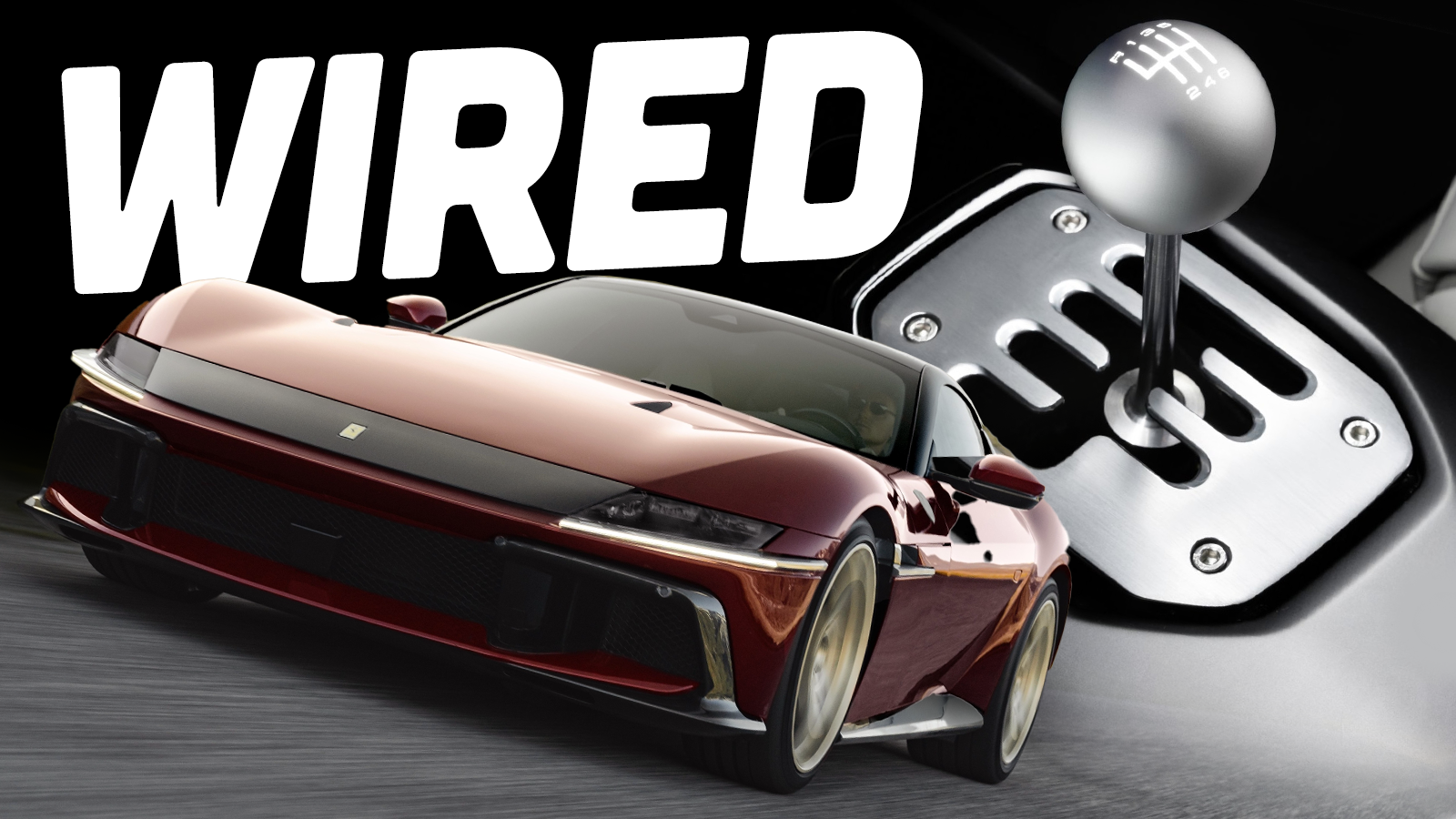
It’s been 14 years since the last Ferrari with a good old-fashioned manual gearbox left the factory in Maranello, and a handful of prancing horse enthusiasts have been clamoring for another row-your-own model since. Over the years, the number of voices in that crowd has grown to a point where Ferrari had to do something. The 12Cilindri Manuele is that something, and it’s weirder than you’d expect.
First, some background on the 12Cilindri, Ferrari’s front-engined V12 grand tourer for the 2020s. Like the 812 Superfast that came before it, the heart of the Enzo lives on underneath the extra-long hood of the 12Cilindri, now turned up to 819 horsepower. There are no turbos here, no supercharging, not even a hybrid system. It’s a full-fat, no nonsense GT car in the traditional sense, albeit with an eight-speed dual-clutch automatic.


The 12Cilindri Manuale…also has an eight-speed dual-clutch automatic, although not quite like any unit we’ve seen. In the car’s center console, you’ll find buttons for reverse, neutral, drive, and low gear, along with a giant gated shifter. Reverse is up and on the left, and you get six gates for gears one-through-six. Where are seventh and eighth? Not used when rowing your own. It’s a definite departure from paddle shifters, but don’t just think of this as the modern version of the Valeo automated clutch setup you could get on a Mondial. The other party piece to the 12Cilindri Manuale sits in the footwell.

Yes, that’s a pedal to the left of the brake, but it’s not connected to a hydraulic cylinder. Instead, it’s entirely clutch-by-wire, letting drivers manually control clutch actuation in the dual-clutch transaxle by reading pedal position and uptake rate, then transcribing that to the actuators. Ferrari assures that operation of this pedal is really up to the driver. It’s possible to stall the 12Cilindri Manuale even though it doesn’t have a traditional manual gearbox.
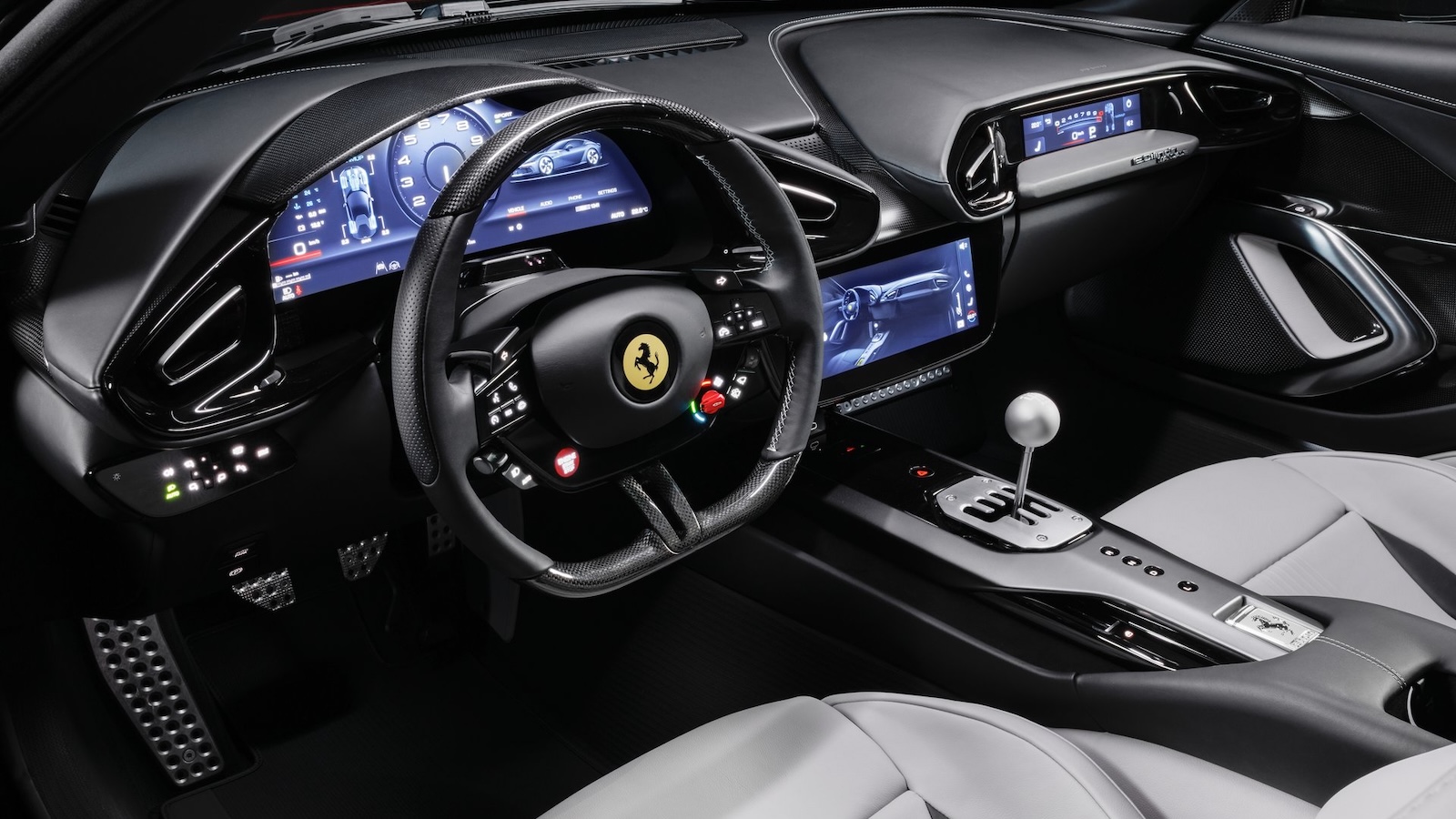
On the flipside, to prevent money-shifting the V12, Ferrari’s devised a lockout for the shifter to prevent moments of cringe-inducing mechanical destruction. As the marque notes, “If the clutch is not depressed, or an unauthorised gear is selected, the system is able to mechanically inhibit engagement, preventing the operation from being completed; when the lock is not active, however, the kinematic mechanism is free to move.” A little bit like training wheels, perhaps for owners who haven’t driven a car with a manual gearbox in ages.

The 12Cilindri Manuale isn’t the first production car we’ve seen with a simulated manual gearbox, but it takes a very different approach than Koenigsegg does in its CC850. That shift-by-wire unit doesn’t use traditional selector forks, or synchronizers. Instead, it uses seven wet clutches, six to select forward ratios and one for reverse, all with their own pressure sensors and mechatronic actuators. Changing up is as simple as engaging the right clutches. In contrast, Ferrari’s gated DCT is much more traditional in design. In addition to having a wet clutch for each shaft of gears, selector forks engage the actual desired gearset, like you’d find in a regular manual gearbox except with mechatronics doing the work instead of a purely mechanical shifting mechanism.

In that sense, the gearbox in the 12Cilindri Manuale is more like a real manual, only with a funky clutch arrangement and wires instead of hydraulic lines and cables. Sort-of like how just about every accelerator pedal nowadays isn’t directly connected to a throttle body. Besides, the era of 2000s performance cars that everyone bangs on about for their so-called analog nature isn’t really analog. Not with electronic ignition and digital fuel control, not with drive-by-wire throttle bodies or traction control. The reason people love cars like the 550 Maranello, the Lamborghini Murcielago, the E46 BMW M3, and the Honda S2000 is because they work perfectly well as normal cars without any old car fiddliness, but the driver’s still an important part of the experience. How much you get out of it depends on how much you put into it behind the wheel.
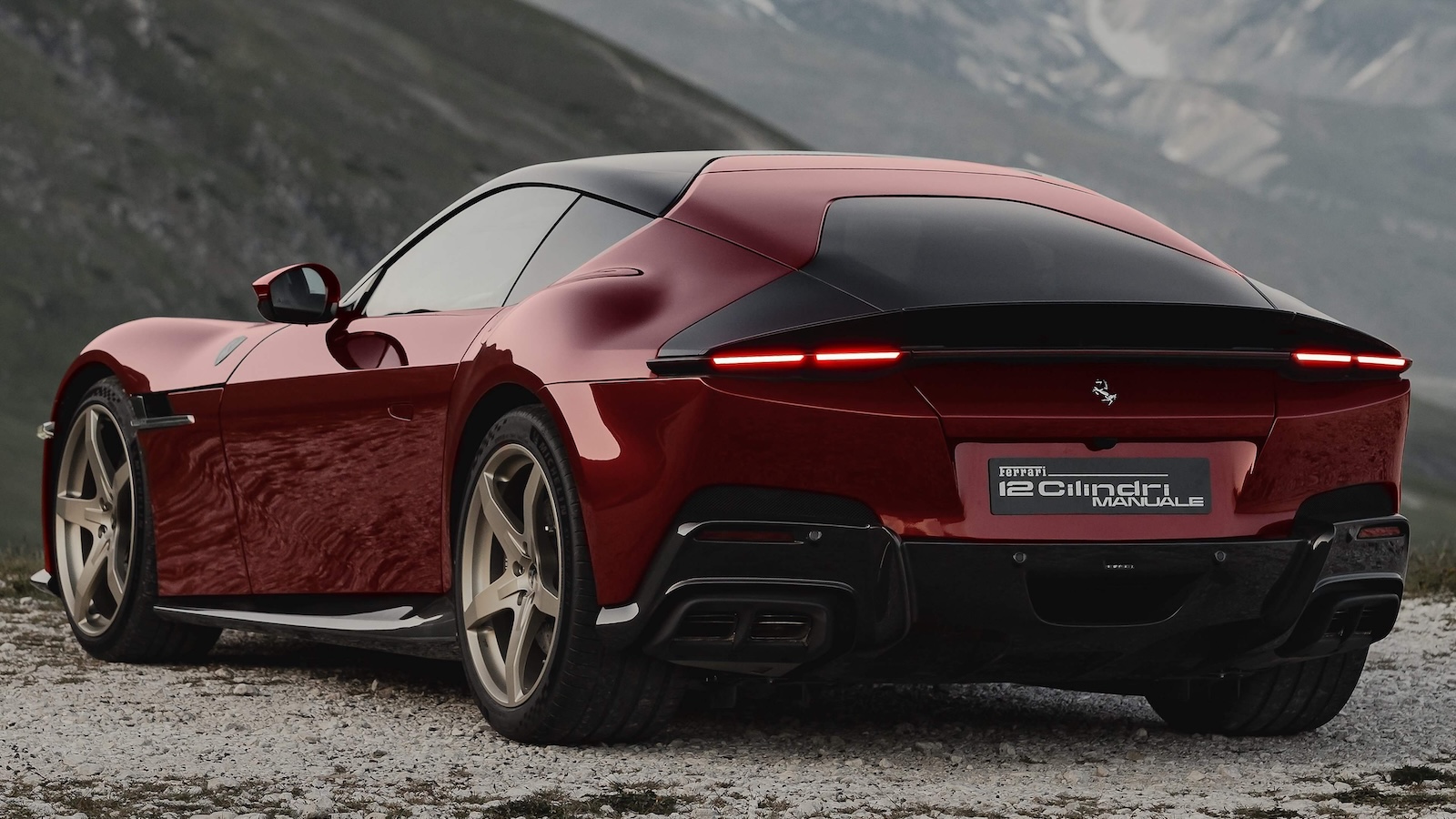
Really, the only shame about the 12Cilindri Manuale is that Ferrari’s only building 1,500 of the things. That’s fewer than 200 more than the production run of the F40. However, this shift-by-wire setup might just save a certain aspect of driving engagement we thought would be ending in the next decade or so. Being able to run a car in automatic mode for drive-by noise testing, fuel economy testing, and all the mildly irksome regulatory hurdles that favor automatic transmissions is a big advantage, and so long as the by-wire clutch and shifter are calibrated well, those who love driving can have their fun too. It might not be a manual gearbox as we know it, but if the tech trickles down and saves rowing-your-own in the performance cars normal people can actually afford, it’s not bad, is it?
Top graphic image: Ferrari


ND/Crackpipe to me…it’s all or nothing: either it’s a real manual that has been built similarly for it’s 135 year existence since the 1891 Panhard et Levassor and advancements in the 1950’s to now but still similar…or nothing. All I care about is a basic manual like what was in my 84 Jetta, 83 Rabbit, and 2 3rd gen Accords (5spd and pop-ups!) among others. I don’t need or want any other unnecessary things besides that especially any fake bullshit. My preference should be perfectly ok, and I don’t need anyone trying to convince me otherwise for no reason other than them not minding their own business
I’m willing to not pass judgment until I’ve driven one of these (which means I will never pass judgment, but never mind that). There’s an actual clutch and you actually control the gear changes. Will it feel the same as a traditional manual and would I care if it’s not quite right? I can’t really say without experiencing it.
I’d love to drive it and have my mind changed lol but not convinced without the mechanical engagement this is actually going to be that satisfying. Part of what makes driving stick fun is that it take finesse every shift, this is basically just a video game controller. And having a bypass mode is stupid imo because somewhere in the sub conscious you’ll always know it’s not real and you could just put it in auto. I appreciate the thought but honestly at this point not sure I wouldnt’ rather just have some flappy paddle.s
I think the pedal is a nice addition to the DCT, but I’d rather have the foot clutch and flappy paddles like a GT racing car so I could treat it like the sequential transmission that it is.
That’s a cool idea and would be an authentic fit with Ferrari’s obvious racing pedigree. I would be very curious to try a street version of that-iirc the clutch pedal is only used for getting started?
After mulling this over some since my original comment, I think the thing Ferrari need to have done and maybe they have accomplished though I’m skeptical, is this needs to completely fool me into thinking I’m driving a traditional stick for it to be successful, if at any point I’m reminded I’m just using an electronic controller of a sequential gearbox it might as well be paddles (with or without a clutch pedal.)
I’m glad I tempered my expectations. A pedal to manually control the launch/crawl in a DCT is worthwhile, I think it’s a great idea that adds a lot to the driving, but I’d rather see a sequential lever or paddle shifters than those apologetic fake gates, and I’d MUCH rather have an actual manual transmission.
Supercars shouldn’t be equipped with an “I’m not really feeling it today” mode, they shouldn’t have contingencies for a disinterested driver, and they shouldn’t be capable of apologizing for being what they are. Ferrari used to know that better than anybody else.
That’s all well and good, and I’m with you. But there’s a dwindling number of people who want that kind of car. Even back in the day, most of the people who drove Ferraris largely tolerated them and their temperament because they looked cool and made a statement…but would have enjoyed a more practical, easier-to-live-with experience if one had been available. Thus, Ferrari and other high-end manufacturers moved to making more daily-able less mechanical cars as it became feasible to do so.
Today’s customer base for a supercar is largely going to be someone who wants to feel powerful and capable because the machine helps them appear that way. They want to go fast, but they don’t want the thing to actually a) embarrass them or b) kill them because they don’t know how to operate it. That’s what Ferrari’s giving them.
I’d argue that part of the draw of the old Ferrari brand was the “authenticity” that comes with driving a demanding car. Like many other boutique brands, it used to communicate something about the buyer’s taste, not just their wealth.
If you sell authentic experiences for die-hards, poseurs will buy them because they want to look like die-hards.
If your bean counters catch onto that and you start compromising the product to chase volume sales, you’ll see short-term gain, but damage your brand in the process of disassociating from the tasteful ambassadors that built your brand’s image in the first place.
I don’t think the death of the manual was the turning point, the F1 transmission and the DCT are both racing-derived bits of kit that enhance performance, the problem is that the rest of the industry caught up and Ferrari failed to pivot to the demands of the trendsetters as the industry evolved.
The 458 was the first auto-only Ferrari, and it’s still a highly-regarded vehicle because it was ahead of the curve in its time. The DCT was impressive, the 9,000rpm redline was mind-bending and flat-plane V8’s were exclusive and exotic. The MP4-12C was more advanced, but the 458 was lauded for just being more special.
By the time the 488 came out, you could get a turbocharger and a DCT in a family crossover, manual transmissions were rapidly disappearing from non-performance cars, and people were starting to resent the industry’s status quo.
After that, Ferrari pivoted from “here’s the car you asked for” to “here’s the car we made, it almost looks like the one you asked for”.
… Not going to hate it until I can try it.
As I explained to someone two weeks ago, the point of people like me wanting a manual transmission is that it’s a full body experience. You have your right foot operating the accelerator (potentially rev-matching), your left foot operating the clutch, your right arm moving the gear lever and your left arm steering.
If they can make it feel no different than I would driving a bored out 550 that’s been on a steady diet of crack-cocaine (that’s what the F140 V12 is), I can’t complain.
The question is how far will they allow for shenanigans and additional control? Porsche lets you clutch-kick (with paddles, not the lever) their PDK-S (RS car) gearboxes, but you can’t skip shift. I assume we’ll be able to skip shift here so long as you wouldn’t be money-shifting. Curious to what else they might allow.
Again, I’m not going to hate it until I can try it. I’d rather companies take a swing at it as opposed to giving us nothing at all. I’d still vastly prefer a manual transmission for many other reasons (serviceability, cost) but I’m aware the extra federalization requirements and emissions requirements are what often blocks the green light.
And in a weird way that needing to finesse or the car bucks, or the gears grind, etc is what makes a perfectly executed shift so satisfying, not sure if this allows for a certain amount of bad driving to actually make it feel like more than a video game controller-though I applaud them making it real enough that the car can stall.
>…way that needing to finesse or the car bucks…
So there’s always a noticeable difference between letting the transmission do everything and you requesting a shift manually. On the “normie” models, and even higher volume trims of sports cars it’s mostly smoothed out mostly because the total duration of the shift action is longer, and also because the expectations of the operator are different.
Gear grinding I just don’t expect to be a thing on any modern car though. That’s not finesse, that’s operation 101. I can imagine a Miata from the past 20 years it’s POSSIBLE to grind gears, but they’re at least double-cone synchros so you have to TRY to be doing that. Honda 6MTs can be a bit hesitant when not warmed up, but that’s not grinding.
——-
Still, for a 2-1 manual (not automated) downshift at pace, at least RS Porsches will buck if you don’t maintain an appropriate amount of throttle.
Moreover, you can also replicate the feeling of a “hard upshift” where you get a VERY real kick in your back if you let up on the throttle slightly no different than you would if you’re slam shifting a manual transmission.
They’re fast, but they’re still mechanical, so the opportunities do exist to replicate a lot of the other sensations in the spiciest DCT gearboxes since the operating windows are very tight. Again, not so much the normal stuff, so a base Carrera (especially given turbocharging where there’s all sorts of other trickery to maintain boost, etc.) isn’t going to offer the same opportunities for that as a GT3 RS is.
Left foot is still out of the game though. Again, I’m curious to see what Ferrari has done (in addition to skip-shifting) to close the gap.
RE: gear grinding, I was probably typing too fast, speaking off the cuff, and meant more like grabbing etc like if I let the clutch out too fast relative to me moving the shifter it will “grab” a little, which in my head translates to “did I just create some syncro or gear wear-i.e. grinding”. But in general the ability to screw up (which I think we agree on) adds a cognitive “weight” to doing it right that is also what makes driving stick satisfying; it’s not just moving a little lever around in concert with my left foot like some kind of Nintendo Wii game.
Sadly I haven’t driven too many modern stickshifts other than a couple VW products and a WRX. Which maybe to your point, the VWs felt almost overly sanitized to me, while the WRX felt kinda clunky and old fashioned BUT arguably more satisfying. And I have driven a 2015 BMW M4 with an auto and agree that with the DCT set to the sportiest settings it was surprisingly mechanical and satisfying, responsive, slamming off shifts, blipping the throttle on downshifts etc. So yeh if they can replicate that sense of connectedness with this it could be quite fun.
Everyone’s missing the point… It’s going to feel like a Manual, it’s going to drive like a Manual. Just because there’s no mechanical linkage, doesn’t mean its not a Manual.
Any naysayer is actively a hypocrite and should from here on out avoid any vehicle with any means of electronic control.
EFI? Nope, carb or mechanical fuel injection.
Want to change the radio station? Swap out the crystal yourself.
That’s a bit extreme. The human never manually injected fuel into an engine. We DID, through physical connection, manually actuate the clutch and associated gear changes.
Nothing is too extreme for the true manual enthusiast.
That’s why we’re going to see an uptick in requests for hand-crank start engines.
Your disdain for manual enthusiasts is rivaling the manual enthusiasts disdain for automatics.
The carburetor has always been a mechanical computer, the move from carbs to EFI isn’t like manual to auto, but more like going from a vacuum/hydraulic automatic to an electromechanical one. I do think the clutch-by-wire will be a good upgrade in terms of engagement, but I’m skeptical about the interface feedback, which is a big part of the manual experience.
What is the REAL reason why the manual transmission is dying, especially in the hyper expensive car market. It can’t be cost, these already cost an arm and a leg. what’s a bit more? If someone wants a manual, why are they not giving it to them? Sure, it costs them money, but, just pass that on to the consumer. They’re millionaires and billionaires, they’re not going to care.
The rich are getting younger. Most probably cannot drive a manual transmission.
That’s a good question. Even if the cost for doing a real manual transmission were such that every single unit incurred a 750K USD premium over a regular self-shifting version, they’d still sell every single one.
Most likely, it’s Ferrari being clever and egotistical. Over the last couple of decades, the brand has begun putting a lot more effort into showmanship and technology than in giving the customers what they really want. I could see them haughtily declaring that their de-automated semi-automated manual is just as good as a traditional manual.
Although it’s an interesting idea. If you’ll recall, some of the original semi-automatics (famously BMW’s early SMG) were essentially a regular manual transmission with some kind of pump action on the back and logic computer to actuate the gears…and could be converted to handshaker manuals. So it’s funny to see Ferrari end up doing kind of the same thing 20 years later.
I imagine part of it is bc from what I’ve read most euro buyers prefer flappy paddles because their transmission paradigm is flipped from the USA. DCT with paddles feels like an upgrade and something different/special in countries where every anemic 1.4 tdi econobox has a stick.
Back in the early aughts when I was in college a friend was dating a british gal and she said in the UK she was going to be required to take her driver test on a stick shift car and was stoked when I helped them find an old (and rare!) stickshift ’70s Fairmont as a cheap beater.
I’d rather the manual die than have to suffer the indignity of this nanny-state bullshit.