

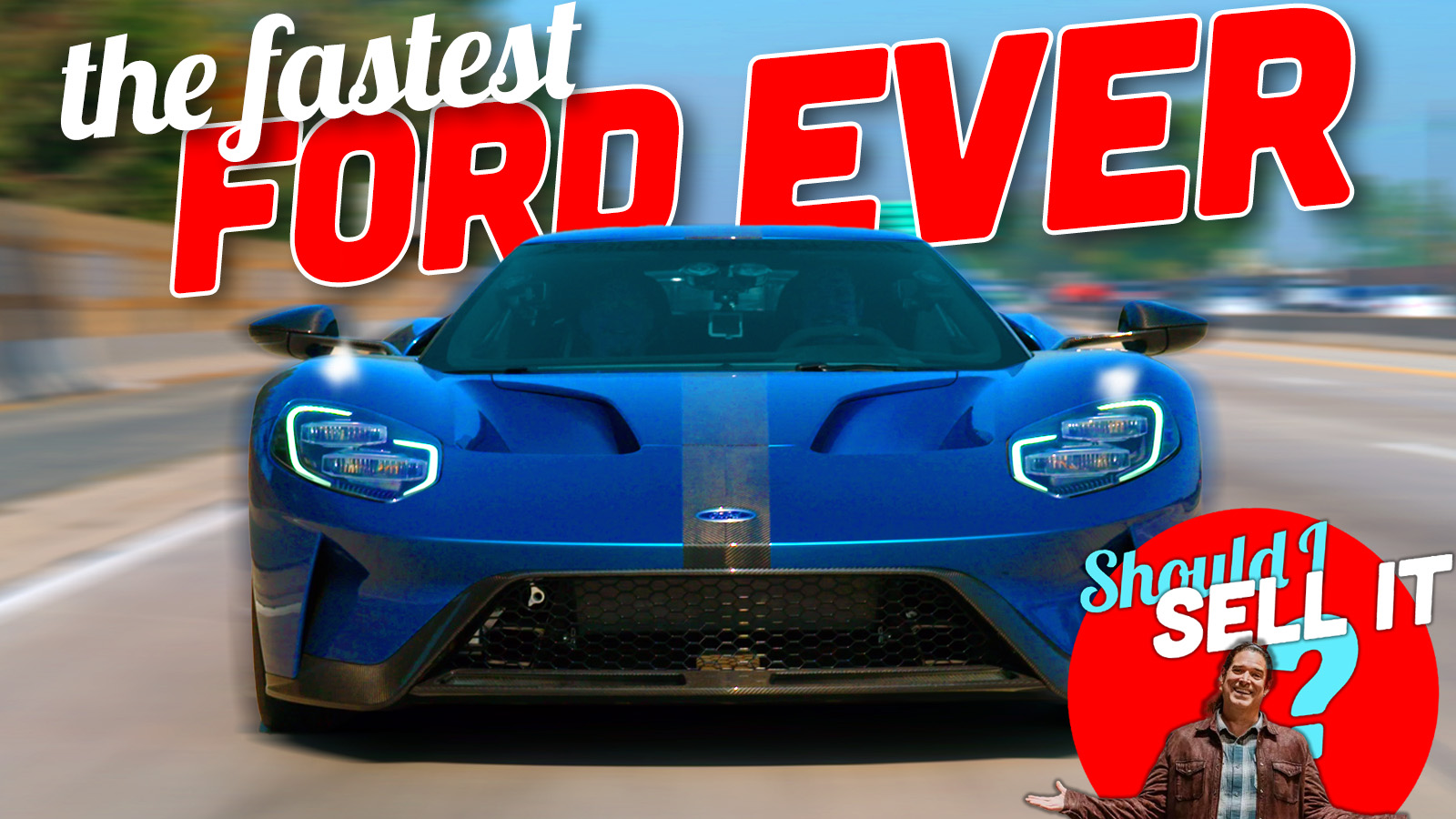
There have been some insanely fast Ford vehicles over the decades, from Focus STs and RSes to Mustang GT350Rs and GTDs, but the king of them all is a vehicle co-developed by Ford and a literal race car manufacturer based out of Canada called Multimatic. I’m talking about the second-generation Ford GT. And the Holy Grail of second-gen Ford GTs is one I forgot even existed: the extremely rare, hard-core Ford GT Competition Series, which doesn’t even come with a radio or air conditioning.
Before I even continue with this article, I’d like to share a photo that I think tells the story of this car quite well.


This photo:

A lot of the cars Autopian cofounder Beau is considering auctioning off later this year are quirky; some are microcars, one is an extremely rare convertible called a Playboy, one was sold by a literal madman, and I could go on and on. But in all the craziness, there are some legitimate performance cars like Carroll Shelby’s DeTomaso Pantera and this: The Holy Grail of second-gen Ford GTs.
It’s called the GT Competition Series, and though the ~$70K+ package was available for two model-years (2017 and 2018), vehicles equipped with it are extremely rare. According to multiple online marketplaces, it seems like only six or seven exist, and from what Autopian cofounder Beau Boeckmann tells me, it’s possible not all of those kept the GT Competition Series’ hardcore spirit intact, because keeping the GT Competition as it came from the factory requires 100% devotion to speed. From Ford:
“The Competition Series was developed with the most hardcore track enthusiasts in mind, providing a tailored set of lightweight features and unique livery to match” [said Raj Nair, Ford executive vice president, global product development, and chief technical officer]. For example, the innovative lightweight, race-inspired Perspex® acrylic engine hatch cover with manual latch and carbon fiber prop rod reduces weight near the roof and shifts the balance of weight lower in the car.
Similarly, the bulkhead Gorilla Glass® behind the driver is about half as thick – and lighter – as on other models. All performance features from the standard production car remain, including the FIA-certified steel roll cage and active aerodynamic system. Items not essential to performance – including air conditioning, radio and speakers, stowage bins and cupholders – are eliminated.
Weight-reducing optional equipment – such as performance enhancing carbon fiber wheels, and titanium lug nuts and exhaust – are standard on the Competition Series.
There was another lightweight GT called the Carbon Series, but it wasn’t the same, as Ford said in a press release:
“While the Ford GT Competition model appeals to hardcore racing enthusiasts, we found more customers asking for more exposed carbon fibre with the air conditioning and radio still intact. So we developed the Carbon Series to satisfy that need while providing a distinct look.”
The Competition Series is the most hardcore second-generation Ford GT ever, and given that the second-gen Ford GT is the company’s fastest street car around the track (certainly in 2017, when this GT came out; the new GTD may have displaced it around certain tracks), by the transitive property you can reason that this hyper-rare Ford GT Competition is the fastest street legal Ford ever. Needless to say: Riding in the ~3,300 pound (dry curb weight: 3,054lbs), 647 horsepower machine around Van Nuys was mind-meltingly absurd.

Before we hit the streets, Beau showed me around the very first special edition Ford GT ever (Yes, this is the first example of the rare Competition Series, and despite that it’s still not even the most special GT that Beau owns; Ford created a special color for Beau called “Beauberry” and painted a GT and Mustang GTD in that color). He pointed out the carbon fiber center stripe:

He showed me the carbon fiber wheels and titanium lug nuts:

Beau pointed to the Akrapovič titanium exhaust acting as the centerpiece of the most beautiful rear end in automotive history:


Then the two of us had a great time trying to prop up the rear acrylic hatch, as it required assembling a carbon fiber tent pole-hood prop:


From there, Beau showed me the interior, which added one thing but subtracted a whole lot more. The addition was the racing harness:

But the rest was removal — the AC is gone, the speakers are gone, and even the radio: replaced with a blanking plate:

Just look at that trio of switches; one is for changing the air vent, one is for temperature, and one is for fan speed. It appears that the latter two aren’t even labeled; I love that.
Oftentimes automakers talk about how they’ve built “a race car for the road,” and 99.9% of the time it’s just marketing BS. The cars have nice infotainment systems, ice-cold AC, and two dozen speakers — they’re not race cars. But this GT is different; it’s not entirely without comforts (it has power windows, a nice front-end lift system to help you get into and out of steep driveways, and the ride is remarkably supple all things considered), but it’s literally a carbon fiber supercar designed by a race car company and devoid of major luxuries; it’s a street-legal race car. And it’s absolutely epic:

I’ve never been a huge fan of the sound of a V6 engine, but the boosted 3.5-liter in the GT feels like a beast of its own. With Beau behind the wheel, it growled and whistled and, with a tap of his big toe onto the big-pedal, SCREAMED AT THE TOP OF ITS (titanium) LUNGs, violently shooting me back against that well-bolstered bucket seat and nearly causing me to experience my first smiling vomit.
The Ford GT’s character on the road is pretty well established. It’s basically a LeMans race car homologation special. Seriously, you remember in 2016 when — only about a year after it first debuted — the new Ford GT won the 24 Hours of Le Mans GTE Pro Class?
It was an epic race exactly 50 years to the day after the legendary 1, 2, 3 finish that inspired the popular Hollywood film Ford vs. Ferrari. This time, though, instead of 1, 2, and 3, Ford’s new GT won 1, 3 and 4, with of course Ferrari being the one to spoil what would have been a poetic re-run half a century later. Still, 1, 3, and 4 in that class is impressive, and it’s hard not to love the second-gen Ford GT when you realize just how similar it is to the race car.
Motor Authority wrote a story back in 2016 titled ‘How The Ford GT Race Car Differs From The Road Car.” Here’s what that piece said:
“First of all, there are very few differences,” said Nair [Ford’s executive vice president, global product development, and chief technical officer]. “This is pretty close to a no-waiver car.” A no-waiver car would have no changes from the production… car to make it competitive in a race series. The reason it is so close is that Ford designed the race car and the production car at the same time, knowing the rules for IMSA’s GTLM class and the FIA’s LM GTE Pro class.
Of course, the production Ford GT wasn’t a copy of the race car; the production car’s headlights had to meet government standards, the production car’s interior (even that of the Competition Series) is a lot nicer than the race car’s, and the aerodynamics are totally different, with Motor Authority writing:
The aerodynamics are completely different between the two. Up front, the race car’s lower grille sits flush, the front fascia is rounded off, the diffuser is unique, and winglets at the corners add more downforce. The street car also has an active rear spoiler that raises at speed and changes pitch when the brakes are applied to act as an airbrake. Active aero is illegal on the race car, so it has a much larger fixed rear spoiler, as well as a massive rear diffuser.
More cooling is needed for the race car, so it has NACA ducts in the center of the big nostrils on the hood and at the front of each rear fender.

As for suspension, it’s all quite similar:
The tub is common to both cars. The suspension geometry is basically the same, though final suspension calibrations for camber, caster and other factors are optimized for racing. The race car also sits lower, and uses some sold-mount bushings that would hurt ride quality in the production car. An active suspension will be used on the street car, but that is not allowed for racing, so the race car uses Dynamic Suspensions Spool Valve (DSSV) dampers, which were developed by [Multimatic] Motorsports, the company that is building both the race and road-going versions of the GT for Ford. The race car also runs racing slicks on unique wheels, and its brakes are iron instead of the carbon ceramics of the street car.
“More so than any car on the grid, there is a lot that is exactly the same on the production car as the race car,” Ford’s Raj Nair says at the end of the article (which you should absolutely read).
That’s the thing about this generation of Ford GT. It may not be as legendary as the OGs back in the 1960s, it may not have a V8 like the beautiful 2005/2006 model, but it’s an absolute engineering Tour de Force — a genuine masterpiece. Whenever I walk into Galpin Auto Sports, I see their head GT technician, Ray, working on these GTs, oftentimes with entire body panels removed. The second-gen Ford GT is one of few cars in this world that looks as beautiful torn apart as it looks fully assembled. Here’s a quick look at Ray showing me under the skin of this amazing machine a few months back:
View this post on Instagram
Looking into the rearview mirror at the GT’s gorgeous bodywork as my internal organs were being thrown around as if in a blender, and listening to the greatest sounding V6 I’ve ever heard, I couldn’t help but marvel at this amazing piece of design and engineering.

As for whether Beau should sell it, that’s going to be entirely up to what the car means to him. It’s an incredibly rare and special machine that he, as the world’s largest Ford dealership, was able to purchase the very first example of. That’s extremely cool, but at the same time, Beau has his ultimate Ford GT, the Beauberry GT:
What’s more, Beau runs a huge dealership group and he’ll tell you himself he doesn’t have the time to stretch this amazing race car’s legs. And this machine deserves to have its legs stretched.
Let us know what you think; if you were Beau, would you keep this #1-of-7(ish)-ever-built hardcore Ford GTs or would you sell it?


While I am certainly not, and never will be, in Beau’s position my logic with stuff like this is very practical. I do collect guitars, and very nice ones at that…but for a someone who’s as passionate as I am my collection is comparatively small. If I buy something and don’t play it often then it needs to go. I personally would rather the instrument be used to make music in someone else’s hands than sit in its case in my basement.
I think this applies to cars as well…and to Beau’s credit, unlike a lot of folks in his fortunate position he does drive these vehicles as god intended. Between that and creating this website solely out of a love for the game he’s A Real One. It’s not like these machines are being mothballed, and I appreciate that we get articles on them.
But if I were him I’d sell the stuff that I don’t have the time or desire to drive. Would something like this have high odds of being mothballed by some weird billionaire? Probably, but there’s also a chance that the new owner will take it out on the track where it belongs. I’d take those admittedly slight odds over the certainty that it would more or less just sit if it was in my possession.
But what do I know? I don’t have an expansive car collection. I have a Hyundai…lol
It strikes me that you and Beau do have some commonality, in that both of your heads will be turned by a nice fender.
Absolutely wonderful!
Lmao I bought a 75th Anniversary American Ultra Tele in April. I told myself it was fine because I bought a factory second and saved nearly $1,000. It’s absolutely unreal, one of the best guitars I’ve ever played.
Fender the corporation has been cringe and out of line but I’m hopelessly in love with their guitars. I have a Jackson American Series Soloist as well that’s similarly captivating…
I especially liked the editing where David holds his camera up to snap a photo of the side view mirror with that crazy view through the back of the car and it was seamlessly edited into the film. Great job Autopian. Let that car breathe on the track like it wants to.
I think he should sell it. Also,I thought Beau was going to write these himself,it would be nice to have the actual owner telling the cars stories. Not that David isn’t doing it right,but I would like his perspective.
If Beau doesn’t have time to track this thing, he likes helming Galpin more than track annihilation. That’s fair, you can love more than one thing.
I vote sell.
The road car has carbon ceramic brakes but the race version has iron rotors?
I assume iron brake last longer for endurance racing(?). If iron brakes are fine for a race car spending its life at 10/10, why carbon for the street?
I suppose it’s because carbon brakes can be made to last longer in the hands of amateurs? I would not be surprised if the main reason is because manufacturers can charge whatever they want for the carbon ceramic brake package though.
Yes it’s so they can charge obscene amounts to customers. And I believe David has a type and meant to write carbon ceramic but instead just wrote ceramic which I what us normies buy for our daily drivers wanting less dust.
I have seen it many times, people who can afford a high trim car like a top corvette or 911 check the box for carbon ceramic (normally $10k or more) then immediately rip those off, sell them to someone more interested in looks, and then buy some high end racing steel brakes that are nearly as light, nearly as long lasting (and in some cases longer lasting), cost less that $10k and, here is the kicker, cost much less to replace, which happens a lot when racing. Carbon ceramic rotors can costs thousands of dollars each to replace, while steel racing rotors are normally under $1k each.
Carbon ceramics do last longer, especially on street-driven cars, but it’s the cost. Truly dedicated race cars are going to go through consumables no matter what, so the iron brakes come out ahead on price.
Carbon ceramics for the street offer dust-free operation and basically lifetime rotor durability.
It seems like you would want every possible performance advantage for a high-level race car.
If I somehow funded a race team running one of these, I feel like I would gladly pay for another set of carbon ceramic brakes if it gave me a podium finish instead of a respectable showing further down the leader board.
Personally, I’m team steel rotor all the way (because I could buy an interesting car for the cost of servicing one axle). If I were running a race team at the level of this car, I may go with the carbon brakes.
This makes me wonder – are there not significant performance advantages to these significantly more expensive brakes?
There are, CCBs are lighter (unsprung weight too, so better handling) and have better fade resistance. Cost no object, they are superior.
As cool as I think these are, I vote sell.
Ford specifically designed these to be special, collectors-edition cars right out of the box, to be sold to carefully chosen very rich people who were willing to basically serve as ads for Ford. Beau’s cooler than that.
Did Multimatic have a hand in the Focus RS?
I know they did the Mustang GTD and Ford GTs. They also did the Aston Martin One77. I visited their development facility once, very cool place with lots of Carbon cars.
Since the previous post on this series, I have given it more thought and changed my position. My previous position was that nobody but Beau should decide what to keep or sell. Mr Tracy encouraged me to form a new opinion, and I have.
My new thoughts: If Beau is willing to give consideration to selling any given car, he should sell it. Period. He should only keep the cars that he can’t bear the thought of selling.
This is the logic I took. If it is crossing his mind to sell, it means he is mentally moved on and ready to part with the car. Beau’s collection may be epic, but I suspect he has a few that would be agony to part with and the rest he could have confidence in their ability to make others super happy.
“ My previous position was that nobody but Beau should decide what to keep or sell.”
Nah. We should decide the fate of his collection for him.
Once again, I’d like to point out that these posts should really be labelled “Partner Post” as they’re effectively ads for Galpin.
It’s good content, but let’s be honest to your readers about what’s happening here, particularly given the part ownership Galpin has in the site.
I wonder if it’s doable to localize it, so if you’re viewing the site from Southern California you get a “Partner Post” notice but not if you’re outside Galpin’s usual sales area. (Yeah, Matt bought his car from them and had it shipped, but he got the same discount they give employees and another partnership – fully disclosed – to ship it across the country).
Is it really an ad for Galpin? I doubt Galpin’s main revenue stream is clearing out collector cars. I also don’t know how many readers here are viable buyers for the cars he’s potentially selling (especially this one).
I appreciate the view into a very exclusive and very auto-centric world that few of us will experience first hand.
It’s irrelevant that this particular car won’t be bought by a member of this audience.
Galpin partly owns the site and is mentioned several times in the article. Other posts like “Trade-in Tuesday” also feature Galpin inventory.
No denying the content is great. I enjoyed reading about this car. But I also enjoyed reading about the Murano Cross Cabriolet – where the XPEL partnership was clearly disclosed.
I feel like the Galpin connection has been fully disclosed from the start.
Daily reminders of the connection would be a lot more like advertising than a mention in a post per week.
A mention in a post that’s about a cool car in a collection, not a new vehicle they can sell to anyone.
Also, let’s be honest. The Autopian probably wouldn’t be a thing without the help of Galpin. From storing David’s Jeep kitten incubator to offering office space, there are a lot of resources that Galpin has made available.
I have no inside knowledge, but I can’t imagine it hasn’t been a supportive relationship.
First it should be illegal to make a car this special and paint it white or any other dull colors. He doesn’t have time to exercise 1 let alone 2 so needs to sell. That being said where does one go to get this serviced? Beau has his own specialist but what is a less connected multimillionaire to do? That first picture looks like DT is asleep
Will it come with a Ford Blue Advantage CPO warranty through Galpin?
Kudos for the sequence of stills, instead of annoying videos. (I have to switch to another browser to view videos, and it’s not usually worth the trouble.)
I lean towards sell, mostly because you have another one. Be great if it could go to someone who can give it plenty of track time.
I love the Ford GT. It’s probably the only supercar I lust after. I was disappointed when Ford cancelled the racing program.
If he doesn’t have the time or desire to track the car, he should sell it to someone who hopefully will. The idea of daily driving any car without AC is crazy in much of the country, so I won’t go as far as to say someone should daily it.
Just make it your winter banger
I enjoy reading about each of the vehicles. This process of judging each one without knowledge of the others is, to quote Torch about BMW, just stupid. If one desires to cull the collection, one should consider the whole collection and rank them. So I’ll read but not vote.
Sell. This one should stretch its legs. That’ll be on whoever buys it.
It’s beautiful, but sell it.
He has doubles of the cars. Some of ’em. That way he knows he has a pristine one in storage. Then he can drive it, it gets scratched, he doesn’t care.
“most beautiful rear end in automotive history”
This is where you lost me. There are legit beautiful cars out there. The Bugatti Atlantic comes to mind. This car is very cool, but not beautiful.
I stand by it. From the rear, the GT is the King. It’s an enginerd’s dream.
It is excellent but I have a few I like better. All built before 1970
I expected nothing less from you. You’ve always stood by your words, unless there was an outright mistake.
As for the GT, beauty in the eye of the beholder, I guess. I see the geek side of it, but that doesn’t always equate to beauty for me.
Beautiful car, yes, but that rear end reminds me of “bad piggy”
I like big buttresses.
I cannot lie.
When a car zooms in with an itty bitty fin I just go no
Notre Dame de Paris. 1 of 7. I would be frightened beyond measure to drive it anywhere but a track. Have ypu seen or witnessed the insanity of other drivers in 2026? Either track it or sell it.
Honestly, cars like this do nothing for me. The one-off custom color is way cooler. Keep that one, sell this one.
However… the sale should include a requirement that the new owner must daily-drive it (as their only car) for three months and then write an article about the experience. It’s the only way I can think of to make this car interesting.
I’d absolutely agree! I also absolutely cannot afford it, but would love to DD it.
You must not live in the midwest.
Yes multimillionaires will agree to silly little requests when spending millions. Frankly when I ponder requirements and decisions on selling cars
Beau Knows
I feel he should keep it, but only if he commits to taking it out for a track day once a year. Honor and respect it’s purpose. Appreciate it. This shouldn’t become essentially a piece of furniture in someone’s portfolio.
Well put. I feel similarly though I voted sell. If Beau were say Ben Keating, I’d have voted keep, as he’d be on the track with it most weekends, it’d be covered in scars for doing what it was meant to. But since he’s not (and nothing wrong with that), it should go to someone who, as you eloquently put it, will use it for what it was built to do.
Edit: he could probably sell it TO Ben Keating. He very nearly got on the podium at Le Mans in 2019, only to have it snatched away during post-race tech. It was heartbreaking.
Personally, I think the blue one is prettier.
If the 1960’s Ford GT was the first generation, and the 2005-06 Ford GT was a different design, then wouldn’t that be the second generation? If so, then this 2017-18 version would be the third generation. Right?
Pedantically the 1960s cars were GT40s, which isn’t quite the same name. I’m not sure whether Ford counts them as distinct or not.
Ah! touché
Nope no toucheing keeps u hands off.
Complicating things, Ford did refer to the orignals as just GTs rather than GT40s in some internal documentation apparently.
If you’re going down that route – the original GT40’s wound up with the Mark V…
…so if we count the continuation GTs in that same thread – this would be a Mark VII (Or 7th Generation) car.
I’ve got no problem making this the car I drive to pick up an order from P Terry’s.
Fellow Texan here for P.Terrys. Shame Whataburger is a shadow of its former glory
Definitely. But got no problem going there if it’s late at night and I’m craving a hamburger.
I didn’t know they did these. It’s telling how few were ordered that people say they want race car… but don’t actually want race car.
DT—I know it was for filming and fun, but I thought it was pretty risky to strap into the 5-pt without a helmet and HANS. Maybe I’m overestimating the risk though.
Especially when driving it on the street sometimes at almost 55mph
I’m not a vehicle safety expert, just a guy who has been in helmet/HANS/harness on really rough stage roads, so take this for what it’s worth.
In the rally car, the helmet protects my noggin’ when banging against the halo seat or cage during a stage/wreck. The HANS keeps my helmeted head from moving too far during a wreck and snapping/twisting my neck. The harness keeps my body intimately connected to the car (via a race seat). In normal street driving, I would be totally comfortable with using a 5 point (or 6 point) harness sans HANS/helmet. If this car was in an front impact collision, I’d get hurt real bad regardless of the type of harness due to my unsupported head moving forward too far and injuring my neck…the injuries would be due to not having airbags.
Again, I’m not a safety professional or expert so if my understanding is incorrect I’m entirely open to additional feedback.
The risk of that type of injury is probably a little less without the added weight of a helmet.
For years, we’ve been trying to write more/make more videos about the amazing cars in Beau’s collection, but we’ve been bogged down. This November auction has given us the kick in the rear to finally do so.
So expect more wild rides/close looks at some of the most fascinating cars in the world! I’m especially excited for this next one, coming Thursday!
If he decides he thinks he wants to sell the Elan I gotta drive that!
Yeah! Let Matt drive! Yeah!
Dibs on reviewing the Cygnet!
Isn’t that just a gussied up iQ? Are you hoping that it’s better or worse than yours?
Honestly, I would giggle so hard if it’s somehow worse. lol
It’s not hard to imagine you giggling hard. I hope you get the chance.
I’m thinking without regular use the car might seem a bit musky
Up next … a very special Should I Sell It / Pontiac Pthursday crossover event you won’t want to miss!