

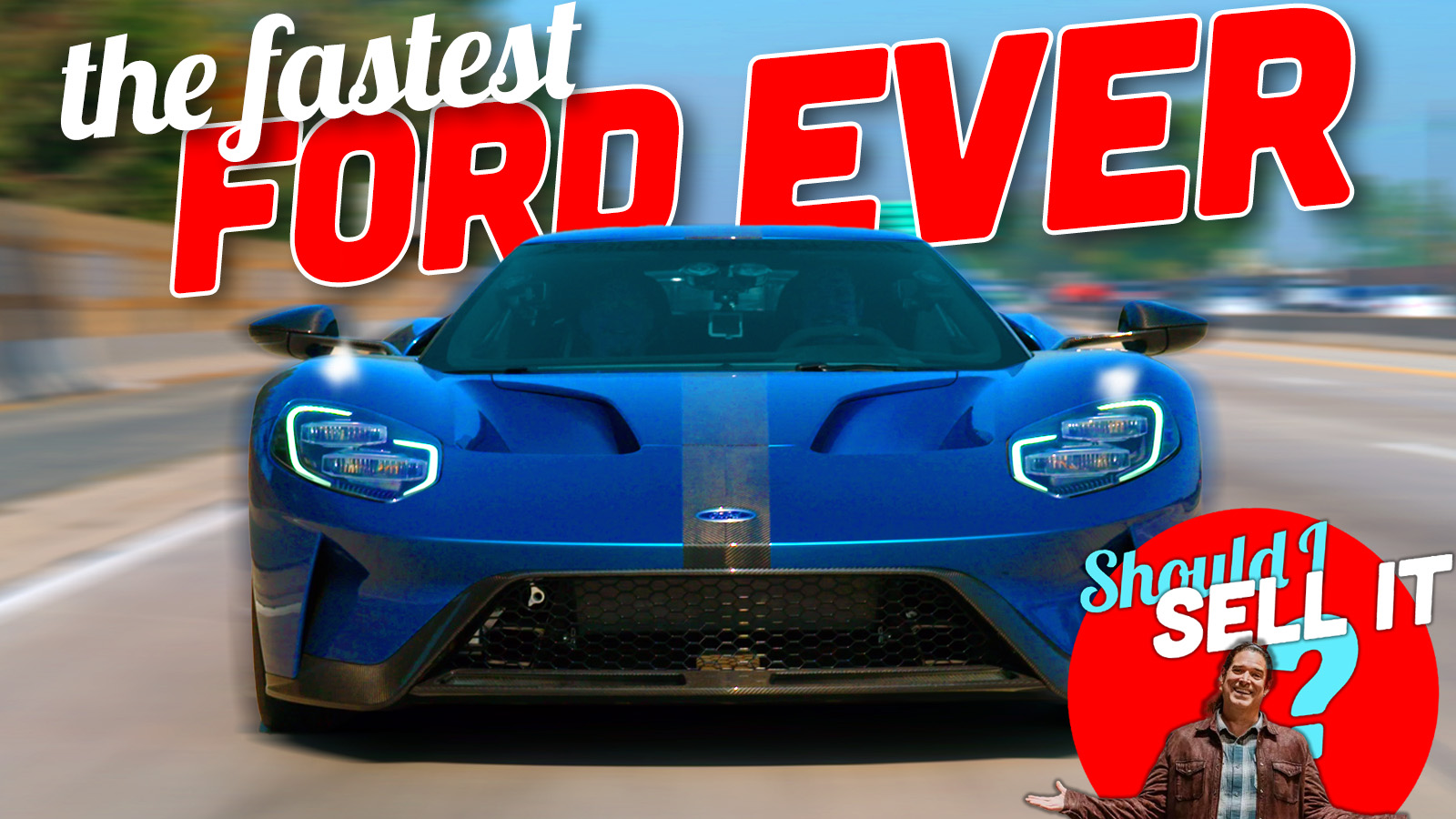
There have been some insanely fast Ford vehicles over the decades, from Focus STs and RSes to Mustang GT350Rs and GTDs, but the king of them all is a vehicle co-developed by Ford and a literal race car manufacturer based out of Canada called Multimatic. I’m talking about the second-generation Ford GT. And the Holy Grail of second-gen Ford GTs is one I forgot even existed: the extremely rare, hard-core Ford GT Competition Series, which doesn’t even come with a radio or air conditioning.
Before I even continue with this article, I’d like to share a photo that I think tells the story of this car quite well.


This photo:

A lot of the cars Autopian cofounder Beau is considering auctioning off later this year are quirky; some are microcars, one is an extremely rare convertible called a Playboy, one was sold by a literal madman, and I could go on and on. But in all the craziness, there are some legitimate performance cars like Carroll Shelby’s DeTomaso Pantera and this: The Holy Grail of second-gen Ford GTs.
It’s called the GT Competition Series, and though the ~$70K+ package was available for two model-years (2017 and 2018), vehicles equipped with it are extremely rare. According to multiple online marketplaces, it seems like only six or seven exist, and from what Autopian cofounder Beau Boeckmann tells me, it’s possible not all of those kept the GT Competition Series’ hardcore spirit intact, because keeping the GT Competition as it came from the factory requires 100% devotion to speed. From Ford:
“The Competition Series was developed with the most hardcore track enthusiasts in mind, providing a tailored set of lightweight features and unique livery to match” [said Raj Nair, Ford executive vice president, global product development, and chief technical officer]. For example, the innovative lightweight, race-inspired Perspex® acrylic engine hatch cover with manual latch and carbon fiber prop rod reduces weight near the roof and shifts the balance of weight lower in the car.
Similarly, the bulkhead Gorilla Glass® behind the driver is about half as thick – and lighter – as on other models. All performance features from the standard production car remain, including the FIA-certified steel roll cage and active aerodynamic system. Items not essential to performance – including air conditioning, radio and speakers, stowage bins and cupholders – are eliminated.
Weight-reducing optional equipment – such as performance enhancing carbon fiber wheels, and titanium lug nuts and exhaust – are standard on the Competition Series.
There was another lightweight GT called the Carbon Series, but it wasn’t the same, as Ford said in a press release:
“While the Ford GT Competition model appeals to hardcore racing enthusiasts, we found more customers asking for more exposed carbon fibre with the air conditioning and radio still intact. So we developed the Carbon Series to satisfy that need while providing a distinct look.”
The Competition Series is the most hardcore second-generation Ford GT ever, and given that the second-gen Ford GT is the company’s fastest street car around the track (certainly in 2017, when this GT came out; the new GTD may have displaced it around certain tracks), by the transitive property you can reason that this hyper-rare Ford GT Competition is the fastest street legal Ford ever. Needless to say: Riding in the ~3,300 pound (dry curb weight: 3,054lbs), 647 horsepower machine around Van Nuys was mind-meltingly absurd.

Before we hit the streets, Beau showed me around the very first special edition Ford GT ever (Yes, this is the first example of the rare Competition Series, and despite that it’s still not even the most special GT that Beau owns; Ford created a special color for Beau called “Beauberry” and painted a GT and Mustang GTD in that color). He pointed out the carbon fiber center stripe:

He showed me the carbon fiber wheels and titanium lug nuts:

Beau pointed to the Akrapovič titanium exhaust acting as the centerpiece of the most beautiful rear end in automotive history:


Then the two of us had a great time trying to prop up the rear acrylic hatch, as it required assembling a carbon fiber tent pole-hood prop:


From there, Beau showed me the interior, which added one thing but subtracted a whole lot more. The addition was the racing harness:

But the rest was removal — the AC is gone, the speakers are gone, and even the radio: replaced with a blanking plate:

Just look at that trio of switches; one is for changing the air vent, one is for temperature, and one is for fan speed. It appears that the latter two aren’t even labeled; I love that.
Oftentimes automakers talk about how they’ve built “a race car for the road,” and 99.9% of the time it’s just marketing BS. The cars have nice infotainment systems, ice-cold AC, and two dozen speakers — they’re not race cars. But this GT is different; it’s not entirely without comforts (it has power windows, a nice front-end lift system to help you get into and out of steep driveways, and the ride is remarkably supple all things considered), but it’s literally a carbon fiber supercar designed by a race car company and devoid of major luxuries; it’s a street-legal race car. And it’s absolutely epic:

I’ve never been a huge fan of the sound of a V6 engine, but the boosted 3.5-liter in the GT feels like a beast of its own. With Beau behind the wheel, it growled and whistled and, with a tap of his big toe onto the big-pedal, SCREAMED AT THE TOP OF ITS (titanium) LUNGs, violently shooting me back against that well-bolstered bucket seat and nearly causing me to experience my first smiling vomit.
The Ford GT’s character on the road is pretty well established. It’s basically a LeMans race car homologation special. Seriously, you remember in 2016 when — only about a year after it first debuted — the new Ford GT won the 24 Hours of Le Mans GTE Pro Class?
It was an epic race exactly 50 years to the day after the legendary 1, 2, 3 finish that inspired the popular Hollywood film Ford vs. Ferrari. This time, though, instead of 1, 2, and 3, Ford’s new GT won 1, 3 and 4, with of course Ferrari being the one to spoil what would have been a poetic re-run half a century later. Still, 1, 3, and 4 in that class is impressive, and it’s hard not to love the second-gen Ford GT when you realize just how similar it is to the race car.
Motor Authority wrote a story back in 2016 titled ‘How The Ford GT Race Car Differs From The Road Car.” Here’s what that piece said:
“First of all, there are very few differences,” said Nair [Ford’s executive vice president, global product development, and chief technical officer]. “This is pretty close to a no-waiver car.” A no-waiver car would have no changes from the production… car to make it competitive in a race series. The reason it is so close is that Ford designed the race car and the production car at the same time, knowing the rules for IMSA’s GTLM class and the FIA’s LM GTE Pro class.
Of course, the production Ford GT wasn’t a copy of the race car; the production car’s headlights had to meet government standards, the production car’s interior (even that of the Competition Series) is a lot nicer than the race car’s, and the aerodynamics are totally different, with Motor Authority writing:
The aerodynamics are completely different between the two. Up front, the race car’s lower grille sits flush, the front fascia is rounded off, the diffuser is unique, and winglets at the corners add more downforce. The street car also has an active rear spoiler that raises at speed and changes pitch when the brakes are applied to act as an airbrake. Active aero is illegal on the race car, so it has a much larger fixed rear spoiler, as well as a massive rear diffuser.
More cooling is needed for the race car, so it has NACA ducts in the center of the big nostrils on the hood and at the front of each rear fender.

As for suspension, it’s all quite similar:
The tub is common to both cars. The suspension geometry is basically the same, though final suspension calibrations for camber, caster and other factors are optimized for racing. The race car also sits lower, and uses some sold-mount bushings that would hurt ride quality in the production car. An active suspension will be used on the street car, but that is not allowed for racing, so the race car uses Dynamic Suspensions Spool Valve (DSSV) dampers, which were developed by [Multimatic] Motorsports, the company that is building both the race and road-going versions of the GT for Ford. The race car also runs racing slicks on unique wheels, and its brakes are iron instead of the carbon ceramics of the street car.
“More so than any car on the grid, there is a lot that is exactly the same on the production car as the race car,” Ford’s Raj Nair says at the end of the article (which you should absolutely read).
That’s the thing about this generation of Ford GT. It may not be as legendary as the OGs back in the 1960s, it may not have a V8 like the beautiful 2005/2006 model, but it’s an absolute engineering Tour de Force — a genuine masterpiece. Whenever I walk into Galpin Auto Sports, I see their head GT technician, Ray, working on these GTs, oftentimes with entire body panels removed. The second-gen Ford GT is one of few cars in this world that looks as beautiful torn apart as it looks fully assembled. Here’s a quick look at Ray showing me under the skin of this amazing machine a few months back:
View this post on Instagram
Looking into the rearview mirror at the GT’s gorgeous bodywork as my internal organs were being thrown around as if in a blender, and listening to the greatest sounding V6 I’ve ever heard, I couldn’t help but marvel at this amazing piece of design and engineering.

As for whether Beau should sell it, that’s going to be entirely up to what the car means to him. It’s an incredibly rare and special machine that he, as the world’s largest Ford dealership, was able to purchase the very first example of. That’s extremely cool, but at the same time, Beau has his ultimate Ford GT, the Beauberry GT:
What’s more, Beau runs a huge dealership group and he’ll tell you himself he doesn’t have the time to stretch this amazing race car’s legs. And this machine deserves to have its legs stretched.
Let us know what you think; if you were Beau, would you keep this #1-of-7(ish)-ever-built hardcore Ford GTs or would you sell it?


The paint color is literally named for him?!
Yep.
Must be nice.
If you enjoyed the handling you should thank Scott Maxwell, Canadian Lemans LMP2 winner, 3 decade Multimatic susp4 sion development master and all-around great guy.
He only has 2 Ford GT’s? He needs triples. Triples makes it safe. Triples is best.
Advertise for someone who will track it regularly.
If he can’t find anyone like that, keep it and commit to making time to track it as often as possible.
Lots of race cars in collections, but most are “retired.” This one hasn’t seen enough track time to retire yet.
Sell it to me! I have hundreds of dollars.
an incredible machine, but its not doing the thing that it was supposed to be doing. set it free.
I’m on the sell side. He doesn’t drive it. He doesn’t have time to go to the track. And he has another Ford GT.
And Track/competition cars suck for regular on-road use.
That’s a keeper
Don’t sell that one.
I don’t care one way or the other about the pink one. But don’t sell the blue one, says I.