

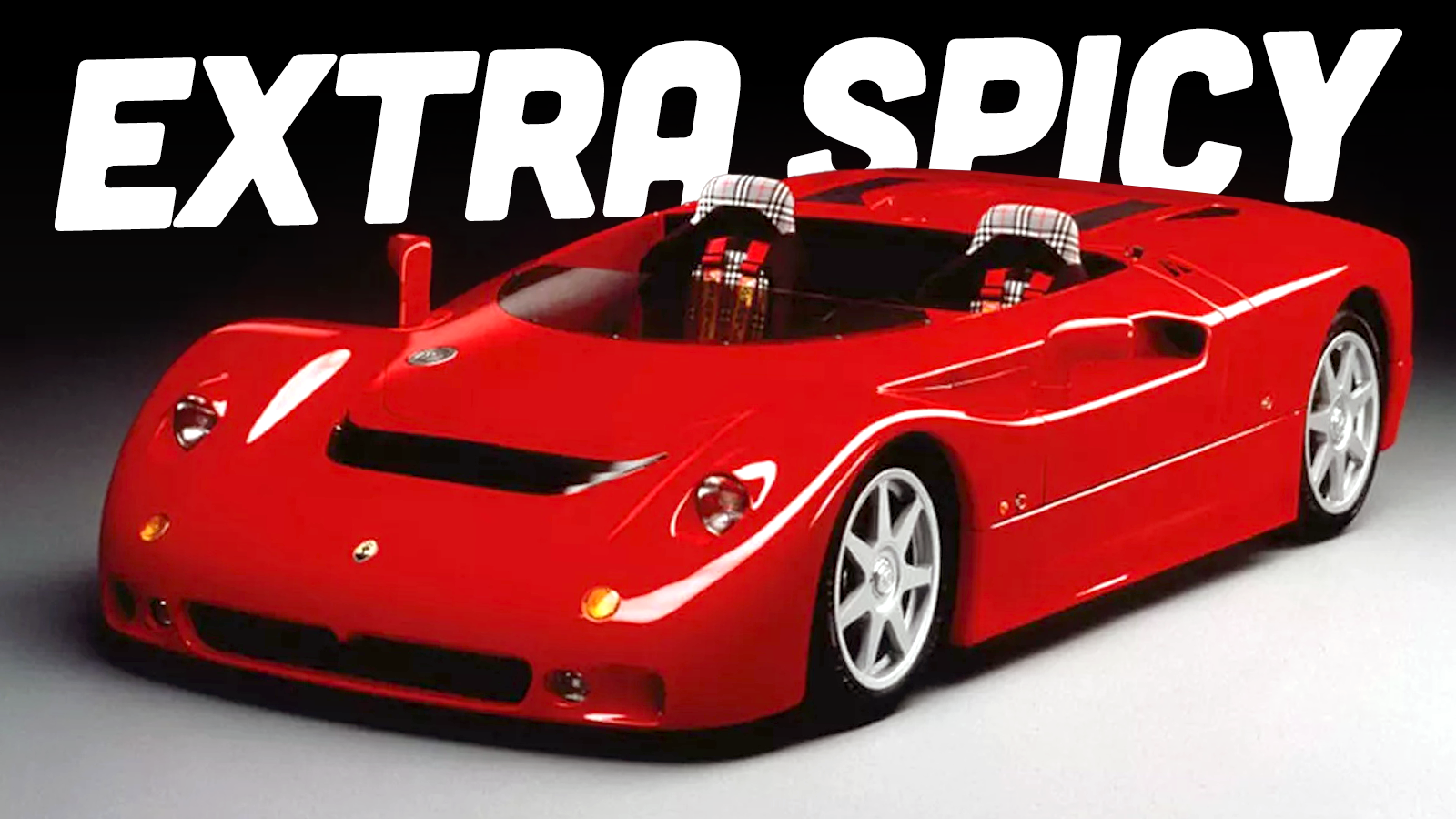
Over the past 20 years, dedicated trackday toys have found a real niche among the silver-yachts-and-mega-spoons crowd – stripped-out, occasionally ruthless chariots for the one percent that frequently run unbridled from the rules of being road-legal. So, where did the modern flashpoint for this wave of cars like the Ferrari Monza SP1 and Pagani Zonda R start? I reckon Maserati did it way, way before it was cool.
Back in the early 1990s, Maserati was on the ropes. After the relative reputational flop of the Biturbo, the marque withdrew from the U.S. market, and found itself generally starved for all-new product. The Quattroporte III and its ritzy Royale variant were coming to an end with no immediate successor, the Karif was just another variant of the Biturbo model, and the Shamal was a V8-powered heavy rework of the Biturbo. However, Maserati had one last Hail Mary up its sleeve: A little something called the Chubasco.


With a honeycomb backbone chassis, pushrod front and pull-rod rear suspension, and plans for a mid-mounted V8, the Chubasco was intended to be a salvo fired directly over Ferrari’s front gate. It was wildly advanced for the turn of the ’90s, incorporating technical innovations we wouldn’t see in road cars for years, and to ensure instant desirability, Marcello Gandini did the styling. Media were shown a full-size mockup, plans were set for production, and then the bottom fell out. The early 1990s coincided with a recession, and Fiat heir Gianni Agnelli may have helped delay Maserati’s supercar dreams, but that didn’t mean learnings from the Chubasco were completely wasted. In the meantime, Maserati found perhaps the most hilarious way possible to use them: without a windscreen.
See, homologating a car for use on the road is really expensive. There’s an enormous set of rules you need to follow, an expensive battery of tests a car then needs to pass, and then all the sales and distribution challenges downstream of that. Building an extremely light and wicked quick track car, by comparison, isn’t nearly as complex. Welcome to the Maserati Barchetta.

The story begins in 1991, when Alejandro De Tomaso announced a new one-make racing series called the Grantrofeo Monomarca Barchetta Maserati. Initially consisting of six races, drivers would line up on the grid in identical Maseratis and compete to see who was the fastest. However, instead of racing reworked Biturbos, the resulting Barchetta was far more interesting.
For one, it had a backbone chassis, nothing like the steel unibodies of Maserati’s road cars of the time. The front suspension was a pushrod setup, the rear suspension was a pull-rod setup, and the engine sat just behind the driver. In layout, the similarities to the stillborn Chubasco were undeniable, with one exception: the engine. Instead of a turbocharged V8, the Barchetta made do with the two-liter twin-turbocharged V6 from the Biturbo. This meant that even after being juiced, it made do with 315 horsepower. One fewer than a 3.3-liter Porsche 911 Turbo, 19 more than a Ferrari 348. That didn’t matter, because this thing weighed astonishingly little. We’re talking 1,709 pounds, which resulted in a power-to-weight ratio of 368 horsepower-per-ton. That’s breathing down the neck of a Ferrari F40, except the Barchetta was crazier because its ultra-low Carlos-Gaina-penned coachwork didn’t have a roof.

Understandably, not many were brave enough to line up on the grid in a twin-turbocharged Maserati with the power-to-weight ratio of an insect, a top speed of three miles a minute, and the price tag of a V8 Mercedes-Benz S-Class. Only five arrived to the inaugural one-make race, with the grid eventually swelling to seven later that autumn. A far cry from the planned 25-car production run. Worse still, one driver proved absolutely dominant. Among a roster of gentleman racers, 1990 24 Hours of Le Mans winner John Nielsen came, saw, and completely conquered. Nielsen won the inaugural race by more than ten seconds, and went on to win the other five rounds of the inaugural season. Fortunately, the ten-round 1993 season attracted more professional drivers. We’re talking 1988 24 Hours of Le Mans champion Jan Lammers, former Formula 1 driver and European Touring Car champion Carlo Facetti, and Argentine Formula 1 driver Oscar Larrauri. However, it would be the Barchetta’s last season of true competition.

A similarly underwhelming fate befell the planned Stradale version of the Barchetta. With lights, mirrors, and emissions equipment, it was set to be a race car for the road. Never mind that race cars generally don’t work so well on the road. Only one prototype was produced, although a race-spec variant did eventually end up gaining the Stradale front clamshell. All in all, only 17 Maserati Barchettas were made over just two years of production, but that doesn’t stop it from being immensely cool.
It’s poster car material, a moonshot of sheer desire so bonkers, it’s amazing it was allowed to come to fruition. Maserati was solidly 30 years too early to the high-end trackday toy market, but what a wild thing the Barchetta was. Even though it wasn’t exactly successful, I’m glad it exists.
Top graphic image: Maserati


At least the chassis went on to be used in the de Tomaso Guarà, so another handful of staggeringly beautiful and undervalued machines exist because of it.
I like the simplicity of the lines on this car. Purposeful, although brick-like compared to subsequent sports-car designs.
Eh… Come on now…
The Philippe Charriol Super Sport Trophy, better remembered as the Lamborhini Trophy was launched in 1996, was quite successful, and basically saved Lamborghini which was in dire straits after being sold once again, this time from Chrysler to Megatech.
Maybe not the one and unique saving factor, but it played heavily. Also put them on Audi’s radar.
It probably didn’t hurt that the Diablo SV-R – the specific model leased for the series – came with a homologation kit, deliverable at lease expiration. This allowed the owner to make the car road-legal.
PS: Have to give it to the 90s, they knew how to design wheels.
That red Barchetta is RAD
I remember one of these showed up at the Australian Cannonball Run in 1994, which was infamously marked by a fatal crash involving a Ferrari F40 that killed 4 people.
http://www.motorsportmemorial.org/focus.php?db=ct&n=3380
How about AMC-Renault-Jeep!
https://www.hagerty.com/media/motorsports/sport-renault-americas-obscure-purpose-built-road-racer/
Or the Renault Sport Spider, but that’s a little later.
At the recent Motor Valley Fest in Modena, part of the four days show was “De Tomaso Reloaded”, a celebration of De Tomaso’s history. Finally Modena giving him a well deserved credit. That included a special show of De Tomaso cars or Maserati built during his tenure. On Sunday a Barchetta won its category at the Concourse d’elegance of Salvarola Terme.
I’ve been infatuated with the Barchetta since I first layed eyes on it about 25 years ago. It was an engineering masterpiece imo. The longitudinal central honeycomb ‘chassis’ bolts to cast magnesium subframes at either end. The suspension and engine subframes bolt to those. You mentioned the rocker arm suspension at either end.
Some great pics
http://www.maserati-alfieri.co.uk/alfieri-barchetta.htm
http://www.maserati-alfieri.co.uk/alfieri03.htm
Thanks Thomas!
Looks like De Tamaso stole a lot of the design from the cancelled Shelby/De Tamaso P70 from the late 60s Can-Am Series.
Well if I am not mistaken, it was later repurposed as the DeTomaso Guara, effectively closing the circle.
He stole it from… himself?
Except Pete Brock, of Shebly/BRE fame did most of the design work. He even wrote a book about it.
Looks like where Kirk Van Houten sleeps.
My uncle has a country place
No one knows about
I was in a Rush to post this comment but at this one lane bridge you’ve left me stranded
The weird thing is that there’s almost a throughline in the styling between this and the later…also admittedly a race car for the road…MC12. Funny how that works.