

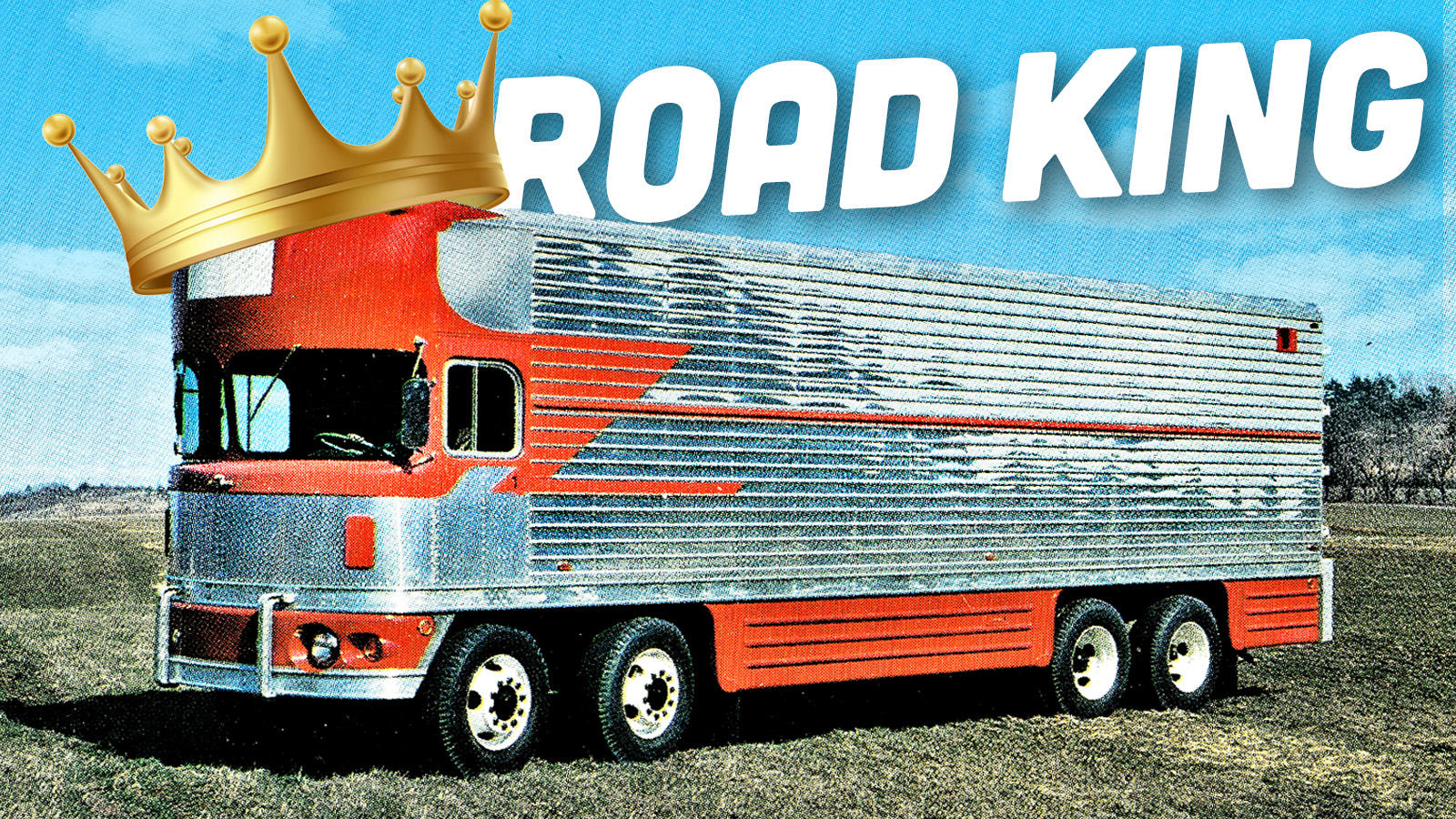
Throughout most of trucking history, manufacturers, fleets, and owner-operators had to contend with state-imposed regulations on total truck lengths and weights. These regulations often varied wildly, which meant that trucks might be legal in some states and not in others, in some cases even in neighboring states. In the 1950s, engineers tried to solve this problem with a big rig to rule them all: the McCullough Road King. The Road King was designed to beat regulations by combining the semi with the trailer, but it would never get a real chance to prove itself.
In 1982, the Surface Transportation Assistance Act (STAA) became law in the United States. Among other things, the Act set federal standards for the dimensions of Commercial Motor Vehicles (CMVs). According to the U.S. Department of Transportation Federal Highway Administration, STAA established a maximum commercial vehicle width of 102 inches, a minimum semi-trailer length of 48 feet, and no limit on total length. State semi-trailer length limits were allowed to be grandfathered, as long as the minimum was 48 feet. Many states chose trailer length limits of 48 feet or 53 feet. The common pick for semi-trailers today is 53 feet, in part due to these regulations, in part due to 53 feet being a sort of sweet spot for fitting 26 pallets in a trailer while still maintaining maneuverability and keeping within weight limits.


Notably, the regulations do not limit the length of the semi-tractor itself. Because of this, the STAA led to the rise of the conventional semi-tractor – a design where the cab is behind the front axle, engine, and a long hood – to dominance in America. Conventional tractors are preferred by American drivers for their greater safety, roominess, and comfort over older American cabover designs, where the engine and cab sit atop the front axle.

It was a long road to reach the STAA. During the early decades of the trucking industry, the federal government only regulated the economic side of trucking, leaving the states in control of determining what trucks were legal on their roads. The first state regulation on truck weight came from Maine in 1913, when that state said that trucks couldn’t be any heavier than 18,000 pounds. By 1933, all states had enacted regulations limiting truck dimensions and weights. While most states largely agreed on how wide a truck could be, weight and total length limits were chaotic. In most cases, length regulations were restrictive.
Because of these regulations, the cabover semi-tractor ruled the road for decades. A cabover generally takes up less length than a conventional, allowing for trailers to carry as much cargo as possible. The regulations also led to a sort of arms race where truck manufacturers competed to create the smallest, lightest, most creative cabover that could haul the largest loads.
In one infamous example, Curbside Classic notes, the railroad lobby successfully convinced the state of Illinois to limit trucks to no longer than 35 feet long. That way, allegedly, the Illinois trucking industry might be limited in growth, potentially allowing for a rise in freight rail traffic. This rule forced trucking firms in Illinois to get creative in their efforts to maximize how much cargo they could carry in such a short length.

The coolest example (above) is how car carriers managed to fit five cars on a single transport by designing trucks that more or less allowed portions of cars to sit between the cab and the engine of cabover car haulers.
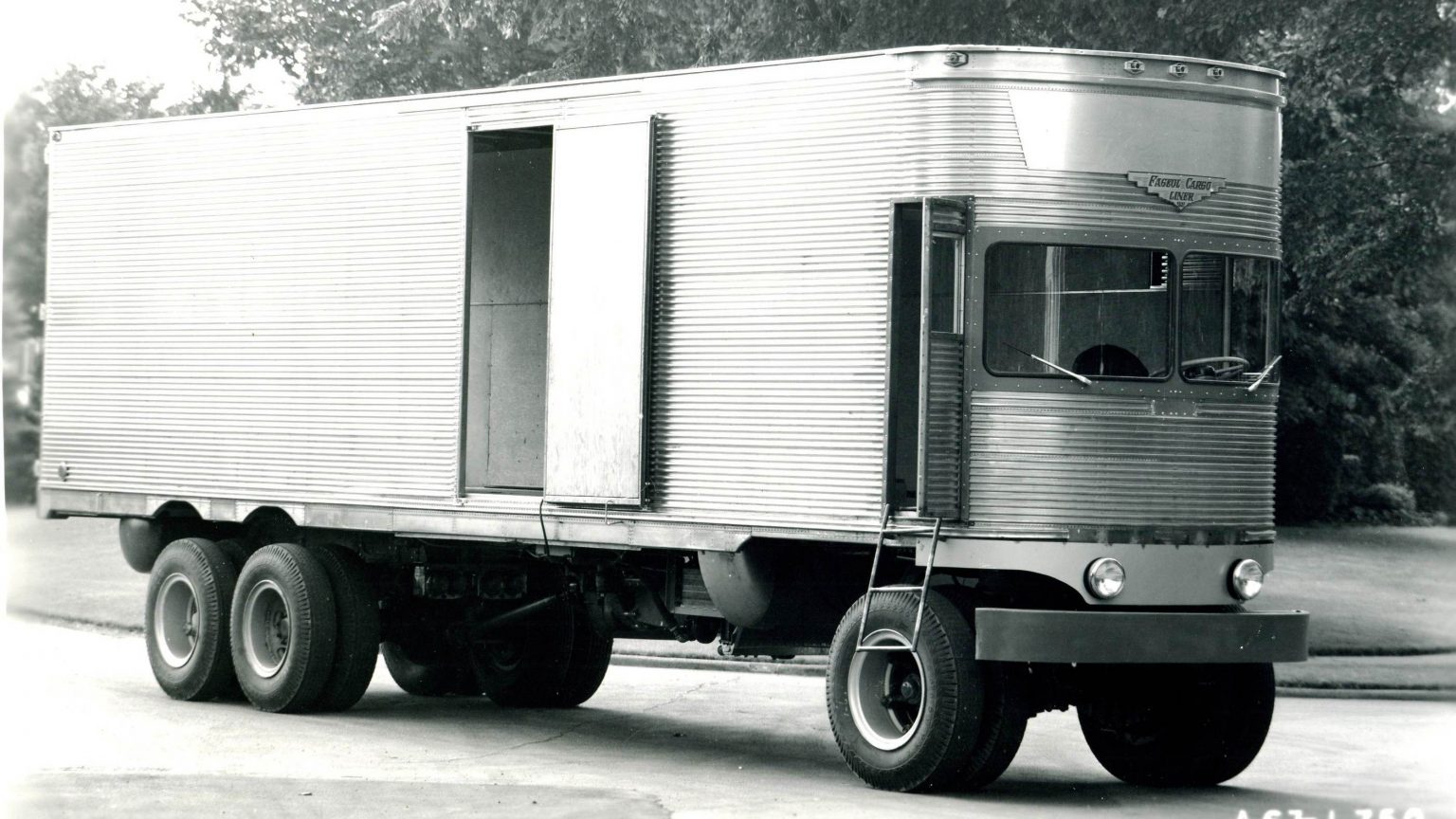
One of the boldest solutions to the length dilemma was to create a truck where the trailer and the tractor were a single unit. I have written about a handful of these weirdos before, including the 1945 Eisenhauer Twin Engine Truck, the 1950 Twin Coach CargoLiner, and the 1963 Highway Products Compac-Van.
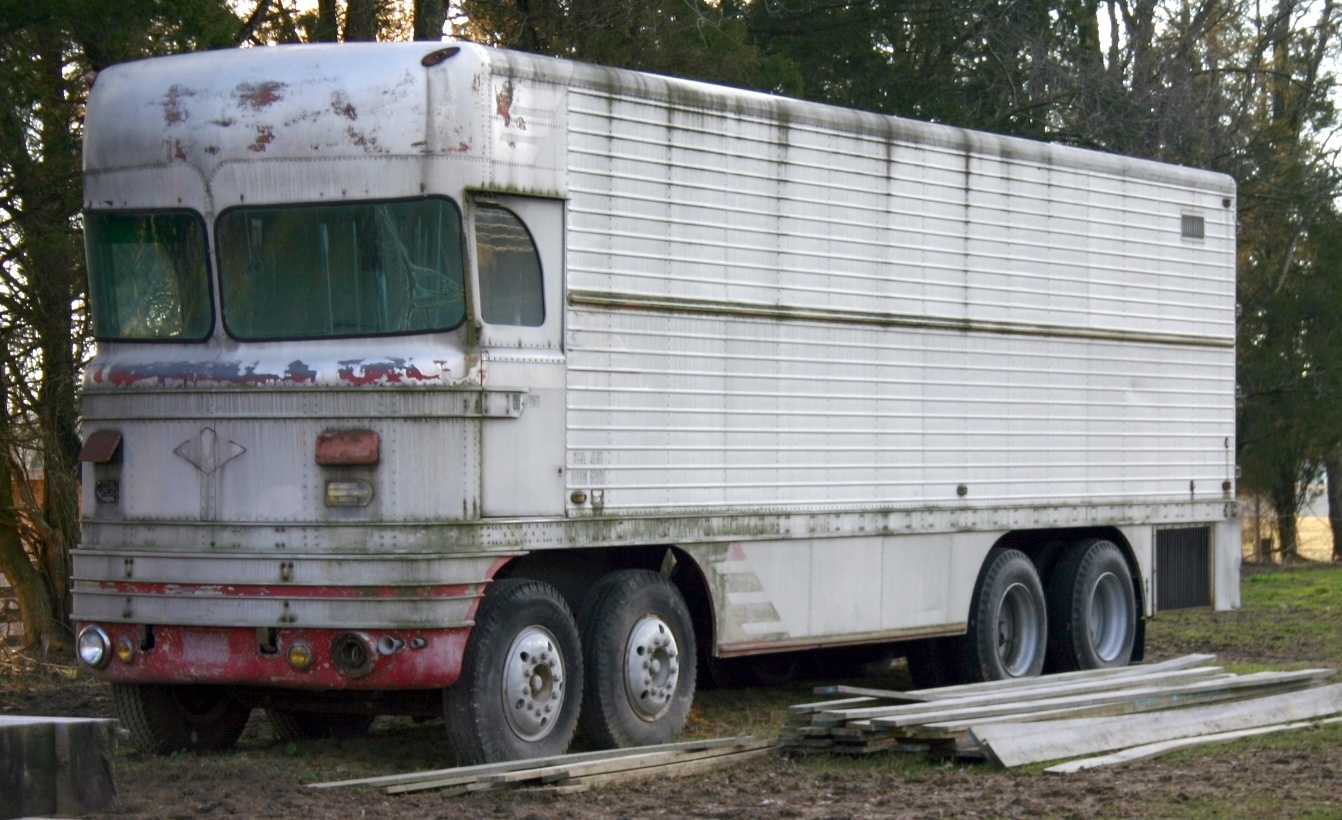
The grandest of all of these efforts was likely the 1954 McCullough Road King, and this truck isn’t just pretty and unusual for a highway truck. Its story also comes with a bit of a mystery.
The Truck Without A Chassis
This story begins with a different company. In 1953, a startup company called McBright, Inc. out of Lehighton, Pennsylvania, announced it had an invention for the trucking world. Its new product was a highway truck, but it had tricks that other trucks didn’t have. Namely, this truck didn’t have a chassis or a separate trailer.
While I could not determine who founded McBright, Inc. or why the company was founded, I did find who was the brainchild behind McBright’s truck. The idea to build a truck with no chassis came from inventor William L McCullough. In 1953, he sought a patent for a unique truck design. Here’s what he said about it:

Under present day conditions, with rigorous restrictions imposed by numerous authorities on the size of the vehicle as well as the gross weight thereof permitted to travel roads under their jurisdiction, it is essential that the ratio of the pay load to the gross weight of the combined load and vehicle be kept as large as possible. While numerous attempts have been made heretofore to improve the usefulness and efficiency of highway cargo vehicles, these attempts have been aimed primarily at other aspects of the problem. For example, various attempts have been made to provide detachable, more or less self-contained units, such as power units and cargo-carrying units, which may be combined to form what are commonly called tractor-trailer combines. It has also been proposed to provide a detachable control unit for the purpose of having a combined arrangement of three independent but interconnected units, each of which being more or less self-supporting. While various advantages may be attributed to such constructions, none have been found which incorporate the advantages of a favorable ratio of pay load to gross weight, while at the same time making possible an overall reduction in gross weight as well as size of the unit.
Thus, under present day conditions, shippers of merchandise or cargo are often faced with the problem of choosing between shipping a reduced amount of cargo over the entire route or transshipping the cargo at one or more points along the route to avoid violating regulations enforced over part of the route to the destination. Very often, the combined weight of pay load and vehicle does not exceed the set maximum but the size of the vehicle does exceed the maximum size permitted in certain localities. This again poses the problem of transshipment, in this instance, to a smaller vehicle, before entering such localities unless a sufficiently small vehicle is used from the outset.

It is, therefore, a principal object of my invention to provide a highway truck capable of transporting a pay load, the weight of which is in favorable proportion to the weight of the highway truck itself, and with the overall size of the truck substantially reduced as compared to trucks capable of transporting equivalent pay loads. A further object is to provide a highway truck capable of transporting a relatively large pay load with the overall size of the truck held to a minimum and only negligibly larger than the space provided for the pay load, while at the same time incorporating the important features of reduced weight, simplicity of construction, and easy access for maintenance and repair.
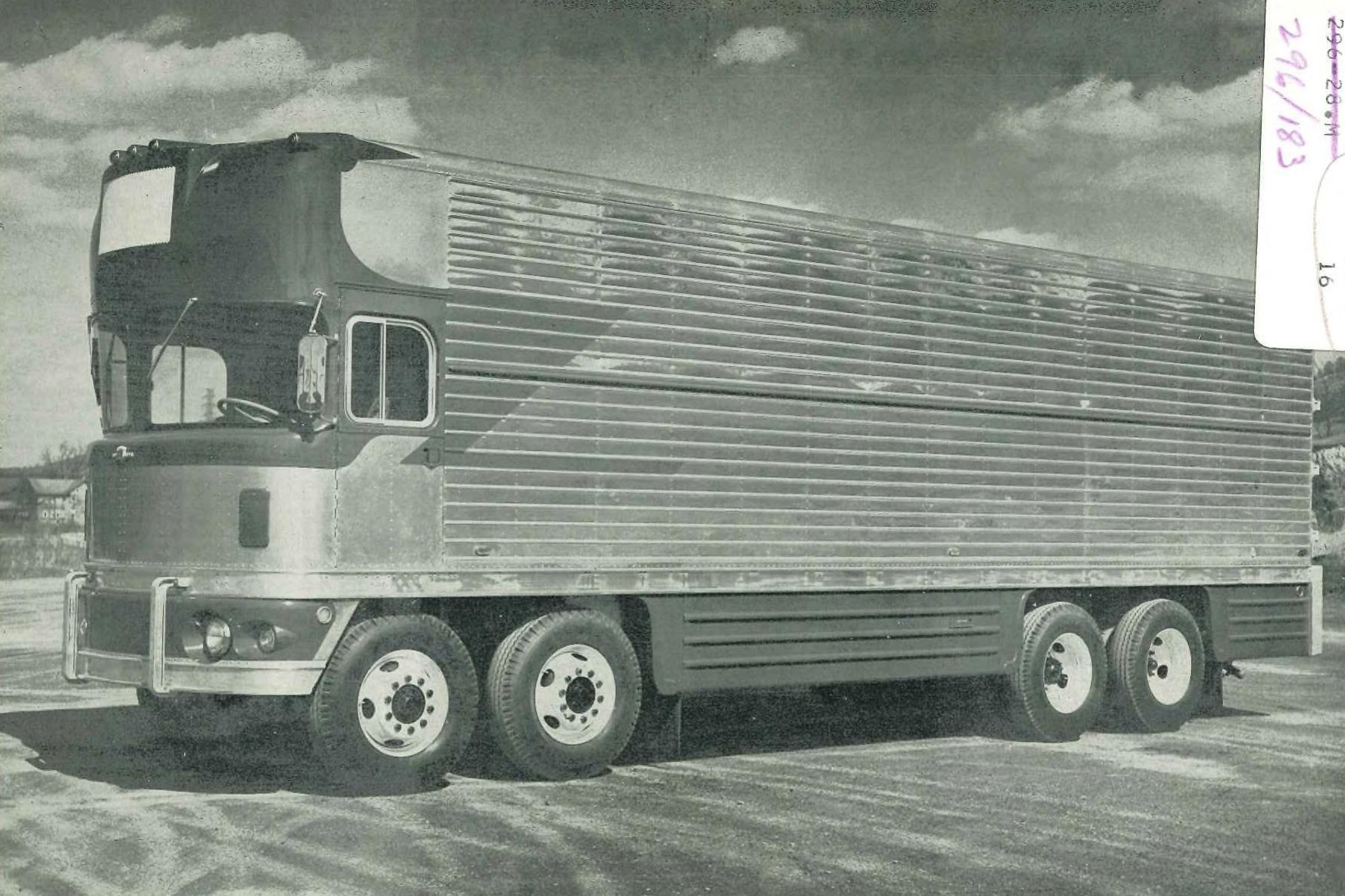
If you just looked at the images of McCullough’s truck, you’d think that it was just a straight truck with a cabover design. But that, to McCullough, just wouldn’t work, because a heavy truck chassis adds unnecessary weight.

To create the McBright Lite-Way, as it was called, McCullough formed an aluminum monocoque body that’s designed to support the weight of the cargo body, the cab, and the entire powertrain. Aiding in this mission is an array of crossmembers, joists, and perimeter framing under the truck’s floor. Structural components are primarily aluminum, and supports are welded or bolted on, while body panels are riveted on.
Then comes the next trick. Since this truck doesn’t have a traditional frame and isn’t really built like a bus, either, where does the engine go? McCullough designed the Lite-Way so that every mechanical component, from the axles and the engine to the transmission and the steering gear, is all suspended from the subframes and crossmembers under the rig.

A 1953 issue of Commercial Car Journal gives more details:
There will be three models put into production which may be 33 or 35 ft long. The first will be with single axle front and rear for light hauling. The second has single axle in front and tandem rear axle for general highway use, and the third has tandem axle front and rear for extra heavy loads. Making extensive use of aluminum, the three-axle model has an overall weight of 14,000 lb unloaded, a gross weight of 42,000 lb for registration purposes distributed with 10,500 lb on the front axle, 31,500 on the rear axle, although it is stressed to carry much greater loads. The four-axle unit will be able to load 23,000 Ib on the front two axles and 36,000 lb on the rear tandem or a total GVW of 59,000 Ib. It will be equipped with Bendix-Westinghouse power steering. All other component parts will be the same as in the three-axle unit.
The 145 hp White Mustang engine is mounted vertically behind the tandem rear axle, supplies power through a White transmission to the second, single-speed driving axle. e driving axle and the dead rear axle are Timken standard production units. The unit also uses a White front axle, Neway suspension, Ross steering and a Bendix-Westinghouse air brakes, clutch, and accelerator. Location of the engine at the rear of the unit is designed for accessibility and easy servicing. A door is provided at either side for routine engine servicing. There is also a panel in the floor at the rear for more complete servicing.
The engine, transmission and radiator can be dropped out as a unit in a matter of minutes. They are fastened with a few bolts and a few connectors which make it possible to complete an engine change in less than four hours. Overall dimensions of the vehicle are: length 32 ft 11 in.; width 8 ft; height 11 ft. It has a 28 ft 11 in. cargo space with a flat floor and 742 ft by 32 in. air conditioned, sponge rubber padded sleeper bunk.

McCullough also finished work on a four-axle version of the truck, which weighed 18,000 pounds empty and carried a 42,000-pound payload. A neat feature about the four-axle version was that, thanks to the use of Bendix-Westinghouse power steering components, both front axles turned to give the truck greater maneuverability.
McCullough Had Fascinating Ideas
Apparently, McCullough had some other interesting ideas aside from a fully aluminum monocoque truck. Trucks back then sometimes suffered locked-up brakes and skidding when trying to stop in lousy weather. To combat this, McCullough designed a braking system where the operator could control how much braking power reached the front and rear. He also considered how changing tires on the side of the road can be difficult, and mounted the spare wheel under the cab on a cable hoist that allows for easy placement of the wheel.
McBright, Inc, would proceed to market the truck as a genius way to turn a profit for a trucking company. Materials touted the truck’s lightweight construction, lack of a chassis, rear engine, and the fact that it was short enough to be legal in all states as reasons to buy in. Indeed, even the longest Lite-Way was only 35 feet long, so even Illinois was okay with it.
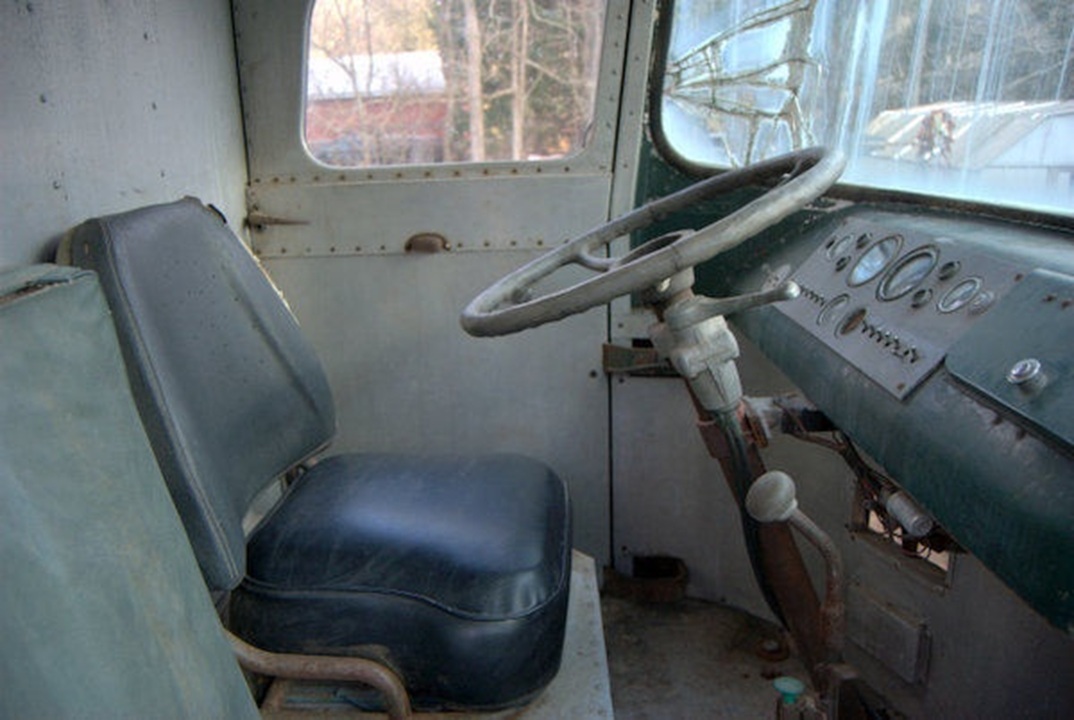
Prototypes featuring four, six, and eight wheels were built and tested. According to a report from Traffic World in 1954, “several” examples were built and leased by trucking companies across America. One triple-axle model was used to regularly haul oranges from Florida to New York. The Daniels Motor Freight Corporation of Warren, Ohio, had a special Lite-Way with four axles and two engines in testing. Traffic World reported that preliminary testing data was promising and that engines could be replaced in as quickly as 20 minutes.
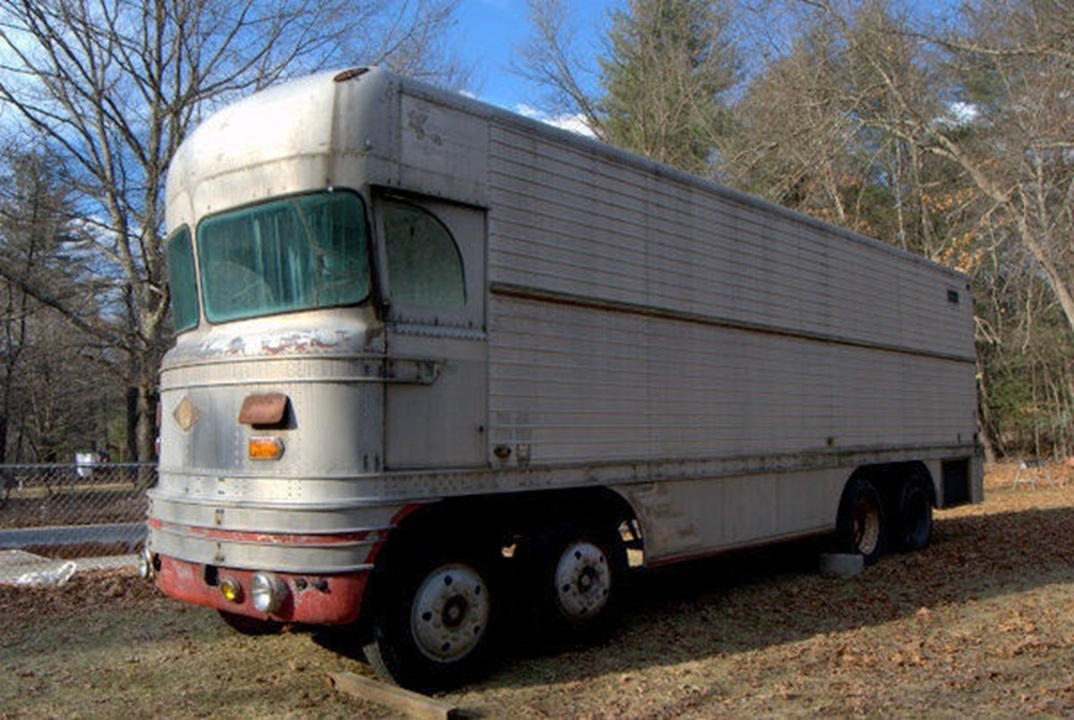
Sadly, for reasons I could not ascertain, the Lite-Way never entered production. One of these trucks appeared for sale on eBay in 2017, and back then, its seller claimed that it was one of only three built. The seller also provided this information, via Bring a Trailer:
“The truck is a prototype carrier vehicle built in 1953 by the McBright Corporation of Lehighton, Pennsylvania. It was built to carry a maximum pay load while conforming with city codes. Built entirely out of aluminum (produced by the Reynolds Company, their first foray into the automobile industry).”

They then go on to explain how they were put in touch with the son of one of the Liteway’s engineers: “As it turns out, the truck was designed and built by a team of aeronautically trained men from World War II. In talking with Robert he sent me photographs, brochures, and newspaper articles. I also met Mr. Moyer, the comptroller of the McBright Corp.,who gave me stationary from the McBright Corp. with their letterhead and an original Road King sales brochure. He also sent me a seven page letter with his memories of his days working at McBright and driving one of the first Road King Trucks.”
Most historical sources note that McBright, Inc. was shuttered in 1955. Yet, the Lite-Way truck itself continued on.
The McCullough Road King

In 1954, McCullough founded the McCullough Motor Corp. in Lehighton, Pennsylvania, and its debut product? It was the Lite-Way. But this time, McCullough covered the rig in flashy dress-up and doubled down on his Colin Chapman-like obsession with removing weight. The truck had a new name, too: the Road King. Allegedly, the Road King name was chosen because it was stronger than Lite-Way. It’s also unclear whether the name change happened before or after the failure of McBright.
Much of the McCullough Motor Corp. Road King was similar to the Lite-Way. It featured the same aluminum monocoque and mechanical components that were suspended from the floor. But, in the only surviving documentation that I could find, McCullough described in rather deep detail how the truck was built:
The gleaming, eye-catching, beautiful exterior of the body of the revolutionary “ROAD KING” is a combination of reinforced fiberglass plastic and Reynolds Lifetime Aluminum. The paneling is of light-weight aluminum sheets riveted to the body structure. The “ROAD KING” is skin stressed, with the strength of aluminum sheeting, which is as strong as structural steel. Since it is light in weight, it reduces the weight of the vehicle, adds extra payload capacity, therefore, more payload. “ROAD KING” body cannot rust or rot — never needs paint for weather protection, yet takes paint beautifully for the streamlining effect on “ROAD KING”. “ROAD KING” bodies incorporate aerotype design – meaning stress—bearing construction – which resists impacts and absorbs pressure. The use of Reynolds Lifetime Aluminum in heavy-duty freight-hauling trucks has many specified advantages, such as: Durability for toughest jobs; Easier road handling; Less costly parts repairs; Less engine and tire wear; Light weight for extra payload and profits; Lower maintenance costs; and lower operating costs.
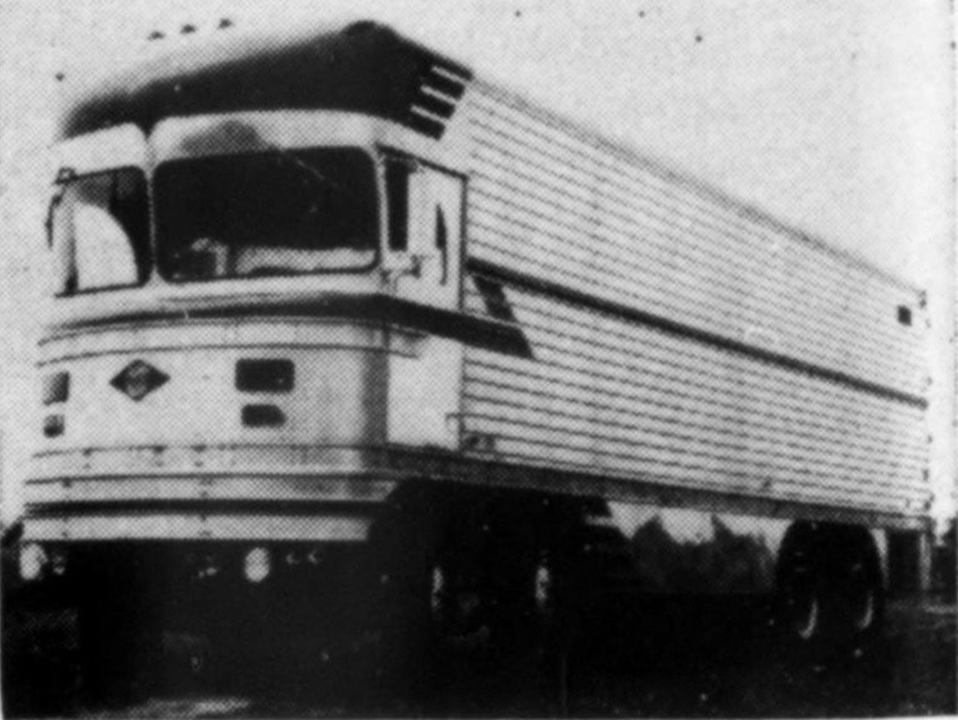
McCullough’s dedication to aluminum was so obsessive that even the truck’s wheels were aluminum. If that wasn’t cool enough, McCullough says that he also employed a rather extensive use of plastic in the exterior design of the Road King:
Reinforced fiberglass plastic has been incorporated with Reynolds Metals aluminum in the original design and construction of the “ROAD KING” in order to produce a light-weight, heavy-duty vehicle that will withstand the rugged service conditions that are expected in heavy freight hauling operations. For example: The ball cap, a big, reinforced plastic part that goes across the top-front section of “ROAD KING” is joined with the front walls of the body. This portion of the vehicle is exposed to many possible hazards. It may be whipped by the branches of road-side trees as the truck speeds along the highway, slashed by low-hanging wires or beaten to pieces when the driver misjudges the clearance of a bridge or underpass. The reinforced plastic nose sections are tough and resilient, able to withstand much of this rouge treatment without damage.
The sections encasing the windshield and head lamps are also fashioned from reinforced fiberglass plastic, Head lamps and turn signals are recessed into the plastic protecting them from breakage. Skirting on either side of the streamlined aluminum body is ais? constructed of plastic. These skirts are hinged to afford easy accessibility to the understructure whenever necessary. The rear skirt, of original design, is also made of plastic. This serves as a holder for the rear lights, stop lights, turn signals, and reflectors. It also bears the hand “ROAD KING” crest. Since weight is of utmost importance to truckers, plastic has been used in place of heavy metals on “ROAD KING” wherever possible, gaining much more strength. The coefficient of expansion between plastic and aluminum is almost exactly the same, so plastic and aluminum have the same expansion rate, which eliminates stress and strain at joints due to heat and cold.
McCullough Motor Corporation, designers and builders of the “ROAD KING’ have combined modern, stream-lined styling and attractive appearance with serviceability, durability, and strength. All the plastic components are produced in our own plastics division of the manufacturing plant.

McCullough further notes that the ceiling, floor, instrument panel, and dashboard of the Road King’s cab are also made out of fiberglass. The cab’s doors feature a mixture of fiberglass and aluminum. Amazingly, the truck also has a sleeper – it’s supposed to be a highway truck, after all – and it’s located under the seats in the truck. The sleeping box is 26 inches by 72 inches and features a duck-material mattress. While that sounds like a coffin, McCullough brags that this was actually one of the largest sleepers of the mid-1950s.
Standard power came from a White Motor Company Super Power 250-AD 340 cubic-inch straight-six gas engine with 145 HP and 275 lb-ft of torque. If you wanted diesel power, the Road King was to have a Cummins JT-6-B, which is a 401 cubic-inch straight-six turbodiesel with 175 HP and 407 lb-ft of torque. Those thoroughbreds reached the rear wheels through either a Road Ranger five-speed 5C-65 or a Road Ranger R-46 transmission with a total of eight speeds thanks to a two-speed rear axle.
Other interesting goodies noted by the technical document are the suspension consisting of air cells made out of rubber and cloth. Air also operated the power steering, the clutch, and the brakes.
Both Trucks Seemingly Disappeared
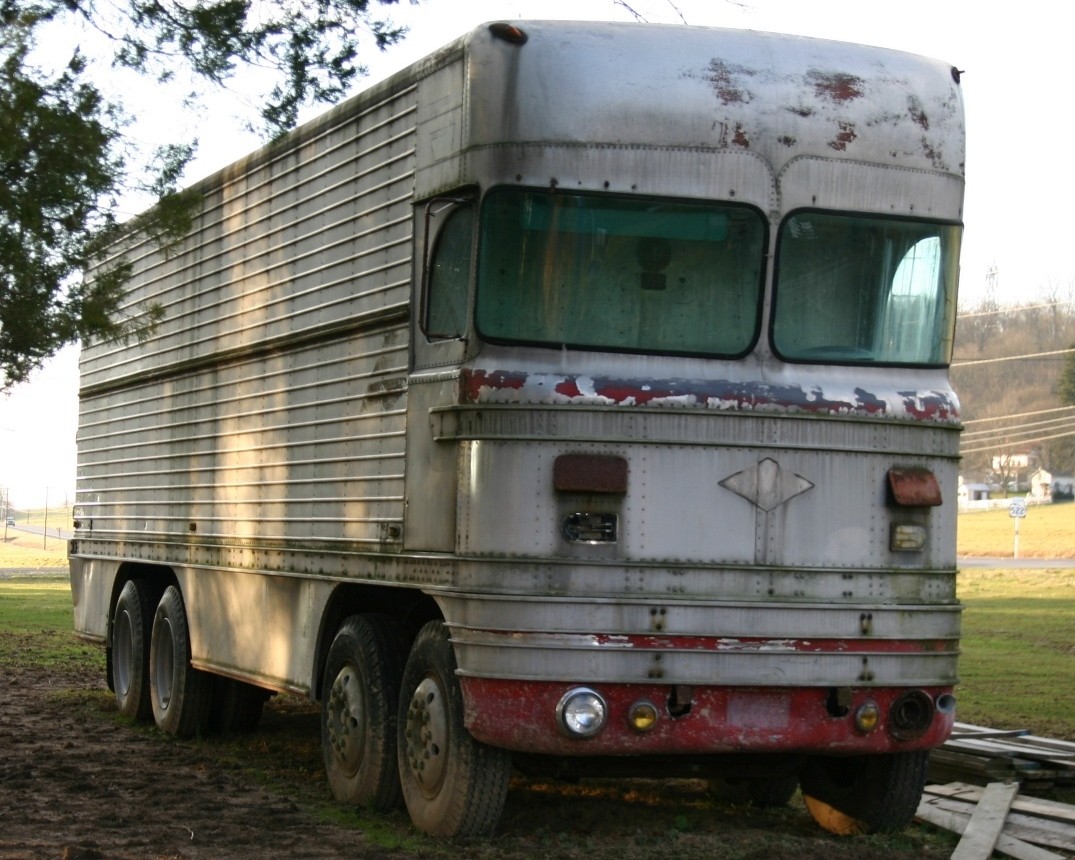
Once again, for reasons unknown, the Road King never entered production. McCullough Motor Corporation is often cited as folding in 1957. At least one prototype Road King was made, and one of the trucks somehow made it all the way to Venezuela, where it went into service hauling Nestlé Savoy chocolate. Today, that truck lives in the Guillermo José Schael Transport Museum in Caracas. Click here for an image of it.
You can also see it here in this video that has practically zero pixels:
Despite days of digging, I have not been able to figure out why McBright or McCullough folded. I did discover Mr. McCullough continued to come up with trucking inventions well into the 1970s, but that’s where the trail goes cold.
However, there are good reasons why this type of truck never took off, despite more than one attempt to make the design work.
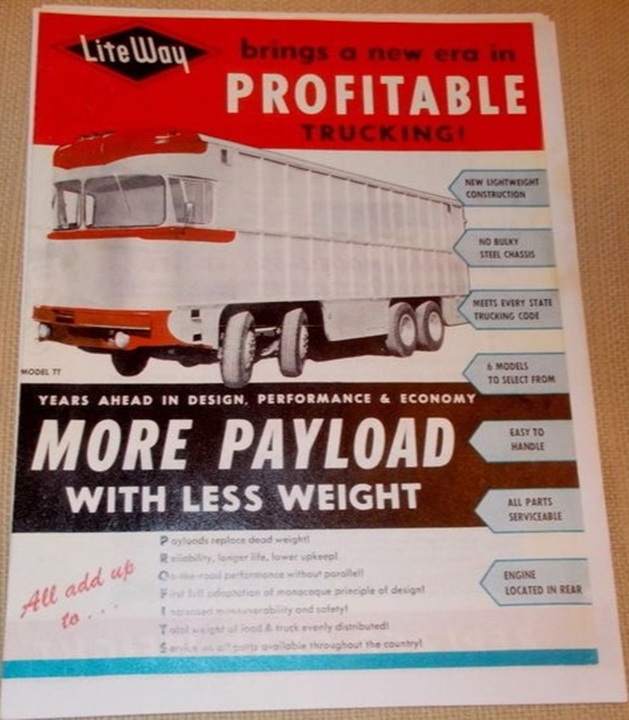
One of the greatest advantages of the traditional tractor-trailer is its flexibility. One semi-tractor could carry a flatbed on one load, a tanker on another, a load of cars on one run, or a dry van on another run. All they have to do is hitch up to the target trailer. Likewise, the truck doesn’t have to hang around while the trailer is being loaded and unloaded. The driver can hitch up to their next load and continue making money.
In the case of the Lite-Way, the Road King, the Eisenhauer, the Compac-Van, and the CargoLiner, you’re stuck with whatever body the truck shipped from the factory with. So, there’s no option to diversify your loads.
The unitized truck is also bad for repairability. If your semi-trailer wears out, you can just hook up to another one. If you have a good trailer but a worn-out semi-tractor, you can just upgrade or repair the tractor. These combo trucks are sort of the worst of both worlds. The cargo area is integrated with the truck and provides load-bearing structure, so that can’t be replaced easily. Likewise, since the tractor is permanently married to the cargo area, options to upgrade the underlying tractor underneath are limited.
These trucks aren’t even that similar to the modern straight truck. Many modern cube trucks have their cargo areas separate from their cabs. Today’s trucks are highly standardized. When damaged, these cargo areas can be removed and replaced.
Of course, by 1982, novel designs like these were no longer that relevant. Gone were the days of needing to fit an entire load in no greater than 35 feet.
Help Me Finish This
Still, I keep finding myself impressed with what the engineers of the past have achieved. When faced with stringent regulations, so many creatives invented all sorts of hacks and tricks to try to create a better, more efficient truck. Things got so desperate that more than one engineer had the idea to delete the chassis from their trucks just to save valuable weight.
The Road King, like its contemporaries, was certainly a product of their time. McCullough pulled everything out of his hat to build the ultimate truck, from extensive use of aluminum to making much of the cab out of fiberglass. That wouldn’t sound too amazing today, but it probably seemed wild back in the 1950s.
But I want to finish this story. I wasn’t able to figure out who started McBright and why. I couldn’t figure out who William McCullough was. I also found no explanation for why this idea failed not just once, but twice. If you can help me finish this story, email me at mercedes@theautopian.com.
Top graphic images: McCullough Motor Corporation via Alden Jewell. – CC BY 2.0; DepositPhotos.com


Oh wow, probably the first time you bring up some weird, obscure truck and I actually know that truck! Always loved this concept; it’s basically a cargo bus (the nemesis of the passenger semi-truck).
EDIT: actually I think I found out about the McCullough after going down a rabbit hole inspired by your article on the Faegol.
Interesting! It’s really pretty much the same concept as the then-contemporary European Setra bus and its later descendants, including the North American Eagle/MCI/Prevost buses and similar ones that followed — Just outfitted as a truck.
There will always be some debate, but I tend to consider all of these to be semi-monocoque (or “integral”) designs. The skin isn’t really stressed and carrying any structural load, unlike a true monocoque design. (You wouldn’t really want that in a truck, in particular, and unless it’s done perfectly, it’s been more trouble than it’s worth in many buses.) Instead, these carry all the weight and stress on the internal structure and skeleton framework, sort of like a box truss. The “frame rails” serve just as a spine for the self-supporting body structure with or without a skin, and the whole thing can be lightweight and then set on top of subframes built heavy enough to carry the load through the suspension to the axles and tires.
The one thing we really don’t have today is the ability to rapidly change out the engine and transmission as a unit — although I think that’s more due to the required complexity of modern engines and auxiliary systems. In the 1950s, you had an engine and simple gearbox connected together, and a simple radiator. Disconnect the driveshaft and shift linkage, the upper/lower radiator hoses and the two heater hoses, the speedometer cable, the battery cables and a few other wires, the air lines from the compressor or dryer, and maybe the power steering pump — then the engine/transmission combination is ready to haul out. In an era where rear bumper regulations on trucks were limited or non-existent, there was very little in the way of removing it.
Today, we have much more complex systems surrounding the engine. Complex cooling and turbocharger aftercooler setups, along with air conditioner evaporator coils that have to be pumped out and disconnected. Far more complex wiring harnesses for engine/transmission management and vehicle-wide CAN bus systems. Then any modern mandatory collision-protection structure in the rear bumper area has to be disconnected or disassembled and moved out of the way. Individually, all of these extra components can be made for simple detachment and re-attachment, but there are just so many that it complicates the entire job and adds time needed to complete it. In-frame maintenance and even overhaul isn’t necessarily any easier, but it often saves time. That’s where conventional cabs hold their advantage — with the “doghouse” swung up or even removed, access to the entirety of the engine is far less obstructed. And removal with a hoist, when necessary, is simplified. Cabovers and underfloor/pusher engine designs can never fully compete for that kind of service access.
This would be excellent as a medium duty delivery truck.
Did that guy really build these things out of Reynolds Aluminum, like the same stuff that I have in the kitchen drawer right now?
Thicker. Much thicker.
Its the same company but not the same product
I read the headline and got a sense of deja vu from the dozen or so articles about older innovations in trucking, such that I thought this was a weird reprint for a moment before realizing it was, indeed, new content. Good stuff. It was just a temporarily-confusing headline coupled with too many of the annoying page-covering pop-ups about “don’t go back to work, read these” (which are really frustrating and – especially since they are not affected by Night Panel – have the opposite effect of encouraging me to click on more content). Some of us get interrupted while reading, and don’t need a full-page reminder that we need to find our place where we were reading yet again.
You’re not the only one, Box Rocket! Since I often reference my own articles when writing them, I’m always getting that pop-up box while trying to read my own posts. Sometimes I’ll have something like seven tabs open, which means I have to close the pop-up seven times.
I’ll notify the powers that be to see if we can change that, or at least make it less aggressive!
Is the actual goal here that Mercedes acquires one of these and converts it into an RV that has space for both tiny cars and motorcycles? Thereby allowing her to ascend to the next level of autopia which I’m guessing is becoming a disembodied intelligence that will live forever in future Smart Cars?
I really like this series 🙂
Really amazing that an apparently very well settled design actually got so many variations throughout the las century.