

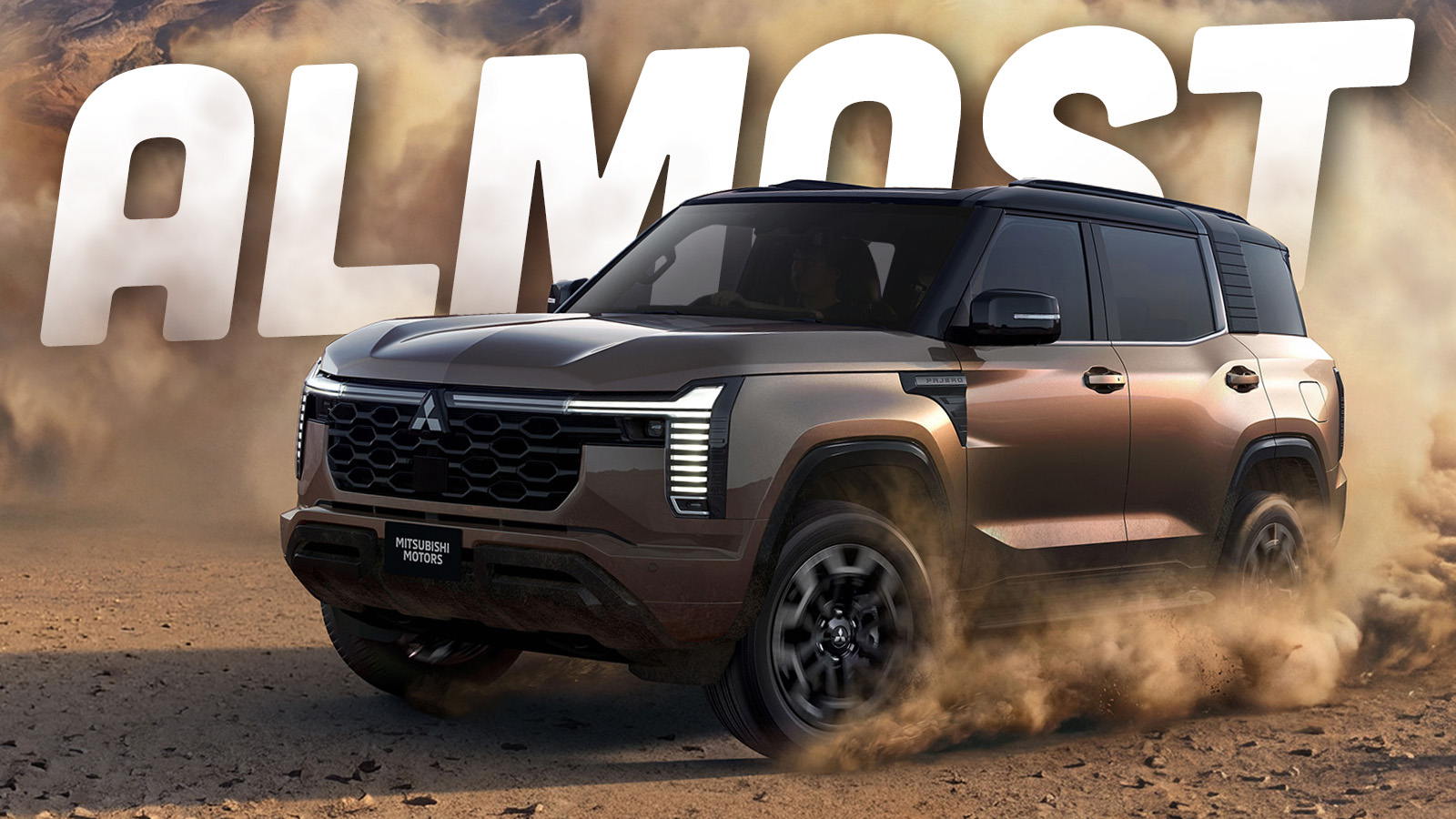
It’s safe to say that body-on-frame SUVs are back. Toyota’s brought a Land Cruiser back to America, Ford’s found success with the Bronco, Nissan recently launched a brand-new Armada, and is readying a new third-generation Xterra. One formerly famous SUV player conspicuously absent from the current scene? Mitsubishi.
The Pajero has won the famously inhospitable Dakar Rally 12 times, and even when rebadged as the Montero for the American market, offered proper capability. However, up until this week, there hasn’t been a new Pajero since 2006. The latest fifth-generation model gets a huge glow-up, but there’s at least one snag preventing it from making a swift journey across the ocean.


Unsurprisingly, the new Pajero is still a proper SUV featuring a separate ladder chassis, part-time four-wheel-drive with a two-speed transfer case, and architectural ties with a pickup truck. Under the skin, the new Pajero is related to the sixth-generation Triton on sale in Africa, Asia, Latina America, and Oceania. Despite featuring coil springs at all four corners, it even shares that model’s 113-inch wheelbase and ability to accommodate the 4N16 turbodiesel inline-four.
That’s a good thing, because the 2.4-liter turbodiesel with 201 horsepower and up to 354 lb.-ft. of torque is the only engine offered in the new Mitsubishi Pajero. Hitched to an eight-speed automatic transmission, it’s certainly competitive on paper with the turbodiesel inline-four that the Toyota Land Cruiser Prado offers in other markets, and the lockable center differential really helps narrow the spec-sheet gap. Actually, if you want to know just how close competitive benchmarking is getting, let’s talk key off-road angles. The new Pajero features an approach angle of 30.4 degrees, a breakover angle [that’s the one that prevents you from grounding out] of 22.6 degrees, and a departure angle of 25.8 degrees. The U.S.-spec Land Cruiser? Thirty degrees, 25 degrees, and 22 degrees, respectively. Even the wheelbases of the two rivals are within an inch of each other.
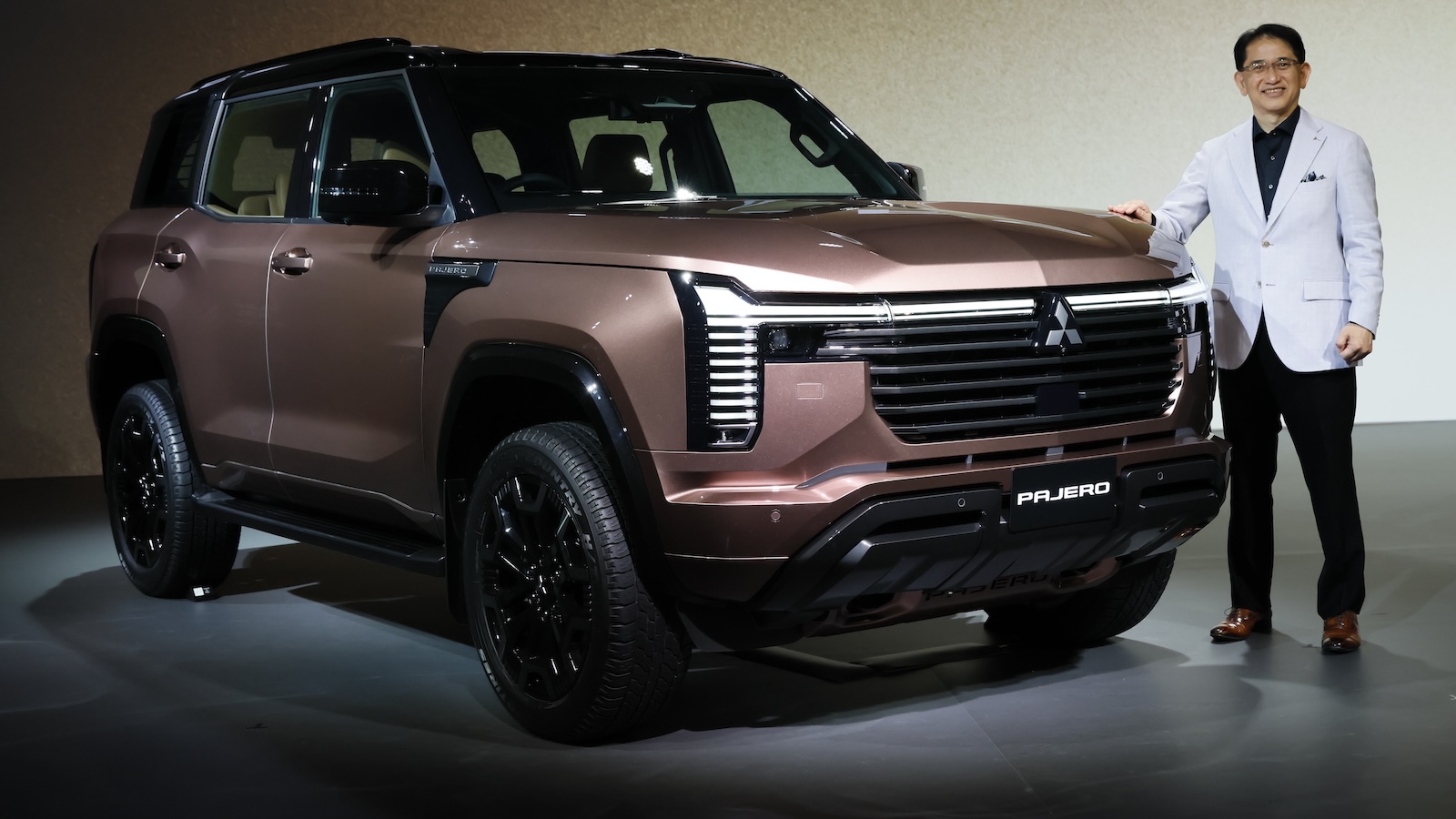
Beyond the Pajero’s rugged credentials, it’s a fairly handsome SUV. Standing 75.2 inches tall with a 193.7-inch-long silhouette, it’s the right mixture of size and squareness. Big but not enormous, blocky but chiseled. There’s plenty of surfacing and trim to break up metal on the flanks and hood, and the grille almost seems refreshingly modest for 2026. The availability of a black roof and pillars chops down the visual height nicely, and those finned lighting elements replicating the grille slats are rather smart.

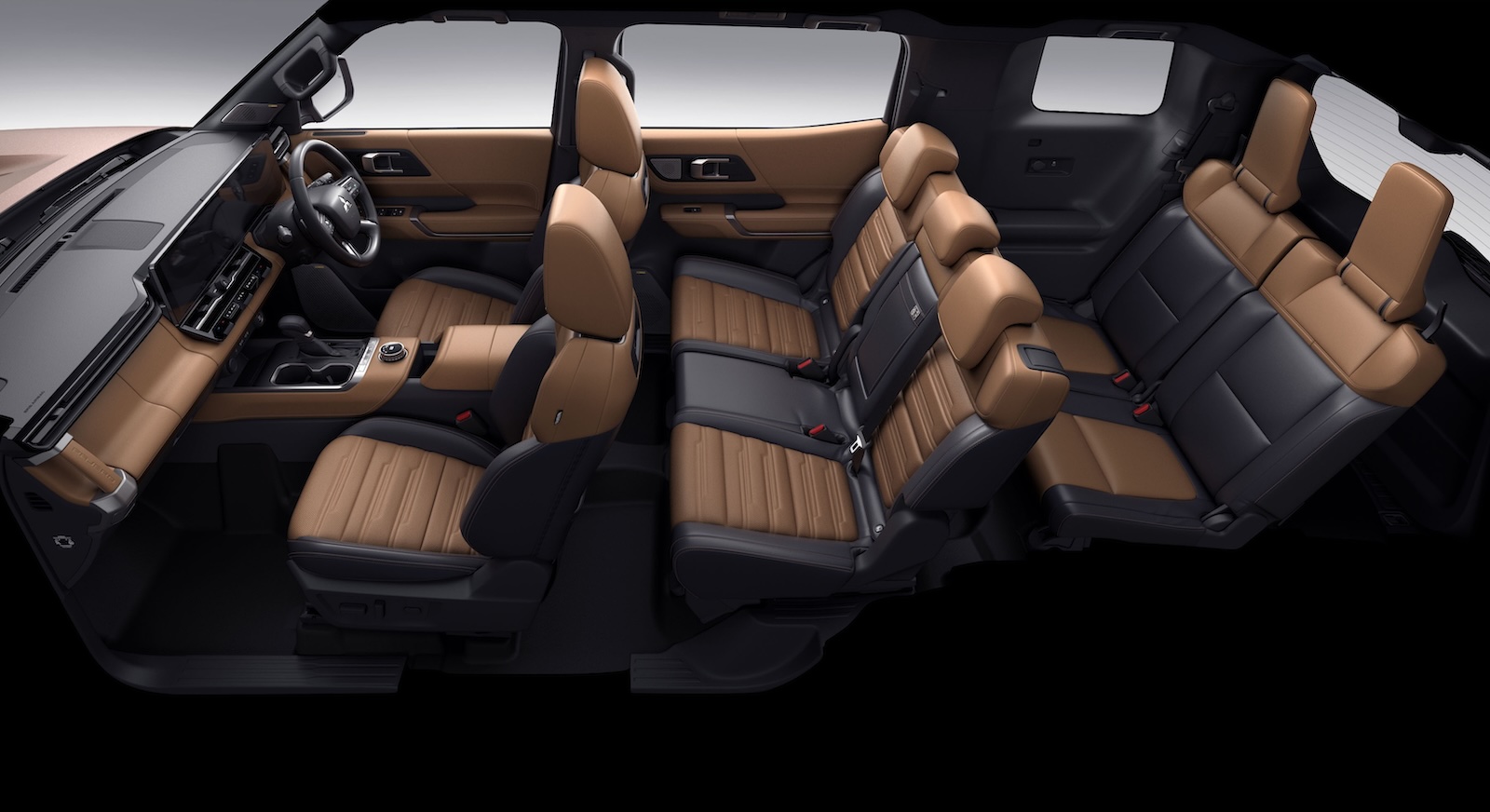
On the inside, the new Pajero looks reassuringly plush yet usable. Big padded sections adorn the dashboard, door cards, and console, while a solid selection of real buttons and knobs ought to work regardless of what your winter gloves are made of. Ventilated seats, three-zone climate control, and a big camera suite including one underneath the SUV are on offer, and three rows of seats ought to come in handy when two simply isn’t enough. Oh, and if you really want to jam out, a 12-speaker Yamaha audio system sounds rather tantalizing.

By now, it seems that the new Mitsubishi Pajero would be almost perfect for the American market. It’s the right sort of size and shape to hook in families willing to splash the cash on a big SUV, and it would add considerable showroom appeal to Mitsubishi dealers across the continent. There’s one big problem though: Diesel prices are sky-high right now, and Mitsubishi doesn’t have a suitable gasoline counterpart in its parts bin.
The marque’s last two gasoline-powered V6s, the 6G7 and 6B3, are dead. At the moment, Mitsubishi Motors doesn’t make any gasoline engines of its own larger than 2.4 liters and four cylinders, and that’s simply not going to cut it for large SUV use in many American situations. California’s almost dragstrip-style on-ramps that feature traffic lights for metering, Detroit’s fearsomely swift freeway known to locals as The Lodge, Rocky Mountain altitude, that sort of stuff. Before even considering the enormous pain and expense of U.S. homologation, Mitsubishi would likely need to develop a new engine suited to American tastes, or borrow one from a partner and shoehorn it in. Even Nissan’s venerable VQ V6 may require some serious reengineering, a process that could be both expensive and time-consuming. It’s also unlikely that the new Pajero is a veiled look at the next Nissan Xterra, given how a teaser rendering of that model shows a markedly shorter rear overhang.
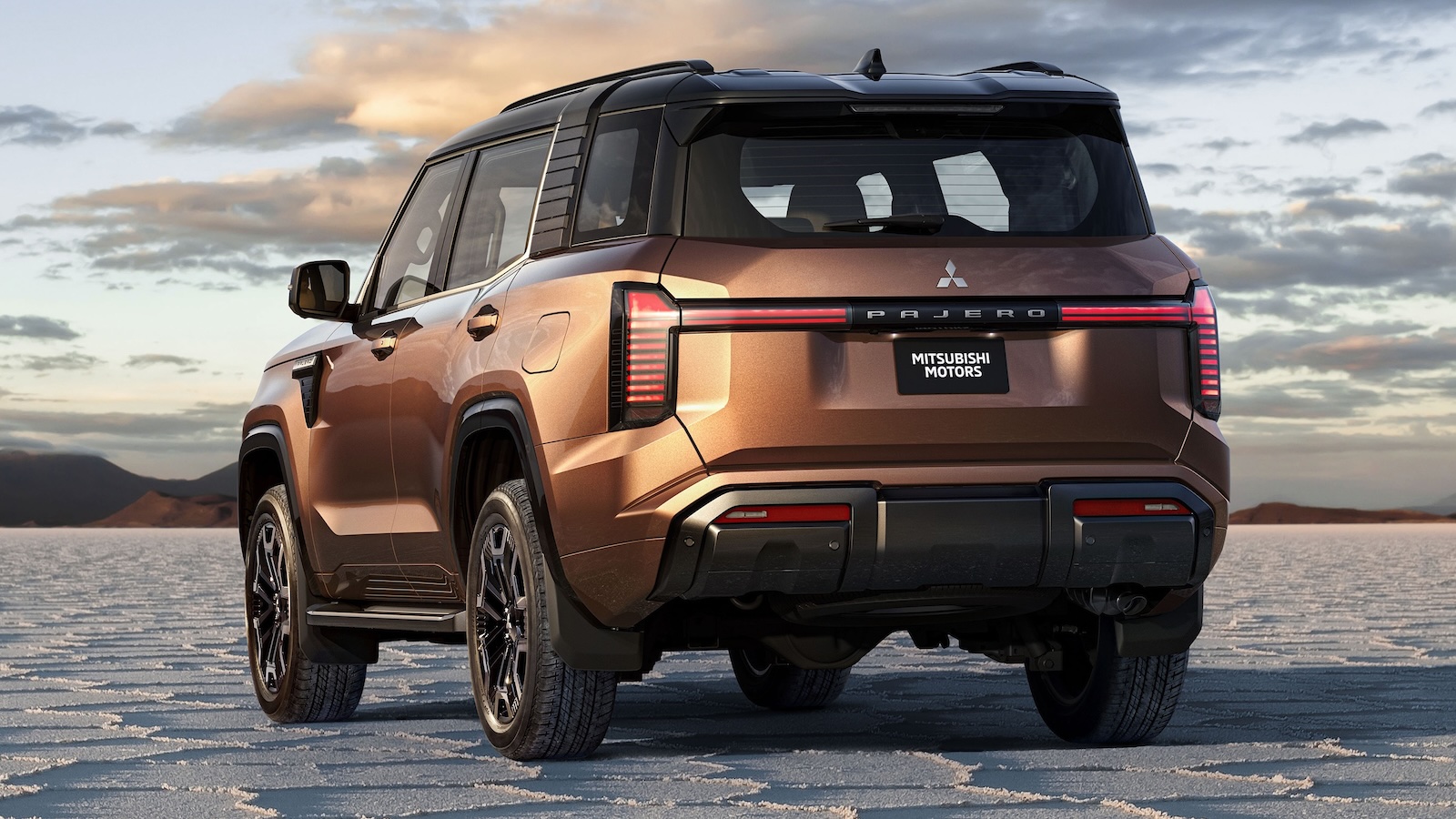
We’ll likely just have to gaze at the new Pajero as seen here from afar, which is a shame because it’s pretty much exactly the sort of SUV Mitsubishi needs in America right now. Plus, it has a rather amusing name. If you don’t know why, ask a friend who speaks Spanish. However, don’t give up hope just yet. Earlier this year, Automotive News reported that Mitsubishi showed its North American dealers an SUV based on the new Pajero. How much will come to America, and how soon? We’ll have to wait and see.
Top graphic image: Mitsubishi


Pajero needs
1) USA compliant engine
2) USA assembly
3.8L V6 used in Frontier?
Nissan Canton Assembly?
or Mitsubishi could purchase the Mishawaka Indiana Assembly that is on the market
They could federalize the diesel engine to get it emissions compliant here… but at the elevated prices for the greasy dino juice we currently see? Oof.
And yeah, this thing really needs a V6. I mean there are clever solutions to get some serious low-end torque with a turbo or twin-turbo 4-pot, but they add additional cost and complexity – which is not what you want when offroading.
Would it REALLY be that difficult and costly to adapt to the VQ38DD that is currently in the Frontier? What about the VR35DDTT from the Armada? Yeah – that one has a turbo, but the Armada is also a burly BOF hauler too. Maybe as an optional plant?
However… the one thing that might make this a non-starter in the US is the fact that Mitsubishi’s dealer network continues to erode in both numbers and market share. It’s not a stretch to think that people see them as playing in the economy segment and this vehicle’s price might be beyond the reach of the average Mitsu buyer in the states.
Thus, they have an uphill battle against the likes of Jeeps, Broncos and other similar BOF SUVs. I can see this being a universally loved vehicle, but not a sales star.
If they could get this in dealers for less than $40k (base model) – it could have a fighting chance. Whether or not that is possible is anyone’s guess.
At under 100,000 sales in USA Mitsu is almost invisible.
Its going to be hard for an import to launch an “all new” model with no manufacturing plant inside the us with all these “trade negotiations” ongoing every 6-9 months. Especially when “the greatest trade deal” is suddenly the “worst trade deal ever” 4 years later.
i wont hold my breath an any new models being imported into the us.
Electrify the current 2.4. Make it a PHEV. Give it a larger electric motor and battery for more oomph. Then it’s modifying a drivetrain they currently have rather than being dependent on an outside supplier.
Mitsubishi sells a 2.4 PHEV in the Outlander already, but stuffing it in this would take some work.
Well they should get to it!!!
To bring back this old meme, KIA/Hyundai called, they want their design book back.
Isuzu?
Suzuki?
Wake me up when we are out of this “design Hell” that the automotive industry and well- design in general is in. Its fucking ugly like everything else. Its like they all took inspiration from a combination of an electric razor and vacuum cleaner and gave it lights. Except more of these ugly, squinty, intense looking lights.
I think another challenge would be Nissan having veto power over Mitsubishi’s North American product plans, they want their investment in Mitsubishi Motors to do well, but they also don’t want them stepping on their own toes too much, if they see this as too much of a direct threat to their own. I’m just thinking back to when Nissan blocked Mitsubishi from accessing Renault/Samsung product that they frankly really could have used
Shut up Thomas, and let us believe !!!
I don’t even need to squint, that looks like a Nissan Armada/Patrol.
The Tacoma/4Runner are 4 cyl or 4cyl hybrid. It could be done.
Ditto the Landcruiser in the US
I almost typed landcruiser also but did not want to check to see if it was hybrid only and get called out by some pedantic.
It is hybrid only.
Ehh, the main complaint I hear through the grapevine is that theyre not that powerful, they’re noisy as hell, and get like 20 mpg tops in the real world, I’m sure the hybrid is way better but let’s be real here, Mitsubishi has to have an edge, and that edge is going to be cost.
They can’t sit there looking at what tellurides and palisades are selling for and think they can ask the same money without doing a solid decade of brand building.
The Toyota hybrid in the Toyota TNGA-F vehicles is for power, not efficiency. For example, it adds over 100FT LBS to the 2.4L drivetrain in the Landcruiser and 4Runner.
Other than lackluster efficiency, the negative is that it comes with a fairly small fuel tank (and the accompanying limited range) and the battery eats into the cargo room.
It can surely be built instead of what ever infiniti is building. If they priced it right and sold it at both Mitsubishi and Mitsubishi / Nissian premium dealer aka infiniti dealers. Could be a win for all.
Just bring us the diesel. I’m sure there are enough wankers here to buy them…
I’m not at all certain how/why Mitsubishi still has a presence in the US. If you take away fleet sales to rental-car agencies and buyers with sub-620 credit scores, I’m sure they sold barely any vehicles at all.
I recently had an Eclipse Cross as a rental (fleet sales! Yay!) and while it was an acceptable vehicle for 3 days, there wasn’t anything about it that would make me consider buying one.
I can’t speak for anywhere else, but in my area, the Outlander PHEV was a reasonably decent seller, at least partially because it was nearly the only affordable PHEV crossover on the market for quite a while (which made it eligible for rebates and HOV lane access), and even now is one of the few (only?) in its segment with a third row, however tiny.
Along with the Outlander PHEV, I do see quite a few of the Eclipse Crosses. I suspect it’s one of the cheapest ways into a newish SUV with a decently long warranty.
Mitsubishi also doesn’t have enough of a reputation to say that they’re unreliable. So it could be a perfectly cromulent SUV to own.
It’s definitely a regional thing. Quebedeaux Buick-GMC here in Tucson has a Mitsu franchise and there’s tons of Outlanders, Eclipse Cross, and Outlander Sports around town. Probably helps that they have a good reputation across the border, too.
Let me guess, tariffs?
Well, the war would have been my second guess. 😉
Hell, maybe I’m weird and tasteless and daft, but this looks rather nice to me inside and out. Well, I’d prefer a gauge binnacle. Otherwise, get a workable engine in this thing a bring ‘er over. Someone needs to kick Toyota in the groin for what they’ve done to the 4Runner and LC.
But call it by it’s proper US 1990s name: MONTERO
Well, Google Translate says pajero = wanker. So…Mitsubishi Wanker has a nice ring to it, but Montero might be the better marketing choice.
…or someone who is not master of his domain!
Pajero
Pah-Djerrr-Oh
Pajerooooooooo
Yeah this would be a tough sell here at the moment. I remember when diesel was cheaper than gasoline, but that sure isn’t the case anymore.
This prompted me to do some math for my upcoming 850 mile round trip drive to Laguna Seca. I usually borrow a friend’s diesel Ram 2500 to tow my trailer as it’s way more efficient than my Sequoia but given current fuel prices I thought that may not be the case.
$5.49 at 10 MPG = 85 gal = $467 for Sequoia
$7.09 at 17 MPG = 50 gal = $354 for Ram 2500
I’m surprised the Ram is still that much cheaper. If my Sequoia’s unloaded MPGs weren’t so crummy the gap would be much narrower, whereas the Ram gets about the same MPG with or without a trailer and basically feels like it’s not towing anything, so I’ll still take the diesel.
2001 Yukon XL 2500 with the 8.1L engine got ~8mpg towing a 9K enclosed trailer but never broke past 10 unladen, meanwhile my friends 2016 Silverado 1500 got 23MPG unladen and 4.5MPG towing the trailer. I was amazed at the difference between the two.
Actually, I am a little surprised. I would not put any silly choices past Mitsubishi at this point.
No, it’s not. It’s just too anonymous, following current design trends but without a unique theme.
And that’s Mitsubishi’s real problem right now. All of their cars look different from one another, radically change from one generation to the next making the old gens look dated and there’s no cohesiveness or consistency.
If they really want to come back, they need a simpler, more elegant design they can iterate on. This is not it. There was a clear familiarity between all past gens and it’s now lost. This looks like a Kia and a Toyota Land Cruiser (Prado) had a child and that child wanted to look a bit like an Infiniti too.
I learned a long time ago that in the car world “handsome” is generally another word for “fine”, with all the passive-aggressive implications that word tends to bring with it. In almost every instance it’s damning with faint praise, whether that was intended or not. The only thing worse than “handsome” is “handsome” with a qualifier like “fairly”. 😉
But… but… my mom calls me handsome…
Actually handsome or just fairly handsome?
Unless…you’re a car. 😉
The mitsu 2.4 PHEV motor is 258hp, 332 lb-ft. It’s not a V6, but it’s comparable to the diesel specs.
I made a similar comment. Beef that up to 300 hp/400 ft/lbs with bigger electronics and start stacking the cash.
Is the design a bit confused? I was hoping for a hint of 1st gen Pajero, but rather we got something that could have anything really.. incredible generic. Also that side view, with the crude chrome detailing, is just plain bad.
I’m really not fond of the slab of screen just tacked onto the top of the dash for your driver gauges. All the automakers are doing it now. Maybe I should just be glad we get anything at all.
Hyundai is introducing base model vehicles without these and everything gets shunted to the center iPad unless you pony up a few hundred more or buy a higher model trim.
If I was a Wan…er, I’d find me a gas engine…
The lighting “signature” looks like its doing the fingers pointed together emoji that I had pasted in here and got nothing but question marks
Now I can’t not see that.
Looks like Hyundai/Kia has some competition for monolithic slabs with diffused LEDs.
I power-scrolled through the text to check if it was actually a rebadged H/K or just trying very hard to look like one.
Diesel SUV, yes plz