

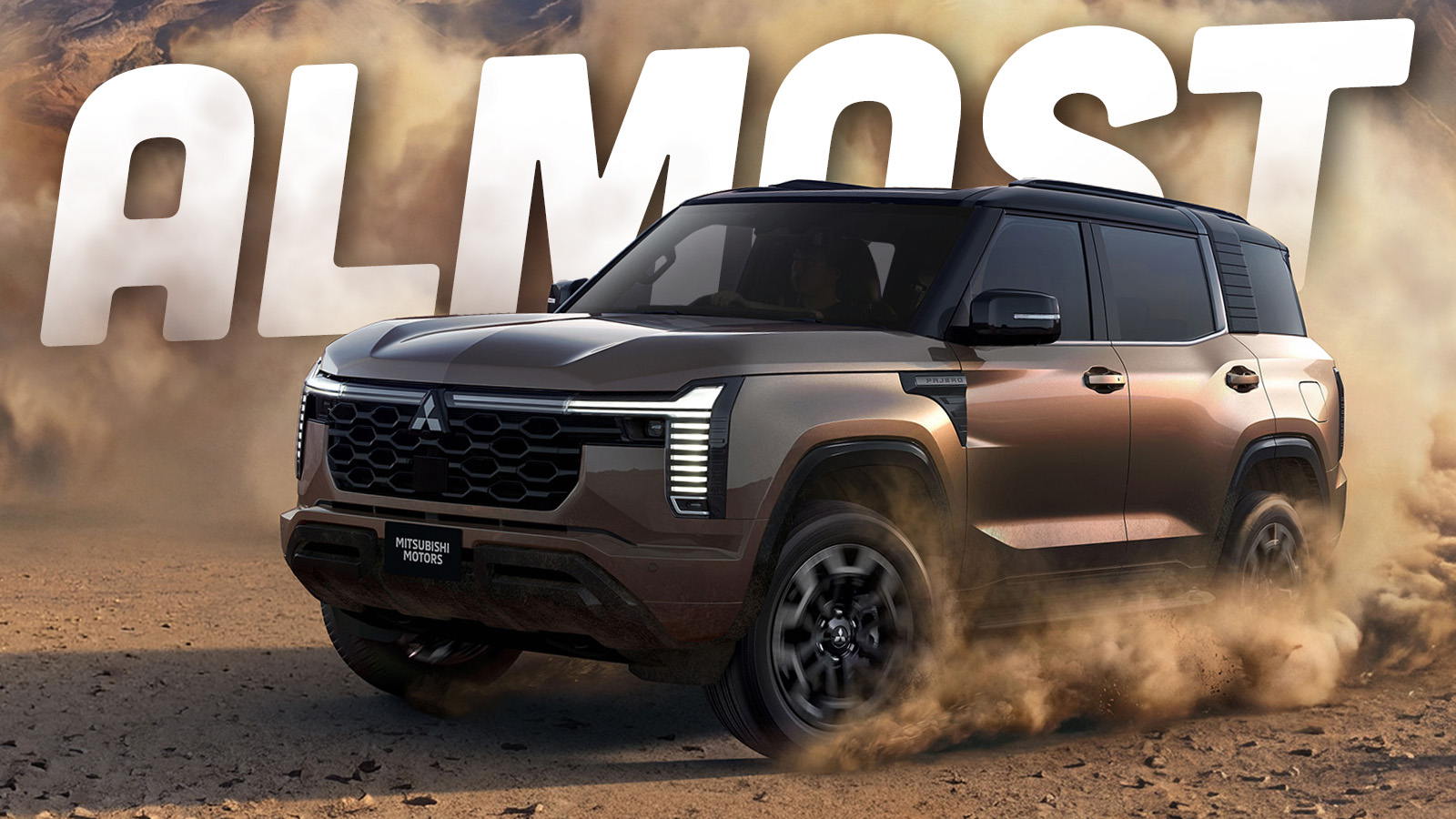
It’s safe to say that body-on-frame SUVs are back. Toyota’s brought a Land Cruiser back to America, Ford’s found success with the Bronco, Nissan recently launched a brand-new Armada, and is readying a new third-generation Xterra. One formerly famous SUV player conspicuously absent from the current scene? Mitsubishi.
The Pajero has won the famously inhospitable Dakar Rally 12 times, and even when rebadged as the Montero for the American market, offered proper capability. However, up until this week, there hasn’t been a new Pajero since 2006. The latest fifth-generation model gets a huge glow-up, but there’s at least one snag preventing it from making a swift journey across the ocean.


Unsurprisingly, the new Pajero is still a proper SUV featuring a separate ladder chassis, part-time four-wheel-drive with a two-speed transfer case, and architectural ties with a pickup truck. Under the skin, the new Pajero is related to the sixth-generation Triton on sale in Africa, Asia, Latina America, and Oceania. Despite featuring coil springs at all four corners, it even shares that model’s 113-inch wheelbase and ability to accommodate the 4N16 turbodiesel inline-four.
That’s a good thing, because the 2.4-liter turbodiesel with 201 horsepower and up to 354 lb.-ft. of torque is the only engine offered in the new Mitsubishi Pajero. Hitched to an eight-speed automatic transmission, it’s certainly competitive on paper with the turbodiesel inline-four that the Toyota Land Cruiser Prado offers in other markets, and the lockable center differential really helps narrow the spec-sheet gap. Actually, if you want to know just how close competitive benchmarking is getting, let’s talk key off-road angles. The new Pajero features an approach angle of 30.4 degrees, a breakover angle [that’s the one that prevents you from grounding out] of 22.6 degrees, and a departure angle of 25.8 degrees. The U.S.-spec Land Cruiser? Thirty degrees, 25 degrees, and 22 degrees, respectively. Even the wheelbases of the two rivals are within an inch of each other.
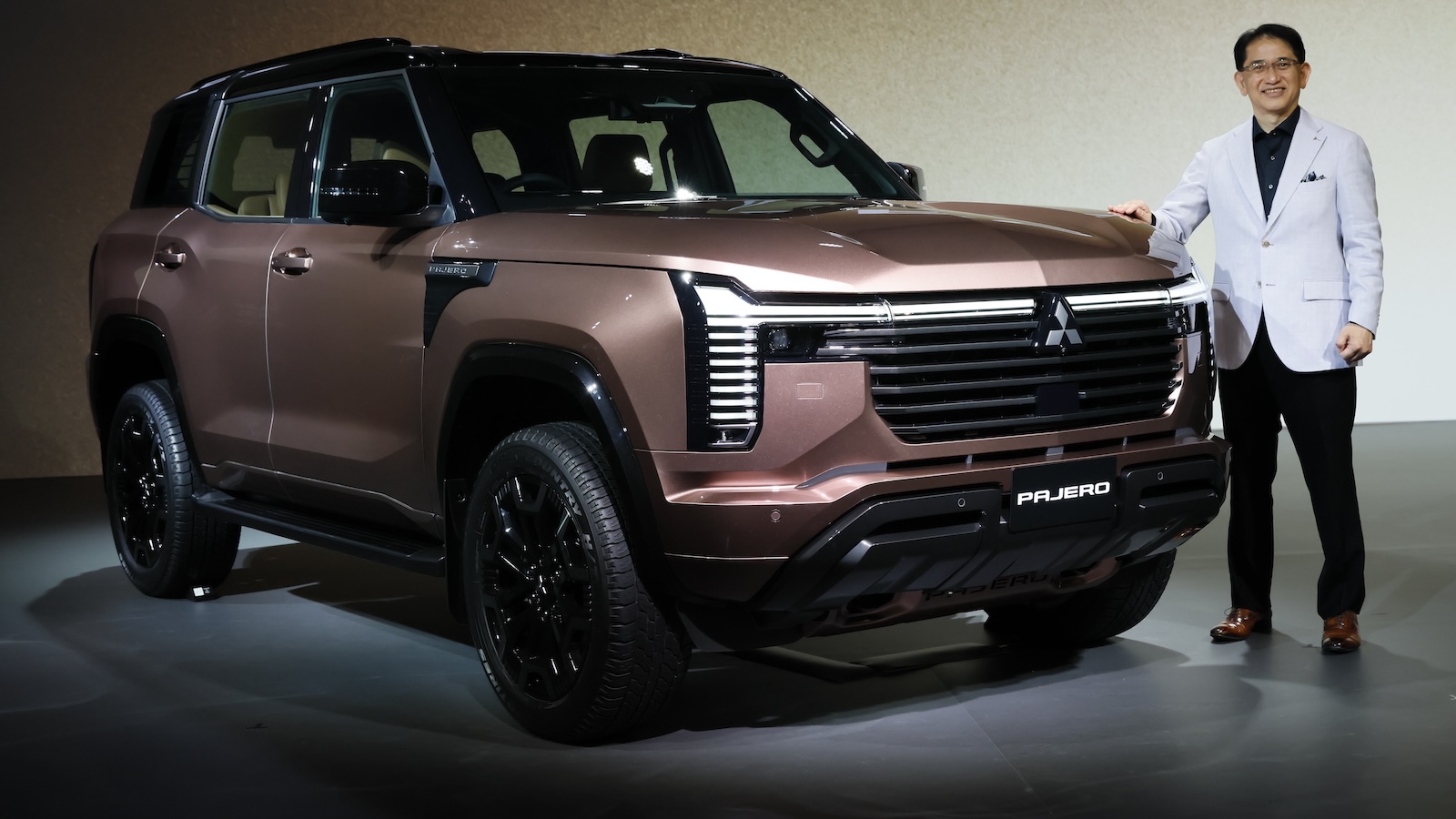
Beyond the Pajero’s rugged credentials, it’s a fairly handsome SUV. Standing 75.2 inches tall with a 193.7-inch-long silhouette, it’s the right mixture of size and squareness. Big but not enormous, blocky but chiseled. There’s plenty of surfacing and trim to break up metal on the flanks and hood, and the grille almost seems refreshingly modest for 2026. The availability of a black roof and pillars chops down the visual height nicely, and those finned lighting elements replicating the grille slats are rather smart.

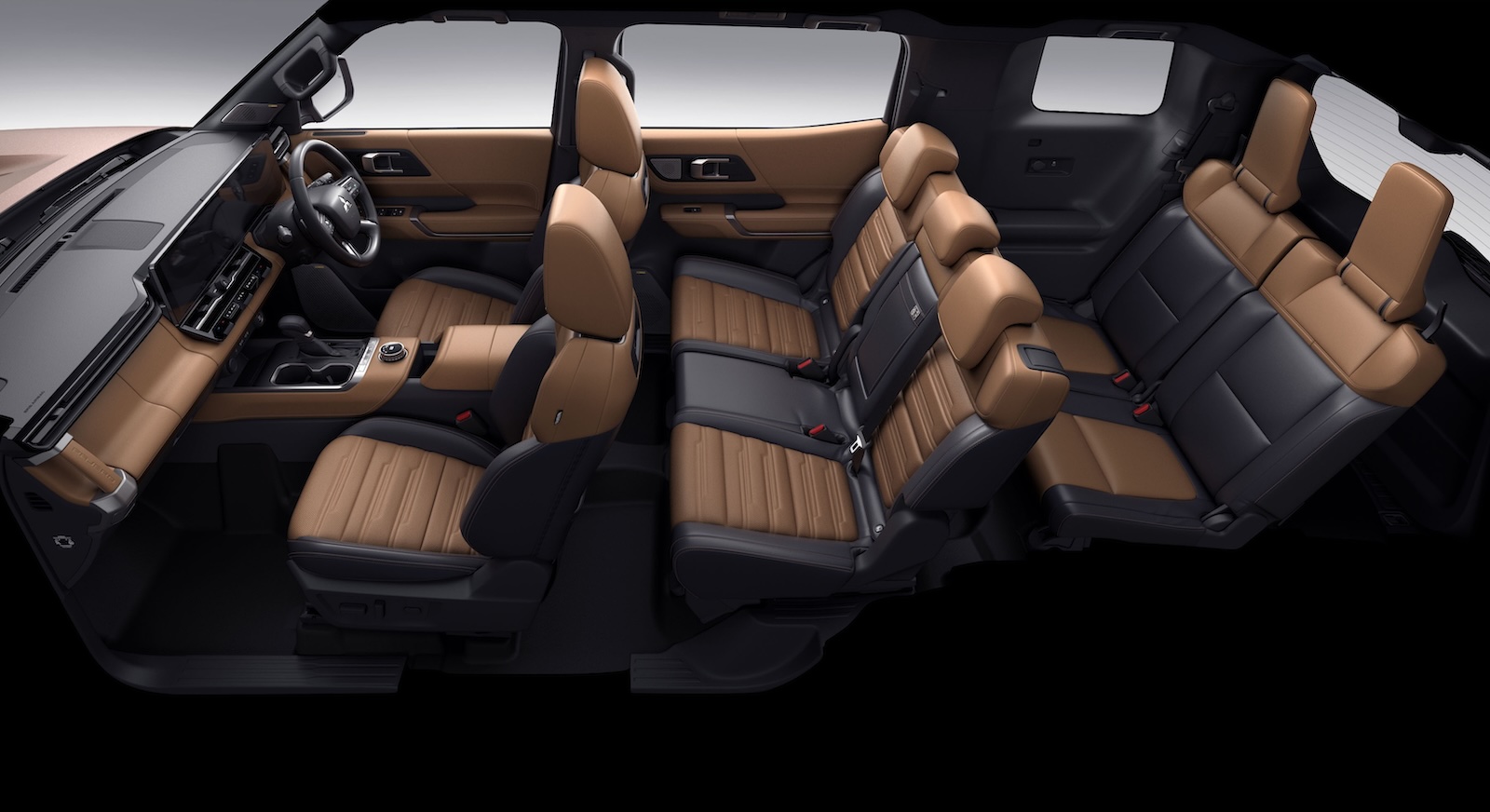
On the inside, the new Pajero looks reassuringly plush yet usable. Big padded sections adorn the dashboard, door cards, and console, while a solid selection of real buttons and knobs ought to work regardless of what your winter gloves are made of. Ventilated seats, three-zone climate control, and a big camera suite including one underneath the SUV are on offer, and three rows of seats ought to come in handy when two simply isn’t enough. Oh, and if you really want to jam out, a 12-speaker Yamaha audio system sounds rather tantalizing.

By now, it seems that the new Mitsubishi Pajero would be almost perfect for the American market. It’s the right sort of size and shape to hook in families willing to splash the cash on a big SUV, and it would add considerable showroom appeal to Mitsubishi dealers across the continent. There’s one big problem though: Diesel prices are sky-high right now, and Mitsubishi doesn’t have a suitable gasoline counterpart in its parts bin.
The marque’s last two gasoline-powered V6s, the 6G7 and 6B3, are dead. At the moment, Mitsubishi Motors doesn’t make any gasoline engines of its own larger than 2.4 liters and four cylinders, and that’s simply not going to cut it for large SUV use in many American situations. California’s almost dragstrip-style on-ramps that feature traffic lights for metering, Detroit’s fearsomely swift freeway known to locals as The Lodge, Rocky Mountain altitude, that sort of stuff. Before even considering the enormous pain and expense of U.S. homologation, Mitsubishi would likely need to develop a new engine suited to American tastes, or borrow one from a partner and shoehorn it in. Even Nissan’s venerable VQ V6 may require some serious reengineering, a process that could be both expensive and time-consuming. It’s also unlikely that the new Pajero is a veiled look at the next Nissan Xterra, given how a teaser rendering of that model shows a markedly shorter rear overhang.
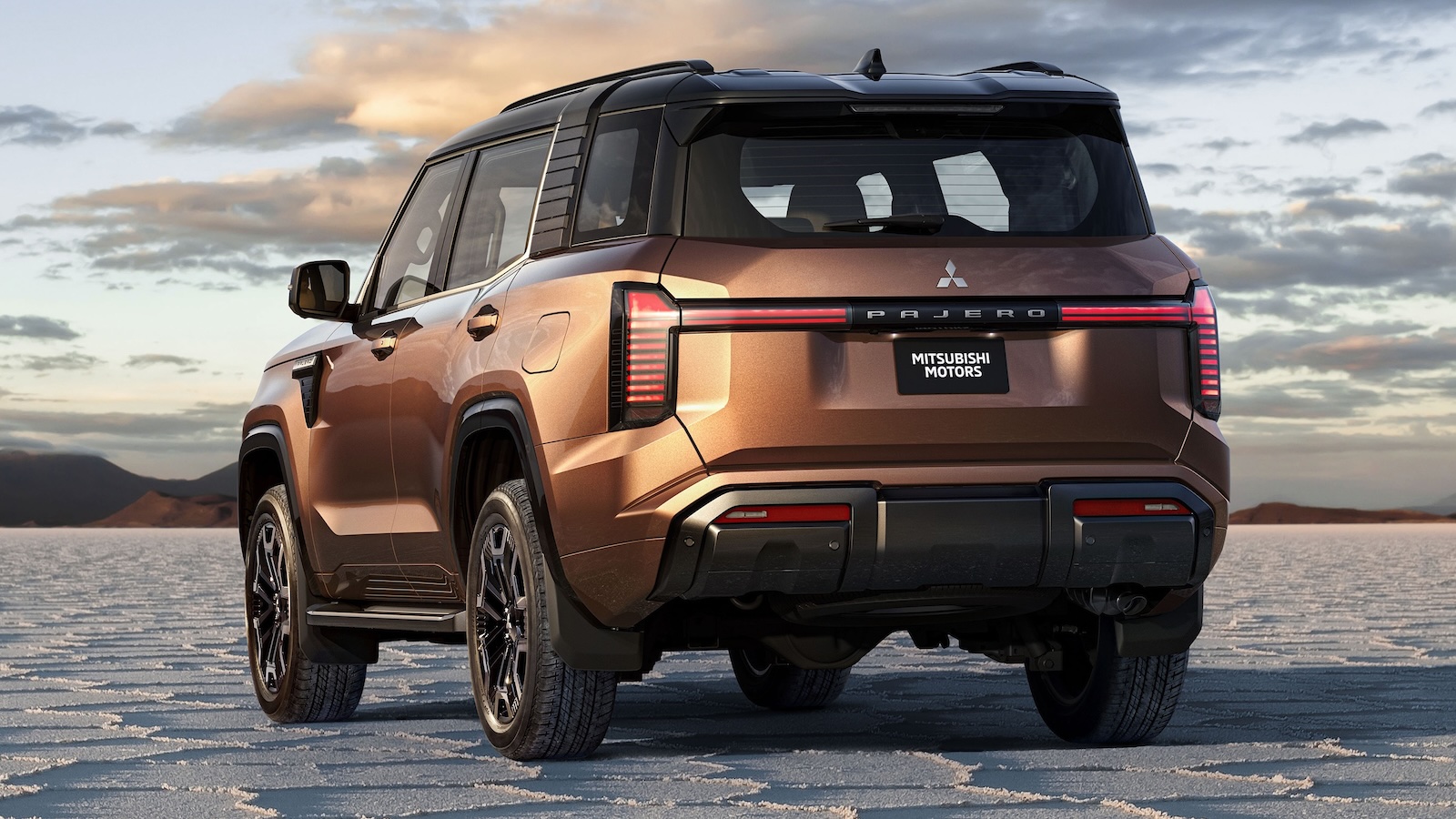
We’ll likely just have to gaze at the new Pajero as seen here from afar, which is a shame because it’s pretty much exactly the sort of SUV Mitsubishi needs in America right now. Plus, it has a rather amusing name. If you don’t know why, ask a friend who speaks Spanish. However, don’t give up hope just yet. Earlier this year, Automotive News reported that Mitsubishi showed its North American dealers an SUV based on the new Pajero. How much will come to America, and how soon? We’ll have to wait and see.
Top graphic image: Mitsubishi


The first- and second-gen Monteros were the only real Monteros. Someone once described them as a small SUV that was built like a 3/4-ton truck, and I believe it. They were beasts. I’d give both of my un-used testes to have a 1st-gen 2-door Montero again.
I always find it interesting on a automotive enthusiast site, seeing how many people feel the need to virtue signal about SUV’s. This is not Europe, we have massive roads, massive houses, massive driveways, massive parking garages. The size of a SUV really is not a problem. Emissions? We could discuss the true differences all day. Really, why do people want to complain SO MUCH.
Because life is unfair.
I don’t have numbers but based on what I recall seeing on the street the last generation of Montero barely sold here (the USA) and that was when Mitsubishi was still a pretty recognizable brand. Now they’re a dead brand walking, I just can’t see them generating the sales they likely need on this thing cool as it is.
And even if they re-brand as the Pajero to get us car nerds excited doubt that name means anything to your average 4runner/Landcruiser buyer that this would presumably compete with. Which is too bad given the success of the 4runner you would think there’s room in that segment for a competitor.
While I’m naturally inclined to root for Mitsu here, the last thing America needs is another goddam land barge so I pray el Pendejo never terrorizes our roads.
“At the moment, Mitsubishi Motors doesn’t make any gasoline engines of its own larger than 2.4 liters and four cylinders, and that’s simply not going to cut it for large SUV use in many American situations”
Unless they turn it into a hybrid or plug-in hybrid.
Anyway… I would rather see Mitsubishi try a market segment that isn’t well covered… like smaller pickup trucks. All there is right now is the Maverick… and nothing else
Mitsubishi should bring over a plug-in hybrid version of their Triton pickup truck.
It’s on the same chassis as the Pajero. So they should bring over both.
And for a new vehicle segment they don’t compete in… a plug-in-hybrid 4cyl minivan/small commercial van.
If I ever wanted this kind of a truckinstein. This looks as good as any.
Ok, time for a new RVR, right?
I’m getting pretty tired of these brand new modern SUVs getting released with ancient and inadequate diesel powertrains.
It would be a little more understandable as an option. But it being the only powertrain available is a big miss, no matter the market.
The LC Prado is the same way in many markets – similarly ancient engine and every single review pans it as underpowered, unrefined, and loud. It’s not even that economical compared to the hybrid offered in the US.
Otherwise this thing looks fine, if a bit uninspired. The interior looks like a decent place to sit, apart from that steering wheel which looks like it came straight from 2009.
Pajero. LaCrosse. Either will get you where you need to go.
Every SUV I see turns into Land Cruiser FJ. Including this Pajero. I have a problem. A problem that can only be solved by leaving USA.
Just bring the damn thing diesel and all. People buy Grenadiers, the East Coast alone should be able to keep this thing afloat just by sheer tyranny of hipster purchase power.
The Grenadier is only sold with BMW’s B58 in America. It’s one of the most celebrated engines of all time and is leagues ahead of this ancient 4 cyl diesel.
The B58 is the only reason the Grenadier is viable in the US.
I know quite well what comes in the Ineos, but the BMW powertrain is the very last thing that will attract me to it.
I really don’t know why Mitsubishi stopped selling the Montero here 20 years ago. That was stupid because big SUVs have *always* been popular here.
The international Montero Sport should’ve still been sold here, too.
The rationale at the time was that the Montero didn’t have a V8.
Mitsubishi updated the last version we had in the US and fitted the same 3.8 V6 that the Galant/Eclipse/Endeavor could be had with. It’s too bad they made the decision to not homologate that major update, because it actually would’ve been a good fit in this market. V8s were less of a “need: by 2008/2009. Sigh.