

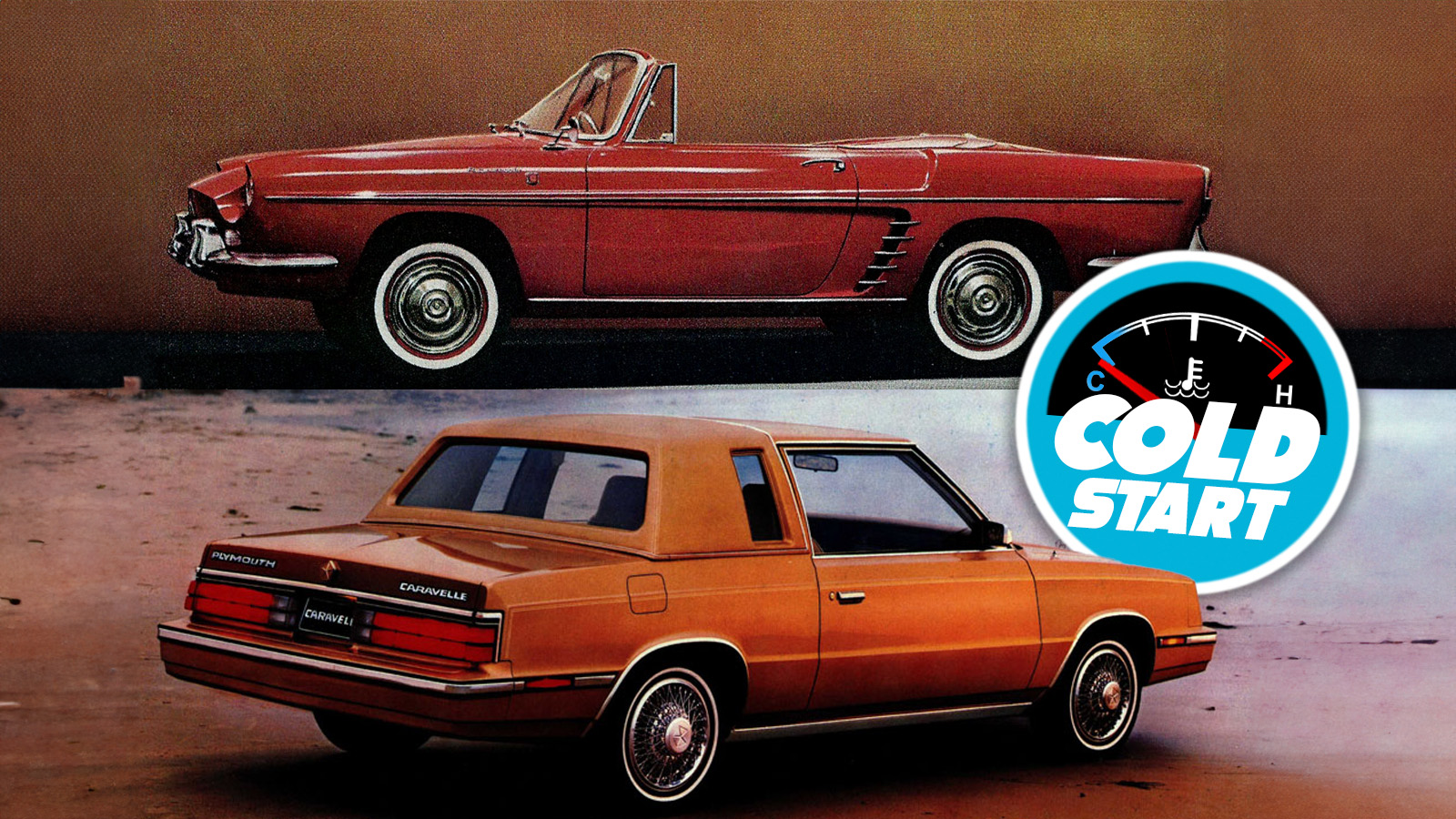
I’m not sure exactly what it is about Renault, but they seem to have a peculiar knack for sharing names with American cars of very, very different design, character, technical makeup, everything. The last time I brought this up, I was talking about Parisiennes, of both Renault and Pontiac varietals, but now I want to discuss Caravelles, still one Renault, but the other this time a Plymouth. Like the other Renault v. American-Car-With-A-Name-That-Starts-With-P, these two cars are wildly different despite sharing a name.
I don’t really understand why this keeps happening to Renault, this knack for sharing names with big American cars. The source of the name Caravelle in both cases seems to stem from the word caravel, the Portuguese sailing vessel designed specifically for trans-oceanic travel. Of Columbus’ famous trio of ships, two – the Niña and Pinta — were caravels.


I think I first heard the word caravel in this song from harpist and suspected elf Joanna Newsom:
Here’s a bit of trivia! I knew someone who played in her band in the earlyish 2000s, and once shared a meal with her and some friends at Canter’s, my favorite LA deli. And now, predictably, I’m posting a video of her singing and playing the harp in a story about a French and American car named for a type of ship that’s mentioned in passing in this song. Life’s funny that way, right?
Anyway, back to the Caravelles; I’m not sure what the reason is for the more luxurious spelling, but it’s a hallmark of both the Mopar and Renault. The Renault was originally named the Floride, because the car was conceived in Florida by a group of American dealers who wanted something sporty and fun to enhance Renault’s image in America. The car was called the Floride in non-English speaking markets, but was renamed to the Caravelle, especially for America, where it was thought the other 49 states might feel bad not having the car named for them.
This seems a little silly to me; it’s not like anyone was expecting Renault to call a stylish little convertible the Idaho or North Dakota.
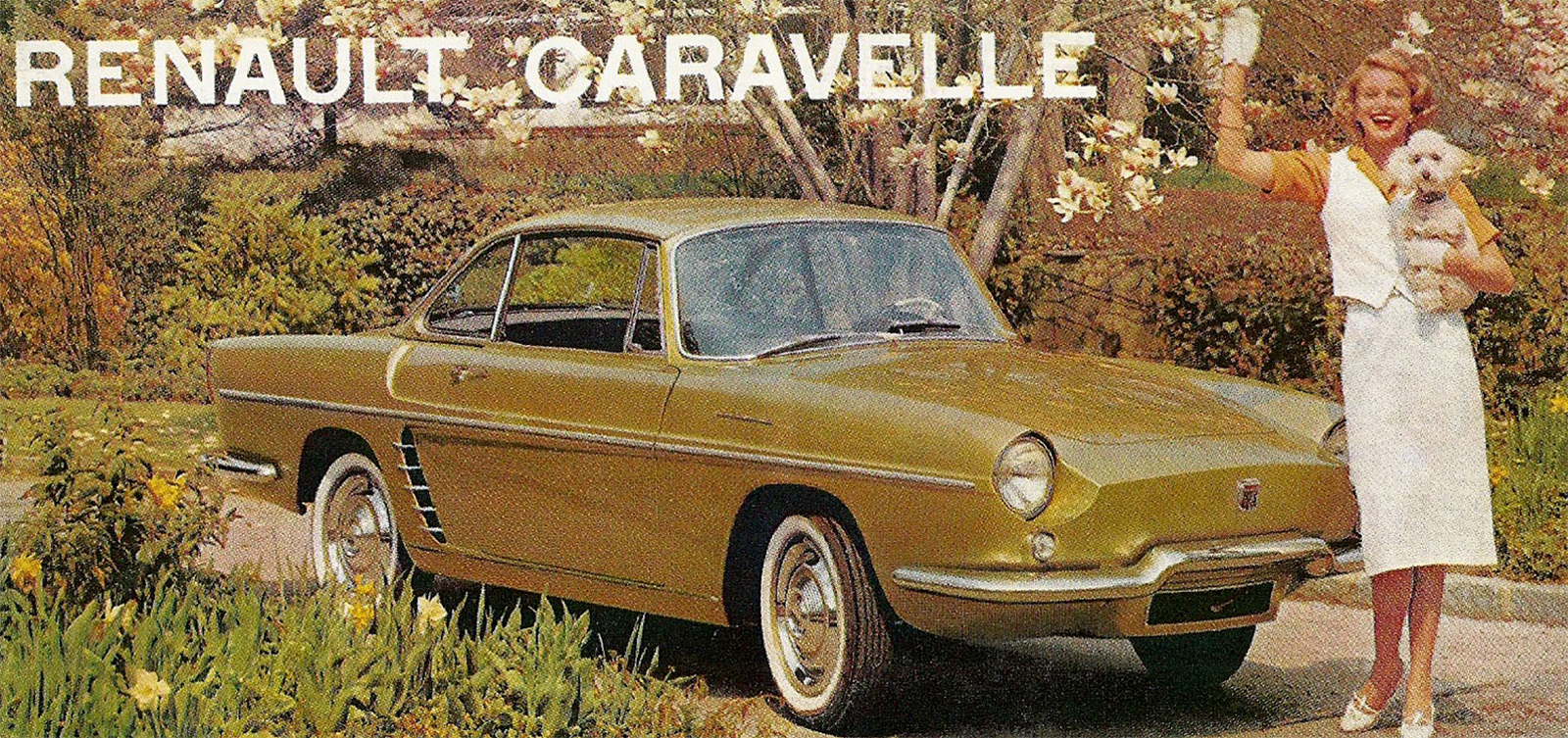
The Caravelle was based on the same rear-engine/RWD platform as the Renault Dauphine, and came in both coupé and convertible body styles. Personally, I think these are just lovely cars, and I especially like the grille-less front end treatment with its forward rake and sharp creases.
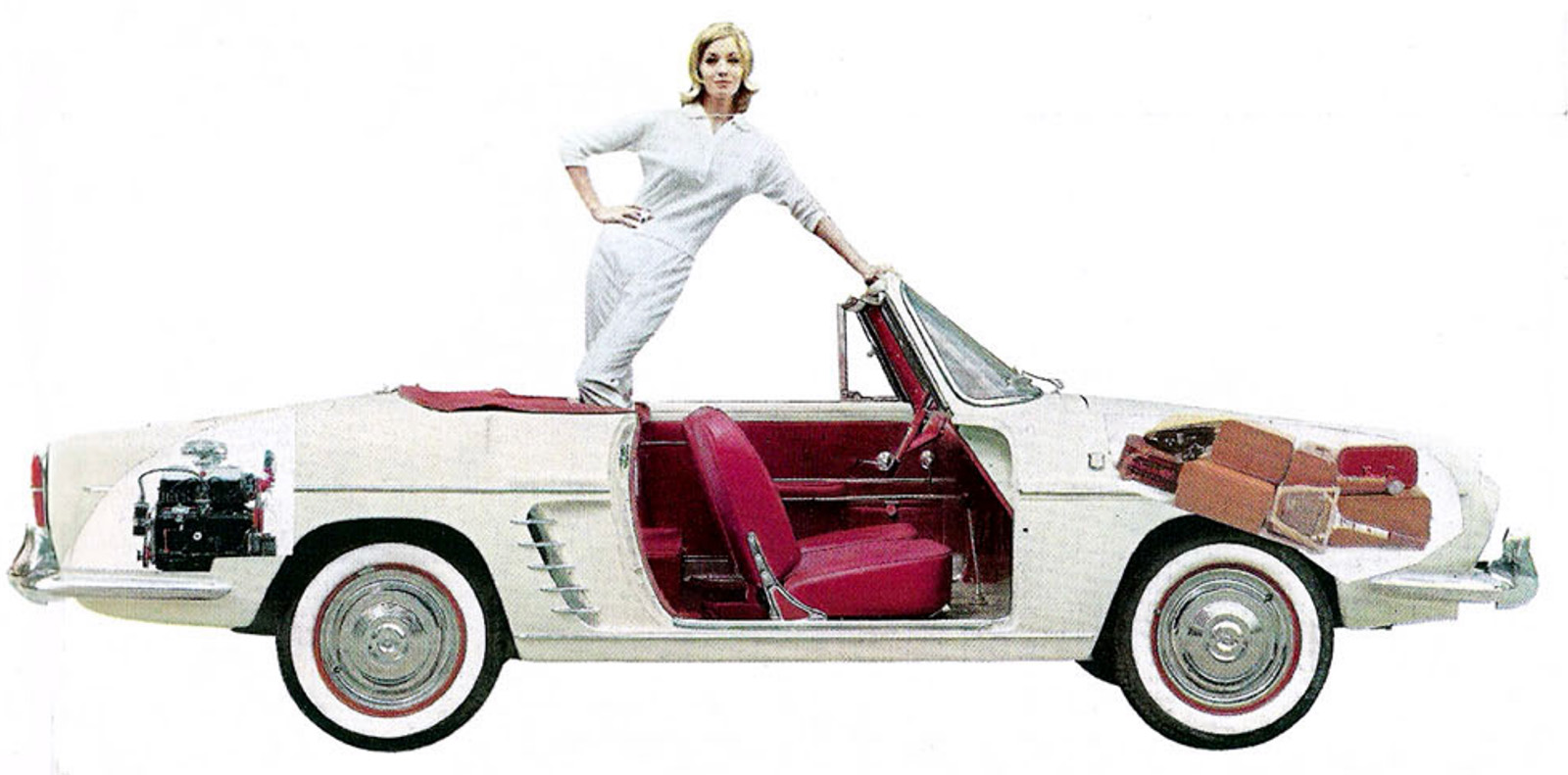
I like this sort of fake cutaway used in the brochure; the effect was archived just by removing a door and superimposing the engine at the rear, and a nice set of luggage packed into the front trunk. This is a pretty quick way to get a cutaway effect, and I’m surprised how well it works.
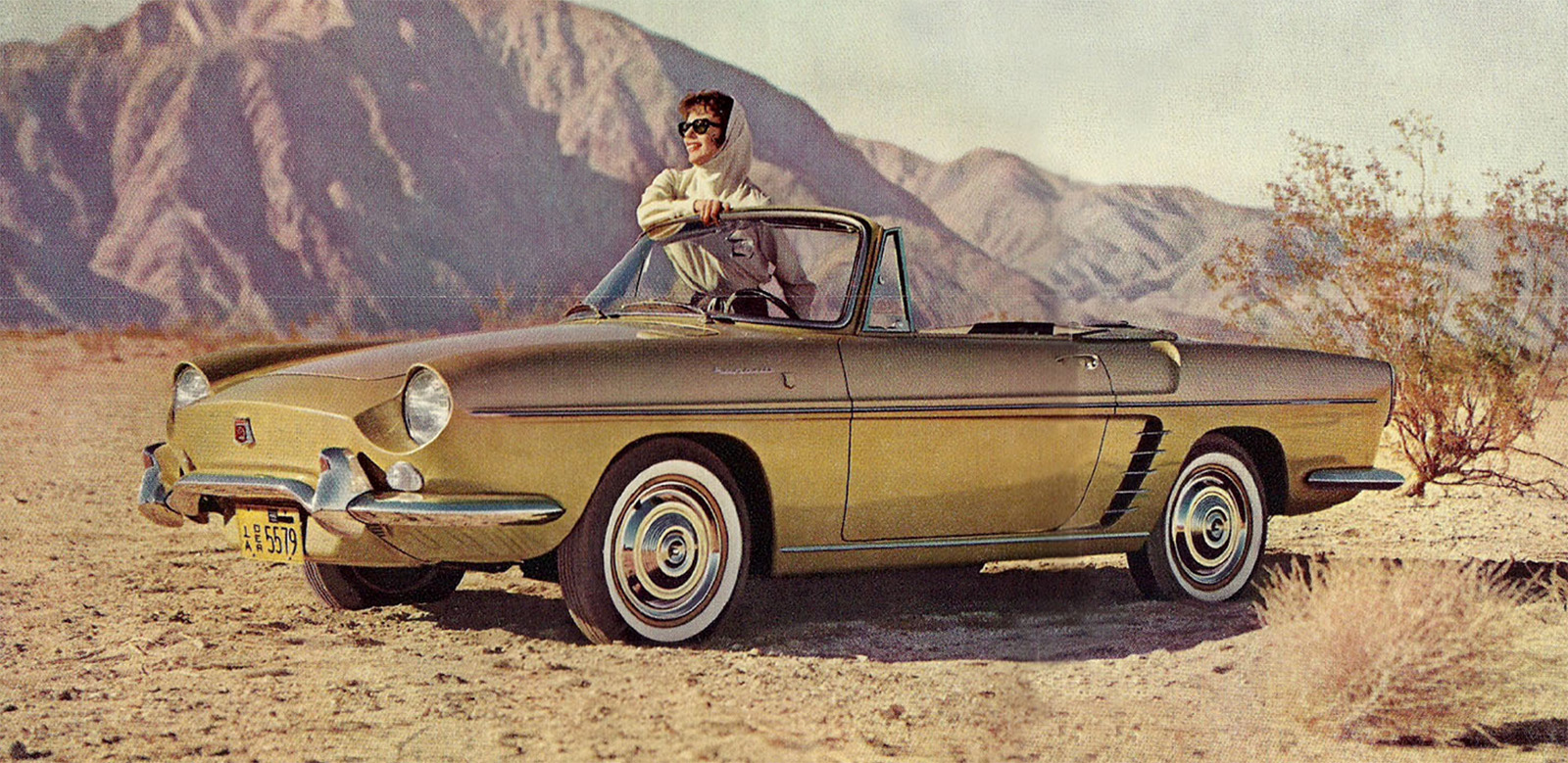
Damn, these were cool! I’ve seen them in person out in the wild once or twice, and they always make an impact. They’re essentially the Karmann-Ghia equivalent to the Dauphine’s Beetle: a sports car built on the bones of an affordable car.

The Plymouth Caravelle is a very different sort of machine; there’s two generations of them, which overlapped, kind of confusingly. The first started in 1983, and was a front engine/RWD sedan and coupé, starting as a Canadian model and then going to the US in 1985. The sedan version (or salon) was a sibling to the Dodge Diplomat, a car, when in police car form, was one of the most destroyed movie cop cars of the 1980s, or at least it seems that way. I had a high school friend who drove a Diplomat and boy was it a steaming pile. Maybe the Caravelles were less so.
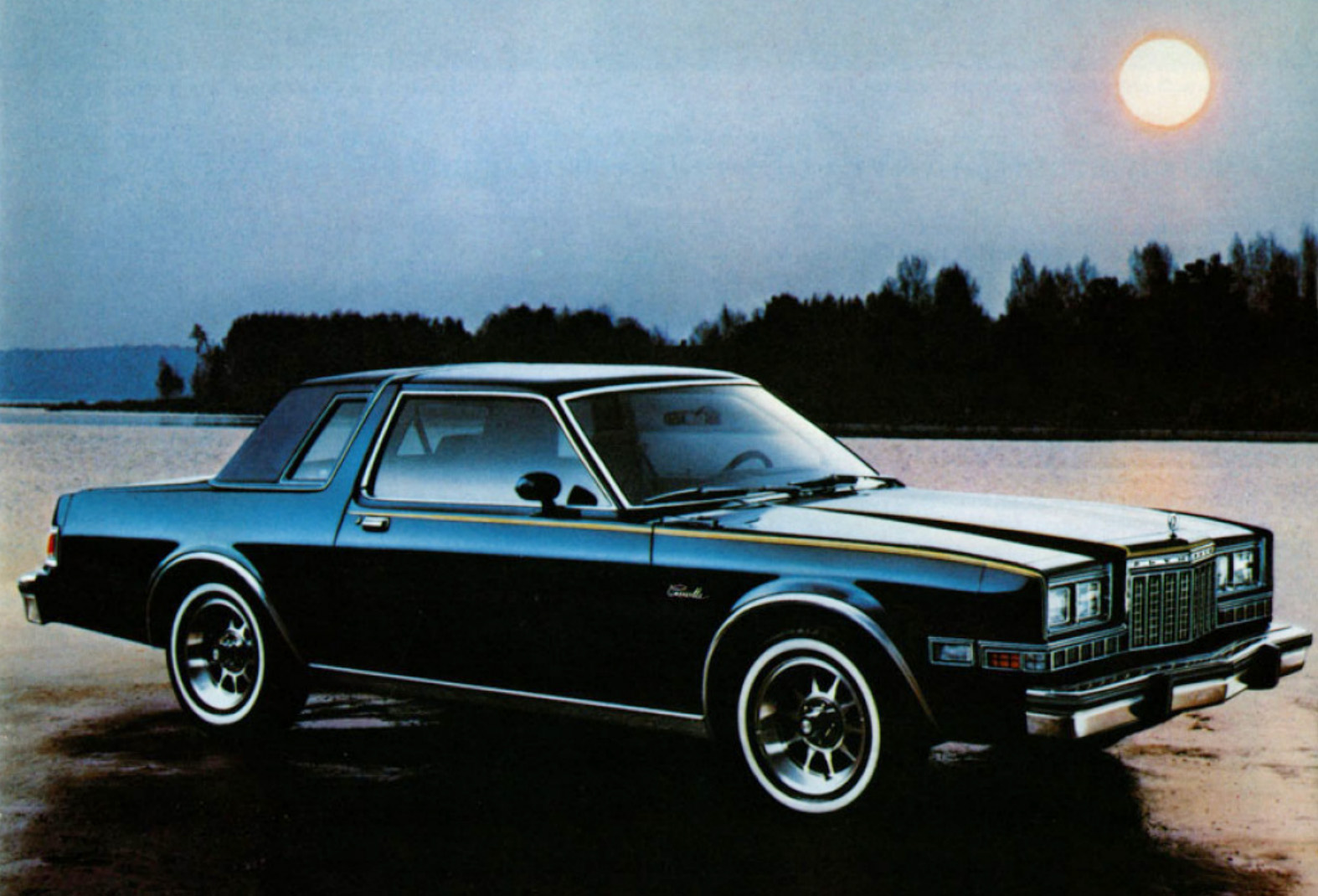 The coupé version had an interesting B-pillar design that incorporated a partial vinyl roof, but these were Canada-only cars.
In 1985, the second-gen Caravelles were created as a way to replace the Chrysler E-Class, and filled the gap between the smaller K-cars and the larger, still RWD Gran Fury. These new Caravelles were K-car-based as well, modern, FWD machines, using the same stretched K-car platform as the Dodge 600.
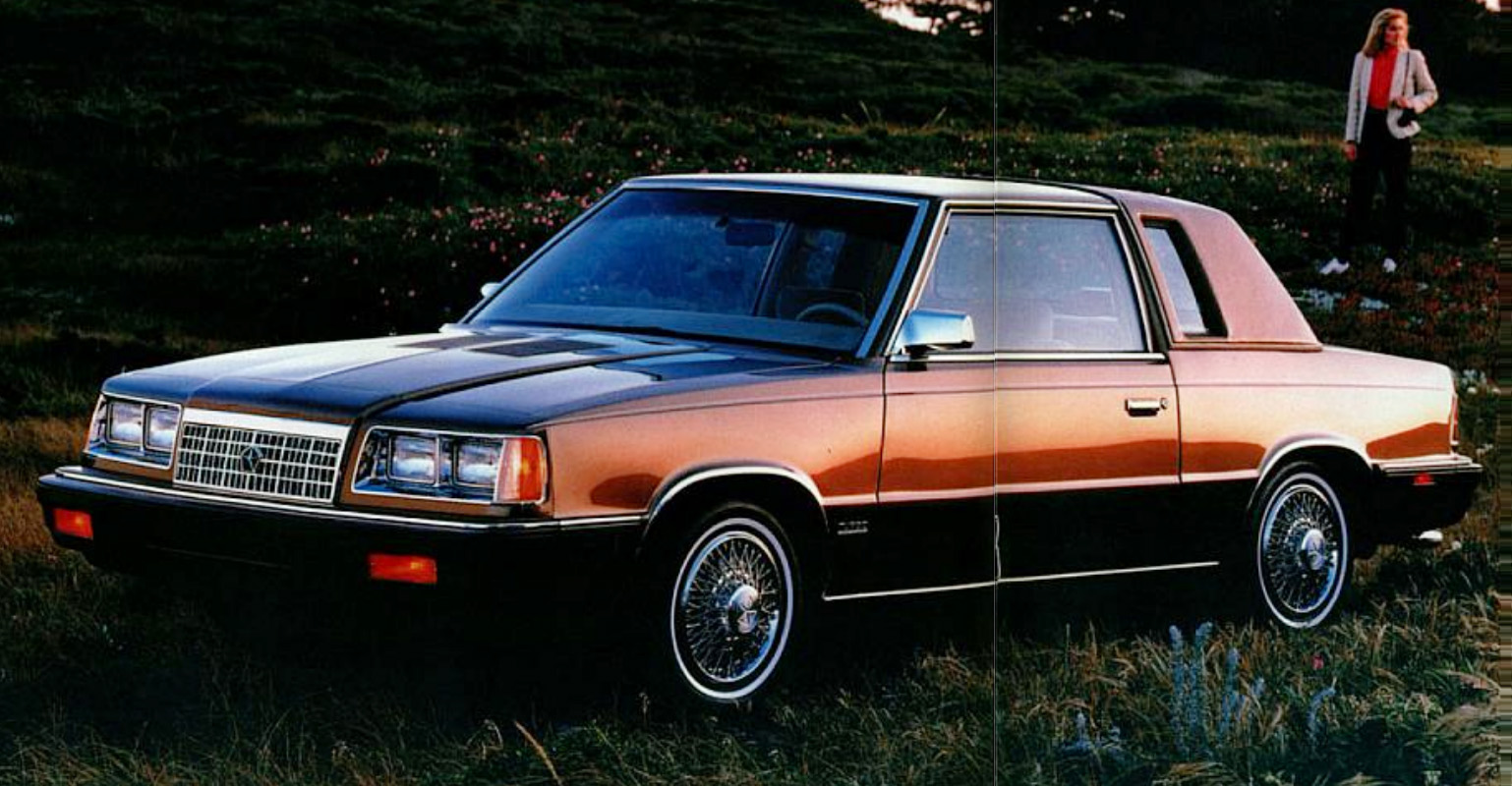
The new Caravelle had a coupé version as well, and could be had with the ubiquitous 2.2-liter four or a Mitsubishi V6. I can barely remember these cars as being any different from many other similar K-car derivatives in the Mopar stable, if I’m honest.
I definitely prefer the French Caravelles in this context, but I’m sure the American/Canadian ones have their fans as well. What’s important is that we’re all well aware that there are two very different automotive Caravelles, and I think we’ve accomplished that.
So you can all relax.





There’s also the Volkswagen Caravelle
https://en.wikipedia.org/wiki/Volkswagen_Caravelle
This car came up in the rugged Lincoln SUV article. I offered up the name Lincoln Caravel since their other vehicles have mostly seafaring names. I completely overlooked the Plymouth Caravelle, as did most of America when those things were produced.
Geez, imagine it’s 1988 and you just left the Ford dealership having just checked out a Taurus for the family. You head over to the Plymouth dealership and see that Caravelle Salon proudly displayed on the showroom floor.
I’d have turned around and left without looking any closer. Did they sell any of those at all to anyone under the age of 70?
I would have seriously wondered if I had been time-warped backward about 10 years or so.
Ahh, the Renault Floride!
Featured in the 2021 film, “Mystère à Saint-Tropez”!
I recommend if for nothing else – the selection of late 60’s/early 70’s cars – including a DS, a Ghibli, a 403 Cabriolet, a Gordini….
https://www.imcdb.org/movie_10537660-Myst%C3%A8re-%C3%A0-Saint-Tropez.html
I’ve never come across a Floride/Caravelle in person; only in the Japanese movie Pale Flower, from 1964. It looks great in that.
This made me want to go to Carvel and get ice cream…
GMTA!
Fudgy the Whale looks funny in these photos.
I thought a Caravelle was a candy bar. I also thought a Corona was a cigar so what do I know? Thanks for showing the Renault Caravelle. It’s a gorgeous piece!
Two local tie-ins for this post!
A friend has a Caravelle (the proper French one) that he hopes to restore, though knowing him, it may never happen.
Joanna Newsome grew up here in Grass Valley, and married SNL alum Andy Samberg a while back.
Yeah, need more coffee… upon first seeing the ersatz cutaway diagram with the white Caravelle and the model in white I thought the model was standing behind the Caravelle and had freakishly long legs (specifically in the shin area or, more pedantically, the crus area.) Looking again showed the model to be actually inside the car and standing on the back seat, a scenario which was slightly disappointing in being so prosaic even as it raises questions about why anyone would be standing on the back seat and leaning on the windshield frame.
The advertising agencies must challenge the norms of logic, sense and behavior to work their dark magic.
I think the 2-door K-car Caravelle was a Canada-only model as well, only the extended wheelbase 6-window 4 door K carried the name in the US. The Canadian-market RWD Caravelle Salon was called Gran Fury in the US.
I bought a 1963 Renault Caravelle S for $375 at a yard sale. I was in high school in 1973, and I loved that car! It had the larger 1100cc engine (earlier ones were 845cc) with 51 HP. Nice leather seats, Michelin radials, 4-speed, four wheel disc brakes, a tube radio that had to warm up, both a hard top and soft top, 32 MPG. It had 65K on it.
The Renault looks like an AI rendering (It is not), which makes me sad that I even think that.
Remember when the “next big thing” was going to be cool? Now it just gives me dread.
Your lede is actually reversed. Obviously, the Renault came WAYyyy before Plymouth. Unless I am in a weird space-time puzzle.
Are the two cars named Caravelle more or less different than the two cars named Monte Carlo (yes, I’m aware one is missing the space between Monte and Carlo)? Within the same manufacturer, all of Ford’s Mavericks are pretty different from each other. Maserati and Chrysler Sebring?
Also, after recently spotting a Saab 900 Talladega, I’d like to suggest a name exchange program for cars named after places they’re not likely to be found (IE the Saab 900 Monte Carlo and the Chevrolet Talladega).
hmm, why does a French car manufacturer share names with American cars which use French words for car names ?
It’s such a mystery!
Why they’d name a car after the people that live in their capital city is just baffling and there must be some reason why Google auto detects French when asked to translate “Caravelle” but it is beyond the ken of mortal minds.
I’m pretty sure no one at Pontiac in charge of naming things had been to France or knew anything about Paris or it’s residents though. It’d be like having a Ford Upper West Side or a Chevy Martha’s Vineyard
My favorite candy bar used to be the Peter Paul Caravelle that disappeared in the late 70s when Cadbury absorbed Peter Paul. I get naming cars after sailing ships (Corvette, Clipper, etc.), but it seems a stretch for candy, although no odder than Three Musketeers, I suppose. I prefer names that fit the product, like Mounds or Chunky. Chunky would’ve been a better name for that Plymouth, too.
I have a sweet spot(!) for stories like that, like hearing Norm tell about Count Chocula or Jerry tell about Pop Tarts 😀
The Caravelle was like a proto $100,000 bar, wasn’t it?
Yep. A little smoother in texture, but basically the same.
You know they changed the name to 100 Grand
Next you’re going to tell me it isn’t Kentucky Fried Chicken anymore and they only use the initials…
LOL
I feel like a car named Florida is just a 10yo Altima with body damage and a temp spare on one corner.
I too love these Renaults – the Chryslers, not-so-much.
Forgot the temp tag, but otherwise agree on the Altima
A car named Florida, you say?
Just doesn’t have enough BAE to have that name.
I had an ’85 Plymouth Caravelle sedan, the K-car version. I bought it for $300 as a winter beater to keep the salt off my Mazda Protege. It has the distinction of being the only car I owned ever to be featured on the radio traffic report. It conked out right in the middle of the on-ramp to Interstate 394 in Minneapolis, in the middle of rush hour traffic, in the snow. I was the “stalled vehicle causing a 30 minute delay.” If you were in that traffic jam sometime in 2003, I apologize.
Did you just leave it there and thumb a ride home?
Renault: Nice!
Plymouth: Ugh.
Joanna Newsom is great.
Joanna Newsom is fascinating, but the standard cautions apply: be wary of accepting her gifts, do not invite her into your home and if she offers you food or drink, do not consume it.
I wonder if she’s part of the same court as Dame Darcy?
A friend of mine in high school had a Caravelle convertible and it could corner like nothing I had ever been in before. I guess it was my first rear engine ride, and it was amazing.
If the headlights are the eyes, the grill is the teeth. You can’t get away with calling it Floride when it’s toothless.
Customers at my granddad’s dealership in West Virginia invariably referred to the Plymouth version as a “Clara Belle,” which was appropriate given the car’s matronly vibe.
The last time I rode in a Plymouth Caravelle was in 1997 (the K car version). The driver had his window down and was holding a shotgun, shooting at crows while we were cruising down a dirt road in the middle of nowhere. Good times…
“What’s important is that we’re all well aware that there are two very different automotive Caravelles”
You forgot about VW Caravelle
we’ll address that one next; there may be even more!
Caravelle Cthursday?
With apologies to Lovecraft, “Ph’nglui mglw’nafh Cthursday R’lyeh wgah’nagl fhtagn.”
It HAS wheels 😉
https://en.wikipedia.org/wiki/Sud_Aviation_Caravelle
Those were really good planes for the day.
There was also the mid-1950s Kaiser Carabela in Argentina.
In a bit of a coincidence, Curbside Classic has a post this morning on the Plymouth Caravelle which also mentions the Renault and Volkswagen vehicles with the same name.
The short wheelbase of the Renault Caravelle is really one of the worst in the history of car design, how hard could it be just to lenghten it so suit something that size? They paid a designer to draw the thing, couldn’t they pay an engineer to come up with a reasonable solution?
That – and the long nose full of air in the center/rear engined Ferrari Testarossa of the eighties. It was so goofy looking they had to paint some of it matte black.
The US one is good looking. Generic car. I like it.
It would have ruined the proportions. Look at the cutaway, and you’ll see that the engine sits behind the back axle, so however long the wheelbase was you’d always have to have quite a lot of car behind the wheels. They did the same at the front to balance it out.
Karmann made it work with the Ghia. Same setup. Maybe have a round butt like on a Porsche or something. Many ways that could have been done better.
You’re right, the Ghia is better. But I googled a bit and figured out why – the radiator in the Caravelle is mounted at the back and there’s additional space required back there, I guess for airflow.
https://automobilesetcetera.com/1967-renault-caravelle/
Weirdly the Dauphine the Caravelle is based on looks to have the radiator in front of the engine.
https://www.vfrenchcarparts.com/wp-content/uploads/imported/0/Renault-4CV-Dauphine-Upper-Hose-Rubber-Radiator-Raccord-Radiateur-5525829-114481677860-8.jpg
The Dauphine is a great shaped car!
Hence my dissatisfaction with something based on it supposed to be more fancy, but looking worse