


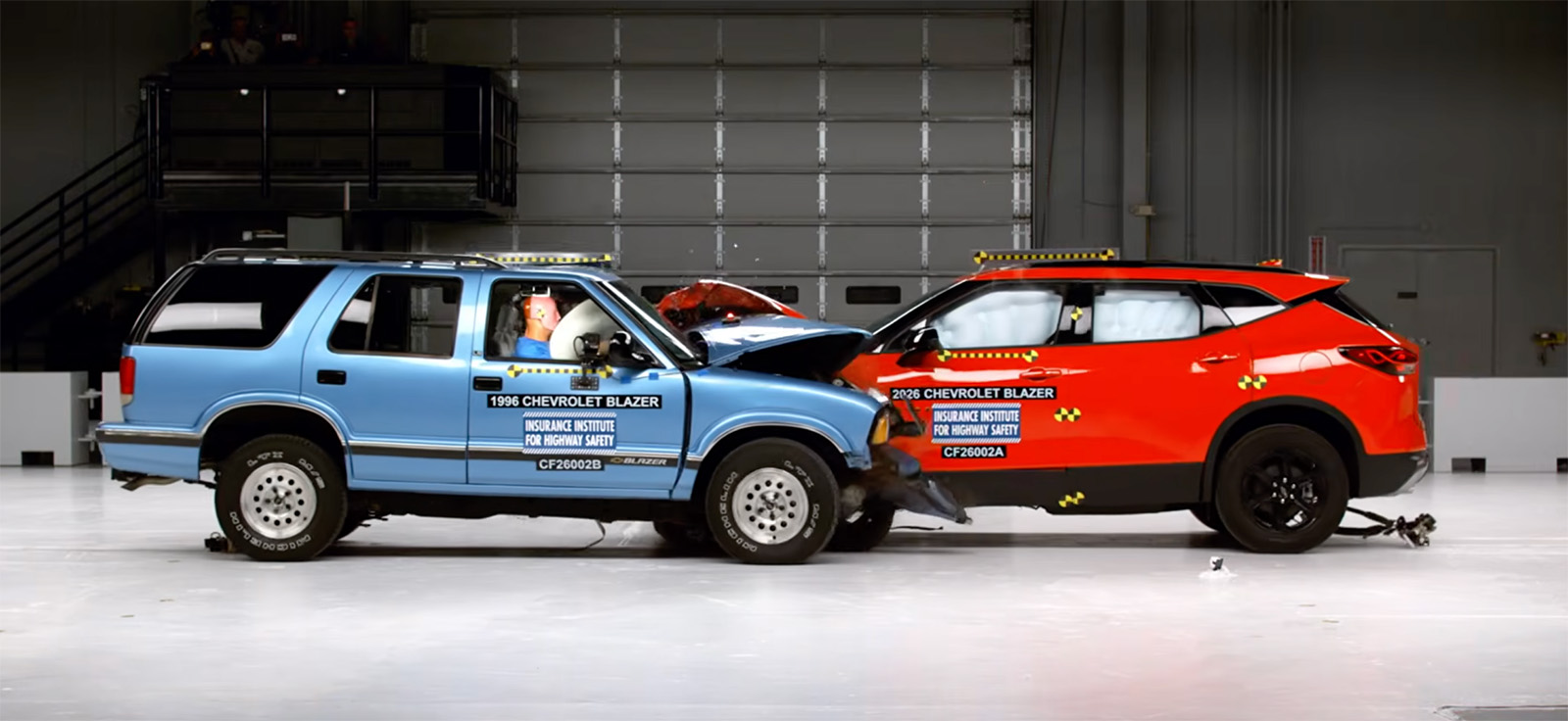
I’m going to admit something here: I don’t really like these old vs. new car crash tests that the Insurance Institute for Highway Safety (IIHS) does. Take this recent one, for instance, where they crash a 2026 Chevy Blazer into a 1996 Chevy Blazer. Now, I’m not a huge Blazer fetishist, but that’s a pretty nice-looking old Blazer! Look how clean and straight that thing is – or was. It seems a shame to wreck perfectly good – or at least restorable, since these crash tests need pretty solid cars, even if they don’t run – old car for an outcome that we all already know.
The 2026 car is vastly, wildly safer in a wreck than the car that’s 30 years old. No shit. I mean, what exactly are we learning here? Nothing. If you were to drive head-on in your ’96 Blazer into, well, pretty much anything, you’d be boned.


And that ’96 Blazer had an airbag! It’s not an absolute deathtrap like the cars I drive, even. At the time, that Blazer seemed like a pretty safe choice. Actually, you know what? Even back then, it wasn’t. It got an overall evaluation of “poor” in the moderate overlap crash test back in ’96. I guess this thing has always been a deathtrap. Which sort of makes a crash test like this even more, I don’t know, gratuitous?
I mean, yeah, okay, that’s some carnage there. I think that dummy in the ’96 Blazer had its head lopped off? It looks like it.
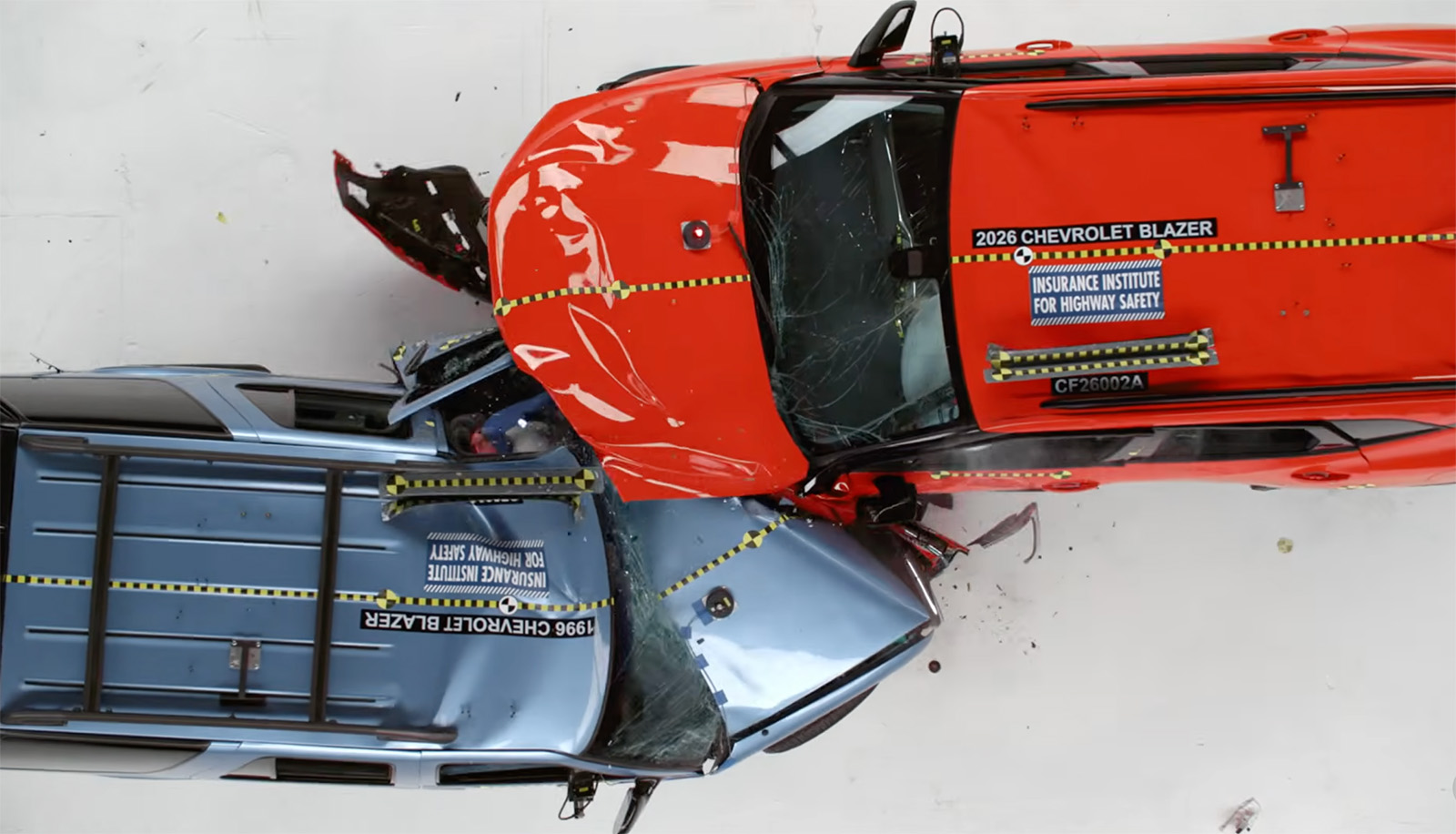
And look at that: look how much farther the new Blazer intrudes into the passenger cabin of the old one. The new Blazer doesn’t appear to have any intrusion into the cabin; the carnage seems to stop before the dashboard, even. Clearly, a vast amount of time and effort and money has been poured into making cars safer, and, like so many human endeavors that work tirelessly behind the spotlights, with tedious and humble methods, it’s worked. Cars are safer now than they ever have been before.
The IIHS itself estimates that 48,352 lives have been saved since the IIHS began their crashworthiness evaluation program in 1995. If you’d like to read the study and see how they arrived at such a remarkably specific number, you can see it right here.
Here’s how the study explains the methodology:
Analysis approach
To estimate the number of lives saved, we estimated the number of fatalities that would have occurred each year if the proportion of rated vehicles on the roads rated good for each test had not increased over time. This calculation was performed with a formula used in similar research (e.g., Teoh, 2025) that requires the number of fatalities in a year, the effectiveness of an intervention, and an actual and comparison rate of the prevalence of the intervention in the population. Effectiveness was calculated using fatality rates (fatalities divided by registered vehicles) with the following formula:
Where FRG is the fatality rate per registered vehicle among vehicles rated good, and FRAMP is the fatality rate among vehicles rated acceptable, marginal, or poor (AMP). Lives saved were calculated with the following formula:
Where GoodRatingInitial is the proportion of vehicles with a good rating in the first year of the test in the data, and GoodRatingYear is the proportion of vehicles with a good rating in a subsequent year.


I hope that helps; also interesting is how researchers determined that of those nearly 50,000 lives saved, over 67% were not assholes or jackasses, at least according to the available metrics, so that’s positive.
I’m kidding! They didn’t have sufficient data to determine who the assholes were.
David actually asked me to write this up, and he had a very different, likely more mature reaction to these sorts of old v. new tests than I did. Where I initially found them to be a sad waste of what could be a perfectly enjoyable old car, David, a relatively new parent, saw it differently:
“I think it’s valuable. It’ll convince people not to give their kids a 1990s car for high school.”
Now, I’m a parent, too, but I’ve had this kid for 15 years, so perhaps I’ve gotten a little jaded. But my kid is on the verge of driving, and I really should be thinking about things like this. So I guess that’s the value of these kinds of tests – it’s not about learning anything new, it’s about making such a spectacle of the carnage and disaster that could happen when you wreck an older car that people will simply be horrified out of ever buying such a deathtrap.
Of course, there’s always the lure of the false survivorship bias thoughts as I recall the deathtraps I drove when I was a kid – and continue to drive until this day – and look at me, I’m not dead! Not physically, at least!
But that’s a stupid way to think. David’s right. These sensationalistic crash tests do have some value, and the value is just in how horrific they are, because, yeah, cars were less safe in the past, and it’s easy to forget that until we see a perfectly nice-looking Blazer get crunched up into a wad and some dummy suffer what appears to be the same fate as Marie Antoinette, but less stylishly.
So, fine. Everyone watch that crash test. Pause and look at how crumpled that passenger compartment in the ’96 Blazer is. Take a moment and reflect on the fate of that crash dummy, and think about the orphaned crash dummy children left behind, and the life of crash dummy crime they will almost certainly fall into as a result of the trauma of being deprived of their crash dummy father and being thrust into the chronically underfunded crash dummy child welfare system. Did I mention this crash dummy was a single parent because their crash dummy spouse had been dismembered in another cruel crash test? I should have mentioned that.
Anyway, I hope the IIHS scared you straight.
Top graphic image: Screen grab, the IIHS


Completely unrelated question: I wonder what a Nissan Pao would look like getting hit by an F-150?
Probably something like this:
https://encrypted-tbn0.gstatic.com/images?q=tbn:ANd9GcThJX8Y_B1PtffMnpIFYNTKx4KG9CRZSK15idfustu-uA&s=10
That depends on how much bumper ham is involved.
Yeah, I give F150’s plenty of room…
Couldn’t be much worse than a Pao getting hit by a deer.
This does NOT make me feel better about my daily driver ’95 Geo Tracker! Grr
Prob similar to the Metro: https://www.youtube.com/watch?v=tb-ARgQxSOo
The one thing this really proves to me is how much crap GM produced over the years. Poor rating 30 years ago but advertise the heck out of it as the new rugged family truckster and I guess let God sort it out.
*Laughs in 1978 Toyota Corolla*
Both Blazers crashed, so the lesson is to avoid cars from the 1990s or newer.
I’d like to see one of these tests with a W123 Mercedes, or a 200 or 700 series Volvo.
We all know that American cars of that era have the structural integrity of a take out container. My parked 740 wagon was in a line of cars that got hit by a police car in a high speed chase in Brooklyn (never park on a corner in Brooklyn!) and the car behind me and the car in front of me were totaled, but nothing at all happened to my Volvo.
Also, I don’t know if high school kids in f150s that weigh 5000 pounds and have the bumper over two feet above ground level are a good idea. They certainly don’t make me feel particularly safe. The idea of “safe cars” in the US is really dumb.
A long time ago (Jesus Christ nearly 20 years ago) Fifth Gear did this test – Volvo 740 vs. Renault Modus. The Modus won.
https://youtu.be/qBDyeWofcLY?si=1RAlF12Uho4HdG-K
Thanks
Interesting, and those offside crashes weren’t something people were designing for.
It even was a newer Volvo 940
Modus was not a light car
I don’t know… only 40k over 30 years? How much has the IIHS spent, and how many secondary costs to make a 3% reduction in fatalities? Those aren’t stats I’d crow about.
Look at this guy acting like 48k lives is nothing…..
I think it’s pretty impressive. IIHS is a non-regulatory 3rd party that doesn’t themselves make cars, safety devices, or whatnot, let alone control, mandate, or have direct influence in the market beyond empirical testing products and sharing results. Saving 48k lives by essentially shaming poor performers and giving high performers a marketable trait to sell on seems…. pretty dang successful.
I don’t think it’s nothing, but my work is public policy adjacent… so I’m keen at looking at what it costs.
The IIHS itself seems to go through around 30MM annually. You’re paying for that through your insurance premiums. That’s just direct costs. The indirect costs would be what you’re paying extra for the cars that are now undeniably safer, the extra fuel/energy to move the heavier structures. Then there’s the increased tirewear and emissions from heavier vehicles (air pollution is estimated to 200k early deaths annually in the USA, 5 times as many as vehicle accidents, and vehicle emissions are the single biggest contributor).
So yeah, if it’s save lives at any cost*, sure pretty dang successful. But I don’t think this is nearly as effective as I would have hoped. But then again automobile deaths are strangely resistant to safety equipment improvements. Lots of work and theories around ABS in particular.
*back of the napkin math, 900MM over the 30 years, or 18k per life saved, direct costs only. actual costs greater.
Sure, if additional safety features/mechanisms were the primary driver for cost, weight, emissions, and tire wear increases I would agree with you. But it’s not. Cars emit less in the past 30 years. They are more efficient. Weight and size are largely up due to regulatory reasons and customer preferences. Tires last longer and perform better. Whole lotta whataboutism going on there….
If a car that weighs twice as much hits objects with twice the force and (for the sake of argument, physics is a bitch, see also spherical cows) causes twice the damage, why aren’t the premiums twice as high?
Or, at the very least, how is encouraging bigger heavier vehicles advantageous to the insurance companies?
Modern safety hasn’t made cars 2x the size, weight, lead to 2x the damage, or increased stopping distances 2x as far, etc. A Miata gained about 250-300 pounds in the past 35 years.
Also, premiums aren’t just related on the cost to repair a car. They are heavily related to human injury severity/rates and death rates. Repairing a car is an insignificant cost relative to repairing a human or cost of death. Even more so in the US where healthcare costs are insane and has been getting more insane over the years with no end in sight.
I’m not making the argument that modern safety has made cars significantly heavier. Plenty of others have, but I think that marketing is primarily to blame for the proliferation 5000 pound trucks sold as cars.
I don’t have access to what public liability insurance costs for different cars which would reveal how insurance companies price different cars, but the safety ratings they publish would seem to indicate what the insurance companies value, and it seem th be biased in favor of occupant safety rather than the safety of people outside the car.
I’m not sure that premiums are heavily related to medical costs. I am paying more now for the same liability limits I had in the past. There have been no negative changes to my insurability. The insurance company isn’t on the hook for more than the contractual amount. (I could be, but that’s not in my premium.)
I believe someone said that if you were really interested in saving lives you would redirect the money spent on cancer research to buyin and giving away mosquito nets.
So some say that aligning spending with outcomes in necessary, but I think maybe both. Well the painting reflecting pools budget count be redirected I guess.
The thing I don’t get is why the insurance companies don’t assess how dangerous vehicles are to people outside the vehicle that are involved in an accident.
The insurance companies pay liability claims, so how much damage a vehicle causes to others seem like something they would wand to quantify and use for rate setting.
Most other kinds of insurance takes that into account.
Keen for looking at what it costs eh?
Are you aware of how heartless and cold blooded that sounds?
Yes, I’m aware. I work in public education. I’m keenly aware that everything has a cost regardless of how noble or helpful. I’m glad no one else here seems to have ever had to make decisions about cutting helpful programs because there’s no money. It sucks, it changes you.
But I’ll duck out of this argument after observing this comment from reddit where this video was posted:
“ The amount of lives saved by better crash performance is certainly in the millions.”
That’s the expectation. But it’s not in the millions. Or a million. Or in the hundred of thousands. It’s 50k total over 30 years. That’s what I’m responding to.
I work in the same field, make the same choices. You cannot allow yourself to start seeing lives in terms of dollars.
Omg man, get help. Life is not just about money. 40,000 families lives WERE NOT ruined.
I think you missed his point, it’s how many lives could be saved if we did something else with the thousand million dollars they’ve spent.
700,000 Americans have died from fentanyl in the last 10 years, could we have saved 50,000 of them with a billion?
1,000,000 die from heart disease every year, could preventative doctor visits, tests and programs save 2500 people a year over 30 years?
And he brought up a great point that the changes brought on by the IIHS can actually lead to additional deaths
While insurance premiums may not be cheaper for the victims/customers, the fact that IIHS is funded by insurance companies suggest that they actually save money by shaming manufacturers into making safer cars.
They make money by using ever increasing IIHS standards to justify increasing the premiums on existing cars. They also make money by charging more due to the repair costs associated with many modern safety systems.
It’s not really a fair comparison. The ’96 is a body-on-frame which are inherently bad at this particular impact, and the ’26 is a unibody, which are designed for this kind of impact. Pretty scary, anyways.
My kids are learning to drive in a 90’s Volvo wagon.
If you’ve never seen the “What does it take to kill a Volvo” video, watch this.
Bonus that I don’t have to worry about my sons getting laid in it.
Video games took care of the last problem you listed.
“My kids are learning to drive in a 90’s Volvo wagon.”
Yeah, about that:
https://www.theautopian.com/this-2026-vs-1996-chevy-blazer-crash-test-is-a-sobering-reminder-that-we-all-used-to-drive-deathtraps/comment-page-1/#comment-981533
(Note: the test uses a 1990s 940 wagon, not a 740 as said in the comment.)
“If you’ve never seen the “What does it take to kill a Volvo” video”
Better question, what does it take to kill the driver of an Altima?
https://www.motorbiscuit.com/nissan-altima-driver-miraculously-survives-worst-crash-weve-ever-seen/
What is this irrational and endless lovefest bestowed on old Volvos?
They are now old cars. They are both unsafe and unreliable like every other old car.
Because Volvos were widely considered the last word in safety so a Volvo should show the best possible result. If a Volvo fails (and it does) it stands to reason everything else will be much worse.
TIL Chevy hasn’t stopped making the gas Blazer yet. I thought ’25 was the last year.
I think the deadbeat crash dummies who skip out on their crash dummy kids get put in the old cars. His crash dummy ex was driving the new Blazer.
The comments highlight the road to hell is paved with overconfidence.
So many last words: “It will be fine!”
Used to?
The headline immediately took me to the Mitch Hedberg joke:
“[We all] used to [drive deathtraps]. [We] still do, but we used to, too.”
Gm had some iffy results around this time, I think most were around S10’s or S10 derivatives, think Blazer, Astro Van, etc. Oh well. My Volt has about 47 airbags and an incredibly rigid structure to protect the battery pack, but I have no fears hopping in my Suzuki tin can and going for a rip.
I was out driving my deathtrap this afternoon. I properly adjusted the mirrors, put the top down, hat on, and off I went. As I rolled out of the driveway, I realized the side mirror (driver side only) had already rattled out of position. Oh well, probably don’t need it anyway and I can still see out of the rearview mirror, sort of. Airbags? they didn’t exist in 1980. Rollover protection? Pretty sure my hat is as good as it gets. Steering? Still a lot of play, so it generally feels approximate to where you point it. Anyway, good fun, even if my wife refuses to ride in it.
Oh, and I want to see them crash a ’26 into a ’26. Does the structure of the newer car affect the outcome for the other newer car?
Edit: I want to clarify that I don’t think old cars are generally appropriate for everyday transportation, especially for newer drivers. Mine is used for fun drives at low speeds and I think about and accept the risks every time I take it out.
For a moment I thought you were talking about a 2026 model and a 1926.
Well, If they can find a 1926 Chevy, I’m down for it.
A 1926 Packard would probably do some serious damage to a modern car. I wouldn’t want t to be in either.
It basically looks like two of the new Blazer from this video. The forces don’t increase with a better structure, the structure is just better at absorbing the forces without reaching the passenger compartment.
Probably these ladder-frame midsize SUVs were some of the biggest death traps going. They were often crude conversions of compact pickup trucks–which themselves didn’t give a lot of attention to safety. On top of that, they had tall centers of gravity, narrow track widths, solid rear and sometimes front axles, and often no stability control…which caused them to handle in ways that people didn’t expect, especially during emergency maneuvers.
I imagine a 1996 Taurus Wagon was much safer than a 1996 Explorer (Bridgestone fiasco notwithstanding).
The US automakers deliberately shifted to SUVs because they were exempt from most safety and had laxer emissions requirements.
IIHS doesn’t have a 3rd gen Taurus on any of their Youtube vidoes, but they do have a 4th gen, and it does do significantly better than the Blazer in front overlap, although there’s some very obvious deformation of the roof over the front door that’d be unthinkable in a modern car. And like you say, Ford advertised heavily how safe those Taurii were as new.
https://www.youtube.com/watch?v=_Lhhw6tp4ck
IIRC Ford stumbled upon making the Taurii better in crashes by accident. I believe it was an interview in Car & Driver with a Ford Engineer. The engineer said one of its key innovations was using sheet metal dimple forming to strengthen body panels while keeping the car lightweight and aerodynamic which when crash tested also showed it absorbed energy better.
I investigate fatal crashes. Put your kid in a 8 year old midsize.
Kids make mistakes. Learning to drive is an enormously complex task. Our licensing rules are starting to realize that, requiring 50 hours of experience before turning ‘em loose in our state. It takes that long for the driving task to sink in, to become something that a human can do without using a ton of brainpower leaving room for some unusual stimulus at the same time – like someone crossing the centerline right at ya.
Yeah, I grew up driving old crap around the farm. And the best defense is the crash you avoid. But people make mistakes. Reduce the consequence of mistakes through a combination of training and technology.
Yes sir, this is the correct take. My brother was going to put his 16 year old in an old jeep with no airbag as his first car. Goofy kid was all for it, talking about taking the doors off. It took me a long time to convince the adult to be an adult. His argument was along the lines of “we drove cars like this and survived when we were kids.” We did, but didn’t have better options. I brought his wife in on the conversation, which led him to make the somewhat correct decision, an older Chevy Colorado, but it at least had airbags. The kid rolled it on a gravel road two months later, with two other goofy 16 year olds as passengers. All walked away without a scratch.
“we drove cars like this and survived when we were kids.”
This is a great example of survivor’s bias.
The people who didn’t survive aren’t around to weigh in on the discussion.
I remember several kids from my HS didn’t make it through due to crashes.
I agree – I learned to drive tractors (that were already 60+ years old) when I was a kid, and I transitioned to field cars, trucks and other equipment. I won’t say that it made me ready to hit the road without any training at 16, but I was able to understand the dynamics of how a vehicle worked, felt and handled in different situations.
My son has started to drive an Allis Chalmers Model B (that my father restored for him) around the field and learning clutch control…he watched my father and I start it and figured it out on his own. I think it’s a good start for him…
How many people can afford an 8 year old midsize sedan for their kids? I know I don’t have 10k laying around.
My first driving kid will be starting training this winter. We have a hand-me-down 2011 Impala. It’s not a tank, but I feel comfortable with it as a first car.
On a five year note with a grand down you are looking at $162 a month.
$5.40 a day.
People spend more than that on bad habits.
Sure, $5.40 a day sounds reasonable, until you consider you’re signing up for that $5.40 a day for the next 1,825 days.
With three kids, there is a LOT that needs paid for over nearly two thousand trips around the sun, and just taking loans out on everything you can’t afford immediately because “it’s just a few bucks per day” is going to fast track you into debt.
It’s no wonder that 50% of our country carries a balance on their credit cards month to month.
“With three kids, there is a LOT that needs paid for over nearly two thousand trips around the sun”
You think you’ll still be paying for your kids needs nearly 2000 years from now?
I both admire your optimism and am depressed at your situation.
*Places face in palm* I deserved that one! That’s what I get trying to sneak in comments between meetings…
One of the mantra’s in Road Safety is that a mistake shouldn’t kill anyone. That extends to making sure the vehicle protects you (and hopefully others) plus ensuring that the things at the side of the road don’t penalize you.
None of us are surprised – this is IIHS clickbait.
We all knew that generation of Blazers were deathtraps when they were new – the crash tests at the time for that generation earned “Poor” ratings.
Show us a car from that time with good and excellent ratings and crash that into a new car with good and excellent ratings – and lets see how that works out.
No, all of us don’t know those era cars were deathtraps.
The normal car customer, which is everyone not reading this blog, has no idea how car safety has changed.
These car crash tests serve a value to educate.
I have shown their famous, or infamous, 1959 Impala into a newer crash test to several car normies who were all shocked by the result. Normies think old cars are safer cuz’ the metal is thicker or some such mythology.
These tests are not “click bait”. Geesh.
The IIHS knew – they did the testing when these vehicles were new.
So yeah – unlike the Impalas, which I believe may have even surprised the testers – the IIHS folks knew the result of this test before they even set it up.
That’s clickbait.
Of course they know. And they would have known the Impala’s results.
This isn’t clickbait but a continued reminder to everyone on the road that just because it’s “a big and old SUV” isn’t anywhere near as safe as modern vehicles.
They don’t make them like the used to, for good reasons.
You don’t appear to understand.
Survivor bias is real.
And ubiquitous in the gearhead community!
To be fair to the 90s the ’96 Blazer scored badly when it was new in this test:
https://www.iihs.org/ratings/vehicle/chevrolet/blazer-4-door-suv/1996
which looks pretty similar to the video. Thinking of random 90s cars got me to the Taurus, which had a good rating:
https://www.iihs.org/ratings/vehicle/Ford/taurus-4-door-sedan/1996
And looks survivable even by today’s standards.
Modern cars have to pass the small overlap test too though, which is much harder.
Jason, you can steal a Mitch Hedberg joke here, given the headline. “I used to drive deathtraps. I still do, but I used to, too.”
I think the best reason to keep doing these things and destroying these older cars is the pervasive myth that older cars were built better.
“They don’t build ’em like they used to.”
Sure don’t. They build them better, and we should be thankful for that.
I do wish they’d prioritize visibility and pedestrian safety more, but that’s a whole other can of worms.
THIS!!! Nostalgia and lack of understanding physics kills.
Safer? Yes. Better? Eh, depends on what you call better. Absolutely no doubt that modern metallurgy and crash engineering has made a much safer car. However, durability of many components seems to be greatly diminished, and repairability of essential components is much more expensive and difficult. 20 years or so ago seems to be a pretty good combination of safe + simple.
Wrong.
Modern cars are orders of magnitude more reliable than old ones were when new.
The average age of cars on the road keeps going up which is directly related to how reliable they are.
Let’s just be honest, cars in the past were unsafe, poorly built, and inherently unreliable.
I didn’t say reliable, I said “repairable”.
I posted a longer reply discussing durability, but I didn’t cover one aspect.
I agree that right-to-repair is important!
However, repairable does not equal durable.
A carburator may be easy to repair and tune, which might have to be done every 20k miles, or even every season. Whereas an EFI and ECU are difficult and expensive to repair. But if the EFI/ECU can go 250k+ miles without issue, isn’t that actually better?
Repairability of modern cars is definitely an issue.
However, regarding “durability of many components seems to be greatly diminished”
Major recalls aside, modern cars are much much more durable than any older cars.
Anecdotally, in the 80s and even 90s, a car with 100,000 miles was old. Hell, cars from the 70s and prior only have 5 digit odometers because no one believed they would actually survive any longer. Now? I think a car with 100k mi is only just broken in!
Fortunately, we have official government data too!
The average age of cars on the road has been pretty much linearly increasing from 1970 (5.6years old) to 2025 (14 years old)
This clearly shows that as cars get newer, they stay on the road longer and longer.
(1970-2000) https://www.fhwa.dot.gov/ohim/onh00/line3.htm
(2000-2025) https://www.bts.gov/content/average-age-automobiles-and-trucks-operation-united-states
And, people are even driving these 0-14 year old cars and trucks significantly further than they used to! Clear data is hard to find, but while the average car drove about 10,000 mi per year in 1970, that number increased by about 2% per year (covid aside) up to 13,500 now.
So in 1970 a person at the lowest rung of reliability and average driving distance, had a 5.6 year old car driving 10k miles/yr
In 2025, they have a 14 year old car driving 13,500 miles/yr.
Great use of data to back up that modern cars are more reliable.
More reliable means that fewer repairs are needed, which saves owners money.
Anecdotes are a dime a dozen, but having lived in the distant past when these old cars were new they were unreliable right off the showroom floor.
Flooding carbs, vapor lock, over heating, oil and transmission leaks, blown hoses, broken belts, instant rust, water leaks in the cabin and serious electrical problems all happened within the first year of ownership. I recall being broke down on the side of road more than once in my parents brand new cars.
Every time someone says “they don’t make them like they used to” I say thank God!
Bingo! You nailed it.
I loathe so many things about modern cars, but you can’t deny the advances made in safety. After spinning a car and luckily hitting the rear end, it really got me thinking about brakes & tires (accident avoidance), and airbags (accident survival) for my next car. The replacement was only 5 years newer (9 if you go by their respective introductory model years), but had four-wheel disc brakes, ABS, and side curtains in addition to fronts, and I made sure that I put good tires on it.
The kicker was that car cost about the same as the one it replaced (and this was in 2021! Jeez, I’ve had that pile of junk for almost five years now… “GM: Runs poorly for longer than most cars run at all”)
They don’t build them like they used to…and that’s a good thing.
Remember that video that’s been circulating for years showing the crash between a 2000’s Malibu and a 1960 Impala?
Guess what I drove in high school in 1989?
A 1960 Chevy El Camino.
Still alive, and I regularly commute on a motorcycle.
The most survivable wreck is the one you don’t have.
“Still alive, “
Are you SURE?
https://www.youtube.com/shorts/yUh9PufRgJY
https://youtu.be/uBxMPqxJGqI?is=OOtFbPc_hta6WWcj
Nope… you’re like the parrot…
https://www.youtube.com/watch?v=iixvQWx7IOM
Crumple zones doing what crumple zones are supposed to do.
New Blazer might be totaled but you will survive the accident and probably not have major injuries. With the old Blazer, it is iffy, at best. A whole lot of intrusion into the cabin.
This is what happens when people invest in engineering rather than waste it on hopes and prayers.
Well said and it looks like the feds have given up science for hopes and prayers.
Sad state of affairs.
The Feds might have, for now, but luckily car makers haven’t.
It’s funny cause in local Facebook groups that post about traffic conditions and minor accidents I still see mouth breathers commenting on how good were old cars since they barely crumple at all whereas a modern EV will turn into a shapeless mess.
There’s a simple response to that:
In old cars YOU are the crumble zone. Your widow will be repairing the car that transfered all the energy of a crash into YOUR body.
Don’t get me wrong, I love older cars, but I have no delusions that they are safer than modern cars.
I make a special effort in my physics class to explain energy transfer momentum and impulse in car crashes. Sadly physics is an optional class.
This is one reason I push back against the “ALWAYS buy used, old, cars that need constant work and no payments.”
Safety matters.
yea yea the few years old lease return is fine.
I also point out that, living in a road salt state, this is a NON-rusty old car.
Yeah an S-10 blazer from around here (if they could find one) would have disappeared in a cloud of red dust in that impact.
Now that you mention it, I would love to see a crash test between the new Blazer and the heavily rusted 1996 Blazer… LOL
I do have one 90s car kicking around, a 1996 Jaguar XJ12, and that’s only because it’s a special car, being the last year of the V12. It does have traction control (out of a contemporary Ford Mondeo, funnily enough)…but I doubt it’s all that safe. The engineering for that basic platform began in the late 70s, during the nadir of the British Leyland days and before Jaguar had been spun off as an independent company and later purchased by Ford.
If I were going to seriously drive a 90s car as a daily, or to put my child in one, I would probably stick to products from Mercedes-Benz or Volvo…or a Lexus LS 400. That’s about it. Otherwise, it’s really not worth the risk, especially in my state where everyone and their mother has a Suburban or an F-250 and treats it like a weapon.
I certainly would not be tooling around in an NA Miata or anything like that.
Nah… those Miatas are death traps.
Instead, how about a nice Geo Metro?
I’m happy the driver survived this, but it’s making me rethink acquiring an NA Miata…
https://abbynews.com/2026/06/20/person-airlifted-to-hospital-after-car-hits-deer-on-highway-1-in-chilliwack/
Rollover? That’s why you install a beefy roll bar if you buy a Miata