


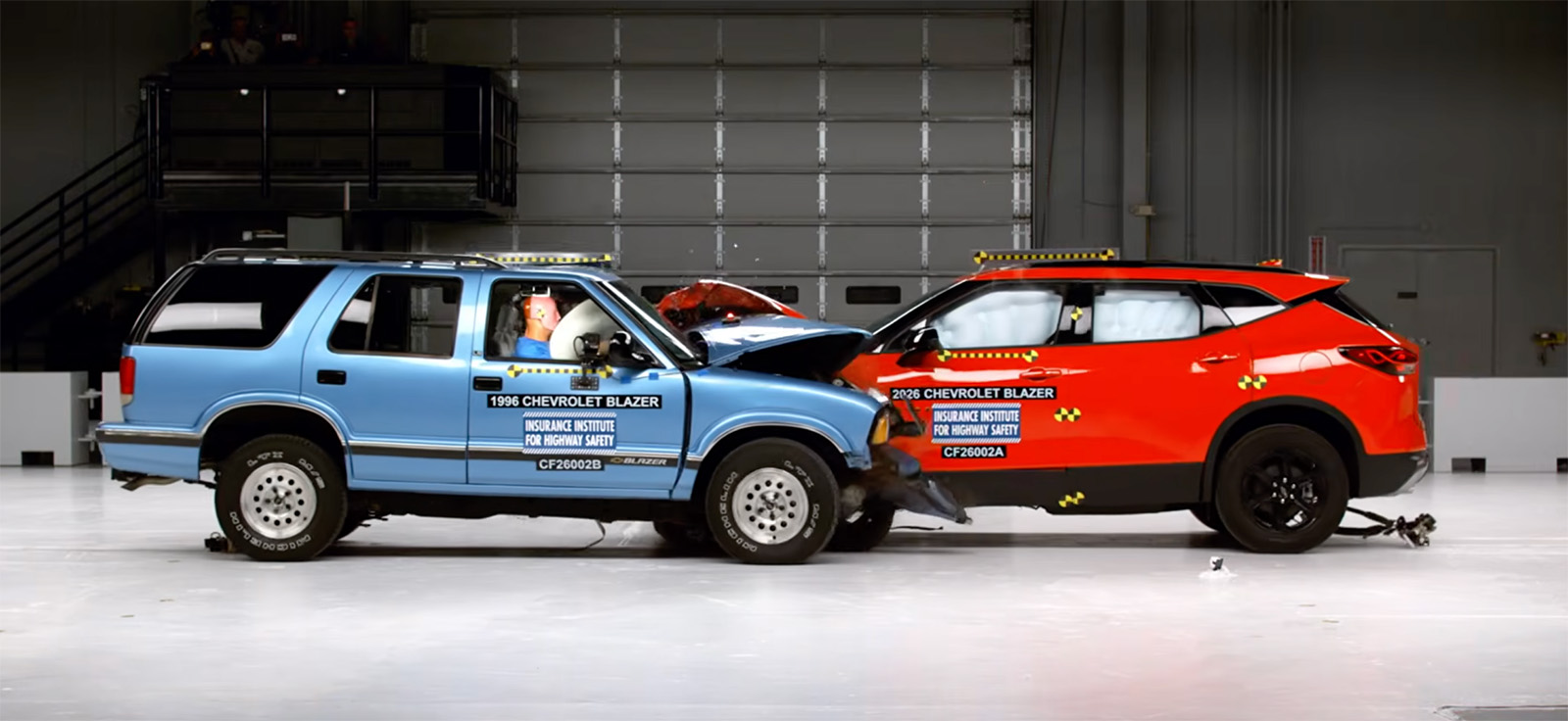
I’m going to admit something here: I don’t really like these old vs. new car crash tests that the Insurance Institute for Highway Safety (IIHS) does. Take this recent one, for instance, where they crash a 2026 Chevy Blazer into a 1996 Chevy Blazer. Now, I’m not a huge Blazer fetishist, but that’s a pretty nice-looking old Blazer! Look how clean and straight that thing is – or was. It seems a shame to wreck perfectly good – or at least restorable, since these crash tests need pretty solid cars, even if they don’t run – old car for an outcome that we all already know.
The 2026 car is vastly, wildly safer in a wreck than the car that’s 30 years old. No shit. I mean, what exactly are we learning here? Nothing. If you were to drive head-on in your ’96 Blazer into, well, pretty much anything, you’d be boned.


And that ’96 Blazer had an airbag! It’s not an absolute deathtrap like the cars I drive, even. At the time, that Blazer seemed like a pretty safe choice. Actually, you know what? Even back then, it wasn’t. It got an overall evaluation of “poor” in the moderate overlap crash test back in ’96. I guess this thing has always been a deathtrap. Which sort of makes a crash test like this even more, I don’t know, gratuitous?
I mean, yeah, okay, that’s some carnage there. I think that dummy in the ’96 Blazer had its head lopped off? It looks like it.
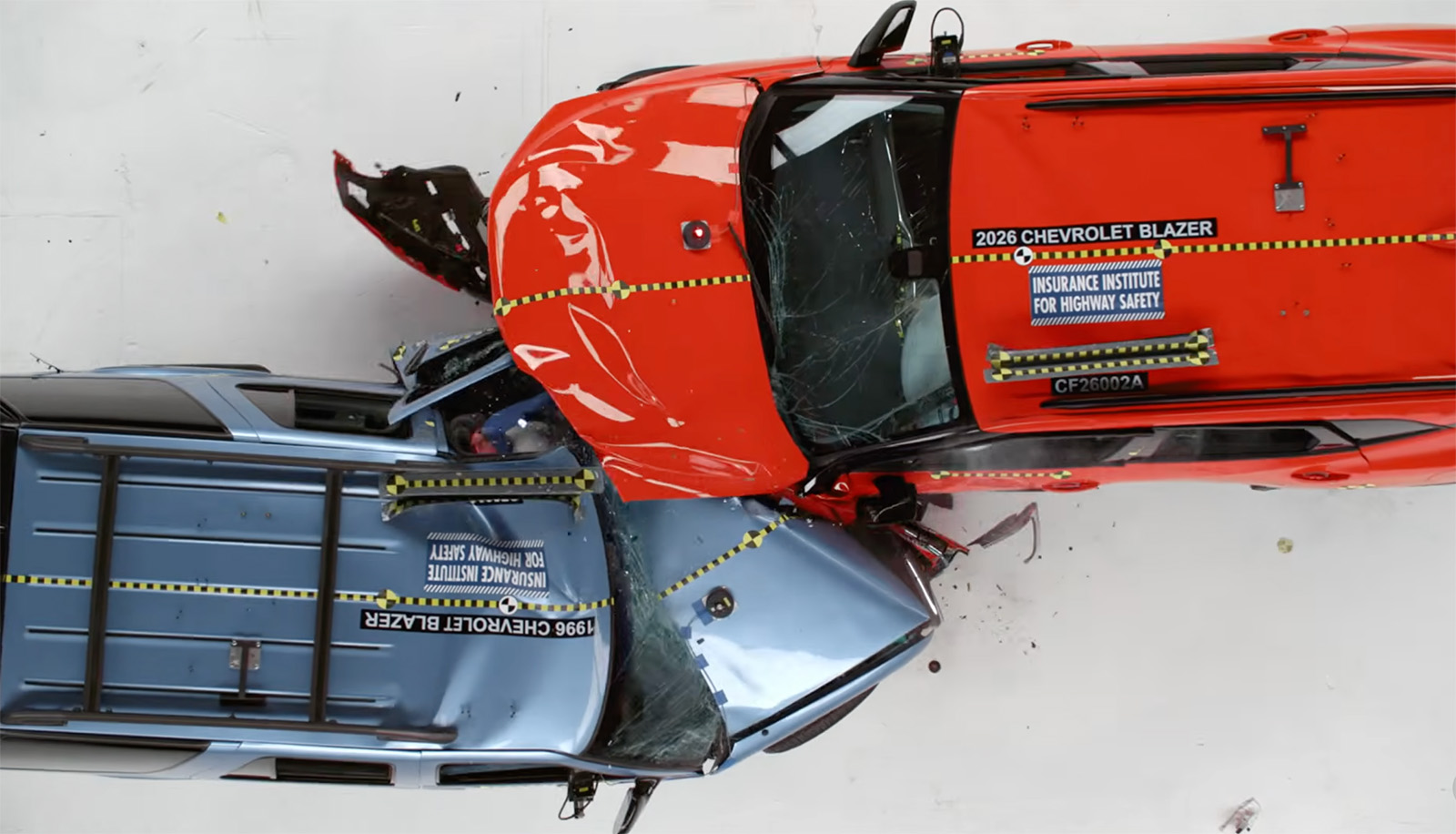
And look at that: look how much farther the new Blazer intrudes into the passenger cabin of the old one. The new Blazer doesn’t appear to have any intrusion into the cabin; the carnage seems to stop before the dashboard, even. Clearly, a vast amount of time and effort and money has been poured into making cars safer, and, like so many human endeavors that work tirelessly behind the spotlights, with tedious and humble methods, it’s worked. Cars are safer now than they ever have been before.
The IIHS itself estimates that 48,352 lives have been saved since the IIHS began their crashworthiness evaluation program in 1995. If you’d like to read the study and see how they arrived at such a remarkably specific number, you can see it right here.
Here’s how the study explains the methodology:
Analysis approach
To estimate the number of lives saved, we estimated the number of fatalities that would have occurred each year if the proportion of rated vehicles on the roads rated good for each test had not increased over time. This calculation was performed with a formula used in similar research (e.g., Teoh, 2025) that requires the number of fatalities in a year, the effectiveness of an intervention, and an actual and comparison rate of the prevalence of the intervention in the population. Effectiveness was calculated using fatality rates (fatalities divided by registered vehicles) with the following formula:
Where FRG is the fatality rate per registered vehicle among vehicles rated good, and FRAMP is the fatality rate among vehicles rated acceptable, marginal, or poor (AMP). Lives saved were calculated with the following formula:
Where GoodRatingInitial is the proportion of vehicles with a good rating in the first year of the test in the data, and GoodRatingYear is the proportion of vehicles with a good rating in a subsequent year.


I hope that helps; also interesting is how researchers determined that of those nearly 50,000 lives saved, over 67% were not assholes or jackasses, at least according to the available metrics, so that’s positive.
I’m kidding! They didn’t have sufficient data to determine who the assholes were.
David actually asked me to write this up, and he had a very different, likely more mature reaction to these sorts of old v. new tests than I did. Where I initially found them to be a sad waste of what could be a perfectly enjoyable old car, David, a relatively new parent, saw it differently:
“I think it’s valuable. It’ll convince people not to give their kids a 1990s car for high school.”
Now, I’m a parent, too, but I’ve had this kid for 15 years, so perhaps I’ve gotten a little jaded. But my kid is on the verge of driving, and I really should be thinking about things like this. So I guess that’s the value of these kinds of tests – it’s not about learning anything new, it’s about making such a spectacle of the carnage and disaster that could happen when you wreck an older car that people will simply be horrified out of ever buying such a deathtrap.
Of course, there’s always the lure of the false survivorship bias thoughts as I recall the deathtraps I drove when I was a kid – and continue to drive until this day – and look at me, I’m not dead! Not physically, at least!
But that’s a stupid way to think. David’s right. These sensationalistic crash tests do have some value, and the value is just in how horrific they are, because, yeah, cars were less safe in the past, and it’s easy to forget that until we see a perfectly nice-looking Blazer get crunched up into a wad and some dummy suffer what appears to be the same fate as Marie Antoinette, but less stylishly.
So, fine. Everyone watch that crash test. Pause and look at how crumpled that passenger compartment in the ’96 Blazer is. Take a moment and reflect on the fate of that crash dummy, and think about the orphaned crash dummy children left behind, and the life of crash dummy crime they will almost certainly fall into as a result of the trauma of being deprived of their crash dummy father and being thrust into the chronically underfunded crash dummy child welfare system. Did I mention this crash dummy was a single parent because their crash dummy spouse had been dismembered in another cruel crash test? I should have mentioned that.
Anyway, I hope the IIHS scared you straight.
Top graphic image: Screen grab, the IIHS


scared straight silliness. crashing a modern car (specifically designed with quarter overlap in mind) that weighs 5-700lbs more than an old car that was known to be unsafe at the time, with a design that is highly vulnerable to quarter overlap crashes provides expected results. what this actually tells me is that if you are unable to afford a 52k new crossover and drive an old car, they are perfectly happy to maim you in the event of a crash, or worse. occupant safety uber alles.
Used to drive?! Ha ha ha ha ha ha ha Thanks for the laugh! Ok, you’re actually right, but only because my current daily is the safest car I’ve ever had. All my other cars were shitboxes which I was proud of and still am. Shitboxes rule! Also, classic cars are so awesome and beautiful compared to all the ugly trash this century that it’s totally fucking worth it to drive what you want, and has a gorgeous design, at that. At the moment, yes this is conflicting but I can’t wait to go back to vehicles I actually want like a 79 Lincoln Mark V Bill Blass awesome land yacht w/ a big ol V8 gas hog so I can cruise in comfort blasting down the highway blasting tunes!
“crash test dummy”
“Ya big dummy!”
-Fred Sanford
im sure its been posted but if not, the 09 malibu vs 59 bel air was an eye opener.
https://www.youtube.com/watch?v=C_r5UJrxcck
<sharp uptake of breath on seeing the Bel Aire passenger compartment shot> damn, so much for ‘old cars were built like tanks’
I wouldn’t want to ride in a crashing tank either
Okay, now do it with a 1996 Chevy Express vs a 2026 Chevy Express. I’d be really interested in that one.
Growing up in Texas in the ’60s and ’70s, I vividly recall numerous situations where I could very well have been a young corpse. Cars with painted metal dashbaoards. No seatbelts–and if there were they were seldom used. Trucks cruising down the highway at 80 mph with half a dozen kids riding in the bed. The list goes on.
Of course, this was also the era when lawn darts were a thing and most kids had BB/pellet guns which were used with little to no adult supervision.
Maybe my parents had ulterior motives when they gave me their old deathtrap and kept the nice new cars for themselves.
On the other hand, soon nobody will be walking away from collisions since the electronic door latches won’t work. Progress!!!
Had a ’95 Blazer, was involved in a highway collision caused by a deer, and my airbag didn’t go off.
This is one of the reasons I want a slate as my DD versus my 89 toyota pickup. Similar functionality, one is a hell of a lot safer.
Yeah. The Slate won’t drag you into war in the Middle East when it’s commandeered by guerilla fighters.
They were deathtraps, but there were fewer collisions back then. Less distracted drivers, less road ragers, and fewer vehicles on the roads altogether.
I’m going to need a source or two man. I assume flipping though a Case Logic CD book while driving in the 90s was as prevalent as texting. Way more smoking too. Less road rage, not so sure about that one either. And 30 second of internet searching seems to indicate collisions per 100k people are down significantly, like 30% ish 96 to 26.
90% of statistics on the internet are made up on the spot, but fewer than 20% of those on the internet know this.
But I do know that with a little googling your claims are easily backed up – collision rates are down.
I am sure that the changes in reducing footwell injuries, and making the 2026 Blazer safer, certainly made the damage to the 1996 one much more like hitting a concrete pylon. That does not say that it would happen to other vehicles and is a actual reality.
As someone who had been exposed to my enthusiasm for 80s & 90s cars from a young age, my daughter, 15, was a bit put out when I informed her that her first car would be no more than 10 years old. Modern safety tech is the one and only reason for this, and the only reason that I don’t daily a vintage car myself.
Connecticut: You can’t drive a kei truck
also Connecticut: a 1985 S Blazer? Go ahead!
Wait until you hear about these things called motorcycles that are statistically 25x more likely to kill you, yet no states are trying to ban them.
Kei truck bans are based on ignorance and lobbying by Polaris et al, whose ridiculously overpriced side-by-sides have no reason to exist when a kei truck does everything better at half the price.
Only 25x eh? I’ve had worse.
Roughly 27 to 28 times more likely to die in a motorcycle accident than a car accident per mile traveled, according to the NHTSA.
I just want to know to what end do we take vehicle safety.
At some point too far, that point is probably around the mandated “drunk” driving lockout device that’s coming soon
TLDR: New car safer than old car.
I wanted my kid to inherit my ’13 Outback for financial reasons, but I really wanted the latest safety and tech attributes. I found a lightly used one-year old vehicle for a screaming bargain (literally a month before COVID hit and skewed the market) and I’m very glad I did.
About 35 years ago, I came within a few seconds of not being here. I was in my ’88 Horizon, approaching a railroad trestle as a slow-moving dump truck came the other way. Suddenly an Escort wagon swerved from behind the dump truck and went head-on into the Celebrity in front of me. The elderly couple in the Escort died. The Celebrity driver had a nasty leg injury, at least, from hitting the bottom of the dash, but I think the relative heft of his car saved him. My Horizon vs. the Escort? Probably lights out for everyone.
Here’s the kicker: My passenger was my father-in-law, who had just been in a gnarly crash the day before. We were going to retrieve his belongings from his totaled Camry, just a few hundred feet down the road. What we didn’t know yet was that his crash had escalated a pre-existing heart condition. It wouldn’t have taken much to kill him as well.
I see actual crash footage with today’s cars, and I’m continually amazed at what people walk away from. I’m pretty sure the one I narrowly avoided would be very survivable in a modern vehicle.
I saw a car absolutely shredded the other day, shredded so bad I couldn’t tell what it was, other than a modern car. We’re talking upside down facing the wrong way on an up slope embankment. All windows gone, all airbags popped. Two wheels snapped off. Probably was a sight to see when it happened.
Guy was just standing in the road talking to the cops while on the phone. Incredible.
One of the jobs that I had was inspecting guiderail crash terminals after they were repaired and certify them for re-use.
The only one that we couldn’t reuse had been hit with an F-150 with the cruise set at 100kph. Driver fell asleep and hit the crash terminal dead on. Vehicle was totalled. Crash terminal totalled. Driver literally walked away.
Is it horrific? I drive at least 2 cars that are older/smaller than this one, and never worry about it.
Thankfully I’m never having kids, so I don’t have to worry about their safety, or discussions with a hypothetical spouse about what is and isn’t safe for them to drive.
They can be a little spendy to maintain, but my two kids are in an ’04 Volvo V70 (7 years) and an ’05 V50 (3 years)…I sleep a little better at night.
I don’t have them myself, but I’ve heard that kids can be more than just “a little spendy” to maintain.