

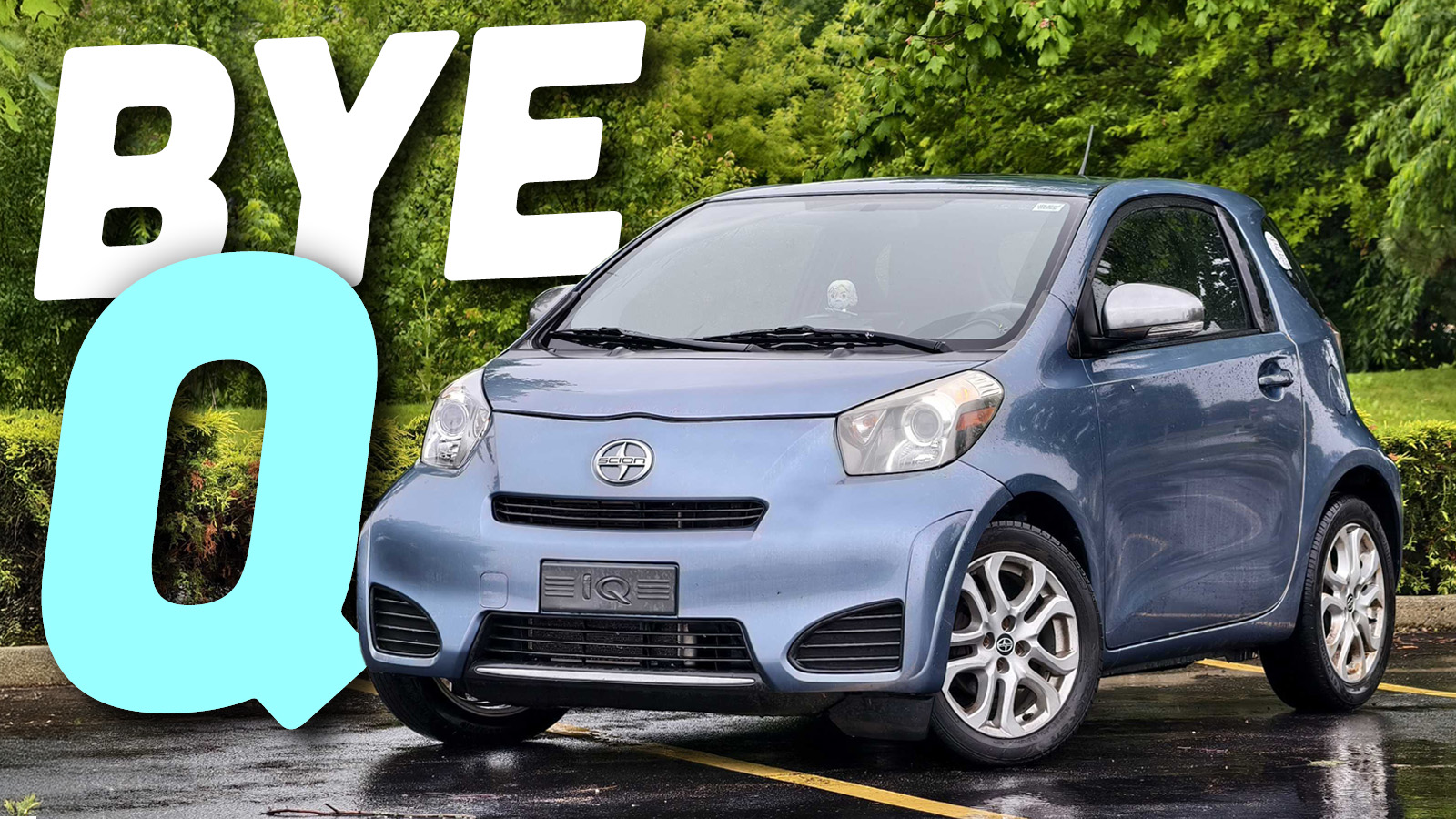
There is a belief out there that if you just need a car to get you around reliably, get a Toyota, any Toyota, it doesn’t really matter which one. I’ve issued this advice myself. So, when my wife told me that she was buying what could be called the Toyota version of my favorite car, I immediately championed the idea. Unfortunately, our 2012 Scion iQ stopped being fun the moment the novelty wore off. Then came the problems. And now, after 70,000 miles, it’s time to say goodbye, and we won’t be crying.
Back in late 2023, my wife found herself in an uncomfortable position. The 2001 BMW 525i wagon that we bought from our secret designer, the Bishop, was pretty tired after driving 40,000 miles in a single year. Meanwhile, her 2010 Toyota Prius was totaled by a friend. Sheryl needed a reliable car and decided to get something fun.


At the time, Sheryl thought she had some of her most driving fun behind the wheel of one of my Smarts. But I didn’t think this was a good idea because Smarts can be finicky and maintenance-intensive. Sheryl needed a car that just worked every time she turned the key.

What if she could get the Smart experience, but without the Mercedes-Benz maintenance quirks? That’s where the Scion iQ came in. The entire point of this car was to do everything that a Smart could, but do it better and with Toyota reliability. On paper, a used Scion iQ was perfect. It was easy to park, it got over 35 mpg, it had a decent trunk when the rear seats were folded down, it had a great dealership network, and it was even cheap to insure. The 2012 iQ we purchased was also affordable at $7,500 and had plenty of life left with only 67,000 miles on its odometer. What could go wrong?
It Was Love At First Drive
At first, the Scion iQ achieved its mission and more. Everyone thought it was cute. Sheryl easily scored well over 30 mpg, and she got her Smart Fortwo fix without the Smart Fortwo quirks. The BMW was able to be parked and worked on at Sheryl’s pace while she had a reliable car to drive to court in. It wasn’t even a month after she got the car when I penned a post that proudly proclaimed: “Daily-Driving The Tiny Toyota America Ignored: Why The Scion iQ Is Criminally Underrated“.

I meant what I said in that article. I marveled at how Toyota’s engineers seemingly strategically identified everything that most people hate about Smarts and then built a car that had none of those issues.
The number one complaint about first- and second-generation Smart Fortwos is that they have a slow and clunky automated-manual transmission. Toyota got around that by giving the iQ a CVT. People disliked how early Smarts felt like they got into a crash every time they hit a pothole. Toyota gave the iQ a smoother suspension. Those same people also complained about how Smarts had only two seats and slow acceleration. Others worried – incorrectly – that a Smart couldn’t survive an accident with anything bigger than a bicycle.

Toyota’s engineers countered by making the iQ the world’s smallest four-seat car. It also had a larger, faster four-cylinder engine and so many airbags that Toyota invented the world’s first rear window airbag. Just for good measure, Toyota’s engineers also made sure that the iQ could turn vastly tighter than any Smart of the day. The iQ even drinks regular gasoline while a Smart demands premium.
We fell so hard in love with the car that, only a few months after getting it, we drove the iQ across America, following the remnants of Route 66. Then, we drove it back home, going directly through the Rockies. The car handled it just fine, which was impressive to me because the iQ is a city car, and climbing mountain passes is about as far from city driving as you can get.
The iQ’s Novelty Wore Away Quickly

Unfortunately, cracks started appearing before too long. In November 2024, I wrote an update about the car after it surpassed 33,000 miles in our hands. In that piece, I noted:
This trip did reveal a few more of the car’s weaknesses. For one, it guzzles fuel above 75 mph. If you drive too fast, the CVT sends the engine’s RPM a bit too high and your fuel economy might get as low as 29 mpg. At least that’s what it’s like in our car. Another downside is noise. There’s a ton of road noise at speed and you can’t escape it. You always hear the tires, always hear the wind, and always hear the bumps. Playing the stereo loud does drown it out, but you’re only replacing one noise with another noise. Add it up and a day of driving the iQ can drain your senses, even if you the drive isn’t particularly demanding. Thankfully, the engine does stay quiet most of the time. But the road noise is loud enough that we’re considering finding a tire known for quietness, which is something we’ve never had to do with any other vehicle, including Smarts.
Sheryl and I have differing opinions on the interior. My biggest problem with the interior is the lack of armrests. Your outer arm has an armrest, but Toyota’s engineers did nothing for your inner arms. So they’re sort of just flopping around uncomfortably. We’ve rectified this with a cheap armrest from Amazon, but it’s sort of a weird oversight.
Sheryl dislikes the seats. She says they are not comfortable on long drives and they’re only made worse by the lack of bolstering and the lack of heating. Smart somehow offered bolstered and heated seats, why couldn’t Toyota? Indeed, I do feel the iQ’s seats are more comparable to the seats found in a city bus, but I don’t find them as uncomfortable as Sheryl does.

The car started giving us our first problems, too. As we exited the Grand Canyon during our Route 66 trip, the car started exhibiting noises we hadn’t heard before. My well-tuned ear identified the noise as a CVT whine, and there was a point in our road trip when the whine was intrusively loud. We had the CVT fluid changed the moment we got home, which killed the whine. Then, the whine came back only 10,000 miles later, with the whine getting worse 20,000 miles after it was changed.
We got multiple opinions from Toyota dealers who used to sell iQs. Both told us that the CVT isn’t really repairable, and that it could blow tomorrow or last the remainder of the life of the car. Either way, the “fix” for the whine is replacing the whole transmission. That issue remains unresolved today. We just change the fluid every time the whine gets loud again.

The other annoyance was the cruise control system. Toyota never offered the iQ with a cruise control system in America, and retrofitting a Toyota OEM system into an iQ is beyond my skill level. So, Sheryl bought an aftermarket cruise control for $800, installation included. This was our favorite upgrade to the iQ, and it made driving the little car long distances so much better.
That was until the cruise control unit began failing less than a year after we installed it. The cruise control unit is tied into the car’s throttle-by-wire system, and when the cruise module fails, it sends bad signals to the by-wire system. In our case, this often led to the car behaving like it’s misfiring before going into limp mode. Eventually, the failed cruise control led to a complete failure of the accelerator pedal. Basically, Sheryl would hit the gas, and the car wouldn’t do anything. The engine wouldn’t even rev. Or, alternatively, she’d hit the gas just a little, and the car would rev to the moon.

We’d later find out that this is a known issue with aftermarket cruise control units installed in some Toyota models, including the iQ. It’s not the car’s fault. Unfortunately, from my personal experience, it seems to me like some of the companies that make some of these units do rather lackluster soldering jobs.
At any rate, Sheryl had both the accelerator pedal and the cruise control replaced. Then both failed for a second time, again, not even a year after installation. The car is on its third or fourth gas pedal now, which is a wild thing to say. Thankfully, the third cruise control unit has been holding together and has not failed, so this issue might finally be a thing of the past.
What Was Toyota Thinking?

When the car wasn’t annoying us by frying its gas pedals, it was frustrating us with how hard its design had made simple maintenance tasks.
See, in order to get the Scion iQ to fit four people, Toyota packaged the super tiny engine bay so that all the components are more or less on top of each other. If you want to change your spark plugs, the proper method involves removing your windshield wipers, removing the hood cowl and its tray, removing the airbox, the intake, and the throttle body, and bam, you’re finally at the plugs. All of this means a job that takes minutes in most may take hours in the iQ.

It seems that many mechanical repairs are like this when it comes to wrenching on an iQ. You have to jump through a bunch of extra hoops because the brilliant engineering that made the car so small also makes it a pain to work on. Yet, it takes me only 10 minutes to replace the spark plugs in a Smart.

All of this was enough to wear Sheryl and me pretty thin on this car, but there’s more. The Scion iQ’s design seems to invite corrosion. The wheel wells have steel alcoves in them that aren’t protected. All kinds of road salt, grime, and other nasty debris get caked up in there, forcing me to clean them out fairly regularly.

Something I also noticed early on was that the vehicle’s door seals trap road salt and other fine debris. If Sheryl took a long enough drive on a salty road, I always found salt under the door seals. Sure enough, there’s corrosion there! I have seen images of Toyota iQs in other countries that had seriously rotted out door sills. I have to wonder if this is where that rot starts?

Rust has been a battle all over this car. There’s a rust spot at the bottom of the passenger door, the subframe is pretty crusty, and the engine bay has also seen better days. I’ve been able to kick the can down the road with an oil-type undercoating, but I feel like I’m fighting a losing battle with all of these places for rust to fester.
Everyone Hated The iQ
The car also seemed to develop an image problem. Once my family, my wife’s clients, judges, and my wife’s opposing counsel stopped seeing the novelty of a tiny lawyer car, they started hating the little thing with a passion. Clients stopped paying their bills, my wife lost lucrative contracts, and my own mom even claimed to have lost some respect for my wife. The wild part is that all of these people loved the iQ in 2023 and 2024. But by 2025, they just weren’t having it. Seemingly overnight, Sheryl went from being seen as an underdog or a wolf in sheep’s clothing to a big phony.

This alone was devastating because it meant that the car was directly impacting her life, and in a negative way. At first, we stayed the course. We told the haters to live with it. But, eventually, it all became too much, and Sheryl began shopping for other cars. She even attempted to buy a Hyundai Genesis while high on anesthesia drugs.
The final nail in the coffin wasn’t the car’s poor image, the rust, the whining transmission, the poor high-speed fuel economy, or the stupid cruise control. It was a Volkswagen. Back in February, I found myself trying to offload my 2012 Volkswagen Jetta SportWagen TDI. Sheryl protested the sale of the vehicle because she loved it so much. This car was also one of the first we bought as a couple, some six years ago. She was way more attached to it than I was.

So, I thought, what the heck, I’ll just give it to her. She has been driving it ever since then and hasn’t touched the Scion even once. The only time the Scion ever moves out of its parking space is when I drive it out of pity. What gives?
Sheryl realized that there’s basically no comparison between the Volkswagen and the Scion. The Volkswagen gets better fuel economy, is infinitely more comfortable, has a lot more room, is so much quieter, and is far less fatiguing. Now, none of this is particularly surprising. The Scion is a city car, while the Volkswagen is a German diesel wagon. To her, the Volkswagen is like playing in the big leagues while the iQ can’t even get into the minors. All of the people who hated the iQ are dumping loads of praise on the Volkswagen, too.

There’s another important factor: The Volkswagen had about 354,000 miles when I gave it to Sheryl. I fully expected the car to break down within 500 miles of her taking ownership. Yet, she’s reached nearly 10,000 miles since taking the car and, aside from tiny repairs like new bulbs and a new blower motor resistor, the car has been great. She’s also getting 45 mpg, which is so much better than the iQ at the same speeds, and the Volkswagen has been cheaper to run despite the high cost of diesel fuel.
I told Sheryl to hold onto the iQ in case the Volkswagen blows up, but the wagon seems rather intent on proving me wrong. Everything continues to run like a fine sewing machine, from the air-conditioner to the fully intact emissions equipment. It has gotten to the point where the iQ is sitting for so long that its gas is going bad, and the parking brake seized.
No Regrets
Sheryl has no intentions of ever driving the iQ again. She says she doesn’t regret buying the car. It was the right car at the time that she bought it. The vehicle served its purpose. But she has moved on, and she doesn’t have the same car tastes that she did in 2023.

So, she’s decided to part ways with the Scion. Thankfully, it won’t go too far away. When my parents heard that Sheryl was getting rid of the car, they made me an offer that I couldn’t refuse. Why, yes, this is the same car that my parents said they hate.
See, my dad drives a gas Ford F-350 that gets in the low teens for fuel economy, while my mom drives a GMC Yukon XL that scores in the high teens. These vehicles, which were purchased to tow heavy camper trailers, spend most of their time not towing anything. To them, having the iQ as a going-to-town rig will be perfect, so they don’t have to drive lumbering giants just to buy some groceries.
I warned my parents about everything I’ve written about here, but they’re determined to buy the iQ, anyway. Sheryl likes this idea because it keeps the iQ in the family, but it also means that we don’t have to worry about it anymore. I’m looking forward to never dealing with that darned intake manifold ever again.

Truth be told, I still don’t think there’s anything wrong with the Scion iQ itself. I think we just got a temperamental example, and then gave it an unfortunate modification. Sheryl then put 33,000 miles on it in a single year. You could argue that Sheryl’s experience wasn’t surprising, given that she used a city car as a road trip car.
If anything, this is a story about knowing what car is the best fit for you. That city car might be cute, but are you going to enjoy driving it on a highway? That Miata is fun, but will you need more than two seats? That huge truck looks the business, but are you going to be okay with 13 mpg and something the size of a small nation? Those are questions every car buyer should ask themselves.
Hopefully, Sheryl’s future car endeavors won’t be so dramatic. I have now written 12 articles about my wife’s iQ since 2023. Some were happy, some were not. With any luck, you aren’t going to hear a whole lot about that Volkswagen. Oh, who am I kidding? Give it a couple more months, tops.
All photos and top graphic image: Mercedes Streeter


Leaky RV/travel trailers, temperamental Scions…your parents just like having a project to complain about, don’t they?
Reliable 200,000 mile Volkswagens are about as uncommon as an Unreliable Toyota.
But contrary to literally every comment thread on the internet, it happens!
My first thought was “oh, no! Not the iQ” but I laughed because I get it. They’re neat, but probably for specific use cases.
I’d avoid selling it to your family, though. They’re going to call you up for all that painful maintenance.
I hope you make fun of your parents new to them car every time you visit them
Rust has been a battle all over this car. There’s a rust spot at the bottom of the passenger door, the subframe is pretty crusty, and the engine bay has also seen better days. I’ve been able to kick the can down the road with an oil-type undercoating, but I feel like I’m fighting a losing battle with all of these places for rust to fester.
One of the big reasons I got rid of my 4Runner. It ran great and had easily fixable mechanical issues, with perhaps the exception of a pretty bad sunroof leak. After not having much success with cleaning the drains, I did a search and found horror stories of fried electrical systems from other owners with that issue.
With the rust, every time I was under that thing, I’d find a new spot of rust, or something that looked crustier than the last time I inspected it. When I first got it, I’d spent the better part of a week under it removing rust and treating the frame with various products, as well as fluid film treatments. Despite that, it was unstoppable. At one point toward the end I was removing my bike rack and realized I could remove chunks of the rear bumper support by hand. Also, a rust bubble started forming under the front passenger fender flare that started to spread pretty rapidly. Add in the roof leak and I was done.
When I got my Ram, the first “mod” was an extensive, $1,200 undercoating treatment. I don’t even know if I want to keep the thing long term, but if I do, I want it to be protected.
“The car also seemed to develop an image problem. Once my family, my wife’s clients, judges, and my wife’s opposing counsel stopped seeing the novelty of a tiny lawyer car, they started hating the little thing with a passion. Clients stopped paying their bills, my wife lost lucrative contracts, and my own mom even claimed to have lost some respect for my wife.” Is…is this parody? Or are you really surrounded by assholes?
RE: the car: Congratulations! You’re maturing! You can now join our club in which we prefer heated seats, 8 way adjustable seats, good NVH, and start to consider actually paying someone else (shock!) to do some maintenance jobs that are a pain in the ass.
There are just some people who attach status to car ownership. To them, you are very much defined by what you drive. I agree it’s completely ridiculous, but if you’re dealing with… less-than-savory members of the public, as lawyers often do, you will run into a disproportionately high number of these people. So it pays (literally!) to have a fancy car as a lawyer. Many big firms actually subsidize their lawyers car payments for exactly this reason.
I am unfortunately aware that image plays into the game of life at times. Fortunately, as a desk jockey, I don’t have to play those games the same way a salesman must.
The lawyers themselves are the-less-than-savory members of the public in this case (and in most cases).
This is why when I wanted to move to a small, efficient city car when I moved to a city, I got a Prius C. It’s small enough to make parallel parking a breeze and drive through narrow city streets, but it’s not SO small that there are too many compromises due to packaging. It has a backseat that, while it won’t win any comfort awards, will still fit two moderately-sized adults, although three is a bit much. It even has doors for those backseats. The backseat of the iQ is for toddlers and amputees only. The cargo area in the Prius C is small, but it’s a hatchback that I can give more space with the rear seats down. Even with the seats up, it still fits all the crap that I kept in the back of my old car, which was bigger. Plus it’s a hybrid, so it gets really good fuel economy for its size. I get 50 mpg on average, with mixed city and highway driving. I also would not say that the Prius C is the best road trip car, but it’s not the worst either. It has to be better than the iQ. Its 99 combined hp isn’t much, but it doesn’t weigh much either, so it will get up to highway speed in a reasonable amount of time, and will cruise comfortably at 80. Yes, the engine gets a bit loud by that point, but I wouldn’t call it crashy.
All in all, the Prius C is about the smallest car that I can live with. There aren’t even many modern cars that are much smaller that were sold in the US, apart from the iQ and the Fortwo, and the Fiat 500. The older BMW Mini Coopers are smaller, but the newer ones probably aren’t, even though they’re 3-door hatchbacks. The only modern 5-door car that I can think of that’s smaller is the Chevy Spark.
Yeah, the Prius C is a really fantastic car. We had one for 6-ish years (2016-2022?), including two 4000 mile road trips, and I was quite impressed. Certainly not the most powerful car around, but it was really good in so many ways.