


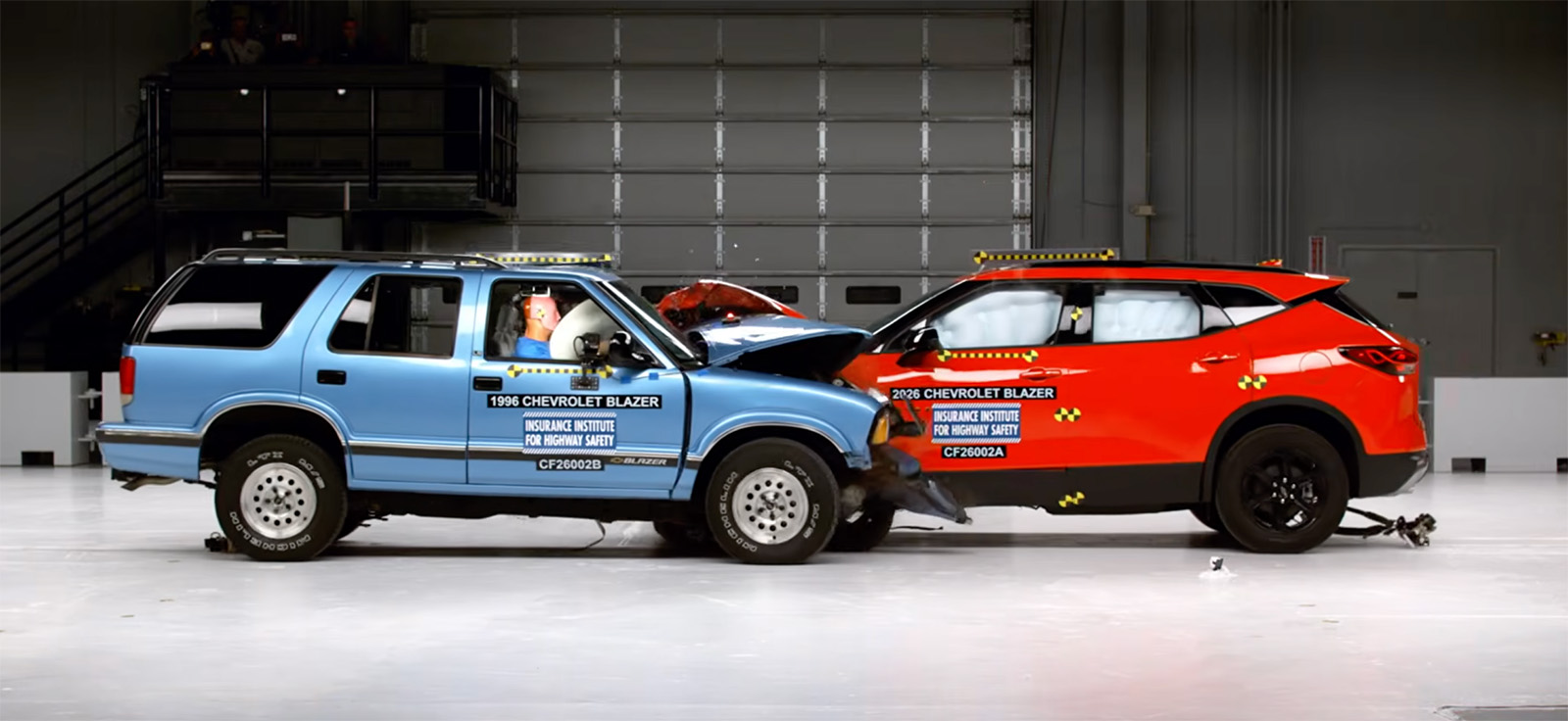
I’m going to admit something here: I don’t really like these old vs. new car crash tests that the Insurance Institute for Highway Safety (IIHS) does. Take this recent one, for instance, where they crash a 2026 Chevy Blazer into a 1996 Chevy Blazer. Now, I’m not a huge Blazer fetishist, but that’s a pretty nice-looking old Blazer! Look how clean and straight that thing is – or was. It seems a shame to wreck perfectly good – or at least restorable, since these crash tests need pretty solid cars, even if they don’t run – old car for an outcome that we all already know.
The 2026 car is vastly, wildly safer in a wreck than the car that’s 30 years old. No shit. I mean, what exactly are we learning here? Nothing. If you were to drive head-on in your ’96 Blazer into, well, pretty much anything, you’d be boned.


And that ’96 Blazer had an airbag! It’s not an absolute deathtrap like the cars I drive, even. At the time, that Blazer seemed like a pretty safe choice. Actually, you know what? Even back then, it wasn’t. It got an overall evaluation of “poor” in the moderate overlap crash test back in ’96. I guess this thing has always been a deathtrap. Which sort of makes a crash test like this even more, I don’t know, gratuitous?
I mean, yeah, okay, that’s some carnage there. I think that dummy in the ’96 Blazer had its head lopped off? It looks like it.
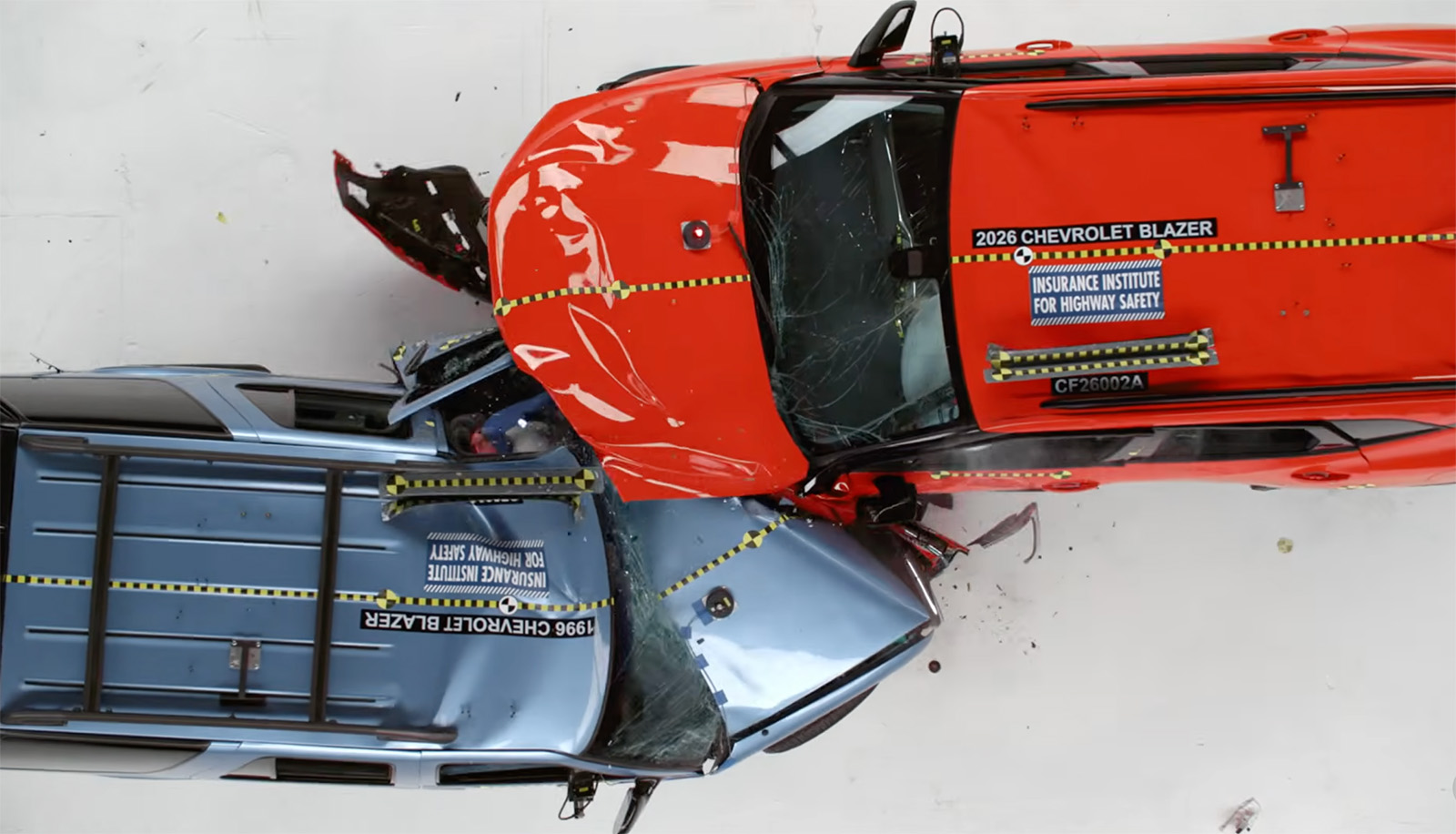
And look at that: look how much farther the new Blazer intrudes into the passenger cabin of the old one. The new Blazer doesn’t appear to have any intrusion into the cabin; the carnage seems to stop before the dashboard, even. Clearly, a vast amount of time and effort and money has been poured into making cars safer, and, like so many human endeavors that work tirelessly behind the spotlights, with tedious and humble methods, it’s worked. Cars are safer now than they ever have been before.
The IIHS itself estimates that 48,352 lives have been saved since the IIHS began their crashworthiness evaluation program in 1995. If you’d like to read the study and see how they arrived at such a remarkably specific number, you can see it right here.
Here’s how the study explains the methodology:
Analysis approach
To estimate the number of lives saved, we estimated the number of fatalities that would have occurred each year if the proportion of rated vehicles on the roads rated good for each test had not increased over time. This calculation was performed with a formula used in similar research (e.g., Teoh, 2025) that requires the number of fatalities in a year, the effectiveness of an intervention, and an actual and comparison rate of the prevalence of the intervention in the population. Effectiveness was calculated using fatality rates (fatalities divided by registered vehicles) with the following formula:
Where FRG is the fatality rate per registered vehicle among vehicles rated good, and FRAMP is the fatality rate among vehicles rated acceptable, marginal, or poor (AMP). Lives saved were calculated with the following formula:
Where GoodRatingInitial is the proportion of vehicles with a good rating in the first year of the test in the data, and GoodRatingYear is the proportion of vehicles with a good rating in a subsequent year.


I hope that helps; also interesting is how researchers determined that of those nearly 50,000 lives saved, over 67% were not assholes or jackasses, at least according to the available metrics, so that’s positive.
I’m kidding! They didn’t have sufficient data to determine who the assholes were.
David actually asked me to write this up, and he had a very different, likely more mature reaction to these sorts of old v. new tests than I did. Where I initially found them to be a sad waste of what could be a perfectly enjoyable old car, David, a relatively new parent, saw it differently:
“I think it’s valuable. It’ll convince people not to give their kids a 1990s car for high school.”
Now, I’m a parent, too, but I’ve had this kid for 15 years, so perhaps I’ve gotten a little jaded. But my kid is on the verge of driving, and I really should be thinking about things like this. So I guess that’s the value of these kinds of tests – it’s not about learning anything new, it’s about making such a spectacle of the carnage and disaster that could happen when you wreck an older car that people will simply be horrified out of ever buying such a deathtrap.
Of course, there’s always the lure of the false survivorship bias thoughts as I recall the deathtraps I drove when I was a kid – and continue to drive until this day – and look at me, I’m not dead! Not physically, at least!
But that’s a stupid way to think. David’s right. These sensationalistic crash tests do have some value, and the value is just in how horrific they are, because, yeah, cars were less safe in the past, and it’s easy to forget that until we see a perfectly nice-looking Blazer get crunched up into a wad and some dummy suffer what appears to be the same fate as Marie Antoinette, but less stylishly.
So, fine. Everyone watch that crash test. Pause and look at how crumpled that passenger compartment in the ’96 Blazer is. Take a moment and reflect on the fate of that crash dummy, and think about the orphaned crash dummy children left behind, and the life of crash dummy crime they will almost certainly fall into as a result of the trauma of being deprived of their crash dummy father and being thrust into the chronically underfunded crash dummy child welfare system. Did I mention this crash dummy was a single parent because their crash dummy spouse had been dismembered in another cruel crash test? I should have mentioned that.
Anyway, I hope the IIHS scared you straight.
Top graphic image: Screen grab, the IIHS


1k lbs weight difference between them , fwiw.
1980’s – “The cars now are SO much safer than they’ve ever been before!”
1990’s – “The cars now are SO much safer than they’ve ever been before!”
2010’s – “The cars now are SO much safer than they’ve ever been before!”
2020’s – “The cars now are SO much safer than they’ve ever been before!”
Someday down the road – “How the hell did they design entire societies around a near universal requirement for an activity that killed tens of thousands of people every year? What kind of dumbasses were they?!”
This is why people in the future are smarter than us and use mass transit.
Hello from Europe—yes we do 🙂
Jealous!
Eh. With some perspective it makes more sense. We are still pioneering times of personal travel. This is but a blip in time on the earths timeline. Never before have we been able to travel at the rate, accessibility, and convenience we currently have with the automobile. If you would have told people in the middle ages they could hope in this carriage that goes vroom vroom and get from Paris to London in less than a day they’d call you a witch.
And will all those carriages on the road, later it will take 2 days due to traffic
True, but we also look back in the Middle Ages and think, “Man, if they’d just had an inkling about sanitation, they wouldn’t have lost.millions to cholera and such.”. Folks of the future may.well look at our current transportation system with a similar eye.
Improvements in medical mortality rate and automotive mortality rates are hardly comparable. Yes, we look back at things that are now basic scientific understanding and scratch our heads. Basic sanitation saves millions of lives a year. In this article, IIHS states over 30 years ~50k lives have been saved. I don’t think people will look back on automotive transportation safety or lack thereof and think about it in the same vein as basic sanitation simply because the numbers are incomparable.
How safe does rapid and convenient, personal travel have to be? Personal travel has been prominent in all cultures for a very long time. Deaths will happen. Busses can’t take us everywhere and forcing that on people is antithetical to human nature. That doesn’t mean I think busses are the devil or shouldn’t be used. I question just how safe do cars have to be when the primary bearer of said safety improvements is the middle classes of the world. Life is precious but we will never be able to protect all of it, so where do we stop?
Dramatic examples are needed in order to dispel myths with no basis in reality. People who have no idea how crash safety works and would otherwise follow their gut will watch this and make better choices than they would otherwise. We live in a world where common sense isn’t very common.
Crashing 2 cars is a small sacrifice to get people to learn a valuable lesson from a credible source.
I drive older cars because I’m economically challenged. I always have been. I spent at least a decade riding motorbikes as main source of transportation. I’m 66 years old and still alive and healthy. I learned to drive in a Ford Pinto. I’m living in California and I’ve owned and driven cars built in 1975 or older because they are pre-smog. I understand the safety thing, but buying a new car just isn’t in the cards for me. Any I’d want, I can’t afford, and if I could afford it, I probably wouldn’t want it. Also I enjoy small, nimble cars. I’ll take my chances. Car makers have really figured out how to keep people relatively safe from bad drives be they you or someone else. When it comes to crashing cars, abstinence is the best plan. just say no to crashes.
I don’t think the power of positive thinking or whatever will magically make the other drivers on the road be as attentive/smart/sober as you. Nobody judges you for driving whatever vehicle you can actually afford, of course! But “I’m still alive” is an anecdote, not data.
You have a strong case of survivor bias.
All it will take is one person on Facetube to plow into the side of your deathtrap old car for you to be in a world of hurt, if you even are still in the world.
You don’t have to buy a new car to enjoy the benefits of safer. The average price of a 2008 Accord is right around $7800 bucks for a decent one. That’s a five star crash rating and a lot of car for the money.
I’d take the risk for the old one. I have zero interest in a new generic blob SUV. Old S10’s are kinda cool.
Pretty soon we are going to see a relaxation of these safety standards cause who cares if your driver dies in a head on collision when you are safely in the back seat getting head from Epstein.
Stuff like this is why I drive a Volvo or a Mazda.
OK. Now let’s see a modern Volvo crash into an old Volvo brick.
Will a ‘modern’ Renault versus old Volvo do? https://youtu.be/qBDyeWofcLY?si=zXWOOedRpcrrOVcd
I say ‘modern’ because this was done 18 years ago.
I saw that crest test after I posted. Yeah, it’s not looking good for old Swedish bricks.
I think about the Fifth Gear 940-estate-into-Renault-Modus demonstration (my ’92 745 was the same shade of Tropic Green) from 2007 now and then, and the phrase I use when I explain to people why I felt okay going from a streak of old bricks (and a Saab) to my Yaris is “for their era” – but that doesn’t mean quite what it did when the Yaris was new, or even when I bought it several years ago, because it’s also from 2007.
It does have the optional airbags. They might even still fire.
[Edit to add link: https://youtu.be/eCLIDvjwvq0?t=1138 ]
[Double-secret-probationary edit: Beaten it to it by three minutes! Great minds, or something. The rest of the comment stands, anyway.]
SPOILER ALERT!! The S-trucks didn’t do well in the 1996 crash test either.
They said as much in the article.
Ha! Joke’s on them, I ride a motorcycle.
Put me in the camp of “waste of a good older car.” I guess you have to show some people so they’ll understand though? But yeah, I know what chances I’m taking when I drive my ’97 ZJ to work. It still gets driven at least once per week.
And how old are those tires? I thought Michelin quit making that style a couple of decades ago.
There’s a good chance it was an unregisterable car. Lemon law, lost title, pre-production, etc. Not saying it’s super common, but it’s common enough that my high school had a brand new GMT400 Chevy Scottsdale for us to wrench on in auto class, donated by a local dealership that had nothing better to do with it. There was also a brand new Ford Escort ZX2 that they won in a competition sponsored by Ford.
Still a waste of parts, I’ll grant you, but probably not much of a car to waste.
And the Carolina deer say, “Psst. Torch isn’t dead yet. We have work to do.”
They don’t do them like they used to.
I recently aquired a 1996 Civic for my 16 year old to learn how to drive in, but luckily it seems to have scored a lot better when new than the Blazer did. A 30 year old car with two airbags, 4 wheels discs and ABS feels weird to me (it’s a VTI, so top of the line for ’96) but it should be easier to avoid a crash than in a Blazer. On the other hand the Vtec kickin in is addictive, but after 2 years of learning to drive and restoring the car I hope he’ll take it a bit easy outside any autocross events. (he can’t legally drive alone until he’s 18 here)
It is a bit scary that there will be tens of thousands of very cheap extremely quick Teslas and other EVs everywhere for kids his age to buy and drive recklessly in, but most of them have some active safety features that can overrride bad drivers.
Back in the day, the newest driver got the oldest car, because they had the best chance of getting in a wreck and therefore the cost would be the least. Considering now that means putting the most dangerous driver in the car that can have the least modern safety features, I don’t know if that makes sense these days.
Full disclosure though… I don’t have kids. If I did have a new driver, I would get them a first Gen Leaf. “It only goes 70 miles…. That means 35 each way. Have at it”.
The Bolts have a teen driving mode that governs the acceleration profile IIRC. IDK about the Leaf.
Yes, I can confirm a teen driving mode for the 2027 Bolt. [I don’t have a teen.]
We have a 2001 Highlander that my wife loves. Now, I have to think about the safety aspect and discuss with her. We are fortunate and can afford to replace it, although she won’t like spending the money. Sometimes ignorance has its uses.
There are so many pros and cons to the old Civic that I’ve lost count. As he can afford to buy any old crap car he wants at least knowing its about as safe as that era car gets helps ease my mind a bit. I also feel that being an extremely analogue and kinda slow car compared to out Polestar 2 helps a bit too. A lowered manual Civic VTi with a semi racing exhaust is also not a car you drive too fast in accidentally or secretly. It’s also generally safer to drive here than most other countries in the world.
I was driving a 1990 Miata with a 2001 Sentra as a DD… and the only difference I sensed was the Sentra had more air bags. When I bought my 2012 Cruze, I immediately felt exposed in the Miata and ultimately sold it and bought a 2006. Auto safety really increased in the mid 2000’s….
It’s definitely easier to avoid a crash in the Civic.
It was body-on-frame SUVs like the Blazer and Explorer that their parents owned back in the day that made Millennials think a Civic was a sports car.
I would still much rather drive the 1996 Blazer, but only if it were the 2-door model. Especially if it had the 4.3 V6 and the NV3500 5-speed. The new ones don’t interest me since they’re all 4-doors.
Making energy absorbing bumper core prototypes in the 90’s, and IP’s, door cards, center consoles, in the 2000’s, I’ve seen the limits of what sacrificial, added energy absorption devices can accomplish. Well engineered crumple zones and safety cages are the Life Savers.
I think all kids should enjoy sliding around a go-cart on a track to get a sense of the fundamentals before their learners permit. The thing about the good old days most remember, at least my recollection, is most were focused on the task at hand, and were attuned to the noises/vibrations our machines were making, and understood what was happening. I think the state of refinement has made that a lost art. Probably for the better, but distractions of a screen interface !@#$%&!
It’s an interesting point. I think it’s pretty reasonable to assume screen=distraction, because we’re so primed to expect that these days (every other screen in our lives is almost explicitly *for* distraction). The amount of information right in front of my face in a modern car is so much more than in the ’90s, when I had only gauges and a radio. Driving is already a task with fairly high cognitive load and we don’t need our attention diverted even more, but The Kids are glued to their phones even more than The Adults (On average. I think.). What does this do to the learning process?
I’m not anti-tech. I even think AI could be a revolutionary tool for medicine and materials. My disgust is with misapplication. Even the Woz thought it was stupid to put screens in cars. Melon lives on hype, and he conned enough to make it mainstream. Why legacy manufacturers chose not to call out the obvious flaws, and instead followed, is why I hope Slate succeeds. It’s the only thing made after 2017 I’d consider.
I have a 2018 BMW & a 2019 VW. The BMW lets me hotkey “turn off the centre screen”, so it’s just a matter of a single physical button press. The VW requires…four?…taps on the touchscreen to accomplish the same. I absolutely feel you—any car for which the centre screen was critical to operation would be an immediate pass from me.
I don’t know what you’re talking about. (I say as I read this on my laptop instead of getting work done….)
“The amount of information right in front of my face in a modern car is so much more than in the ’90s, when I had only gauges and a radio.”
I was a new driver in the 90’s. I had gauges, a head unit with a single CD player. I also had a folder that held about 60 CDs. Since most CD’s only had one or two good songs listening to music went something like this:
I managed not to wreck but CD players were one heck of a driving distraction. Far more than hitting a button on the steering wheel today and saying “Play song XYZ”
Keeping a 90s blazer alive for the last decade has not given me any sympathy for one more off the road.
I remember when you could take the bumpers off a Plymouth Prowler.
The Blazer was bottom tier for 1996. We should be testing something that was actually considered safe AT THE TIME vs. its modern equivalent. Ford Windstar vs. Explorer? They’re the Ford big family cars.
I actually can’t think of too many cars from that era that were both 5-star crash rating and have a modern equivalent.
1996 Volvo 960 vs 2026 XC60?
and that weighs roughly the same
Miata, but they likely didn’t have the best crash ratings. We also don’t need to sacrifice any more Miatas on the altar of crash survivability as there’s already plenty of evidence of that.
Subaru Outback?
Legacy Outback was 4-star I think.
Yeah, 95-99 and the 2000 refresh are 4 star. Nice memory!
https://fueleconomy.gov/feg/Find.do?action=sbs&id=12123&id=47801&id=16051
If we take reference from the Euro NCAP test results from around that time, the safest car then was supposedly the Volvo S40, which was the first car to gain full marks in Euro NCAP at the time.
The closest equivalent to that today would be the XC40 I guess.
I felt the same way when someone (IIHS then too?) crashed the 2009 Malibu into the 1959 Malibu when there were people openly wondering if the X-Frame cars were even as safe as its contemporaries. No shit cars people in the 50s openly expressed concern about the safety of aren’t comparable to a car that released in the late 2000s.
It would much more interesting comparing cars you actually still see on the road in numbers that weren’t rebodied body on frame SUVs from the early 1980s like the 1996 S-10 is in 2026; like early 2000s CamCords or the full size FWD GM cars that were engineered after real crash testing started being done and are still believed to have an element of safety designed into them as a result. That would give a much better barometer for how safe someone driving the cars you still frequently see when the average car on the road dates from 2010; especially when so much of crash testing of the past decade or so has been graded on crash avoidance systems rather than safety of a car in an actual accident.
What do you mean “Used to drive”?
Right? I’d never have one of those. Even then we knew they were deathtraps.
Actually the opposite. I still drive them.
To be honest I am confused by this article. They fight vigorously to have Kei cars but then harm on the dangers of cars designed and built 30 years ago.
I figured, I was being a bit facetious.
In a slight defense of kei trucks they generally are being used at lower speeds, and have somewhat newer crash tech than the ol’ S-10 and its brethren. Some even have airbags, I believe.
Fair enough. 🙂
And right hand drive and shifting a manual with your left hand. Not many can want or do that.
Maybe you can confirm this, but I believe even factory options like the Sasquatch package delete that tube.
Its like pads, helmets, etc., in sports. Its an arms race. People are driving pillboxes where you can drive like a douche and atill get away with it. Of course an older car can’t compete
Man… those old Blazers are dangerous. I’m convinced
Instead of getting my kids an old Blazer to use, I’ll get them bicycles instead.
They are healthier too!
I approve of this… as long as you don’t live in Florida.
Just not throttle controlled electric bicycles. I see kids flying around on both legal and not so legal e-bikes and worry. It’s better to have them pedal and work up a sweat like we did, or my gen Z kids did
Yeah, this is definitely a pretty solid piece of research from the Institute of Overstating the Obvious.
I do get a lot more anxiety these days driving any of my cars, but especially my 1968 Olds. People drive so much faster than they did just ten years ago and I don’t even have headrests.
My ’72 Olds does have headrests, but they’re nowhere near my head, so I’m not sure how they’re supposed to help. Plus, it’s a convertible, so I don’t have shoulder belts. Good times.
I recently watched the crash test video for the 97 F150 I bought recently. Not pretty. I’ve got an air-cooled Beetle as well and I know that’s about as safe as a wet paper bag. Which is why I have a newer daily. I used to dream about daily driving my Beetle when it was fully restored, now I have no desire to do that. I’ve seen too many people more interested in their phone than safely driving their CHILDREN around to feel comfortable daily driving a 50hp tin can of a car.
That may be a perverse incentive here. Modern cars feel safe enough they allow that behavior.
I once watched a lady in a minivan almost drive off a two lane road and into a rock wall, a minute later she nearly left the road by a near vertical ~100 foot drop. She was speeding, watching videos on her phone, and there were at least two kids in the back. It made me a little sick, honestly.
I don’t think the actual safety of the car has much to do with that, though. It’s more that driving is such a common task and people mostly don’t get into accidents, so generally people perceive it as safe and are way less cautious than they should be. I’d wager a guess that even if safety systems hadn’t improved at all over the last 30 years people would be just as likely to drive distracted by their phones.
I guess the exception is lane keep assist and especially level 2 “autonomous” systems where it does make taking your eyes off the road seem less risky, but I feel like the context of this article is more focused on crash safety improvement.