

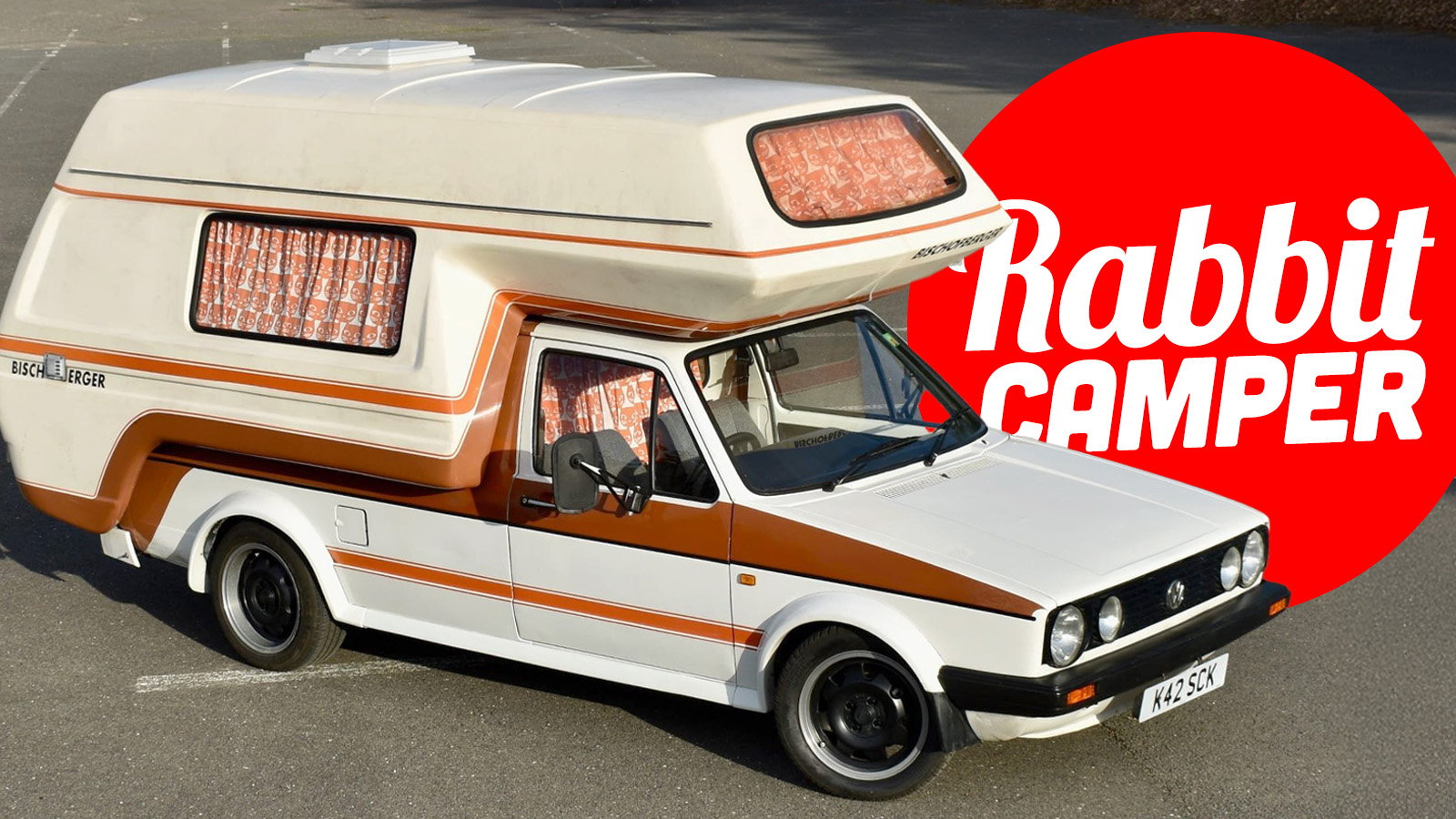
Some RV fans believe that, with a few exceptions, most new RVs lack soul and character. Some units roll out of factories aping some of the most boring trends in home design, and there’s a whole lot of sameness across the industry. If you want something with a little extra dose of fun, you can always look to the past. A great example of what you can find is this 1989 Volkswagen Caddy Bischofberger Family Hochdach. This motorhome might have a long name, but it’s built out of sturdy materials and comes paired with a reliable diesel engine and a five-speed manual transmission.
The Class C motorhome is an attractive option for the buyer looking for something bigger than a camper van, but also doesn’t want to commit to driving around in a large truck or bus. A modern Class C is often built out of something like a Chevrolet Express, Ford E-Series, or Ford Transit. Some others are built on pickup truck platforms, and then there’s the Super C, which tends to be based on a heavy-duty commercial platform and gets as large as a Class A.


This Volkswagen Caddy is a fantastic example of the other side of Class C motorhomes. RV manufacturers used to take the cute and compact trucks from the likes of Toyota, Chevrolet, Ford, Nissan, and Volkswagen to create little motorhomes. What was great about these compact guys was that they could fit in regular parking spaces, just like a van, but their fiberglass bodies offered more room to move around than a van did.

If you’ve never seen a Volkswagen Caddy motorhome before, don’t worry, you’re not crazy. This motorhome wasn’t sold in America, and it’s currently in the United Kingdom. But it is only a boat trip away from America, where it can enjoy a whole new life.
For When Camper Vans Aren’t Enough
This wonderful little motorhome is the work of Bischofberger Motorcaravan GmbH & Co., and it’s the work of Helmut Bischofberger, a man who ran a Volkswagen and Audi dealer in the 1970s and the 1980s in Germany. Bischofberger thought that camper vans just weren’t good enough, and that he could do better. German motorhome magazine Pro Mobil explains the story of the Bischofberger Family, roughly translated into English:
As a VW dealer, Helmut Bischofberger often dealt with people longing for a more adventurous outing with his VW campervan, which was a source of inspiration. But when it came to extravagance, the man from Backnang was way ahead of his time. Soon, he was creating motorhomes with steel-frame bodies, nicknamed “Crane,” built on chassis from Toyota, Mitsubishi, Opel Bedford, VW campervan, or VW LT; the latter also offered a luxurious high roof, and these vehicles, known as Ohio or Colorado, rolled out into the world. And then there were the passenger car campervans based on the VW Caddy or Audi, called “Family.”
Even the creator himself once admitted that this was his “most difficult, but also most satisfying task.” Those in the scene are well aware of the background to its creation, with the Swabian inventor initially practicing on a VW Golf. “Bischofberger did complete that one,” Josef Lürken reports, “but never actually put it on the road.” That would hardly have been conceivable anyway, given the two bolted-together rear axles.
[…]
The first Audi “family” was based on a used Type 43, as the Audi 100, introduced in 1976 , was known internally, and was also presented in Ingolstadt. Hard to imagine today: Mr. Bischofberger was immediately promised a Type 44 – the “new” Audi 100, which was launched in 1982 – which, after modifications, he was allowed to take with him for desert testing. “That was important for homologation,” explains Josef, “because the body couldn’t appear unstable, even though significant parts of the supporting structure had been cut out during the conversion and replaced with an in-house design.”

Reportedly, Bischofberger Motorcaravan built around 40 or so motorhomes out of the Audi 100 C2, the Audi 100 C3, the Audi 200, and the Volkswagen Caddy. The operation folded in 1990, making these RVs rather rare. There are supercars more common than a Bischofberger Family.
This Bischofberger Family

So, what do you get in a car-based Class C motorhome? From the looks of it, a lot of fun! This Bischofberger Family Hochdach started life as a 1989 Volkswagen Caddy, and Autopian contributor Zoe wrote about the Caddy, which was also called the Rabbit or the Pickup:
The pickup was named after a bunny because it was based on VW’s existing Rabbit hatchback—known as the Golf to the less fun-loving markets around the world. It was the brainchild of a crack US engineering team, led by one Duane Miller. It was a small crew that was fiddling around with Rabbit derivatives, but a keen one. The truck ended up in production in good old Pennsylvania, sidestepping that bothersome chicken tax that ruined so many plans gone by.
The engineering was just what you’d expect for a hatchback turned into a truck. Up front, the pickup was mostly Rabbit, from the front bumper to the rear cabin wall, though it scored upgraded struts and springs for its new workaday lifestyle. Out back, it scored a simple double-wall tray for cargo, tools, or whatever else you needed to haul on a given day. Supporting the rear was a simple beam axle with leaf springs, a low-cost and rugged choice that also provided the maximum possible bed space.
The Rabbit pickup debuted just as America was going through its first big diesel craze, before GM turned everyone off the idea. The pickup also shared its drivetrain options with the hatchback. That meant you could get a 1.6-liter gasoline engine good for 78 hp (76 hp in California), or a 1.5-liter diesel good for 48 hp. The gasoline engine would do 23 mpg city and 35 mpg highway with the five-speed gearbox. It was easily trounced by the diesel, which offered a mighty 41 mpg city and 54 mpg highway.

This Caddy has been given some tasteful modifications. When new, this motorhome had a Volkswagen EW engine, which is a 1.6-liter four-cylinder mill with 74 horsepower on tap. In 2010, the original engine was replaced with a 1.9-liter AAZ indirect injection turbodiesel inline-four with 75 horsepower and about 110 lb-ft of torque on tap. The original 5B transmission was also replaced with a 020 CHD five-speed manual, which still drives the front wheels.
Other modifications in and around the hood are noted to be a Radtec aluminum radiator, dual electric cooling fans, a Febi-Bilstein 90-amp alternator, new wiring, a GTE Track Thatcham GPS tracker/immobilizer, new insulation, and dual Hankook XL31 130Ah deep-cycle batteries. Complementing those parts are TA Technix adjustable front coilovers, Monroe Max-Air height-adjustable rear shocks, a rear axle flip, ATS Cup wheels, and 25mm aluminum rear wheel spacers. Not bad!

The camper body built atop the Caddy is made out of fiberglass and is supported by a tubular steel frame. Some Bischofberger Family motorhomes had pop-tops, while others had solid roofs. This one is the latter, and it comes with double-layer plastic windows, a widened rear track, side skirts, a roof vent, a split door, and groovy brown stripes.
The motorhome’s total length is about 15.5 feet, and it weighs in the ballpark of 2,860 pounds. An interior height is not listed, but at 6 feet 3 inches tall, this motorhome fits in a standard garage.

Here’s the description of what’s inside:
The cabin houses front bucket seats upholstered in gray cloth. Sparco drilled pedals and a Pioneer stereo have been installed. The odometer indicates 98k miles, approximately 3,500 of which were added under current ownership. The seller notes that the steering wheel sits approximately one centimeter off-center while driving straight.
The camper interior incorporates facing bench seats, a removable dining table, a collapsible double bed, a children’s sleeping configuration, under-seat storage compartments, a wardrobe, overhead cabinets, a stainless-steel sink with electric faucet, a two-burner gas cooktop with grill function, shore-power capability, and a roof vent. Improvements under current ownership include a 12-volt Alpicool compressor refrigerator, dimmable LED lighting, a Renogy 1,000-watt inverter, USB charging outlets, dual 40-liter fresh-water tanks, a rear cabin power cutoff switch, custom mattress protectors, fitted sheets, and two fork-mount bicycle carriers.

I love the Sparco pedals. For something that probably takes three business days to reach American highway speeds, the pedals are wishful thinking. But there’s nothing wrong with having a little fun! There aren’t many RVs you can buy that even have a manual transmission to go with a diesel engine.
This motorhome was imported into the UK by Madisons of Preston and, when new, had a starting price of around 10,000 pounds. The UK’s Motor Week reviewed one in 1984, noting that the camper body was actually removable, and that, when installed, the Caddy had no issue cruising at 70 mph, even in high winds. Fuel economy was also said to be “well over” the equivalent of 31 mpg US with a diesel engine.

The Bring a Trailer listing claims that the camper body is permanently affixed to the Caddy. One discrepancy is the model year. The listing claims that this Caddy was converted by Bischofberger Motorcaravan when it was new, and that it is a 1992. But that seemingly shouldn’t be possible, since that means this motorhome was built two years after its maker folded. The VIN seems to tell the full story. The VIN is WVWZZZ14ZKW009625, with a tenth digit of “K.” That should translate to a 1989 build year, which would make logical sense. I wonder if it was assigned a new year when it was imported into the UK? I’m not sure, but I did comment in the listing, looking for clarification.
Fun-Size RVing
At any rate, regardless of the actual model year, it’s such a cool little rig. I would have so much fun rowing through the gears on the way to a campsite. The listing notes that the Caddy’s doors and right-front fender were replaced and repainted, possibly due to corrosion on the original parts. It also has broken fog lights and some wear on the fiberglass. Those are relatively minor issues for a 37-year-old motorhome. I know of much newer RVs with worse going on!

The other good news is that, considering its age, this motorhome is perfectly legal to bring to America! Its nice and long VIN also means that even the states that ban Japanese Kei cars will probably leave this alone. Bids are at £7,000 ($9,375) with six days to go on Bring a Trailer. The bad news is that, between exchange rates and import duties, this will be an expensive buy for an American. But likely still cheaper than getting any new motorhome.
But if you can swing the cash, it sounds like you’ll be getting a wonderful way to travel. Sure, you won’t be getting anywhere fast, but this is a motorhome that’ll fit in a regular parking space, get decent fuel economy, and has a little bit of an enthusiast touch.
I also love that this little guy is full of character. It looks cute, groovy, and inviting all at the same time. I wish there were more small-scale motorhomes like this. Imagine if something like this were done to something like a Ford Maverick. RV manufacturers, are you listening?
Top graphic image: Bring A Trailer


Good thing they upgraded to a turbo diesel. N/A diesel Rabbits were mostly WOT around town.
Was it slower up hill than a campervan?
OK for short people I guess – not the stand up height, but the driving legroom and the bed for sleeping. It must be the only a vehicle a Westy van can outrun!
Too much wood for me. I’ve seen rabbit pickups with truck campers you can still get small truck campers that seems the way to go here. Still have use of the truck when not using the RV for most people thats most of the time. In theory the truck camper can still be used as a camper on its stands too.
Bischofberger even made some I think. I know scout campers makes a small camper that fits the maverick I’ve seen one driving around. I think they call it the tuktut.
This thing is adorable, and pretty nice inside. I’d camp it. Its like they looked at the old tortoise that was the Dolphin Hilux and said old mein bier. Lets put a 2000lb block on the back of one of the slowest cars VW ever made.
(I say this as a type 2 Westphalia owner)
Thanks, Mercedes! I had never heard of Bischofberger before, even though I gobbled up every piece of information I could about cars in my teens (late 80s). I’m absolutely sure I wouldn’t have forgotten the Audi camper if I had ever seen the picture before.
BTW the idea of calling a Golf used for hauling things a Caddy proves that we’re not completely devoid of any sense of humor. Cue the Caddyshack jokes in 3, 2, 1…
Caddyshack.
Dammit, I was already writing! 🙂
Beat me to it as well! Well played
The world needs ditch diggers too.
Sorry, it was just lying there Probably, the difference in time to post a one-word comment versus fuller narrative.
Great minds think alike. Or, roughly translated from German: two idiots, one thought.
Zweifellos!
I don’t see the point in this. I could just sit in my house and let continental drift get me to the campsite faster.
Et alors la marmotte, elle met le chocolat dans le papier d’alu…
Reminds me of that cabbie in Bulgaria hauling us around in a Trabant and explaining at lengths how he had swapped the engine with a Golf Diesel one, all this while we could hear the engine zing-zing-zing-ing in its inimitable aristocratic Trabant way…