

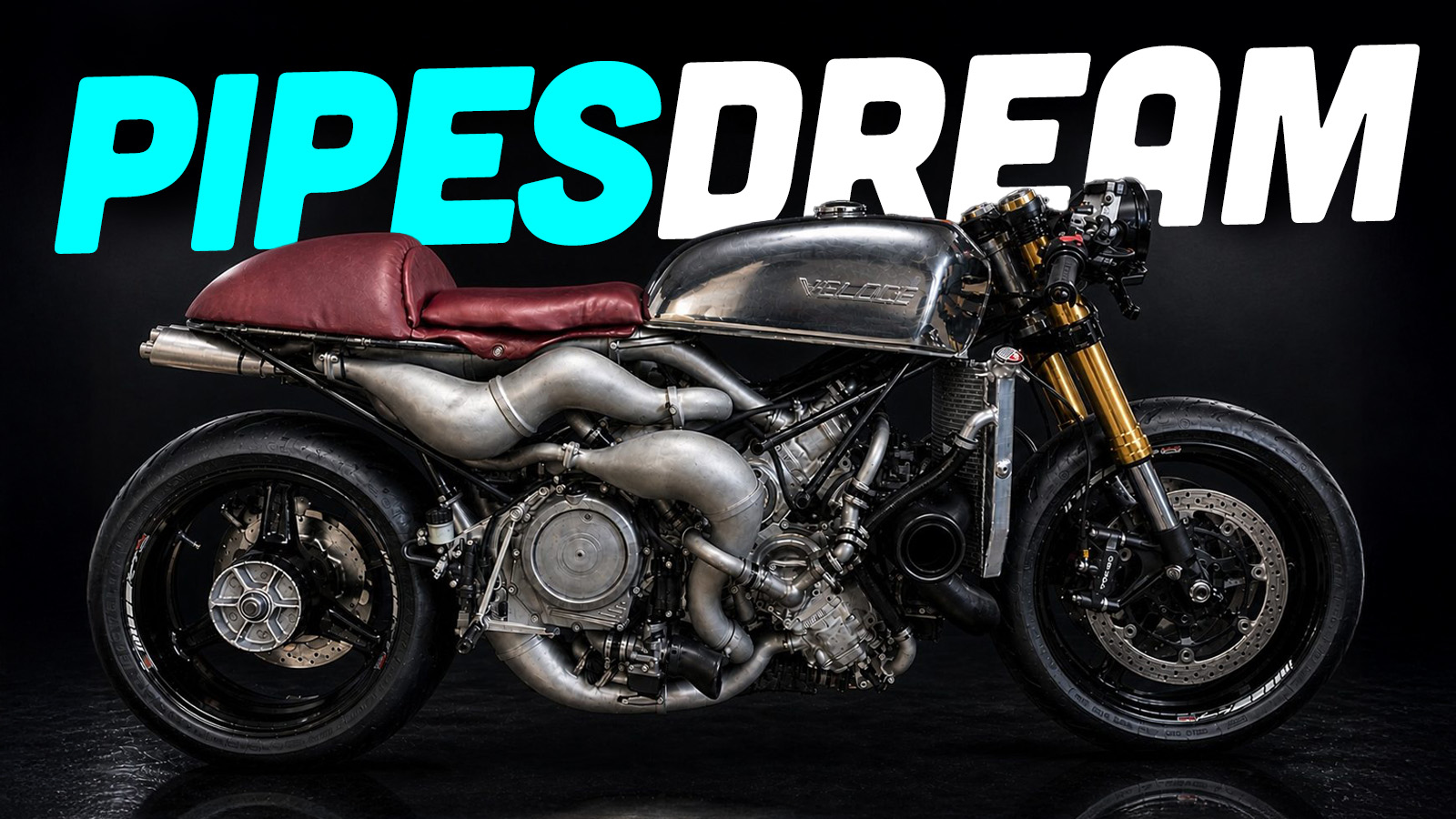
New two-stroke roadgoing motorcycles are nearly extinct. You can’t even buy a street bike with a two-stroke engine from any mainstream manufacturer in America today. Sadly, that leaves you only with boutiques few people have ever heard of, but one of these companies has found a creative way to get its name out there. This is the Veloce Aperion concept, and it’s not only a weird bike with a two-stroke engine, but that engine has eight cylinders shaped like an “X” and a ridiculous claimed output of 280 horsepower. It’s all kind of stupid, and I doubt any will ever be made, and yet I can’t stop looking at it.
There was a time when the two-stroke motorcycle ruled both the road and the dirt. A two-stroke engine completes a combustion cycle on every crankshaft rotation, delivering twice as many power strokes as four-stroke engine, which devotes one full revolution to intake and combustion followed by a second revolution for exhaust. Two-strokes are known for their high power-to-weight ratios, relatively compact size, and, depending on the exact design involved, mechanical simplicity. Some new dirt bikes are still developed with two-stroke engines because of their peaky torque curves and light overall weight compared to similar four-strokes.


But the two-stroke also has some quirks inherent in its design. The mechanical simplicity that makes a two-stroke so appealing was also its undoing. Basic two-strokes burn their lubricating oil, which makes meeting modern emissions standards increasingly difficult. There have been some two-stroke designs that use a closed oiling system, but even if you get past that hurdle, two-strokes tend to waste a decent percentage of their fresh air-fuel charges right out of their exhausts, which is bad for the environment.

In theory, engine manufacturers could have designed cleaner two-strokes, but most of the motorcycling world just moved to pumping more power out of cleaner four-stroke engines. Occasionally, you can still find roadgoing two-strokes. My 2005 Genuine Stella scooter has a 150cc two-stroke engine. Janus Motorcycles was slinging 50cc two-strokes as late as 2015. Of course, some random cheap Chinese bikes out there have two-strokes, too.
Veloce is sort of an odd one out. In a world of electric motorcycles and four-strokes, this British company is cooking up not just a 1,000cc two-stroke, but one with eight cylinders in a strange shape.
From A Company Nobody’s Ever Heard Of
Veloce Automotive Ltd. is a funny company. Its website is annoyingly minimalistic, and its About section has less detail than the design of a Tesla Cybertruck. I won’t fault you for assuming this company trades in vaporware and not real motorcycles. According to the UK Government, Veloce Automotive was formed in 2024 by 32-year-old Jack James Levy. Amusingly, the company’s initial filings suggest that someone originally misspelled “Automotive” as “Automotve” somewhere in the process. Oops!
I could not find anything about what Mr. Levy did before this company or what his engineering bona fides may be. All the company offers is this unhelpful explanation on its website:
Veloce Automotive Ltd is a private company formed to bring innovation and performance to the UK motorcycle market.
Based in Oxfordshire, England, Veloce Engineers passionately create products that are unique in their segment. Veloce powertrains and motorcycles are developed at our own engine cell and test circuit in Carmarthensire [sic], Wales.
Anyway, the company’s apparent debut product is properly nutty.
An ‘X8’ Two-Stroke Motorcycle

The Veloce Aperion is a peculiar oddity. It was rolled into the Bike Shed Moto Show in London in May, and while that one (pictured in this article) doesn’t run, James Levy swears that there is one functional prototype. Apparently, there is a real functional “X8” motorcycle scooting around England right now.
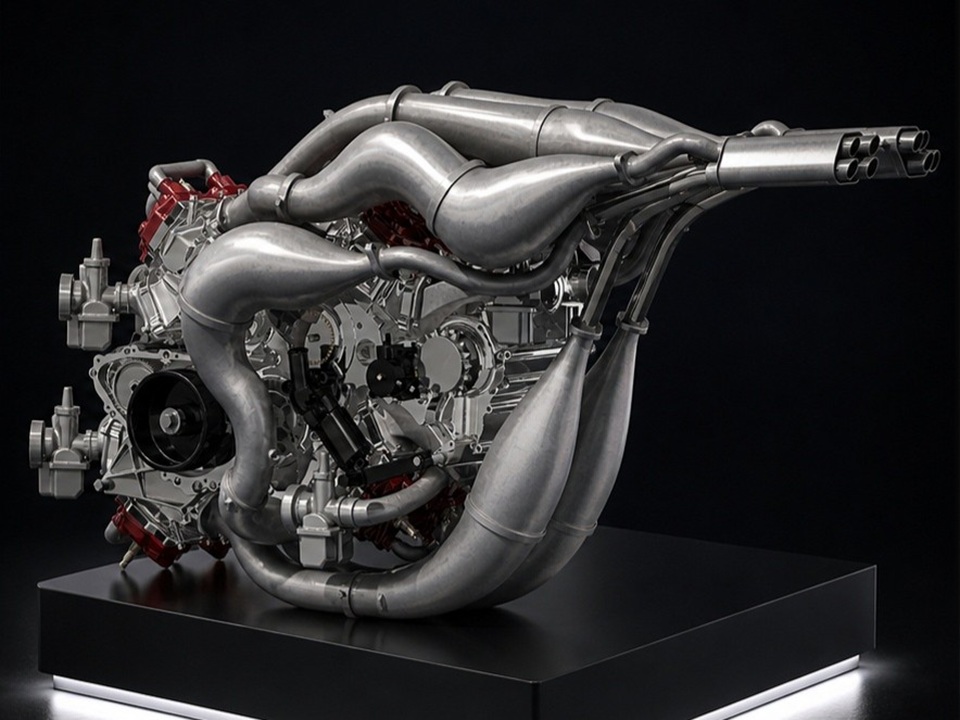
The biggest question, of course, is what the heck is an X-shaped engine? According to a report by Motor Cycle News, the engine consists of eight Rotax/Aprilia RS125 cylinders arranged into two V4s, with one V4 running upside-down. Here’s what one of those engines looks like:

From the report:
Each bank is machined in four parts from billet, and contains two crankshafts, geared to a common jackshaft, driving the custom clutch and transmission. Fuelling is by four pairs of 24mm Dell’Orto carbs, controlled by a fantastic eight-cable ‘spiral’ throttle twistgrip design, and it runs on premixed petrol and two-stroke oil. The firm claims 280bhp from the powerplant, which ties in with an expected 35bhp from each of the eight 125cc cylinders; complete with performance parts by Mitaka.

Levy says that going with two-stroke engines enabled the X-shape. Since the engines are running premix, he says, there’s no problem with the lower V4 running inverted. Levy also says that the X-shape has the pistons firing together in a “diagonally-opposed” configuration, and the opposing forces cancel each other. The result is that the engine’s combustive, inertial, and rotational forces allegedly have “perfect” balance. The final benefit of the twin V4s, Levy claims, is that he didn’t have to fashion eight cylinders into a row, which would have made the engine either really wide or really long.
Levy also found it easier to get the prototype engine running since he only had to deal with eight carburetors and eight throttle cables rather than fiddle with electronic fuel injection. Of course, running carbs also gives the motorcycle a glorious old-school touch, though I’d highly doubt anyone is in a rush to maintain and tune eight carburetors.

Anyway, like many modern motorcycles, the engine is a structural element, and subframes of welded steel tube trellises connect to the engine’s front and rear. Inverted forks, a Veloce-designed pullrod-actuated rear coilover damper, and a single-sided aluminum swingarm round out the build. Sort of weird is that the damper is under the bike and actually in front of the engine for cooling and geometry. The powertrain unit weighs 231 pounds.
Veloce makes no mention of where the other parts come from, but to my eyes, those wheels look awfully similar to what was mounted on a Suzuki GSX-R750 from the mid-1990s.
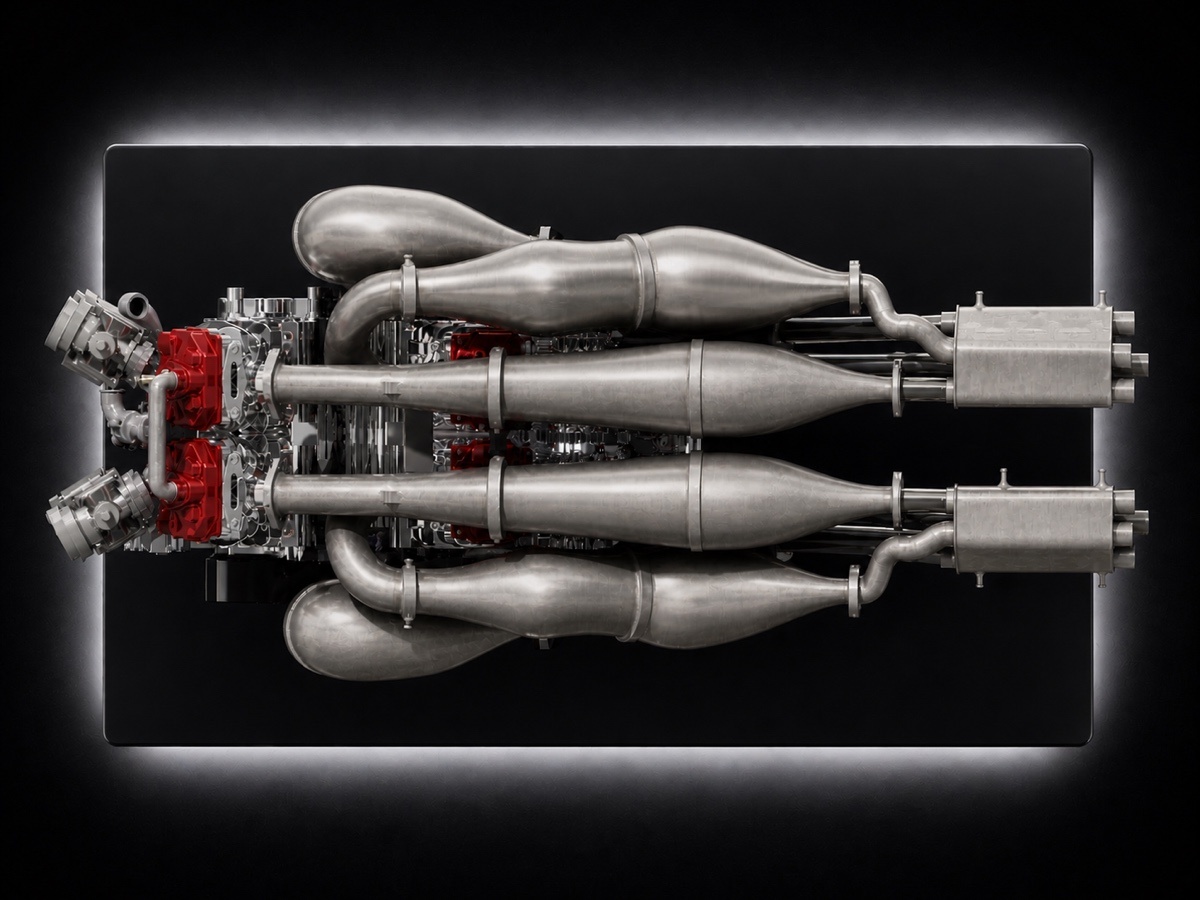
According to the moto gearheads of MCN, even the pipes have a purpose:
But the most visually striking part of the installation is the exhaust expansion chambers. Making efficient two-stroke engines relies heavily on these: they need specific volumes and lengths, with accurate cones, to properly optimise power production. Getting that right is hard enough on a twin or four-cylinder machine, as a look at any old 250 or 500GP bike shows. Managing to fit eight of these complex 3D shapes within the limits of a motorcycle is mind-blowing.
[Ed note: The specific volumes and lengths and “accurate cones” mentioned above refer to the “tuned pipe” geometry that allows a two-stroke engine to make maximum power. This video explains the ingenious way pipe shape affects two-stroke engine performance. – Pete]
But Veloce appears to have managed to do just that, thanks to the latest in 3D printing technology. The pipes are laser-sintered from metal powder, directly from a CAD computer program, allowing engineers to perfectly package the expansion chambers into the most efficient space around the engine and frame, while keeping the walls thin and light – without the complex cutting and welding of thin metal traditionally used.
Something I noticed that the motorcycle buff mags didn’t is that the promotional images show two different stages of development. The bike shown on the Veloce website does not have a chain drive, or any way to drive the rear wheel, for that matter. Likewise, there’s an exhaust chamber only inches from where your genitals would be.

The version of the bike that came to the Bike Shed Moto Show has a piece of leather draped over the exhaust in that area. The bike from the show also has a chain. However, it’s said that the one at the show didn’t run. But there is a running prototype at the company’s R&D facility in Carmarthenshire.
Veloce is trying to burst out of the gate with not just one model, but two. The second bike, the Ethereal, is goofy in a different way.
Veloce’s Other Two-Stroke

That one sports an L4 500cc two-stroke engine with 145 HP on tap. The engine is not as nutty as the Aperion’s, but the body makes up for it. The fuel tank has mini wind tunnels under it that are designed to feed air to the motorcycle’s under-seat-mounted radiator. It also has a weird “reversed” transmission setup where the input shaft is located behind the output shaft. Apparently, that was done to optimize the swingarm and drivetrain geometry.
Veloce says that, sometime in 2027, it’ll make 24 Aperions and 48 Ethereals. When that happens, both bikes will be fully road-legal, at least specifically in the United Kingdom. Price? The flagship Aperion is £78,000 or $104,535. That’s about the price of a nice used Audi R8 V10 these days. Given the rarity, you should be able to convince the U.S. government to let you import one here. Well, that’s assuming they ever enter production, anyway.

But even if they do enter production, I’m not entirely sure either will be a practical motorcycle to ride. It’s clear from the flap of leather on one version of the Aperion that the eight buzzing 125ccs generate a lot of heat. Are all eight of those pipes going to steam your hams as you shuffle through traffic? Also, where are the taillights? Meanwhile, the Ethereal has what might be the least comfortable motorcycle seat I’ve ever seen.
I suspect that, given the rarity and the six-figure-equivalent price, these bikes will largely sit in a collection somewhere and their owners won’t really have to worry about such things as practicality. Again, that assumes they even happen. Veloce hasn’t even produced a single sound video, which is a huge shame. I’d love to hear what a dual V4 two-stroke would sound like!
But even if, in the likely event that both of these bikes never leave the prototype stage, I must give them credit for making me dream. I love boutique motorcycles for doing the kinds of asinine experiments that the likes of Harley-Davidson and Yamaha wouldn’t dare try. I feel like half of these bikes are designed the way they are solely on the basis of “because we can,” and that might be silly, but I’m into it. Sadly, short of buying a Janus, there’s not a chance I’ll ever be able to afford any boutique machine, so I’ll continue checking them out from afar.
Top graphic image: Veloce


280HP = Motorcycle Assisted Suicide
Those exhaust headers border on erotic. These weird bikes you keep showing seem like you’d want Nomex pants to ride.
The ~50 HP my first bike, a 1980 Suzuki GS550E, made were plenty enough to propel me over 100 mph quickly enough. I saw 110 indicated once on a spirited ride that would’ve been a very expensive ticket. At the of one of those 100+ mph rides, I got pulled over. But fortunately, it was a local LEO I was friends with and mysteriously, over the radio, he reported he lost me. I delivered a case of Moosehead, which we both liked, the following Saturday and we had a nice catch-up.
That bike was fun to ride and its four carburetors never needed fiddling with. I was surprised to read about four pairs of carburetors to try to keep in sync. I don’t know if the gas/oil mix makes FI more difficult, but seriously? Carburetors in 2026?
I know a guy with a Triumph 2300 Rocket 3 and while it’s a cool bike to look at, I have no interest in a motorcycle with an engine with more displacement than the first two cars I owned.
But thanks for bringing the weird to us, because I won’t be seeking stuff like this out on my own.
You would think I held a higher opinion of a motorcycle exhaust system that reminded me so much of haggis; there must be an uncanny valley for intestinal lunchmeat.
Me: Hey, Computer! Show me a multi cylinder cafe motorcycle with a custom exhaust.
Computer: Pa-tooey.
Okay, so the engine was developed by engineers but the exhaust was sculpted by H.R. Giger.
Considering he’s been dead for a dozen years, I think the exhaust’s overall shape looks about what you’d expect.
Bimota tried a 2 stroke, around the 2000s, was is called the v due?? I think it was their first try at their own engine.
Yes! The V due,… the old man still has it!
Bimota V Due – Wikipedia
It’s also the engine that killed them.
They didn’t do the injection right and pretty much all of them seized. So a bit like Facel Vega, they went belly up for trying to go with their own engine.
The injectors they used in testing (that worked) were too expensive and unavailable in sufficient quantities to use in production, and the ones they got for production could never be mapped correctly. Plus the crank seals were weak and leaked air.
Piero Caronni bought the old stocks and along with Bob Steinbugler reworked everything back to good working order, with carbs, beefier seals and a lot of machining (new bespoke crankcases altogether).
Neat! It had great bodywork, but the exhaust was really odd..
Two-strokes also put out twice as much heat, or at least have less time to dissipate it between combustions.
While the radiator might keep the cylinders cool, there’s the exhaust to consider.
This bike seems to be 85% exhaust pipe, by area.
Transmission output of the Aperon is behind the swingarm pivot which seems opposite to other brands. Theoretically, you don’t need a chain breaker if you remove the rear wheel, but changing your output sprocket might mean a swingarm removal.
Now, on the other hand, I’m not sure how the Etheral would handle that much chain distance – I’m sure setting slack isn’t as straightforward being that far away from the swingarm pivot.
Does it come with a Verge solid state battery?
I can’t see how you could ride the thing without turning your legs into kebabs. But as an “art bike” it is very cool.
This bike looks like it has intestines, because with 280 hp it will eat its riders alive
They look like they should be pulsating.
Yeah, nah yeah.
I had a Cagiva 125cc twostroke and buddy had the Aprilia RS125. Both about 34 hp and both much fun. Actually, I would say fast enough aswell.
Then buddy went and bought an RS250 at around 70 hp. Well let me tell you. Fun was gone. These things were fast and would kill you like it is nobodies buisiness. Like the speed and acceleration of a Yamaha R6, with better braking and cornering. But with a serious temper issue.
Four times that? Forget about it. You will not enjoy unless you have zero fear for death.
Where do I sign up? 😀
The engineering in this is insane. Taking v-twins and essentially turning them into a radial is something you’d expect to see Alan Milyard do in his shed, not a manufacturer to attempt to do.
The segmented silver “dish” on the right side of the rear wheel is where the cush drive would go on whatever bike that was taken off of. Actually seems the same on the one with the gold wheels. You think for $100k+ price tag, he could’ve (A) found a wheel for single-sided swingarms, or (B) made a cover so it looked cleaner than it does.
Agree that it’s really funny the bike pics on the official website have no drive mechanism. Like you said, if they ever got made they would be “conversation pieces” so I guess that’s not important.
Looks like an art project that may end up with a few miles on it before it ends up in someone’s collection.
I like the visuals of this engine, it definitely looks interesting and shows off some cool/precise manufacturing/engineering. I find it odd that they said running fuel injection would take too long as even with this unique engine configuration, running some simple injectors, some crank/cam angle sensors and a basic controller (MegaSquirt maybe or any number of RaspberryPi type controllers), an experienced tuner should be able to get this running well in about the same time it takes to do a single round of tuning all those carbs. And then it should run well for years instead of needing to retune the carbs constantly. So I take pause in the rest of what they say.
I realize they probably went with carbs specifically because its an old-school style and figure the few people that buy these for collections want to look at carbs instead of new fangled injectors as their bike sits unmoving forever, but please just be honest about that. No one will actually ride these leg melting machines other than the few times the company shows its possible to ride them.
No doubt these will be a pain to ride in real life, but I am a sucker for laser sintered additive manufacturing.
I’m not familiar with laser sintered materials. Can it really take the heat, pressure and vibration of an expansion chamber?
I think I would have hydroformed some 3-2.5 titanium alloy if it was my project, but even in the age of 3D printed molds that’s a bit of an investment. Maybe the laser sintered stuff is good enough for a prototype.
You can laser sinter titanium too.
Those mad expansion chamber would look amazing as the titanium blued with heat. You know, it the engine actually ran and was in any way connect to the rear wheel to generate some load.
The rocket combustion chambers for SpaceX Raptor engines are laser sintered, so I’m pretty sure a 2 stroke bike exhaust should hold up OK.
It’s an engine with an overly complex cylinder layout that really doesn’t make sense, huh? Yet another British manufacturer joins the ranks of the Napier Lion/Deltic/Sabre, and BRM’s V-16 & H-16…
Also the engine sans bike kinda looks like a mechanical meteor.
No, the Meteor was a British V-12. Def mechanical, tho.
…yeah, forgot about that one.
NGL, this looks like some kind of unholy mashup of an engine and a digestive system.
This really does have that H. R. Giger feel, slightly discomforting.
However having some high output 2-strokes in my past, I have a tendency to look upon pistons and rings as expendables. The real horror could be servicing this thing.
The horsepower is totally believable a race 125 single makes well over 30 horses.
If DT thinks having a timing belt to change every few years is an unacceptable servicing requirement he’s going to really hate having to routinely replace pistons.