

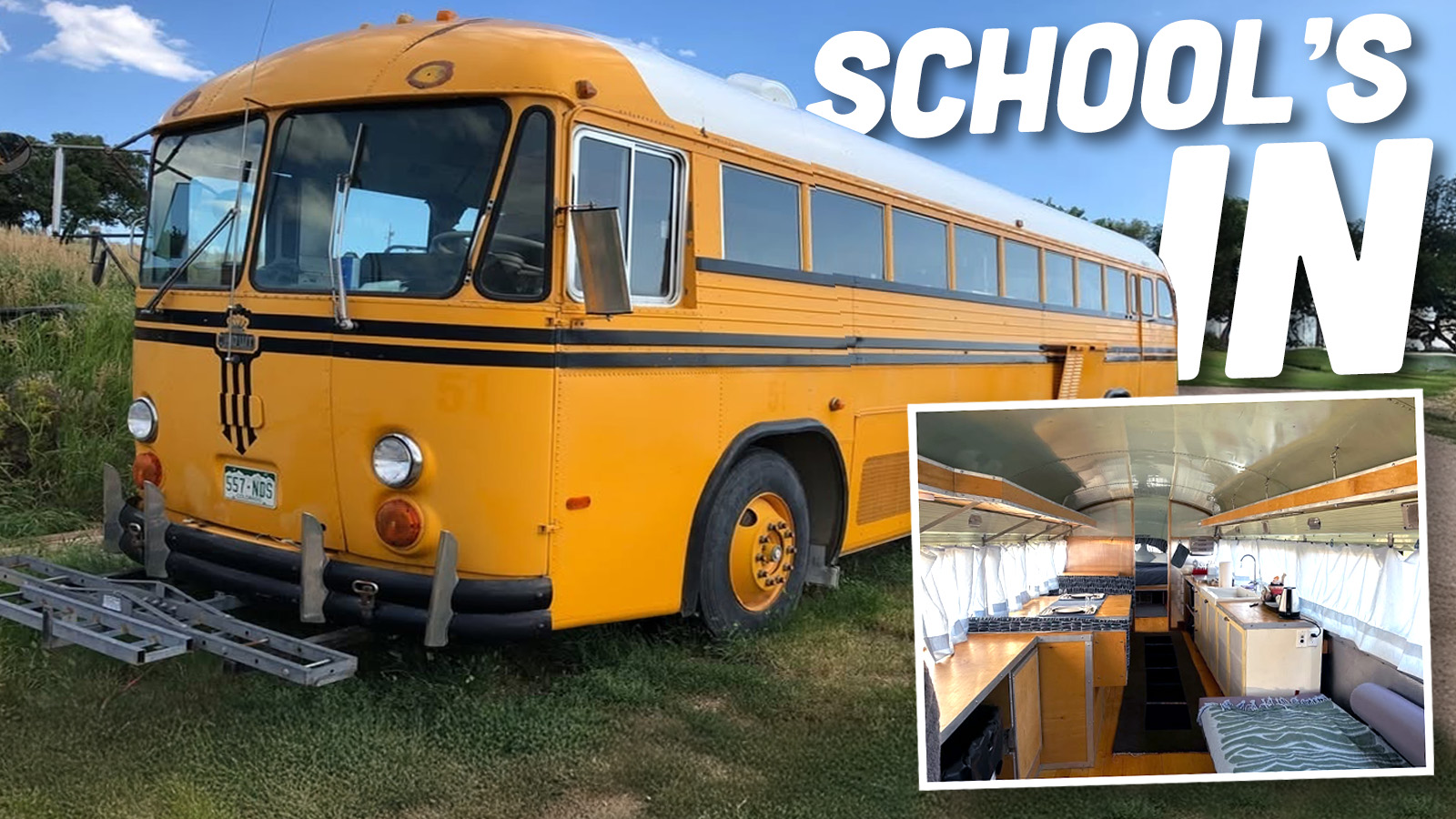
I have a longstanding hot take, and it’s that the modern motorhome scene isn’t terribly exciting. Recently, the most fun thing I’ve found in a motorhome that costs over a million bucks is a sport mode. Otherwise, so many motorhomes feel like single-family homes on wheels or rolling casinos. If you’re looking for a motorhome, but want it a bit weird, I found what seems to be a fun option. This 1982 Crown Supercoach started life carrying kids in California. Now, it’s been converted into a simple motorhome for the kind of person who likes their diesel engines in the middle and to row their own gears in a large vehicle.
The school bus is one of the greatest platforms for a custom motorhome. School buses are designed to be durable, sturdy, and safe so they can carry their precious cargo for years. They have all-metal bodies that resist the weather better than a stick build can ever dream of. They’re often easier to work on than a coach bus or a transit bus. There are countless “skoolie” builds out there that are based on modern buses. These buses often have reliable diesel engines with decent parts availability, some modern amenities, and can be wrenched on by many mechanics. A lot of skoolies also have fun interiors that you can’t really get in a motorhome built in a factory.


But I have a soft spot for a skoolie build that saves or preserves an old bus. Those new buses might be easier to live with and have better performance, but these old buses have a sort of beauty that I think no modern school bus can match. A prime example is this 1982 Crown Supercoach RV conversion. I could stare at this rig all day, and would love to find out what it’s like to drive a mid-engine diesel bus with a manual transmission.

The Crown Coach Corporation
This bus was built by the long-defunct Crown Coach Corporation, which was once a dominant force in school buses in the American West. Crown was founded in Los Angeles, California, in 1904 as the Crown Carriage Company. Here’s what I wrote in a previous skoolie article:
Crown was founded by Don Murrillo Brockway and in those days, the company was a coachbuilder known for mail coaches and depot hacks. Brockway previously hunted buffalo for a railroad before moving to Los Angeles and working for Ernst and Rucker, the city’s first hardware store. His real passion was in wagons and carriages and that was the motivation for founding Crown.

As the Crown Coach Historical Society writes, in 1910, the horse-drawn carriage began losing ground to motor trucks. Apparently, Brockway believed that the horse could never be replaced, but reluctantly started building truck bodies, anyway. Brockway’s focus on horse-drawn vehicles continued into 1916, when Crown began constructing open-air buses on Federal truck chassis. Winds of change came in 1921 when Don’s son, Murillo M. Brockway joined the family business. The son could see what his father couldn’t. The horse was losing to the gasoline engine and the company’s fortunes were not in horse-drawn wagons. As the Crown Coach Historical Society writes, gasoline-powered buses were becoming common in the region. Eventually, the elder Brockway was convinced and Murillo was put in charge of the company’s school bus operation. Reportedly, the workers couldn’t remember Murillo’s name and eventually, they just started calling him “Brock.”
The move to buses turned out to be the correct one and, in 1923, Crown moved to a larger facility to meet the high demand. Horse-drawn wagons were phased out entirely as the company went all-in on buses and truck bodies. From there, the company would evolve its buses and even get into airplane manufacturing. In 1927, Crown changed its name to Crown Motor Carriage Company and introduced what is said to be the first school bus with dual rear wheels for greater passenger capacity. In 1930, Crown’s 43-passenger school bus rode on a Mack chassis and for the first time, the company’s buses featured metal bodies.
In 1932, Don’s son, Murillo M. Brockway, took over the reins of Crown while Don remained on as president of the company. Murillo was quick to begin implementing his big ideas for the future of Crown. That year, Crown introduced what’s said to be the first school bus with an all-steel body and a frame integrated into the body through welding. This was done in the name of safety.

Another safety innovation introduced by Crown in 1932 included safety glass with wire mesh embedded in it to better resist shattering. These windows slid open, a massive upgrade over the old-school roll-up curtains that were used in early buses. To increase outward visibility, Crown also started building cab-forward designs where the driver sat at the very front next to the Waukesha gasoline engine. Crown also compensated for potential service brake failures by introducing a redundant hand-operated brake.
In 1935, Crown revised the 1932 cab-forward bus design, creating the Super Coach, which carried up to 76 students. Aside from upgrading the coach’s passenger capacity, the Super Coach also introduced an air-based service brake system. The Super Coach would also serve as the basis of an intercity bus with sleeping accommodations for the All American Bus Lines of New York. To facilitate increased passenger loads on these buses, Crown would move the coach’s engine from up front to under the floor in the middle of the bus, utilizing Hall-Scott gasoline engines.

By 1937, the mid-engine design was implemented on the school bus version of the Super Coach, which upped student-carrying capacity by three to 79 kids. Only three years later, Crown changed the configuration again, shoving the engine in the rear of the bus. The Super Coach was also upgraded to comply with the then-newly established Minimum Standards for School Buses, which set 44 standards for body length, ceiling height, emergency exits, aisle widths, and more.
Come 1946, Crown decided to begin development on a new generation of the Super Coach, which would be called the Supercoach. This bus was originally designed as a transit-style sightseeing coach first, and brought some evolutionary updates to the table. The floorpan was built out of high-tensile steel. On top of the floorpan sat a heat-treated, double-walled aluminum body with riveted panels. The body was mated to the coach’s steel nested channel frame rails and cross-members through bolts and welds.
Adding additional safety to this build were high-tensile steel rollbars and body posts placed throughout the length of the bus. Crown also seems to take the credit for building America’s first production diesel school buses in 1954. From there, the original Supercoach design underwent only a handful of incremental changes until Crown’s closure in 1991.
This Supercoach

That brings us to this bus, which was built right during the beginning of the end for Crown. This Supercoach might have been built in the 1980s, but it’s still based on the old-school 1950s design. The seller gives us some history on the coach:
This 1982 Crown school bus was originally in service in Lodi, California, as Bus #51. It is powered by a Detroit Diesel 6-71 turbo “pancake” engine paired with a 5-speed Fuller manual transmission. Most of the major mechanical components are the same as those found in 1980s Class 8 commercial trucks, so parts are readily available. The engine is mounted in the center of the bus, making it one of the best-balanced coaches available. Combined with Crown’s rigid roof structure, these buses are also known for their exceptional safety. Crown buses were often referred to as the “Cadillac of school buses.” The body panels are aluminum and are in good condition, though the exterior could benefit from a fresh paint job.

I purchased this 31 ft bus in 2003 from A1 Bus Sales in Sacramento. It has been a pleasure to own and drive. Because the transmission is non-synchronized, you must either double-clutch or match engine RPMs to shift gears. It’s very satisfying once you learn, but if you don’t know how to drive a manual transmission, this probably isn’t the bus for you.
I have kept up with the maintenance, including changing all fluids, replacing the belts, and installing a new battery. The odometer currently reads approximately 132,000 miles. However, when I purchased the bus, I was told the mileage might not be accurate, as these buses were built to last 500,000 miles or more and were often repowered with replacement engines during their service life. They were truly built to last.
That aforementioned Detroit Diesel 6-71T is a 7-liter straight-six two-cycle turbodiesel with 270 HP and at least 762 lb-ft of torque on deck. Like any two-cycle Detroit, of course it sounds glorious. Here’s a sound clip from a different Crown Supercoach with the same engine:
What I like about this coach is that the builder of the RV conversion has left the exterior mostly untouched. The stop lights have been deleted, but otherwise, it’s a classy yellow and white bus. It’s hard to tell from the images, but it doesn’t look very rusty, either.
Moving inside, the RV conversion was pretty minimalist, but still seemingly pretty cozy. From the seller:
The conversion began as a simple camping vehicle and has gradually been upgraded over the years. It features a maple floor, custom birch plywood cabinetry and built-in furniture, and a queen-size bed in the rear. There is an RV toilet with a portable black-water tank, and the kitchen sink also serves as the bathroom sink.

The fresh water tank is made from a converted hot water heater tank and uses pressurized water from filling the tank, so no electric water pump is required. The interior lights are wired to the house battery system. My plan was to install rooftop solar panels after repainting the exterior, but I never got around to it. The house batteries can currently be charged with portable solar panels or a portable generator (neither is included).
Since I live in Colorado and only used the bus during the summer, I never installed air conditioning or a permanent heating system. I simply used a portable propane heater when needed. The refrigerator is currently a 120-volt model.

Based on that description, this bus isn’t going to work exactly like a factory-built RV. There’s no air conditioner and only a radiator for a heater. The electrical system depends on solar panels or a generator. The only running water onboard seems to come from the sink, leaving you with a cassette toilet. As for a shower, well, you’ll have to figure that out on your own.
The good news is that most of the missing bits can DIY’d. A portable air conditioner and a diesel heater would be affordable fixes to the lack of HVAC, and an outdoor shower can clean you up. If you know how to build things, there’s room next to the toilet to build a shower if you really want one.

The price for all of this is $30,000, and the bus is located in Carbondale, Colorado. Part of that, of course, is just paying for the vintage school bus itself. Crown was such a famous brand that there are some folks out there who still collect these buses. A quick search does suggest that there’s a market of Crown Supercoach conversions between $20,000 and $40,000.
The seller for this one does say the price is negotiable, so who knows what you could drive it away for.

A Piece Of History
Despite all of that, I love quite a lot of it. I adore all of the natural light from the intact windows, the wood touches, and what appear to be spacious places to sleep. I could totally listen to that engine all day, too.

The ideal buyer for this bus would probably be someone who isn’t afraid to spin a wrench or fix a problem on their own. You’ll also want to inquire about gearing, because if this bus does not have highway gearing, you’ll be going everywhere at around 60 mph. Of course, this bus is also 44 years old. It’s going to have some quirks, almost certainly some problems, and will probably develop a problem at some point in the future. If you just want a cheap motorhome, you can get one of those for under $10,000 on Facebook.
But if you’re okay with all of the above and want something a little more special than a typical motorhome, this bus seems like a neat choice. This rig would look so cool rolling into the vintage RV days at my local campground. Dare I say? If Crown built a Supercoach motorhome, I could imagine it looking something like this inside.
Top graphic images: Facebook listing


My mom was a school bus drive in Lodi at this time so I’ve almost certainly ridden in this bus. She would drive our routes and then just keep us on the bus and take us to the “bus yard” as we called it. Lodi had mostly Gilligs up until around this time when they started buying Crown busses.
I’ve been watching the reactions of the European footie fans in the US for the first time for World Cup; one of their biggest surprises was that yellow school buses are a real thing, not just in movies.
It’s called sticking to the bit.
This old bus brings back memories. As an elementary school kid in the 80s I remember riding in these. Our district had a handful of them that were always used for field trips since they were the nicer buses. The majority of the fleet was old Gillings from the late 60s.
Skoolies will always hold a special place in my heart.
It’s one DIY project my wife would accept as well.
Love this. I grew up in OC in the Sixties and Seventies, and Crown SuperCoaches and FireCoaches ruled the area. Still think they are the best looking of both.
I have had two converted buses and going by the external appearance of this one I thought there was a misprint and it was a 1952 model, it certainly looks like it’s from the 50’s. My first one was a 1969 and looked way more modern than this. 31ft is a decent size for 2 people, not too big.
A school bus conversion is ALWAYS better than a modern motor home. Just ask any Deadhead!
It’s just bizarre that so many of these builds don’t have real plumbing and 12 volt electrical. Neither is terribly difficult, particularly given the structure of these overbuilt buses. If you can rig a sink, you can rig a shower and real toilet. If you can run 110 volt stuff, it is super easy to run a 12 volt system and an inverter. Parts are readily available. I’ve talked to several people who converted cargo vans, and said it was a lot cheaper than factory builds to do their own interiors, complete with diesel appliances and 12 volt everything else. For me, the ability to boondock would matter more than all that house current stuff.
I can’t see someone paying $30k for a 40 year old school bus with a bed, a cassette toilet, and some cabinets strapped down in it. It does have a look. It will probably be dragged somewhere and made into a traveling restaurant or food truck. I suspect aged hippies are responsible for this. You can almost smell the patchouli.
That front looks like eyes with bags under them as if begging to be put out of it’s misery
I don’t feel I can trust a DYI project build from someone who doesn’t install AC because he only uses it in the Summer.
It is a curious statement. Many of the houses in the mountains don’t have ac. So I sort of understand that especially as it cools off at night. But it’s an RV so you probably won’t be where you live in summer while traveling in it. Trying to apply any kind of logic to it they just used it in the mountains they live in for 20 years in the summer? It’s gotten aged hippies written all over it.
Yes spend the summer in the RV in the driveway
California crown bus for the win!
Crown used to make fire engines based on the same platform. My dad rose through the ranks at UC Davis’ fire department while I was a kid and I remember they had at least one Crown while he was there. He and a colleague also drove a Seagrave ladder truck fresh from the factory in Wisconsin back to Davis. Around that time, the City of Davis FD had a beautiful American LaFrance.
I grew up in Orange County in the Seventies, and all the nearby cities used Crown Fire Coaches. Westminster had white ones, Fountain Valley had safety yellow ones, and Huntington Beach traditional red ones. Before the 911 system, these 3 cities automatically backed each other up, as a matter of fact, even though I lived in Westminster, it was always the last truck to get to our neighborhood because we were on the border with Huntington Beach.
It’s cool, but no septic system or shower is a deal breaker. One of the biggest advantages of a regular RV or camping trailer is the ability to avoid the inevitably nasty bathrooms and showers at campgrounds. A cassette toilet does not cut it.
A Crown would be one of the ONLY school buses I would want to use for an RV conversion, but you hit on a major issue with them – they are typically geared for the usual stop and go of a school bus route. Another candidate would be a properly equipped rear engine Blue Bird All-American – my hometown has some of those with coach seats and air suspension they use for school roadtrips. The center-engine ones are also a PITA to work on compared to a rear-engine coach, and they still usually have horrible ride quality. If you find one that was meant for long routes that can actually go modern highway speeds, great, but those are relatively rare. Non-Crowns are just a body slapped on a medium-duty truck chassis – and they drive like medium-duty trucks. Nope – I’d want a proper over-the-road coach with air suspension (or an Eagle with thier weird rubber torsion spring suspension) that is meant for doing highway speeds all-day every-day if I was doing this sort of thing. Leaf-sprung school bus conversions just shake the house systems to pieces.
I used to drive coaches as a part-time job. While I am all about “save the manuals” in cars, a non-synchro ‘box in a bus is a major PITA. Because not only are you dealing with a non-syncro box, you are dealing with a non-syncro box with a convoluted shift linkage, a convoluted clutch linkage, and a convoluted throttle linkage (and if karma hates you, an air throttle). And in rear engine buses you can barely hear what the thing is doing if your passengers aren’t asleep. Fun. Give me an automatic. But I do absolutely love Detroits. My choice for a conversion, assuming I couldn’t afford a Prevost, would be a GM PD106 or PD4108. With an automatic, preferably a modern five or six speed Allison upgrade and not the original three speed.
You have clearly given this some thought and I can’t argue with a single point you’ve made. I’ll just second that Blue Birds are awesome. They have such an understated presence.
I freely admit to being a bus nerd. But I also am under absolutely NO illusions as to what it costs to own one, so I have very little interest in doing so. I did enjoy driving them quite a bit, though definitely not enough to have made a career of it. I did have a great uncle who drove for Greyhound for almost 50 years.
I think the optimal solution is a Bluebird motorhome, since they were factory built as motorhomes by a bus company so you have highway gearing and a full set of domestic systems. The chassis should also support a drive train update and you can easily work in solar panels , updated AC,and a modern refrigerator.
Those are good RVs. That is basically what I was talking about with the Bluebird All-Americans. They are still kind of crude compared to a proper coach though.
Another solution would be older (Pre-2008, and preferably pre-SCR/DEF) Monacos, Holiday Ramblers, and Beavers. The Monaco Signatures and companion badge-engineered Holiday Ramblers are built on real semi-monocoque structures like modern coaches. Lower-level Monaco/HR/Beaver motorhomes are built on a separate chassis, but with a lot more structural integration than what’s rolling off RV lines today.
The builder was actually a Prevost upfitter that decided to build a mostly clean-sheet motorhome, so they start out with a lot more motorcoach thinking in their designs. Also a lot of focus on proper insulation, a very strong roof structure, and real wood throughout the interior. No thin/cheap/weak lauan anywhere so the interior will hold up and can be customized with normal woodworking tools and skills. Engines vary, but are generally 400 HP and above — on up to 525 and even 600HP. Transmissions are Allsion 3000 or 4000 series, depending on the engines used.
Like Blue Bird Wanderlodges, they’re not necessarily cheap, though. They’re built to rack up mileage without complaining. In fact, the worst thing to do with Blue Birds and Monaco/Monaco derivatives, Foretravel, Newell, or motorcoach conversions is to let them sit most of the year and only shuttle between storage and the RV resort. Sitting isn’t good for large or small vehicles and when you wake them up, sooner or later you’ll wind up repairing problems due to “sedentary rot” that’s bad for rubber, air systems, and hydraulics.
They still aren’t as good as a proper coach that was built to go literally millions of miles.
For sure sitting isn’t good for anything, and the heavier and/or more complex the vehicle, the more of a toll it takes. And RV owners almost never maintain the things correctly to start with, ESPECIALLY coach conversions where the maintenance can be VERY expensive.
Even for the 1980s that bus is a rolling anachronism, they sure bled that design for every ounce of use they could. Might contest with Checker for the longest lifespan of an original design? Seeing the two together, knowing they were both built in the 1980s is weird for sure.
They were built through ‘91! Ad I mentioned below my high school district ran these through the early ‘00s
It almost feels creepy to see something with that design language in use in the aughts.
Is a liminal bus a thing?
Ford C-Series
When you get the design right, why change it for the sake of change? They are without question, the finest school buses ever made. The problem is that also made them the most EXPENSIVE school buses ever made too. And much of the country has mandatory retirement ages for school buses, so the longevity baked into them wasn’t much of an advantage.
Bingo!
Best school bus ever made: Crown
Most expensive school bus ever made: Crown
Longest lasting and most trouble free school bus ever made: Crown
We ran them until Cali forced us to scrap them, which was around 10′ if I recall.
Some of them were 40+ years old and still more reliable than the new buses.
I remember seeing row after row of them at the local scrapper, roofs being ripped off, that was sad sad sad.
They, the state, paid us good money to scrap them, as much as $100k each. But it had to be destroyed.
What a complete and utter waste.
Yes. We could have replaced the engines with CNG, most of them were on multiple engines anyways, but nope, the state wanted them crushed.
There would probably still be some on the road in California if their engines weren’t so dirty. I think they got forcibly retired 10 or so years ago because of emissions. Anaheim actually still has a Firecoach that is decades old in use modified for some specialty task.
The original design was so robust, they didn’t need to make changes to it, even as safety standards got tougher. These would last decades. Changes throughout its life cycle were minor.
How would the body be rusty if is made of aluminium?
The panels may be aluminum, but the structure they attach to is NOT. The chassis and body structure is steel. Basically the same way a Land Rover was built. GM buses ARE nearly entirely aluminum until the RTS. This is something to be very wary of with MCI and especially Eagle coaches too. The body panels are stainless, but the actual structure of them is steel and rusts like crazy. So the bus can look lovely but be rotten as an old pear underneath.
But most Crowns were used on the West Coast and thus saw very little if any salt.
The integrated chassis and floorpan of the bus are steel. There are only a couple of underfloor shots, but it doesn’t look bad.
That last picture, a golden hour shot of the nose peeking out of the tall prairie grass with mountains silhouetted in the background, reminds me of a NatGeo photo of bison in Yellowstone. Since both the bus and bison are relics of bygone eras, only surviving through careful human intervention, it seems fitting.
Hopefully the bus doesnt chase a tourist and flip him 10ft in the air due to anger issues.
They were just playing tag. You’re it!
<redacted>
reading comprehension issue on my part
I rode in lots of Crowns as a kid. My high school district was using them through the early ‘00s. I can still feel the grain of the seats upholstered in super thick green vinyl in my head.
We used to have a Detroit Diesel 6V-53 in the engine test lab, V6, 53 cubic inches per cylinder. 2 cycle, supercharged AND turbocharged. Essentially a 318 it had loads of power in a small package. That thing used to scream!
Great conversion with a super cool drivetrain. My only question/concern is the same issue Mercedes raised: can it maintain normal highway speeds?
It depends on gearing. I think the fastest ones could go about eighty. The ones designed to go around town could only go forty or fifty. They had a multitude of engine and transmission options.
A stick-shift, Screamin’ Jimmy school bus RV sounds like it’d make travel tons of fun, and save on hotels while you’re at it! Engine that sounds like it’s going twice the speed it is, and rowing your own gears while you roll from campsite to campsite to kitschy Route 66 tourist destination.
You can rent a lot of cars and hotel rooms for $30,000. You won’t even have to shit in a Home Depot bucket, unless you want to.
I did say it’s not for everyone! Haha. Personally, I’d rather sleep in an RV during every AirVenture than in a hotel. It’s great putting some dogs on the grill while watching some jet tear across the sky.
I’ve RVed across the country a few times. My folks used to travel from Michigan to Washington state every summer; first in a Tioga Arrow, later in an old Airstream class A. I get the appeal of an RV, but money savers they are not. If James wants to save cash, they should get a Coleman tent and sleeping bag. Any problems encountered with either one of those can be solved with a roll of duct tape. I guarantee the tent will leak less, too.
When I was younger, I used to wonder why so many relatively new movies and TV shows set in California all chose to use vintage school busses, before eventually learning that these were built into the 1990s and were probably mostly brand new at the time
I logged a LOT of seat time in one of those Crowns back in the day. I seriously think George, the driver I had for most of middle school was the inspiration for The Simpson’s Otto character.