

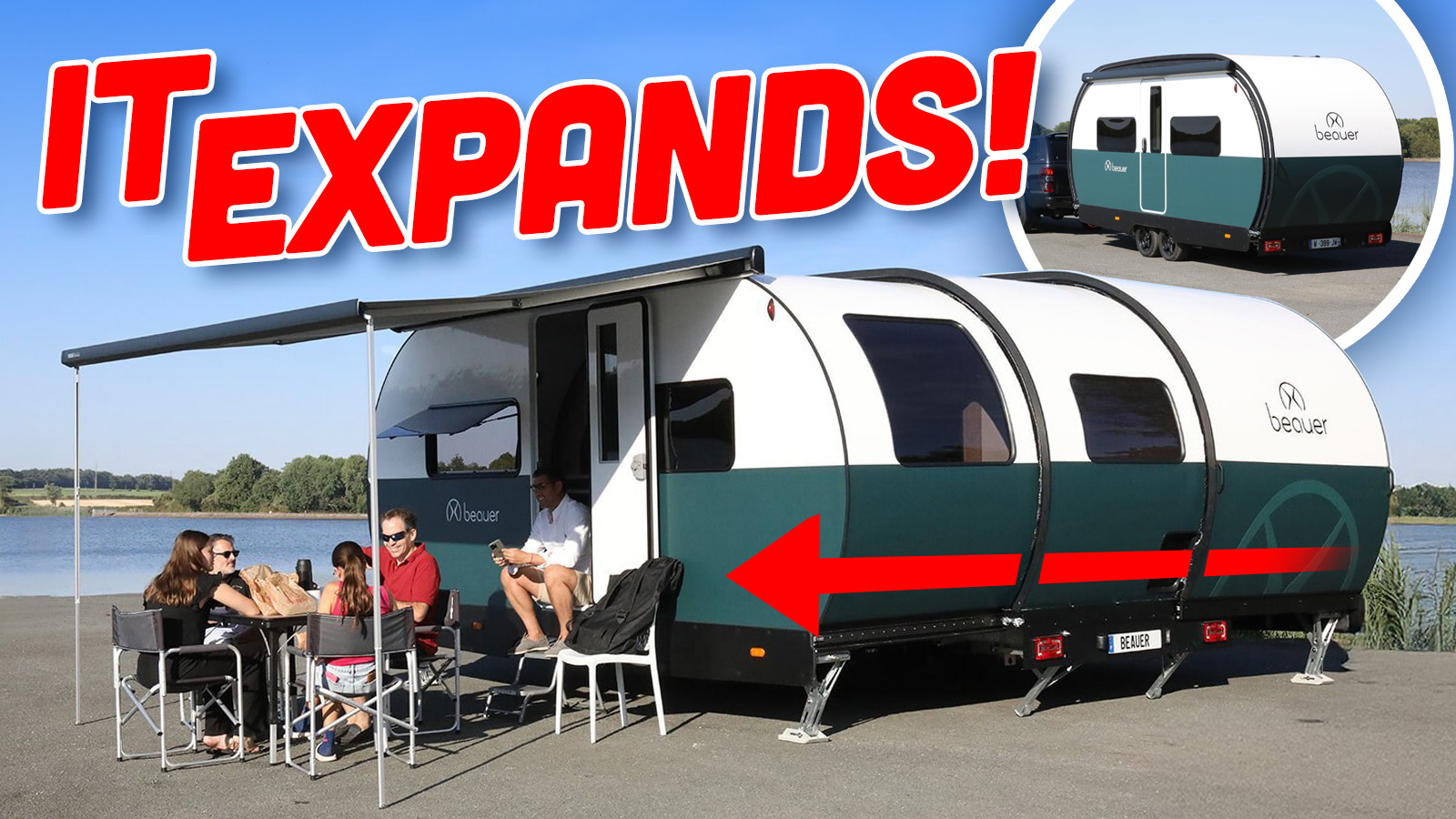
One of the most important inventions in RV history is the slide-out, which has been around in some form or another for over a century. Slides are a proven way to expand an RV’s interior space without making the unit any bigger while it’s on the road. Have you ever wondered what the concept of the slide would look like when taken to the extreme? This is the Beauer X8, and it’s a 21-foot-long camper that triples in width at the press of a button. Despite appearances, this thing will be available in America, too.
The RV world is full of trends, no different than the automotive industry and motorcycling. I’ve been writing about these RV things for about six years now and have noticed some fascinating emerging trends over that time. An increasing number of Americans don’t want to haul around immense travel trailers or fifth wheels. Larger RVs generally cost more to store, to maintain, and to operate. Then there’s towing or driving that leviathan around. That’s not to say that titanic fifth wheels and motorhomes are in danger of going extinct. Instead, it just means that part of the RV market is adjusting to satisfy this new demand.


One of the exciting developments from this trend is the proliferation of more compact European designs on the American RV market. Some importers are just dragging in actual European RVs, while some American RV manufacturers are coming out with European-inspired designs. One of the companies that sells to Americans but doesn’t actually advertise it is France’s Beauer. This company’s whole schtick is taking small campers and making them two or three times their size through a clever slide system that forms the trailer equivalent of a Chinese nesting box.

Beauer has launched its latest travel trailer, and this one is silly, even by American standards. The Beauer X8 allegedly sleeps eight people by roughly tripling in size when it’s parked.
Weirdness From France
I wrote about Beauer last year when its most popular product, the compact 3X, went viral. The Beauer 3X, which expands out to almost three times its size to sleep four people, wasn’t at all a new camper, as it had already been around for about a decade. But the 3X is one of those RVs that’s just perfect fodder for social media algorithms. It looks like some product from the future or like something that AI would make. If clickbait were a travel trailer, it would look like a Beauer 3X.
Yet, unlike everything that’s so fake on the Internet, the Beauer 3X is real. The people at Beauer have even told me that some of them are in America. The first Beauer was shipped here in 2022, and American customer shipments began in earnest in 2024. As of publication, Beauer still sells RVs to Americans.

As for Beauer, it’s been around since 2010 after designer Eric Beau and his dad wanted to build a camper that looked like it came from the 1960s. But more than that, Beau wanted a camper that was big on the inside and small on the outside. To facilitate that, he invented a trailer with modules that nested into each other, creating the first 3X, which was built in Beau’s garden.
Beau’s friends and family asked where they could get their own 3X, and that inspired him to turn the concept of the 3X into a whole business. Production began in 2012 with the 3X. In 2020, Beauer expanded the line by making a larger version of the 3X called the 3X Plus. Then, Beauer’s designers mounted a 3X on a truck, creating a funny motorhome called the 3XC. Beauer later went smaller, creating the 2X trailer.

Today, Beauer has changed its lineup again. The 2X is no longer being marketed, and the 3X has been renamed to the 4X. The company’s new naming scheme indicates how many people can sleep in the camper rather than the camper’s multiplication factor of expansion. The line now includes the prototype 6X, which more or less doubles in size to sleep six, and today’s subject, the triple-expanding action 8X. This trailer appears to be based on the 3X Plus that Beauer announced in 2020, but with a whole new interior and an updated exterior.
Three Times The Camper
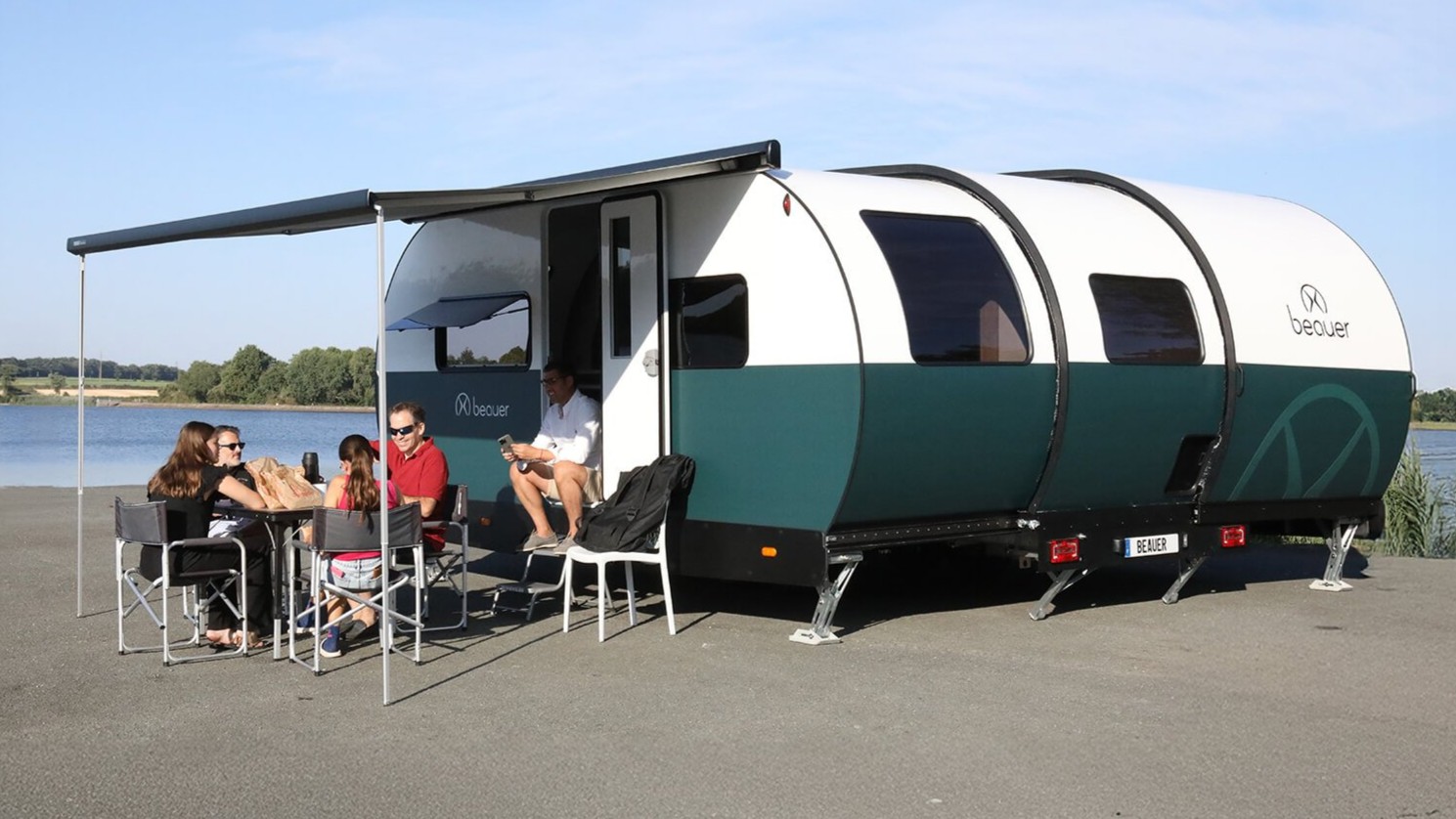
The Beauer 8X starts life as an AL-KO dual-axle aluminum chassis featuring six AL-KO stabilizer jacks and AL-KO shocks. The body on top is a composite, and each section is one piece surrounded by a giant rubber seal. The trailer measures 21.8 feet long, 6.7 feet wide, and 9.5 feet tall in travel mode. At the push of a button, electric cylinders extend two rooms from within the trailer. This process takes about 60 seconds and, in an unfurled state, the trailer becomes 15.7 feet wide. Beauer says that, in their extended state, the additional two modules triple the interior space to 323 square feet.
There is some redundancy baked into the telescopic system. Beauer says that, if the electric cylinders fail, only three bolts hold each cylinder on, and they’re accessible from under the trailer. From there, you can manually open and close the modules until you replace the cylinders.

Something that I have always found neat about Beauer’s campers is how the interior is built. The surfaces and furniture pieces in the trailer are designed to either slot into the pieces in the extension modules or simply move out of the way during the room deployment or retraction. Here’s a video of the 3X expanding, and you can see the interior pieces slide out as the trailer opens up:
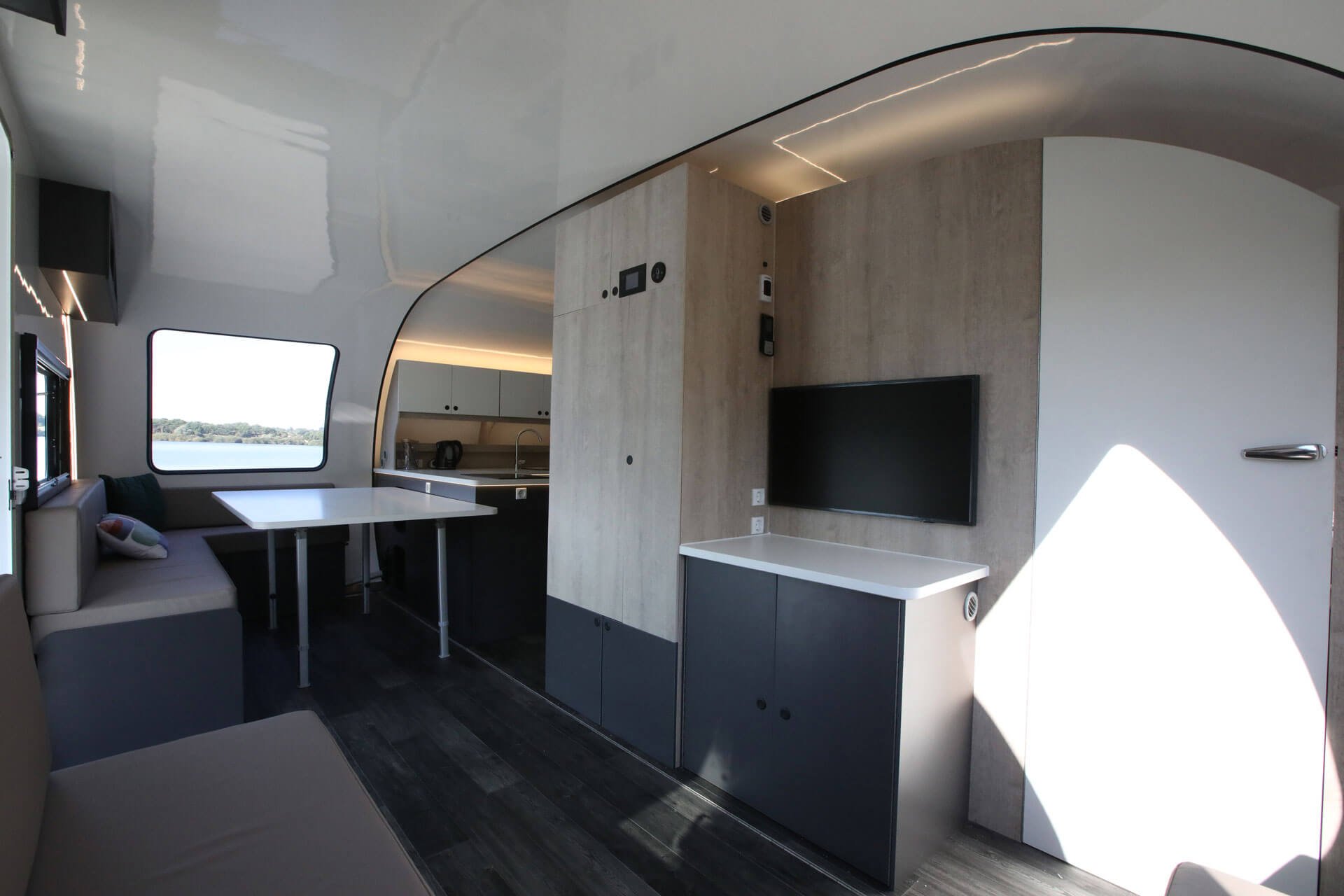
Thanks to this clever system, the Beauer is able to sport two separate bedrooms, a living room, a kitchen, and a bathroom. The trailer’s main layout consists of the two bedrooms in the right-side (from the rear) module, the kitchen and bathroom in the central module, and the living room in the left module.
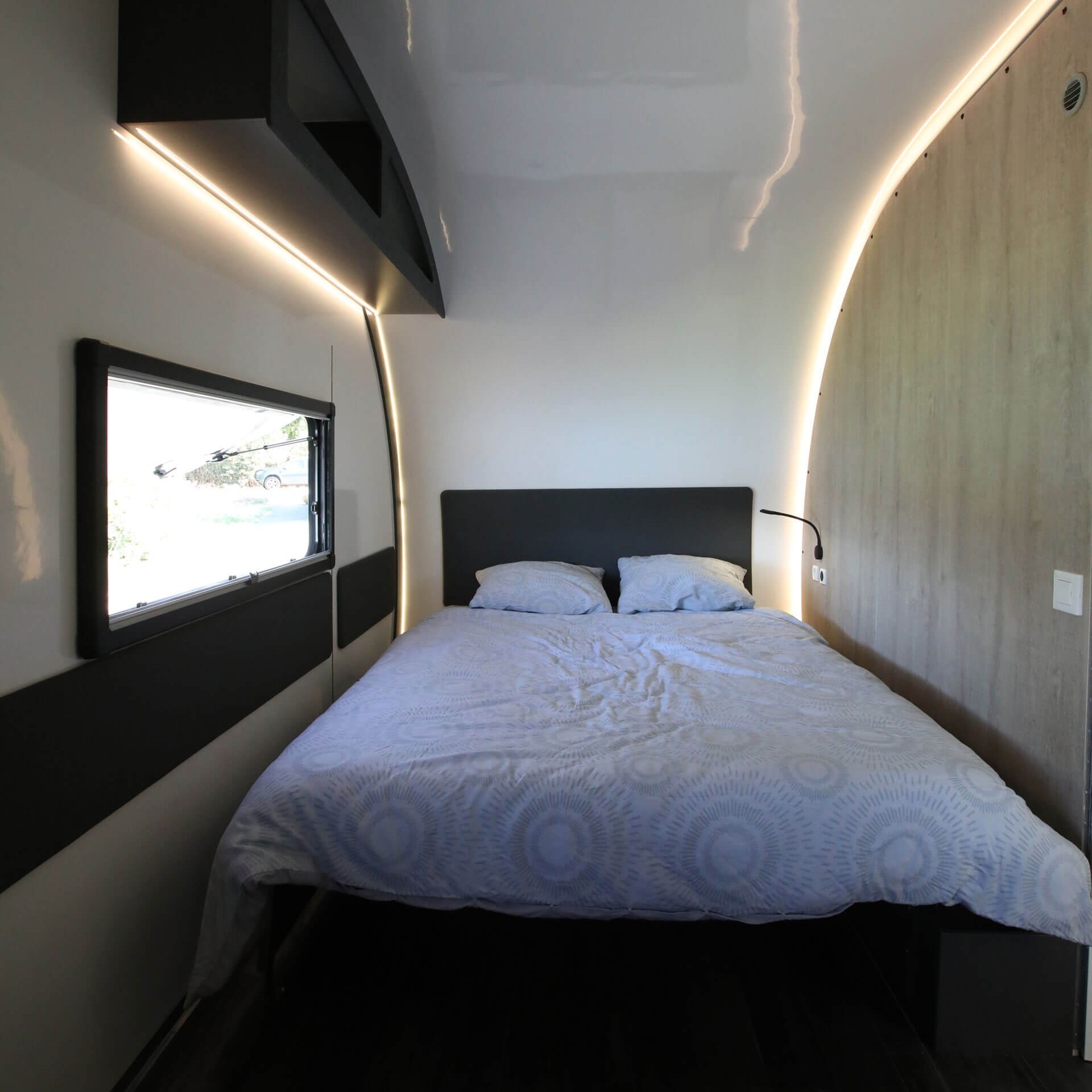
Starting with both bedrooms, each room features its own door, its own storage, and its own 63-inch by 78.7-inch bed. The portals from the bedroom lead into a shared closet in the middle. Beauer says that these two bedrooms are large enough to sleep two people each.
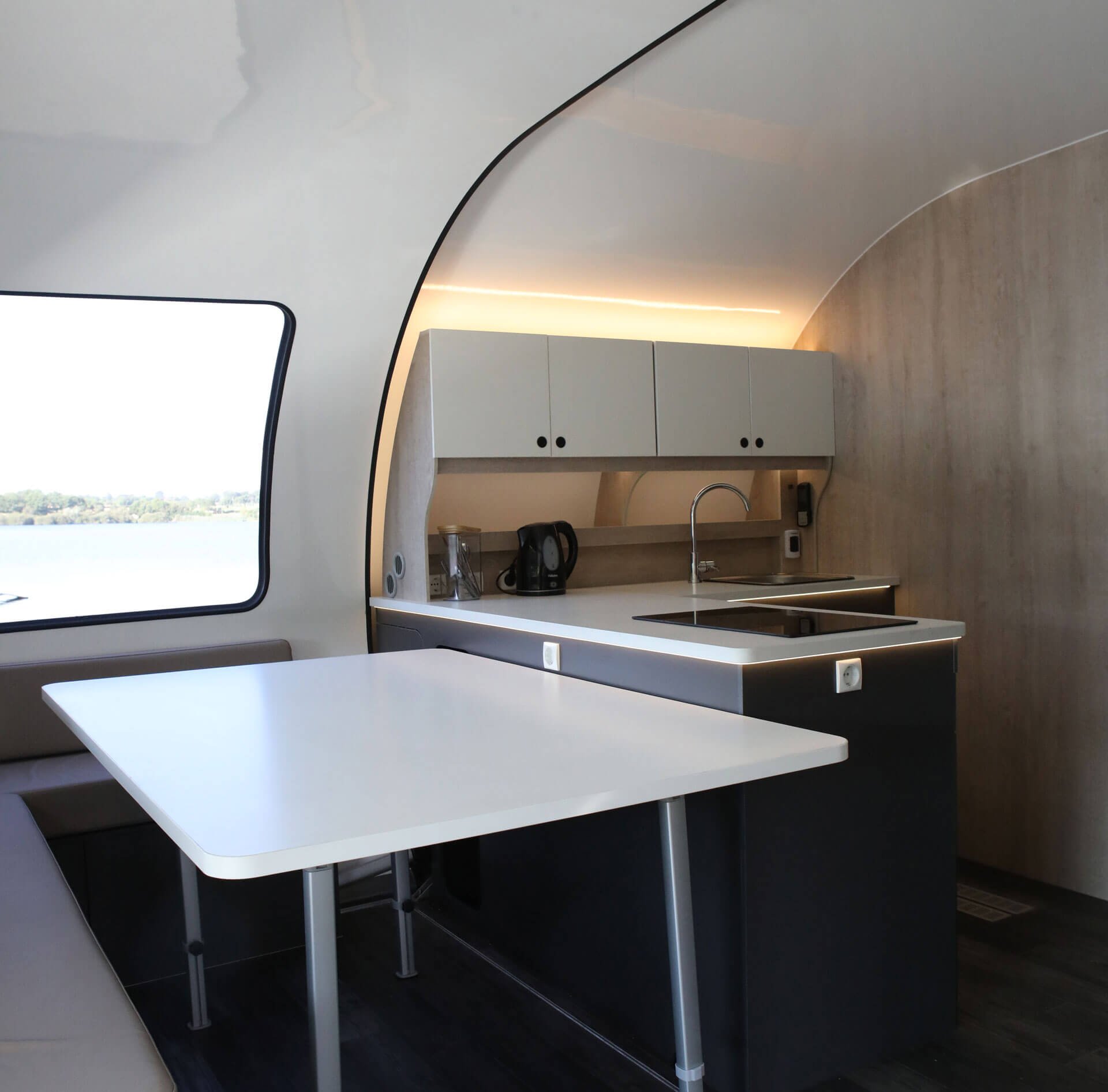
In the center module, you get a kitchen with a sink, a three-burner stove, a 190-liter refrigerator and freezer combo, plus cabinetry. Beauer says that these surfaces feature gray and white finishes, plus a splash of light wood on upper cabinets and partitions. The flooring adds another wood touch.
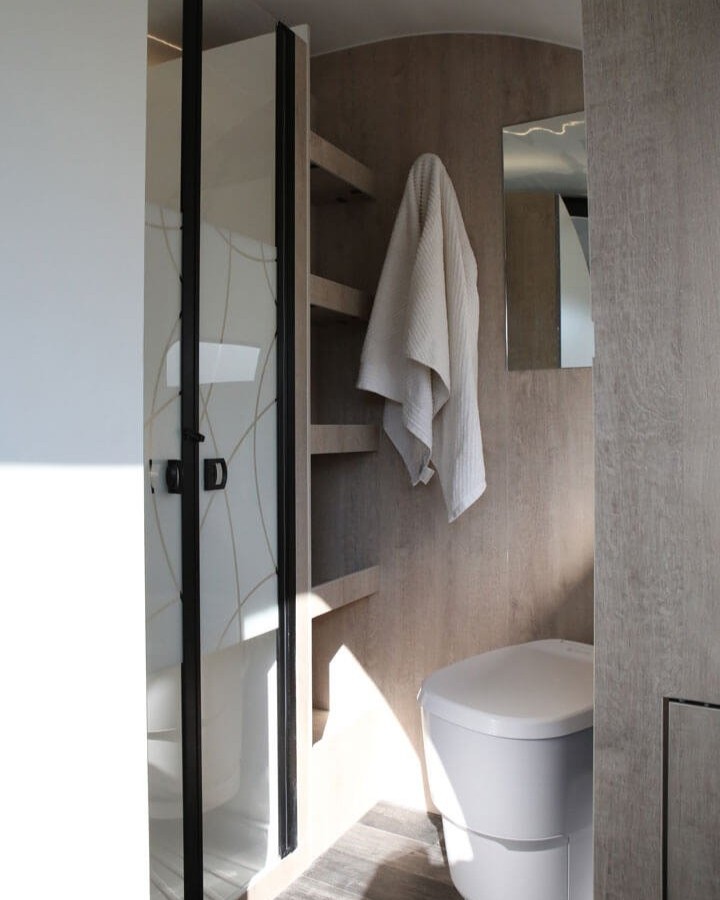
On the other side of the center module is a bathroom featuring a 27.5-inch by 27.5-inch shower, a Thetford cassette toilet, and an optional washing machine. The central module also features an outdoor shower. The water facilities pull from a 14.5-gallon tank and a 6.61-gallon water heater, then drain into a 14.5-gallon gray tank.
Finally, we arrive at the living room, which features a handful of windows, two L-shaped couches, and a coat rack. Both couches, which feature faux leather cushions, convert into a pair of 55.1-inch by 78.7-inch beds for four more sleepers. Eight people in a camper that’s only 21.8 feet long is impressive.
All of this is powered by a 150 Ah lithium battery. Household outlets and USB ports are found throughout the trailer. Beauer says that, for the trailers that get shipped to America, they receive a 115V electrical system, U.S.-style plugs, and a chassis from the U.S. arm of AL-KO.
The list of options is vast. From Beauer:
– 2 × Dometic chassis-integrated reversible air conditioning (heating/cooling).
– 2 × Mover with dual motors, remote-controlled.
– 4 flexible 100W solar panels.
– 13-inch black or gray aluminum wheels.
– Thule Awning, 4.50 m.
– Outdoor Lighting.
– Foam-backed fabric kit for bedroom wall paneling.
– 200 Ah lithium battery (upgrade from the standard 150 Ah battery).
– Reinforced insulation kit with inflatable gasket.
– Full exterior covering in a color of your choice.
– 1/2 Exterior cover in a color of your choice.
– White cabinetry (lower section) and wood (upper section + countertop).
– Safari Room for Thule Sunshade.
– Induction cooktops.
– Gas or electric oven.
– BOB Dishwasher.
– Microwave.
– Television.
– Engine compartment and boom painted black.
– Clesana C1 Eco-Friendly Toilet.
– Heating + 2,000 W Webasto gas or electric underfloor water heater.
– Truma Eezy 1,800 W Electric Heater.
– Fiamma Bike Rack.
– Washing machine built into a kitchen cabinet.
– AL-KO Trailer Hitch Lock.
SIGNATURE OPTION: Choice of colors for cushions and the end wall inside the living room.
The Price Makes An American Camper Seem Cheap
That’s right, the base model does not have heat or air conditioning. Thankfully, both are optional. You would think, then, that the Beauer 8X is affordable. Well, that fancy telescoping system is apparently very expensive. The base price of the 8X is 109,990€, or $127,480 at current exchange rates. This price does not include shipping the unit across the ocean or import duties. Beauer does not say what a loaded example costs.
That price comes with several limitations. Beauer says that if you run your option sheet through the garden, the trailer will weigh 5,732 pounds (empty weight is not quoted). The gross vehicle weight rating of the trailer is 5,952 pounds, so if you get the trailer loaded with nearly the whole options list, you have only 220 pounds left for cargo and gear.

The low cargo weight is really only the start of the drawbacks with this unit. One of the quirks of having an expanding design is that the inner walls of the rooms don’t go fully to the ceiling. That’s not that big of a deal for the bedrooms, but it does mean that the bathroom is technically open to the living room. Now, this isn’t unheard of; both of my family’s campers vent their bathrooms into the rest of the trailers, too. But it does mean that, like my family’s campers, you might not want to unload your Taco Bell into the toilet in a loud manner.
Another potential drawback with the camper’s design is that when the trailer’s compacted for travel mode, the bathroom is inaccessible. That’s not the worst thing, given the abundance of rest areas on American highways. But, if you’re on a long enough stretch and cannot find a bathroom, you have to deploy the trailer’s modules to get to the toilet.

The water tank is barely large enough for one person to use off-grid, let alone eight. So, this is strictly a camper that you’ll be taking to improved campsites. That is, so long as you can find a campsite that has enough horizontal space for 15.7 feet of camper. I have been to many campgrounds with huge sites, so I’m not too concerned about the size. Still, all of these are factors to consider.
Then there’s the U.S. support, or the lack of it. Beauer says that it’s selling units to Americans. The company does zero actual advertising to Americans. You won’t find a Beauer at an RV show. While there is a U.S. importer for Beauer trailers, there is no real service network. If you want one in America, you have to ring up the company’s office in France, order a U.S. model, and have it shipped. I have seen American owners of Beauers reaching out to the company’s social media pages asking for documentation and manuals for their trailers.

What this means to me is that you shouldn’t buy one of these expecting the same experience that you’d get by buying a camper from Winnebago, Forest River, Heartland, or Jayco. Instead, if something breaks, you might be on your own to fix it. Of course, all of what I just stated is a lot to ask for a trailer priced at $127,480.
But if you can put up with all of that, and it is a lot, and then are willing to drop six figures on a camper halfway across the world, you’ll get something that nobody else at the campsite has. I do not doubt that you’ll get non-stop questions wherever you go, and your party trick of expanding by three times will be the talk of the campground. This trailer is basically built for the extrovert.
Given the pricing and the lack of nationwide support, I suspect that I will probably never see one of these in America. Despite that, I adore the creativity at work here. Beauer took a common concept, the slide-out, and basically put it on steroids. Sure, it’s not that practical, can’t carry much weight, and costs more than a Lotus Emira, but it’s so silly I can’t help but give it a thumbs up.
Top graphic image: Beauer


As a Frog, I understand the concept… There’s a lot or roads here in France where one of the American RV won’t even be allowed to go (and if they try, they usually end up with a massive problems), while this trailer will get no problem.
I’m going to give a basic, even if it’s probably edging on the extreme side, example : Ailfroide Camping in the Alps. you can go there with a van, some small RVs (what we call camping cars which are basically modified/slightly expanded vans), and small trailers. Mercedes familly trailer woun’t be able to negociate the road (just the single lane hairpins with jutting rocks on both sides will block it… If it manages to go through the 30m long tunnel, the 90° turn and the small bridge [in that order, and all in less than 100m]… single lane, as even for modern cars (yes just cars) it involves careful crossing the incoming traffic [to avoid hitting hidden rocks on the sides, as there’s barely enough room] )
Yo Dawg, I heard you *really* like trailers, so I put a trailer inside your trailer inside your trailer
Slides. Adding leaks and broken parts to RVs for more than a century.
2 50′ seals to keep those water-tight.
No problem with the precision of French manufacturing.
Huge sites, sure, but huge parking pads to accommodate a 3-wide trailer? In every site I’ve ever stayed in, this would be hanging off both sides of the parking pad (or really far off just one side), which seems like it would cause problems for levelling and door access. That sort of negates a lot of the benefits of having a small trailer. There are probably a lot of places you could park a 40 foot 5er that this won’t fit in.
I don’t hate the layout as much as I thought I would though. They seem to have wisely filled the center section with a lot of cabinet storage, which is always one of the complaints with expanding trailers of any sort. But there are so few places I could park this that even if I were looking for a six-figure+ trailer I don’t think it would be on the list.
This is a legitimately cool design, but that price is… a bit much for the average buyer.
I love it. Seems like there are SO MANY failure points that purchasing one would be an insanely poor idea, but I do love it!
Who has worse build quality? The French or Thor Industries?
(That’s not sarcasm, that’s an actual question)
legit question – probably Thor though…
I liked the little one, thought it was a great concept, the flat-roof makes me pause though, should have some curve for water-run off.
There’s totally a market for this, and I wish I was part of it. But that’s too expensive for my tastes.
I can always haul extra water and a grey water dump container.
a great idea but only worth the price if storage space is at an extreme premium. For that money better come with a long warranty given all the complexity.
I grow weary of trailers that give you little spare room for cargo weight. This is a solvable problem–just make the chassis, suspension, towing and related a little stronger. So it’s extremely annoying when the limits are so tight.
This is a bigger problem for boondocking. Often when you tank up with water you have little room for much else. Super big problem.
“. The base price of the 8X is 109,990€, or $127,480 at current exchange rates.”
Ouch.
I think I’ll stick with my tent… and/or stay in hotels/motels.
If I were to take a 2 week vacation every year in a $200/night hotel or motel, that’s $2800/year.
And that means the payback for this is… FOURTY FIVE YEARS… if I live long enough to see that breakeven point.
Yeah… I’m gonna stick with using tents.
My tent camping days are behind me, 3 upper GI surgeries mean a bathroom is ideal, and I want to go where hotels aren’t.
But this is still about 100k too rich for my blood.
Solution… separate bathroom tent with a portapotty.
Either that or a separate bathroom tent and a bucket.
LOL
Tent camping behind me and the GI issues are two separate statements.
I desire:
-A real mattress
-A bathroom
-Refrigeration
Not having to set up/tear down a tent is just a bonus.
“-A real mattress”
No problem… we can get you a real mattress right here
We can even get you some satin sheets for the bed.
“-A bathroom”
Have you covered right here.
“-Refrigeration”
Oh look at Mr Fancy!!! Well okay… We can set you up with a portable fridge that plugs into the 120V outlet your BEV or Plug-in hybrid has.
“Not having to set up/tear down a tent is just a bonus.”
I have a hunch that you’re not truly into the ‘camping’ thing.
LOL
I fail to see why I need to sleep in a tent to enjoy the outdoors.
“I fail to see why I need to sleep in a tent to enjoy the outdoors.”
Yeah… you’re right! Just throw the air matress on the ground and just sleep out in the open!!
As for your spine… we need to tell your spine to stop being such a slacker and pull his bootstraps up!!!
I’ve always found it odd the gatekeeping of “it’s not camping unless you suffer.”
Brother, if I’m spending the day hiking or canoeing or rock climbing, I want a real sleep back at camp so I can actually recover and do more things the following day.
Or even after driving there in the first place.
The better rested you are, the more you’ll enjoy your vacation.
I’m just joking and I totally understand.
An air mattress is not a real mattress. My spine has reminded me of this every time I’ve used one.
most campgrounds have cabins
Wife wants to do provincial parks across the country. While some have cabins, they’re more suited to “this location is our only stop this trip”
What happens if you accidentally push the button and compact the entire family?
No more Ozempic needed!
Genius!~ Instant savings…
I’m guessing that the motors have an overload switch, so if any significant pressure is exerted on them, then they will go into error mode, like your garage door. Of course this will cause all kinds of problems when the pivot points on all of that folding furniture start to age.
Or- maybe the motors go into overdrive and the family still gets cubed.
Don’t threaten me with a good time.
To support this comment, smash that “like” button if you like your family to be smashed.
Horrors! LOL
Don’t just stand there. Try and brace it with something.
I find it very funny that Beauer’s official images of it being used are people “camping” in a… parking lot? Boat ramp? What an odd location for an official photoshoot. Do they even have any pictures of it being used at an actual campground?
“What this means to me is that you shouldn’t buy one of these expecting the same experience that you’d get by buying a camper from Winnebago, Forest River, Heartland, or Jayco.”
I’m confused? Are you saying I should expect a good buying and service experience then?
Woah, let’s not get carried away, the RV industry has standards.
I’m not sure that they do.
They have them, they aren’t high standards
Do they have standards? Yes.
Would those standards require having MSHA Part 48 (Underground Miner) training to reach them? Also yes
That’s interesting but I prefer the Chinese expanding two story RV. The Feixiang FX RV S800. It seems like it would be less likely to break in a catastrophic way and way less likely to leak.
Is there any other way?
Triple your chances of a leak.
Yeah. I am going to be interested to see what happens to these after 10 years of use. I mean normal RV’s with slideouts already have enough issues.
So doing the math.
Camper – $127,000 (base)
F150 Lariat – $77,120 (with towing features and the nice audio system)
Total – $204,120
I just don’t get RV/Camper life.
Do you not have that F150 Lariat already for commuting-on-flat-roads & child-learning-to-drive reasons already?
It’s effectively a given.
I own two Honda Civics, so; No.
I’m so far from the demographic this would appeal to it’s almost comedic.
You would be more in the demo for an Excel II camper, you can tow those with a Civic, easily
I can’t imagine spending a weekend as a family of four in this.
Its for two people, kids can go in a dome tent outside. Although, I think they used to offer an add-on room attachment that doubled the floor space
It just looks so sad though. Like if Eeyore was a trailer.
Order a brighter color
Color isn’t the problem, it’s just so droopy. Like it’s already ten years old.
That’s just how it is. I think the design dates to the 1960s and hasn’t changed much, originally a Danish company (Combi-Camp), but they don’t seem to have protected the IP very well, because a bunch of different companies all built the same basic design at different points over the past few decades
That looks like a motorcycle trailer.
Hold on a minute, don’t get the F-150! Clearly, you just need to attach the two Civics together, and then the trailer to the Cciivviicc. Boom, problem solved!
Side by side, naturally.
That is why IMHO…. my small 1996 Tacoma with aluminum camper top is the most ideal. Throw in a futon mattress and all the other crap and go. Pull up to the camp site and you’re all set. And no need for the heat as your body heat does it for you.
Can you make sure you’re at least three campsites away with that username?
This is why I’m doing it with my Excursion ($9500) and a trailer from the neighbour ($2500)
The math is a lot more logical at my end of the spectrum.
Honestly, even a 10K Excursion seems like decadence to me.
I mean, it’s $6700 after conversion to AmeriBucks. That’s about as cheap as you can get for a tow rig that doesn’t have reliability problems.
But it was much cheaper to buy a $9500(CAD) truck than a $70k truck. So it’s what I got.
Ambitious idea. But rvs already age poorly and depreciate like a cannon ball fired at the ground from a clifftop. Curious to see how well these do (or do not) work after a decade.
How wide is an RV spot at a national park campground?
Probably not this wide. This seems designed for those open lawn European style “campgrounds” or KOAs over here.
I’m not spending 100 grand to stay in fucking KOAs.
No, don’t you see? You just have to jackknife your trailer so you can park it perpendicular to the parking spot’s orientation so the slideouts can slide out. And then you get to do it all over again when you try to leave.
Easy peasy.
Genius!
This. Not only a national park, but any state park, KOA, etc. Outside of “overlanding” (and I’m still not entirely sure where you can do this outside of Utah/Nevada) I don’t think you could realistically deploy this thing anywhere outside of the parking lot in the promos…
I mean – I know zero zilch about RV-ing.
This thing is probably not much wider than any large US monster that expands. However, it will be shorter.
Do the large expanding ones need larger RV spots? Is there such a thing as a large spot or a smaller one, with the matching price difference, on the different types of campgrounds?
Campsites have RV spots, usually designated as such because they have electricity and water hookups. They are also usually longer, because RVs and trailers are long.
Most RV slideouts do not triple the width of the RV, because again, they are already long. They usually add maybe 8-10′ of total width maximum, and that’s if the RV has sliders on both sides. Plus those sliders are elevated from the ground, making the parking space footprint effectively 0′ extra from non-deployed.
The national parks I’ve camped in (which isn’t many) definately wouldn’t fit this.
The New York state campgrounds I’ve stayed in (which mostly don’t have powered sites but these days mostly have hot showers) would fit this pretty easily. So YMMV
Depend on the park and a lot of times campsite to campsite.
Any campsite that can hold a A or C class RV with slides can accommodate this trailer. However, you might have to unhook and spin it 90 degrees before extending the slides.
Lol, spinning this monster by hand is not happening. So that means $4k in a trailer valet. Yet another thing to tote and keep the battery charged.
European RVs tend to be light because of their licensing laws.
The largest one is 2,600 kg with a 100 kg payload.
The smallest one is 1,200 kg with a 150 kg payload.
Still not happening. I have a 1600 lb (725ish kg) camper. Moving it around by hand on flat paved ground is possible but needs two adults. Add in gravel and it’s not happening. A camper about double the weight won’t do it with two people.
Like they say, your mileage may vary. My parents’ boat is more than double the weight of your camper and we move it around their garage without a powered pusher.
Gravel is a problem. That likely would require some help from the tow vehicle and a tow bar.
https://www.amazon.com/dp/B0F2J3NCZ9?lv=shuf&channelId=500&plpRedirect=mhFallback&th=1
I like the X4, that seems the right size for the niche they’re trying to fill. When deployed it’s length x width isn’t too different as a regular 5th wheel so may fit in camping spots better, but much easier to transport, most mid-size SUVs could tow it. It also may actually fit in some garages for better storage out of the weather.
Do RV owners have a fetish for things that break, leak and mold in their own driveways?
Obviously, yes.
Based on how much money my parents have spent fixing water damage? Yes!
Thankfully this one’s not built in Indiana.
I don’t need an RV for that.
I prefer to refer to RV owners as mobile masochists.
Definitely an interesting way to do that. Just thinking of the state campgrounds I stay at with my RV, going wider might be a little problematic. The sites are usually setup deep rather than wide so getting enough level-ish ground for all that plus avoiding firepits and tables might be tricky. Still neat though.
It’s an interesting solution to the need for maximum deployed space with minimum storage space. I think you would want to deploy the slides as infrequently as possible to stretch out the life of the rollers and bearings, because they can make the pistons simple to replace but the internal components will probably be a major/expensive pain to work on. I’d be blasting white lithium grease into every part I can reach before closing the camper down for transport.
Bearings like to be rotated on occasion, or the grease gets sticky and they slide instead of spin, which develops flat spots.