

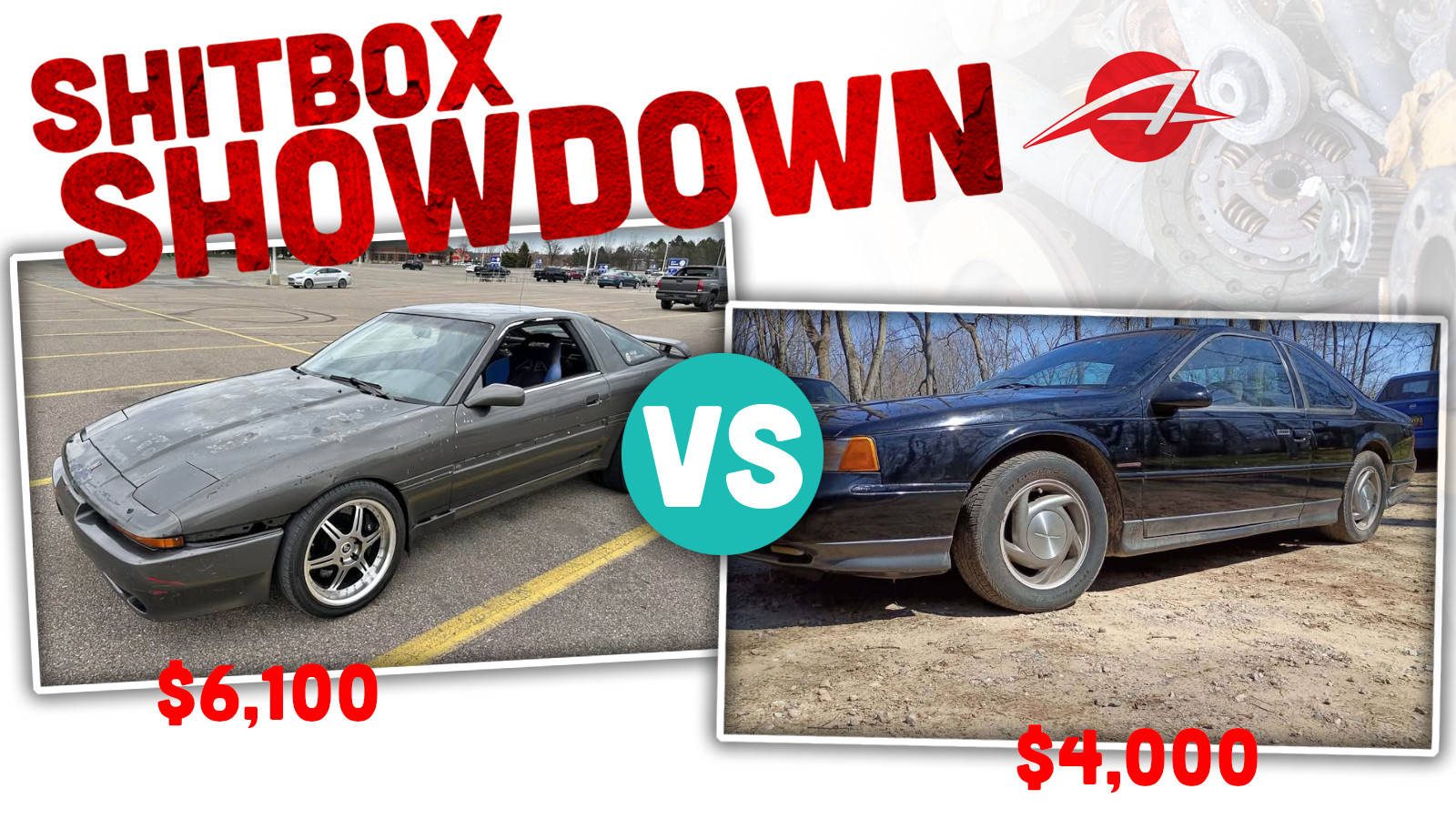
“There’s no replacement for displacement,” the saying goes. But we all know that isn’t true; there are lots of ways to make a car go faster that don’t involve increasing the engine size. Forcing more air into an engine is a time-honored approach that both of today’s competitors use. They just pressurize the incoming air in different ways.
Yesterday was a weird one, I know, but I wanted to write about both of those vehicles, and neither of them fit with anything else. That’s the way it goes sometimes. More of you wanted to play with an old fire truck than finish someone else’s project, and the big red Chevy took a pretty decisive win over the half-ute-converted Beetle. I loved some of the suggestions for what to do with the fire truck too, especially the idea of converting it into a giant BBQ smoker. Once it fought fires; now it encapsulates them and uses them for good. It’s perfect.


But I think that if I were choosing one for myself, I’d take the Beetle ute. I’ve always been curious about the Smyth kits, and this one has the hard part (the cutting) already done, and the leftover metal pieces already disposed of. Putting it together might be kind of fun.

You all understand the difference between turbochargers and superchargers, right? Just in case, I’ll go over it really quickly: A turbocharger uses the engine’s exhaust gas pressure to spin a turbine. The other end of that turbine pulls fresh air into the intake side of the engine. A supercharger, on the other hand, is a mechanical air pump that does the same thing, but is driven by a belt running from the engine’s crankshaft. In both cases, the engine is force-feeding itself more air, which creates more power. One of today’s cars came from the factory with a turbocharger, which has been replaced by an even bigger turbocharger, and the other came with a supercharger, and has had its head gaskets replaced. Let’s check them out.
1988 Toyota Supra Turbo – $6,100

Engine/drivetrain: Turbocharged 3.0-liter DOHC inline 6, five-speed manual, RWD
Location: Westland, MI
Odometer reading: 134,000 miles
Operational status: Runs and drives well, needs a few things
The Toyota Supra started out as not much more than a Celica with a six-cylinder engine and a nose job, but by the time this third generation came around, it had evolved into a full-fledged grand touring coupe, with a roomy interior and elegant styling. The inline six remained, but now it was offered with an optional turbocharger. For many second and third owners, even the turbocharged engine wasn’t enough, and they turned to the aftermarket to create some truly audacious power numbers – but in the process lost the elegance and good manners. This appears to be such a car.

The Supra Turbo’s engine – 7M-GTE in Toyota-speak – is a 3.0 liter twin-cam unit making 231 horsepower in stock form. That was a serious number in the late ’80s, but of course it’s minivan horsepower now. This car’s engine has gone a bit beyond that. There’s a laundry list of high-performance parts in the ad, along with a claim of 500 horsepower. Take that number with a grain of salt, of course, but suffice it to say this isn’t a slow car. It does have a power steering leak that needs addressing, and it sounds like it could use higher-flow fuel injectors to really take advantage of the other go-fast parts, but the seller says it drives well as it is.

The Supra was a really nice car inside when it was new; I had a neighbor who owned one, and I got to ride in it a couple of times. This Supra is nothing like that car, unfortunately. The comfy seats have been replaced with racing seats and harnesses, most of the trim is removed (but included, thankfully), and it has a bunch of add-on gauges and an absolute travesty of a steering wheel. If this is your scene, more power to you, I guess, but I would much rather see a stock Supra interior.

It’s in reasonable shape outside, but not great. The paint is pretty bad on the hood, it’s missing some trim, and there are a couple of small rust spots. It has aftermarket wheels, but those are unavoidable on a car like this. The original wheels would have looked better, but they probably went to the recycler long ago. It still has that perfectly-proportioned wedge shape, though. I’m not sure Toyota ever sold a better body design than this.
1991 Ford Thunderbird Super Coupe – $4,000

Engine/drivetrain: Supercharged 3.8-liter OHV V6, five-speed manual, RWD
Location: Jackson, MI
Odometer reading: 140,000 miles
Operational status: Runs and drives well
Ford’s Thunderbird more or less created the personal luxury coupe category. For years, it just kept getting bigger and fancier, never a high-performance car, but never really slow, either. Like so many other cars, it reached its nadir in the late 1970s and early ’80s, first as a giant baroque monster and then as the most forgettable version of Ford’s Fox platform. In 1983, Ford abandoned the opera windows and hidden headlights and brought the Thunderbird into the modern era with a sleek new body design, though still based on the Fox platform. Then in 1989, a whole new Thunderbird appeared, with classy styling and independent suspension all around, and an available supercharger.

Ford’s 3.8-liter Essex V6 already had a reputation for weak head gaskets, and unfortunately, the supercharger only made things worse. I have heard a lot of stories of head gasket failures, and warped heads, on Thunderbird Super Coupes. This one has recently had its heads resurfaced and its head gaskets replaced, along with a bunch of other work, and it’s now ready to roll. Super Coupes are also hard on their automatic transmissions, but you’ll have no such worries here: this one is a five-speed stick.

Like the Turbo Coupe before it, the Super Coupe has a much sportier character inside than your typical old-person-oriented Thunderbird. It has big bolsters on the seats to hold you in place around corners, and a blessed lack of fake woodgrain. This one is in pretty good shape, but it looks like the radio is missing, judging by the wires hanging out of the dash. Also, I should point out that the first few years of this era Thunderbird came with motorized seat belts. Sorry.

The photos in this ad aren’t great, but from what I can see, this looks like a really original Super Coupe, with all its ground effects and original wheels intact. It has a few flaws, but nothing out of the ordinary for a well-kept 140,000 mile car. The seller helpfully includes a couple of under-car photos, and it looks really clean under there. No rust worries here.
Two-door coupes are getting hard to find these days, unless you want a Mustang, but when these two were built they were very much in demand. Both of these cars were available in lesser variants, but these are the ones everyone wanted back then. Now, thanks to time and depreciation, they’re way more within reach. Which one is more your style?



I was going to pick Supra from the small photos on the main page (easy win!) but then opened the story and actually saw it. Woof. That thing has been ridden hard and put away wet. Super Coupe, please. I liked those.
Around these parts the locals love their American trash, so the Birdie wins this one!
Ooof… In stock form, the Supra is easily the better choice. But as is, I’m… I’m reluctantly leaning towards the T-bird. The lousy engine & automatic seatbelts really turn me off, but it’s a manual, and I could see a half cage and a 5.0 in its future. And you don’t have to worry about Bubba da Ricer’s half-baked mods.
“I did all these cool mods and now I’m selling it after 2500 miles…but trust me bro, it is running nice”.
Those MN12s were magic carpets. It got my vote today. But if the Supra had had t-tops it would have been a different story.
i am going for the Supra despite the fact that it’s been monkeyed with. I have always wanted one and it’s the best Supra. The Ford has a cool intercooler pipe though. I could put that one on the Supra as a turbocharger boost pipe.
Supra for me. both have pros and cons, but the Supra is still more attractive to me. an 88 Turbo Coupe T-Bird in really good condition might sway that way I suppose.
Yeah, no wrong answer here, but I’m a sucker for that gen Supra.
Another day of, “why not both?”
Since I have to make a decision, I’ll go with the Supra and rescue it.
They are both rusty Michigan cars. At least both owners took pictures underneath.
The Super Coupe wins by a mile. It appears to be unmolested, is in way better shape, AND it’s less expensive. That rolling pile of Pep Boys trash Supra ain’t worth the gas in the tank.
Definitely the Supra. Even if you managed to blow the 7M again (yeah, even with the headgasket retorqued) the car has what appears to be the bulletproof R154 5 speed transmission which is worth nearly $3,000 on its own if you opted to part the car out instead of fixing it.
If stock, I would honestly go Supra. Already owned an MN-12 ‘Bird. As shown and priced, Thunderchicken all day.
Unfortunately, I would be embarrassed to drive that Supra in public. T-Bird for me.
If the Supra were unmolested, that would have been my choice. But I’ve always liked the Super Birds so the vote wasn’t too hard today.
The maintenance required to keep SuperCoupes running makes this T-Bird a ticking time bomb.
On the other hand, the Subaru is a grenade with the pin lying on the ground.
I’m surprising myself with a Thunderbird vote.
Pretty sure that’s a Lambo, dude.
I had a boss who had a Super Coupe. Both he and the car were terrifyingly fast. His was a stick and he enjoyed driving it how it was meant to be driven. The car was pretty competent on big sweepers and its ride wasn’t abusive. One of Ford’s best efforts in that era, IMO.
OTH, that poor, poor Supra.