

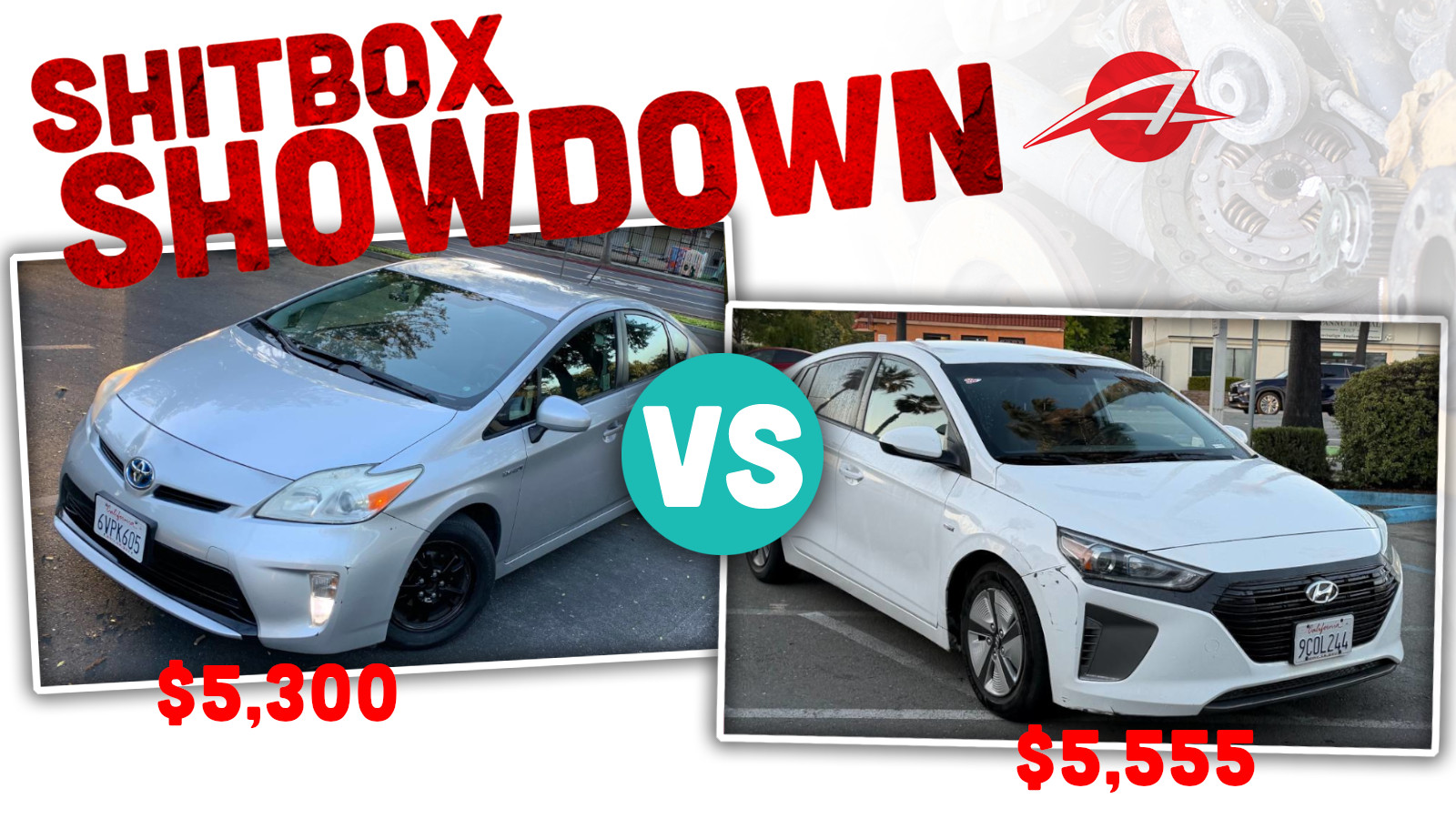
Small cars are a great way to save money on gas, but these days, there’s a better way: hybrids. By combining a small gasoline engine with an electric motor, you can get decent performance out of a larger car while clocking some truly impressive fuel economy numbers. Toyota was first to popularize this setup, but since then, other manufacturers have joined in, and now there are lots of choices. And they’re starting to depreciate down to cash prices, so they’re fair game for us here.
I don’t think I impressed very many of you with yesterday’s choices. Big blobby crossovers are no one’s cup of tea, it seems. Still, they got you talking and voting, so I call it a win. The Mazda CX-9 took the win by a large margin, despite its higher price tag and higher miles. It seems the reputation of the Buick’s 3.6-liter engine preceded it.


The Mazda is definitely the smart choice here, it seems. As fond as I am of GM vehicles, I recognize an overreach when I see one, and that High Feature V6 is just too far outside GM’s wheelhouse. Cast-iron pushrod engines that only rev to 5,000 RPM and run forever a quart low on oil, that’s GM’s forte. For cool, clever, high-tech engines, I’ll trust Mazda more.

For inexpensive, well-used hybrids, I figured the best place to shop would be the San Francisco Bay area. I had to include a Prius, of course, but I also found one of its rivals with a very similar form factor. They go about the whole hybrid thing in a different way, though, so the driving experience is probably a bit different. Is one better than the other? That will be up to you. Let’s take a look.
2012 Toyota Prius – $5,300

Engine/drivetrain: 1.8-liter DOHC inline 4 plus electric motor, CVT (kinda) automatic, FWD
Location: San Jose, CA
Odometer reading: 208,000 miles
Operational status: Runs and drives well
Here is a car that needs no introduction. The Toyota Prius has been so successful at spreading the gospel of hybrid cars that “Prius” is practically synonymous with “hybrid.” It’s almost like Kleenex or Q-Tips. It’s been around for more than twenty years now, gradually improving with each generation. The Prius not only has a reputation for excellent fuel mileage, but also damn near eternal durability. This third-generation Prius has more than 200,000 miles on its odometer, but it still has plenty of life left.

It was only a few years ago that I got interested enough to understand how Toyota’s hybrid system works. It’s absolutely elegant in its simplicity. You have the engine on one side, the electric motor on the other side, and a differential gear between them, so that the engine and motor can rotate at different speeds. They both can send power to the front wheels, and the motor can also act as a generator to charge the battery. A computer controls the whole thing. There isn’t much to go wrong, which is always the best way to keep a system reliable. This one runs and drives just fine, according to the seller.

The photos of the interior aren’t great, but from what I can see, it’s in decent shape. It has some extra seat cushions you may or may not want, and a fuzzy cover on the armrest that’s probably covering up some cracks in the vinyl. The seller doesn’t give a lot of details about the functional condition of the stuff inside, but it’s a Toyota; I’m sure it all works fine.

Outside, it’s silver. Of course it is. Did these even come in any other colors? The black wheels aren’t original, and personally, I’m not a fan. It has a few scrapes and scratches, but nothing worth mentioning for a 200,000-mile car. The Mystery Spot bumper sticker is a nice touch.
2019 Hyundai Ioniq Hybrid – $5,555

Engine/drivetrain: 1.6-liter DOHC inline 4 plus electric motor, six-speed DCT automatic, FWD
Location: Fremont, CA
Odometer reading: 189,000 miles
Operational status: Runs and drives well
Hyundai has been a big name in electric vehicles in recent years, but it all started here, with the Ioniq. It was available as a hybrid, a plug-in hybrid, or a full EV. What we have here is the standard hybrid model. It’s a five-door hatchback, just like the Prius, and it actually looks a little like it as well. I guess if you’re going to copy someone’s homework, you may as well copy from the head of the class, right?

I’m not sure exactly how Hyundai’s hybrid setup works, but it’s different from Toyota’s. Instead of a single-speed planetary gear reduction like the Prius, it uses a six-speed dual-clutch transmission. The engine is a 1.6-liter four-cylinder from Hyundai’s Kappa line, and together with the electric motor, it sends 139 horsepower to the front wheels. It gets even better gas mileage than the Prius. This one has 189,000 miles on it, and the seller says it runs and drives fine. The seller is a dealership, so we don’t get any more info than that. Best to have it checked out by someone who knows these cars, just to be sure.

The interior of the Ioniq is a little more conventional-looking than the Prius, which I prefer. I’m not a fan of Toyota’s center-mounted instrument panels. It has really interesting seat fabric too, which is something of a Hyundai tradition at this point. I don’t know why there’s a cover on the passenger’s seat and not the driver’s; it’s a little strange.

Even if a dealership can’t or won’t disclose information about a car’s past, sometimes you can tell just by looking at it what sort of life it led. This Hyundai has been around the block and bumped into a few things along the way. It has dings and scuffs all over. It’s not unusual for a city car to have a few battle scars, I suppose.
I personally wasn’t sold on the idea of hybrid cars at first, but they have proven themselves reliable and durable over the years, and you can’t deny the fuel savings. The Prius is the gold standard, but it’s a bit weird and comes with some baggage that you won’t find in the trunk. The Ioniq is not as refined, from what I’ve read, but it gets even better mileage, and it’s less famous (or infamous), so you can fly under the radar. Which one would you pick?


if the Ioniq didn’t have nearly the same miles as the Prius, I might lean newer. But at almost 200k? We’re going with the Toyota product
Prius all day every day. I put about 220k NY/NJ miles on a gen 2 Prius and it was an amazingly versatile car. In the end it died a death of a thousand cuts – needing 12v battery, tires, body work at both the front and rear, burning oil, and the dash combo-gauge failure repaired. Pre-Covid when we could replace it with a decent car for decent money it just didn’t make sense to fix everything. Mine was a Touring and had relatively attractive alloy wheels under the hubcaps and I am pretty sure those wheels are stock for the gen 3. If you don’t like the look I am sure you could get new hubcaps and still be under the price of the Hyundai.
Prius, however I wanted to like the Hyundai, too much damage, our Niro has the same powertrain and its bullet proof!
The Ioniq may be/probably is fine but the Prius is a surer bet. Sale by owner should/could lend a little more intel on the history too. The difference in condition inside and out just firms up the choice.
There are some fleet management entries in the Hyundai’s attached Experian report that mention “Mount Laurel, NJ” and what looks like a water (one hopes) stain on the back seat. The ad says nothing about easy financing, but the Prius has only two owners in its past and maybe 10 percent more miles, so that seems the best choice.
There’s no objective reason to avoid the Prius.
Toyota it is.
I have heard that this is one of the less reliable Prius generations. I forgot what major repair my friend just paid for, but it was over $1,000. That said, maintenance up to that point was low.
Had a white Prius. Wife drove it for years and except getting sandwiched sitting at red light it went forever. Replaced front fascia and rear bumper and it kept on chugging. Only sold it because my wife eventually wanted something different, which she regretted. You can haul a LOT of stuff in it. I’d do another Prius that vintage in a heartbeat.
The Hyundai? Pass.
Me neither. I wouldn’t be happy with any vehicle that had that, even if it was the logically better option.
I cannot remember if this is one of the oil disappearing Hyundai/Kia motors so I voted for the prius.
I’ll take the Ioniq – for the simple reason that it
‘s not a Priusdoes not have black wheels.I think those are just the alloys that lived underneath the plastic wheel covers, for aerodynamics. A replacement set should be cheap/easy to find.
For the ultimate fuel economy winner combine both: small car + hybrid.
Knowing nothing of the Ioniq’s reliability, Toyota seems like the easy choice.
I’ve put a few thousand miles on one of these generation Prii. I put about a thousand miles on a rental Ioniq once as well.
I don’t know what the longevity/reliability of the Ioniq is, but in my experience it was a very comfortable car and put together well. I think you could do a lot worse for that kinda cash.
The Prius is a Prius. You’ll do without some of the tech and comforts, but probably for another 100k miles.
I picked Ioniq but (disclaimer) without researching maintenance issues.
A 200K mile Prius or a 200K mile Hyundai?
Bender put it best:
Hahahahaha! Oh, you’re serious. Let me laugh harder HAHAHHAHA!
The Prii is a Prii, and was pretty much sorted out by this point. You can also do lots of things with these now. I don’t think Hyundai was hitting its stride yet, especially as I don’t think I’ve ever seen this version of the Ioniq. Even if it wasn’t West Coast only, there can’t be many of them.
7 years newer for under 200 more. Not really a tough choice.
Covers on the passenger seats and not drivers? Almost certainly an uber/lyft to provide a fart (or other various fluid/spill) barrier. IN my experience, that means the tires are shot, the suspension is beat to shit and it’s been driven horribly for the majority of its mileage. I’d take the Prius.
I was thinking it was a rideshare myself. And it’s either aged/mileaged past their standards, or it was DQ’d because the exterior bore the scars of one too many love taps.
That was my first thought as well. My second thought was that they took the seat cover off the driver seat to show it wasn’t completely worn out (which is what I assume when a car is listed with seat cover).
Same thought, but why show off the stained back seat then? Could just be water stains on the base fabric but I don’t want to investigate further either…
I wouldn’t be at all surprised if both of these cars had been taxis.
I wanted to find a reason, any reason, to vote for the Hyundai, but that poor car looks like it was rode hard and put away wet. On the other hand, the seat fabric is cool and I do like my gauges placed directly in front of me.
But even with the higher mileage (it’s not that much higher), and being seven years older, the Prius is the better buy here, imho.
“I wanted to find a reason, any reason, to vote for the Hyundai,”
The wheels! Look at the wheels!
I don’t doubt that I would prefer the drive of the Ioniq over the Prius every time, and the stupid central gauges piss me off, but it’s a high mileage Hyundai. That will always be a no from me, so by default the Prius that I would hate wins.
Hybrids are the one thing that impresses me about Toyota. That, and exhaust systems that seem to last for ever… and there are probably a few other things
If I ever get a Prius, tho, it’ll be a V
The V was the default taxi in Barcelona (and still very common). It might not be exciting, but if taxi drivers choose it, it’s a good sign.
I agree. And I never really liked the back end of the Prius. The V fixes that and is more practical for hauling.
Does the Ioniq use a gasoline direct injection motor? I’ve heard stories about Hyundai/Kia small displacement GDI motors, and they are stories of carbon fouling and wallet drainage. With mileage in the 200,000 range I trust Toyota more than Hyundai.
I don’t believe so, we have the same motor in our 2023 Niro, and folks report 200k+ very reliable, plus with the hybrid setup the motor doesn’t get worked as hard.
I believe I would want to try the last of the Chevy Volts for that money. https://www.cars.com/vehicledetail/e8c4582f-e000-4986-b95f-420344771003/
That’s a fine deal if it checks out. That sucker’s gorgeous. But maybe check to see if their features list is correct; I don’t think the LT had “Automatic Emergency Braking”.
(Or you can wait for the third gen, but I wouldn’t recommend it.)
Prius.
If it ain’t broke, don’t fix it.
I voted the Hyundai just because it is 7 years newer and less miles. The Prius I would be concerned with battery health at that age and mileage.
Mileage is close enough to the same for me, and while I agree that I would worry about the Toyota battery, I also worry about a 200k Hyundai, especially one that was apparently used for bumper cars.
Yeah true I didn’t look to closely at the pictures but that Hyundai has seen much better days then the Prius and as Matt K said below me the Prius battery would be much simpler to replace then the niche Hyundai.
The Prius has only a handful of miles more than the Hyundai, and the exterior doesn’t look like they parked by Braille.
Plus, if the Prius battery pack goes, there’s a ChrisFix step-by-step restoration video. Not sure something like that exists for the relatively niche-y Ioniq.