

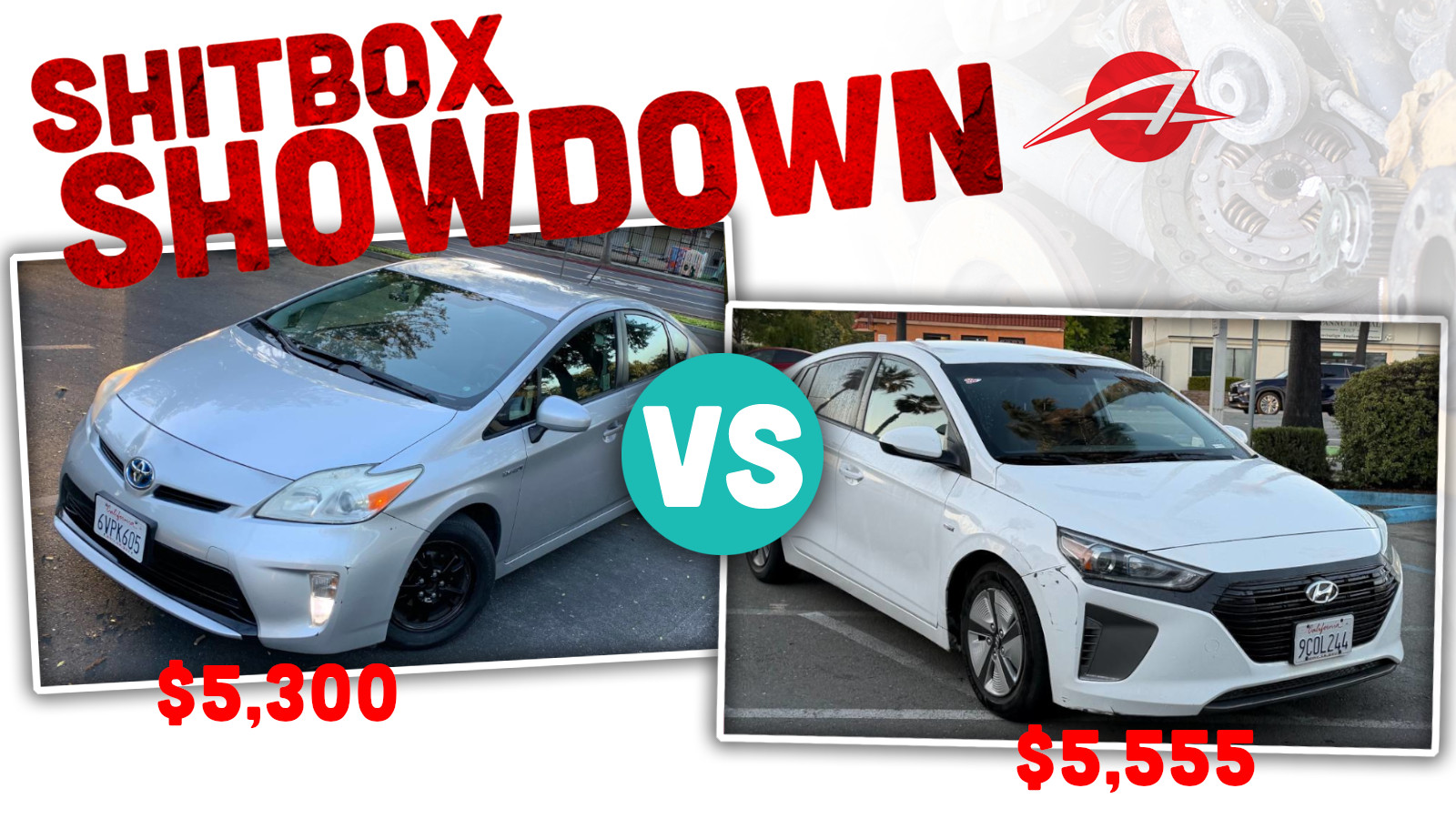
Small cars are a great way to save money on gas, but these days, there’s a better way: hybrids. By combining a small gasoline engine with an electric motor, you can get decent performance out of a larger car while clocking some truly impressive fuel economy numbers. Toyota was first to popularize this setup, but since then, other manufacturers have joined in, and now there are lots of choices. And they’re starting to depreciate down to cash prices, so they’re fair game for us here.
I don’t think I impressed very many of you with yesterday’s choices. Big blobby crossovers are no one’s cup of tea, it seems. Still, they got you talking and voting, so I call it a win. The Mazda CX-9 took the win by a large margin, despite its higher price tag and higher miles. It seems the reputation of the Buick’s 3.6-liter engine preceded it.


The Mazda is definitely the smart choice here, it seems. As fond as I am of GM vehicles, I recognize an overreach when I see one, and that High Feature V6 is just too far outside GM’s wheelhouse. Cast-iron pushrod engines that only rev to 5,000 RPM and run forever a quart low on oil, that’s GM’s forte. For cool, clever, high-tech engines, I’ll trust Mazda more.

For inexpensive, well-used hybrids, I figured the best place to shop would be the San Francisco Bay area. I had to include a Prius, of course, but I also found one of its rivals with a very similar form factor. They go about the whole hybrid thing in a different way, though, so the driving experience is probably a bit different. Is one better than the other? That will be up to you. Let’s take a look.
2012 Toyota Prius – $5,300

Engine/drivetrain: 1.8-liter DOHC inline 4 plus electric motor, CVT (kinda) automatic, FWD
Location: San Jose, CA
Odometer reading: 208,000 miles
Operational status: Runs and drives well
Here is a car that needs no introduction. The Toyota Prius has been so successful at spreading the gospel of hybrid cars that “Prius” is practically synonymous with “hybrid.” It’s almost like Kleenex or Q-Tips. It’s been around for more than twenty years now, gradually improving with each generation. The Prius not only has a reputation for excellent fuel mileage, but also damn near eternal durability. This third-generation Prius has more than 200,000 miles on its odometer, but it still has plenty of life left.

It was only a few years ago that I got interested enough to understand how Toyota’s hybrid system works. It’s absolutely elegant in its simplicity. You have the engine on one side, the electric motor on the other side, and a differential gear between them, so that the engine and motor can rotate at different speeds. They both can send power to the front wheels, and the motor can also act as a generator to charge the battery. A computer controls the whole thing. There isn’t much to go wrong, which is always the best way to keep a system reliable. This one runs and drives just fine, according to the seller.

The photos of the interior aren’t great, but from what I can see, it’s in decent shape. It has some extra seat cushions you may or may not want, and a fuzzy cover on the armrest that’s probably covering up some cracks in the vinyl. The seller doesn’t give a lot of details about the functional condition of the stuff inside, but it’s a Toyota; I’m sure it all works fine.

Outside, it’s silver. Of course it is. Did these even come in any other colors? The black wheels aren’t original, and personally, I’m not a fan. It has a few scrapes and scratches, but nothing worth mentioning for a 200,000-mile car. The Mystery Spot bumper sticker is a nice touch.
2019 Hyundai Ioniq Hybrid – $5,555

Engine/drivetrain: 1.6-liter DOHC inline 4 plus electric motor, six-speed DCT automatic, FWD
Location: Fremont, CA
Odometer reading: 189,000 miles
Operational status: Runs and drives well
Hyundai has been a big name in electric vehicles in recent years, but it all started here, with the Ioniq. It was available as a hybrid, a plug-in hybrid, or a full EV. What we have here is the standard hybrid model. It’s a five-door hatchback, just like the Prius, and it actually looks a little like it as well. I guess if you’re going to copy someone’s homework, you may as well copy from the head of the class, right?

I’m not sure exactly how Hyundai’s hybrid setup works, but it’s different from Toyota’s. Instead of a single-speed planetary gear reduction like the Prius, it uses a six-speed dual-clutch transmission. The engine is a 1.6-liter four-cylinder from Hyundai’s Kappa line, and together with the electric motor, it sends 139 horsepower to the front wheels. It gets even better gas mileage than the Prius. This one has 189,000 miles on it, and the seller says it runs and drives fine. The seller is a dealership, so we don’t get any more info than that. Best to have it checked out by someone who knows these cars, just to be sure.

The interior of the Ioniq is a little more conventional-looking than the Prius, which I prefer. I’m not a fan of Toyota’s center-mounted instrument panels. It has really interesting seat fabric too, which is something of a Hyundai tradition at this point. I don’t know why there’s a cover on the passenger’s seat and not the driver’s; it’s a little strange.

Even if a dealership can’t or won’t disclose information about a car’s past, sometimes you can tell just by looking at it what sort of life it led. This Hyundai has been around the block and bumped into a few things along the way. It has dings and scuffs all over. It’s not unusual for a city car to have a few battle scars, I suppose.
I personally wasn’t sold on the idea of hybrid cars at first, but they have proven themselves reliable and durable over the years, and you can’t deny the fuel savings. The Prius is the gold standard, but it’s a bit weird and comes with some baggage that you won’t find in the trunk. The Ioniq is not as refined, from what I’ve read, but it gets even better mileage, and it’s less famous (or infamous), so you can fly under the radar. Which one would you pick?


The Prius is probably the smarter choice, but it’s a Prius. I’ll gamble on the less common, somewhat beat-up Ioniq.
Gotta say, only in the Bay Area will you find a bumper sticker of a hunting knife along with a USA one a Prius.
That Hyundai has lived a VERY hard life, and there isn’t much left in it. I’ll take the Prius which probably wasn’t used as a delivery vehicle.
That Ioniq has lived a life as an Uber vehicle…and then as a delivery vehicle for sure. The seat cover is to provide some protection when doing those food runs. So Prius for me, although it is getting close to head gasket time on that engine.
I prefer how the Hyundai looks. However it has multiple aspects that – to me – are red flags.
-DCT in a FWD configuration: No company has yet mastered this combination.
-1.6L GDI: Other Hyundai/Kia engines of this displacement are known for going ‘splodey, and I don’t trust it.
-Serviceability
-I’ve heard that on many hybrids if the transmission fails then it can cost more than the value of the vehicle to replace/repair it. Admittedly that’s mostly on e-CVTs, but I imagine it’s similarly true on a DCT.
So the Prius is leading almost by default.
The Prius has these green flags:
-it’s a Prius, the most ubiquitous hybrid on the planet.
-There’s lots of support for it, and countless forums with DIY support.
-it’s not painted white (or black).
-These are known to survive hundreds of thousands of miles of even some of the most abusive driving in the world: taxi service in NYC.
Prius takes it.
-DCT in a FWD configuration: No company has yet mastered this combination
VW?
I’m including them in my assertion. They’ve gotten better over the generations, but still not mastered.
RWD DCTs are a different animal, FWIW. They also make much more sense in a RWD-based configuration than FWD-based.
VW is the most prominent manufacturer of DCTs in the world. They’ve mastered drivability, performance and aftermarket support with huge communities already available. They can last with maintenance, but its inherent design will never make them last longer than an average torque converter auto or a fully manual transmission.
You sound like you’re from their advertising team, lol.
Much like CVTs maintenance is key. The problem is that the manufacturers didn’t/don’t divulge proper maintenance for these newer technologies, and/or they don’t fully understand them themselves so make too-conservative estimates (or designed for deliberate obsolescence?), and/or (IMHO) are chasing that “cost of ownership” metric too much for their own good, so they push maintenance items past the measured periods, even at the expense of the component, because once it’s past warranty, why should they care?
Case in point, let’s look at the Ford PowerShift DCT, used most famously in the Focus and Fiesta. Not their best design, but not their worst. If you don’t “creep” in traffic, drive it slightly more aggressively (so the computer has clear input data that it can determine when and how to shift), and change the fluid every 50K miles, they’re generally decently solid. I have an acquaintance who treats the gas pedal like an on-off switch (I refuse to ride with her for my own sanity) and she’s close to 200K miles on hers in her Focus SE with no issues, and is getting ready for its third transmission fluid change.
YMMV always applies.
Hey VW, you owe me a paycheck LOL.
No, It’s just that the DSG have not been making headlines and horror stories as much as they used to. The technology is much more mature, they’ve really stepped up their game. I have only owned 1 DCT car (and it was a dreaded, clunky shifting 1st year Powershift, LOL) and I’m fine that way, but if I really had to it would be a DSG wet clutch vehicle.
Besides the obvious longitudinal vs transverse and resulting packaging challenges of the later what else makes them different animals?
I know VW offers both dry and wet clutch FWD DCTs.
I’m wondering what the source is on this bit – the Toyota e-CVT is a planetary gearset between the engine and the starter/generator electric motor. It’s so dead simple I don’t even know how it would fail.
Hybrids with a traditional multi-gear transmission (or mechanical CVT, but I can’t think of any hybrids that have one) I can absolutely see the transmission failing first and being really expensive to fix, but not on the e-CVT.
The Toyota e-CVT is what swayed me into being a hybrid believer, since instead of adding complexity by adding electrification it actually reduces the overall system complexity by eliminating the conventional transmission.
Joys of touchscreen keyboards where the backspace is next to the M and N.
It’s supposed to say “non-eCVTs”. Like the Hyundai Sonata/Kia Optima Hybrids, IIRC. I think there was a variant of the Fusion that had a similar issue, maybe the Energi?
Ahh, gotcha. I think most of the Ford hybrids have used a similar setup as the Toyotas – Ford independently developed essentially the same system at the same time as Toyota.
There is one eCVT hybrid I know of that has had very expensive repairs, though – The Pacifica PHEV uses a similar layout, but in standard Stellantis fashion they found a way to make one of the most reliable drivetrain layouts possible just as unreliable as everything else they sell.
If they’d somehow gotten it right i probably would have bought one, since AFAIK it’s the only 3 row PHEV that has a planetary gear style eCVT.
Yeah, it’s baffling how Chrysler/Jeep managed to screw up their hybrids as much as they have.
The phrase I used was a perfect storm with the backspace issue. “on non-CVTs”, so chance of hitting the backspace 3 times. I’m not even sure which ones survived. I’ve given lots of feedback to SwiftKey about changing the sensitivity of the backspace key, especially on screens with curved edges.
Ah, something I can provide insight on.
I have a Kia Niro with the same drivetrain as the Ioniq, with mine currently sitting at 177,000 miles and averaging about 48mpg. My commute is 40% city, 60% highway, and the hybrid setup with the DCT is great. The car is by no means powerful, but the DCT does make it more engaging than a CVT. The DCT is also pretty reliable, provided routine maintenance is done, especially replacing the shift actuator hydraulic fluid.
We’re the Ioniq not beat to crap it would get my vote, but since it is, I’m going Prius.
Is this the generation of Prius that suffered from head gasket issues? Or was that the one that followed?
I believe it’s the third generation (like this), as the Prius V also suffers from it. Fairly straightforward fix, though.
Yeah, the Prius is overpriced, but with this kind of age and use, I trust it more than Hyundai’s first crack at hybridity.
Also, I miss our 2009 Prius somethin’ fierce. (Got totalled by someone who’ll remain nameless, but who is a much better driver these days).
So we had this young engineer who bought a ’19 Ioniq new. And one day she goes on this rant in the office that she only gets 30 mpg, gonna join a class action lawsuit over efficiency claims, yada yada. But turns out she averages 90 mph on the freeway to work. And she doesn’t want to admit that her average speed might have something to do with fuel consumption.
Yeah, she didn’t work out doing our engineering stuff either.
Prius! Like you said it basically wrote the book on hybrids and it’s a Toyota so reliability as well. They are weird looking but I was really surprised how nicely they drove and how much space is in the backseat and under the hatch. I can remember my dad pulling into the pickup area at the lumber yard to get some 2×4’s. They guy loading cars and trucks just stared until my dad said “it’ll fit”. Sure enough, 8 feet all the way to the dash.
Is this really a question? The Toyota. Duh.
Toyota synergy drive for the win. Basically bulletproof if boring. I don’t want a single motor hybrid + DCT like Hyundai uses.
My parents had this gen of Prius and it was rock solid.
Also there are lots of options for aftermarket batters and OEM batters are still available for the Prius.
I vote Mystery Spot! Love that place. Both campy and magical.
In my city, I don’t think silver is common. Blue, green, and red are popular, or are those just the ones I notice? I do notice a number of white ones.
I see a million grey ones around my city. Or maybe it’s the same guy just driving around all day?
Update: There are a lot of silver Prius in my town. I just don’t notice them…….
To echo everyone else’s thoughts, the Prius has clearly received far more care, and when something eventually does go wrong, it’ll be documented and supported by the aftermarket.
Besides, I’m already used to silly center-mount gauges. The wheel never gets in the way! Not ideal if you have a backseat driver, though.
I was surprised how easy it was to adapt to the center console. But yes, the whole cabin gets to see your speed.
I already have a 2nd-gen Prius, so I don’t really have any interest in a 3rd-gen, but I was intrigued by the Ioniq at some point when looking at fuel efficient things and wouldn’t mind finding out what ownership was like.
If I were to get a Prius I’d want the newer generation. This one might be my least favorite in terms of appearance, and I loathe centered instrument clusters.
The Ioniq is rougher on the outside despite being that much newer, but screw it I voted for it anyway. It’s a shitty commuter car to save fuel so I don’t really care. And AFAIK, the Kappa engine is fine and it’s the Theta that had all the issues. I still dislike Hyundai as a company due to those engine shenanigans, but with a used car they ain’t getting my money so I think I could deal with that.
I have a friend with the PHEV version of that Ioniq and it’s a really solid car. Can’t beat a prius though.
Hyundai for me. At almost 200K miles in 7 years, someone was (probably) driving on the highway a lot, or it was an Uber. I’m going to bet on the highway and say they were easy miles and the persoin just didn’t know how to park. Mostly I just don’t like Toyota.
Never cared for the center stack in this era of Toyota, so I was hoping to like the Hyundai. Unfortunately, there’s too many creases & crinkles in the sheet metal for anything like that. Prius it is, guess I’d learn to deal with the dash.
I was definitely one of the car enthusiasts who shit all over the idea of hybrids, and the Prius in particular when they were a new thing.
I was wrong. The Prius has proven itself to be an incredibly durable tool to move things and people from A to B over and over and over again, while just sipping fuel. I don’t know the market to know if this one is priced right or not, but you can probably get another 100-200k miles out of it for very little trouble and cost. I’ll have that one over a mystery Hyundai any day.
I’ve yet to run into a mechanic who had bad things to say about Prii.
Same here.
Yup – I was a hybrid naysayer at first but once I really looked into how the Toyota system operates I was really impressed by the ingenuity of the whole thing. They’re not exciting to drive, but they really are an engineering marvel.
Those Prius wheels may very well be stock. They had dark alloy wheels but covered them with plastic covers. Assuming to have a lightweight wheel (alloy) with good aero (covers).
Yeah, younger family member has a Prius from that generation that’s missing one of those black hubcaps. From the stickers, I’m going to assume Mom’s car was passed down to the kid.
This is correct – these are the stock wheels without their covers.
Prius for me. It seems to have lived a less rough life. For that gen of Prius, just have to confirm whether the headgasket and EGR maintenance was done. And if not, look at getting it done… especially if it’s ‘using coolant’.
7 year old Hyundai vs 14 old Toyota, each with close to the same miles and price?
Yeah there’s a reason that Toyota still has that much value after 14 years, and that Hyundai will be worth about zero when it gets to the Toyota’s current age.
This just isn’t a fair contest.
My determining factor was the unknown durability of the 6sp automatic vs. bulletproof e-CVT.
I guess I’d go for the Prius. I never knew they had that center gauge cluster – not a fan. But, they set the standard for reliable hybrids and the body is not all beat to snot so I guess it would be the choice.
Having owned a 2009, I can tell you that the center gauge cluster is off-putting for the first drive or two, but isn’t a hinderance in any way.
Prius 90%
You can get lucky as a Hyundai/Kia ticks to higher mileage (meaning over 100k for these cars) like my parents and I but that’s in-spite of whatever weirdo cost-cutting they’ve done and I’m not interested in worrying about another surprise.
A hybrid is the best place for Hyundai’s dry-clutch DCT but I’m not sure I’d love it long term. Drove a similar age Niro hybrid in the past (although that was a few years ago) and I acknowledge the powertrain drove fine but up against the bulletproof powersplit/eCVT? Eh.
I’m pretty sure battery repair options are minimal for the Sonata and Optima hybrids last time I checked, wondering if it’s the same for the Ioniq hybrid.
I hear Kia vehicles getting trash talked and I want to go cover the ears of my daughter’s Forte with 210K VERY trouble free miles.
I don’t want it to get any funny ideas at this point in the journey.
We had a 2004 Elantra GT that started as my dad’s car, worked its way through the family, and is still running around as my cousin’s daily with close to 300k on it now.
It started a bit of Hyundai brand loyalty, until the Sonata my mom bought and then gave to my brother suffered death by oil starvation. Strangely, he bought another, newer one and it had the same fate not long after.
My 177,000 mile Niro says the DCT can be fine when maintained properly.