

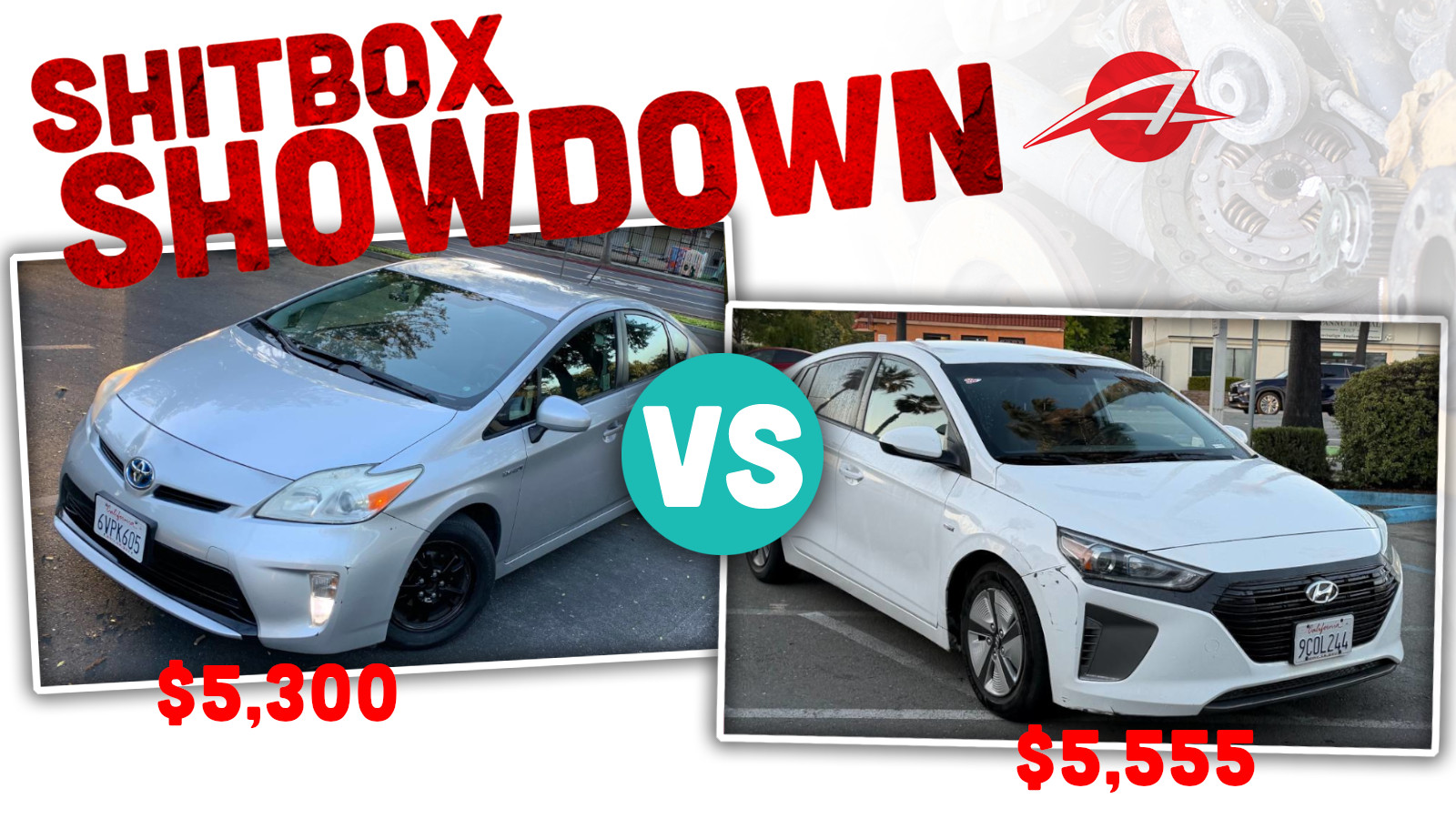
Small cars are a great way to save money on gas, but these days, there’s a better way: hybrids. By combining a small gasoline engine with an electric motor, you can get decent performance out of a larger car while clocking some truly impressive fuel economy numbers. Toyota was first to popularize this setup, but since then, other manufacturers have joined in, and now there are lots of choices. And they’re starting to depreciate down to cash prices, so they’re fair game for us here.
I don’t think I impressed very many of you with yesterday’s choices. Big blobby crossovers are no one’s cup of tea, it seems. Still, they got you talking and voting, so I call it a win. The Mazda CX-9 took the win by a large margin, despite its higher price tag and higher miles. It seems the reputation of the Buick’s 3.6-liter engine preceded it.


The Mazda is definitely the smart choice here, it seems. As fond as I am of GM vehicles, I recognize an overreach when I see one, and that High Feature V6 is just too far outside GM’s wheelhouse. Cast-iron pushrod engines that only rev to 5,000 RPM and run forever a quart low on oil, that’s GM’s forte. For cool, clever, high-tech engines, I’ll trust Mazda more.

For inexpensive, well-used hybrids, I figured the best place to shop would be the San Francisco Bay area. I had to include a Prius, of course, but I also found one of its rivals with a very similar form factor. They go about the whole hybrid thing in a different way, though, so the driving experience is probably a bit different. Is one better than the other? That will be up to you. Let’s take a look.
2012 Toyota Prius – $5,300

Engine/drivetrain: 1.8-liter DOHC inline 4 plus electric motor, CVT (kinda) automatic, FWD
Location: San Jose, CA
Odometer reading: 208,000 miles
Operational status: Runs and drives well
Here is a car that needs no introduction. The Toyota Prius has been so successful at spreading the gospel of hybrid cars that “Prius” is practically synonymous with “hybrid.” It’s almost like Kleenex or Q-Tips. It’s been around for more than twenty years now, gradually improving with each generation. The Prius not only has a reputation for excellent fuel mileage, but also damn near eternal durability. This third-generation Prius has more than 200,000 miles on its odometer, but it still has plenty of life left.

It was only a few years ago that I got interested enough to understand how Toyota’s hybrid system works. It’s absolutely elegant in its simplicity. You have the engine on one side, the electric motor on the other side, and a differential gear between them, so that the engine and motor can rotate at different speeds. They both can send power to the front wheels, and the motor can also act as a generator to charge the battery. A computer controls the whole thing. There isn’t much to go wrong, which is always the best way to keep a system reliable. This one runs and drives just fine, according to the seller.

The photos of the interior aren’t great, but from what I can see, it’s in decent shape. It has some extra seat cushions you may or may not want, and a fuzzy cover on the armrest that’s probably covering up some cracks in the vinyl. The seller doesn’t give a lot of details about the functional condition of the stuff inside, but it’s a Toyota; I’m sure it all works fine.

Outside, it’s silver. Of course it is. Did these even come in any other colors? The black wheels aren’t original, and personally, I’m not a fan. It has a few scrapes and scratches, but nothing worth mentioning for a 200,000-mile car. The Mystery Spot bumper sticker is a nice touch.
2019 Hyundai Ioniq Hybrid – $5,555

Engine/drivetrain: 1.6-liter DOHC inline 4 plus electric motor, six-speed DCT automatic, FWD
Location: Fremont, CA
Odometer reading: 189,000 miles
Operational status: Runs and drives well
Hyundai has been a big name in electric vehicles in recent years, but it all started here, with the Ioniq. It was available as a hybrid, a plug-in hybrid, or a full EV. What we have here is the standard hybrid model. It’s a five-door hatchback, just like the Prius, and it actually looks a little like it as well. I guess if you’re going to copy someone’s homework, you may as well copy from the head of the class, right?

I’m not sure exactly how Hyundai’s hybrid setup works, but it’s different from Toyota’s. Instead of a single-speed planetary gear reduction like the Prius, it uses a six-speed dual-clutch transmission. The engine is a 1.6-liter four-cylinder from Hyundai’s Kappa line, and together with the electric motor, it sends 139 horsepower to the front wheels. It gets even better gas mileage than the Prius. This one has 189,000 miles on it, and the seller says it runs and drives fine. The seller is a dealership, so we don’t get any more info than that. Best to have it checked out by someone who knows these cars, just to be sure.

The interior of the Ioniq is a little more conventional-looking than the Prius, which I prefer. I’m not a fan of Toyota’s center-mounted instrument panels. It has really interesting seat fabric too, which is something of a Hyundai tradition at this point. I don’t know why there’s a cover on the passenger’s seat and not the driver’s; it’s a little strange.

Even if a dealership can’t or won’t disclose information about a car’s past, sometimes you can tell just by looking at it what sort of life it led. This Hyundai has been around the block and bumped into a few things along the way. It has dings and scuffs all over. It’s not unusual for a city car to have a few battle scars, I suppose.
I personally wasn’t sold on the idea of hybrid cars at first, but they have proven themselves reliable and durable over the years, and you can’t deny the fuel savings. The Prius is the gold standard, but it’s a bit weird and comes with some baggage that you won’t find in the trunk. The Ioniq is not as refined, from what I’ve read, but it gets even better mileage, and it’s less famous (or infamous), so you can fly under the radar. Which one would you pick?


I would trust the Prius a lot more. I drove a former boss’s first-gen Prius a fair amount in the mountains with a passenger and a load of tools and radio hardware, and it did just fine. Plus, I could actually fit in it and drive it comfortably.
We have the Ionic, but in top spec. Spouse’s daily and dang the mileage is freaky good. I especially love that at fill up (about 10 gallons +. -) the reading says 600+ miles. 6 years with it and the only issue was water in the muffler. Replaced for free. Then again ours has only 42,000 miles. I hate the low profile tires, and it is quieter and more fun in winter with the Hockies on. 15″ with real profile instead of 17″ trying to look cool. As a former Top Gear addict it will always be a Pry Us nor Pree us.
Prius, hands down. That is a well-proven, genius drivetrain. At 200k miles, it is not even half used up.
The Hyundai, on the other hand: we’ve had two Kia’s of that generation, and both started using oil on the high side of 100k miles. One needed a complete engine replacement, the other I traded off quickly. Fool me once…
The latter was a hybrid Niro with the 6-speed transmission. It was sometimes vague and undecided about shifts. Mileage was outstanding though – darn near 50mpg for a small CUV. I just wasn’t confident about its longevity.
I see your Mystery Spot, and raise you a Mystery Hole.
https://www.mysteryhole.com/
The Prius is a bit cheaper and looks cleaner on the outside, so it gets my vote today. That Hyundai has seen some things.
I would never buy a car from the bay area, so my vote is “no”, but thats not the rules so Ioniq. My bet is on, a 14 year old car from San Jose with 208K probably has spent 10,000 hours on the local roads, even with a fastpass. A 7 year old car from Freemont with 180K probably actually hit the speed limit (and a few other things), occasionally out of the area on the open road and has newer tech and better interior. They are both fugly so dents be damned.
Just saw the thing about the Ioniq having lived in New Jersey, still voting for it. And leaving it parked on the street while I walk to the bus to the Caltrain station to the BART connection to the bus again where I walk to the corner with my cardboard sign asking for bus fare.
3 rules of used car buying:
Condition
Condition
Condition
The Prius does not have A motor it has 2 motors. That second motor is very important as the Starter/Generator splits the power path between the engine and wheels and in the process varies the gear ratio between the engine and wheels.
Also as others have mentioned those are the factory wheels, just missing their aerodynamic wheel covers. Replace them and not only will you improve the looks you’ll increase the MPG however slightly.
Despite the fact that it is far from the most reliable, the Prius still got my vote.
I’m here to recommend YouTuber Technology Connections recent video detailing the system. Excellent explanation of an excellent system. https://youtu.be/KnUFH5GX_fI?si=sySY2xWbX_EyA9sD
I’d give it a B or maybe B+ because most of it is spot on but he does get a couple of things wrong and does some hand-waving about how the Starter/Generator makes the power split device work as a CVT, how much torque it harvests to do so and how that makes it possible to keep the engine working at peak efficiency. That increase in engine efficiency is kept to the point that it exceeds the conversion losses of transferring some of the engine output electrically and/or charging/discharging the battery.
It’s an interesting choice between the two. I’m not a huge fan of the 3rd gen Prius, head gasket issues, less bulletproof ecvt, and other little things that aren’t very common for the 2nd gen. But I’m not sure the dct in a Hyundai is all that great after 190k mi. Being a 2019 the earlier battery and power electronics issues that plagued them is probably better though maybe I just stopped paying attention to them. Still picking the Prius because even though the 3rd gen has issues they regularly make it to 400k mi. Plus ecvt is a good thing.
Uugh… hybrids. I’ll take the Ioniq (“ick”y) since it has a better design and has the instrument panel in the right spot. The Prius is ugly and overrated. I’d rather have Uncle Buck’s backfiring and black smoke belching land yacht comfy cruiser than either of these…
I wanted to go with the Hyundai since its 7yrs newer and less miles. If it was a little less beat up, I probably would have. I know from personal experience that you can get replacement motors from Japan with ~60k miles for when the head gasket goes.
I think the Hyundai has the same drivetrain as my husband’s Santa Fe hybrid, just without the turbocharger. It’s good! It shifts smartly and doesn’t hunt for gears. Definitely better than a mooing, moaning sort-of CVT.
I don’t know about the IONIQ, but the gen. 3 Prius has a couple of expensive gotchas, namely the head gaskets and the brake booster.
yeah, it’s probably the least reliable generation of Prius out there. The HG issue is fairly common. But at the end of the day my gut said a HG would be less expensive than the DCT 6 speed in the Hyundai and the Prius is a very well known, dialed-in vehicle if you need parts and repairs done to it
Since I owned a Gen 2 for 300k miles and now have a Gen 4 AWD Prius, I chose the Ioniq, just for the difference!
Aren’t the four sets of screenshots in the CL ad of the service, the info one would be looking for?
I’ll grant it’s not as warm and fuzzy as printed receipts from different shops that I usually keep in my glovebox, but probably authentic, no?