


Electric vehicles are generally less likely to catch on fire than their internal combustion-powered counterparts. They aren’t filled with highly combustible fuel and don’t have hot engines that mingle with that fuel and other flammables. But when EVs do go up in flames, they have a tendency to burn very hot and very long. Such was the case of a Tesla Semi that burned down in California yesterday. The truck burned for so long that it shut down an entire section of Interstate for hours as it reduced itself to a pile of ash.
At around 5:35 p.m. Pacific Time yesterday, a Tesla Semi was traveling down the southbound lanes of I-880 in Hayward near Route 92 when it burst into flames. The truck wasn’t involved in a crash; it was just moving along in traffic. Luckily, the driver escaped the cab without harm and watched from the side of the Interstate as their rig became a roaring blaze.


The truck involved was one of the early production units delivered to Frito-Lay to transport snack foods, and it was pulling a leased trailer. The fire appeared to center around the battery area of the tractor, but eventually spread to the whole unit. Here’s what one of these trucks looks like when it’s in one piece:

Information is a bit thin on the ground right now, but we know that the California Highway Patrol was on scene within ten minutes and immediately shut down both northbound and southbound lanes of I-880 from Winton Avenue to Route 92 due to concerns about toxic smoke. The Hayward Fire Department then arrived and began dousing the truck in foam.
A passenger in a passing vehicle got footage of the rig when the fire was in its earlier stages. I have embedded the video below; click here if you cannot see it:
This is what it looked like for us, before cops or fire got there.
According to CHP, the driver said that the rig just caught fire, and they had no idea why. As for the fire itself, CHP says that, due to the truck’s battery, the fire proved rather difficult to extinguish. Then, even when there wasn’t a visible fire, hazardous smoke continued to billow out of the rig for some time.
As we recently wrote when covering the EV blaze that took 18 hours to extinguish at a Cadillac dealership, putting out an EV fire isn’t as simple as just tossing water onto the flames.

Here’s what the UL Research Institute’s Fire Safety Research Institute’s “Full-Scale Electric Vehicle Fire Experiments and Recommendations for Fire Incident Response” report recommends for firefighters when faced with EV fires:
Immediately Suppress EV Fire With Water While Protecting Exposures
Suppression with a handline with water (no additives) is recommended as the first choice of suppression strategy, similar to a conventional vehicle fire attack. The use of tools designed to introduce water directly into the battery pack was not examined in this work. However, firefighters should not open or pierce the battery pack outer case.
Fight the Vehicle Fire First, the Battery Fire Second
The fire in the passenger compartment represents a significant portion of the thermal and chemical exposure hazard and will readily respond to water. Rapid suppression of the cabin fire reduces the thermal and chemical exposure hazard to surrounding objects, civilians and first responders, especially if battery involvement is prevented.
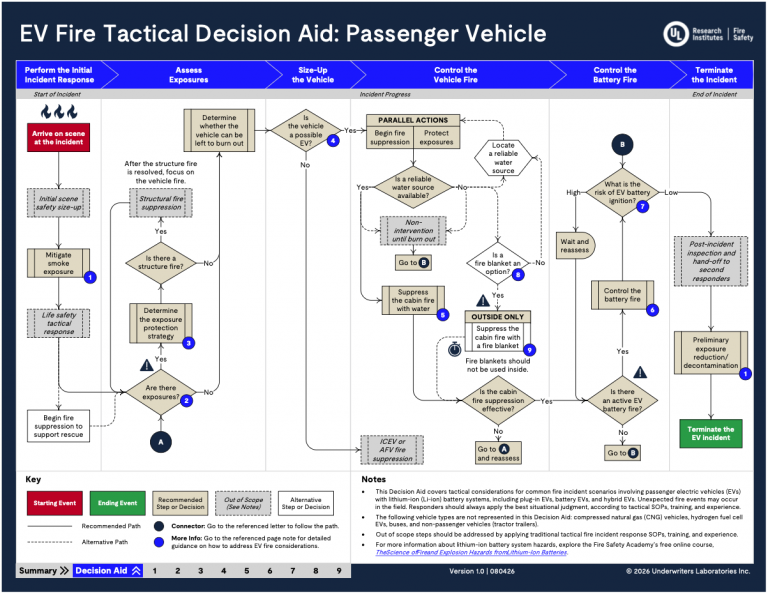
The battery fire is best controlled by supervising the battery fire until thermal runaway stops. Water should be applied intermittently to prevent reignition of the rest of the vehicle and redirect flames from exposures if necessary. Applying copious amounts of water to the battery enclosure is wasteful and will not stop thermal runaway. Likewise, introducing water into an uninvolved battery may increase (re-)ignition risk.
Use Caution if Deploying Fire Blankets
Fire blankets, while not recommended as the first choice in suppression strategy, may be effective under limited operational scenarios. They will not stop thermal runaway or the resulting production of flammable gases, and they limit firefighters’ ability to monitor the vehicle. Firefighters should not manipulate the blanket once it is deployed and remain cognizant of the latent reignition and deflagration hazard. It is inadvisable to use fire blankets in areas where flammable gases may accumulate and form an explosive atmosphere, such as indoors. Fire blankets should remain undisturbed for at least one hour after the last visible fire or smoke emanating from under the blanket.After the Fire
Following extinguishment, the vehicle should be observed for reignition risk to identify any ongoing hazards. Release of the vehicle should occur after inspection has identified the relative reignition risk. Even if the battery appears to have burnt out, it cannot be excluded that moving the vehicle may cause a short circuit and subsequent reignition of remaining intact cells. For this reason, firefighters should remain vigilant and continue to use an SCBA during overhaul and inspection. Fire departments should consider escorting the tow truck to the tow lot to ensure rapid identification and suppression should reignition occur. A quarantine distance of at least 5 m (16 ft) to any other combustible object should be left at the salvage yard.
The whole report is a whopping 150 pages, which you can read here.
A known cause of EV battery fires is thermal runaway. Batteries are made up of clusters of individual cells, and it’s possible for a single cell to be damaged, be it through overcharging, a physical impact, overheating, a short circuit, or even just a defect. When this happens, a chemical reaction can occur that generates heat and toxic gases. This reaction eventually becomes self-accelerating, as the battery heats up faster than the vehicle’s systems can cool it.What’s really insidious about thermal runaway is that it will reach a point where isolating the cell or disconnecting the battery from the vehicle’s systems will not stop it. As all of this occurs, the rapidly heating cell causes neighboring cells to also heat up, eventually causing them to enter a thermal runaway, too. At a critical breaking point, the toxic cloud of gases spewed by these batteries can ignite into a fire or even an explosion. From there, the fire more or less feeds itself.

One important note is that subsequent short circuits and battery cell thermal runaway events can extend the time it takes to extinguish a fire. The fire might not consume the whole battery at first, and cells that might have survived the initial fire might fail later. Experts recommend that, when the burned EV is finally towed away, it should be stored in an open area away from other vehicles and buildings as the battery may light up again. Some fire departments use special blankets to fight these fires.

The Australian Government has an entire EV fire safety website dedicated to educating the public and first responders about the science and dangers of EV fires. The short of it is that, when EVs go up in flames, they burn hard, hot, and for long. Something like a Tesla Semi adds an additional curveball by having a battery with eight times the capacity of a long-range electric passenger car. That’s close to 10,000 cylindrical cells that firefighters might have to battle.

Thankfully, in this case, the fire was limited to just the tractor, and firefighters even extinguished the flames faster than originally anticipated. Northbound lanes of I-880 were reopened at around 8:40 p.m., while the southbound lanes, where the burned truck was, were reopened at 3:30 a.m. Wednesday morning.

At first, CHP estimated that the fire could have taken through the morning commute hours to extinguish. That was 10 hours to deal with what was a single-vehicle fire. Depending on intensity and other factors, a fire emanating from an ICE vehicle can be extinguished in under an hour.

Videos and images show that there was little of the Tesla Semi remaining. The truck’s rear frame and axles survived, and there were even still tires on the wheels. But the rest was essentially leveled into nothing. The trailer came out of the other side pretty burned and warped, but largely still in one piece.
This is the second reported instance of a Tesla Semi fire. The first one happened in 2024. In that incident, a Tesla-operated Semi was driving down I-80 near Emigrant Gap, California, from Livermore, and was headed to Tesla’s facility in Sparks, Nevada. As the National Transportation Safety Board reported, the truck failed to negotiate a curve and left the highway, striking a delineator post before plowing into a tree. The rig’s batteries were damaged in the crash, causing a fire that took 15 hours and about 50,000 gallons of water to extinguish.

Big truck fires are actually pretty common in America. According to the National Fire Protection Association, during the span of 2018 to 2022, firefighters had to battle an average of 15,462 commercial truck fires a year. The vast majority of these trucks were powered by internal combustion, and mechanical failures were a cause of 44 percent of these fires. So, while a Tesla Semi burning down might be news, it’s not like other trucks don’t do the same thing.
Ultimately, investigators will be seeking to figure out why this truck went up seemingly all on its own without a prior crash. Hopefully, whatever they find out is an isolated occurrence and not likely a widespread fault.
I think it’s also worth applauding the first responders here. CHP quickly and effectively shut down the freeway, which prevented the fire from being a hazard to drivers. The firefighters also successfully wrangled the truck fire, while recovery gear cleared it all out in time for people to get to work in the morning. The best of all is the zero reported injuries, even among the first responders. Great job, everyone!
Top graphic images: BlueSky; Tesla


I find it crazy that fire departments in the greater San Francisco metro still do not have tools to fight EV battery fires.
Like what? Based on the guidelines shared in the article, the recommended tools are basically “use water to keep it under control until it burns itself out, there’s nothing you can do to stop it”.
That works if you don’t want to spend any money and are good with shutting down a road for hours and hours. If you want to put out a battery fire quickly you either have to flood the battery directly with a piercing nozzle or you flood the entire car by submerging it.
Two commercially available piercing nozzle:
Electric vehicle fire in California
Rosenbauer Battery Extinguishing System Technology (BEST)
In the UL quote above piercing the battery is not recommended:
Suppression with a handline with water (no additives) is recommended as the first choice of suppression strategy, similar to a conventional vehicle fire attack. The use of tools designed to introduce water directly into the battery pack was not examined in this work. However, firefighters should not open or pierce the battery pack outer case.
“The use of tools designed to introduce water directly into the battery pack was not examined in this work.”
They didn’t investigate piecing the battery so they don’t recommend it.
Unless you can create an airtight seal that won’t melt before all the oxygen gets exhausted, this stuff is simply going to burn. There are some battery chemistries that prevent thermal runaway (the amount of energy released by a cell is not sufficient to compromise the next cell over due to heat), but those are deterministically less energy-dense (whether by weight or volume or both) than the chemistries you need to actually make electric trucking viable.
In other words, by solving the energy-density problem, you also get fire risk.
There has been some research around cell isolation (IE, if a pack of cells faults, be able to eject it or flood it or otherwise isolate it), but that comes with its own set of problems.
There has been more than research into flooding an EV or hybrid battery. There are commercially available tools to do that. See above for two examples.
“How can that be profitable for Frito-Lay? “
Happens less often than ICE fires so far?
In my firefighter days I worked three auto fires, one trailer fire, and one heavy machinery fire.
All three auto fires were determined to have been started by electric issues. Two involved collisions in which the batteries were shorted. One was vibration on a rough road causing insulation failure and a short to ground. All three were partially a result of wear and tear.
The trailer was due to a failed wheel bearing. The machinery was poor maintenance allowing crap to build up in the engine compartment. Both would have been prevented by proper maintenance.
Given the causes, I would guess that the number of fires in EVs will increase as time goes on, but I suspect that the high voltage electrical systems are more robust than the low voltage systems on ICE vehicles.
That’s my once a week commute. Thank God I wasn’t in the office that day.
I told Chester Cheetah that I didn’t think it was a good idea transporting those flaming hot cheetos in a Tesla EV
Yeaaaaaaah! Can’t wait for a few hundred thousand more of these to be put in service.
That’s the rub: they catch fire much less often but it’s far worse when they do. Passenger EV’S catch fire at 1/10 the rate of ICE vehicles. So 9/10 of EV drivers avoid the fire. And it really, really, really sucks to be caller number 10.
Lower frequency, higher severity. Balances out to equal on the ol’ risk assessment form.
That is when you are comparing 50 years of ICE Vehicles to 10 years of low sales EVs. Imagine if every vehicle on the road was an EV and they start aging out. I bet the rate will actually increase until it is the same but the damage to the environment and people will be devastating
No no. I’d keep everything outside the environment.
Not a lot of 50 year old ICE vehicles driven on the road, let alone catching fire. You’d think they’d have improved enough in 50 years to not catch on fire so often. I’m betting we are still the beginning of the EV curve and EVs will improve faster first.
This….all day long
A fire that happens less often but is impossible to put out sounds worse to me. One day one of these things will catch on fire on a bridge. And important bridge.
If they can quickly get water on it they can save the bridge. If not one of these could destroy a concrete or wood bridge. (It won’t collapse a concrete bridge but they won’t allow it to be used until fixed)
Philadelphia had a fuel tanker catch fire under an important bridge in the past 10 years. The fuel burned hot enough to bring the structural integrity into question. There’s plenty of risk from transporting fossil fuels too.
Cincinnati lost an interstate bridge (I-471) due to a playground equipment fire a couple of years ago. Composite wood/plastic material apparently burns REALLY hot and it was under the highway bridge.
I-85 in Atlanta had a highway bridge section collapse after a fire underneath. The fire wasn’t caused by an automobile of any sort, but a fire like this semi could have had the same result.
Point being that a lot of vehicles and cargos being transported can cause catastrophic bridge damage, not solely electric semi tractors.
You… Ah numbah six
If Tesla’s autopilot is so damm good why didn’t thing drive itself to the closest fire station? Asking for a friend.
or into the nearest lake/ocean?
Probably because Tesla’s autopilot is, not so damn good.
Man, I love Cheetos. Not sure if they’re so good fried.
I fell into a Flamin’ Cheeto fire
I went down, down, down and the battery burned hotter
And it burns, burns, burns
The Tesla Semi, the Tesla Semi
It’s so ironic since Cheeto’s does have a Flamin’ variety on store shelves!
Exactly!
Maybe change it to Tesla Fryer
Nice.
Interesting that it was painted in POTUS livery.
Not the pictures I’m seeing just typical Frito Lay Cheetos
It’s ORANGE
Comparing Cheetos to POTUS is an insult to Cheetos.
The poor thing burned when it really wanted to fly.
1) I’m glad to hear the driver is okay and managed to get to safety.
2) So you want a pallet of cargo? How about pallet of fire instead? Pallet of fire, completely free!
The future is bright.
FritoLay, more like Frit-oh-holy-shit!
This fire needn’t have begun with the electric drive system, but once it started the batteries make it much more challenging to extinguish. A locked brake/overheated hub can start a fire.
you’d still think the battery compartment would be designed to have a certain degree of fireproofing. Even if it’s only 30 minutes, that would give time to get some water on whatever else is burning.
Might have been burning undetected for that long. We have to wait for the investigation results
I thought we don’t have time for investigations if the motto is move fast and break things?
I am not saying they do.
But EVs could have a simple system that detects these kinds of things early. Temperature, voltage and current are all monitored at the cell level. So if something is of with one of those 3, at least pop an icon on the dash.
First, they could ad a nozzle that is easy to reach by fire dept. So if water is injected there, it goes to where it is most needed inside the pack.
Then, they could design a pack that seperates into modules. Have the modules separate electrically by some sort of controlled fuse. And seperate them thermally using the water supply.
This might stop the snowballing of the thermal runaway.
I am surprised that no regulator worldwide has mandated a port in EVs that firefighters can connect to and flood the battery. Other countries are updating their firefighting equipment but his could be handled in the design stage.
We know the quickest way to put out a battery fire is to flood the INSIDE of the battery with water and there are piecing nozzles specifically made for EVs that do that. Or the entire car can be submerged and some locations do that by basically bringing a dumpster and pushing the car into it.
Wouldn’t the water and lithium make an unfortunate mix?
The lithium is inside the shell of the battery cell which is waterproof. The water is to cool the existing fire and prevent it from jumping from cell to cell to cell and module to module to module. Two commercially available piercing options below.
Electric vehicle fire in California
Rosenbauer Battery Extinguishing System Technology (BEST)
I had a Shorai Lithium battery fail in spectacular fashion in my motorcycle. As with almost every VFR ever made, my regulator/rectifier shat the bed during a ride, sending 15+ volts constantly to the poor lithium battery.
The bike completely shut itself off after puttering for a few moments, I pulled the clutch and coasted to a stop, in a white, cherry-scented cloud emanating from under the seat. I had the pillion cover on the seat, and getting to the battery required a 5mm hex key to remove it – something I didn’t have on me. Extricating the smoldering battery was not an option.
All I could do was watch and pray that it didn’t self-ignite – thankfully, it didn’t. That single overvoltage event burned up my ECU and the speedometer in a matter of seconds, luckily not the entire bike…
I was on my first ride after bringing home my new (to me) VFR when it (luckily) died the normal way: not charging, instead of overcharging. The person I bought it from said they had done the upgrade to the R/R, but upon inspection post-incident I found that to not be the case.
Needless to say, I did the recommended upgrade to the R/R ASAP after that and it’s been fine since. *knocks on wood*
Honda really bungled the ~pre-2006 VFRs, I think I read that in ’06 they finally fixed that Achilles’ heel.
Interesting – my 2003 Triumph Sprint ST’s R/R failed (also blowing up the stator) and I discovered that it was a known issue after the fact. I wonder if Honda and Triumph used the same R/Rs during that period?
I’d wager that the best VFR was the 5G one (’98-’02?) – mine was a 4G (’94-’97). The 5G paired up the marvelous V4 with gear-driven cams with fuel injection for the first time. Of course, Honda borked that bike with the first iteration of linked brakes, which was the first thing that VFR riders wanted to remove from the 5G.
The worst part of a carbed VFR were, in fact, the carbs. Next to impossible to sync, and very prone to float valve failures – I had a set on my bike deposit 4.5 gallons of fuel into the crankcase over the winter TWICE.
Every VFR generation had it’s faults, the R/R was present for several generations – enough that the VFRNess aftermarket wiring ground harness was a mandatory addition to any bike. I had one, it didn’t save my R/R that day… I put half a dozen different R/Rs on my own machine over a 15+ year ownership.
I also kept a spare R/R under the pillion cover that I couldn’t remove, too. However – even if I could, the battery, ECU, and speedo were fried, I wasn’t riding that bike home that day…
I’m hoping replacing the wiring (no VFRness, seems like this is supposed to take its place) with this is good enough: https://roadstercycle.com/index.htm
So far it has been, but I ride less than 100 mi/week so it hasn’t had time to fail again yet.
My ’86 VFR died at 21 years old, never needing much more than tires, oil, & brake pads. That bike did everything well! Scrapped it because the bodywork degraded and was NLA.
Do you know that you can replace the battery? All you need is a good chainsaw. Ask Jason for instructions on how to do so. He’s become a pro at it!
This is why I haven’t switched to a lithium battery in my Seadoo. The R/R’s in the older ones are NLA. The cheap ones don’t last long. I had one work fine then decide to send 32 volts out. Disconnected the stator standing in shallow water 30 seconds after the dash started screaming at me. The AGM battery had enough juice to get back to the ramp, though! Replaced with a 50 amp genuine Shindengen from a BMW GS and it was running fine when I put it away.
That is why I always carry a chainsaw
that’s a lot of wasted cheetos
Nominative Determinism strikes again!
Underrated comment.
Only if you’re smart enough to know what nominative determinism is! Which I am not!
XXTRA Flamin’ Hot!
I really wanted to be a smart aleck here, but I won’t. So I’ll just say, shadenfreude.
Argh. This is breaking my brain. Here’s what I’ve got:
Driver shouldn’t’ve pissed off Thelma and Louise.
So many references to media and you missed burn notice. I would not have thought of all those
I didn’t miss burn notice. The entry just got burned. You don’t even know it existed.
A work Silverado self-immolated over the weekend, in the yard, alone. The amount of damage was brain-melting. And running board- and tire- and bedliner- and interior-melting. Just astonishing how much more destructive than a “classic” car fire.
Flaming hot Cheetos!!
I mean the joke was definitely already there. I read the article expecting it, but it made it through somehow, besides the title.
Doesnt help that it was a truck hauling cheetos. Those things are 90% grease so that probably helped fuel the flames!!!!
Cheetos make a halfway decent fire starter in a survival situation.
And their boxes were probably helpful, too
Plus the plastic bags. A whole managerie of wonderful things
I believe it is corn based carbohydrates, vegetable oil, and light weight structure that makes them burn so good
I recall burning a few in boy scouts and how well it burned. And burn for long periods. I think of that sometimes eating them, imagining the effects on my innards.
Well, they’re pretty much pure carbohydrates; just a whole lot of stored energy. Goes great with a six-pack of Mountain Dew as all-nighter-fuel.
We used to have gallons of Mtn Dew at one of the startups I was at. The entire IT department was seemingly addicted to it. I wound up drinking a lot of it too and it got to be normal cracking one open at 11PM. I don’t miss those days.
Since there are so few Tesla trucks on the road, it’d be useful to know fires per miles driven for ICE vs Tesla. I suspect Tesla still has fewer, but that’s a guess.
Too early to tell unless you only compare ICE trucks built in the same period as the new model Tesla Semi. Then probably not a large enough sample size
The Flaming Hot Cheeto’s jokes write themselves!
And that first Tesla truck crash? I mean, it was on its way to Sparks!
The worst part about putting out this kind of fire is all the orange dust that gets on your fingers.
You mean you don’t eat your Cheetos with chopsticks?! Savages!
I use a fork
Just kidding, I don’t eat them at all
missed opportunity for fritolay to put out a limited-time Cheetos Holder
yep, and I dump the crumbs from the nearly empty bag into my mouth to boot. I am a savage indeed!
And sadly, water won’t wash it off or put it out, either.
No in this case I believe that orange dust got all over the fireman’s hoses