

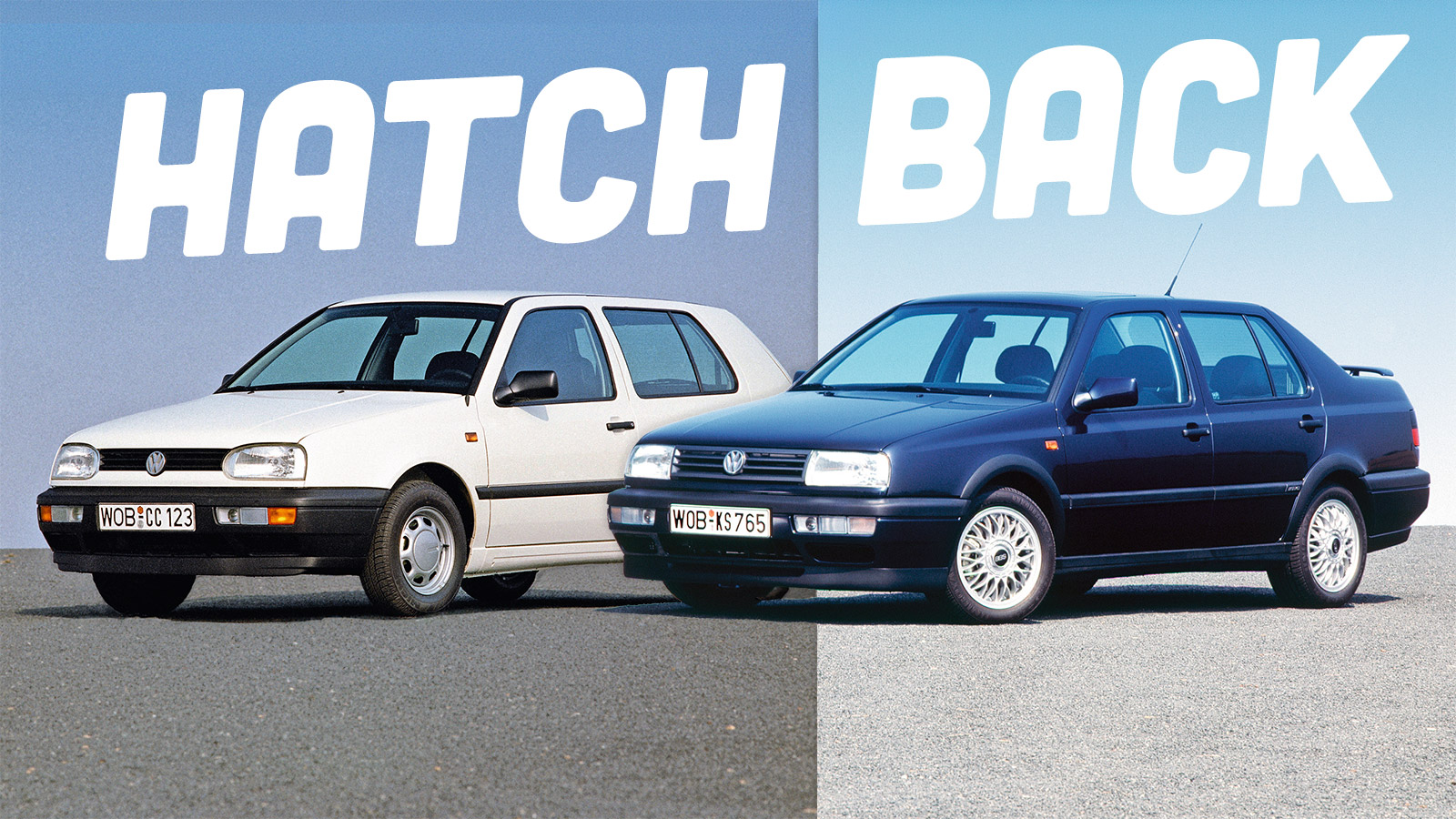
There’s a fascinating type of car, that at first seems like one of the most regular cars you can think of. It’s a four-door sedan, right? But looking at the dimensions, it’s obvious it’s a hatchback first and foremost, with a trunk grafted on. Over the years this has been done well, or cooked up hastily, resulting in some terrible looking three-box cars.
This differs from the introduction of a model range (for example, the Ford Mondeo) where you have a four-door sedan, a five-door liftback and a wagon all available from the get-go: instead, the sedan is often brought to the market later to bring in buyers that wouldn’t for some reason choose the regular hatchback, often sold under its own model name.


It’s a sort of a hatchback backlash: perhaps luggage should travel in its own distinct compartment and not share cabin space with the passengers.

The Volkswagen Jetta is one of the earliest examples of this. The Mk1 Jetta was introduced in 1979, five years after the Mk1 Golf and Rabbit hit the market. With North American sedan buyers in mind, Volkswagen created a seemingly larger car just by engineering a trunk onto the 1974 Golf’s rear end.
The result was a large and tall enclosed cargo area and a more formal three-box design that didn’t completely look like an afterthought, even if it was developed from a smaller econobox. Especially in four door form, the longer Jetta reached a bit above its Golf origins. Volkswagen replicated this with the second generation Jetta, introduced a year later than the Mk2 Golf, seen in this 1988 VW lineup photo from 1988.

Earlier, Volkswagen had had a go at this with the smaller Polo from 1975, which spawned the two-door Derby sedan variant in 1977.
Interestingly, the second generation 1981 Polo was initially available as an upright “Steilheck” wagonback only, with a more regular shaped hatchback (Polo Coupe) introduced a couple years later, to join the wagon and Derby sedan. The near vertical rear wasn’t as palatable as VW had imagined. The first generation Polo was also sold as an Audi 50, but the second gen wasn’t, and the 50 never got a sedan.
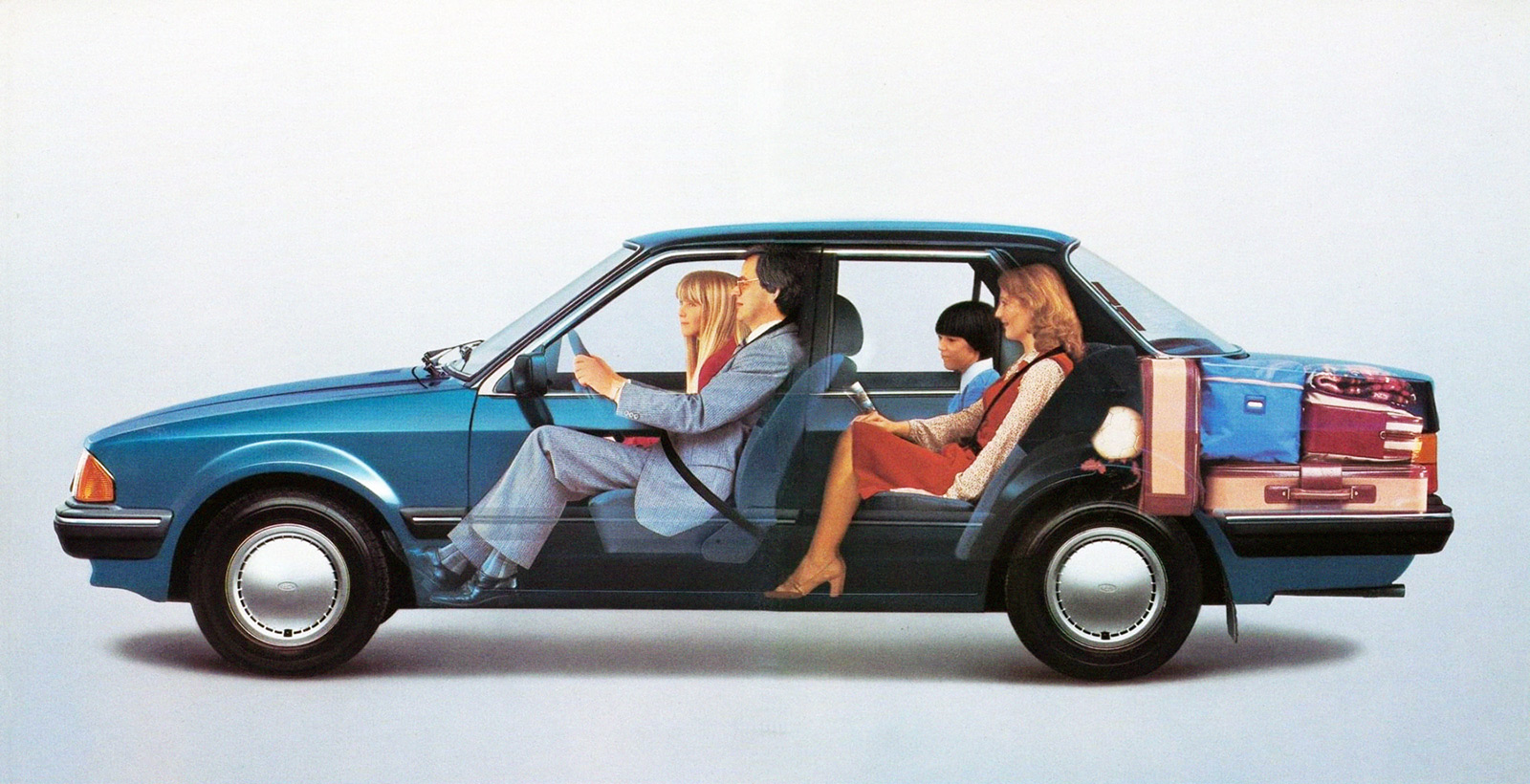
Ford’s front-wheel-drive Escort also got a sedan variant in Europe, but not in America. While Ford Europe started selling the sedan, called Orion, in 1983, the American Escort was sold as hatchback and wagon only, with the Escort-derived Tempo bridging the gap between the Escort and the Taurus. The Orion was likely deemed too small, and it’s not difficult to see the Tempo as the FWD version of the Ford Sierra (Merkur XR4ti in the States).

With the Orion, Ford was also able to appeal to buyers that had preferred the ruler-straight lines of the earlier Taunus/Cortina to the round 1982 Sierra, which only got a sedan version at the 1987 facelift.
This also brought the Sierra further away from its Probe concept car roots, seen above in this design studio shot. You can read more about this period from Adrian’s earlier piece.

The sedan Sierra, also marketed as the Sierra Sapphire, was an interesting notchback development of a far more round car, yet the redesign looked satisfying. It also coincided with the modernizing facelift that brought the Sierra larger headlights and integrated indicators instead of the television shaped headlights of the earlier car.
Ford also created an RS Cosworth version of the Sapphire, which certainly helped improve its image. Later ones were available with four-wheel-drive.

Saab’s 900 and 9000 also gained sedan versions years after the originals were introduced. With the 900, the story is somewhat convoluted: the 900 was based on the 99, which was first and foremost a sedan when it came on sale in 1968, with the three-door “Combi Coupé” introduced in 1974. The longer 900 was sold from 1978, and for the first years, only the Combi Coupé version was sold (with three or five doors), with the sedan only joining in 1981. Saab’s designers managed to combine the curving side window line with a low sedan rear, in a way that looks quite harmonious. It was sold in two- and four door-form, and the two-door 900 also formed the rear half of the 99/900 mashup called Saab 90.
For the 9000, the range started in 1985 as the 9000 CC with five doors, with the 9000 CD sedan sold from 1988. Saab didn’t drop the ball here, as the 9000 CD was smooth work.

For a really good looking hatchback derived sedan, you have to go to the 1999 Jetta, which was sold as the Volkswagen Bora in Europe. It’s one of the rare occasions where you can hardly tell where the design originally started, as the Bora/Jetta only shares its front doors with the Mk4 Golf: earlier Jettas had used Golf rear doors as well.

The roofline and rear quarters of the Jetta Mk4 have a pleasing swoop, instead of the pronounced back of the ‘90s Mk3 version that’s genuinely “Oops! All Trunk!”. As a result, the Mk4’s cargo area isn’t cavernous, but maybe it’s not a bad sacrifice when the design is so easy on the eye.
The sixth generation Jetta was far more its own car than earlier Jettas, as it didn’t share any body panels with the corresponding Mk6 Golf.

The 1990s Seat Toledo is the opposite of a hatchback derived sedan: it’s technically based on the Mk2 Jetta, but it’s a hatchback that looks like a sedan. Instead of a small trunk opening, it has a large fifth door hinged above the rear window, not terribly dissimilar to a Dodge Shadow/Plymouth Sundance.
Another reversal of the process is the AMC Gremlin, which was just an AMC sedan with the rear sliced off – and that showed, too.

Japanese manufacturers have also had a go at creating sedans out of hatchbacks. Take the second generation Suzuki Swift, which was sold as the Suzuki Cultus in its home market and the Geo Metro in the United States. In 1989, Suzuki supplemented the range with a sedan, which it called the Cultus Esteem. The Esteem name would return with the Baleno’s sedan version, which was also sold in North America. That’s the Better Call Saul car.
The Swift’s sedan derivative was also built in India for over a decade, as the Maruti 1000, and despite having just a 970cc engine it was considered nearly luxurious compared to the small hatchbacks that had been dominating the Indian market up to that point. It’s amazing what the addition of a trunk can do.

While the Mk2 Jetta was produced in China for ever and ever, French manufacturers competing with Volkswagen have also created their own “Jettas” there, out of cars that didn’t get sedan versions in their original markets. A good example of this is the Citroen ZX, which was quite successfully refreshed into a sedan for the Chinese market in the late 1990s.

A less good looking car is the 2006 Peugeot 206 sedan, which was initially introduced for the Iranian market, but which has also been sold in Eastern Europe, Turkey, Russia and some of the Balkan countries. The sedan bodywork just somehow hangs on top of the rest of the car, like it was draped on it.
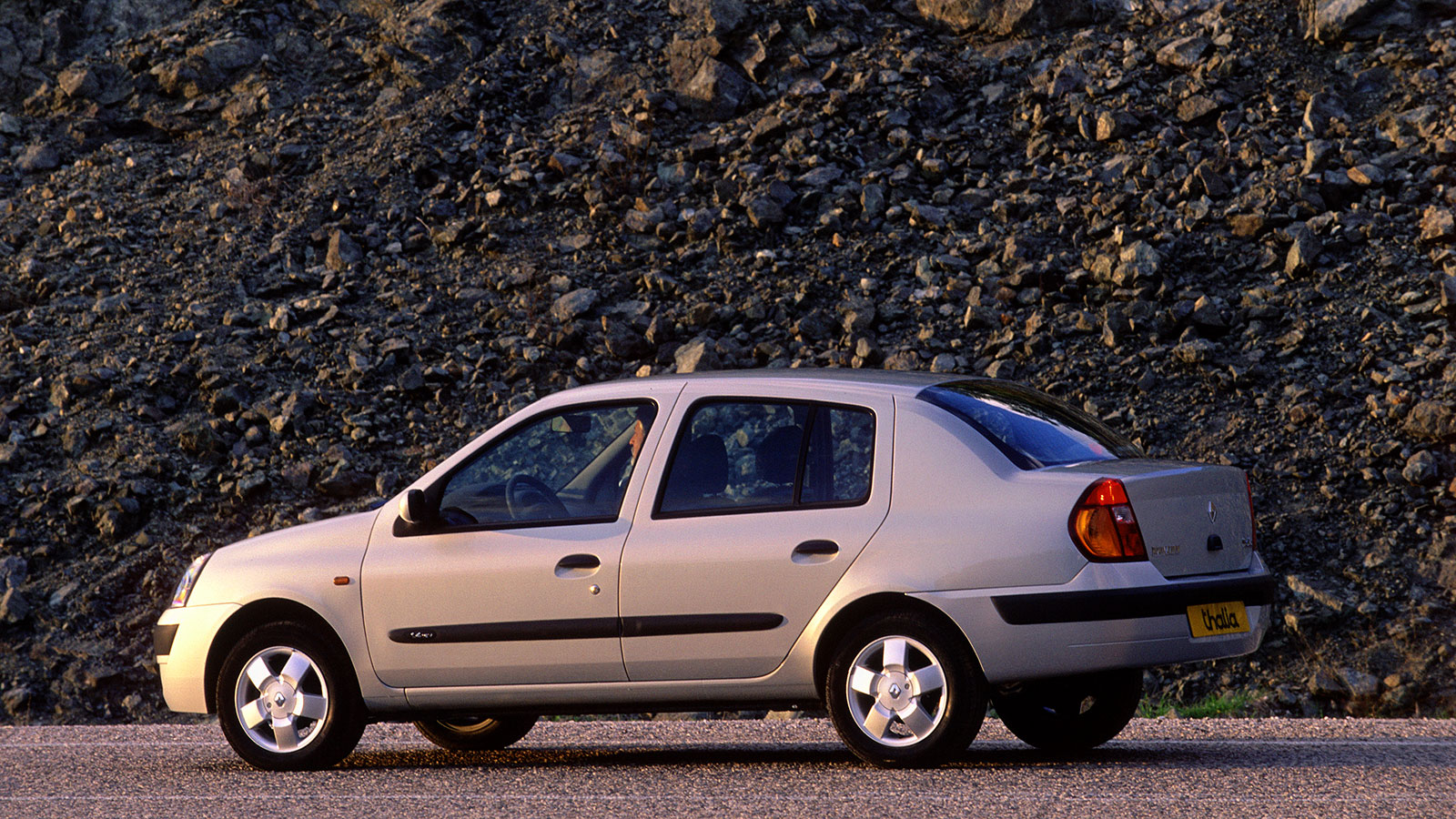
One of the likely worst looking examples is the Renault Symbol, based on the second generation Renault Clio. The C-pillars of the Clio hatchback are so pronounced, with a waterfall roundness to them, that it’s really difficult to integrate a trunk smoothly into that rear end, and it shows. The trunk just looks huge and nothing less than an afterthought, even if there only was a year’s gap between the hatch and the sedan’s introduction.
The Symbol/Thalia also suffers from the same visual problem as the 206 Sedan and the Mk3 Jetta: there’s a lot of stuff above and behind the rear wheel, which is also quite a bit forwards. You’re just driving a huge trunk around. The other thing is that when you’re building a bigger car out of a small hatchback, the rear seat space often remains unchanged.
The Symbol wasn’t even sold in mainland France, but in Eastern Europe, Middle East, and in South America, sometimes as the Renault Thalia. In Mexico, it was badged as the Nissan Platina.

A far better looking Renault was the late ’70s Renault 7, or Siete, which was a sedan version of the R5 or “Le Car.” Should it have been sold in the States?
The UK-based motoring website Petrolblog has taken to calling these sedan hatchbacks “Shatchbacks”. While that’s certainly a mouthful, it’s a term that’s stuck at least in parts of Weird Car Twitter and “Weirdcarbs” aka Weird Car Bluesky.
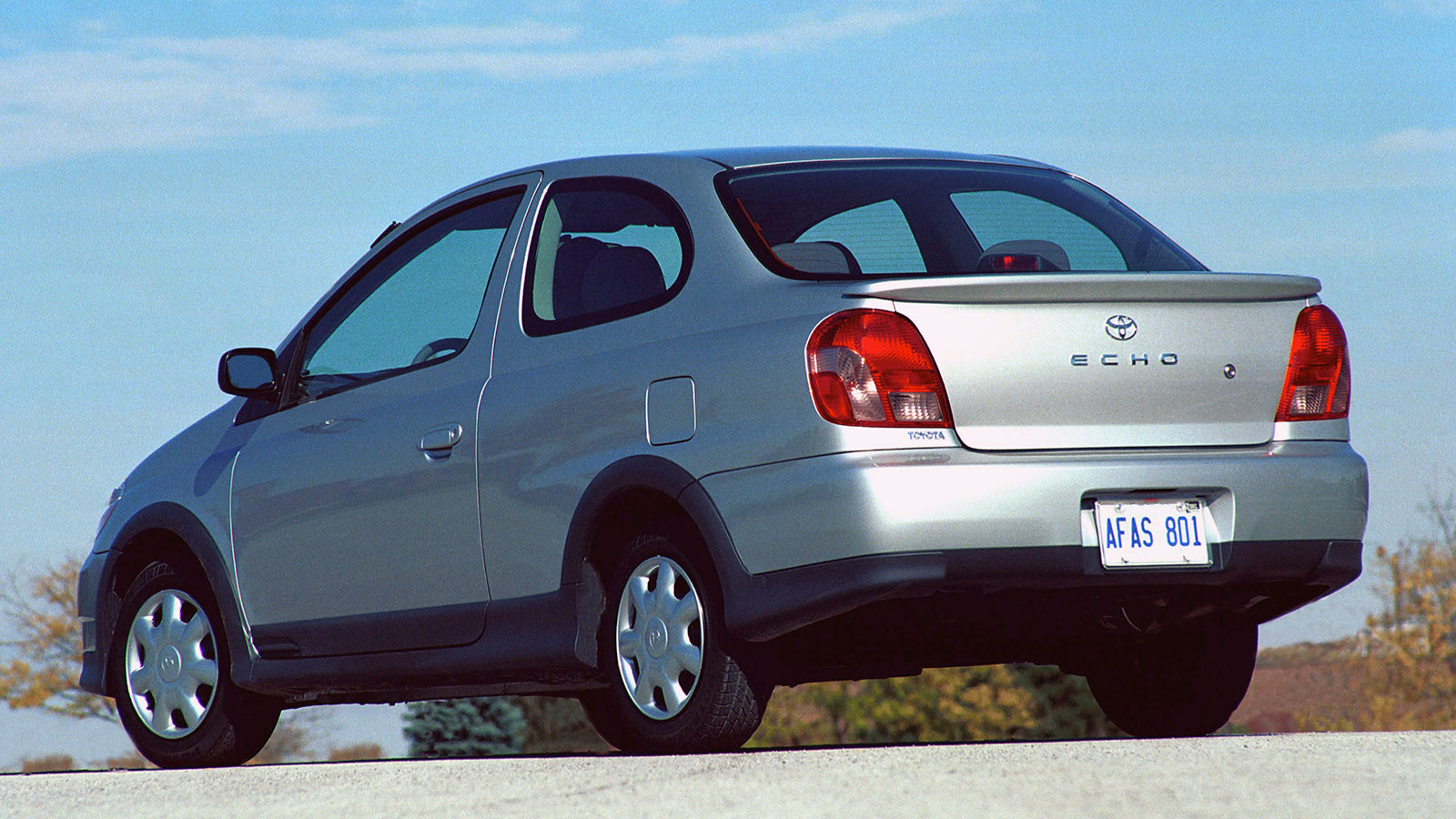
My personal favorites in a Sickos-Yes sort of way are the Skoda Fabia sedan and the Nissan Versa, especially in the light fudge sort of metallic brown that they always seemed to be. I also like the Toyota Echo, probably because we never got it here in Europe. It’s just a Yaris with a trunk, and it was even sold as the Echo Coupe in two door form. Make mine beige.
(Top image: Volkswagen)



Unrelated to the topic but because you mentioned them:
MK4 VWs are ****ing timeless. Our daily is an 04 Beetle Turbo S, so it’s slightly lower with some nice mesh wheels, and it still looks so fresh. I loved my Mk4 GTi and Golf as well, they’re just great cars.
I really don’t understand why people buy new boring cars when instead you could have a nice tuned mk4 vw, so many interiors can be swapped in, they’re safe, relatively easy to fix, parts are cheap, and they look great.
TIL that the new Beetle was originally on the Mk4 PQ34 platform and not a Mk5 under the PQ35.
Mazda 2/Yaris iA hatchback vs sedan. It’s so obvious that the sedan was secondary in design. The hatch is cohesive and handsome while the sedan is weirdly proportioned
The last couple Impreza sedans from Subaru were like this too
I always wanted a mid 80’s Shelby 024.Nice looking and had some power for back then. It is based off the Horizon/Omni but that is actually a hatch too so not sure if it counts but will still throw them in.The earliest of those shared the same motors as the VW Rabbit back in late 70’s.My dad had a 1991 Subaru Loyale hatch and that car was an absolute turd.
I would say based on the criteria in the article, the Omni 024/Charger/Horizon TC3/Turismo do not count. Sure, they share the same L-body platform as the 5-door hatchbacks and the interiors, but the entire body structure is different and not a single exterior stamping is shared.
The mk2 Vauxhall Astra wasn’t a bad looking car, I actually liked how the GTE looked.
Then there was the version for people who wanted to awkwardly post stuff into the boot through a tiny door instead of a huge hatch, and they called it the Belmont. We all called it the Bellend.
GM were really good at ruining cars like this. The Vauxhall Nova 3-door hatch had Audi Quattro wheel arches, and they all looked like rally cars. The salon one looked horrible.
“The Volkswagen Jetta is one of the earliest examples of this.”
The Wolseley Hornet and Riley Elf from 1961 would like a word.
The Mini wasn’t a hatchback though, so the Hornet and Elf aren’t Shatchbacks
As soon as I read “The Volkswagen Jetta is one of the earliest examples of this.” I thought of the Renault 7, which is ultimately mentioned at the end. It predates the Jetta MkI by 5 years.
BMC also have a good, early example of the reverse phenomena: the Austin 1800, 3-Litre, and Maxi.
You skipped Korea. I don’t quite remember the details, but some 2nd-tier country made a sedan of the car originally sold as a Mazda, Kia, and the US-only Ford Festiva. Someone here will remember the details and find a photo.
I was always a fan of the 121. I thought it looked cute.
https://classics.honestjohn.co.uk/media/_v6/6398002/Mazda%20121%20(1).jpg
Weirdly as far as I can tell that one was only ever sold as a sedan, even though it looks like it should have been a hatchback. I almost posted it myself! It seems it’s the previous generation 121/Pride/Festiva that sprouted a (surprisingly not bad) boot.
https://upload.wikimedia.org/wikipedia/commons/b/bc/Ford_Festiva_%CE%B2_002.JPG
Interesting! I didn’t know about that one!
Saipa 131 & 132. Maybe the 141? Not sure on that one.
There’s also the 151 – as a truck. Very cool.
https://en.wikipedia.org/wiki/Saipa_151
Easily the Jetta, most of these rest of these look worse than their hatchback siblings.
I’ll add that I particularly hate the 2008-12 Subaru Impreza sedan that I assume was an afterthought because the backend is so frumpy that is the only valid excuse. But the shatchback that takes the cake for ugly at least in the USA was the 2010ish era Nissan Versa sedan.
Good call with the Impreza!
Likewise, my 2023 Legacy is absolutely an afterthought from the Outback. I don’t think the trunk lid is quite as obvious as your example, but I think it’s still higher than if they had designed it outright.
I’d believe it, the Outback that shared a lot with was obviously the money maker for them and I have to think by ’23 the Legacy was an afterthought. I will say I thought it was a heavily revised version of my wife’s ’15 Legacy which I hadn’t noticed that on but now I’ll have to take a closer look!
I think it’s very obvious in 2010 when the Outback became the dominant design and the Legacy was the variant vs the 2009 where it’s clear that the Legacy was designed first.
The Impreza sedan looked strange past 2012 too. The hatch was so much more handsome
Sure I agree, but even that sedan imo looked a lot better than the ’08-12 generation. Of course the rest of that car was not Subaru’s best work anyways. I also have a recency bias bc I walk by one in my neighborhood regularly where I can marvel at what a terribly proportioned car it was and wonder at how obsessed Americans used to be with sedans that someone bought it over the better looking and more practical Impreza hatch.
Agreed. Every time I see the sedan of something that came as both sedan or hatch, I shake my head in disappointment.
I’ve only owned a couple of hatchbacks, so the sample size is small. I LOVED my ’96 GTI. It was a blue one. It would carry a lot of stuff if needed, but it always made me smile to drive it. Even at a measly 110 horseponies, it was super fun. Balanced handling, sounded good, looked respectable, good mileage.
I’d have kept it longer, but by the time it was 5 years old, all the bits had started to fall off of it.
I know people who have turned their cars into shatchbacks when they misjudged flatulence.
I much prefer when someone takes a sedan, with it’s compromised separated cargo area, and makes a proper wagon out of it.
The original Mazda6 hatchback and wagon were far better looking (and more practical) than the sedan.
One of the worst is the sedan version of the last-gen Fiesta. Truly hideous.
Came here to say this. I believe the sedan was US (or North America) only. Every time I see one on the road (which thankfully, isn’t very often anymore), I die a little inside.
It certainly wasn’t offered in Western Europe.
We suffered that atrocity in Latin America as well.
Choosing the Fiesta sedan over the hatch should have resulted in a trapdoor opening under the offender in the finance office, down into a pool of sharks with frickin’ laser beams.
*second-to-last-gen Fiesta. They got one more in other markets, and I for one am extremely disappointed in Ford for not offering it here (I’m also upset that we only got the 5-door version of the prior Fiesta, but it’s better than nothing at all). Same deal for the Focus.
Citroen C4 that was built on the longer 307 SW floorpan.
Issue is the ones I would like would be well-executed, which would also make them unremarkable.
I can really only think of the ones that are so obviously cobbled together that they become hilarious.
Calling it a shat-back probably wouldn’t help sales.
That’s what they call the exhaust that fits the longer bodies.
A couple of my favourite Snatchbacks (which is how I read it initially) are the 1991-1996 Ford Escort Hatch/Sedan as well as the 2000-2007 Ford Focus Hatch/Sedan.
“Snatchback” is objectively a better name!
I wish the Ford Fiesta/Focus sedans got the ST treatment from their hatchback versions.
The Fiesta Sedan was hilariously frumpy, and the back end fits the literal wording of “shatback”
The only good hatchbacks are 2-door hatchbacks like the ’91 Metro 2-door hatchback I used to own.
https://media.ed.edmunds-media.com/geo/metro/1992/oem/1992_geo_metro_2dr-hatchback_lsi_fq_oem_1_1280x855.jpg
I don’t much care for a 4-door hatchback. Although, nowadays, many of the car-based CUVs are really just 4-door hatchbacks or small 4-door wagons like our 2024 Trax LS.
https://autoimage.capitalone.com/dealer/2024-Chevrolet-Trax-LS-KL77LFE24RC198996-dealersync_KL77LFE24RC198996_47414H-80e2ebab74751da351a86899e2ed08a3.jpg?width=1214&height
As an American, it’s sad this isn’t something we ever really get here; even during the hatchback heyday of the 80s, manufacturers either built both from the start, or (shockingly) only a hatchback model. Unless there’s some mythical Ford Probe coupe I’m missing (which in my mind has Lotus Europa-like proportions).
At first I thought this was asking for more diarrhea song versions.
When you’re driving your sedan
And feel something hit the fan…
I’m going to do a really deep dive here and go for the Chevy Vega notchback.
https://encrypted-tbn0.gstatic.com/images?q=tbn:ANd9GcRwNw8_LVZQhg6plseafQTfQpDBgl0Mmir0mn6jpO7FO2IuleyyC0Q_zgWp&s=10
My favorite will always be the MK1 Jetta as the most obvious version of this style.
I had one, so it might not make me objective, but every time I see one like the above, I still think “that’s a good looking car”
Was going to post the Renault 7 but glad to see you already had it. It was weird that they back-dated it by using old-style metal bumpers but that could have been a local market preference.
I owned a 3rd gen VW Jetta. It was black with a light grey interior. His name was Dieter. I miss him.
I’m not sure the 2004 SEAT Toledo III qualifies, as it is technically still a hatchback. Yet it is nothing more than an Altea (which originally didn’t look half bad) with a trunk-like notch grafted onto the hatch. The results were an impressive trunk capacity and a rear that was so hideous it was fascinating.
https://i.auto-bild.de/ir_img/3/8/2/5/8/0/9/SEAT-Toledo-3797-474×267-9cbd12e4d7177121.jpg
It’s like Seat designers looked at concurrent Meganes and Vel Satises and said, “yeah! that looks good!”. And then proceeded to copy it in the usual half assed Spanish way before buggering off for a siesta.
Honourable mention for the Siete! 😀
My favourite is the Opel Kadett E saloon (elsewhere called Vauxhall Belmont, if I am not mistaken). That thing looked good for a hatchback-based saloon.
https://upload.wikimedia.org/wikipedia/commons/thumb/f/fe/Opel_Kadett_sedan_1.6S_Life_rear.jpg/1280px-Opel_Kadett_sedan_1.6S_Life_rear.jpg
Oh look – A Daewoo/Pontiac LeMans/Asuna/Passport Optima!