

It’s time for another episode of Carbage Time, where we here at The Autopian argue about our dumb takes. Because, like all humans, we have opinions about things, specifically car things, and we’re deluded enough to think that, bafflingly, you need to hear about these opinions! So if you’re pining to hear us opining, boy are you in luck. Last week, in our very first episode of the series, David and Matt discussed the largely disastrous Ferrari Luce. This time Matt and I are going to talk about something far more accessible than some poorly-designed and overpriced battery-powered Ferrari: drive modes.
Yes, drive modes. My suspicion is that it took you a moment to remember just what the hell those things were, because while it’s fairly likely your car has them – if you have a relatively modern car, made in, say, the last decade and a half or so, at least – I also suspect you probably haven’t used them in a while.


Sure, when you first got the car, I bet you tried them out: switching from Normal to Sport, let’s say, perhaps watching your instrument cluster dramatically change from a bluish color scheme to a more exciting, even angry red, and feeling your throttle response quicken a bit, the suspension stiffen a little, and so on. Maybe you kept it on sport for, oh, ten minutes before going back to Normal or even Eco, because what are you, made of money?
You should watch the debate, I think. It’ll be cathartic:
You can also just listen to it, too, if you’d prefer that. I don’t understand why you wouldn’t want to look at out beaming faces, but, you know, some people just don’t want to feel joy:
Oh, and to listen to more podcasts episode you can go to Apple Podcasts, Spotify, or you can use the RSS feed and point your favorite Podcast player at it.
Here’s What I’m Getting At
Now, I get that there are some drive modes that are genuinely useful: the OG sort of drive modes from vehicles with 4WD, for example, really do change the driving dynamics of a car, because going from 2WD High to 4WD Low of course changes things. Those aren’t the kind of “drive modes” I’m talking about.
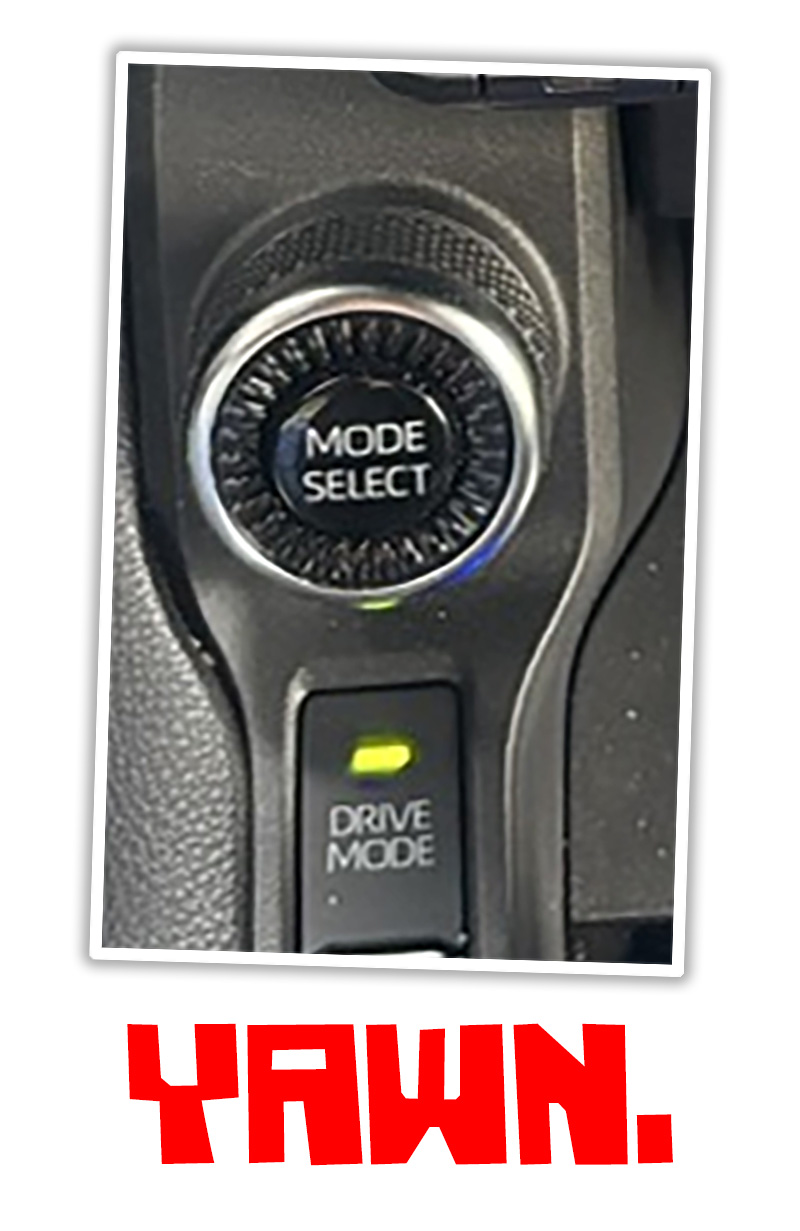
I’m talking about the more recent sort of drive modes that are usually some variant of Normal, Sport, and Eco. Those are definitely not the same as activating a whole other drive axle. Besides, on all my old cars that don’t even have automatic chokes, let alone drive modes, you still could have all of the effects of drive modes by, you know, changing how you drive.
You stomp on the gas and crank that wheel hard, boom, you’re in “sport” mode. You coast down hills and treat the gas pedal like you’re using your foot to pet a cat whose pupils are the size of dinner plates, then you’re in eco mode.
A modern car, with all its electronics and sensors, could easily determine you’re driving and adjust things accordingly, no modality needed. That’d be fine! But you wouldn’t have that visceral moment of changing the drive modes, which I think is most of what drive modes are: a bit of theater.
Theater is, of course, just fine in a car. Cars are not rational, and will never be, at least I hope they’ll never be. But even with that in mind, I still think most of these drive modes are silly things that, again, nobody really uses, except perhaps the obvious, driving-condition related ones, like snow mode or tow mode or something clear like that.
But the others? I dare you to get in your car and, without looking, tell me the difference between “normal” and “eco” modes. And what is “Normal” mode, anyway? It feels like the chassis dynamic engineers couldn’t really decide how to tune the car and drivetrain, and so to get around having to make a hard set of compromises, pushed the problem to the owner, who could pick a an ever so slightly more efficient behavior or a slightly more sporty one or whatever. No one really cares.
Look, maybe I’m wrong here! Maybe I’m being a dismissive dickhead and you love love love your drive modes, switching between them like you were shifting gears! If so, tell me in the comments, make your case, and, what the hell, remind me I’m a dipshit! Can’t hurt!





I had a Mazda CX3 as a courtesy car once. In the regular drive mode, that thing wouldn’t pull a hair out of your leg. In sport, that thing wouldn’t pull a hair out of your leg, but acted like it was hepped up on coke.
I hated that thing. So much.
Mazdas are fun because they give you 100% throttle at 50% peddal travel.
Proud to say our 2024 Chevrolet Trax LS has zero drive modes other than PRNDL – with the L being a semi-manual way to manually go through the gears using a button on the side of the shifter.
It also has analog-style gauges and a real ignition key that you have to insert into the slot and turn in order to start the vehicle.
As an added bonus, the wheels are silver and not black! (We have the LS convenience package so we were upgraded to the silver painted aluminum wheels instead of the steel wheels with plastic hubcaps)
None of those silly drive modes for us to worry about. 🙂
My 2013 Acura has PRNDS, with S similar to your L. I use it all the time, mostly because I live in places where the speed limit is precisely on the cusp that makes the auto shift up just a little too soon, leaving the car in a sluggish state one or two gears too high for comfort. In those areas, I drive in S mode and shift manually with the paddles on the steering wheel. It’s been my favorite car with an auto transmission to drive because of this.
“the L being a semi-manual way to manually go through the gears using a button on the side of the shifter”
I greatly dislike GM and Ford’s little +/- buttons on the shifter. Unpleasant and fiddly to use.
I rarely use them. The wife’s Cruze has it as well. I tried downshifting with it once to see if it would slow down while descending a hill, but while the little 1.4L turbo motor revs higher, there wasn’t much in the way of engine braking. I assume the 1.2L in the Trax would react the same way.
My truck has the H-pattern 1-5 + R and it’s a lot more fun to drive. 🙂
I had a Fiat 500 Abarth where the Sport button made a big difference: the rated/advertised horsepower was achieved only in Sport mode. In “not-sport” mode at full throttle, the turbo boost would peak at 18 psi but taper down after 4000 rpm. At full throttle in Sport mode, it would hold 18 psi up to about 6000 rpm. Also, in Sport the throttle response was crisper and the steering had less assist. When I sold the car recently, I sure to point this out to the new owner.
Former Abarth owner–can confirm. Drive mode made a huge difference, and mine was in Sport+ (had to hold the sport button for 5-10 seconds for the plus) most of the time.
Hard agree
I really, really disagree with this take. The standard mode for most modern cars is a lazy, lethargic “let’s ace the EPA test” mode whose lag and delay is not acceptable.
This doesn’t get solved by pushing harder on the pedal as you suggest – response matters, not just the performance you get out of it.
This is the correct take.
I beg to differ. As long as I can select in which mode the car would default at startup, I’m good.
All in all, like most things – if it’s done right, it serves its purpose. If it’s done wrong – it doesn’t.
Little cry for losing a perfectly good rotary knob for something you switch between seasons, when HVAC and radio are sent to touchscreens. Not on my Kia, but on others.
Most Subarus come with “X-mode” which works great in the snow, then automatically switches off over 18 mph. I like it.
Is live in a very snowy place, and yet, have never found a use on the road for XMode in the 8 years I’ve owned my Subaru. The only time I needed it, was trying to get up a very slippery grass hill.
Don’t need drive modes. Set it up right in the first place. What I do want though is the ability to turn off stability control, traction control and all the various active safety interventions. I especially hate the fact that most new cars “normal mode” seems to include fighting my steering when I want to change lanes or applies brakes when getting “too close” to the car in front. For several years M3 cars would allow turning off of stability control and traction control but unless you had the “performance driver package” the car would insist on turning them back on (as well as roll up the windows) under hard braking. Made taking the stupid thing to the track real frustrating. Pulling a fuse fixed it.
The “individual” mode on Mercedes Benz that lets you permanently turn off start-stop is worth using!
Same for BMW
I am behind you all the way. Frankly ever since they started putting electric windows and door locks I’ve said it is just useless shit that they want you to spend more money on. Something with 3 buttons that don’t really do anything is just like buying gasoline with that higher octane scam. Frankly I’m not sure if even diesel is any different but at another $2 a gallon I’m not going to try it. I bet the same people who came up with drive modes came up with global cooling, global warming, and okay fine climate change.
If you tune a car for efficiency, like with an msd ignition advance, you can get them to a point where they won’t run on regular gas.
Performance up too.
Many vehicles benefit enough stock.
Just do the math. With a van it depended on the price of premium. Some places gouge.
Counterpoint : “Tow/Haul” mode on the F-150 / Expedition is actually pretty nice, especially for the “Please downshift more readily to provide engine braking going downhill” logic.
Someone else already complained that Ford’s drive modes don’t stick between driving cycles, which sucks (took our trailer to Moab a few weeks ago and I got tired of having to swap Tow Mode back on every time we got back on the road after snack/gas/potty stops). I would kind of like it to stay where I left it until I decide to change it.
Other counterpoint: use of drive modes/magic keys to enforce more responsible behavior. Valet mode, Teen Driver Mode – there are conditions where it’d be nice to use the Power Of Computers to limit or de-tune a car. Yeah, you could ask that parking lot attendant to take it easy, I mean – he’s a professional, right? – but throwing some enforcement down on that request seems like a sound and technically feasible idea.
I’m pretty sure you can make drive modes sticky with Forscan. The software is free, but you need a special $50 USB-OBD2 cable. It also gives you dealer-level diagnostics and can usually unlock some features if your particular trim didn’t come with them. If you own a modernish Ford, it’s well worth having.
My Prius v has “PWR”, “Eco”, unwritten “normal”, and tangentially an “EV” mode.
Normal/PWR/Eco only has two effects…primarily, it’s how sensitive the gas pedal is. The car remembers normal or Eco between shutting it off or turning it back on, but not power mode…which is kinda funny because a friend described power mode as “feeling like a normal car.” Really, though, I’ve grown to love how much slack it has in Eco mode. If it weren’t for the pedestrian warning noise, you could seriously sneak up on someone in this thing. You could move in inches in silence with room for error.
Eco mode has a secondary side effect of restricting the A/C compressor in some way or another. I don’t mind, but I do think it’s dumb those effects are tied together.
And at the end of the day, flooring it gets you the same result in all three modes–so really, it should just be some 3-position switch for “pedal sensitivity” with a separate “A/C Eco” toggle somewhere. I do appreciate adjusting pedal sensitivity, because my dad’s Sienna is way too touchy from a stop and there’s no way to adjust it that I’ve found (without installing aftermarket equipment).
Also, the switches shouldn’t be buttons right next to the center cupholder, seemingly designed to catch spills. What a dumb decision. I had to take the armrest apart to clean them when I first bought the car, removing the plastic bits of the switch from the electronic components.
The other mode button is EV, which is a mixed bag. Since this isn’t a PHEV, the gas engine comes on basically at the drop of a hat. EV mode is good for moving the car between parking spaces or otherwise just moving it around a parking lot, but it only goes into it if it feels like it. Haven’t turned the car on in a while? Too bad, engine’s coming on. Freezing outside? Too bad, engine’s coming on. Press the pedal too hard? You guessed it, engine’s coming on.
It’s a nice feature, especially for someone like me who’s paranoid of the 12v dying if you turn the car on and back off too quickly, but it’s only been useful on a handful of occasions.
May be cutting the AC compressor at idle?
The manual’s exact (and only) wording is:
“The torque generated in response to accelerator pedal depression will lessen compared to normal, and air conditioning operation (heating/cooling) will be restrained, thus suiting driving with improved fuel efficiency.”
I wonder what that means?
Interesting phrase
The 12V in a Prius only powers the computer and the car accessories. Engine start is via the Hybrid battery pack.
However it does it, it does absolutely depend on the 12v functioning. When my original 12v was on the way out, I had to try the power button multiple times before it’d go into READY mode. It would also freak out with many dashboard lights on sometimes. Apparently, that’s normal when the 12v is low.
Yep, had the same with my daughter’s old ’08 Prius. A LiION jump pack will work as a stopgap to get it in READY mode.
Now that these have been around for a reasonable amount of time, I’m curious – how do they hold up, function/parts-wise? Are they pretty robust, or can they break down and leave you stuck in limp home turtle mode or something?
> limp home turtle mode
That’s Jason’s “normal” mode.
My Avalon, purchased from my dad for next to nothing, is a total dog in eco mode. Eco is fine for normal commuting, but in heavy traffic, I use sport mode.
Say I want to merge and the gap to merge into is on the smaller side. If I put my right foot down on the gas in eco mode, there’s a lag where the car just doesn’t really respond for a second or two. It’s just a dangerous non-response. In sport mode, the car feels more like my older manual transmission vehicles, with a direct mechanical connection between the gas pedal, engine, and transmission. It goes, and doesn’t think or hesitate. No danger. The person I’m merging in front of doesn’t have to touch the brakes or get annoyed like they might with eco mode.
Sometimes the person in front of me accelerates, and eco mode doesn’t let me keep the gap between vehicles tight because of that delayed response. Invariably, someone will cut in dangerously and I have to go from accelerating to slamming on the brakes. Once again, sport mode is just safer because I can keep up better, and there’s no gap for someone to cut into.
Less useful than drive modes: video podcasts (<3 u guys and Matt has already learned me why they are important but they're stupid and the rest of the world/social media is wrong about this)
Wife’s car has Eco (99% of the time, blue), Normal (0%, also blue), and Sport mode (1%, for uphill acceleration, red). No idea what Normal is since I’m driving a hybrid, and the only motivation for me in driving it is to maximize the MPG. Normal probably worse than Eco.
What I want to do is drive a full tank on Sport to see how much worse the MPG are.
And, what changes are made to the engine/trans between Eco and Sport? Are transmission ratios being changed? Are compression ratios being changed? Timing getting forwarded or something?
Is there a transcript mode for the podcast? Asking for a friend who doesn’t want to see your faces or hear your voices.
Yes, Eco and Sport definitely keep the transmission in difference RPM ranges.
I would think it varies by manufacturer. If you drive conservatively, being in sport probably would have little effect unless it is used to adjust suspension and steering feel as you wouldn’t be running to redline or be aggressive with the throttle.
It still changes throttle mapping and in cars with gears changes gears stupidly…
Yes, but if you drive conservatively, mode shouldn’t make much difference with mileage. If the throttle opens sooner, you push it less, just like if that was the only mode. It might take time to get a feel for it, but then it would become normal as you adapt. Like the shitty throttle calibration of my GR86 that I’ve adapted to (still don’t like the non-linear, front-loaded mapping, but I long since adapted to be able to drive it without looking like a learner).
I have yet to find an auto with more than 4 speeds that doesn’t annoy me with bad shifts no matter the mode. I’ve even come to prefer CVTs, which the most popular hybrids have, but I’m buying manuals for as long as I can.
I agree with almost all of it, except that the latest experience with automatics (8-speed torque converter ZF, 7-speed dual clutch Getrag and whatever 6-speed dual clutch the Smart Forfour has) are fairly good at choosing ratios in normal driving.
In spirited driving you just go into manual, so whatever the car’s brain thinks would be best is irrelevant.
I limit my experience with automatics, but even the “sporty” one in my BIL’s Cadillac ATS 8 or 9 speed was dog slow to respond to manual commands when it responded at all, would constantly upshift when you didn’t want it to, and hunted for gears. Anything else has been worse at it. The Toyota and Subaru CVTs I’ve driven are much better experiences only in that I don’t find them frustrating, merely unsatisfying. Better to drive than either were old school slush boxes. As much as I hated them in the day and as inefficient as they are, they were predictable and did what you wanted them to do when you wanted them to do it. While the limited number of available ratios certainly meant there wasn’t much overlap for the transmission to hunt or jump around, I wonder if a big part isn’t that there also wasn’t an idiot programmer in between ruining it with stupid code, though if there was, back then the programmers were actually competent, so I wouldn’t expect it to be bad at all. Speaking of which, you’re mentioning EU cars in the EU and I wonder if there are programming differences between the markets that would make the US ones worse or maybe I’m overly irritated by machines that “think” for me and almost always chose wrong.
Well, my experience with an Alfa Romeo Giulietta with a dual clutch was deeply frustrating. It was so bad that I would drive in manual mode even in normal circumstances.
That car was a car to put off people from automatics.
I was wary of the dual clutch in the Smart, but that is surprisingly fine. Even if sometimes it is in too high of a gear (considering it is just a 90bhp engine and what must be half a foot-pound of torque). But it is not annoying.
I rented a lot of cars in Germany last year for work related reasons. Some had automatic gearboxes (i20, Corsa or Focus) and they were in general… fine. Maybe not perfect, but not annoying in a way you’d bang your head in the A-pillar repeatedly like the Alfa was.
I would drive the same way. I hope. The car is not interesting to drive in any way, except that it is old enough that I can control my iPod on the screen. A newer car won’t do that, and a newer audio deck (the one in my old car) won’t do it.
It feels gross to hand something over to AI, but if you care to, you might be able to cram this through AI and get a mostly useful transcript from it. I draw the line presupposing it will yield a useful summary though.
I’m not ashamed to pretend I’m that friend. No offense to our beautiful staff, but I can read a 30-min podcast transcript in 3 minutes, leaving 27 minutes for other important tasks, like considering washing my car and deciding against it.
I had some sophisticated vcrs, before Sony turned to crap, that would run higher speeds with pitch adjusted.
Great for watching the news in ten minutes.
Priceless for a four hour foreign film in subtitles.
Early days dvds couldn’t reproduce this.
My TiVo had a “25% faster” mode with audio. Sadly, Cable Companies decided to become streamer assisters, and their DVRs suck.
Aaargh!
Streaming is essentially a more profitable version of cable.
If you want to understand high finance in the states now, compare the exact same video services from the same company here and in other countries, including UK.
It’s a miracle I have interwebs here.
The cable and web supplier near here refused to run a line to this house decades ago even when the company the owner worked for offered them a blank check.
Suppliers generally jump at those high profit runs, as it’s win-win for them.
I was offered three phase once at a hookup cost of $10,000 for a short run in the city. Turned it down.
I probably owe net access to a rural wiring subsidy. Most of this country by area has no physical access. I am just outside the city limits.
You just know insurance companies and the law will figure out a way to use modes and vehicle data to screw you.
“You say you were just driving down the road obeying all traffic laws huh? Well, your vehicle data tells me you were in Sport Mode when the accident occurred. In other words, you were sporting about and probably recklessly. So, you’re getting a ticket and your insurance company is going to refuse your claim.”
*hides tennis racket from insurance adjuster*
“No, nope, no sporting here! I wouldn’t know what to sport about the first place! “
All of these things allow them to engineer cars worse rather than get them right. Watch little boy youtubers driving proper old cars for the first time and see the genuine shock—not the stupid punch-me thumbnail faces they choose—at how good the car feels. Yeah, because back then, people weren’t miserable overly safety obsessed wusses and how a car rode and drove mattered, which drove competition in that regard and success relied on actual engineers not idiots who write bad software. “Oh, but we gave you a bunch of (bad) options instead, isn’t that better?!”
What I like about the GR86 is that it doesn’t have driving modes other than being able to shut off the driving nannies and the suspension is well sorted for it. Throttle, OTOH, I don’t know why it’s taken until ’27 for them to program it to be linear.
I think many cars are engineered to be non linear on purpose, to mock power and response.
I definitely think that’s why they did it, especially where it’s relatively low on torque and I guess that might fool people on a test drive, but for something marketed as a budget track car, having less consistent throttle and essentially truncated travel as the last 30% does almost nothing makes no sense as that’s where you’d want consistent, finer control (another reason nannies suck—they allow the typical lazy, incompetent programmer to use traction control as a crutch for bad programming where old cars would have longer travel for the driver to better control the power themselves). I never recall taking issue with any cable throttle, it’s only when they went DBW and idiot programmers were given the job that things noticeably sucked from hesitant (sometimes severely) response that replicated burned points in a distributor that was no longer there to terrible inconsistency that was even more pronounced with manual transmissions. With two cars, I learned to lightly pump the throttle when trying to get off from a stop smoothly or else it would bog or pogo like I was a learner. I had to unlearn it with the last car that didn’t need that.
Linear seems more desirable.
A common high performance engine setting goes the other way for purposeful reasons, limiting low rpm power in lower gears to maintain traction.
A common use of multiple tunes has been ideal settings for a clean exhaust, needed in some states.
I have an early tier EPA setup on an International. I don’t know what eco stands for, but that’s where I keep it set.
It’s been adequate so far.
On tunable tow vehicles, a light load and heavy setting would be useful, done properly.
Yeah, if my car had real low end torque, the dumb quick ramp throttle opening would make it a handful. As it was, it makes it a lot worse in the snow on steep hills than it needs to be.
I think they’re good, just overused. Of course we all have our default mode we use, but that’s the point. The car gets to specialize a bit when appropriate without always having to be compromised for daily driving. On my car sport mode stiffens the magno-whatever suspension, tightens steering, quickens throttle response. I don’t want that when I’m commuting, but I do when I want some fun. Track mode goes further and takes off a lot of the traction aids. Again, I want those for safety and whatnot most of the time, but when I am able to really wring things out or do some donuts (safely in an empty parking lot) it’s great. I don’t want surprise donuts, those are scary. Some of the off-road modes adjust traction control to allow for slippage to let you power through iciness. Maybe the “sport mode” on a corolla doesn’t do anything, so sure, they’re overused, but I don’t mind them so much when they’re actually thought through.
I can only account for the Repentastar in the Caravan, but Eco mode noticeably dampens the throttle response and it tries to 1. get into a high gear as fast as it can, and 2. stay in that higher gear as long as it can (hence the damned throttle response) even to a degree that I think it’s lugging the engine too much.
On the other hand, that thing gets really rev-happy on E85 (flex fuel). Wonder if it can run a more aggressive timing and fuel map because of the knock resistance or something.
> Repentastar
I loled.
the 3.6 Pentagram
Rest easy, friends: the “FEAUTRED” tag is not a typo, as there are four other posts since 2023 that include it, and that simply cannot be a mistake. There are no mistakes in Autopia!
“…could easily see determine you’re driving…”
There’s no editing either.
uggghh FINE I’ll fix it
Should there be a sin tax on syntax?
I think that’s a portmanteau of faux and tread, like a bald tire or a slippery work shoe.
Every time I’d visit my parents and drive their 2003 Forrester they’d complain soon after I leave that the transmission shifts very abruptly and the gas pedal feels touchy. Dunno if it’s true, but I also felt like the car wouldn’t wake up until the 3rd or 4th time I drove it.
You must be providing the Forrester with what engineers call an “Italian Tuneup”.
(that is when you drive a car like a banshee and shake loose all the carbon, etc)
Many 90s performance cars would learn your driving style over as much as 1200 miles.
Before I bought my manual Honda Fit I had some seat time in a CVT one. Eco mode made a real difference in feel, the car was much less sensitive to the throttle and made for a higher ratio much more readily. Also helpful in snow when the trick is to put down just enough torque to get moving bu not enough to break traction.
Drive modes are silly. Just engineer the car properly and call it a day.
Also:
“A modern car, with all its electronics and sensors, could easily see determine you’re driving and adjust things accordingly, no modality needed. That’d be fine!”
My car does that. Let me tell you it is most definitely not fine. The car cycles through model haplessly trying to hunt what it thinks is best. And it is mostly wrong. Don’t do “different modes”. Just a single good setup.
I’m sarcastically interested in hearing what your definition of “engineered properly” is, because it sure ain’t any engineer’s definition
Here’s the thing: if you want the car you are designing to drive in a way that maximizes fuel economy, you want a certain set of parameters. Gear shifting that keeps the engine in a certain RPM range, throttle sensitivity, fuel/air mixture, et cetera. And if you want that car in a way that provides better acceleration, you want a completely different set of parameters. And if you try to split the difference, you end up with a boring hunk of metal that does neither.
So unless you have a technology that allows the car to read the driver’s mind, the only way to know what the driver wants to have a button.
I am sure that you don’t want to provide “better acceleration” in a Clio Hybrid and you don’t want to “maximise fuel economy” in an Alpine A110.
In any case, mode or no mode, if you mash the throttle all the way, deep into the carpet you still get all the acceleration, so…
The annoying thing, at least in my Maverick hybrid, is that it doesn’t remember the last mode you had it in. I use eco mode. I always put it in eco mode when I start driving. I love you Maverick, but why can’t you remember that?
You have to throw down $80k on the Filson Maverick for that kind of hoity toity feature.
Logo Bags which are made to block the windows: No extra charge.