

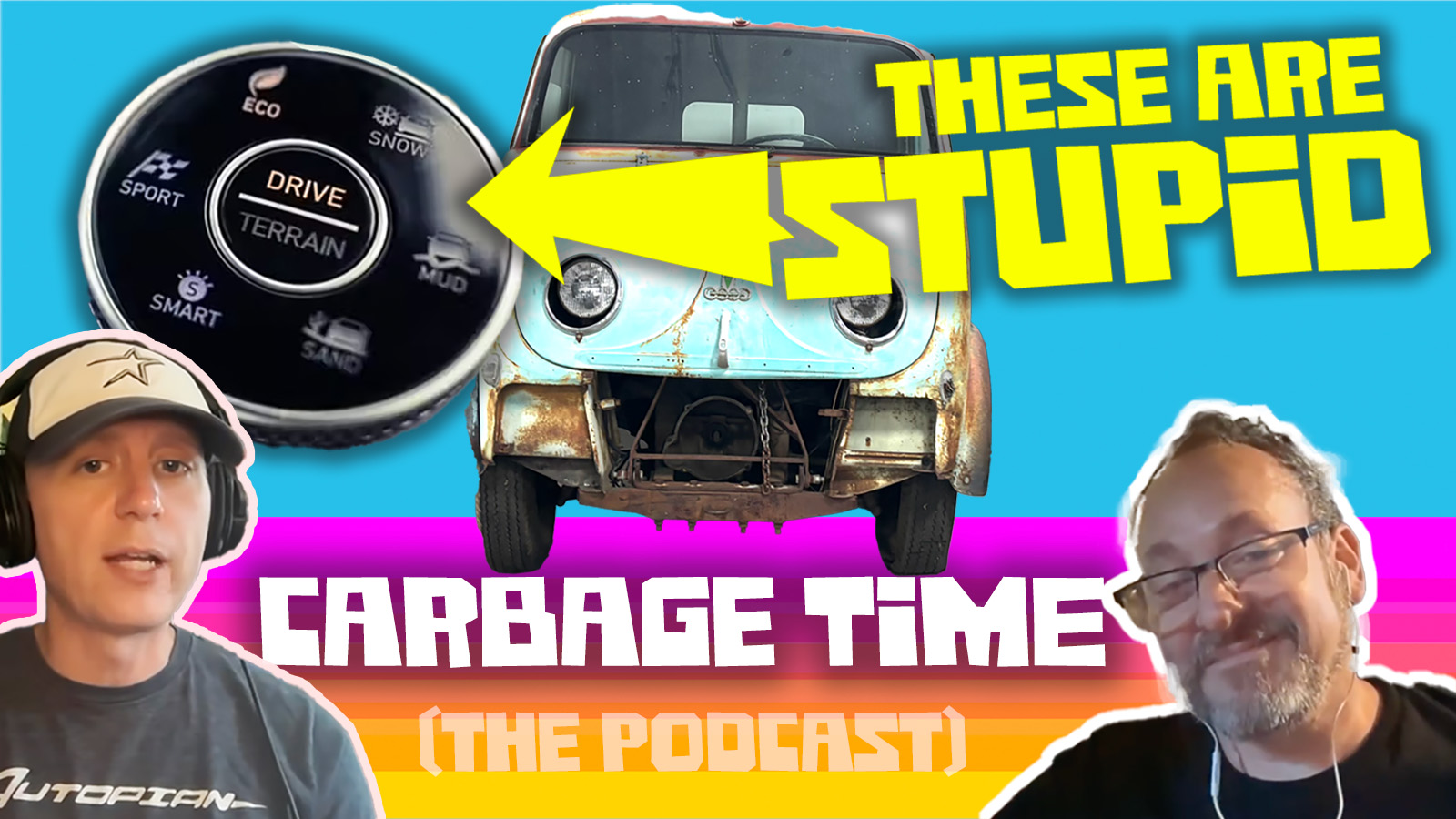
It’s time for another episode of Carbage Time, where we here at The Autopian argue about our dumb takes. Because, like all humans, we have opinions about things, specifically car things, and we’re deluded enough to think that, bafflingly, you need to hear about these opinions! So if you’re pining to hear us opining, boy are you in luck. Last week, in our very first episode of the series, David and Matt discussed the largely disastrous Ferrari Luce. This time Matt and I are going to talk about something far more accessible than some poorly-designed and overpriced battery-powered Ferrari: drive modes.
Yes, drive modes. My suspicion is that it took you a moment to remember just what the hell those things were, because while it’s fairly likely your car has them – if you have a relatively modern car, made in, say, the last decade and a half or so, at least – I also suspect you probably haven’t used them in a while.


Sure, when you first got the car, I bet you tried them out: switching from Normal to Sport, let’s say, perhaps watching your instrument cluster dramatically change from a bluish color scheme to a more exciting, even angry red, and feeling your throttle response quicken a bit, the suspension stiffen a little, and so on. Maybe you kept it on sport for, oh, ten minutes before going back to Normal or even Eco, because what are you, made of money?
You should watch the debate, I think. It’ll be cathartic:
You can also just listen to it, too, if you’d prefer that. I don’t understand why you wouldn’t want to look at out beaming faces, but, you know, some people just don’t want to feel joy:
Oh, and to listen to more podcasts episode you can go to Apple Podcasts, Spotify, or you can use the RSS feed and point your favorite Podcast player at it.
Here’s What I’m Getting At
Now, I get that there are some drive modes that are genuinely useful: the OG sort of drive modes from vehicles with 4WD, for example, really do change the driving dynamics of a car, because going from 2WD High to 4WD Low of course changes things. Those aren’t the kind of “drive modes” I’m talking about.
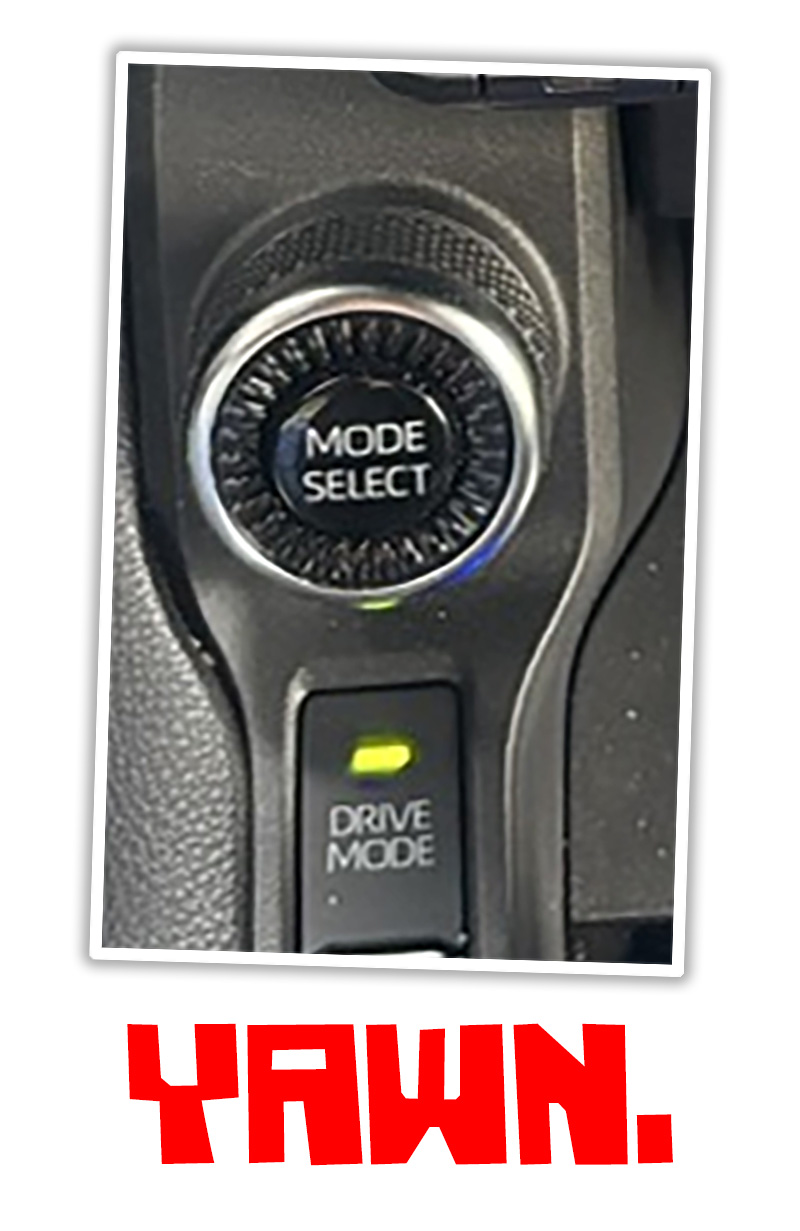
I’m talking about the more recent sort of drive modes that are usually some variant of Normal, Sport, and Eco. Those are definitely not the same as activating a whole other drive axle. Besides, on all my old cars that don’t even have automatic chokes, let alone drive modes, you still could have all of the effects of drive modes by, you know, changing how you drive.
You stomp on the gas and crank that wheel hard, boom, you’re in “sport” mode. You coast down hills and treat the gas pedal like you’re using your foot to pet a cat whose pupils are the size of dinner plates, then you’re in eco mode.
A modern car, with all its electronics and sensors, could easily determine you’re driving and adjust things accordingly, no modality needed. That’d be fine! But you wouldn’t have that visceral moment of changing the drive modes, which I think is most of what drive modes are: a bit of theater.
Theater is, of course, just fine in a car. Cars are not rational, and will never be, at least I hope they’ll never be. But even with that in mind, I still think most of these drive modes are silly things that, again, nobody really uses, except perhaps the obvious, driving-condition related ones, like snow mode or tow mode or something clear like that.
But the others? I dare you to get in your car and, without looking, tell me the difference between “normal” and “eco” modes. And what is “Normal” mode, anyway? It feels like the chassis dynamic engineers couldn’t really decide how to tune the car and drivetrain, and so to get around having to make a hard set of compromises, pushed the problem to the owner, who could pick a an ever so slightly more efficient behavior or a slightly more sporty one or whatever. No one really cares.
Look, maybe I’m wrong here! Maybe I’m being a dismissive dickhead and you love love love your drive modes, switching between them like you were shifting gears! If so, tell me in the comments, make your case, and, what the hell, remind me I’m a dipshit! Can’t hurt!





Depends on the point of the car and the execution. The FSport Lexus IS and GS350 were supposedly quite good, making meaningful changes to the adaptive suspension, steering, and powertrain response appropriate to a milder sport sedan.
In contrast, the modes in a V6 automatic 9th gen Accord kinda sucked, all they did was change shift logic on a lazy slushbox that had no manumatic gear selection. So that one was stupid. My non-Fsport GS has fixed suspension so it’s a similar system and similarly useless. Normal works well. I have paddle shifters if I want control over what gear it’s in.
I was about fling my Danish to the floor in a fit of rage at the mere insinuation that any of my vehicles have a drive mode. But I am humbled, you are correct I have a selection of both 2WD, 4Hi and 4Low.
Gobbles.
On my car the sport mode stiffens the suspension and quickens the throttle response. Then the transmission has its own sport mode that dramatically quickens downshifts and holds lower gears for longer; plus when you use the paddles when the gear selector is in sport it holds the car in that gear permanently until you either go too slow for the gear or take it out of manual mode.
I can get behind the Eco/Normal divide, and maybe some sort of “slippery” mode as a shortcut for manually fiddling with the assist settings. but beyond that yeah it’s just pointless.
Big difference in throttle response between Normal and Eco in my Toyota Hybrid. That siad, I leave it in Eco 99% of the time.
These “Eco mode”, “Sports mode” etc settings are really just a waste of time. What we need are some more useful options:
“In-law on board:” mode:- softens suspension, cuts acceleration by half
“Beemer” mode:- just disables the indicators
“Grandma” mode:- accelerator becomes like an on/off switch
“Dad” mode:- Sat-nav provides the most complicated and time-wasting route possible, whilst saying “I know exactly where we are” every 3 and a half minutes
Such a shame COTDs are not awarded on weekends…
I always thought cars with a knob to adjust the anti-sway bar wile you are.driving looked like fun. And a ride height adjustment would be truely useful.
I get how throttle tip in response would be a good thing to adjust, sometimes an on off response is fun, sometimes you are trying to park.
But I hate modes with names that don’t describe what they actually are. It makes an everything harder to use if you have to reverse engineer the stupid modes.
My father in law had a suv with modes for mud and for snow and off road could never figure out what the difference was, or which was the right one for wet grass that you don’t want to tear up.
I love adjustments even though if you have five things you can adjust five ways there’s only one out of 3125 settings that are correct.
Letting a car choose its own drive modes brings us one step closer to Homunculus.
My perspective as a former OEM engine designer: driving modes let us do all the emissions testing in whatever the default start-up mode is.
Then you can select the sport mode which is the one we prefer driving.
But sure, blame us for poorly conceived government testing encouraging us to find loopholes.
How big is this loophole? I mean, how much more emissions are we talking about?
Many cars have a very aggressive warmup mode that can’t be avoided.
This would be very inefficient until it reaches its happy place where it would be more efficient and test cleaner.
There have been recent reports of oil washing by excess petrol on short trips damaging engines. Purely from a performance centric approach I was told years ago to preheat an engine before starting to enhance longevity.
Redline has confirmed that oil temperature is crucial even with their hotsy totsy oils.
Some hypermilers have preheated engines to see if it enhanced efficiency with promising results.
With the threat of oil washing, there may be stronger reasons to preheat and shorten or eliminate that radical warmup mode.
With my mechanical turbodiesel, I find even short block heating periods in vaguely chilly weather make a difference in startup. Specifically, there are no electronic adjustments, hardwired or not in that engine.
So there may be longevity justification for preheating along with a reduction in cold start fuel use.
What would an ideal warming temperature be for startup? 80F? 100F? 100C
Ideal for the engine would be operating temperature. I’m not sure what temperature would stop the warmup cycle, but the incomplete testing I saw on a hypermiling site seemed to shorten the cycle considerably with short preheating, probably using an oil pan heater. For best oil performance redline urged me to lower the oil level in a high capacity pan to accelerate oil warmup. Some race cars use preheating and run up oil pressure before starting. A car with a tightly regulated oil temperature system was being kept over 200 degrees. They found a 10% reduction in friction by ramping up oil temperature.
My Cummins diesel is a thousand pound block, all mechanical. Fuel metering is fixed. The only compensation for cold is a block heater and intake heater. The intake heater kicks in at about 60 degrees and less. At 40 f and 50 f, to my surprize, even fifteen minutes running the block heater makes a dramatic difference in start and warmup behavior. I clearly save fuel by shortening the warmup time. I also block most of the radiator in cold weather. I will be adding an oil pan heater and transmission heater.
So it’s a P-pump equipped Cummins then? A 1994-early 1998 Ram?
Yes, pickup is a 1998 Cummins, slightly uprated injectors, larger turbo, tuned P pump, all external airflow enlarged including exhaust manifold.
I have a 2005 Camry 4 cyl with a very rapid warmup mode, and a factory defective temperature gauge. Fun stuff.
I think preheating would help the Camry in all weather.
The P-pump trucks are simpler and less failure-prone than the later stuff, but they sure don’t love cold starting in sub-zero weather! The 5.9L common-rail injected trucks are quiet, powerful and they cold-start so nicely in cold weather. The 2005-06 were probably the apex because they had more durable injectors and an in-tank fuel lift pump. But the P-pump trucks will run ’til the heat death of the universe!
If it’s an auto gearbox then the shift points could move quite a bit.
The old noise pass by test would let you have a silencer bypass valve open all the time in selectable modes. That’s been fixed now, it has to pass the test in all modes.
That is the only good argument I can accept.
What is the preferred driving mode for a Clio Hybrid, also sport?
The preferred mode is on a hidden menu that switches to “not a hybrid Renault” mode.
I will look for it, report back when I find it!
I have to admit that I’ve not even sat in a Clio since about 2002.
Most of the modern cars I’ve driven have been Lotueses.
I might be slightly envious now.
It was one of the best perks of working there, but the salary meant I don’t own a car newer than 2012.
Ha!
That’s just mean
I laughed—but, still 🙂
My 1990 Citroën XM had a sport mode button. It was great!
My 2002 VW Lupo 3L had eco mode: Got 94 MPG at one time, by just feathering the throttle and keeping behind the trucks on the highway.
Was the XM a manual or auto?
5 speed manual 110, drove sooo goood, a really nice, cool and fun ride!
Proper Citroën! Also weird to have a sport button on a “typical” Citroën.
With eletronic control of the suspension (opposed to mechanical in earlier models), it must have been quite easy to make it firm up just by pushing one button, and then labelling it “sport”. Had a lot of fun with that 🙂
https://en.wikipedia.org/wiki/Citro%C3%ABn_XM
It was further developed in to the absolutely ruling anti roll “Activa” system, but then phased out around the beginning of the Stellantis era 🙁
https://www.youtube.com/watch?v=EZ_3HRMy2js
That Xantia Activa is legendary. If I am not mistaken it held the record for highest speed in the moose test until very recently
I found that locking the throttle at a certain distance behind trucks gained 5mph purely from aerodynamic advantage.
Too close for comfort in that car though.
Valet mode is good. There’s no reason for a valet to need any more than one horsepower, much less a hundred.
My feeling is that luxury vehicles have better defined and more dramatic modes, which improve as you go up in spec adding, for example, adjustable suspension. My Lexus has strangely dramatic differences between drive modes and a slight tinge of customization… You can have the suspension on comfort while the steering is on the firmer setting, and the powertrain and be normal, more or less laid back. My “CUSTOM” mode is comfort suspension, sport steering, normal powertrain.
Mainstream cars, like a Chevrolet Bolt EUV I used to own, have nearly imperceptible differences between their normal and sports.
Speaking of Chevys, the Honda Prologue has no modes of any kind anywhere, which is weird for an electric vehicle. I don’t think you can even adjust the brake regen.
Something I thought of with what they can do with drive modes; some cars have a “teen driver” mode that can limit speed and acceleration, it should also set the shock absorbers and power steering to their hardest and lowest settings respectively, disable active noise cancelling if the car has it, and just basically maximize driver feedback.
Just about the only thing that bothers me in my Maverick hybrid is that it doesn’t remember my driving mode! So I have that 4-button-push muscle memory after 4+ years of driving that puts it into Eco Mode every start.
I’m old, I’m cheap, I’m retired. Go around!
That said, I have found Wet Mode to be useful on snowy or very wet pavement. Sport Mode only gets activated by accident!
Same as in my Clio Hybrid, sport mode seems pretty redundant. You get full power in eco mode anyway if you bury your foot deep into the carpet…
I beleive they have to do that to meet government testing standards, the same reason stop/start has to be disabled on every startup. (weird that they don’t allow restarts in ECO though, probably lazy programmers)
You can change the default with Forscan if you want.
The only way to do that is by disabling all other engine modes. A hot topic on the Maverick Truck Club forums.
Our Odyssey has en eco mode that makes a difference. The van feels like its got half the power. Its completely miserable driving in that mode. I tried it exactly once. Our Accord V6 has notably different transmission tuning in sport mode. When autocrossing, it actually feels right.. the RPMs are usually where you wanted them. On the road? Almost undriveable because the engine braking is so strong. Verdict? Eco is idiotic and sport was a win.
The eco mode in a GLA220d 4Matic was so lethargic I went back to comfort after some minutes.
The eco mode in the M140i was hilarious. It would put itself in 8th as soon as it could and drive on the wave of torque. It didn’t feel compromised at all.
I unintentionally installed one on my old Cruze. An aftermarket tune got rid of OEM wonkiness in 4th gear. It also spun the turbo more for moar powah! Turning off the cruise control enabled the higher power mode. It was fun dropping a gear, flooring it and flipping the switch as the engine went past 3000 RPM. It would act like an old school turbo and noticeably increase acceleration. I didn’t do it that often. But it sure got me out of a few things and I was glad to have it.
In my 2014 Mercedes GLK 350, ‘Eco” means the engine enters auto stop-start mode. “Sport” quickens throttle response and hold lower gears. The other mode is so boring that I cant remember the name, but it’s fine for 90% of my driving.
It’s Comfort mode. In my C class it’s ok but in my husband’s S class, it feels a little bit too isolated for my taste. In Individual you can dial in or mix and match the settings and also turn off start-stop.
In comfort, you can manually turn off start stop but you have to hit the button every time you start the car. At least there’s an off button.
On my Yamaha MT-10, the ride modes affect throttle opening, traction control, slide control, and lift (wheelie) control. I always leave it in A-mode and just control with my wrist. It really isn’t hard.
But in my buddy’s M340i, yeah the modes are quite stark. I probably wouldn’t switch that often as you note, but the difference is definitely there.
My BMW i4 the drive modes actually deliver different amounts of horsepower with your throttle application
It’s actually fun when you’re accelerating at a steady pace and switch it to sport and it gives you a very noticeable boost
And I have the iconic driving sound option, so in sport mode it makes noises Hans Zimmer composed for BMW
In eco mode the heads up display gives me an efficiency gauge, and in sport it gives me a throttle/g force gauge
Just lots of entertaining little differences
My old 530iT sport mode just changes the shift points, but still fun
24 Telluride here. From what I can tell, drive mode does two things:
1) shift points
2) AWD bias
In eco mode, for example, upshifts happen quicker, at lower rpms, and the car switches from pushing power to all four wheels to just the front ones sooner.
In sport, the opposite – upshifts come at higher rpms, and all four wheels keep spinning longer.
Snow mode obviously puts even more emphasis on keeping all four wheels engaged.
I *think* “smart” mode tries to do the shift points more dynamically based on how hard you’re stomping on the gas.
I tend to leave it in “smart” and my wife preferred “eco” because, well, it was “eco”
Then I took her out in the (6MT) WRX and demonstrated how dynamically different shift points under different driving conditions just make sense.
My Saab had two drive modes unrelated to the stability / traction control dash switch.. Normal, learned mode that was hyper-efficient and miserly economical, or after a battery disconnect and a pulled fuse, No Memory Mode aka Power Mode.
I could light up the tires with ease, or fight torque steer all the way to the speed limiter.
My Polestar 2 has a basic “fun” switch that just barely lets the tires make little squeals on hard launches and hard turns. But I hear there is a service mode that lets you do burnouts with whichever motor you want, with the caveat that picking the wrong mode will fireball the car.
Or so I hear.
Drive modes with active exhaust systems and Magnaride shocks are goated.
As others have mentioned, Tow/Haul on trucks is legitimately useful as well.
For a beige NPC mobile, I can see the argument.
It’s good that my TTRS isn’t always in sport mode. Accelerator gets reeeeal touchy and suspension (magnetic) ain’t concerning itself with your butt no more.
Dunno why we’d want them in a commutermobile though.
Yes. On my 2015 Fit Econ makes it a snail so the mileage sucks because my foot is deep in the accelerator. Sport makes the car act like it’s been stung by bees. Like the Goldilocks the car is, Drive is just fine.
I once had an RX-7 with adaptive dampers and a drive mode switch. I drove it for many years.
Then I got the Turbo edition of the car. No drive selector. Always fast.
It’s how it should be.
Well, whatever kind of car it is.
I can’t help myself.
Also changing the response of the car screws with the driver’s internal model of the car. The machine needs to behave predictably.
AND the changes, especially damping, are useless. You choose a spring rate for performance, and then correct damping is a small range determined by the spring rate. The car switching spring rates to “firm up” the suspension is crap and lowers the upper limits. Worse than worthless.
What about drive modes on 4WDs such as Land Rover and Toyota/Lexus? There are differences that modes can assist with that wouldn’t be possible without them due to newer safety technology on cars like ESC and traction control. Namely, driving on sand or in mud, versus snow or just wet pavement we may want the car to have higher or lower tolerances for various situations.
Also, CRAWL Control on Toyota/Lexus models kind of falls into a mode category, and we’ve all seen the videos of vehicles getting themselves unstuck from sand, etc. using it in a way that wouldn’t be possible without a defined mode.
BMW M240i 6MT driver, and boy are you wrong when it comes to that car. There are four modes, the “Eco” one, “Comfort”, “Sport”, and “Sport Plus”. I’ll grant you that there’s very little different between Sport and Sport Plus, but the other modes are each very distinct. The Eco thing completely sucks the life out of the car and I’m pretty sure it only exists to help out with the CAFE standards. I could also see it being handy in snow, but we don’t get that here so I wouldn’t know. I personally have no use for it. Comfort is the daily driver mode, with significantly improved engine response but the same soft suspension settings. This is “Wife” mode and it is very important. I had a 2006 330i with the sport suspension and my wife hated riding in that car because it rode so harshly. It makes no sense to have a car my wife hates riding in if it’s not a Lotus or at least a Miata. She is very happy with the 240 in Comfort mode, however. Sport mode tightens up the suspension significantly, to the point that my wife does not like riding in the car. It is a much better mode for fun street driving, autocross, etc. though. From what I understand, Sport Plus is the same as Sport with a few of the nannies looking the other way.
So take it from me – in at least some cases, the driving mode thing can be extremely beneficial.
I had an M140i with the 8-speed automatic and ECO was hilariously brilliant.
Yeah, there’s palpable differences in the BMW modes. The f30 430i I tried had very noticeable changes in ride compliance and steering effort. None of the modes made that rack any more communicative or natural than a Camry, unfortunately, so I passed on that car.
But I did like how you could customize steering, suspension, and powertrain response individually.
Yeah, you’d need a “non-BMW” mode to un-numb the front end.
Sport and Sport+ makes a larger difference with the auto on my previous G42 M240i