

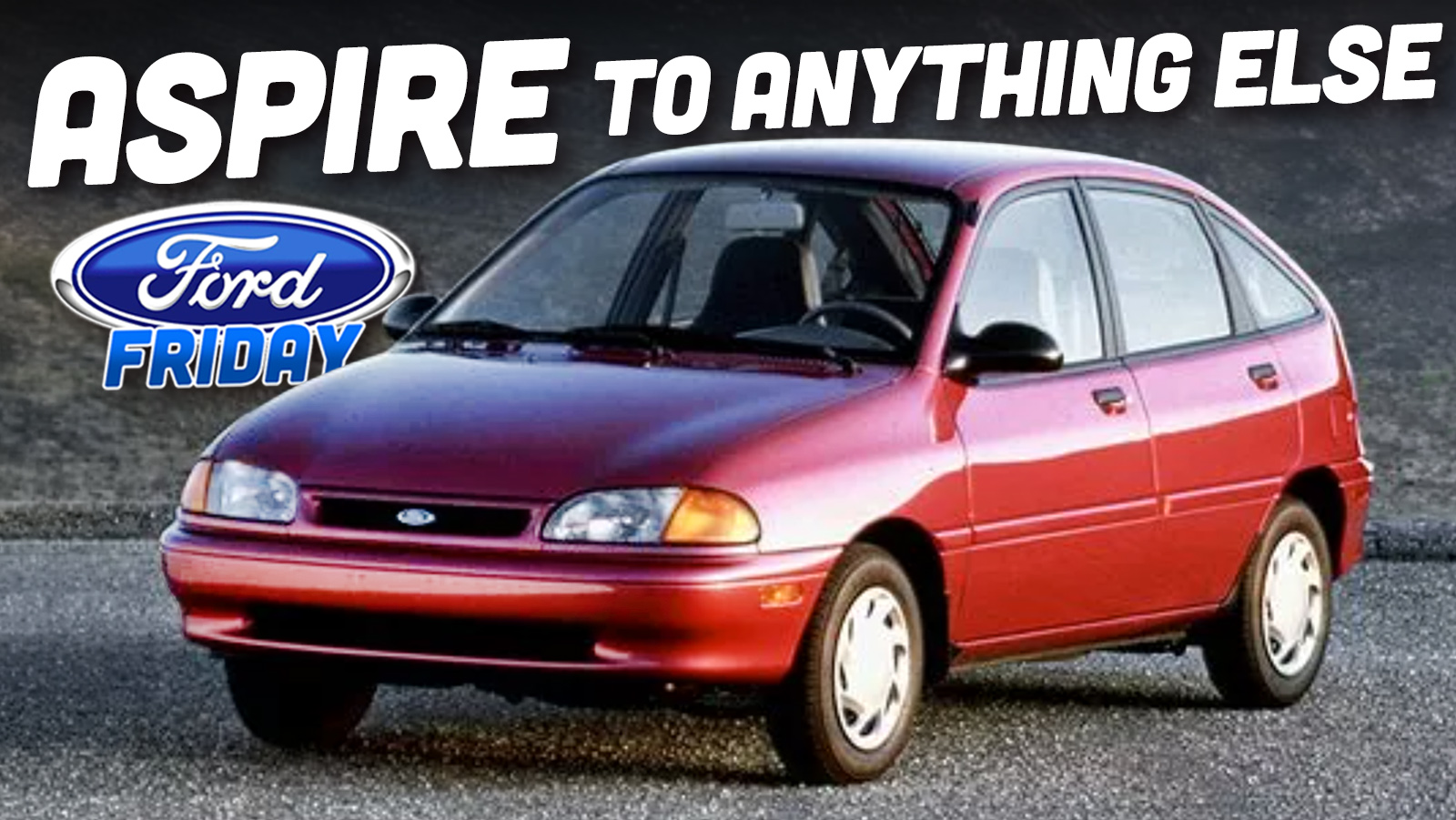
Throughout much of automotive history, the cheapest cars money could buy were astoundingly basic. You often didn’t get an air-conditioner, and you were lucky if you even got a radio. But these cars worked. They got you from ‘A’ to ‘B’ relatively reliably and came with a new car warranty. If you looked up ‘Basic Transportation’ in an automotive dictionary, the image accompanying the definition might have been the Ford Aspire. Built for just a handful of years in the 1990s, it was a cheap, relatively attractive way to get around. But it couldn’t live up to the car that it replaced.
Almost as important as actually making a car is the image the automaker wants that vehicle to project. Maybe you want your vehicle to conjure an aura of toughness, one of youthfulness, or maybe one that demands respect. You can see it today. Trucks are hard-working vehicles that take a beating, sports cars are light and pure, while crossovers bring the family home.


Back in 1994, Ward’s Auto reported, Ford charted the course for a new brand strategy. Citing “competitive reasons,” Ford decided to flip its own script. Each Ford nameplate was supposed to get a sharper identity, as was every brand under the Ford umbrella itself. Ford wanted to reduce product cycle time from 36 to 24 months, reduce its number of car platforms from 24 to 16, and increase derivatives from each platform from five to eight. All of this was in a search for a leaner, meaner, more globalized Ford.

A large part of Ford’s new strategy involved grouping its existing cars into categories that fit the “lifestyle” of the targeted customers. Cars for families included the Taurus, Crown Victoria, Windstar, and Aerostar, while the Explorer and Expedition were categorized as “Expressive” SUVs. Ford then had “Sporting” cars in the Mustang, Probe, and Thunderbird, as well as “Tough” F-Series trucks.
Then there was the “Youthful” category, or the vehicles meant to get young people into showrooms despite them having light wallets. These vehicles included Escort, Contour, and Ranger. Then there was the Aspire. It, too, was supposed to be a car to get the youth excited to buy a Ford, and Ford tried to do so by leaning in on how cheap it was. Meanwhile, for Kia, the brand that built the Aspire, the car was part of its own plan to plant permanent stakes in America.
Almost The Perfect Hatch
The Aspire story starts with a much blockier car, the Ford Festiva.

Back in the 1980s, imports flooded America from Japan, and domestic brands had to adapt or leave money on the table. Ford already had an ace up its sleeve here because its longtime partner, Mazda, already knew how to make modern small cars. My retrospective on the Ford Festiva continues:
As was tradition at that point, Mazda was the creator of several of Ford’s international models. At home, the Ford-Mazda relationship was best represented by the Courier truck. The two brands had partnered up with each other since 1969, when Ford, Mazda, and Nissan formed the Japanese Automatic Transmission Company, more commonly known as JATCO. Ford would score a 7 percent stake in Mazda in 1974, increasing that to 24.5 percent by 1979. So, when Ford reportedly called upon Mazda to design a new subcompact in 1981, Mazda was already deeply embedded in the Ford ecosystem.
The new car wasn’t going to be a single model. As Old Motors notes, Ford and General Motors were also exploring using South Korea as a base of manufacturing. GM partnered up with Daewoo while Ford befriended Kia. Each of the now three members involved in the project had something to gain. Ford would have a car to fight the Chevrolet Sprint, Hyundai Excel, the Subaru Justy, and the Yugo. Mazda would get some much-needed action for its post-1970s recovery. Kia would get a cheap subcompact to sell in its home market, too, while also building cars to be shipped to America.
The resulting vehicles were the Ford Festiva, Mazda 121, and Kia Pride. Mazda handled the engineering, Kia built the car, and Ford slapped its badge and marketing on it. The Festiva platform was also a truly global vehicle, spreading its wings throughout Asia and even landing in Australia. Production began in 1986 and, amazingly, there are modern versions of these cars. Iran’s Saipa built several different versions of the first-generation Kia Pride until 2020 before passing the design on to Wallyscar of Tunisia.

The Festiva was one of those rare “econoboxes” that got so much right. It was tiny, but ridiculously roomy. The Festiva’s engine didn’t make much power, but its body was light, and its manual transmission was surprisingly engaging. It rode on adorable 12-inch tires, but felt as nimble as an eager puppy. Features? You got everything you needed and nothing you didn’t. Visibility? There isn’t a car sold today that can match the Festiva. You could even get 40 mpg out of a Festiva if you tried hard enough.
But I suppose that isn’t too surprising, as fun-loving Mazda engineered the Festiva, Kia built it, and Ford merely slapped a badge on it. In my experience, the Festiva also took a serious beating over hundreds of thousands of miles without giving up. According to the International Directory of Company Histories, the Festiva was also a smashing success, selling over 350,000 units in America alone. For Kia, building the Festiva and its siblings was such a big business that it had to expand its facilities. Likewise, for some people, the Festiva and its siblings were the first time they had ever heard of Kia.

Today, the Festiva has a large enthusiast following. There are people out there who hunt down what few mint-condition Festivas and preserve them for the future. Other people tune them, restore them, and even race them. I once turned a rotted-out Festiva into a road-legal go-kart for the Gambler 500. If I had the space, I’d totally find one of the minty ones for my collection.
Such a success can sometimes be a bit of a problem for an automaker. How do you follow up a car that eventually became a bit of a cult hit? Ford answered with the Aspire, a car that was like the Festiva, but also not.
The ‘Youthful’ Car For Penny-Pinchers

Despite the visuals, the Aspire is not a totally new car. Instead, the Festiva is still largely hiding underneath.
This time around, some of the roles were switched. The Aspire was designed by Ford in Michigan, built by Kia in South Korea, and had powertrains supplied by Mazda. Ford focused on bringing the Festiva’s design into the 1990s. This meant a more aerodynamic jellybean shape, rounded edges, and a lot of circles inside.

One of the themes of the Aspire was to give buyers more for their dollar. The Aspire was 14 inches to 20 inches longer and two inches wider than the Festiva. Here in America, we got the Aspire as a three-door hatch or a five-door hatch. The Aspire, which was sold elsewhere as the Kia Avella and the Sauber Teenager, also came in a sedan model in other markets.
The components under the Ford body were largely similar to the outgoing Festiva. The 1.3-liter Mazda B3 inline-four made a return, with 64 HP and 74 lb-ft of torque on deck. The charismatic John Davis of MotorWeek noted that the Aspire got an upgrade of 1 HP over the outgoing Festiva. Other publications said the output was exactly the same 63 HP of the Festiva. Power reached the front wheels through your choice of a three-speed automatic or a five-speed manual.
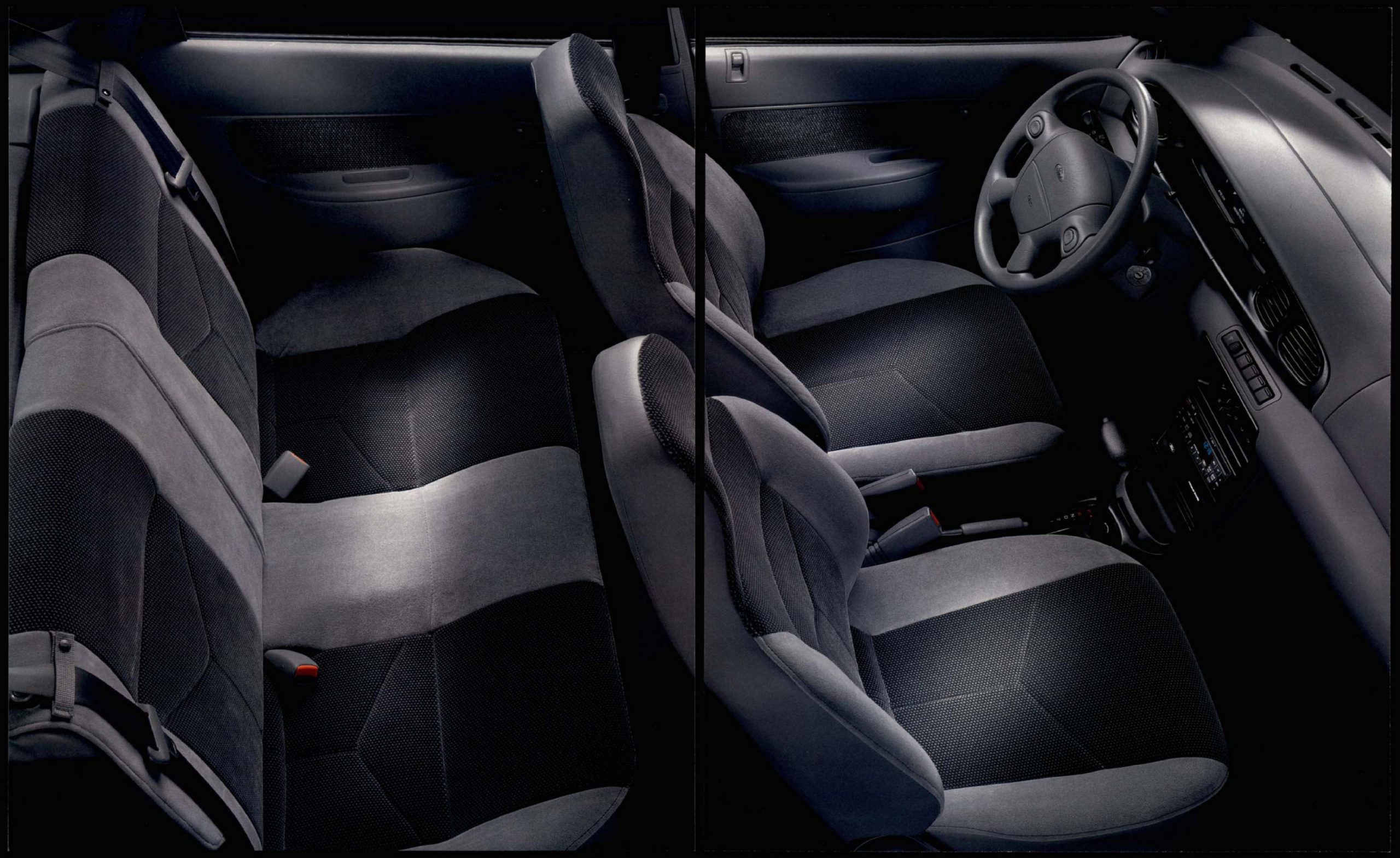
Backing the engine up was MacPherson struts up front and a torsion beam with coil springs in the rear. The Aspire rode on 13-inch steel wheels with alloy wheels as an option. As you might expect, the Aspire didn’t really light the drag strip on fire. Here’s what Bill Russ of the Auto Channel said in his review of the new 1994 Aspire:
This is an entry-level automobile aimed at people who have a limited amount of money to spend on the purchase and operation of a new car. The Aspire shows just how far such vehicles have come since “the good old days.” It is basic, utilitarian transportation but solidly put together and available with features that once were found only on far more expensive machines. The Aspire is certainly no fire-breathing sports car but a perusal of car magazines from the early 1960s brings some surprises: its’ 0-60 acceleration time is as good or better than those of any similarly-sized sports cars of that era and 8 to 10 seconds better than any similar sedans – including some revered ones that in retrospect were better in memory than reality. And its fuel economy is far better, too. During the past few years technological advances have brought about many design, performance, and safety improvements that we now take for granted. Modern technology really works for the buyer.
[…]
ROADABILITY: In spite of the Aspire’s economy-car heritage it handles quite well. If compared to more expensive cars, its handling is a bit harsh. Still, it behaves far better than some memorable economy cars of the past. Inexpensive front-wheel-drive cars often have annoying torque steer problems. Not the Aspire, with its modern front-wheel-drive design. Its steering is not power-assisted, but the lack is only noticed when parallel parking. Wind and road noise are at acceptable limits.
PERFORMANCE: The 1.3 liter 4-cylinder, eight-valve, single overhead cam, electronically fuel- injected engine gives decent performance and good fuel economy. The Aspire’e EPA ratings of 36 city and 43 highway are among the highest in the nation. Its smooth and quiet five-speed manual overdrive transmission delivers power to the front wheels. Excellent low-end power allows it to cope with American driving conditions, and keeping up with traffic around town is no problem. Adroit shifting is required for uphill passing and merging. While acceleration falls off above 50 mph, normal highway travel presents no real problems. Considering what this class of car used to be like, the 1995 Aspire looks pretty good.
MotorWeek (video above) had similar conclusions that the Aspire was basic and had a few features that cheap cars of the past didn’t have, but got the job done. The press of the 1990s seemed pretty fair to the little Aspire. In MotorWeek‘s hands, the Aspire hit 60 mph in 13.8 seconds and dispatched the quarter in 19.7 seconds at 71 mph. MotorWeek‘s suggestion was to get it with the five-speed manual, not the slower automatic.
While the mechanics weren’t terribly exciting, Ford really pushed the Aspire’s safety features. When the Aspire launched for a base price of $8,240 ($19,243 in 2026) in 1993 for the 1994 model year, Ford said it was the cheapest car in America with dual front airbags. Optional were the anti-lock brakes for $565 ($1,319 in 2026). There was also a fancier SE model with better seats, a wing, foglamps, alloy wheels, decals, and updated interior trim.
A Rough Road
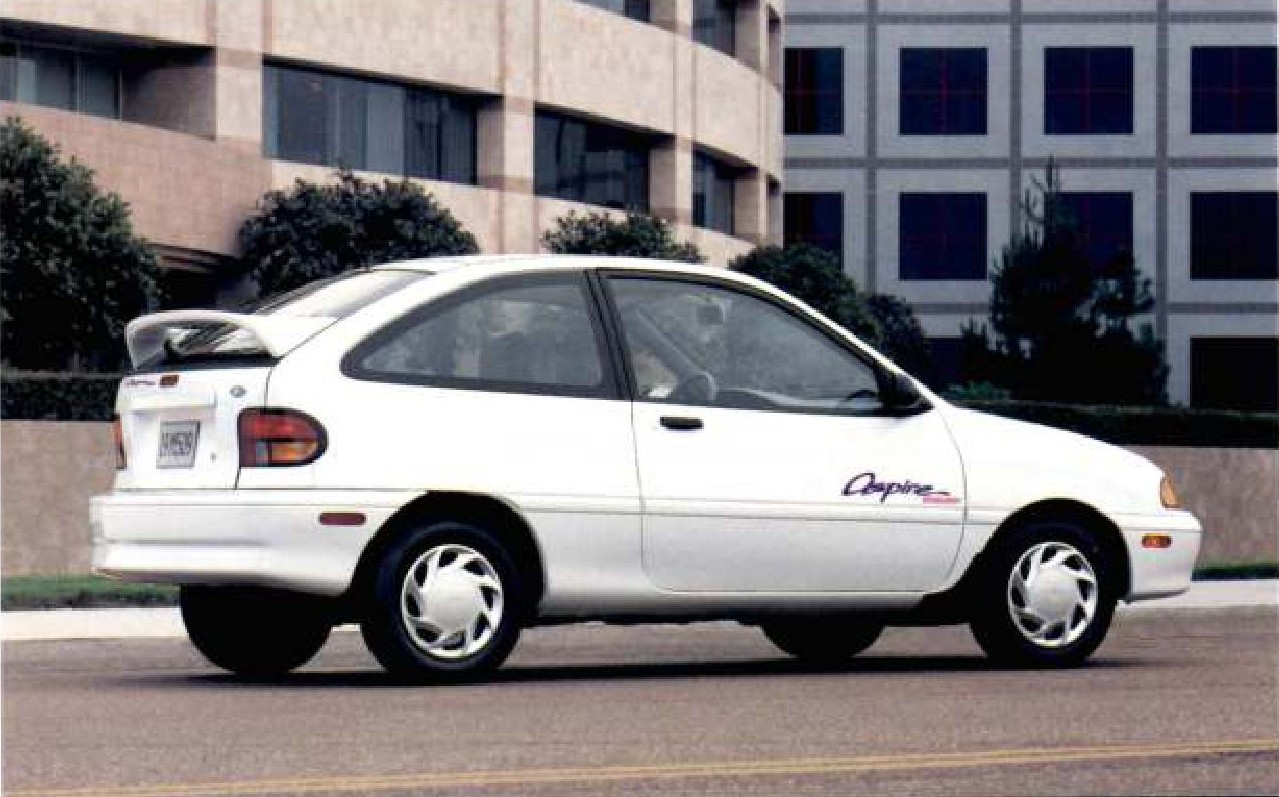
Unfortunately, the Aspire was a bit of a hard sell from the start. It was as early as January 1994 when the car buff mags and regular people began cracking jokes about the Aspire name. In April 1994, John E. Nicholson sent this rant to the editors of Motor Trend:
I’ve noticed an interesting phenomenon. Various auto companies have begun producing things that at first glance might appear to be cars, but apparently aren’t. Thankfully, the companies give you a fairly blatant tipoff in the name. For instance, there’s the Charade. The goal is to guess what it is. We’re still guessing. Then there’s the Protege, which presumably will someday grow into an actual car. The Mirage is really interesting since it isn’t there at all. You only think you see it. Also running around is the Sidekick, which, presumably, you could buy to have run alongside your Crown Victoria, or other real car. Last but not least, we now have the Ford Aspire. I’m driven to the conclusion that while not yet a car, the Aspire will some day transform into a Taurus, Thunderbird, or some other real car.
Ouch!

The Aspire was a part of a new era for Kia. According to Automotive News, Kia used the Festiva to perform recon on the American market. It then took what it learned to establish Kia Motors America Inc. in 1992 and begin importing vehicles under its own brand. Leading Kia’s charge into North America was Greg Warner, who brought 26 years of experience to the table, notably including stints at Toyota and Hyundai. The New York Times wrote that Warner wasn’t afraid of taking chances, and, apparently, was an avid helicopter skier.
Kia’s first U.S. import under its own name was the Sephia, which arrived in America either in late 1993 or early 1994, depending on the source you read. By November of 1993, Kia had 20 dealerships in the United States. The first-generation Sportage came a year after. According to Kia Motors America, its mission was, via Motor Trend:
“[T]o build cars that are of comparable quality to the Japanese competitors, sell them for a price that won’t send consumers through the roof, then give them the kind of service every car owner deserves.”
In practice, Kia saw itself as a viable competitor to Honda and Toyota, but at much lower prices. According to Automotive News, it cost only $35,000 ($81,737 in 2026) to become a Kia dealer, and despite the low base prices of the cars, they were so cheap that margins were high. Kia reportedly spent six years researching the American market before pulling the trigger, and it even had a clever way to get its name out there, from Automotive News:
The first 2,000 Kia Sephia sedans were sold to Budget Rent-A-Car for use in rental fleets. For four months, Kia received feedback about the Sephia from drivers of rental cars and incorporated many of those suggestions into the final product. Before Sephias were sold to consumers in the United States, Kia hired engineering consultants to test the cars’ durability through 100,000 miles of driving on American roads. Those programs were the basis for two TV commercials developed by Kia’s advertising agency, Goldberg Moser O’Neill in San Francisco. The company says the spots have advanced consumer recognition of the name of the company and the product. [See video below:]
With product testing complete, Kia was ready to begin its market-by-market rollout. Kia first offered the Sephia sedan to the western United States in February 1994 at four dealerships in the Portland, Ore., area and one in Las Vegas. In the spring, Kia opened dealerships in Washington, Arizona, New Mexico, Texas, Utah, Colorado and California.
In 1994, Kia sold 12,163 Sephias and opened 88 dealerships in 13 states. In 1995, sales rose to 16,725 Sephia cars and 8,015 Sportage sport-utilities for a total of 24,740. Kia introduced the Sportage in January 1995. Also in 1995, dealerships were opened in Louisiana, Tennessee, Mississippi, Alabama, Arkansas, Florida and Georgia. Kia’s future plans in the United States include a larger sedan to compete with the four-door, V-6 models that are popular today.
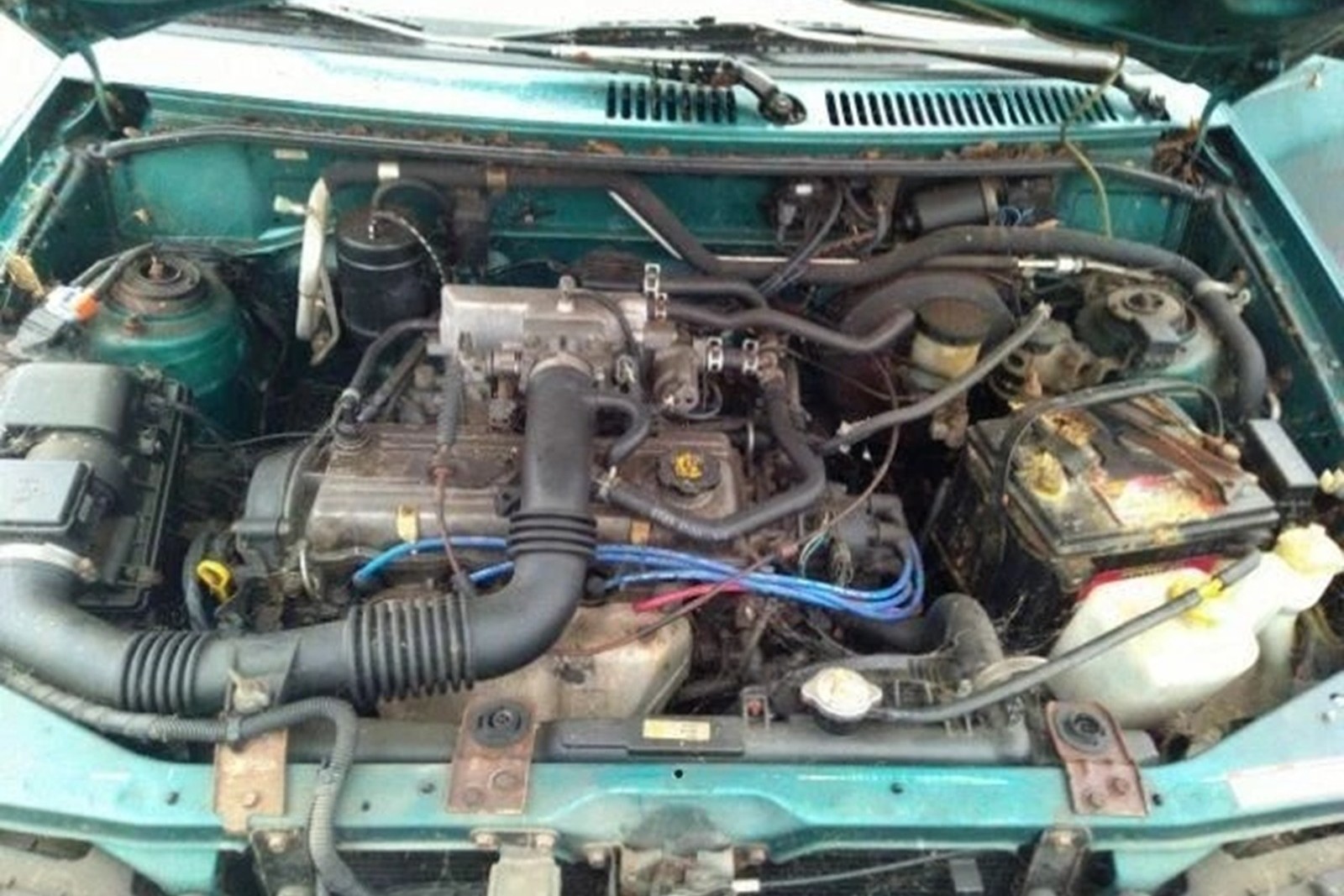
Technically, by selling cars in America, Kia competed against its old friends at Ford and Mazda. However, in addition to building the Ford Aspire, Ford still owned 10 percent of Kia, while Mazda had eight percent of kia. Ford had another 24.5 percent of Mazda.
Sadly, the Aspire might have been the wrong car for the wrong time. The Geo Metro didn’t have the Aspire’s airbags at first, but got better fuel economy for a cheaper price. By 1995, the Geo Metro got standard dual airbags for a lower price than the Aspire. Meanwhile, the Ford Escort and Dodge Neon were faster cars for not a whole lot more money. Really, the only reason to buy an Aspire was its price, and even then, you had to be okay with it being heavier and slower than the Festiva it got its bones from.
Mostly Forgotten
Sales are often cited as a reason why the Aspire made it only to 1997. Based on the data that I could find (here’s one sales chart), the Aspire sold around 5,000 units a month at its peak and closer to 1,700 units a month near the end of its production. In other words, Ford sold a modest number of Aspires, but ultimately, far fewer units than the Festiva it replaced. Today, several car publications label the Aspire as a “worst” car or a “biggest sales flop.” Yes, it did sell fewer units than the Festiva, and it got destroyed in sales by Ford’s own Escort, but is it the worst car Ford has ever sold? I see the Aspire like I see the Mitsubishi Mirage. Maybe the Aspire wasn’t the best at anything, but it was honest transportation.
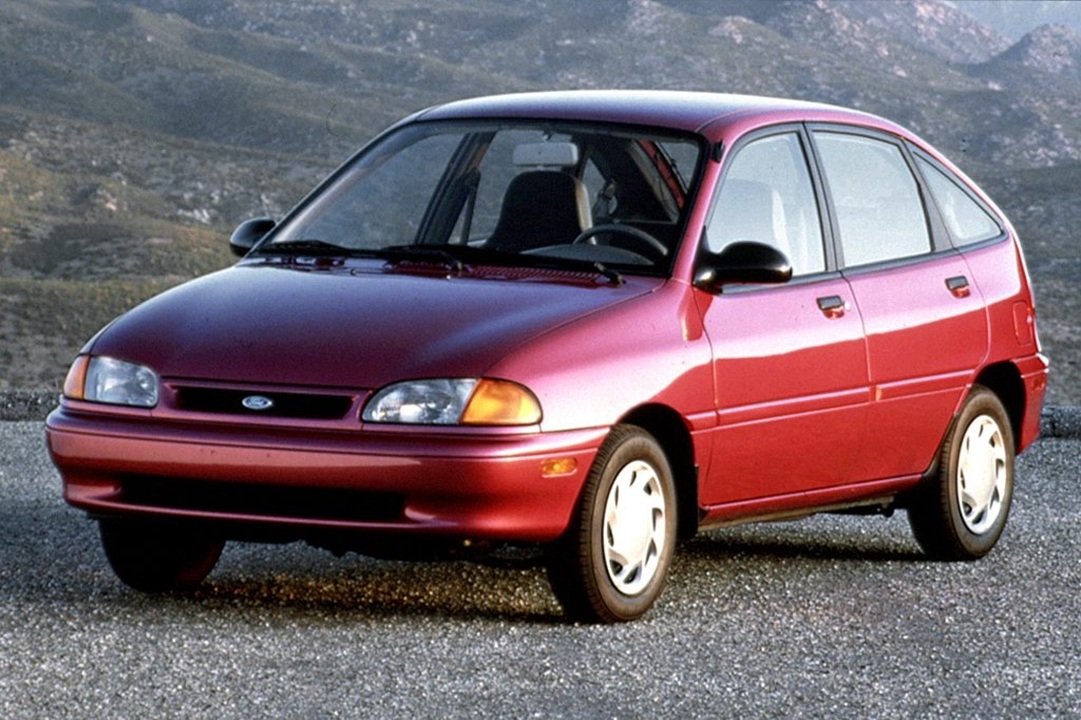
The Aspire is arguably lousy by current standards and maybe even fairly mediocre by the standards of the 1990s. However, like the car journals of the day noted, the Aspire was the kind of car for the person who wanted a new car without spending a single dime more than they needed to. It was a car where the most luxurious optional features were alloy wheels, an air-conditioner, a tachometer, and a cassette player. But it was also a car where, after checking those options boxes, it was expensive enough that you probably should have gotten the Escort, anyway. Something like the Aspire might have been more successful for a lower price, or if it had been on the market earlier.
Today, the Aspire is probably an endangered species. Rust has taken countless examples out, and many of the rest were beaten within an inch of their lives as disposable economy cars. Many of the survivors have enough miles to have driven to the Moon and partially back. The Aspire is also so unloved that it’s one of the few cars that you can probably find for $1,500 or less in running, but not necessarily good, condition.
The Ford Aspire is a great example of how hard it is to follow up a great car. In theory, a larger, rounder car should have been just the thing. But it seems that Ford and Kia might have missed the mark on what people liked about the Festiva. I hope to see a mint condition Aspire at a car show one day. Sure, everyone seems to hate it now, but one day, people will appreciate seeing a preserved version of a car everyone’s forgotten.
Top photo: Ford


Can confirm.
I always try to attend Festiva Madness every October in Louisburg, NC. The organizer is a friend. The participants are some of the most ecclectic and interesting people you could ever meet.
Maybe the Aspire would have sold more if Ford had created a catchier jingle for the ads.
“It’s a Foooooord, it’s a Festiva!” has been stuck in my head since the 80’s!
This car came out when I was in high school and was the butt of many jokes and this was from poor teens driving clapped out cars from the early 80’s.
As others have said the problem was three fold.
Just based on the actual car – increasing the size and weight but keeping the same underpowered engine was a big mistake.
The bigger problem was the same problem every cheap car has. It costs a certain amount to make a basic car. That is the floor. From there making a better car doesn’t cost a lot more. So something like the Aspire just looks like a very poor deal sitting next to nice cars in the same lot – especially when the manufacturer strips out things like power steering.
Then there is the stigma of being cheap. Not many people Aspire to own the very cheapest option of anything. Even among higher end cars the base model is generally the worst selling of the trim levels.
We had to special-order our 2024 Trax LS in order to get a base model with analog gauges and an actual ignition key. We aspired to order it that way. Also, the ACTIV models on the lot had black wheels and looked crappier than the LS we ordered with the 17″ silver-painted wheels when we added the LS Convenience package. We think ours looks nicer than the more expensive models.
2024 Trax LS
Count yourself as one of the “not many people” I was referencing.
Most rental companies don’t even order base models anymore.
It’s all marketing
I’m glad to hear that they still have analog gages and keyed ignition as options. Even if you had to special order, I’m sure there are some models/brands where that isn’t even a choice.
There is a midcycle refresh coming up for 2027 or 2028 Trax models. I fear the ignition key might disappear then.
The stigma of being cheap is what hurt sales of the Tata Nano too.
When we were shopping for a C-Class a while ago, the C180 had worse residuals than the C200, which meant that the cheaper car had higher monthly payments.
Not uncommon. That is why most large rental car companies no longer buy base models. They found that mid trim cars hold value better when it comes time to sell them a few years down the road.
Bonus that their customers like having a nicer equipped car.
Now that’s the economic logic I have been wanting to see here.
TBH I was watching a episode of Top Gear and they were covering the Jaguar of this time and I believe the sales figures mentioned were actually less than the Aspire.
Jim Anchower drove a Festiva until his buddy Ron lit it on fire with Roman candles.
https://theonion.com/you-gotta-be-careful-with-fireworks-1819584015/
As far as I can tell, he never bought an Aspire.
Funny Roman and Festiva are the only names I recognize here
*…while crossovers are the angry robots that bring the family home.
It still amazes me that the angry robot face is currently so infused into the landscape that it is invisible, not even noticeable. Like I imagine tail fins were at the end of that era.
That is why they kept making them bigger
My Festiva remains one of the favorite cars that I have owned. It didn’t have a lot of power, but it was light and fun to drive. The problem with the Aspire is that it was a few hundred pounds heavier without any additional horsepower to go with it. Building a car that is worse than the car it replaced is usually considered a bad move.
If you’d ever had four adults in your Festiva, that’s how an Aspire feels with just two.
I owned an ’88 Festiva LX, which had a 5-speed. Yeah, with four adults I had to do a lot of downshifting, but those in the back seats never complained about being cramped. It was one very roomy car.
My passengers were always surprised at how much room the rear seats had. My boss at the time was a large gentleman and he never had a problem fitting in the back seat. A running joke was that the A/C button was ‘acceleration control’ as I would turn it off when I needed a little extra oomph with a full car.
These were perfect cars to be a passenger in. They only killed the soul of the driver. Passengers aren’t purchasing decision makers.
“This is an entry-level automobile aimed at people who have a limited amount of money to spend on the purchase and operation of a new car.”
-Something no American automobile manufactures would ever say today.
That’s decidedly honest, and I’d look rather favorably at a brand who’d do that.
I miss the Mitsubishi mirage, especially since they were sold with genuine colors like purple, or bright green – unlike everything else on the road that angrily takes itself too seriously.
The colors they offered were great and a lot of people actually chose the colors! I also liked the Ralliart version. I parked next to one in a parking lot and I don’t know if they drove any better, but it looked like silly fun.
I saw a Mitsubishi hybrid suv ralliart yesterday and actually felt nostalgic about the over the top graphics all. Over. The. Car.
The Detroit 2.5 are right now “truck all the vehicles” and “sell to wealthy Boomers”. This works but will need to change. Gen X and Millennials have far less disposable income to dispose of on gas for a giant truck.
Nor do environmentally conscious young generations want a truck or anything large and wasteful, as another oil war rages.
I like a good fun gas engine as much as the next gearhead. And they are great toys. Electric is so much better for personal transportation it’s not funny. We could have chargers everywhere and affordable zero direct emissions vehicles. It’s a matter of deciding we want to do that rather than all of us subsidizing giant, monster trucks as personal transportation. Save the oil (and its emissions) for stuff we can’t yet replace and for toys.
FWIW not fair to compare an aspire with a tach to a base escort, since those little jellybeans didn’t have them unless optioned. Apples to oranges!
Last time I saw a Festiva I was assisting a friend buy an especially clapped out one on the wrong side of Dallas. The seller was smoking a giant blunt. The paperwork was missing. The car was filled with valentines balloons for some reason. My friend was a former Ferrari mechanic. He somehow limped it four hours home. Fond memories.
I love Ford Fridays.
That sounded like quite an adventure. I’d have matched the seller with another blunt.
My first car was a 1990 Ford Festiva. Yeah it didn’t have much power but it was also very light.
And because of that, it had a decently fast 0-60 time of 10 seconds with the manual… But a top speed of only around 150km/h
And it had some quirks… At over 100km/h, the windshield wipers would lift off the windshield and become ineffective
And parts were about 50% more expensive than the 1991+ Ford Escort
And when the Aspire came out it had 2 problems… The name was stupid (they should have kept the Festiva name) and they upped the size and weight, but they didn’t up the power. In other markets, that car had the 1.5L Mazda engine and they should have made that standard for North America
Also the 1.8L Mazda BP would also fit in that car and it would have turned it into a great pocket rocket
But Ford was too focused on making it cheap rather than good.
150kmh meant you buried that needle into the dash.
We added helper springs to the wiper arms, it made a huge improvement. Modern low-profile wiper blades would have likely helped too.
Thankfully despite parts being more, it didn’t need much for maintenance. It was an amazingly reliable car.
There’s absolutely no good reason it can’t be both, except the industry wouldn’t want buyers to choose it over more-expensive, higher-margined products. An Aspire with a turbocharged 1.8L Protege engine wouldn’t have cost much more to produce than the Aspire we got, but it would be punching above its weight at cars that cost 3-5x as much or more within Ford’s own lineup.
About power:
Same engine in different markets will often have different output due to regulations.
And many moto journos do not know that there are two horsepower sizes: Metric and english based. Metric (PS, CV, HK, HP) is ~735W and english (HP) is ~745W. Going between W, HP and PS you will often see screwups. And 64 vs 63 is at the ‘right’ ratio.
I always thought this name was even worse than “Probe”. Sure, it conjures unappealing thoughts of a medical probe, but everyone making the hackneyed jokes knew it was supposed to reference space probes. “Aspire” has no cool interpretation and I don’t know why they didn’t keep “Festiva”. Typing of which, the Festiva had an appealing chunky mini rally car look. While cheap, it appeared fun and like it would hold up to a beating. The Aspire had the shape and features of a small turd and looked about as durable. Whether true or not, it had very selective appeal for something that needed to sell in fairly high volumes. As mentioned, it also fell into the typical subcompact trap where the price with some basic options (at a time when basic things were optional) got it up to the price of the much better compact that had many of those features standard. Without some special appeal that would get people to buy the smaller car anyway, like being more fun to drive or having a more fun appearance, there’s little incentive to get the smaller car that, in the real world, generally got about the same mileage as the larger one, had worse build quality, less space, worse performance, and poorer resale.
Performance of these were comparable to my FWD ’84 Subaru GL wagon with an auto, but a bit slower than the FWD manual ’83 sedan. Not too bad considering they had less hp and torque, but I’d still rather a GL (make it a pillarless hardtop with a manual).
It didn’t help the Aspire’s cause that seemingly 75% of them were built in that horrid metallic pink color. And most of the rest were teal, when teal was going out of fashion.
My very first car was a 4yo ’82 4dr manual Subaru GL. Memories…
That color was horrible! IIRC, it either faded or the clear coat deteriorated pretty quickly, too. And as fond as people seem of teal today, it was getting very tired in the ’90s. That damn champagne gold color, too, but the ancient mummies who bought that color had no interest in giving it up for a little while yet.
My high school – aged kids call that color “Boomer beige.”
Oh now I have the name for what my 2005’s color is, I’ve been calling it “off white” but this is way better.
I’m going to borrow that. Boomer Beige.
I’d have designed the Aspire a bit differently. Same footprint, sacrifice the goofy styling in favor of all-out drag reduction(get it to ~0.20 Cd and it might look like a cross between Greenpeace’s Renault Twingo SMILE and the 2005 Mercedes Bionic, but with the Aspire’s same headlights and tail lights), make it RWD, and the standard engine would have been a 1.8L from a Mazda Protege, with Duratec V6 option, and if I could make it fit, maybe even a 5.0 V8 option. In either guise, it would have had absolutely terrifying TVR-like driving dynamics to attract enthusiasts, have been a fuel economy champion when used normally as a daily, AND would have still been a cheap entry-level beater with profit low margins.
I don’t think people would have made fun of it anymore. Not if it could blow the doors off of much more expensive cars in a straight line(nevermind lap them in a track setting), while still serving its main purpose: cheap, basic transportation.
But making inexpensive, tiny, low-margin cars into something “cool”, aspirational, and desirable enough that a kid would want a poster of it on their bedroom wall, is very much verboten in the US auto industry for some reason. All the “cool” cars have to be bloated things with high margins that only well-off or even rich people can afford.
These Ford Friday articles have been great. Fact filled. With details many nonFord people may not know. Keep them coming. Also, I hope you do the Fox platform because it is arguably the platform that carried Ford through the 80’s and the 85-93 Mustang V8 saved the modern muscle car. Fight me.
I remember a rental car commercial bragging about the size of their junk low end rental (see what I did there). For comparison they showed a big man all scrunched up to fit in a Ford Aspire they dubbed the “Speck”. A friend of mine who was hefty enough to have the nickname Fat Rat bought one and we couldn’t help but make the comparison. I still think Speck when I see one, which is pretty much never these days.
Two things.
1. A Mondeo (Contour) youthful?
2. I now want that italianate Ford Festiva.
That one baffled me. The biggest problem with the Contour was that it was much smaller than but cost nearly as much as a Taurus. Thus having very little appeal to “buy them by the pound” Americans. It was nicer to drive, but in a country where most of the roads are straight and flat, nobody cared.
And in Europe it was just a family car. One with a good drive, but a family car nonetheless.
That’s all it was here too. Slightly cheaper, but much smaller. And much more expensive than the craptastic Tempo it nominally replaced.
The SVT Contour we got in the States was a nice little pocket rocket. A friend’s dad had one. Surprisingly good in the snow when he took my friend and me skiing one snowy weekend day.
That was the equivalent of the Mondeo ST200?
Appears so.
I used to own a tuned Contour. It was surprisingly stable and competent above 100 mph. I can’t say the same for most of the Americans cars of that vintage that I’ve driven at similar speeds. For a FWD sedan, its driving dynamics were surprisingly great. The Duratec V6 also gave it plenty of acceleration.
Not at all surprising given it was a European car. Even decidedly non-sporting ones like Volvo 240s are generally much better to drive than the average Ameribarge of the same era. The Taurus was actually a bit of a revelation in it’s class.
The killers in this week’s episode of a murder podcast I listen to used a Ford Aspire as a getaway car. It had three different types of tires, so the tracks were distinctive.
The Aspire was Scheiß. If we talk of cars without enough power to motivate themselves, this is a car that lacks motivation. It was spartan, and then made into a McDonald’s American-biggie-sized pastiche of a basic small car.
It was a victim of American management saying whatever they had before just wasn’t big enough, so they ruined it.
The Festiva/Pride/121 was basic transportation. Unabashedly.
The Yaris was basic transportation.
The Tercel was basic transportation.
The Aspire was hot garbage. Ford should feel bad about it.
In my circle of friends, this car was known as the ‘Asspipe’.
I aspire to to be – Car. Aspire is arguably the worst possible name for any product much less a car.
When I was in sixth grade I didn’t show up for the first couple weeks of school. We were having some whacky eccentric family adventure although I can’t remember what. Anyway as a result of missing the first two weeks I was awarded the county wide “Most Improved Speller” on account of someone being terrible at statistics. Not to mention that “most improved speller” is only a little bit better than , say, “most improved hygiene”
Anyway the aspire branding seemed to be short for “it aspires to be a better car and if all goes well, eventually it will suck less.”
Sort of like Pinocchio’s aspiration to be a real boy, this thing wants to be a real car,
So at best the name was saying “nice try” but mostly was a reminder that Ford had a car for losers who really wanted something better , and you were driving it.
Some sort of gibberish that reflected Bill Ford’s shoe size and the chemical symbol for rust, or “bite the wax tadpole” or “female horse stuffed with wax” would have been much better marketing. Toyota has done fabulously with something pronounced Turd, and Chrysler managed to get people to buy a car that phonetically was Ass Pin—Watch out for those broken springs in the seat!
Aspire? That’s hazardous to even stand near, lest it tiggers people to reflect on life’s disappointments at the same time they are trying to remember who that guy standing just to the right of it is. Oh is that the most improved speller of 1967?
Awful awful name.
It could have made sense as an internal project name for a heap so disappointing it’s owners would trade up at the first opportunity, but selling it under that name was tremendously out of touch.
Bingo.
I remember the “running gag” on the Aspire’s name.
Don’t remember who started it but the most popular nickname for it was “Ass-Fire”!! They were very popular with teenagers and old folks alike,who wanted a car with decent fuel economy and utility at a low price.
I always thought aspire did econobox well. You sort of knew it was Korean but they still felt better then hyundais even several years later. Some of them has a pretty rad interiors and colors. They are true cockroaches I don’t know how many I’ve seen as junk yard cars. Contours and escorts all sort of disappeared.
I once sat in a new Aspire at a car show. I recall the interior “new car smell” was extremely acrid and unlike anything else on display. Definitely a turn-off and memorable over 30 years later.
I remember them having not a great smell as well. The Hyundai accents had it worse. It smelled like the whole assembly like was sweating in it. Must have been the Korean foam or something.
Good call! I had forgotten about that.
Korean cars still smell funky. My mother’s ’23 Soul had a vile new car smell for the first few months. If she doesn’t drive it for a while and it sits in the FL sun, it comes back.
I think it’s interesting we don’t really have any stripped down econoboxes here in the US anymore. I’m curious if Slate succeeds if they’ll turn their eye to the hatchback market next?
We don’t have them because they have never sold well and often result in the manufacturer taking a loss. For awhile they were willing to do that with the idea that selling someone a cheap car at a loss would bring them back later to buy a more expensive car but the data really doesn’t support that.
Things really changed when leasing took off. The role of the cheap entry level car was taken over by the CPO off-lease used car. Buyers got a better car for their monthly payment and automakers got to make money on the car twice.
That is not the reason they sold these money-loser econoboxes. It was ALL about CAFE. Selling Aspires at a loss allowed Ford to sell gas-guzzling Exploders etc at massive profit margins without incurring CAFE penalties.
Once that went away with footprint-based CAFE, so have the money-losing crapcans. No reason at all to bother anymore.
CAFE was part of the reasons to sell small cars. It wasn’t the reason to sell extremely stripped down cars like the Aspire. The Escort provided plenty of CAFE credits and outsold the Aspire more than 10:1
The Aspire died in 1998 – well before the footprint rule. The Chevy Spark survived to 2022 – a decade after the footprint rule.
I am speaking in general as to why this sort of thing is no longer a thing at all, not specifically about the Aspire. Which was just an utter crapcan that they couldn’t sell enough more cheaper than the Escort for many people to bother with. CAFE had LONG surpassed the “ownership ladder” as the reason for cheap cars.
To think that I once Aspired to buy one of these to replace my beat-up, oil-using Festiva, Then I got a good look at them and decided to wait it out. The Festiva finally gave up the week before my new PT Cruiser arrived.
On one hand, I certainly miss the basic-ness and simplicity of cars like the Aspire and Festiva. On the other hand, some of the least expensive cars you can buy today are the Elantra and Corolla hybrids (~$26k) that give you 10,000x more car while getting 50 mpg, a figure that the Aspire could… never aspire to get.
I had an Aspire, it was a perfectly fine car even though it was several owners old before I got it. Sure, you could get a car that was 10,000x more car, but there’s only 1 of me, not 10K. In my case, it was almost all city driving with a 200 mile RT every few weeks. Same Haynes manual as the Festiva. Eventually it got T-boned.
There’s a kid in town who delivers pizza who drives an Aspire. Slap a Papa John’s sign on top and that’s good for at least 10 hp. It’s beat to hell, various shades of teal and bondo, but will probably never die. Seeing it in traffic I’m pretty sure it lives at the redline.
It’s a shame we can’t buy cars like the base model Aspire today.
I knew an old mechanic who worked on Porsche 911s for a living. He used a manual transmission Ford Aspire as his daily, and was a millionaire. This was circa 2010, and you wouldn’t know he had money by looking at what he drove. It was obvious what his priorities were.
I bet if this car were RWD and came with a Duratec V6, it wouldn’t have cost a whole lot more to build, but would have had a LOT more appeal from enthusiasts and could have been a genuine hot hatch. Ford really dropped the ball on not making it have appeal, because they’d rather sell more expensive, higher-margined vehicles.
I can’t help but think “heh, they won’t think I’m fleecing ’em if I drive this to work…” but I’d like to think that was a possible happy side effect.
I like the slipperier, Duratec-powered factory-SHOgun idea (or did you mean front-engined?) – I imagine a select few would’ve chosen it over an Escort GT, Mustang, or Contour V6, but it would’ve gotten some attention.
Heck, they could’ve fit a 1.6-1.8 323/Protege drivetrain in place of the 1.3 version and tweaked the suspension for a sort of Great Value 8v Mk2 GTI effect; forget even the BP from that Escort GT and friends if market segmentation was that much of an issue.
That mechanic didn’t start out a millionaire. He was a minimalist who saved his money to get there, back when it was actually possible for ordinary people to get ahead. It only took him an entire lifetime of work, and his habits that got him there never died.
A 170 horsepower Duratec in an Aspire probably would have out-performed the Mustang GT of the era in a straight line, given the power to weight ratio.
A 1.8L Protege engine also would make a whole lot of sense as a swap for this car. It’s still light enough not to throw the car out of balance, and makes 122 horsepower, almost double what the Aspire had. Even better would have been to turbocharge it to somewhere around 180 horsepower which was possible with the technology of the time.
Yup. You can’t spend yourself into becoming wealthy.
Putting your money in some tasty dividend-producing stocks and REITS, on the other hand, is very rewarding.
The Dacia Sandero is probably that car and can be bought new.
Not in the USA it can. At least if you want to actually be able to legally drive it on the roads here.
Also, before the manual was killed, the Mitsubishi Mirage would probably be the closest Americans can get to such a thing readily available. There’s not many Aspires left, but there are lots of manual Mirages out there for sale. Like the Aspire, the Mirage was very much a no-bullshit car.
Well in Europe there still are some options:
– Fiat Panda and 500 with a 1 litre three cylinder 70bhp and a 6 speed manual.
– Citroën C3 and Fiat Grande Panda with a 1.2 litre turbo 100bhp and a 6 speed manual.
– Skoda Fabia and Seat Ibiza with a 1 litre three cylinder 80bhp and a 5 speed manual.
– Hyundai i10 and Kia Picanto with a 1.2 litre 84bhp and 5 speed manual.
And probably more, but those are the ones I can think of off the top of my head.
Bonus track: the brand new Renault Twingo E-Tech, an 80bhp EV which with the government grant here you can buy for under €13,000.