

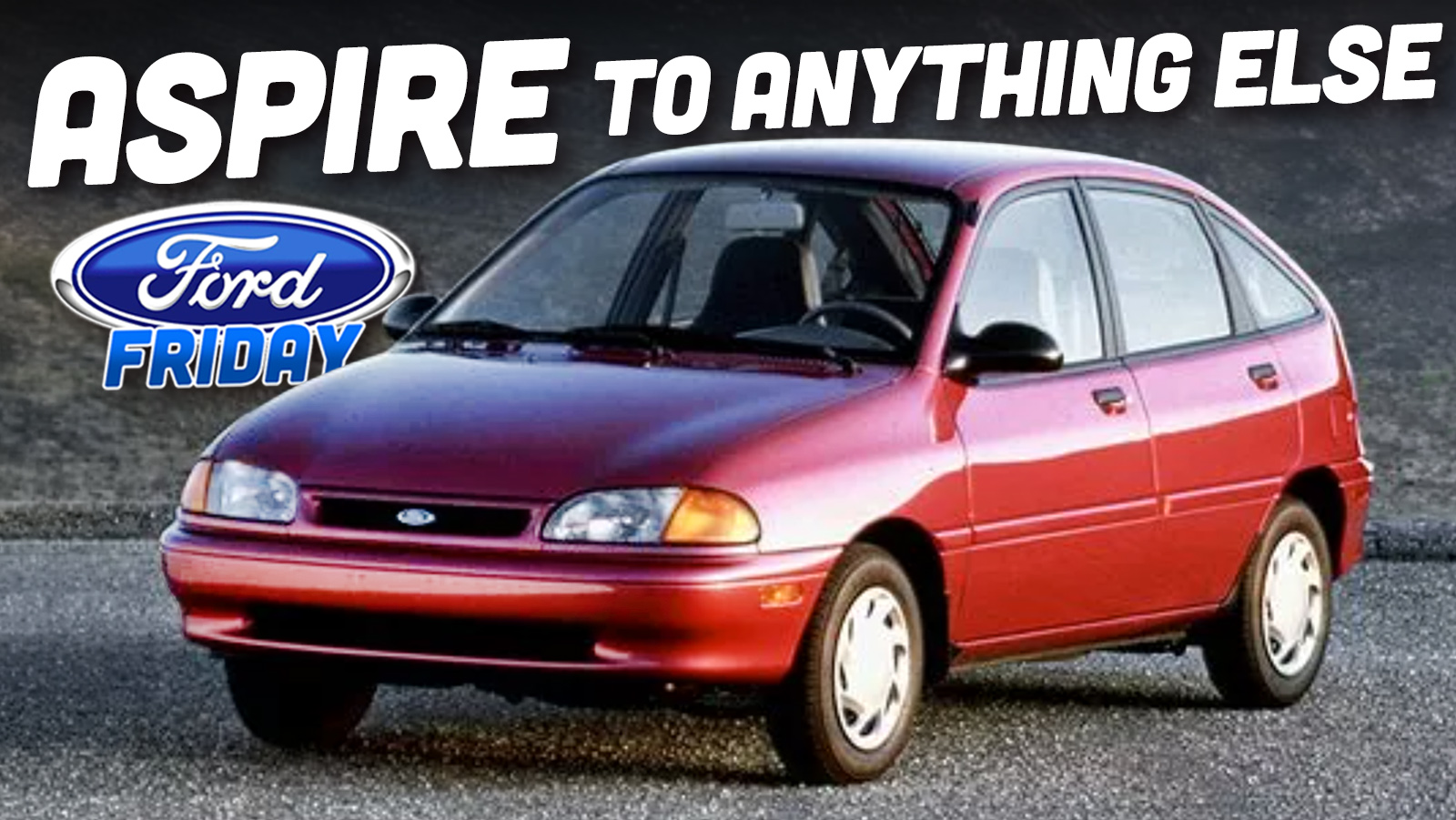
Throughout much of automotive history, the cheapest cars money could buy were astoundingly basic. You often didn’t get an air-conditioner, and you were lucky if you even got a radio. But these cars worked. They got you from ‘A’ to ‘B’ relatively reliably and came with a new car warranty. If you looked up ‘Basic Transportation’ in an automotive dictionary, the image accompanying the definition might have been the Ford Aspire. Built for just a handful of years in the 1990s, it was a cheap, relatively attractive way to get around. But it couldn’t live up to the car that it replaced.
Almost as important as actually making a car is the image the automaker wants that vehicle to project. Maybe you want your vehicle to conjure an aura of toughness, one of youthfulness, or maybe one that demands respect. You can see it today. Trucks are hard-working vehicles that take a beating, sports cars are light and pure, while crossovers bring the family home.


Back in 1994, Ward’s Auto reported, Ford charted the course for a new brand strategy. Citing “competitive reasons,” Ford decided to flip its own script. Each Ford nameplate was supposed to get a sharper identity, as was every brand under the Ford umbrella itself. Ford wanted to reduce product cycle time from 36 to 24 months, reduce its number of car platforms from 24 to 16, and increase derivatives from each platform from five to eight. All of this was in a search for a leaner, meaner, more globalized Ford.

A large part of Ford’s new strategy involved grouping its existing cars into categories that fit the “lifestyle” of the targeted customers. Cars for families included the Taurus, Crown Victoria, Windstar, and Aerostar, while the Explorer and Expedition were categorized as “Expressive” SUVs. Ford then had “Sporting” cars in the Mustang, Probe, and Thunderbird, as well as “Tough” F-Series trucks.
Then there was the “Youthful” category, or the vehicles meant to get young people into showrooms despite them having light wallets. These vehicles included Escort, Contour, and Ranger. Then there was the Aspire. It, too, was supposed to be a car to get the youth excited to buy a Ford, and Ford tried to do so by leaning in on how cheap it was. Meanwhile, for Kia, the brand that built the Aspire, the car was part of its own plan to plant permanent stakes in America.
Almost The Perfect Hatch
The Aspire story starts with a much blockier car, the Ford Festiva.

Back in the 1980s, imports flooded America from Japan, and domestic brands had to adapt or leave money on the table. Ford already had an ace up its sleeve here because its longtime partner, Mazda, already knew how to make modern small cars. My retrospective on the Ford Festiva continues:
As was tradition at that point, Mazda was the creator of several of Ford’s international models. At home, the Ford-Mazda relationship was best represented by the Courier truck. The two brands had partnered up with each other since 1969, when Ford, Mazda, and Nissan formed the Japanese Automatic Transmission Company, more commonly known as JATCO. Ford would score a 7 percent stake in Mazda in 1974, increasing that to 24.5 percent by 1979. So, when Ford reportedly called upon Mazda to design a new subcompact in 1981, Mazda was already deeply embedded in the Ford ecosystem.
The new car wasn’t going to be a single model. As Old Motors notes, Ford and General Motors were also exploring using South Korea as a base of manufacturing. GM partnered up with Daewoo while Ford befriended Kia. Each of the now three members involved in the project had something to gain. Ford would have a car to fight the Chevrolet Sprint, Hyundai Excel, the Subaru Justy, and the Yugo. Mazda would get some much-needed action for its post-1970s recovery. Kia would get a cheap subcompact to sell in its home market, too, while also building cars to be shipped to America.
The resulting vehicles were the Ford Festiva, Mazda 121, and Kia Pride. Mazda handled the engineering, Kia built the car, and Ford slapped its badge and marketing on it. The Festiva platform was also a truly global vehicle, spreading its wings throughout Asia and even landing in Australia. Production began in 1986 and, amazingly, there are modern versions of these cars. Iran’s Saipa built several different versions of the first-generation Kia Pride until 2020 before passing the design on to Wallyscar of Tunisia.

The Festiva was one of those rare “econoboxes” that got so much right. It was tiny, but ridiculously roomy. The Festiva’s engine didn’t make much power, but its body was light, and its manual transmission was surprisingly engaging. It rode on adorable 12-inch tires, but felt as nimble as an eager puppy. Features? You got everything you needed and nothing you didn’t. Visibility? There isn’t a car sold today that can match the Festiva. You could even get 40 mpg out of a Festiva if you tried hard enough.
But I suppose that isn’t too surprising, as fun-loving Mazda engineered the Festiva, Kia built it, and Ford merely slapped a badge on it. In my experience, the Festiva also took a serious beating over hundreds of thousands of miles without giving up. According to the International Directory of Company Histories, the Festiva was also a smashing success, selling over 350,000 units in America alone. For Kia, building the Festiva and its siblings was such a big business that it had to expand its facilities. Likewise, for some people, the Festiva and its siblings were the first time they had ever heard of Kia.

Today, the Festiva has a large enthusiast following. There are people out there who hunt down what few mint-condition Festivas and preserve them for the future. Other people tune them, restore them, and even race them. I once turned a rotted-out Festiva into a road-legal go-kart for the Gambler 500. If I had the space, I’d totally find one of the minty ones for my collection.
Such a success can sometimes be a bit of a problem for an automaker. How do you follow up a car that eventually became a bit of a cult hit? Ford answered with the Aspire, a car that was like the Festiva, but also not.
The ‘Youthful’ Car For Penny-Pinchers

Despite the visuals, the Aspire is not a totally new car. Instead, the Festiva is still largely hiding underneath.
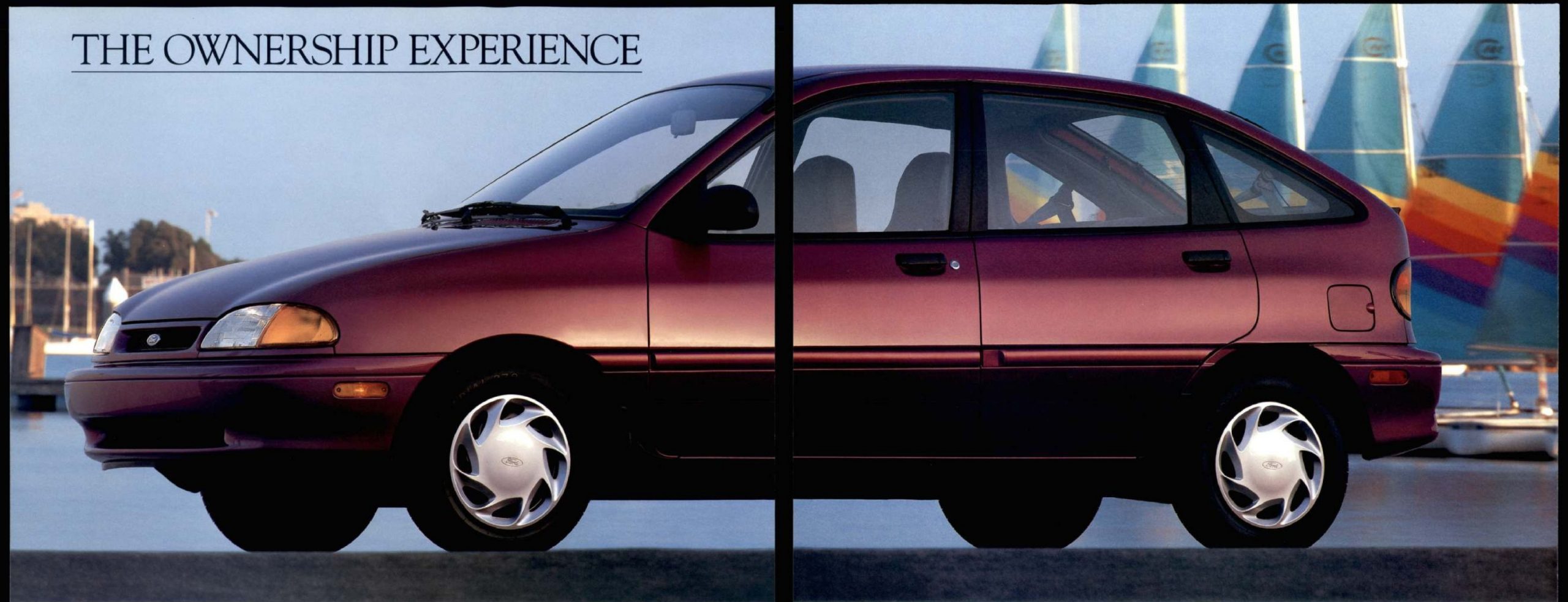
This time around, some of the roles were switched. The Aspire was designed by Ford in Michigan, built by Kia in South Korea, and had powertrains supplied by Mazda. Ford focused on bringing the Festiva’s design into the 1990s. This meant a more aerodynamic jellybean shape, rounded edges, and a lot of circles inside.

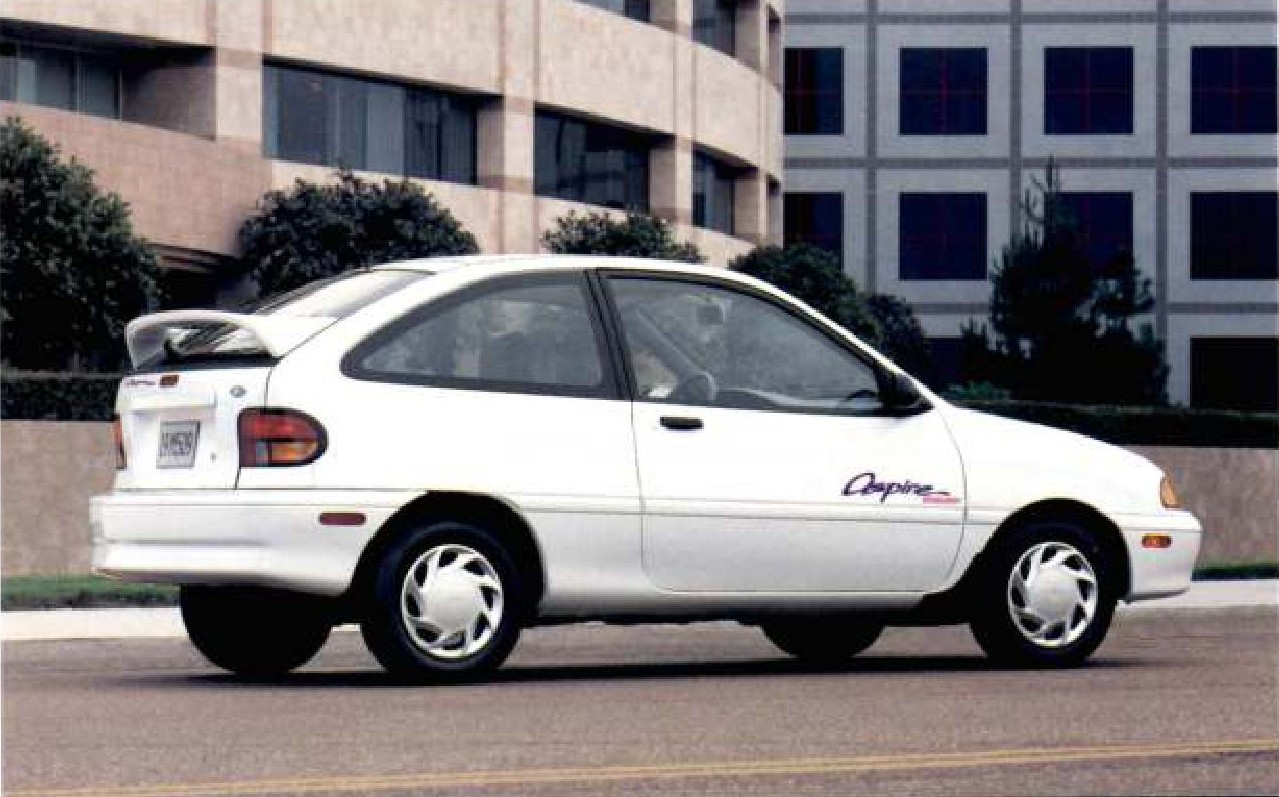
One of the themes of the Aspire was to give buyers more for their dollar. The Aspire was 14 inches to 20 inches longer and two inches wider than the Festiva. Here in America, we got the Aspire as a three-door hatch or a five-door hatch. The Aspire, which was sold elsewhere as the Kia Avella and the Sauber Teenager, also came in a sedan model in other markets.
The components under the Ford body were largely similar to the outgoing Festiva. The 1.3-liter Mazda B3 inline-four made a return, with 64 HP and 74 lb-ft of torque on deck. The charismatic John Davis of MotorWeek noted that the Aspire got an upgrade of 1 HP over the outgoing Festiva. Other publications said the output was exactly the same 63 HP of the Festiva. Power reached the front wheels through your choice of a three-speed automatic or a five-speed manual.
Backing the engine up was MacPherson struts up front and a torsion beam with coil springs in the rear. The Aspire rode on 13-inch steel wheels with alloy wheels as an option. As you might expect, the Aspire didn’t really light the drag strip on fire. Here’s what Bill Russ of the Auto Channel said in his review of the new 1994 Aspire:
This is an entry-level automobile aimed at people who have a limited amount of money to spend on the purchase and operation of a new car. The Aspire shows just how far such vehicles have come since “the good old days.” It is basic, utilitarian transportation but solidly put together and available with features that once were found only on far more expensive machines. The Aspire is certainly no fire-breathing sports car but a perusal of car magazines from the early 1960s brings some surprises: its’ 0-60 acceleration time is as good or better than those of any similarly-sized sports cars of that era and 8 to 10 seconds better than any similar sedans – including some revered ones that in retrospect were better in memory than reality. And its fuel economy is far better, too. During the past few years technological advances have brought about many design, performance, and safety improvements that we now take for granted. Modern technology really works for the buyer.
[…]
ROADABILITY: In spite of the Aspire’s economy-car heritage it handles quite well. If compared to more expensive cars, its handling is a bit harsh. Still, it behaves far better than some memorable economy cars of the past. Inexpensive front-wheel-drive cars often have annoying torque steer problems. Not the Aspire, with its modern front-wheel-drive design. Its steering is not power-assisted, but the lack is only noticed when parallel parking. Wind and road noise are at acceptable limits.
PERFORMANCE: The 1.3 liter 4-cylinder, eight-valve, single overhead cam, electronically fuel- injected engine gives decent performance and good fuel economy. The Aspire’e EPA ratings of 36 city and 43 highway are among the highest in the nation. Its smooth and quiet five-speed manual overdrive transmission delivers power to the front wheels. Excellent low-end power allows it to cope with American driving conditions, and keeping up with traffic around town is no problem. Adroit shifting is required for uphill passing and merging. While acceleration falls off above 50 mph, normal highway travel presents no real problems. Considering what this class of car used to be like, the 1995 Aspire looks pretty good.
MotorWeek (video above) had similar conclusions that the Aspire was basic and had a few features that cheap cars of the past didn’t have, but got the job done. The press of the 1990s seemed pretty fair to the little Aspire. In MotorWeek‘s hands, the Aspire hit 60 mph in 13.8 seconds and dispatched the quarter in 19.7 seconds at 71 mph. MotorWeek‘s suggestion was to get it with the five-speed manual, not the slower automatic.
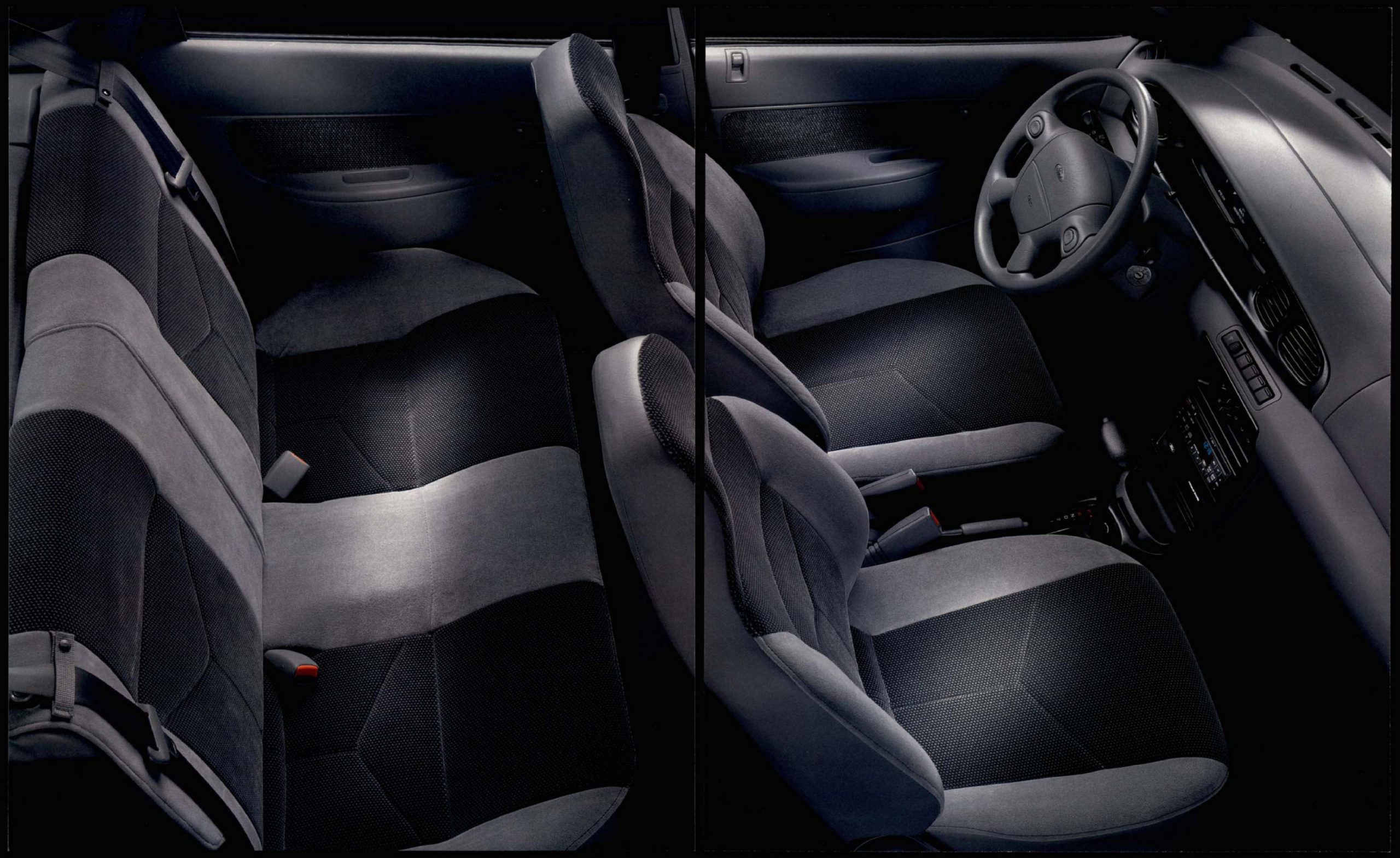
While the mechanics weren’t terribly exciting, Ford really pushed the Aspire’s safety features. When the Aspire launched for a base price of $8,240 ($19,243 in 2026) in 1993 for the 1994 model year, Ford said it was the cheapest car in America with dual front airbags. Optional were the anti-lock brakes for $565 ($1,319 in 2026). There was also a fancier SE model with better seats, a wing, foglamps, alloy wheels, decals, and updated interior trim.
A Rough Road
Unfortunately, the Aspire was a bit of a hard sell from the start. It was as early as January 1994 when the car buff mags and regular people began cracking jokes about the Aspire name. In April 1994, John E. Nicholson sent this rant to the editors of Motor Trend:
I’ve noticed an interesting phenomenon. Various auto companies have begun producing things that at first glance might appear to be cars, but apparently aren’t. Thankfully, the companies give you a fairly blatant tipoff in the name. For instance, there’s the Charade. The goal is to guess what it is. We’re still guessing. Then there’s the Protege, which presumably will someday grow into an actual car. The Mirage is really interesting since it isn’t there at all. You only think you see it. Also running around is the Sidekick, which, presumably, you could buy to have run alongside your Crown Victoria, or other real car. Last but not least, we now have the Ford Aspire. I’m driven to the conclusion that while not yet a car, the Aspire will some day transform into a Taurus, Thunderbird, or some other real car.
Ouch!

The Aspire was a part of a new era for Kia. According to Automotive News, Kia used the Festiva to perform recon on the American market. It then took what it learned to establish Kia Motors America Inc. in 1992 and begin importing vehicles under its own brand. Leading Kia’s charge into North America was Greg Warner, who brought 26 years of experience to the table, notably including stints at Toyota and Hyundai. The New York Times wrote that Warner wasn’t afraid of taking chances, and, apparently, was an avid helicopter skier.
Kia’s first U.S. import under its own name was the Sephia, which arrived in America either in late 1993 or early 1994, depending on the source you read. By November of 1993, Kia had 20 dealerships in the United States. The first-generation Sportage came a year after. According to Kia Motors America, its mission was, via Motor Trend:
“[T]o build cars that are of comparable quality to the Japanese competitors, sell them for a price that won’t send consumers through the roof, then give them the kind of service every car owner deserves.”
In practice, Kia saw itself as a viable competitor to Honda and Toyota, but at much lower prices. According to Automotive News, it cost only $35,000 ($81,737 in 2026) to become a Kia dealer, and despite the low base prices of the cars, they were so cheap that margins were high. Kia reportedly spent six years researching the American market before pulling the trigger, and it even had a clever way to get its name out there, from Automotive News:
The first 2,000 Kia Sephia sedans were sold to Budget Rent-A-Car for use in rental fleets. For four months, Kia received feedback about the Sephia from drivers of rental cars and incorporated many of those suggestions into the final product. Before Sephias were sold to consumers in the United States, Kia hired engineering consultants to test the cars’ durability through 100,000 miles of driving on American roads. Those programs were the basis for two TV commercials developed by Kia’s advertising agency, Goldberg Moser O’Neill in San Francisco. The company says the spots have advanced consumer recognition of the name of the company and the product. [See video below:]
With product testing complete, Kia was ready to begin its market-by-market rollout. Kia first offered the Sephia sedan to the western United States in February 1994 at four dealerships in the Portland, Ore., area and one in Las Vegas. In the spring, Kia opened dealerships in Washington, Arizona, New Mexico, Texas, Utah, Colorado and California.
In 1994, Kia sold 12,163 Sephias and opened 88 dealerships in 13 states. In 1995, sales rose to 16,725 Sephia cars and 8,015 Sportage sport-utilities for a total of 24,740. Kia introduced the Sportage in January 1995. Also in 1995, dealerships were opened in Louisiana, Tennessee, Mississippi, Alabama, Arkansas, Florida and Georgia. Kia’s future plans in the United States include a larger sedan to compete with the four-door, V-6 models that are popular today.
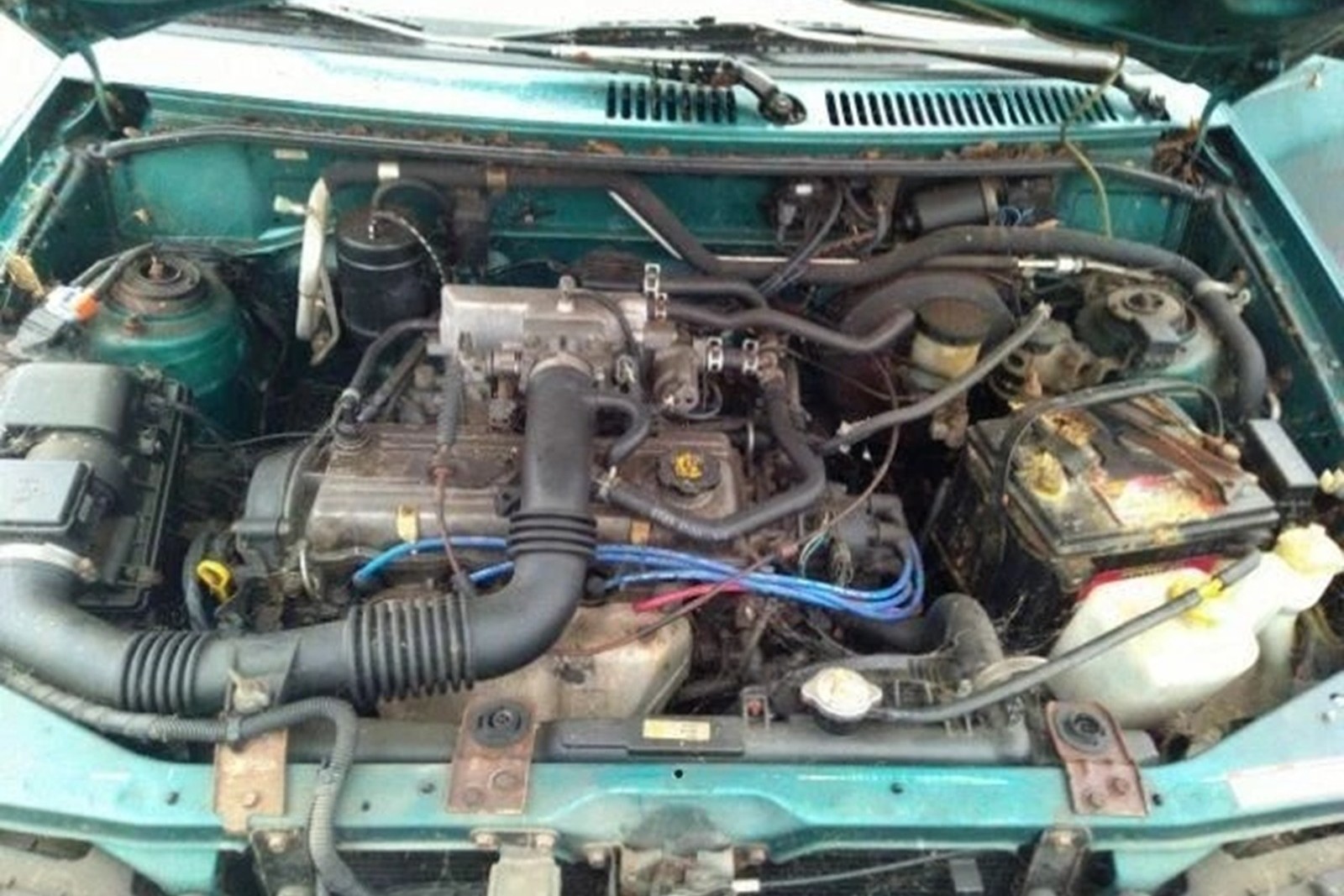
Technically, by selling cars in America, Kia competed against its old friends at Ford and Mazda. However, in addition to building the Ford Aspire, Ford still owned 10 percent of Kia, while Mazda had eight percent of kia. Ford had another 24.5 percent of Mazda.
Sadly, the Aspire might have been the wrong car for the wrong time. The Geo Metro didn’t have the Aspire’s airbags at first, but got better fuel economy for a cheaper price. By 1995, the Geo Metro got standard dual airbags for a lower price than the Aspire. Meanwhile, the Ford Escort and Dodge Neon were faster cars for not a whole lot more money. Really, the only reason to buy an Aspire was its price, and even then, you had to be okay with it being heavier and slower than the Festiva it got its bones from.
Mostly Forgotten
Sales are often cited as a reason why the Aspire made it only to 1997. Based on the data that I could find (here’s one sales chart), the Aspire sold around 5,000 units a month at its peak and closer to 1,700 units a month near the end of its production. In other words, Ford sold a modest number of Aspires, but ultimately, far fewer units than the Festiva it replaced. Today, several car publications label the Aspire as a “worst” car or a “biggest sales flop.” Yes, it did sell fewer units than the Festiva, and it got destroyed in sales by Ford’s own Escort, but is it the worst car Ford has ever sold? I see the Aspire like I see the Mitsubishi Mirage. Maybe the Aspire wasn’t the best at anything, but it was honest transportation.
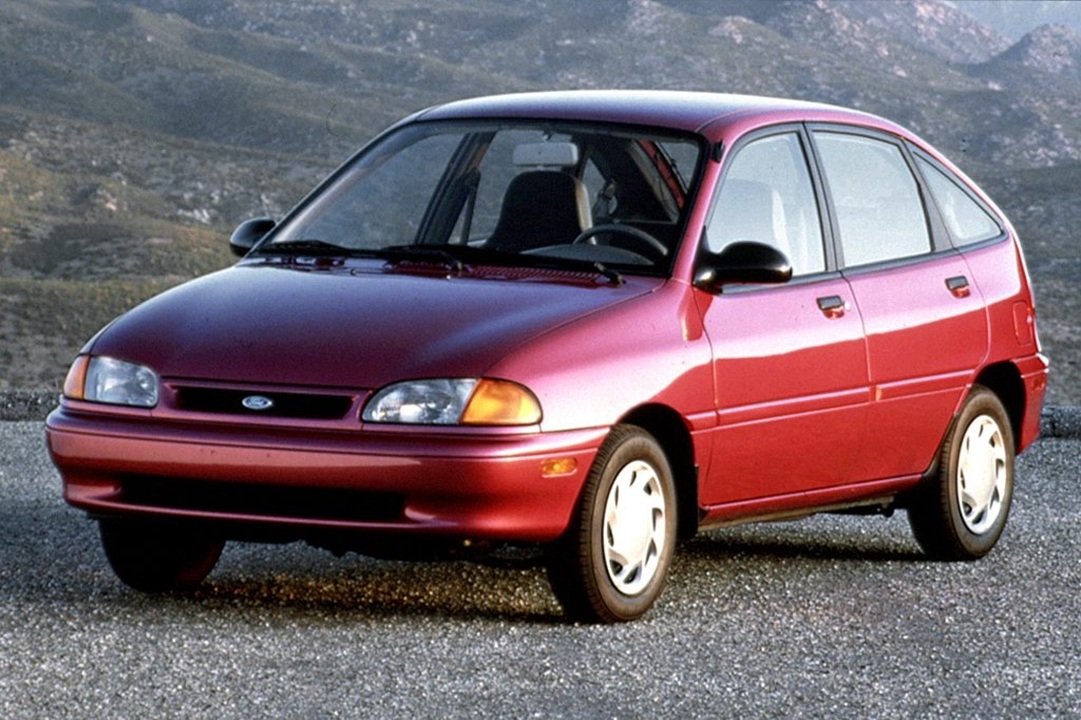
The Aspire is arguably lousy by current standards and maybe even fairly mediocre by the standards of the 1990s. However, like the car journals of the day noted, the Aspire was the kind of car for the person who wanted a new car without spending a single dime more than they needed to. It was a car where the most luxurious optional features were alloy wheels, an air-conditioner, a tachometer, and a cassette player. But it was also a car where, after checking those options boxes, it was expensive enough that you probably should have gotten the Escort, anyway. Something like the Aspire might have been more successful for a lower price, or if it had been on the market earlier.
Today, the Aspire is probably an endangered species. Rust has taken countless examples out, and many of the rest were beaten within an inch of their lives as disposable economy cars. Many of the survivors have enough miles to have driven to the Moon and partially back. The Aspire is also so unloved that it’s one of the few cars that you can probably find for $1,500 or less in running, but not necessarily good, condition.
The Ford Aspire is a great example of how hard it is to follow up a great car. In theory, a larger, rounder car should have been just the thing. But it seems that Ford and Kia might have missed the mark on what people liked about the Festiva. I hope to see a mint condition Aspire at a car show one day. Sure, everyone seems to hate it now, but one day, people will appreciate seeing a preserved version of a car everyone’s forgotten.
Top photo: Ford


Drove one of these through most of high school. Hated the thing. It had no AC and was too small for me to comfortably use the clutch, which made the stick more a chore than a pleasure. There was no release for the rear hatch, you had to take the key out, walk to the back, and open it from there.
I guess it functioned as cheap, basic transportation, but it also made me understand why cheap, basic transportation doesn’t sell even in poor countries. If there’s any way to get something nicer, you should. Stuff like the Aspire is the definition of “penalty box”.
The nose on these things always looked like you put a Windstar in the dryer on high heat.
I feel bad about this now, but back in the ’90s my friend’s girlfriend had one of these and we absolutely ragged on that car. Definitely made the “it aspires to be a real car” jokes… Looking back though, she got a brand new car while one of my buddies was driving an early ’70’s Buick Skylark and I was driving my Mom’s old ’88 Ford Escort station wagon. Was it an awesome car to teenage boys? No. Did my friend’s girlfriend deserve us giving her a hard time about it? NO. We were just shitheads and if I could find her now I’d like to apologize. But between us… I still don’t like the Aspire.
I was off the grid for the weekend, so I didn’t see this Friday! As a two-time (a 95 and a 97) former Aspire owner, I’ll add my 2 cents.
They were GREAT work commuter cars. An hour each way on some twisty, hilly country roads. The five speed kept me awake as they wouldn’t climb hills in high gear! They were decent, cheap cars. Nothing more, and that’s all they needed to be. I really only stopped driving them because I couldn’t get parts anymore! I hit a coyote with one and messed up the front sheet metal. Couldn’t find replacements, so bought a whole other Aspire! That one was retired when I couldn’t locate a distributor that cost less than the car was worth! Mazda/Ford/Kia had the brilliant idea to build the ignition module into it, and they all fail. I rigged up a work-around with a generic GM HEI module, but it never worked real well.
I took my driver’s education training in an Aspire. Godawful car, and there was a piece of sheet metal near the pedals that tore a hole in my shoe.
I didn’t know that JATCO was a collaboration of Nissan, Mazda and Ford. So Ford and Mazda brought “Zoom Zoom” and “Built Tough” to Nissan’s “Innovation That Excites”?
There’s a great moment on Car-Talk where Tom just rips into a caller’s Aspire, and it so happened to be on the day Dateline I think was filming a special on them too. Imagine getting your car roasted on car-talk and then it being played on primetime TV.
The problem with a base shitbox like a Festiva is when you start looking at the row of used cars at the dealer you can buy for the same $$$$ Especially now days with how well made/durable cars are. My Lexus ES350 was 6 years old, low old lady miles and cost about what a new Corolla would have. 6 years later Im glad I bought a nicer but older car vs a new one, it has been fautlessly reliable as well
Yours is a familiar refrain, and one that I’ve agreed with personally, however “we” (those on this site) are more car-oriented than most people. You had more understanding about which vehicle/brand to target – a brand with a great rep for quality and longevity – and you had the ability to understand what you were seeing in the vehicle itself regarding condition. You know all that stuff, but that’s certainly not the case for most.
For these people, buying a new car with a warranty is probably a better choice. Chances are, they are just looking to get around and don’t care much about the overall experience, plus the warranty will save them from things like ridiculous cost for over-engineered luxury. NOTE: I realize that’s not what you bought, but in that situaiton, a “normie” is more likely to be tempted by a used BMW/Benz/Audi without knowing what the potential extra costs might be to keep one on the road.
I wish people would educate themselves a bit about what to buy. Cause its not hard to do a simple google search on a car you are interested in and see if there are any expensive “gotcha” repairs that are common.
Ive known a couple people who bought used Hyundias with that junk turbo engine who had it blow up on them. This was when the problem was well known. Well it was like $8000 cheaper than a Camry. I told them both there is no such thing as a free lunch, buy a 4 cylinder Honda or Toyota. One of them had it repossessed and wrecked their credit, the other was lucky enough to have Hyundia cover most of the repair, they were still out of a car for months.
In “National Lampoon’s: Vegas Vacation,” at the end of the movie the Griswolds head home driving all the cars Rusty (Jay Mohr) won gambling illegally underage in Vegas. I was a kid, but the lineup always stuck with me:
A Dodge Viper.
A Ford Mustang.
A HUMMER H1.
…and then Audrey gets a Ford Aspire.
They don’t even acknowledge it as a joke. She’s genuinely excited about it.
That may have been the most excited anyone ever was, real or otherwise, about Ford Aspire.
Nice deep cut there.
Bottom of the market, which today is like a Hyundai Venue? Wild how things have changed and how they haven’t. Always obnoxious how people like to hate on small/cheap cars because…of reasons? Cause they’re assholes and it’s easy? Cause it makes them feel big? Idk it’s hard to sort.
I’m not one to hate on cheap shitboxes, because they’re some of my favourite cars, but the Aspire does seem to be the most generic possible car. Compare it to something like a Twingo, which managed to be fun and quirky, while still being cheap.
Oh yeah it was certainly a mediocre car, but that’s ok. I’m mostly referring to the pull quote from the guy ragging on every econobox he could, just go buy your big truck and chill out, whoever he was.
Oh, great. Now I have to have Wallyscar.
What’s a Sauber Teenager? I’ve only seen drunk ones.
The Aspire gets so much undeserved hate in my opinion. I like the looks, it had an attractive interior, and they wore like iron in the same way Festivas did (I mean the powertrains are the same, after all.) The only one I ever drove was my friend’s in high school, a ’97 with the automatic. It was, predictably, slow as shit due to the auto and a chore to drive due to no power steering. But it never once broke down that I can recall.
Cheap basic transportation is what part of the population needs. No complaints.
Designed by American Ford and supervised by people who probably got yelled at by Hank Ford for even thinking of a cheap car. Ford had it right the first time. Let the overseas branch design it while all the US branch does is write the checks. It’s a rare small car that was designed in Detroit given the antipathy to small cars that came from there.
I’m no car sales expert but I play one on the Autopian blog. But the Aspire story sounds more like a prequel to modern day attempts of trying to cash in on successful cars with a inferior vehicle. Now I don’t know why manufacturers seem to want to turn over a vehicle at a certain time length but to me if it is selling keep it going with a few new features. If it isn’t change sooner. And if you are going to launch a new vehicle with a classic successful car name do your research. You can’t take a underpowered square box with under 100 HP VW Van that became a success after a decade launch a new overpriced totally different fancy EV with the same name at collectors prices before you even sell one. Same with the mustang
Given a choice between one of these and a Ford Tempo with the same equipment, I’d go for the Aspire. The Tempo was truly awful.
But the Neon was across the street. A fight only the least compassionate of states would sanction.
The Tempo was a crowning achievement in the crowded category of domestic shitboxen that sucked from the factory.
Jack Baruth wrote a good column about selling a pink Aspire and some Ford dealer shenanigans. I more or less skipped over the Aspire. I wasn’t looking for a car when they were new, and bought a used Escort in 97 that was a much better family car.
Since we lived in Beaverton we saw the end of Daihatsu and the beginning of Kia.
I aspire to never own an Aspire! Ha ha…Fix Or Repair Daily/Found On Road Dead. What’s funny is the Chevy Aveo is actually worse…what a sorry penalty box that was.
Also, I can’t believe some of the vehicles on that link of Road and Track’s “Worst Cars of the 90’s” Check this out:
-Acura CL (no Acura should be on a worst list)
-Toyota T100: Really? You put a TOYOTA TRUCK on a worst list?! Plus it’s actually a small truck where you can actually put stuff in easily
-Dodge Ram Van: Yeah, they weren’t the greatest, but not the worst and they were still cool…plus you can “live in a VAN down by the RIVER!
-Saab 900: Wow, seriously? Worst?!
-Honda Del Sol: No Honda should be on a worst list
-Oldsmobile Cutlass Supreme Convertible:
These will run badly longer than other cars will run at all…plus convertible fun! Not the worst
-Toyota Previa: This was a family vehicle growing up and was pretty good; plus some had a stick or superchargers
-Honda Odyssey: Seriously? The best minivan ever made! They only put it on due to these gens having glass tranny’s
-Nissan 200SX SE-R: Wow, not the worst
-Saturn cars AND the company: They actually called Saturn the worst company…morons. Look at this beautiful Saturn from this week’s Shitbox Showdown
https://www.theautopian.com/will-you-stick-with-the-chrysler-concorde-go-for-the-1995-saturn-sl2-or-choose-the-mystery-car/
-Suzuki X-90: They just don’t like it because it’s so FUN, awesome and good looking
Torch! It would be awesome if you started doing that series again where you redeem cars from that “Worst Cars” book…that was so interesting and hilarious!
https://www.theautopian.com/worlds-worst-cars-book-redemption-oldsmobile-toronado/
Agreed most of that list are sales flops or oddballs or both. The Ford Tempo is more deserving of worst car than the Aspire
We had a Tempo. It was a fine, basic transportation car which came with super cold A/C and enough power to keep going on the highway with it on when a lot of basic cars still didn’t have A/C at all. I don’t recall ever having to turn off the A/C for an incline.
The Tempo seemed to have been assembled well or as least I do not recall any squeaks or rattles, even at 10 years old. It was comfortable, even on all day trips and it was VERY reliable. It’s greatest sins were being an appliance and being an invisibility cloak.
It kinda reminded me of the Ranger, it got no respect or much love but it did get the job done.
Has a Tempo it came with super cold AC OR power to keep going on the highway you couldn’t get both.
I drove ours several times between Sacramento and San Diego and had no problem that I recall getting over the Grapevine with the A/C blasting. Perhaps because I stick to the speed limit. This thing was not built for the Autobahn.
I admittedly base this on my experience with rental Tempos in 93-94, plus my baseline was an A1 Jetta. I think the 2001 Escort from Enterprise may have been my worst. it felt like a downgrade from our 95 Escort
I had a Mk2 Scirocco at the time so from memory I wouldn’t consider an 80’s VW as much of an upgrade from an ’80s Tempo, at least as far as comfort, NVH and reliability. The Scirocco was a much better sporty car but that’s not what the Tempo was about.
If you use metrics instead of real data this is what list you can expect. I think this is the real reason the Metric system failed in the US.
Not sure I can parse the logic for these, but a lot of it has to do with perceived regard and popularity.
-Acura CL, weak replacement for the Legend that didn’t sell that well and got a hefty reboot for the aughts. (styling was an issue–and I liked the styling)
-Toyota T100, too small to be a big, serious truck. Also Toyota’s V6s in the 1990s had issues. Mostly just a marketing miss that Toyota fixed
-Dodge Ram Van, third-best of USDM vans? Okay you got me there
-Saab 900, so OG900 legend, NG900 (mid-1990s) buckle up there will be some problems, OG93 sneaky good, NG93 a really nice Opel/SWB Malibu
-Honda Del Sol, assassinated by the Miata but also the targa was troublesome
-Olds Cutlass, there are only so many ‘meh’ FWD droptops to choose from for a listicle, why not this one?
-Toyota Previa, crash tests (!) otherwise giant cockroach class not the worst
-Honda Odyssey, most likely referring to the first version which was an embryonic Merc R-class but a flop because it was quite ugly compared to the other stuff Honda was fielding at the time
-Nissan 200SX SE-R, inferior to the preceding Sentra SE-R, despite being an SX car it was not built on an S platform, otherwise not the worst
-Saturn, by the late 1990s, yes, Saturn had already become one of the worst (and saddest) projects GM had ever embarked on. Early cars were competitive but it quickly became a pointless brand and thus easy to pick on
-Suzuki X-90, completely ridiculous so it has to be on a worst list for somebody, but it’s a legitimately fun good car
Wow, yeah a lot of good points…that’s more than I knew. Thanks!
The post Bonds R&T is pretty awful.