

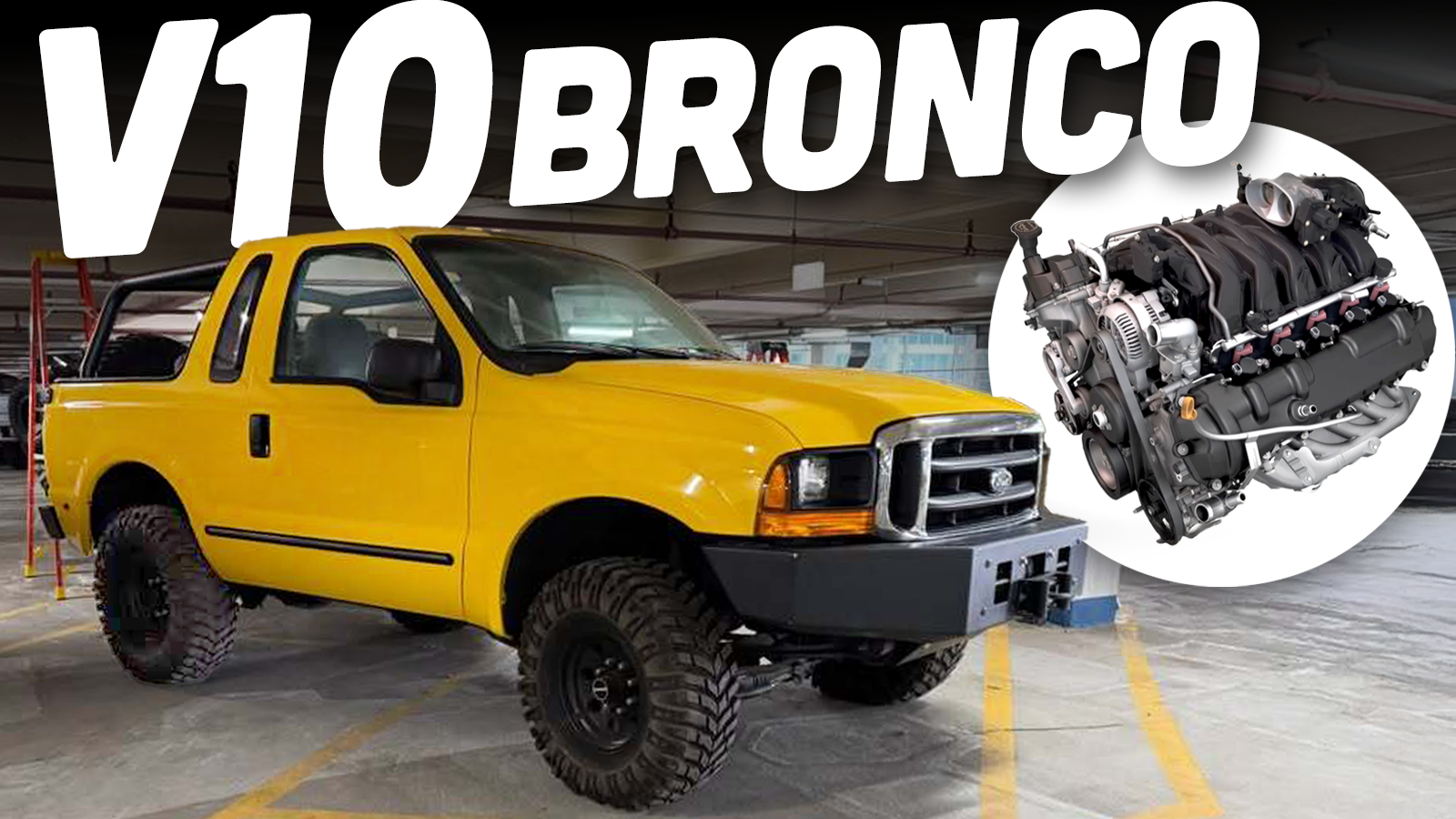
Concept cars are a window into what could be. They don’t just showcase a new styling direction, but they tease high-tech developments while getting people pumped for the future. Some concept cars just show off a great idea that sometimes never reaches production. The 1998 Ford F-250 Super Duty “Bronco” concept is one of the latter. This big truck converted into an SUV has a V10 engine, a manual transmission, and even an open top, but Ford didn’t even show it off to the public. Now, we’re seeing what could have been.
Back in 2025, Ford formed what it calls the Heritage Fleet. Ford realized that it had around 300 production, concept, and prototype vehicles that Ford employees had saved. All of these vehicles were scattered all around the world, from England and Germany to Australia. Many of them had been rescued by their designers or engineers and were just sitting in a secret place.


Meanwhile, Ford didn’t really have a car collection here in America. Production vehicles are often used by the media and are then sold. The historic vehicles in Ford’s possession have been sent to live with The Henry Ford Museum or have been auctioned off for charity. Ford CEO Jim Farley wanted to fix the fractured nature of Ford’s car collection. Hardcore Ford enthusiasts within the company decided to save their favorite concept cars and prototypes, creating a massive collection of unique Fords. The Ford Heritage Fleet is a private horde of cars in a secret garage within Ford’s headquarters and is not open to the public. However, when the fleet was originally compiled and parked in the garage, Ford invited automotive media to take a look.

Many of the vehicles within the space are Ford Performance projects, like the 1993 SVT Mustang Cobra and the Ford GT Mk II. Then there were tantalizing prototypes like the 2002 Ford SVT Lightning Bolt Ranger. I somewhat recently wrote about that truck, and its silly 5.4-liter supercharged V8 that was lifted from the Ford SVT F-150 Lightning.
The Heritage Fleet also includes a bunch of concept cars that never made it further than the auto show circuit. Remember the 2007 Ford Interceptor concept? That’s in the Heritage Fleet; so is the truly bizarre Ford Airstream concept, below. Ford says its collection also contains archival vehicles like the 1914 Model T replica built for Ford’s 100th anniversary, a 2000 Ranger EV, and the Ford F-150 Lightning EV driven by former President Joe Biden.

Then there are concept cars like the F-150 Atlas concept and cars used in media stunts like the Mustang that got perched on the top of the Empire State Building for the 50th anniversary. Ford’s also keeping the 10 millionth Mustang produced. Ford is also saving both generations of the modern GT as well as many famous Shelby variants.
The Ford Heritage Fleet is a perfect complement to the Ford Heritage Vault, an excellent portal to find great nuggets about Ford history. How useful is the Ford Heritage Vault? Whenever I write about an old Ford, at least a few images will come from the Heritage Vault.
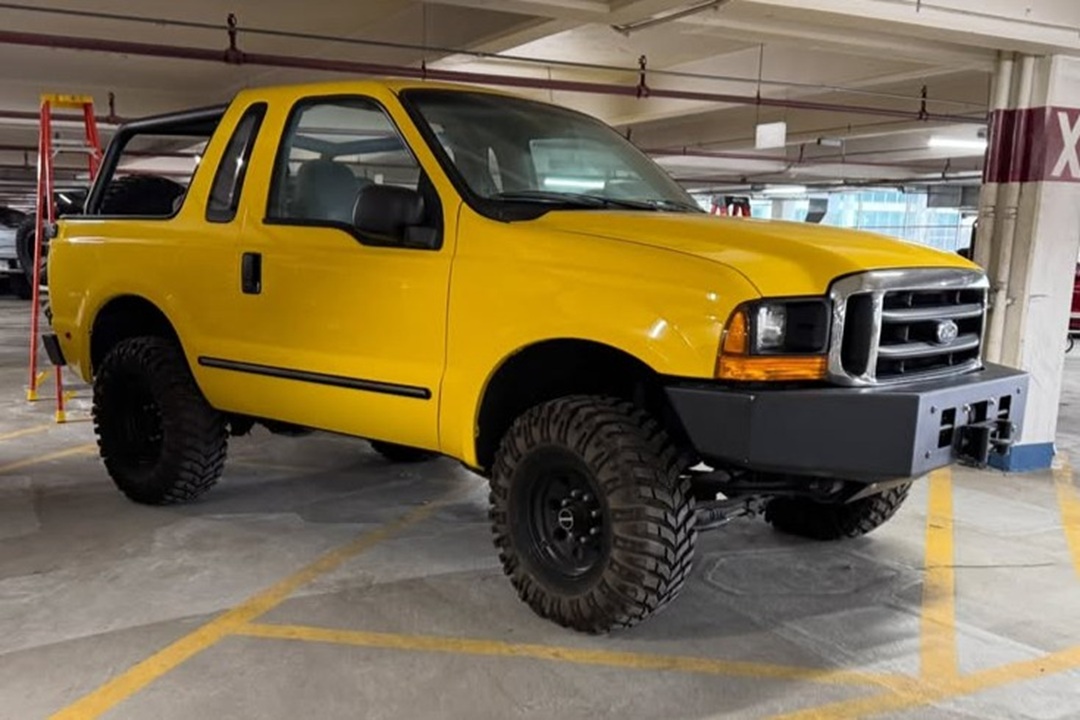
The 1998 Ford F-250 Super Duty “Bronco” Concept is unique in that it’s not a vehicle that millions of eyes have seen.
Heavy Duty Bronco
We learned about the existence of the Super Duty Bronco concept through Ford Heritage Fleet Manager Matt Korczyk, who posted about the big Bronco last week. His Instagram post is embedded below, but you can click here if you cannot see it. If you’re not allowed to view Instagram on the device that you’re using, don’t worry, because I have the images here.
View this post on Instagram
It’s a bit wild that the reason this is our first time seeing this truck is because the formation of the Heritage Fleet is the first time that the truck has left the confines of the design studio that penned it. Yep, this truck hasn’t seen the outside world for over 27 years.
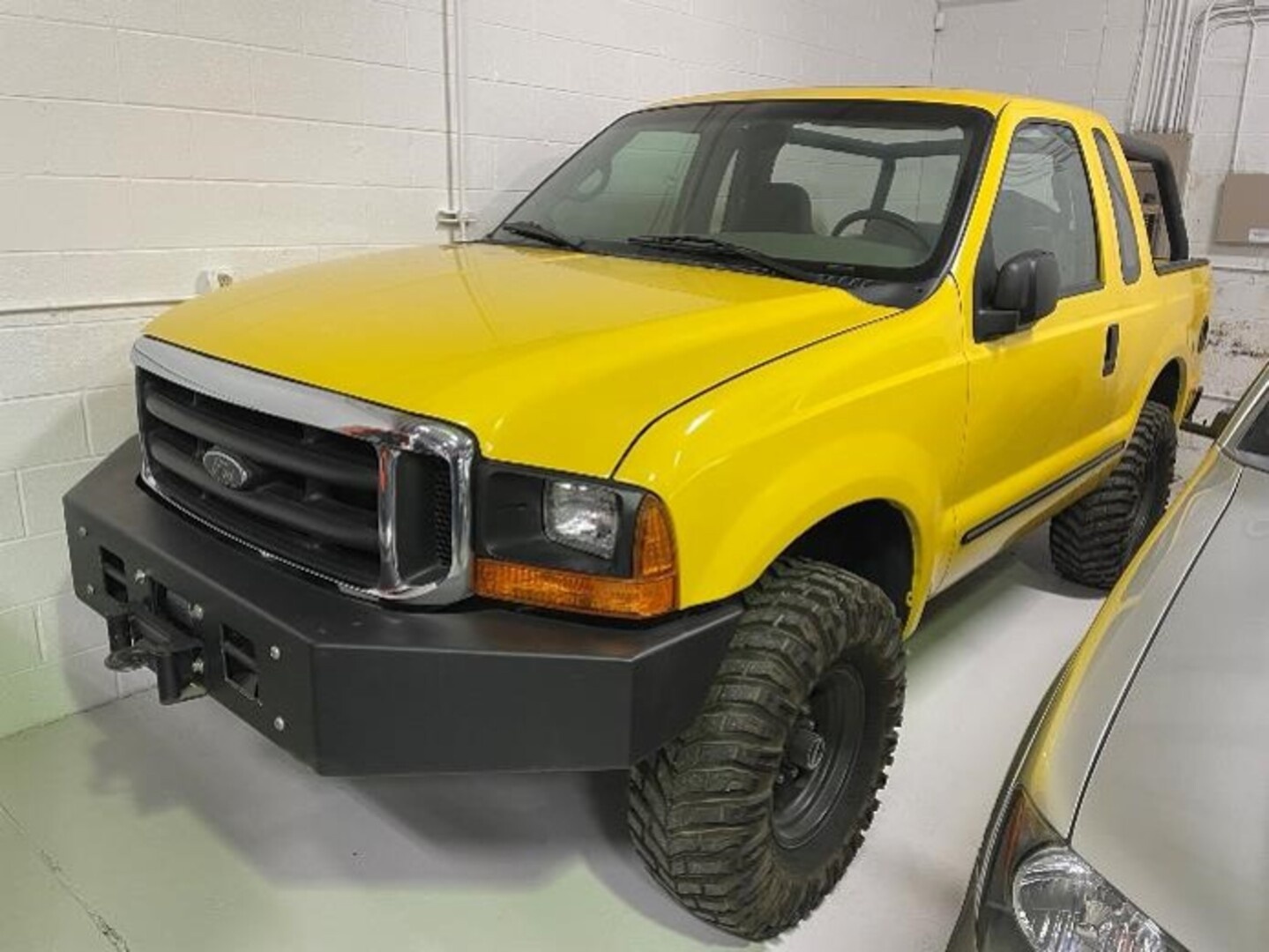
According to Korczyk, the Super Duty Bronco concept started life as a 1998 Ford F-250 Super Duty XL prototype with a 6.8-liter Triton V10 engine, a SuperCab, a short bed, Dark Hunter Green metallic paint, and a five-speed manual transmission. Assuming that the V10 was production-spec, that’s 310 HP and 425 lb-ft of torque under your right foot.
The base truck was a prototype, as this was the era when the Super Duty was born as a separate truck that did not follow the development of the light-duty F-150. From my retrospective on the history of the Super Duty:

For the past [28] years, the higher-capacity trucks have slotted into what Ford calls Super Duty trucks. Now, on the surface, this is a bit confusing. Ford has definitely sold big trucks for far longer than 25 years and the Super Duty name certainly wasn’t invented in 1998, so what gives? Well, Ford says it goes back to the very first F-Series trucks from 75 years ago. Back then, you could buy the half-ton F-1 and the classes climbed all of the way up to the F-7 and F-8 “Big Job” trucks. So, heavy-duty trucks built for hard work have always been a part of the Ford truck formula.
Those early trucks had a Gross Combined Weight Rating (truck plus trailer and payload) up to 41,000 pounds and a Gross Vehicle Weight Rating (truck plus payload) of up to 22,000 pounds. As the F-Series marched forward, Ford saw demand for an engine better suited for heavy work. Thus, in 1958, the brand launched the Super Duty engine. The Super Duty name made a return in the late 1980s for a Class 4 chassis cab truck.
Alright, so the Super Duty name long predates the brand of heavy-duty trucks, so what’s up with that? As Ford explains, in the late 1990s, the light-duty F-150 and the heavy-duty trucks split into two platforms. The trucks on the heavy-duty platform became the Super Duty brand of F-Series trucks. Why did Ford split up its F-Series trucks? The company says it was done in response to changing buyer demographics. The F-150’s development path was making it more daily driver-friendly with smoother driving dynamics and car-like convenience features. However, many buyers still just wanted hard-working, no-frills trucks to get their jobs done. The Super Duty line was created to serve those people.
Last year, YouTube Channel Late Model Restoration got to see the truck (above), and Matt and Ted gave some details.
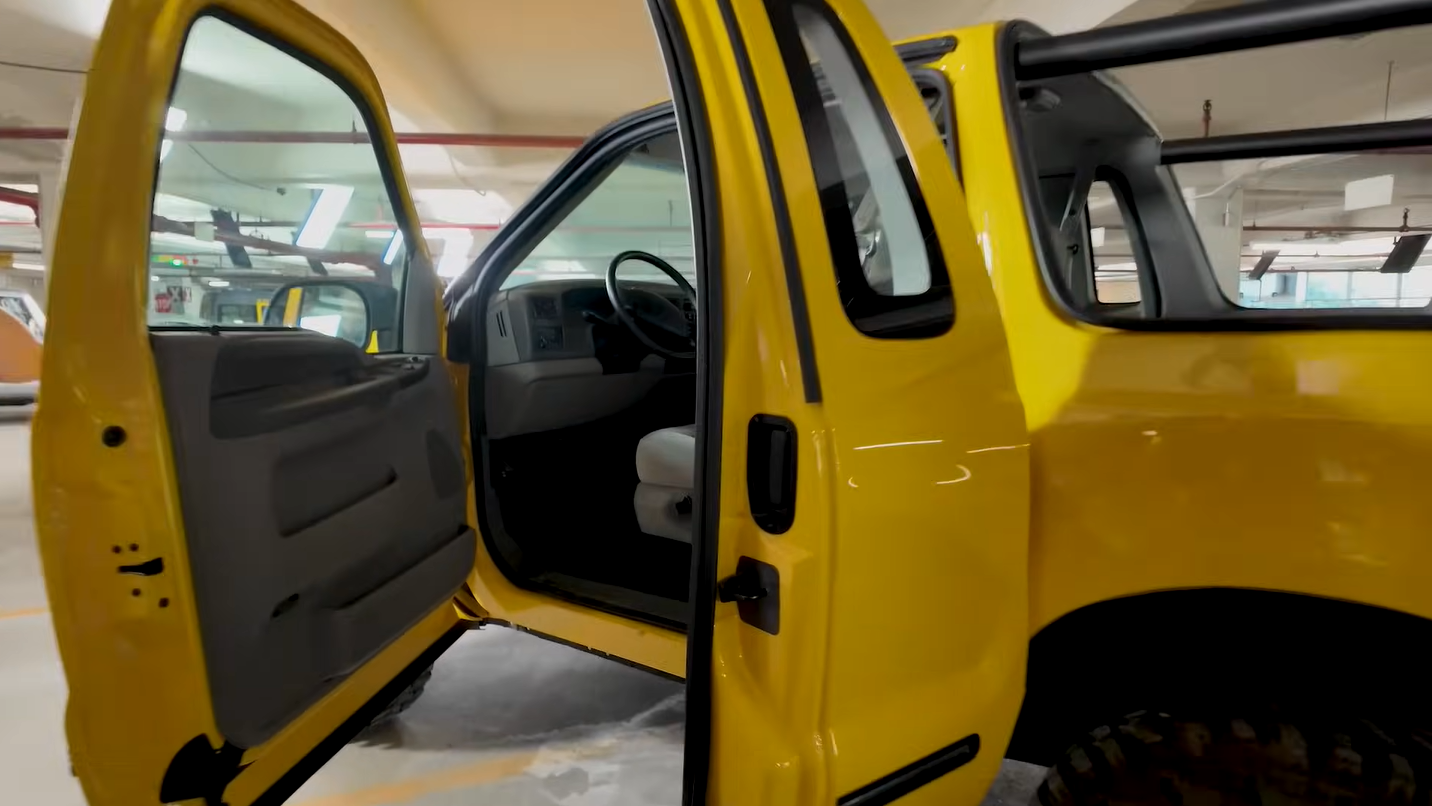
Apparently, the F-250 had its bed and rear doors chopped and then joined to create the familiar Bronco body, just on a heavy-duty pickup truck base. The modifications must have been extensive, as the Super Duty Bronco has a shorter wheelbase than the donor F-250 did. Amazingly, the rear door of the SuperCab still works – it’s just tiny now!
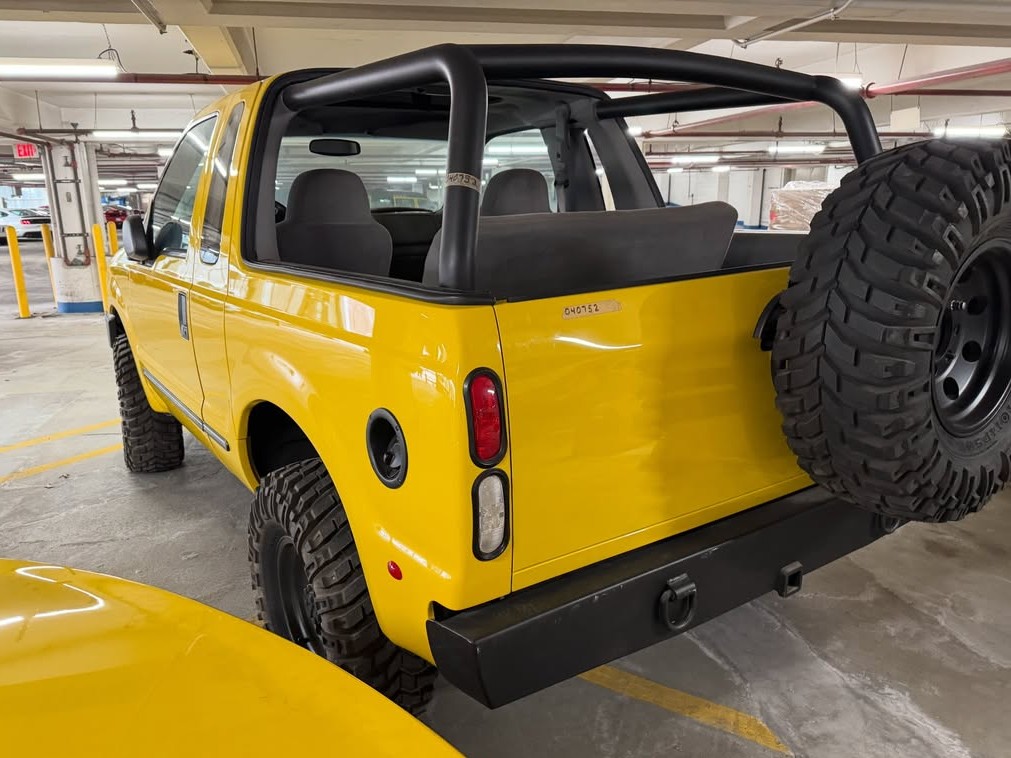
The back of the Super Duty Bronco has a bench seat and roll bars. It’s said that it had a black fiberglass cap over the open area when new, but it was removed at some point. The video also shows a large sunroof in the covered part of the cab.
The Ford team says that one unnamed executive loved the concept truck so much that he commissioned the company that built the concept to assemble a second one just for him. It’s unclear what happened to that truck, but this one never left the design studio and sat for years, gathering dust. It’s been sitting for so long that the truck’s throw-out bearing and master cylinder are worn out, but the truck could be put on the road again if desired.
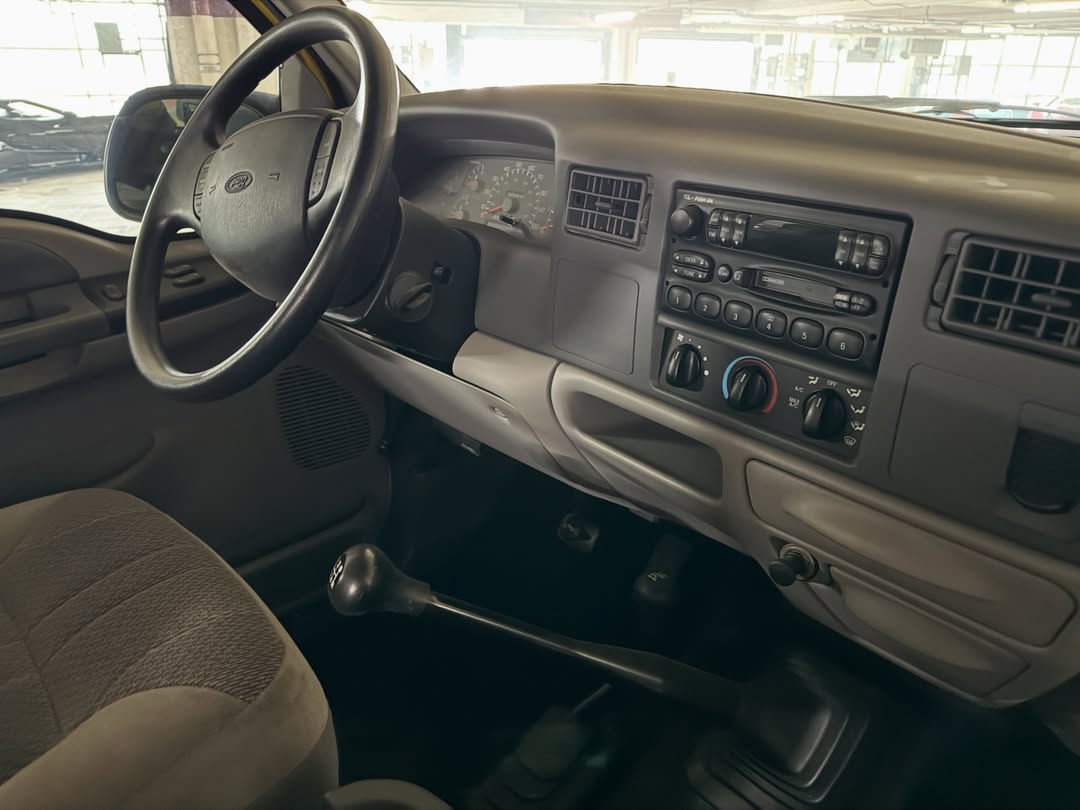
Matt says that when the team first heard about the Super Duty Bronco, they thought it was the 1997 Ford F-150 Rox. I can see that assumption happening, given that the two have the same color and a similar rear-end treatment.
Apparently, that changed when they finally saw the Bronco concept in person and realized that it’s based on a Super Duty. Here’s what the Rox looks like:
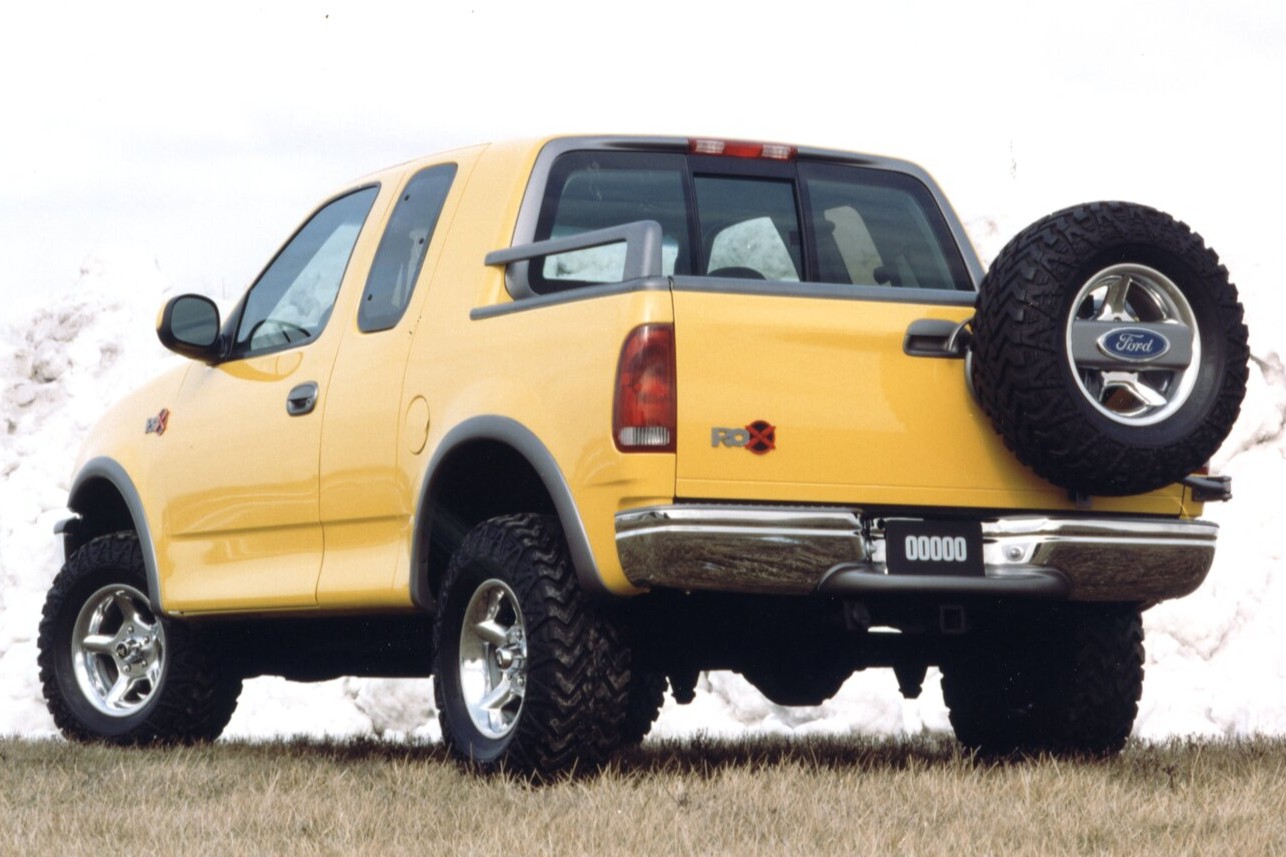
In 1997, Ford teased the Rox concept, which was a bright yellow F-150 with an extended rear seat area and a short, integrated bed. Ford said it was built as an exercise to bring “the comfort and versatility of a sport utility vehicle with the load-carrying practicality of a pickup.” This was less of a Bronco and more like a predecessor to the Explorer Sport Trac.
The Super Duty Bronco concept is bigger and more gnarly than the Rox. Like the Rox, the Super Duty Bronco didn’t go into production, either. As it was, the Super Duty Bronco came two years after Ford had already discontinued the fifth-generation Bronco.
I have reached out to Ford to see if anyone knows the inspiration behind this truck. I want to know who had the wild idea to turn a Super Duty into a Bronco, and why. I’d also love to know which company built it and where the second one might be. I’ll update if Ford responds with the details.
Until then, I’ll just dream about what could be. I love the fact that someone at Ford apparently thought that there needed to be an extra-large, heavy-duty Bronco, and I love it. I can only imagine what fun it could be to take this beast off-road with the top off and the V10 screaming. Honestly, I’d be asking to take a spin in the concept if it weren’t essentially a one-off and broken. This truck might be the most American thing I’ve seen all week.
Top graphic images: Matt Korczyk; Ford


I’d love this. The current Bronco’s towing capacity is terrible
Thanks for the article, especially for the Heritage video link. Well done.
Cheers
How do I get access to the Heritage fleet. I go out to Michigan once a year and I would love to see the collection
That’s a nice Isuzu Amigo you got there.
But what happened to the taillights?
In yellow, that’s a Cream City brick sh!thouse if I ever saw one. She’s mighty mighty and can tow a whole six tons.
It falls apart at the trailer taillights. With that curvature, ’90s Escort wagon ones would probably work as well as anything.
310hp and 425 pounds of torque is basically what the 2.7l Turbomax 4 banger in my 26 Silverado makes. Wild what engineers can do these days.
Ah, but at what RPM?
3k
I dig it. My 2000 F250 V10 got 10mpg whether I was empty, hauling an 8000lb trailer, or had 3800lbs of rocks in the bed. I imagine this wouldn’t be much better, but it would look pretty sweet and I’d have a good time wheeling it on trails too tight for a longer fullsize truck.
Yeah, I specifically bought my 2000 Excursion with the 5.4 V8 so I could get SOME semblance of fuel economy when unladen vs the V10.
It also tows just fine, it just takes me longer to get to speed.
But I really want this thing.
I hear that. I only used the truck for truck things, so the only time it was unladen was when I was on my way to load it up, making the V10 a more justifiable choice.
I also eek out a bit more towing (got 13.5mpg on my last towing adventure) cause it’s the family adventure mobile. The plan is to travel across Canada, and I’d like to not be totally broke by the end, hah.
Best of luck!
Can confirm the gas mileage
…my Imagination is now filled with what could have been: this V10 chonker bouncing recklessly through the countryside in a open world car game.
I pictured it in a police chase through LA
It’s not white.
It’s not moving fast.
Somebody had access to the toybox and just started playing. The full-size, 2-door SUV was dead and buried several years before, with the GMT400.
It’s odd they didn’t put in the effort to use rear quarters from an Excursion and just used off the shelf trailer tail lights.
Given this is a ’98 and the first MY of the Excursion was ’00, it probably just missed that opportunity by a few months to get hands on the finalized parts.
Thanks. I really was just guessing at the timeline.
I thought the lights were a tribute to the original Bronco.
With the small quarter window added and with yellow paint I’d say it’s more like an extra large Land Rover Freelander.
It just needs a 7.3 or a 12v cummins to be really great
I think it’s better with the V10 gasser as it’s not a tow rig and more a 15/10ths Wrangler
Though fuel economy in this with a 12v would be pretty good. My D250 gets around 20mpg so something a little short and possibly light might get a little better. Though a 4BT in this might get even better but that thing would be a dog hah
Rad! But why would a throwout bearing go bad from sitting? Rusted and seized?
My dad worked in construction and in the early 90s, he drove a work truck that was badged as an F-SUPERDUTY instead of F-150, F-250, etc.
I think only the cab chassis trucks used that badging. The ’97 F250 did have “HEAVY DUTY” under the 250 badging to differentiate it from the 7-lug light duty versions, too.
His had an extra long frame and a custom body so that checks out.
Yes the F-Super Duty was only available as a cab and chassis as was the norm for higher than class 3. It was later, after the F-250 and up line gained the Super Duty name, that they added a F-450 pickup.
I don’t mean to be rude about this, but the Rox was based on a jellybean F150 and anyone with eyes can immediately tell a Super Duty apart. Ford employees making this mistake makes me wonder if they were recently transferred from the Quality Department.
You mean the best F-150 design?
If you’re a blind wombat, then yes.
stupid wombats always being stupid and blind
If you don’t have anything nice to say, don’t say anything at all, is what I was taught, so my response is:
I saw this take on your video of the Lightning at the Concours and I thought it was a bit spicy. I dunno about best in general, but I do have a soft spot for these as I was a Ford tech from ’98-’01 and I owned a ’00 F-150. They were definitely cohesive with the overall design theme Ford had back then. The design was so good that Toyota largely copied it for the Tundra.
I love the 97-03 F150’s, they were roomy and comfortable. Would like to do a Coyote transplant to a single cab short bed.
I weirdly like and hate it at the same time. I don’t like the shapelessness of it, but I like that it kept Ford’s contemporary extreme conservatism and utilitarianism. Something about the near lack of any design at all seen in the ’80s LTD and F-Series, for example, is really nostalgic and charming to me. Is Hank Hill’s pickup a Ranger or an F-150? They have the same damn face so who knows!
The jellybean styling should’ve been used across everything up to the F650 where the wide beam front axles take over. That’s how it was always done before. HD pickups SHOULD look awkward and dorky.
Glad to know I’ll have some company when I die on *10th gen F-150 hill.
*My research tells me that 10th gen F-150 hill is approximately 20 miles northeast of Burlington, VT
I hated the jellybean F-150. Mostly, I still think of the previous generation as the platonic ideal of an F-150. Like, if someone asked me to picture an F-150 right now, I imagine an early 90s F-150 with the two-tone paint finish.
I will say, this is generation of F-150 that had the absolute BEST looking Flareside bed. To this day I feel like the truck was designed around that bed and the styleside was an afterthought.
I have a jelly bean F150 and apart from fuel consumption it’s great for truck stuff. The 10th generation is also important as the first clean sheet Ford pickup in ages since the 80-98 OBS trucks evolved from the dent side and bump side trucks. The jelly bean finally ditched Twin I-Beam and both the 300 I-6 and Windsor V8s
If I understand what Matt’s saying correctly, it sounds like they learned about the existence of the concept and thought it was the Rox (it’s unclear why they thought so). They realized it was a Super Duty, and therefore not the Rox, after seeing it in person. I added a clarification!
With that said, if you find the Super Duty Bronco in the Ford Heritage Vault, it’s tagged as “Rox” without any explanation. So, who knows what’s going on.
That makes much more sense, although I liked the joke.
I did, too! 🙂