


One of the greatest American sport pickup trucks of all time is the GMC Syclone. When the Syclone launched in 1991, GMC gave enthusiasts a truck that couldn’t haul anything, but was so fast it could even outrun some of Maranello’s best. Depending on who you ask, it was even the world’s fastest stock pickup truck for several years. But like all flagships, the Syclone wasn’t cheap. For just a single year in 1992, GMC had just the truck for people who wanted a Syclone but couldn’t afford one. This is the Sonoma GT, the truck that had most of the bones of a Syclone, but a dramatically lower price. Weirdly, it’s rarer than a real Syclone, too.
Automakers have long engaged in the practice of selling a cheaper version of a performance model. While enthusiasts might drool over headlining trim levels, they might not be able to afford the price tag of the halo car, or the insurance rate it commands. This was especially true in 1970, when the insurance rates for the most violent muscle cars were so high that the cost was most of the price of an average new car. According to Phil Skinner, collector car market editor at Kelley Blue Book, muscle car insurance often ran between $1,000 and $1,500 in 1970, which isn’t bad until you realize that, at the high end, a muscle car was $4,000 back then. $1,500 was only a few hundred short of the price of a new 1970 Volkswagen Beetle.


By selling a cheaper, more accessible version of the flagship, buyers were able to shortcut those insurance hurdles. It also opened the door for younger, less affluent enthusiasts to buy into the brand, too. In the past, many of the most famous muscle cars had lesser-known cheaper variants. If you couldn’t afford a Pontiac GTO, the GT-37 was easier on your wallet. If you just couldn’t swing an Oldsmobile 442, the Rallye 350 got you a taste of your dream.

Today, you can walk into a BMW dealer, and if you don’t have the dough for a full chat M car, you’ll be able to at least look the part by getting an M Sport model. Audi has a similar deal going on with its S Line. Mercedes-Benz does it, too, with the AMG Line. Even Volkswagen, Hyundai, and Kia are in on the game with their R-Line, N-Line, and GT-Line, respectively. There are more examples out there, and yes, some of those names have hyphens, and some don’t. It seems to vary between automakers.
When the GMC Syclone began its reign on the American blacktop in 1991, it had a base price of $25,970, or the equivalent of $64,426 today. In 1992, just as GMC wrapped up Syclone production with 2,998 units built, the truck maker figured out how to slice nearly $10,000 off the Syclone’s price tag. The result was the Sonoma GT, and it’s one of the hottest-looking regular trucks of the 1990s.

Small, Black, And Mean
Back in 1987, the sinister Buick Grand National’s run of terror against unsuspecting sports cars was coming to an end. The General didn’t have many high-caliber vehicles in the works at the time, which would have left the Chevrolet Corvette and the turbocharged Pontiac Trans Am standing as the best representatives of GM performance. GM engineer, doctor of marketing, and drag racer Kim Nielsen just didn’t like the idea of his automaker’s performance portfolio looking so thin.
Nielsen would concoct the “Cyclone” concept, a bombastic truck that had the heart of a Grand National shoehorned into the engine bay of a GMC S-15. GM brass said the truck would take seven years and $200 million to put into production. Nielsen also lost his star engine, as the 3.8 turbo V6 was ending production. But Nielsen and some enthusiastic engineers made the truck a reality by subbing the Grand National plant for a 4.3-liter V6 with its own turbo.

But how do you shortcut a projected seven years of development? By outsourcing some of the work! Here’s what I wrote in a retrospective:
One potential choice was ASC/McLaren, which worked on the Pontiac Turbo Grand Prix by ASC McLaren. The other was Production Automotive Services, which had its hands on the Pontiac Firebird Trans Am Turbo. ASC/McLaren’s prototype sport truck was a GMC S-15 with a turbocharger. Production Automotive Services did the same, but that firm’s prototype went further, borrowing an AWD system from the then-new Chevy Astro AWD and instrumentation from a Pontiac Sunbird Turbo. Nielsen’s team tested both trucks and the Production Automotive Services prototype was a clear winner.
From there, Production Automotive Services would be in charge of developing the truck, certifying its emissions, and building the production versions. Out of the other end came a truck that stomped the competition for years. PAS added a Mitsubishi TD06-17C turbocharger and a Garrett water-to-air intercooler to the S-15’s 4.3-liter V6. Other changes came from a twin-bore throttle body from the Corvette, lower-compression pistons, a new intake, and new exhaust manifolds. Power spiked from 160 HP to 280 HP and 350 lb-ft of torque. A BorgWarner transfer case ensured 65 percent of the engine’s power fired to the rear wheels.
GMC advertised the truck’s ability to hit 60 mph in 4.6 seconds and a quarter mile in 13.4 seconds. As I noted earlier, Car and Driver figured out how to beat the advertised acceleration time, cutting that down to 4.3 seconds and the quarter in 12.98 seconds. It is because of that test that you’ll read that the Syclone was even faster than a Corvette ZR-1 and a Ferrari 348ts. Sure, the Corvette and the Ferrari had higher top speeds and could take a corner, but at least to 60 mph and often to the quarter mile, the Syclone was effectively untouchable.

The Syclone blew everyone away at GM, from then-president Lloyd Reuss to head of design Chuck Jordan. According to Hagerty, Chuck Jordan remarked that the prototype was faster than his brand-new Ferrari, which is equal parts awesome and hilarious.
The Syclone and later, the Typhoon, would go on to become two of the greatest vehicles ever assembled by General Motors. There was even a GMC Marlboro Syclone Edition, which somehow made the Syclone look even cooler while popping its top. Click here to learn more about the Syclone with Hagerty’s excellent video.
But by 1992, it was all over. Only three Syclones were shipped that year, capping off a production run that lasted only 2,998 examples. If you couldn’t afford to pony up the cash for a new Syclone, you lost out.

In early 1992, guests attending auto shows got to bear witness to the Sonoma GTX (above). This truck was essentially the same as a Syclone, but with a high-tech touch. In a first for the compact segment, the bed was made out of composites. The GTX also featured trick Delco electronic shocks, articulated headlights with built-in washers, Firestone Stratos run-flat tires, and a head-up display with a projected boost gauge.
The Syclone For Light Wallets

According to an April 1992 report by MotorTrend, GMC officials hinted that they were considering the GTX as a production option. This never happened, but GM had been hinting at a sporty, but not Syclone, trim of the Sonoma since late 1991. That truck ended up being the Sonoma GT.
Upon first glance, the Sonoma GT is a Syclone. It has the same sinister black paint – Frost White, Bright Teal, Aspen Blue Metallic, and Apple Red were optional – and the same ground effects kit. GMC even emblazoned “Sonoma GT” on the doors of the truck with a similar font to the one used on the real Syclone.
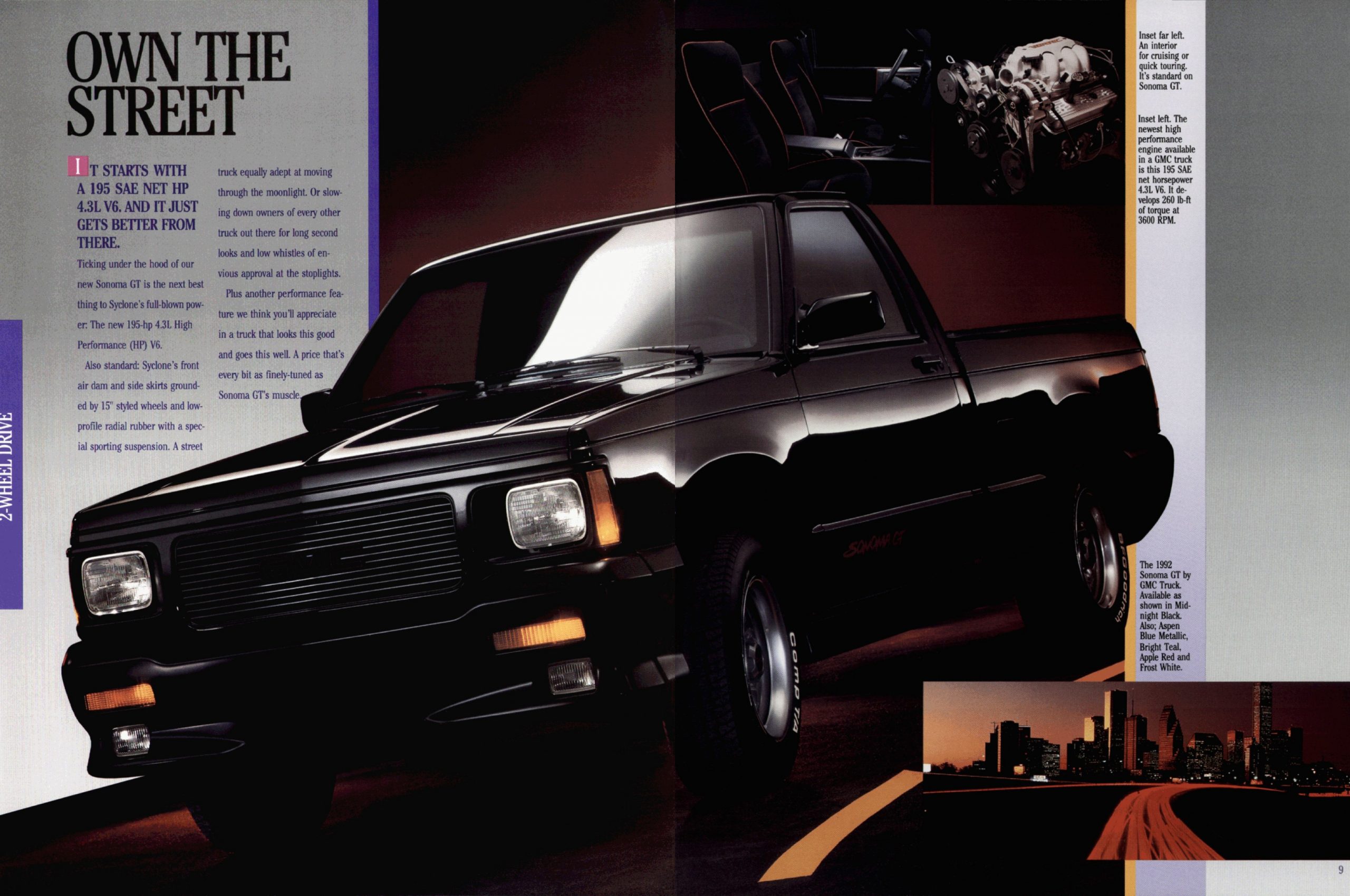
The biggest difference between the Sonoma GT and the Syclone was what was under the hood. GMC gave the Sonoma GT the second-best engine from the Sonoma lineup, which was the 4.3-liter L35 Vortec High Performance V6. This engine uses tricks like central port fuel injection for a healthy 195 horsepower and 260 lb-ft of torque. Power is transmitted solely to the rear wheels through a four-speed automatic transmission. Backing the powertrain up is a sport suspension with Bilstein shocks, plus 15-inch wheels shod in 215-section-width BF Goodrich Comp T/A tires.
Inside, the Sonoma GT’s cab is a clone of the Syclone’s right down to the instrument panel, but without Syclone badging and without a boost gauge. GTs included cruise control, air-conditioning, power mirrors, power steering, and interval wipers as standard. Reportedly, Production Automotive Services finished the Sonoma GTs just like it handled the Syclone.

The Sonoma GT doesn’t sound all that fun, at first. The V6 doesn’t have any forced induction, and there’s a decent gulf between the 195 ponies of the 4.3 High Performance and the 280 horses of the boosted version. At least the 4.3 High Performance makes a good 35 horses more than the standard version.
The performance numbers are better. In MotorWeek‘s hands, the 3,300-pound Sonoma GT was able to sprint to 60 mph in 7.6 seconds, completing the quarter mile in 16 seconds at 85 mph. For comparison, in MotorWeek‘s hands, the Syclone hit 60 mph in 5.4 seconds and hit the quarter mile in 14.1 seconds at 98 mph. However, John Davis did note that the Syclone was tested on a 90-degree day and that, on a cooler day, a Syclone might do the deed in under 5 seconds.

Still, what this meant was that the Sonoma GT didn’t have any of the complexity or cost of the boosted powertrain, but still had a lot of speed for a pickup truck. It wasn’t eating any new Ferraris for lunch, but at a base price of only $16,300 ($39,412 in 2026), you weren’t breaking the bank, either. Undoubtedly, some Sonoma GT owners figured out ways to squeeze more speed out of their trucks. I know that, at least in the modern day, there are aftermarket turbos for the 4.3 out there.
Here’s what Truck & Sport Utility Performance magazine said of the Sonoma GT:
Even from idle the engine is eager to get down to business. Nudge the 4L60 4-speed into “Drive,” stomp on the accelerator and the GT’s fenderwells begin to bellow smoke—right foot control is a must. The truck pulls hard enough off the line, but when second gear pops in, brace yourself. The GT really digs in and goes, pinning your shoulders to the seatbacks. At speed throttle response is excellent, thanks to the L35’s central- port fuel injection and internal balance shafts. While performance-minded automatic trannies have come a long way, a 5-speed manual would have been at the top of our wish list. It would give the driver control of the shift points and more revs mean more performance.
After gathering gobs of seat-of- the-pants feedback, we took the Sonoma GT to Los Angeles County Raceway (LACR) to evaluate the truck’s potential with a stopwatch. The Sonoma was up to the challenge, screaming down the strip in 16.65 with a terminal velocity of 81mph. When corrected for altitude (LACR is at an elevation of about 3000ft.) the GT recorded a time of 16.12 topping out at 84mph. With a set of headers and a free-flowing exhaust system this truck could easily break the 15-second barrier. It should be noted that even during the footstopping performance testing the truck averaged 21.2mpg. This was right in line with its EPA rating of 18 and 24.
With the Sonoma GT’s straight-line performance figures duly noted in our logbook, it was time to wring the truck out on the twisties. Again, we tip our hats to GM’s team of engineers. They put together suspension components that work in concert, allowing the truck to corner like it was on rails, yet still deliver a cushy, forgiving ride. This balance was attained by using torsion bars up front and a two-stage leaf spring setup in the rear. A set of specially-valved Bilstein shocks and P215/65 x15 BF Goodrich Comp T/As add to the GT’s sure-footedness. When put to the test the suspension is easy to anticipate. At the apex, the Sonoma tends to over-steer, but modulating the throttle brings the truck back on track. The combination of the powerful engine and a more-than- able suspension give the driver the confidence to search out the edge of the truck’s performance envelope. As refined as the Sonoma’s road manners are, the truck is designed for the general public, not performance enthusiasts. The GT would really corner like a slot car if it were dropped three or four inches all around and shod with bigger, even more aggressive rubber.

John Davis from MotorWeek was equally excited about the Sonoma GT and even pointed out that the Sonoma GT was more practical than the Syclone. The Sonoma GT had a payload capacity of 950 pounds, nearly twice the 500-pound payload of the Syclone.
Weirdly, Davis also said that with a factory-installed trailering package, a Sonoma could tow up to 9,500 pounds. So far as I could tell, whoever wrote that script made an error, because hauling capacity maxed out at 6,000 pounds with the Sonoma’s Z82 towing package. I also haven’t seen a published towing capacity for the Sonoma GT, specifically. Check out the MotorWeek review:
Ignored When New, Somewhat Forgotten Now
Perhaps the weirdest part about the Sonoma GT was its production run. GMC found few takers for the Sonoma GT, and only 806 examples were sold that year. The trim level did not get a second year of production. That makes the Sonoma GT rarer than a Syclone. GMC did keep the GT name alive, but started applying it to the two-door Yukon in 1993. Chevrolet also got a Suburban GT that year, too.
Today, it’s not really known how many Sonoma GTs are still around, but they’re considered to be rather rare. I have seen more than one example for sale for under $15,000. Only one Sonoma GT has shown up for sale on Bring a Trailer, and it failed to sell after bids reached $22,500. There is one currently for sale in Florida for $35,100. That’s the one shown below with that teal and white paint job. While the teal is correct, the bottom white should be gray. I can forgive the incorrect color for the totally ’90s theming.

While the Sonoma GT was only a one-year deal, GM did continue to make sport appearance packages for its small trucks. During the platform’s third generation, which launched in 1994, there was a Chevrolet S-10 SS, the Xtreme, and the ZR-5 Sport Package. So, the GT wasn’t a one-off idea. But what did make the GT stand out compared to later iterations was that it was most of a Syclone.
The GMC Sonoma GT, much like the Syclone, was a product of a different time. People weren’t afraid to buy smaller trucks with regular cabs, automakers weren’t afraid to take a chance on something silly, and automotive history got some real gems.
General Motors was willing to sell you a pickup truck that sucked at being a truck, but was too fun for you to care. I miss that era of nonsense. Imagine if today’s absurd 700-plus horsepower trucks were distilled into something smaller. It would be hilarious to see any domestic automaker build a production compact truck that could outrun a sports car today. Sadly, it seems that dream will remain just that. Otherwise, there’s always a Syclone or a Sonoma GT that’s calling your name out there.
Top graphic image: GM


That truck looks like one of my Friday work shirts.
It looks like the 9500lb Motorweek was quoting was probably the Sonoma’s max GCWR.
Not a compact truck, but Ford Performance is happy to sell you a blower for your RCSB F150 that bumps it up to 700hp. Plenty of dealers sell them in various trims from sleeper build to loaded out.
That teal/white truck has ‘Florida Flip’ sprayed all over it.
Inevitably, the first owner of the Bright Teal Sonoma GT drove it regularly and left it parked in the Florida sun every day. They did try to keep up with the sun and salt damage, but the wheels and the gray trim looked worse every day.
The truck got parked when the pride and joy of ownership faded like the hood clearcoat. 20 long, dusty and salty years follow.
Enter Florida Man, with his Instagram-inspired ’90s coffee cup aesthetics and a can of white paint! Will you just look at that! Trendy 90s collectible pickup in trendy 90s paint! Some Gen X-er will DEFINITELY give $35k for this…
disclaimer: I didn’t follow the link and actually look at the truck for sale. The above is just where my mind wandered when it was mentioned it was for sale in FL…
“Nielsen also lost his star engine, as the 3.8 turbo V6 was ending production”
I never understood why GM didn’t keep the 3.8L turbo around.
That paint job…it looks like what Sonny Crocket would use for Home Depot runs. It’s perfect.
That color scheme makes it look like the official truck of Deutsches Bundesbahn Those Germans do love their teal and magenta.
Every jacket on a ski hill in the late 90s and early 00s.
It’s the Solo Jazz EdtionTM
I really miss neon colors on trucks.
I miss when cars makers had fun.
Best S10 was the Xtreme.
Could even get that with the base 2.2L4. Proper frugal sport trucking.
As much as I hate SUVs in general, I always preferred the Typhoon to the Syclone.
The Sy seemed weird. What’s the point of having a pickup bed that you’re never going to use as a pickup bed? Of course, I later thought the same about shit like the Lincoln Blackwood, but when these trucks came out we hadn’t gotten into the “pickups as a fashion statement” mindset yet.
I thought the Typhoon looked better and made more sense. It also looked larger, which added to the comedic value of waxing Porsches in a truck.
The reason the Sonoma GT was largely forgotten is that it was largely forgettable, in the same way as if you took a Veyron and put a Passat motor in it. The one thing that made the Syclone interesting and desirable got deleted.
The Sy was useless as a truck, but it was fast as shit and so it made sense to buy it just for the stoplight giggles if nothing else.
The Sonoma GT was useless as a truck and was decidedly not fast as shit so… Why?
BTW, there are plenty of trucks out there being sold today that suck at being a truck. Anything from a luxury marque, the Cybertruck, Jeep Gladiator, etc, and that’s not even getting into all the SUVs that by definition suck at being both a truck and a car.
The difference is that many if not most people don’t buy trucks to do truck things anymore, so we don’t even really notice when a truck sucks. Whether you can put 5,000 pounds or 500 pounds in the bed doesn’t matter because most people aren’t hauling either one.
Not gonna lie, I would daily the crap out of that Sonoma GT. So much great American iron relegated to the dust bin.
GM just needs to bring back a small, inexpensive basic little truck. Price it low enough so people buy it.
Ford sold close to 5 million Rangers throughout the 1980s and 1990s and Chevy/GMC sold more than 5 million S-10s and S-15/Sonoma trucks during that same span.
That’s over 10 million, and that doesn’t even include Nissan, Mazda, Toyota or Mitsubishi.
So when the inevitable naysayers claim dozens of people would buy one, remember that those 10 million plus people couldn’t have been too wrong.
I owned a 2-door 1984 S-10 Blazer and a 2-door 1995 S-10 pickup. I currently drive a 2-door Canyon with a 5-speed but would prefer something smaller like the S-10. There just aren’t any of them left in my neck of the woods due to rust.
Sources:
1. Ford Ranger
The Ford Ranger was the undisputed sales king of the compact pickup market during this golden era. [1]
Total Sales (1983–1999): Roughly 5.2 million units were sold in the United States. [1]By the Decades:1980s (1983–1989): Approximately 1.75 million Rangers were sold.1990s (1990–1999): Sales exploded to roughly 3.45 million units, peaking in 1999 with an all-time annual high of 348,358 trucks. [1]Overall Lifespan: Over its entire multi-decade U.S. run (1983–2012), the Ranger nameplate recorded over 7.6 million total sales. [1]
2. Chevrolet S-10
Introduced for the 1982 model year, the S-10 was the primary domestic competitor to the Ranger. [1, 2]
Total Sales (1982–1999): Roughly 4.5 million to 5 million units were sold across both decades.By the Decades:1980s (1982–1989): The S-10 was a massive immediate success, regularly selling over 300,000 to 400,000 units annually in the mid-80s, netting roughly 2.2 million sales.1990s (1990–1999): Maintained strong numbers with its second-generation redesign in 1994, averaging 230,000+ units a year toward the end of the decade (e.g., 233,669 in 1999), tracking at roughly 2.5 million units. [1]
3. Toyota Pickup (Hilux / Tacoma)
Before it was officially named the Tacoma in 1995, it was simply known as the “Toyota Pickup” or Hilux in the North American market. [1, 2, 3]
Total Sales (1980–1999): Estimated at roughly 3.2 million to 3.5 million units in the U.S.By the Decades:1980s: This was a massive boom era for Toyota’s compact 4x4s. Between 1983 and 1989 alone, Toyota sold 1,710,683 pickups in the U.S., peaking in 1986 with 320,661 units.1990s: The original Toyota Pickup wound down sales by 1995 (selling roughly 815,000 from 1990–1995) before handing the reins to the new Toyota Tacoma, which added another ~700,000 units to finish out the decade. [1, 2]
4. Nissan Pickups (720 / Hardbody / Frontier)
Nissan revolutionized the market by opening a massive plant in Smyrna, Tennessee, in 1983 specifically to build these small trucks domestically. [1, 2]
Total Sales (1980–1999): Estimated at roughly 2.3 million to 2.5 million units in the U.S.By the Decades:1980s: Dominated by the transition from the Datsun 720 to the famous Nissan D21 “Hardbody” in late 1985. Annual sales often pushed past 150,000–200,000 units, totaling roughly 1.2 million for the decade.1990s: The Hardbody line generated 1.2 million sales alone during its total production run (1986–1997). Combined with the early years of its successor, the Nissan Frontier (introduced in late 1997), Nissan moved roughly 1.1 million to 1.3 million trucks during the 1990s. [1, 2, 4]
Yes but add the government requirements and that adds at least 10K. The government refuses to let inexpensive vehicles of any type be built
The government sucks.
There are two comments I hear more than any other when people see my Ram 50:
1) “Never heard of it.”
2) “I wish they still made trucks like this.”
Love me a Ram 50. I photograph all Mitsubishi L200s I see whenever I go outside of the US.
I got a good pic of one in Chile earlier this year.
GMC also had the Sierra GT. I bought one used, not sure the year(maybe a ’91?). Bright red, color match bumpers, same vinyl badging.
I had the 95 S10 SS, which also had that CPI 4.3L. Made great power and made for easy burnouts as a high school student. I ran it at LACR quite often, and I think the best I got out of it was a 16.3 at that altitude.
Note that the turbo kits for the 4.3L V6 will not work with the Vortec CPI in the Sonoma GT. They work with the later CMPI engines (identifiable by a different plenum with a top hat over the throttle body). The CPI’s injector was a piece of junk, and they liked to rot out the tubes between the injector body and the poppet valves resulting in an expensive repair job. The CPI also would have needed a 7th injector to support forced induction.
I always loved the S10 SS, more than the more extroverted Xtreme package. For a long time I dreamt of finding an S10 SS and LS-swapping it.
I got rid of mine before the LS swap became common, but I did have a Jaguars that Run S10 V8 swap manual. I was planning to do an LT1 swap and my Dad convinced me to sell it and buy a Mustang instead.
During college in the late ’90s I drove auto parts delivery. One of our trucks was a well-used ’91 S-10 longbed with the 4.3 and the automatic. The store had a partially-gravel lot and it was nearly impossible to get that thing moving when empty without throwing stones. Most of our drivers were HS or college guys and so more often than not that truck was squealing out of the parking lot.
When I first bought it the stock skinny tires were pretty well worn… on a rainy day making a left turn across an intersection I pretty much was always spinning the thing around. Some fat rear tires and a little more experience solved it
I got a new Huffy 20″ bike in 1988 or so in the same teal, white, and hot pink livery as the title pic. It was totally bitchin’!
That style…schwiiiing!
That paintjob looks like a Syclone crashed into a Taco Bell drivethru, I like it!
Too bad Syclone and Typhoon production didn’t last longer. And too bad they never made the 4-door Typhoon.
Shit, GM could easily bring them back. Install an LS V8 in them. V8 Canyon -> Syclone. They’re also too stupid to give us the international Trailblazer (which is a Colorado/Canyon wagon). Put a V8 in it –> Typhoon
GM offered a V8 in the mid-2000s first gen Colorado/Canyon and also the GMT360 wagons. Since they made a TBSS and 9-7X Aero, why not a GMC Typhoon too?
I just experienced a ’90s overdose.
Am I the only one who thinks it looks way better in that fantastic ’90s teal than the Syclone ever did in black? Even when they were new and blacked-out cars and trucks weren’t done ad nauseam I thought that; all-black-everything on the GNX and GLH-S just seemed to highlight how dated the underlying Regal and Omni’s detailing was by washing it all out in the same color, somehow worse than monocrhomatic red or “cocaine” white would’ve.
I always preferred the T-Type to the GN for being available in colors.
The ultimate ’80s sleeper would’ve been a GNX in that 2-tone slightly pinkish beige and brown (“Light Rosewood Metallic over Dark Rosewood Metallic”) with a matching (dark) velour interior and (light) landau top.
Not far behind, possibly better, would be a GLH-S in light blue metallic with matching interior and base Plymouth grille, taillights and bumpers.
I remember seeing the occasional Sonoma GT’s back in the 90s…. I had no idea that they were so rare though. Probably haven’t seen one since though.
Meanwhile – Why were Teal (and Purple and Magenta) such a big deal back in the 80’s, you might ask yourself?
You have one guy to blame: Alexander Julian.
https://www.nba.com/hornets/news/the-often-imitated-never-duplicated-purple-and-teal-revolution
https://www.tiktok.com/@philedwardsinc/video/7677207730502814990