


Assembling a brand new WWII Jeep from hundreds of individual parts was extremely difficult. It would have been one thing to purchase everything as a huge set, but as the purpose was to demonstrate the enormity of eBay Motors’s WWII Jeep parts selection, I decided to buy almost all the parts one-by-one. This led to a few challenges: 1. There were boxes; lots of boxes. 2. Figuring out how to organize (not lose) things was not easy and 3. This was very obviously not the most cost-effective way of building a WWII Jeep (but again, that wasn’t the point).
If you want a fully restored WWII Jeep, you can generally buy one for around $25,000. As anyone who has restored a car will tell you: If you want to save yourself the headache, just do that instead of restoring a car yourself. It will save you lots of time, and to be honest, it’ll likely be cheaper. In my case, that was especially true because of the way I built my Jeep: I ordered hundreds of parts, individually, meaning I didn’t get the volume-discount that you get anytime you purchase loads of parts all bolted together in the form of a complete vehicle (for example, if I had purchased this one from eBay).


Still, the prices of the individual components were great, so this could have been a lot pricier than it ended up being. At the same time, because I was in a rush, I did have to make some hasty purchases so I probably could have optimized a bit better. Anyway, let’s get into it, starting with the biggest expenses.
Parts That Cost Over $300
Here are the priciest individual purchases, starting with a bit of a luxury item that I didn’t need, but wanted — the brand new engine:
Brand New Engine Block: $6,309.53

The Body: $4,441.88

The Frame: $2,765 (I paid the seller an additional $376.44 — total: $3,141.44)

Complete Engine Overhaul Kit (With Manifolds, Camshaft, Oil Pan)

Combat Wheels:

The Spare Engine: $1,097.50

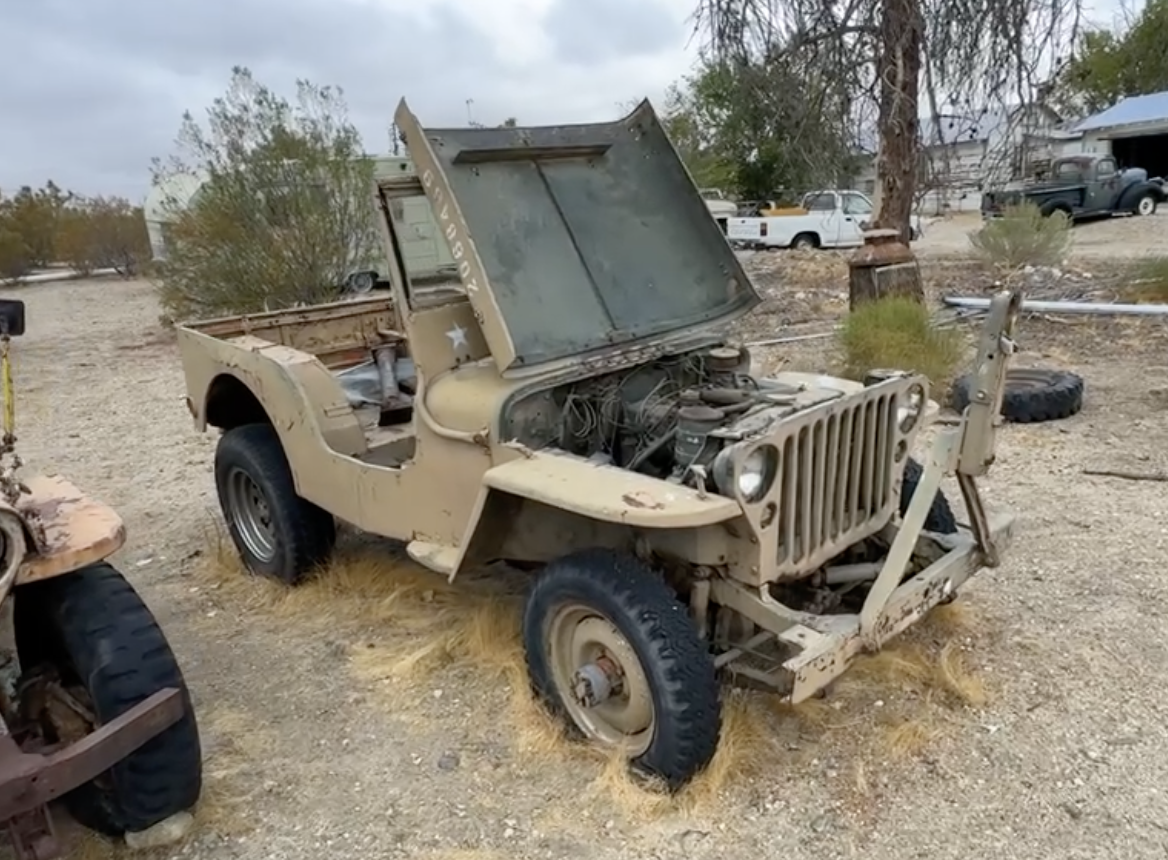
Reference Vehicle: $1500 (purchased from a local)
Crankshaft: 987.75

Axles/Transmission/Transfer Case: $658.50

Generator: $658.50

Full Wiring Harness: $649.95
 Connecting Rods: $592.65
 Cylinder Head: $538.31

Specialty Vehicle Registration Costs: $510

Roof Cross Bow Set: $469.11

Fuel Tank: $433.51

Tires: $498.45

Leaf Springs: $476.55

Driveshafts: $442.28

Assorted Hardware Kit: $395.11

Voltage Regulator: $347.08

Starter Motor: $329.25

Rear Seat Frame: $329.24

Distributor: $309.22

The total of all parts that cost over $300 comes to about $30,100. These higher-priced, large items represent the bulk of my expenses.
Parts That Cost Between $100 And $300
Parts between $100 and $300 represented the smallest category of the three arbitrary categories I created for this article. Here are some examples:
Clutch Kit: $243.21

Windshield Glass: $119.90

Muffler: $122.92

Brake Lines: $178.88

Oil Bath Air Cleaner: $214.01

Steering Shaft: $208.54

Steering Gearbox: $113.40:

Lots Of GL4 Gear Oil: $109

In total, parts between $100 and $300 made up only $7,300 of my vehicle’s total cost.
Sub $100 Parts
It’s the sub-$100 parts that make up the biggest volume of purchases, and as such, adding them up also comes out to about $10,100. Here are a few examples of some important sub-$100 parts. I’m not going to list their individual prices because there are just too many parts in this category (Note: The $10,100 figure includes fluids and small pieces of hardware/tools I had to pick up from local stores):


If you add up the cost of the more expensive parts ($30,100) with that of the $100 to $300 parts ($7,300), and add that to the cost of the cheaper parts ($10,100), you end up with a total of about $47,500. If you add in about $1,000 worth of miscellaneous tools and fasteners I had to buy (a conservative estimate), I end up at $48,500. Luckily, I managed to sell the reference Jeep and the spare engine for a total of $6,000, bringing the total for me to build and register this WWII Jeep to approximately:
$42,500
This is about the same price as a restored Slat Grille MB like this one, but it’s more than buying an average, fully restored WWII Jeep, largely because I bought loads of parts individually, shipped many of them individually, and — the biggest cost — I insisted on one major luxury: that brand new engine.
I could have easily just bought a used, running engine or had a motor rebuilt for much less than buying a fresh engine block, a fresh cylinder head, fresh manifolds, a fresh crankshaft, a fresh camshaft, etc.
If you factor in all the ancillaries, that new engine probably ended up costing me $7 grand, but if I’m honest: It was worth it. To me, the spirit of the build called for a brand new WWII Jeep, and a brand new frame and body weren’t enough for me to feel comfortable calling the whole Jeep brand new. Also, I just think a brand new 80 year-old engine design is cool.

So there you have it. If you want to assemble new WWII Jeep from scratch, and you want a fresh, new motor, a rebuilt transmission and transfer case, a new frame, a new body, new wheels, and pretty much new everything except axles and gearbox housings, it’ll cost you a little over $40 grand if you decided to buy most of the parts piecemeal (and if you make a few grand buying and selling a reference Jeep). That’s probably not the most efficient way of doing things, and you’ll probably spend more than that on labor associated with organizing the parts and actually building the Jeep, but hey, it’s character-building and the end-result is something in which you’ll feel enormous pride.




I’ve been accused of gatekeeping the word ‘enthusiast’, because I feel like people who go to the dealership and just get a credit check and sign some paperwork and walk out with a 392 Challenger or Supra or something, well…. they don’t know S about F. But like.. I don’t mean it in a negative way, it’s more aspirational to learn more and grow your skills.
I still feel that way. IMHO there are tiers of what being a car enthusiast means; they range from “I do my own basic maintenance” (low level) to “I pulled my engine and rebuilt it and put it back in and now the car drives again” (higher level), but the top tier, ultimate S-class variant of being a car enthusiast?
CREATING A CAR FROM SCRATCH. Kit cars, something like this, or building a street rod from garbage, creating a vehicle from previously NOTHING is just absolutely wild.
Congrats DT! You have reached automotive nirvana/full enlightenment with this build.
I hope to get there some day 🙂
Asking for a friend, what level would you call “I pulled my engine and rebuilt it and put it back in and now the car
drives againstill doesn’t run”?I know I’m late to the party, but I have an older, fatter friend with the same question.
“$42,500”
And if you tallied up the labour you put into it, it explains why people will just buy an existing similar example for less instead of building a ‘new’ one from scratch.
And I have to say that for that amount of money, there are numerous other vehicles I’d rather have… even if we are only talking about offroaders.
It’s a neat project for sure. But it’s definitely the kind of project I like reading about. Not a project that I’d want to do myself.
David buried the lead here. Could have been “How Did Jeep Let An Engineer Leave, WITH EXCEPTIONAL COST ACCOUNTING SKILLS”
Stellantis Things
Good work, if you count your time (and your friends’ time) as slave labor and unpaid, then you successfully built a 2026 new car for a good bit less than the average new car price, despite the lack of mass manufacturing and economies of scale. That’s impressive.
“built a 2026 new car for a good bit less than the average new car price,”
But when you adjust things for the lack of features it has compared to the average new car (which has an average cost of US$49,220), is it truly a good bit less?
I’d argue that given the lack of features like a proper convertible top, stereo and not even factoring in safety and anti-pollution features, I’d say it’s a good bit more in practice.
It’s not like you could use that old style Jeep as a daily driver as-is.
My experience is that building something from individual pieces is going to be 10x or more in cost than what can be done with high volume manufacturing, so I’d say the comparison would be with something that is ~$4k from a factory. In which case it is quite good, downright amazing. I was expecting closer to double the cost. As a direct cost comparison it’s of course not going to compete with anything from a factory.
3 fiddy for a voltage regulator?
naw, hell naw.
Also: There is one economic factor left out: How much was your time and labor worth?
Gotta add at least $10k for that.
The guy who flew in from Australia without payment for his flight was worth a lot.
I was a little surprised at the price but I had forgotten about the new engine and the desire for mostly period correct parts. In that case, it doesn’t seem unreasonable for what is essentially a brand new one-off jeep.
It was a cool project to watch. I’ve always thought something like this could be done in theory and seen much ink spilled about how it could be done, but it was awesome to see someone actually do it and thoroughly document it. Bravo!
I hope it gets used for more fun stuff in the future. Maybe with a fancy Autopian wrap or decal set.
This is a lot cheaper than I was expecting, I’d say this was well worth it for a myriad of reasons.
I have a 1991 Mazda RX-7 Turbo II that I bought on New Year’s Eve 2004. I daily drove it for five years and then took it off the road to restore it as it was in rough shape by then. I kept every receipt I could for almost everything I bought for the car. They are all in a file folder in a garage cabinet. I have NEVER totaled the costs on all of these receipts and I am not sure I ever will.
Some things, we just don’t need to know.
Am I the only one that went “ooooh, nice” at ‘Roof cross bow set’ before zooming in on the picture and then going “oh, that makes more sense”
That would give it a very mad-max feel – like that bed mounted 4-barrel blow-dart gun from Road Warrier
Plus:
* transportation for Laurence and other friends
* hundreds and hundreds of expert wrench hours. Say 5 hours a day for 3 months at $150/hour, that’s $67,500
So in reality you built a Jeep priced like a new Mercedes SL.
Came to post this, was not disappointed.
Didn’t he also drive a significant distance to pick up some of those parts as well?
OH MAN I AM BACK AFTER OVER A YEAR AWAY! Sorry life, kid, new house, all that. You understand of all people amirite?
Now I have to catch up on this whole saga. And I missed a track day? Dammit!
Just the sheer magnitude of the number of parts you had to source is astounding. It’s amazing that you were able to find almost all of them on eBay, but the real jaw-droppinng thing is that you actually put them together and made a working Jeep.
Some of those parts were not so much found on eBay, but were specifically listed for David to buy via eBay instead of through the shop’s normal storefront.
Yeah, I think that’s a bit of a cheat, but I’ll allow it. This time.
“ Voltage Regulator: $347.08”
Wow.
Yeah, this was the price I found most surprising, along with the distributor. I guess they are starting to get scarce so prices are going up on what’s left.
this and the generator, $650!
“Regulators! Mount up…”
Thanks for tallying all of this up.
Question – how did you register it? I’ve found the CA DMV’s “statement of facts” and a bit of patience to be a successful combo when registering old Willys.
From the article Specialty Vehicle Registration Costs: $510
The CA DMV Details on the process: https://www.dmv.ca.gov/portal/vehicle-registration/new-registration/register-a-specially-constructed-or-modified-vehicle/
Thanks!
Cars are expensive
And it hasn’t even started breaking down yet!
It has if you count the $650 generator not even making it to the second day of the drive to Moab.
wowsers, that is way more than i thought
Some of those parts seem spendy. I bought that identical $347 regulator from O’Reilly for about $80 (O’Reilly is an outlier here.) I suspect if DT had the time to look for deals a chunk could have been shaved off the price. An amazing accomplishment, nonetheless.
Really? That’s a factory-correct regulator (and it’s huge); I haven’t seen those anywhere for under ~$300.
Modern reproduction, but same as the one that was on my Crosley, and my ‘48 Plymouth, etc. Pretty standard part. Most other parts stores it’s around $150.
I always take a look at the auto parts stores and RockAuto. Sometimes they surprise me. But that’s outside the scope of your eBay build, of course.
Great job on the Jeep!
https://www.oreillyauto.com/detail/c/standard-ignition/standard-ignition-6-volt-35-amp-voltage-regulator/std0/vr1?q=6v+regulator
Yeah, if this were a budget build and I didn’t care about originality (on a replica-ha!) I’d have just nabbed that.
Makes $25,000 for a new Mahindra Roxer seem reasonable.
How about $15,000 for a little mouse?
What is a mouse?
Topolino.
The Topolino is a screaming deal at $15K
David you devil, or kill devil, I see what you did here and it’s genius. Since you used it for content you got paid to build it on company time. With the eBay motors deal you got the parts for free. Dang you got a brand new Jeep for free. Now that’s a story.
BTW I didn’t see a cost for tipping your mail man and UPS Driver.
Your membership dues are David’s tip.
HINT HINT
Ouch on some of those prices, particularly the generator and voltage regulator, especially since apparently they aren’t working together nicely and actually charging the battery. Overall I’d say the price isn’t too bad, though I don’t think you can really count the profit made on selling the reference Jeep and spare engine against the cost of the vehicle.
But know we know what a new old Jeep costs, with “some” assembly required.
Original MB generators are just hard to find. CJs? All day. But not MBs…
I understand they aren’t common, but at those prices I’d expect working components.
Would it be a Jeep if everything worked?
I agree, factoring in the profit made from selling off the reference jeep and engine should not be used to deduct from the total cost. I knew there’d be some fuzzy math on this total cost calculation. It looks more like $45,902.5 after ignoring the reference jeep and engine.
Do those listed prices include taxes? And will you be painting it at some point or is it ‘finished’?
I track every expense on my projects ….. which is one reason I don’t do that many projects anymore.
Best thing I ever did on my first project was buy 2 cheap cars with different problems.
The worst thing I did was buy an old Porsche as my primary car straight out of school because it was the same price as a lightly used Civic. Then I got in an accident and took the payment from the other driver’s insurance company as down payment on modifications I wanted to do. I then stripped down the car and found more and more problems and also found out that Porsche parts are 3X what you might expect them to cost……
That’s why I stopped tracking expenses
I’ve only tracked cost on two projects, our bathroom reno and my road bike.
Everything else is blissful ignorance.
I understand David’s desire for a new engine, but fact is it cost him a month.
And most likely all the timeframe anxiety.
That’s a bit more than I was expecting, actually. I’ve got a whole binder full of receipts for my Super Beetle, dating back 22 years. I’ve never added them all up and I don’t intend to. I know I’ve put far more money into that car than it will ever be worth.
Yeah, my project Saab could probably be sold for *maybe* $4k on a good day, and I’m pretty sure I’ve spent twice that much on it over the past few years. For my own mental health I think it’s smarter to not track expenses lol
Same on my 03 Civic, I’ve sure spent a lot of money to keep a $3K vehicle roadworthy and reliable.
Well when the battery isn’t dead, which it is, again…..
Just think of it this way:
It would be very different costs between a Super Beetle and a Super…Bee, ha ha
This is my classic car conundrum… I’d enjoy working on it more than just driving/showing it.
Did you beat inflation?
During World War II, a standard military Jeep (such as the Willys MB or Ford GPW) cost the U.S. government roughly $738 to $780 per unit. (per Google)
$780 in 1945 dollars is $14,522 today so he most definitely did not beat inflation.
That’s wartime government bulk prices I imagine, a CJ2A retail price might provide a more realistic base price for comparison purposes what ever that might have been. A crazy point in history to try to work from. I remember ads in the back of magazines in the late 1960’s offering surplus Jeeps “from $200”.
The whole thing was an interesting project that falls into the “what do you think it should cost? Now double it and add labor.” model that automotive projects tend to follow.