


There was a time when you could reasonably expect that any car or truck you bought had a physical pedal or handle that, when actuated, activated a parking brake on your vehicle’s rear wheels via arm muscle. This brake could park your car or help you instigate some sideways shenanigans. But physical parking brakes were complex, prone to seizing in some environments, and heavier than they could be. The electric parking brake has proven itself to be simple, reliable, and light, but takes all of the fun out of using the handbrake. That’s where Ford and RTR Vehicles come in. For the past couple of years, the Ford Mustang has been available with an electric parking brake that pretends to be a manual brake, and it’s sort of the best of both worlds.
Ford’s Electronic Drift Brake is not a new feature. It was first announced back in 2022 during Ford’s marketing blitz for the launch of the 2024 Mustang. Ford’s revered pony car lost its physical handbrake in the launch of its seventh generation, and normally, this would be bad news. Enthusiasts love pulling stunts in their Mustangs, and thanks in part to the popularity of folks like Vaughn Gittin Jr. and the late Ken Block, that’s not going away anytime soon. Handbrakes are a fun way to initiate drifts, donuts, and all sorts of slides.


Ford, with the help of Vaughn Gittin Jr., found a way to have both an electronic parking brake while also still letting enthusiasts have fun. Originally offered as part of the Performance Pack, and able to be coupled to any engine, the Electronic Drift Brake uses a real, weirdly heavy handbrake connected to a series of electronics and servomotors to do what we used to be done with cables and hydraulics. I got to test it out for myself and, if electronic parking brakes are going to be here to stay, I think Ford figured out the fun way to do it.

(Full Disclosure: Ford invited me out to Napa Valley, California, to experience the 2026 Ford Mustang RTR and the 2026 Ford Mustang Dark Horse SC. Ford paid for my travel, lodging in an amazing winery, and made sure I was very well-fed.)
The Parking Brake Breakdown
Last month, Editor-In-Chief David Tracy penned one of his classic hot, but sincere takes. This one was “Why Electric Park Brakes Are Superior To Old Hand Brakes And Foot-Pedal Brakes,” and at the time, I didn’t agree with him. Even though I live in the Midwest, which kills physical parking brakes, I’d still rather have a handle pulling physical components than just a button. Many readers didn’t agree either, likening David’s take to his “If Your Car Has A Timing Belt, It’s Not Really ‘Reliable’” post.
As David notes, until the proliferation of electric parking brakes in about 2012, most cars had a purely mechanical parking brake. You’d stomp on a pedal or yank a handle, and that motion would be transmitted to a physical cable that may connect to another lever to amplify your force and to a splitter to send the cable to both rear wheels. At the wheels, the parking brake could be shoes in a drum brake, a drum brake within a disc brake, or a caliper and pad.

Some parking brakes in large commercial vehicles and RVs lock the driveline rather than the brakes in individual wheels.
What made the physical parking brake so great was that it was an extra layer of redundancy in your braking system. If you had a total hydraulic brake failure, you still had a mechanical backup. Of course, since these brakes also only locked up the rears, it was also an easy path to getting the rear end to slide out for some fun. If you grew up driving low-powered front-drive cars as I did, the handbrake was the only way to get sideways. The handbrake was the only way you were going to get plastic lunch trays under your rear wheels to have fun with your friends in an empty parking lot.

Unfortunately, David’s story is correct in that physical brakes need regular adjustments and maintenance to remain in working condition. Worse, as anyone in the Midwest with an old car has experienced, parking brakes like to seize at the most inopportune time, stranding you someplace with your rear wheels locked up.
In the most basic electric parking brake, the physical handle is replaced with a button, which saves a ton of space in the vehicle’s cabin. When you pull or push the button, an electric motor pulls the cables, which locks up the brake.
In a more advanced electric parking brake, there are motors in the rear calipers themselves, eliminating the cable entirely. David used this handy image to illustrate the three systems:
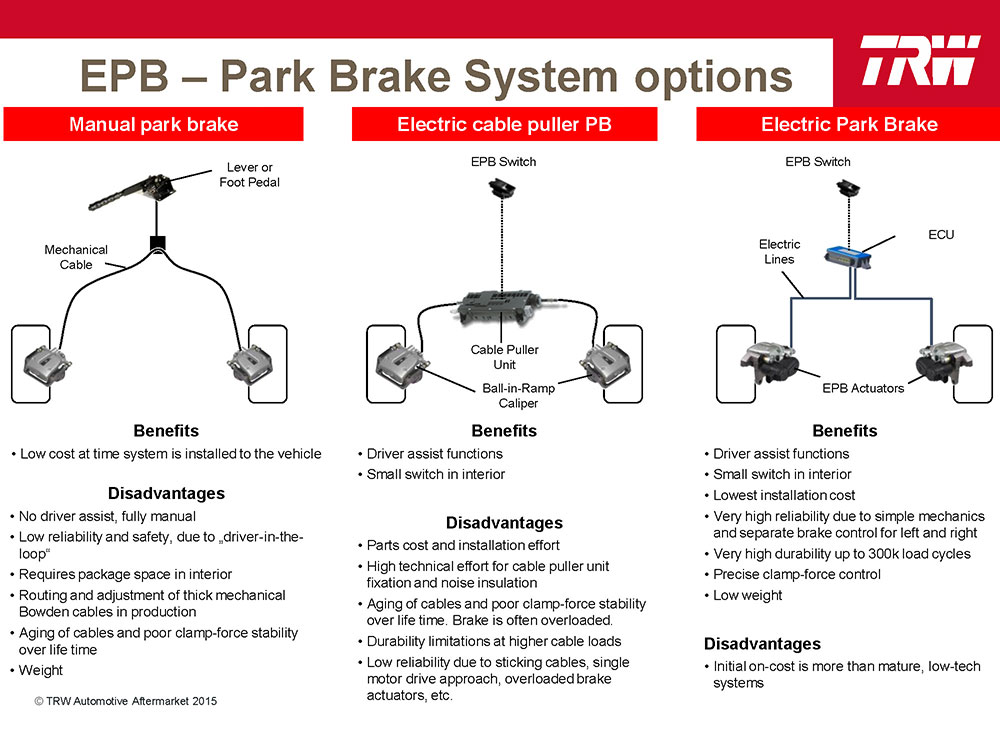
Yes, it’s exactly as complex as it looks, and it really does put an adorable gearbox into a brake caliper. Resident suspension engineer Huibert Mees added more detail:
There are a few other things that come into play with electric parking brakes. Government regulation requires parking brakes to be able to hold the vehicle on a steep hill while requiring no more than 500N of force to pull the parking brake handle. As vehicles got heavier and heavier, this requirement became very difficult to meet. Drum-in-hat parking brakes were one way of helping because the braking material could be made from a very high friction material that would eat the rotors if they were used as regular brakes as well. But since parking brakes are meant to be used only while stationary, the aggressive materials never caused wear on the drums since they were never spinning. Electric parking brakes solve this problem because the clamp force they produce is independent of the effort it takes for the driver to activate them. All he/she does is pull a switch. The 500N requirement basically drops out of the picture.
The extreme gear reduction that electric parking brakes use does mean that a low torque/high RPM motor is able to achieve the clamp force required to hold a heavy vehicle on a hill, but it also means that the system can’t be back driven. Once the motor turns off, there is really nothing that stops the force in the system from turning the gears in the opposite direction and un-clamping the pads. However, the extreme gear reduction means that even a small amount of friction means that the clamp force is not enough to cause all those gears to spin in the reverse direction.
Lastly, electric parking brakes mean that they can be activated independent of driver interaction. In the Model S, we used this to get rid of the parking pawl in the transmission. The parking brakes always activated when the car was put into park and this prevented any roll-away issues.
Click here to get more technical details from David’s story.
From a technology perspective, electric parking brakes make so much sense. They even serve a purpose as an emergency brake. Hold the parking brake button for long enough while moving, and the electronic system will eventually activate, then bring the car to a stop. Electric parking brakes are also designed to ignore accidental button presses while traveling at speed.
But all of this is sort of lame for the enthusiast. Electric parking brakes are either on or off. Normally, there’s no way to modulate braking action. Even then, it’s not like a button is even a great way to have fun with a parking brake, anyway.
Ford’s Fun Lever
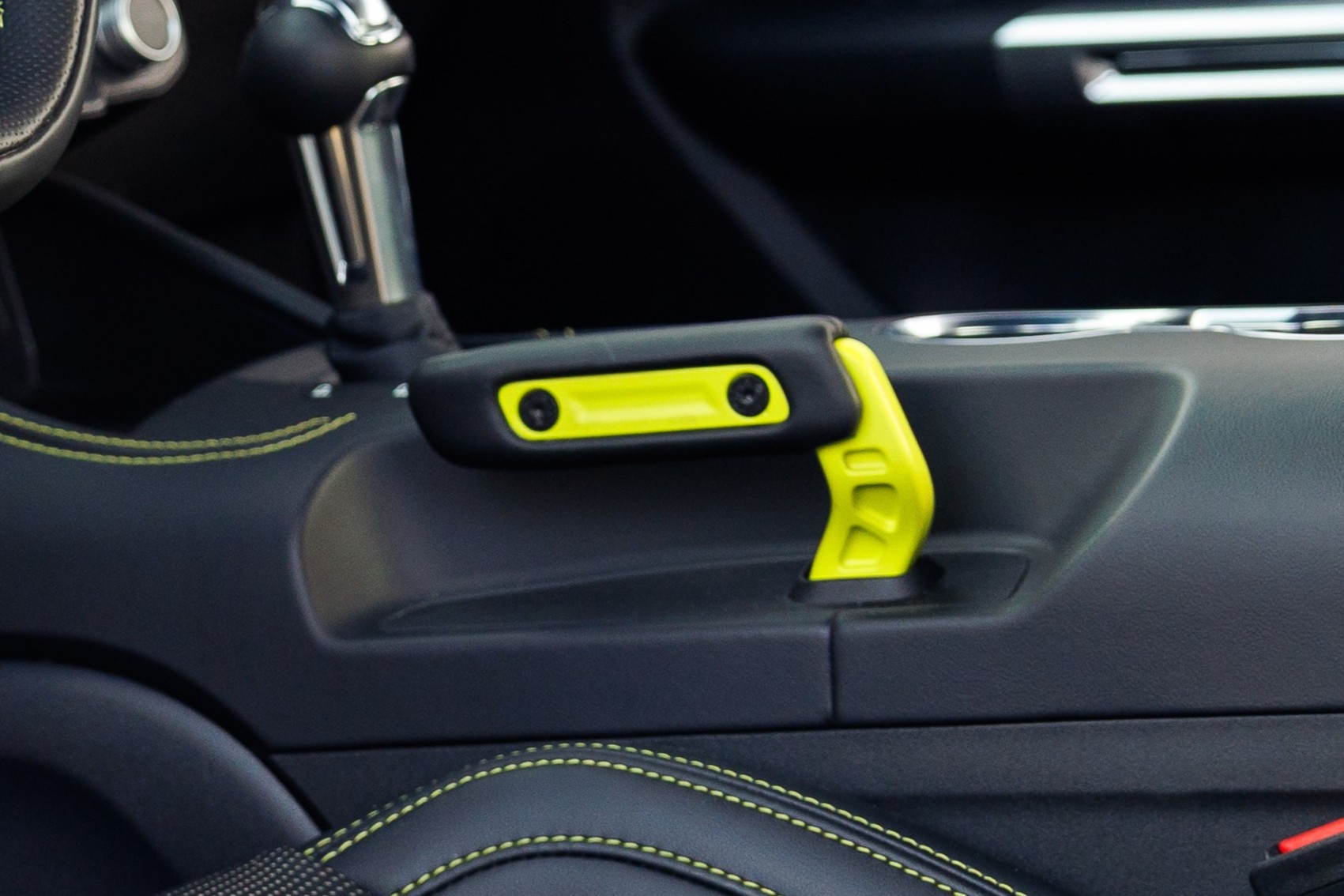
That’s where Mustang tuner RTR Vehicles and Ford come in. When launching the seventh-generation Mustang, Ford wanted to do the best of both worlds. The result was what Ford and drifter Vaughn Gittin Jr. call the Electronic Drift Brake.
In normal vehicle settings, the Electronic Drift Brake works just like any other electric parking brake, but with a handle instead of a button. Give the handle a little flick – only about the travel that a button would have is necessary – and the parking brake is set. Push it down, like a button, and the parking brake turns off. It’s super easy, barely an inconvenience.

But the magic comes when you flip through a menu on the infotainment to turn on the Drift Brake. This turns Track Mode on, and now the handle is no longer a parking brake. Instead, it functions like an old-school cable brake or a hydraulic drift brake, in that brake pressure is proportional to lever travel. Pull the handle just a little bit, and you get just a smidge of brake force; pull harder, and more braking power is applied – just like you were pulling the cables yourself.
As Vaughn explained to journalists at the 2026 Ford Mustang RTR event, the Electronic Drift Brake, which was designed by Ford engineers with help from Vaughn and Chelsea DeNofa, is electronic-over-hydraulic.
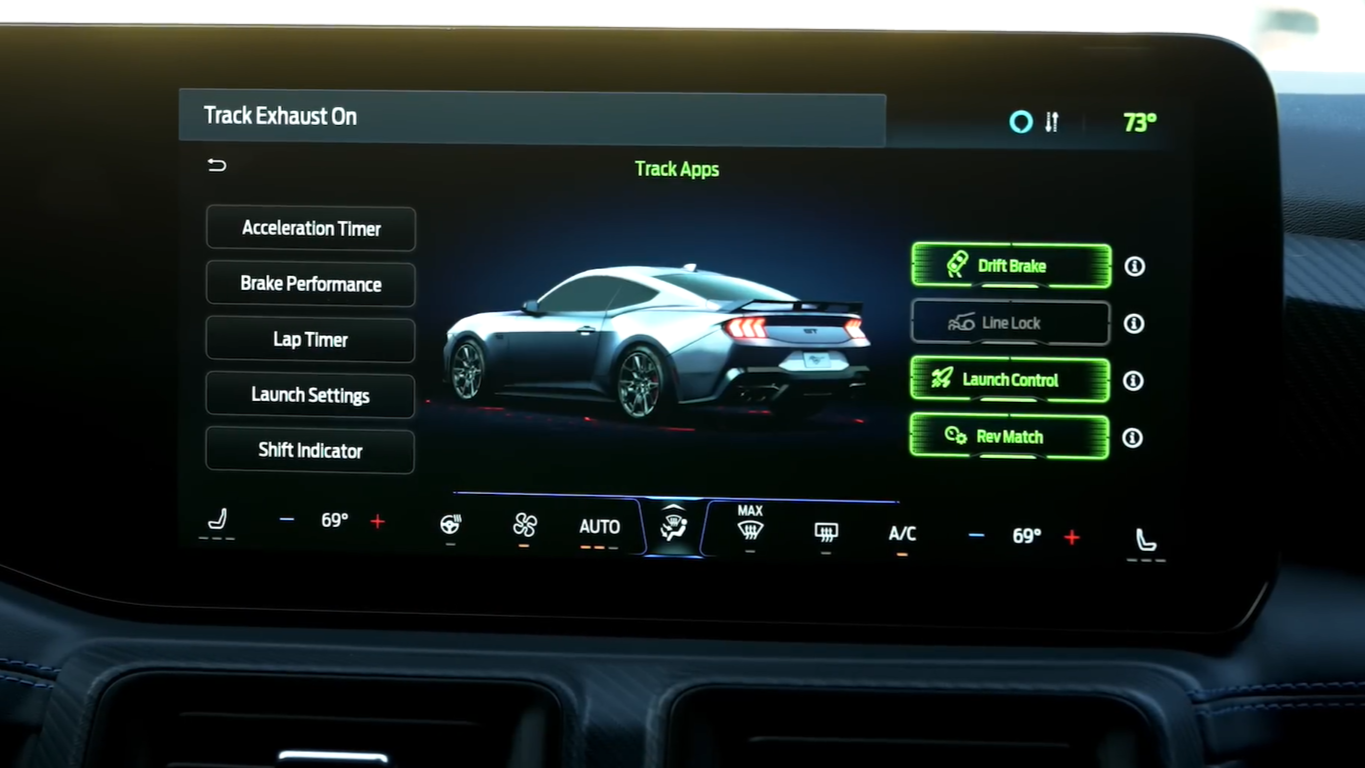
When you yank the handle, a signal is sent to the Brake Control Module, telling the module how fast and how far you pulled the handle. The Anti-Lock Braking System module then has its actuators clamp down the rear brakes, with the pads giving the appropriate amount of pressure. It’s the same bits that allow the ABS or stability system to intervene in an emergency; only now, they’re being used for fun, rather than safety.
Pull it slowly and lightly, and the system brakes slowly and lightly. Just yank it hard to a stop, and the system acts with allegedly four to five times more braking force than a conventional manual parking brake to lock up the rear wheels. The brake lights also come on when you’re using the drift brake, you know, for safety.
Explaining how it works is one thing, but how is it to use in real life? In a word, impressive.
Feels Almost Old-School

I found that the handle, which, again, isn’t connected to the rear wheels whatsoever, to be weighty, just like an old-school one. I’d say it took a little less force to get this handle to its max height than how much muscle it takes to get a traditional brake handle to its maximum deflection. I appreciated the weight because even though it was purely digital, it did feel like it was me, not a computer, that was actually doing something to the rear wheels.
But the handle wasn’t a perfect emulation of an old brake handle. Usually, when I pull a brake handle, I do feel mechanical action as the lever moves. In some cars, I find resistance increases the farther the lever moves. That isn’t the case here. You don’t feel a cable, and the movement of the handle and lever are butter smooth. It’s close, but you never forget that you’re more or less yanking the car equivalent of one of those dimmer dials that control the brightness of the lights in a room.
Still, it’s a minor quibble because in the world of electric parking brakes, the alternative is a switch that’s purely on or off.

Sure enough, the Mustang’s drift brake works as advertised. On my first attempted drift of the day, I didn’t pull the handle hard enough, and the brakes didn’t lock. Instead, I entered the drift box, didn’t break the rear end loose, and just looked like someone who stomped on the brakes. Oops.
On my second try, I just let the handle rip. That time, it nearly instantly locked the rears. I held the handle that way for about a second, then let it go. It slammed back to the console, letting the rear wheels free. Then I stomped on the gas and gave it a load of countersteer, completing a beautiful drift. Vaughn says that the system reacts faster than a cable or hydraulic system. That’s a huge claim, and it means that a computer and servos have to somehow be faster than a cable connected to a handle.

If there is input lag between the handle and the rear wheels, it’s so minimal that I didn’t notice. I suspect the huge clamping force of the brakes helps a lot, too.
What I can say is that it’s insanely fun to yank the handle. It’s a shame it was a blazing hot day in California when I tested this. I would have loved to see how the brake works in the rain or snow, not just on hot, dry tarmac. I will say that I still prefer a handle connected to a cable, but I also recognize that the world’s moving to electric parking brakes no matter how much I cling to old technology.
More Electric Parking Brakes Should Be Fun
There are a lot of cars out there with built-in drift modes. A Volkswagen Golf R, for example, can get sideways using its nifty torque-vectoring rear differential to get the rear end out and keep it out there. The Ford Focus RS drift mode used similar AWD and computer trickery to get the job done. In the Mercedes-AMG E63 S, the car has a mode that decouples the front wheels, sends all its power to the rear wheels, and tells the electronic nannies to buzz off for a more authentic drifting experience.

Yet, only the Ford Mustang and a dwindling number of other cars allow you to get sideways by pulling a handle. So far as I can tell, only the Mustang digitized the experience for our modern-day world of tech inside of everything. Add in the Mustang’s Line Lock and Launch Control features, and the Mustang is pretty much just built to get silly in.
I had so much fun with the 2026 Ford Mustang RTR that I have an even bigger idea. In this world of electric parking brakes, I’d love to see more manufacturers tossing in a lever and a mode that allows drivers to lock the rear wheels for the funsies. Obviously, family cars and whatnot should just keep the regular button.
But for sporty cars? If you’re going to delete the physical parking brake, at least do what Ford did and try to do the best of both. You’ll still get a lot of the benefits of an electric parking brake system, but enthusiasts still get to have their fun. I see that as a win-win. So, good on Ford for finding a clever way to keep people smiling.
Top graphic images: author


This is pretty cool. I hated the electronic parking brake on my integra at first till I came to understand how that enables the brake vectoring in the back. Then I thought it was pretty cool, I like the brake hold it allows too which I find useful. This option from ford would be the best of both worlds.
I’ve got an even better idea: A physical handbrake, that acts… Erhh well, just a physical handbrake actually 😉
Keep it simple.
Huh, I hadn’t realized it acted like a button when you use it in normal drive modes. I would end up pulling up on it hard like I currently do with the real thing.
My wife’s car has an electronic parking brake, and it sets automatically whenever you put the car in park. I actually kind of like that, since I was never in the habit of setting the parking brake in automatics and this just does it for me, eliminating rocking and saving the parking pawl.
So – it now uses electronics and servos and software to accomplish what used to be done by a couple of cables and a lever.
This is progress?
No wonder everything is more expensive and prone to malfunctions than it needs to be.