

There aren’t a lot of cases in economic history of anyone ultimately winning a trade war they started. It’s typically the countries that don’t engage that, over time, end up doing better than the belligerents. With the United States and Canada having failed to make a deal, who is really going to win here?
My guess is that the biggest winners in a Canadian-US trade war are probably Mexico, Europe, and China. How did we get here when, according to last week’s Morning Dump, the two countries were so close? A little disagreement over a very large truck.


Chinese automakers have their own issues with large vehicles, which is to say that even their mid-sized vehicles are super heavy due to battery weight. The country’s cars are going to have to go on a diet. Volkswagen is also undergoing a big transformation, though it looks like it’ll be shedding more jobs than pounds.
Americans continue to be delinquent on auto loans at a super high rate, yet lending is easing up. What’s going on there?
Canadian Parts Association Alleges The US Is Trying To ‘Get Rid Of Auto Manufacturing In Canada’

As of Thursday, it seemed as though the United States and Canada had a trade deal all but complete. That’s what the American side said, at least; the Canadians were a bit more circumspect.
Let me just check Truth Social to see what kind of normal things the President is saying about the deal:
Canada has been ripping off the United States of America for years. Their ridiculously high tariffs on our Farmers and farm products has made life impossible for these great American Patriots, and has long created a 60 Billion Dollar Deficit between our two Countries. Not sustainable, and NOT ANYMORE! On January First, 2027, Tariffs on all Cars, Trucks, both large and small, Automotive Parts, and Steel, will be increased to 50%. Build in the U.S. and there are ZERO TARIFFS. Canada will be treated like a State no longer! On Trade, and in other ways, also, they are among the worst Nations in the World to deal with. They feel entitled, and yet, WE DON’T NEED CANADA, THEY NEED US! They do 95% of their business with the U.S., with us, the exact opposite! Thank you for your attention to this matter! President DONALD J. TRUMP
That’s not great. I don’t want to get too deep into responding to everything the President says, because this President says a lot of things and often they are not true. I would like to address the 95%/5% thing, because, as the economists at TD Bank point out, the US is a major consumer of Canadian petroleum products, but also a large exporter of goods to Canada, which clouds the concept of a trade deficit:
Last year, Canadian exports of energy products (oil, natural gas, power) to the U.S amounted to nearly $170 billion, or almost 1/3 of total shipments. In contrast, energy accounted for only 6% of all U.S. imports. Put simply, Canadian sources are critical to U.S. energy security. Remove Canadian energy exports from the equation and the trade story flips. Ex-energy, the U.S. enjoys a trade surplus with Canada of around C$60 (US$45 billion).
When looked at through the lens of automotive production, Canadians are relatively small producers of cars, yet large consumers for US-built automobiles (which, due to aligned safety standards, can’t be sold a lot of other places). Before the trade war started, Canada produced 14 models and consumed 325. Looking at final assembly, Canadian production accounts for less than 10% of cars sold in the United States, whereas Mexico is historically double that number.
The US economy is many times larger than the Canadian economy, so it’s true that the US market is more pivotal to the Canadian one than vice versa, but there’s still a ton of trade that US businesses rely on that’ll be impacted by tariffs. According to the Office of the United States Trade Representative, the trade of goods between the two countries was fairly close last year:
U.S. goods trade (exports plus imports) with Canada totaled an estimated $715.5 billion in 2025. U.S. goods exports to Canada in 2025 were $333.6 billion, down 4.8 percent ($17.0 billion) from 2024. U.S. goods imports from Canada totaled $381.9 billion in 2025, down 7.2 percent ($29.8 billion) from 2024.
During the first Trump presidency, the three largest countries that make up North America further linked their automotive production, which makes the automotive industries highly reliant on one another.
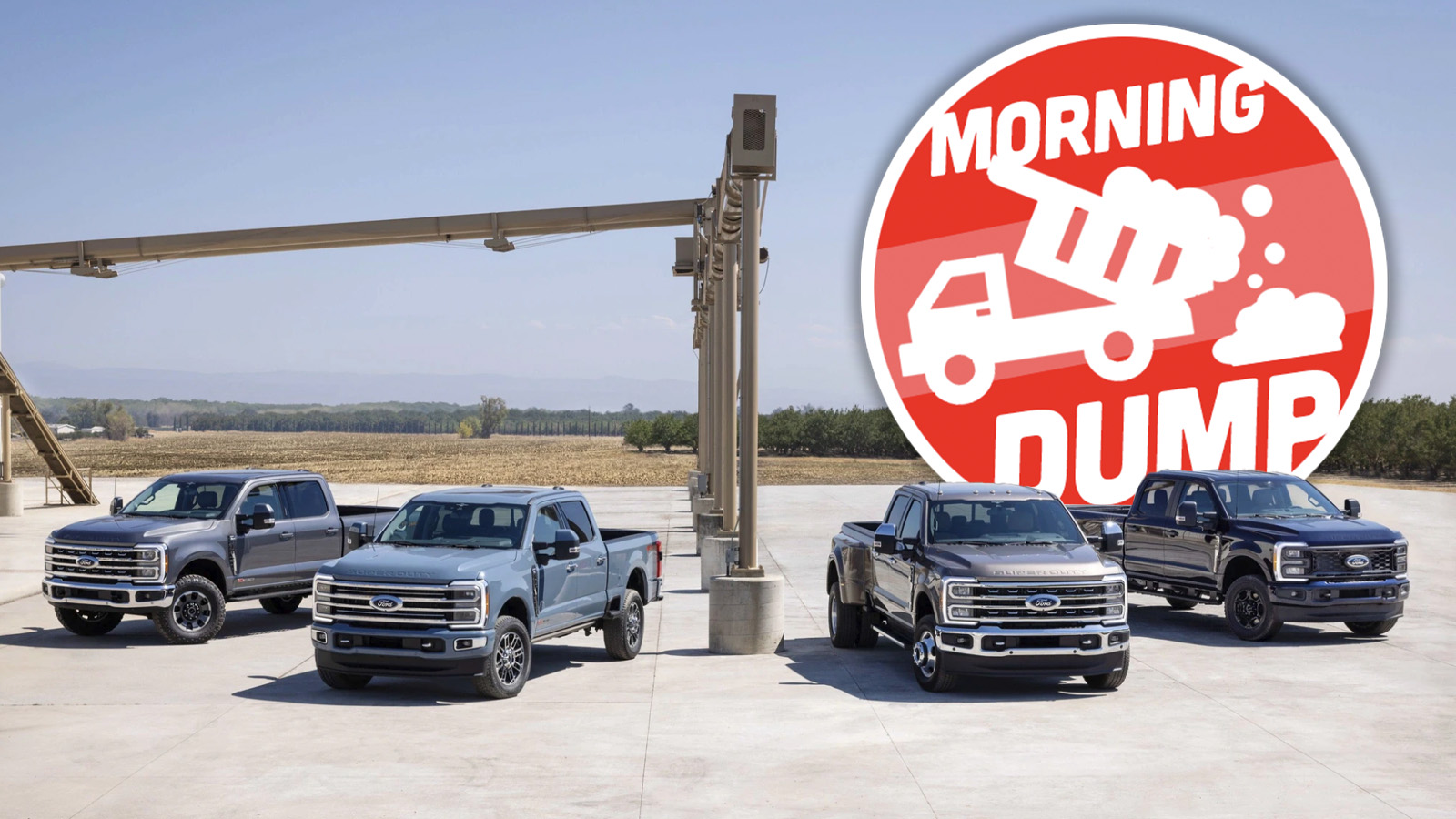
So what happened? According to this Bloomberg report, representatives for the US and Canada disagreed at the last minute over whether or not the lowering of tariffs from 25% to 15% would extend to medium- and heavy-duty vehicles. Specifically, Canadian representatives wanted to make sure the F-350, which is built at the Oakville, Ontario plant, wouldn’t be subject to tariffs.
The Americans said this was a last-minute request from the Canadians, the Canadians say the exclusion of medium- and heavy-duty trucks was something the Americans decided to change without notice. I wasn’t there, so I’m not sure what happened, but someone quoted by Bloomberg thinks they know:
“At the last minute, the Americans pulled that classification out of the class of product that would get a reduced tariff,” Flavio Volpe, president of the Automotive Parts Manufacturers’ Association, told the Canadian Broadcasting Corp. Saturday, referring to super-duty pickup trucks such as the Ford F-350s.
Volpe suggested the impetus may have been to “get rid of auto manufacturing in Canada.”
That sounds like a wild theory until you remember President Trump has frequently said he doesn’t see the need for Canadian cars.
So what happens next? It’s always hard to predict with this administration, but it sounds like the Canadian government is going to wait out the midterm elections to see if they have more leverage for a deal. In the interim, any hope of having Canada and Mexico team up to help combat China’s growing influence seems to have gone out the window. Canada already opened the door to warmer relations with China, which feels more logical at this point.
Chinese Cars Have To Get Lighter

While Chinese EVs have taken over the globe, the huge advantage automakers in that country have enjoyed are derived in large part from a robust supply chain and cheap labor, as opposed to a purely technological advantage. Specifically, Chinese EVs tend to run a little heavy.
S&P Global Mobility predicts the Chinese industry is going to follow other industries in trying to find ways to make its cars lighter:
The added vehicle mass has created challenges related to energy efficiency, material utilization and the long-term funding of road infrastructure maintenance. As a result, industry experts and policymakers in mainland China have increasingly discussed reforms to vehicle taxation and road-use charging mechanisms, including approaches linked to vehicle mass, to encourage more sustainable vehicle development.
Against this backdrop, mainland Chinese automakers are pursuing vehicle lightweighting strategies to improve efficiency. These efforts range from increasing the use of lightweight materials such as aluminum and magnesium to incorporating advanced high-strength steels in place of conventional steel when feasible. They are also redesigning vehicle architectures to eliminate unnecessary structures and integrate multiple functions into single components, giving rise to a multimaterial, highly integrated BIW strategy.
Taxing vehicles by weight would be a quick way to encourage automakers to Zepbound their production.
The Next Few Weeks Are ‘Crucial’

I gave space on Friday for the head of VW’s main union to say that Volkswagen’s management is reportedly in ‘cloud-cuckoo-land‘ due to its margin forecasts. I’ll give some room for CEO Oliver Blume to, via Bild, explain why the company has to change:
In an interview on the company intranet, Blume prepared employees for bad news: “The situation is more than critical.” While the company is capable of acting, it also has an urgent need for action, Blume said. He told BILD: “The next few weeks are crucial: everyone has to pull together. We have launched the biggest transformation plan in the history of the Volkswagen Group.” The Group’s 2030 vision is “a comprehensive, global program for products, technologies, competitiveness, structures, and growth. The next few years will determine who stays in the race and who takes the lead.”
And further: “The global automotive industry is in a mega-crisis. And the Volkswagen Group is right in the middle of it. Geopolitics, trade barriers, regulations, weak markets and fierce competition are challenging everyone.” Now it’s time to roll up our sleeves: “For the people, our company and the competitiveness of Germany as a business location.”
It’s going to be an epic fight between a management that sees huge challenges and a workforce tired of management screwing up and relying on cutbacks to balance the books.
Lenders Seem To Care Less About Auto Delinquencies
With loans extending out towards the horizon and everything getting more expensive, the increase in automotive delinquencies feels like the natural result. What’s less natural is how lenders are shrugging them off. The rate of serious delinquencies (more than 90 days) was at 5.5% in Q2, the second highest level since the Federal Reserve Bank of New York started tracking that figure (the highest was Q1 of this year).
Lending, though, seems to be expanding. What’s going on here?
Lenders’ willingness to extend credit during a time when more debt is late on payments seems paradoxical. But “there’s nothing in the data that says lenders are being reckless,” said Jonathan Gregory, senior director of economic and industry insights for Cox Automotive.
The abundance of auto credit in the face of high delinquencies could stem from the fact borrowers do eventually pay the bill, Gregory said.
Default rates haven’t tracked delinquencies as closely as they did before the COVID-19 pandemic, he said.
“More borrowers are behind on their payments, but then fewer are actually defaulting,” Gregory said. “That’s just a gap that we’re keeping our eye on.”
As I’ve said before, all this is fine until it’s not. If the economy stays strong enough, then we’ll all survive. If the global economy hits a snag, well, it’ll probably be terrible.
What I’m Listening To While Writing TMD
My daughter is learning to play the electric bass, and my dad suggested I play her “Tighten Up” by Archie Bell & The Drells. It does have a great, driving bass note. If I ever end up making my Houston movie, this is the opening song, for sure.
The Big Question
How much does your car weigh? Is it heavy? Is it light?
Top photo: Ford




2015 Fit EX weighs 2,630 pounds.
“Tighten Up” has been a favorite of mine since it was new.
Lightest: 2CV – 1100 lbs.
Heaviest: Laforza – 5100 lbs.
I stand with Canada. Our president is a terminally insecure senile authoritarian, who would happily destroy America and the world just to make himself feel like a big man. Sadly, the GOP has become a party of sycophants and cowards, so there is no restraint on his worst impulses.
Miata ND1 Club: 2,332lbs
10th Gen Accord Sport 2.0T: 3,377lbs
My understanding so far is that the Trump Administration is far too stupid/malicious to consider anything that’s not “we physically sell you a completed product” as counting towards whether the US has trade surplus/deficit. Hence why the EU paying billions of dollars to Microsoft and Amazon every year doesn’t count for mysterious reasoning. I suspect there was never any intention of the US actually walking away with a trade deal with Canada.
Jaguar XKR: ~3800 pounds
Lotus Elise: ~1900 pounds
TBQ, a selection:
KTM SX with a plate and a big bore kit: 250 lbs, 60hp
Lotus (Fauxtus): 1600 lbs, 368 hp
Tundra* Single Cab Long Bed 4×4: 4490 lbs, 240 hp
* It pulls the previous 2, and saves likely a ton of weight with the manual crank windows and vinyl floor.
It is interesting that the Lotus feels like a total racecar, but the KTM supermoto feels merely like a quick bike even though the hp/weight is similar.
Our Outlanders…
2022 Outlander 3759 lbs.
vs
2024 Outlander 3860 lbs
weight difference due to the fact that my wife drives the ’22 Outtie and it never has any gas in it and I have a sunroof in my ’24.
and our ’24 Mirage that our oldest kid drives…
2024 Mirage G4 2161 lbs.
I honestly did not think the Mirage was THAT light.
My 2014 mirage is 1950 lbs. maybe the automatic is heavier?
G4 sedan. Maybe an extra couple of side airbags?
“Taxing vehicles by weight would be a quick way to encourage automakers to Zepbound their production.”
This is the right way to deal with the grossly obese PHEV and BEV: heavier weight contributes to particle pollution from tyres and brake pads.
Many vehicle testers have shown that the heavier PHEV get worse fuel economy when running purely on ICE after the batteries are depleted, tugging the “dead weight” of batteries. BMW i8 owners complained the same about shocking tiny range when running on ICE alone.
Kia EV6 GT: ~4800lbs (batteries are heavy)
Jeep TJ: ~4200lbs (big axles, big tires, and steel armor all over are heavy)
> “The next few weeks are crucial: everyone has to pull together”
What does that mean, exactly, other than “we’re going to squeeze the line workers and probably lay a bunch of them off, lol” (except in German)?
Are the execs “pulling together” and cutting their pay, or laying themselves off for the greater good?
It’s a job. Fk “pulling together” whatever that means. Go in, do the work you’re paid to do, go home to your kids.
> The global automotive industry is in a mega-crisis. And the Volkswagen Group is right in the middle of it. Geopolitics, trade barriers, regulations, weak markets and fierce competition are challenging everyone.”
He conveniently forgot emissions cheating, terrible product decisions, shit quality, and undifferentiated bs lineups (Audi). But go ahead, blame trade policies, regulations, or the unions.
> My daughter is learning to play the electric bass,
BADASS
https://youtube.com/@ellenplaysbass
Chevy Bolt = 3,560 pounds
Express 4500 = 10,950 pounds
2920lbs with me in it, and about a half a tank of gas. 1994 Pickup. Just went over a scale last week dumping 300lbs of yard waste.
The bubble will be bursting soon. It’s not going to be good. We just need to make sure Torch isn’t touching random shit when it does happen.
TBQ:
1999 Mazda 626 ~ 3200 lb
2002 Jeep Grand Cherokee ~ 4000 lb
I thought there would be a greater difference.
I have a 2018 Outback. I feel it’s very heavy.
Matt, if she digs Tighten Up, I might recommend doing some digging into the Stax Records catalog.
At the light end is my 2020 AWD Prius at 3220 lbs while my 1992 F350 long bed dually crewcab is a hefty (and even) 6000 lbs.I don’t want to know how heavy it is with the overcab camper on board.
Wow, I’m amazed by how light the F350 is. I once had a 2001 Yukon XL 2500 with the 8.1L and that thing weighed 7860 with the back two rows removed and those seats are HEAVY.
NC Miata so according to the internet it’s insanely heavy, haha.
I wanted to get an NC but getting a CDL in order to legally drive it seemed like too much of a hassle.
My NC has the power hard-top, so I should probably be looking out for the road cracking under my wheels right?
I’m happy with people slagging off the NC, because it keeps them cheap 🙂
So we’re being setup for another huge subprime crisis… this time in the automotive sector instead of housing like in 2008.