

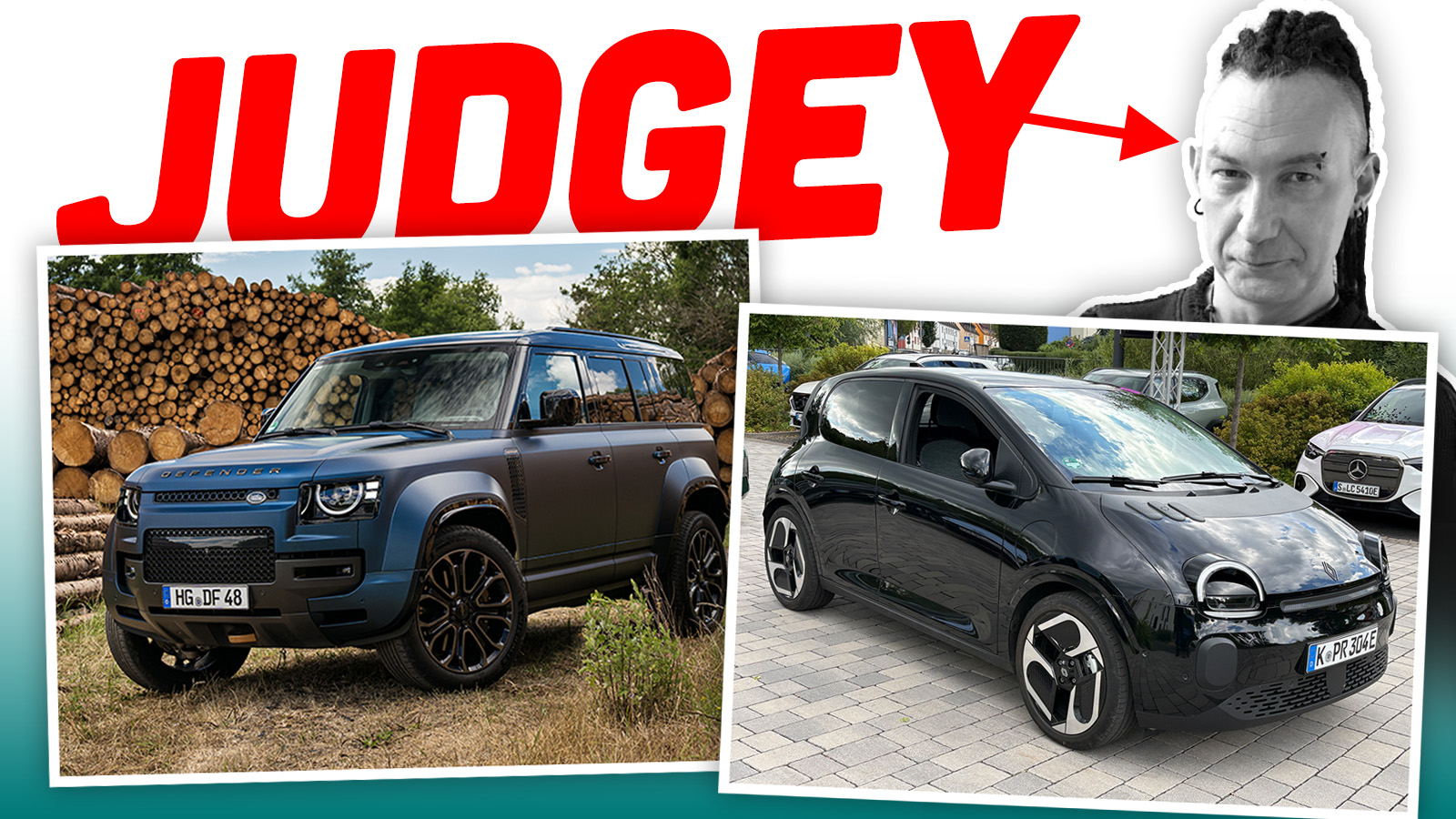
Welcome, my American friends, to the beautiful game. I had a feeling that the USNMT had somewhat flattered to deceive in the group stages of the World Cup and would get absolutely creamed by the first half-decent team they faced. If you only started taking an interest in soccer a few weeks ago, don’t worry. There’s plenty of disappointment in store for you in future tournaments. As an England supporter, I should know.
Except ever since crashing out to Iceland in the first knockout game of the 2016 Euros, England have become surprisingly unshit at international tournaments. We made the final at the 2020 and 2024 Euros and lost a semi-final to Croatia in the 2022 World Cup. Footballing expectations are running at fever pitch in England at the moment – and as a World Cup enjoyer I have been savoring every match. Switzerland vs Algeria at 4am? Sign me the fuck up. England vs DR Congo in the round of 32? Brilliant. Glancing at my impeccably organized calendar, I noted with wry amusement that the match was taking place whilst I was in Germany. Never let it be said the universe doesn’t have a sense of humor. I’m not the most diplomatic person at the best of times, but asking a bunch of German hoteliers where the nearest big screen was so I could watch the England game with their team having been knocked out three days prior did elicit some sympathy from me. Haha, only joking, of course it didn’t – because I have a crystal-clear memory of England losing to Germany in the semi-final of Italia 90. When Harry Kane equalized against DR Congo, I cheered loudly while getting the skunk eye from every German in earshot.


I didn’t travel to Germany with the sole purpose of winding the locals up
… that was a side benefit. I was actually there to drive some cars as part of the GT Test event which forms part of the German Car of the Year judging. The hotel on hosting duties had a duck race built into the pavement outside the entrance and one of those toilets with electronic controls. These were all labelled in German, and Apple translate was no help at all, but I managed to avoid pressing the button that released the tentacles. It was all a bit confusing, and before you ask, no, I was not drunk on complimentary beer. It was the result of a brutal 6 am flight departure that morning. One thing I was certain about was the cars I wanted to drive. The organizers had sent out a list prior to the event, and in a serendipitous piece of happenstance, these two cars represented polar opposite approaches to twenty-first century motoring.
Land Rover Defender Octa
I first clapped eyes on the L663 Defender in 2017. That car fully occupied two years of my working life until its release in 2019, and [redacted], [redacted] and [redacted] versions of it for six months after that. Because JLR is a hugely dysfunctional and incredibly stingy company, I never actually got the chance to sample the fruits of my labor. A company in the business of building cars doesn’t actually let regular employees drive them. During the time I was at Land Rover, a friend I graduated with was working in the VW Future Studio in Berlin. I asked him if VW was the same and his reply was “we’ve got a cupboard full of keys and can book out whatever we want.”
As gamekeeper turned poacher, I went from creating to criticizing, and my appeals to the JLR media office for access to the press fleet were met with the usual “we’ve only got a small fleet and have to limit availability” bullshit, which translates to “go away, person we’ve never heard of.” I’d have more respect for them if they just told me to fuck off, to be honest. So the Defender and I have history. Whatever. I finally held the keys to a one, and no one was going to stop me.
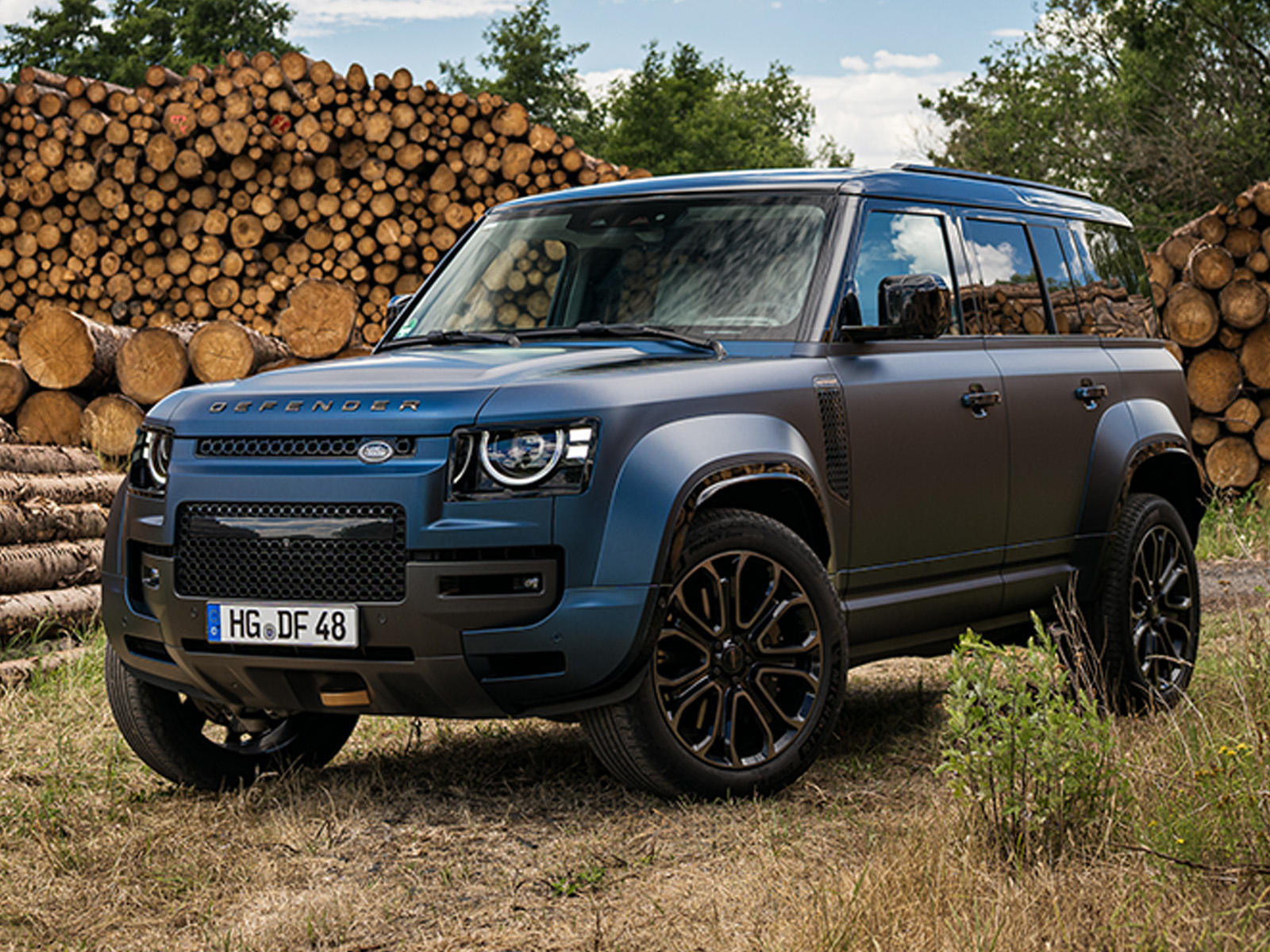
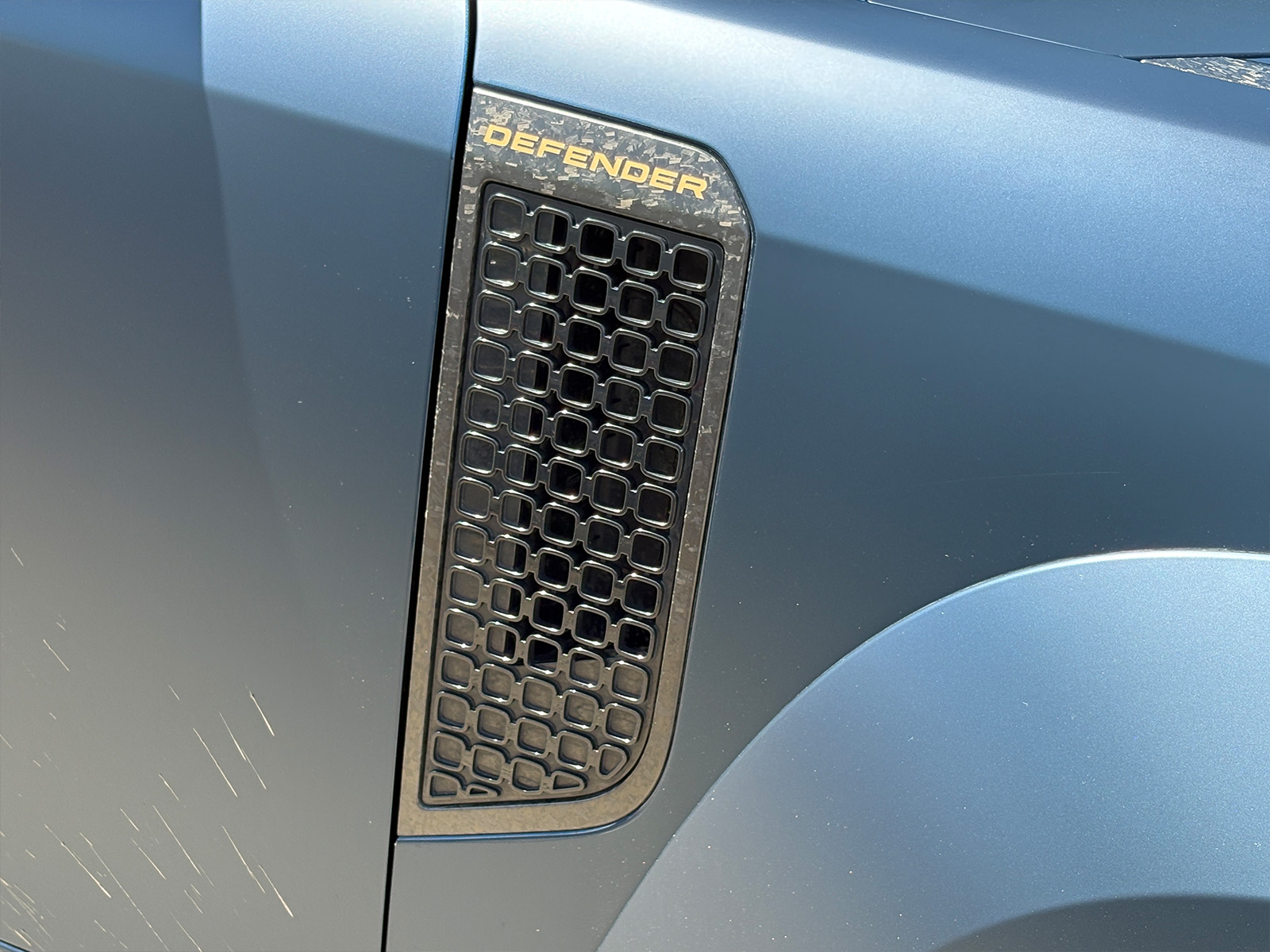
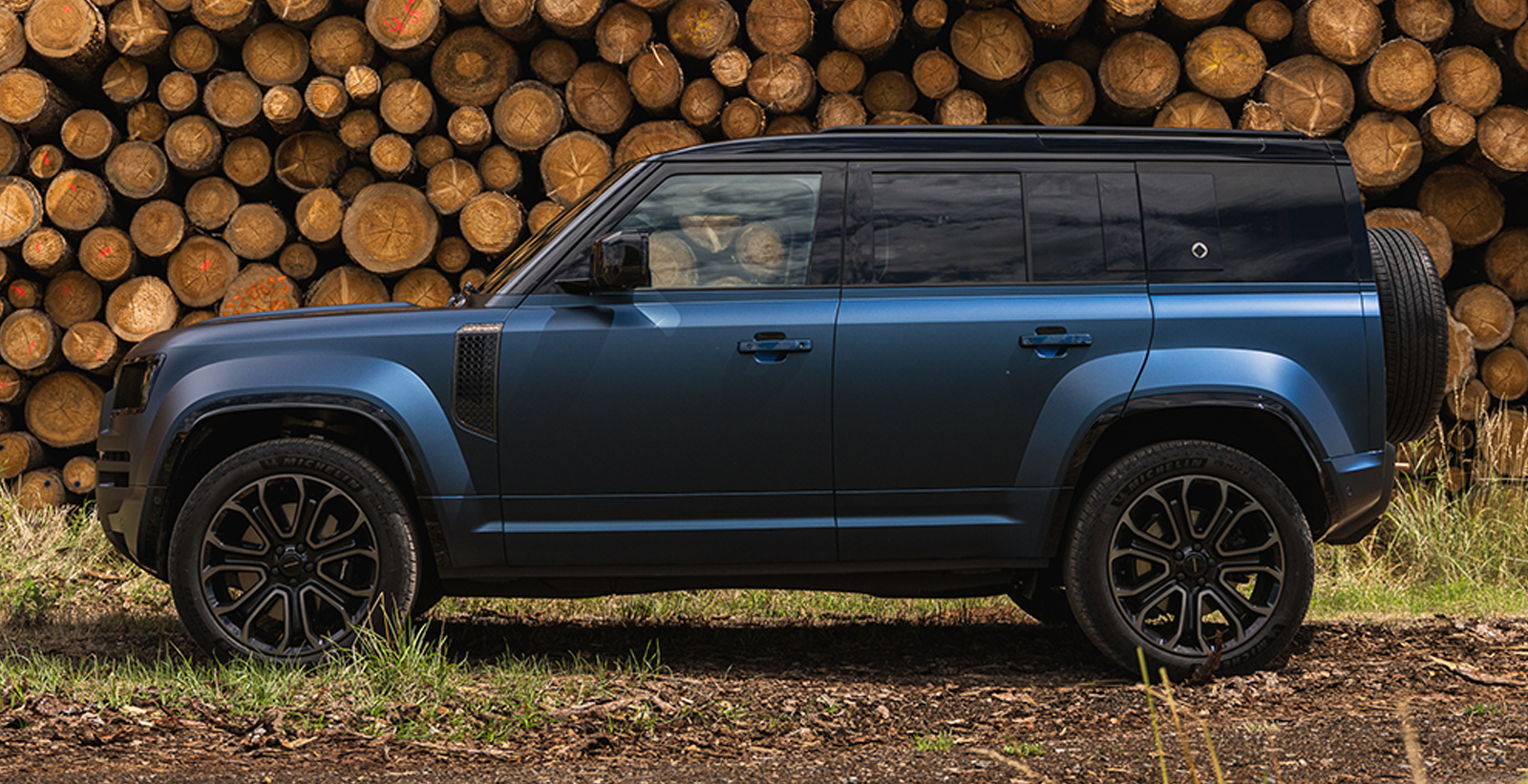
Not just any Defender mind. This was the Octa, the most extreme version of an already extreme car. JLR’s Special Vehicle Operations have turned the standard Defender 110 into something more akin to an F150 Raptor without the open bed – no surprise there as former SVT Chief Engineer Jamal Hameedi crossed the pond to take up a position as director of SVO at Gaydon in 2018. But the Defender Octa is much, much more than a road-going Trophy Truck sporting dressage top hat and tails. Beyond some subtle badging and grille details, the most noticeable visual addition to the Octa over the standard car are the wheel arch extensions, which look to be tacked on over the existing bodywork. These are necessary because new bespoke wishbones poke the wheel and tire package out 68mm (2.5”) beyond the standard fender. This truck has stance. It also means that space is liberated under the arches for Land Rover’s super trick 6D suspension system.
Purloined from the top-spec Range Rover Sport SV, this ingenious hydraulic semi-active system controls not only roll, but damping rates and crucially pitch on a millisecond basis. This allows the Octa to do away with anti-roll bars, allowing for an extra 100mm (3.9”) of axle articulation over the standard car. In an effort to please David, all the dimensions crucial for off-roading without cracking the sump open are increased: ground clearance is 323mm (12.5”), the departure angle is now 43 degrees and the wading depth a scarcely believable 1000mm (39”). Coupled with the usual Land Rover uppy-downy air suspension and comprehensive suite of off-road software, this is the most off-roady version of the British off-roader yet.
I’ve never driven off-road and have no intention of ever doing so. It’s bumpy, dusty, wet, dirty, or a horrifying combination of the above. There’s a high likelihood of getting stuck, and while awaiting rescue you have to subsist on something called fresh water, which doesn’t contain any alcohol. No thank you, I’m much happier on the road. Due to all that fancy suspension putting the laws of physics into a choke hold, the Octa is very good at that, too.
The V8 up front is no longer the venerable AJ V8 that’s been in service since Ford owned the company. BMW is getting the last laugh; under the hood now is the 4.4 twin turbo V8 found in the M5. This motor has already been in service in the L460 Range Rover and L461 Range Rover Sport, but this is its first starring role in the Defender. It makes a hilarious 626bhp and 553lb ft, and the 48v starter generator can shovel on an extra 27bhp worth of coals under load. So that’s 643bhp by the time the throttle hits the carpet, in a two and a half ton (5530lbs) SUV.
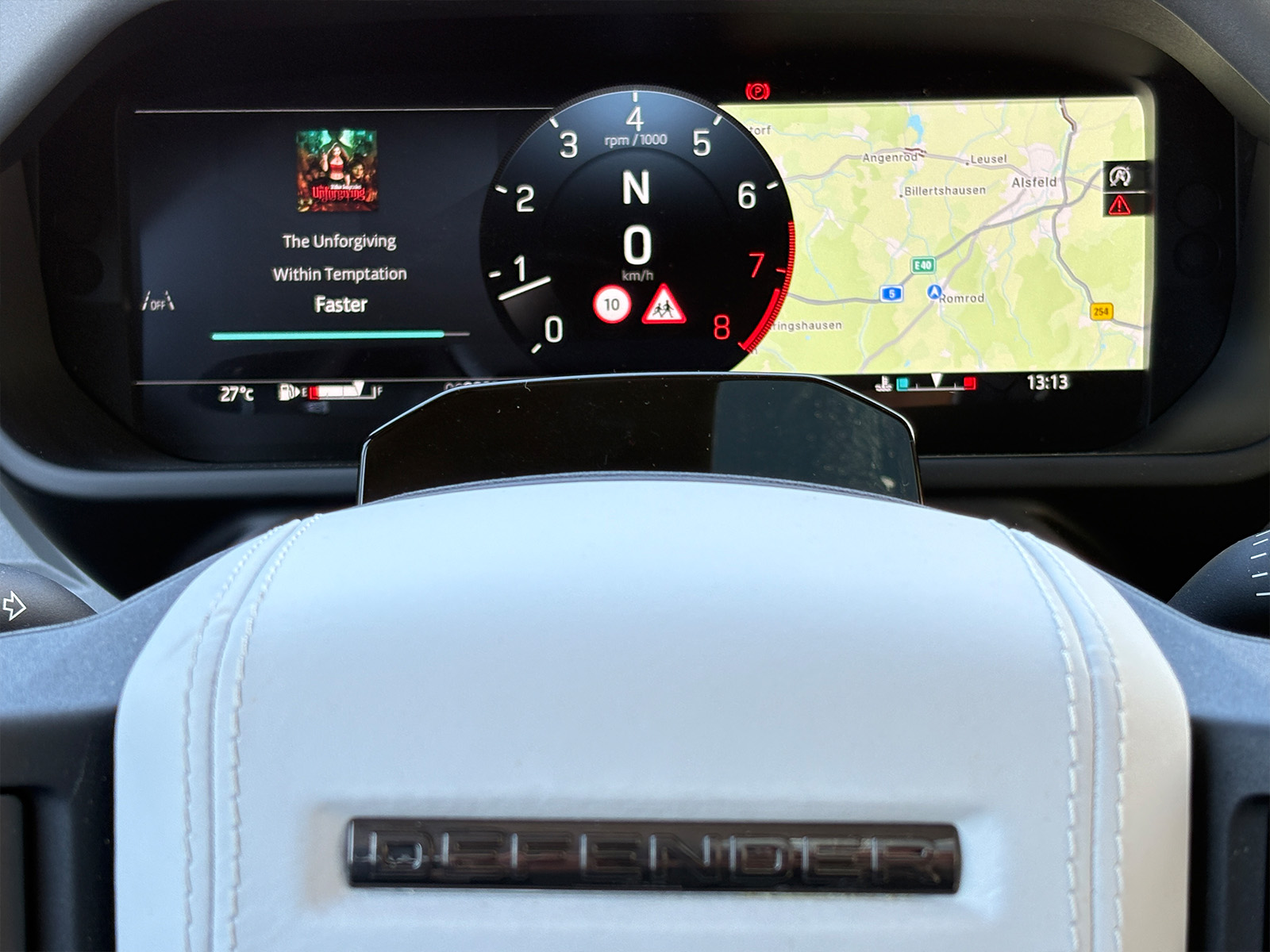
I can’t say you don’t notice the lard, because at first you do. In the normal driving mode, the BMW motor takes a looooooong stab of the gas to wake up. The nose pitches skywards and then, then, it finally kicks off its heels, lifts its skirt and moves. You initially don’t think you’re really going that fast until you glance at the HUD and notice you’re suddenly doing nearly 160kph (100mph) on a narrow German rural road. Whoops. This ‘nothing is happening, oh bloody hell!’ feeling is not helped by the engine noise, which in normal driving mode is muffled like the bodies of several poor people are stuck under the hood.
A friend of mine has an Octa, and he regularly describes it as being like a high-riding 911 GT3. And he should know because he’s got one of those as well. You can switch between dune-leaping Octa mode and 911-frightening Dynamic mode with the push of a button on the steering wheel. Dynamic drops the suspension closer to the tarmac and puts it all in a straitjacket. None of this is especially novel, but what is amusing is the end result. The motor gets a bit more vocal and corners and bumps that were previously gently accepted and negotiated with are now just beaten into submission. There’s still a hint of that squat and dive, but it’s for effect, to let you know what’s going on. You can start punting this faintly ridiculous vehicle along at extremely ridiculous speeds, while still enjoying an extremely agreeable level of ride quality. The Octa still has a lot of suspension travel and a healthy sidewall height after all. At one point I put two wheels off the side of the tarmac and didn’t feel a thing; I only realized because I noticed an enormous cloud of dust I’d just kicked up behind me in the passenger mirror. Five seconds later it dawned on me this meant an extra few inches of road width to play with. It just feels completely unstoppable, which is probably what Land Rover were aiming for.
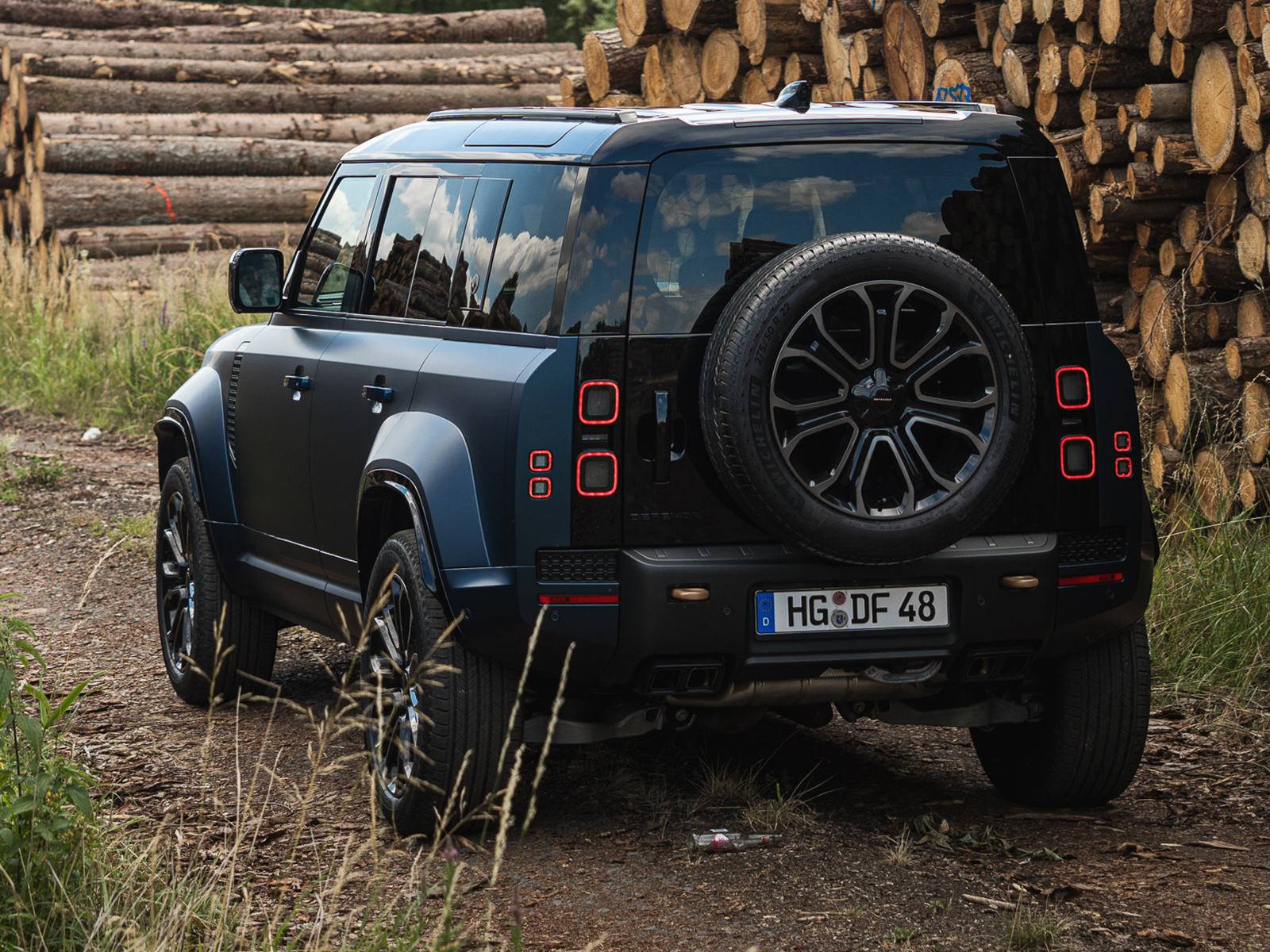
It’s hard to compare the Octa to a regular Defender because I’ve not driven the standard car. What I can say is the characteristics that make the best Land Rover products so appealing are still evident. You may recall that years ago I had an L320 Range Rover Sport as a daily – and in some ways the Octa felt exactly like that with fifteen years more development. The same languid throttle pedal with its tiny step-off delay. The same feeling of being Lord or Lady of all you survey from behind the wheel. The sheer bloody usefulness and fuss-free practicality of the thing – the Octa is still a five-seat luxury SUV with chunky controls and lots of storage space. It would take more talented hands than mine and an afternoon in the desert to confirm it, but I have no doubt the Octa takes the off-road capability of the standard car and dials it way past eleven, in the same way it does on road. I just wish it presented itself more in that vein. I mean white leather and a matt blue exterior? Is this a Land Rover or a wellness destination?
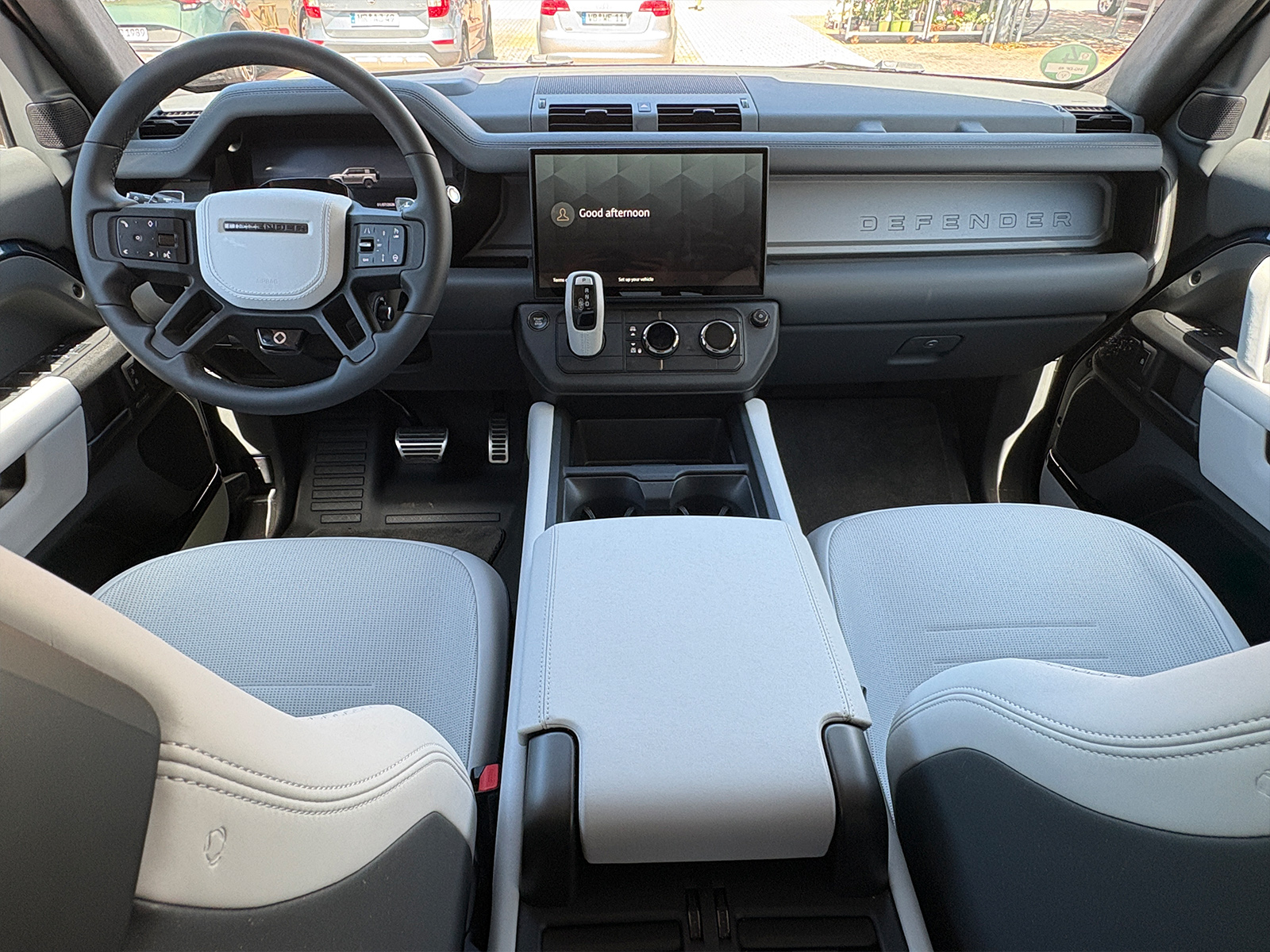
Truth be told, I was expecting the Octa to feel a bit more aggressive and I said as much to the PR guy when I gave the keys back. He informed me this was a deliberate choice because of where the car was pitched in the market. This ties into a thought I’ve been having since the reveal of the second Defender facelift last week. It’s a tragedy for me that since launch, Land Rover have slowly nudged the Defender further and further upmarket. It started off as a somewhat accessible SUV with a steel wheel option, a forty grand commercial version and a fuss-free industrial feel. It’s now morphed into yet another hyper-premium Land Rover product with muted colorways, coming within touching distance in price of the Range Rover proper and Range Rover Sport. My theory seems to be supported by the increasing number of murdered-out-spec Defenders I see around now. You can’t argue with the numbers; the Defender is their best-selling model, so why sell 100,000 units per annum at $60k when you can shift the same amount of metal at $100k? God knows the Land Rover side of the business needs to keep the Jaguar side of above water in the near term.
Later on that afternoon the Octa returned to the hotel absolutely caked in mud – so it’s certainly a Defender that can rodeo. But with a list price of $160k it feels like the furthest it’s going is Rodeo Drive. Perhaps the mooted Dakar version will swap the yoga pants for cargo pants, but one thing is certain: you’ll be paying for the privilege.
Renault Twingo
How do you turn a couple of car designers into a pair of grinning children? The answer isn’t to deposit them in a watch showroom or turn them loose in a poncey stationery store. Last summer at an industry gathering, Sam Livingston of Car Design Research (possibly the only person in professional car design as smart and waspish as me) and I spent twenty minutes ogling the details on a Whirlpool-white first-generation Renault Twingo that was in attendance. With its kawaii visage and supreme dedication to cost saving and rationality, the 1993 Twingo was a masterpiece of making the most with the least. A mini-monovolume designed by Patrick le Quement, it had a Fisher Price interior with a central instrument binnacle and multi-configurable seating that could increase cargo volume or fold-flat into a bed. Only available on mainland Europe in LHD, the original Twingo was a 1980 Fiat Panda with a sense of humor: designed to be something that appeals in spite of its purchase price, rather than because of it.
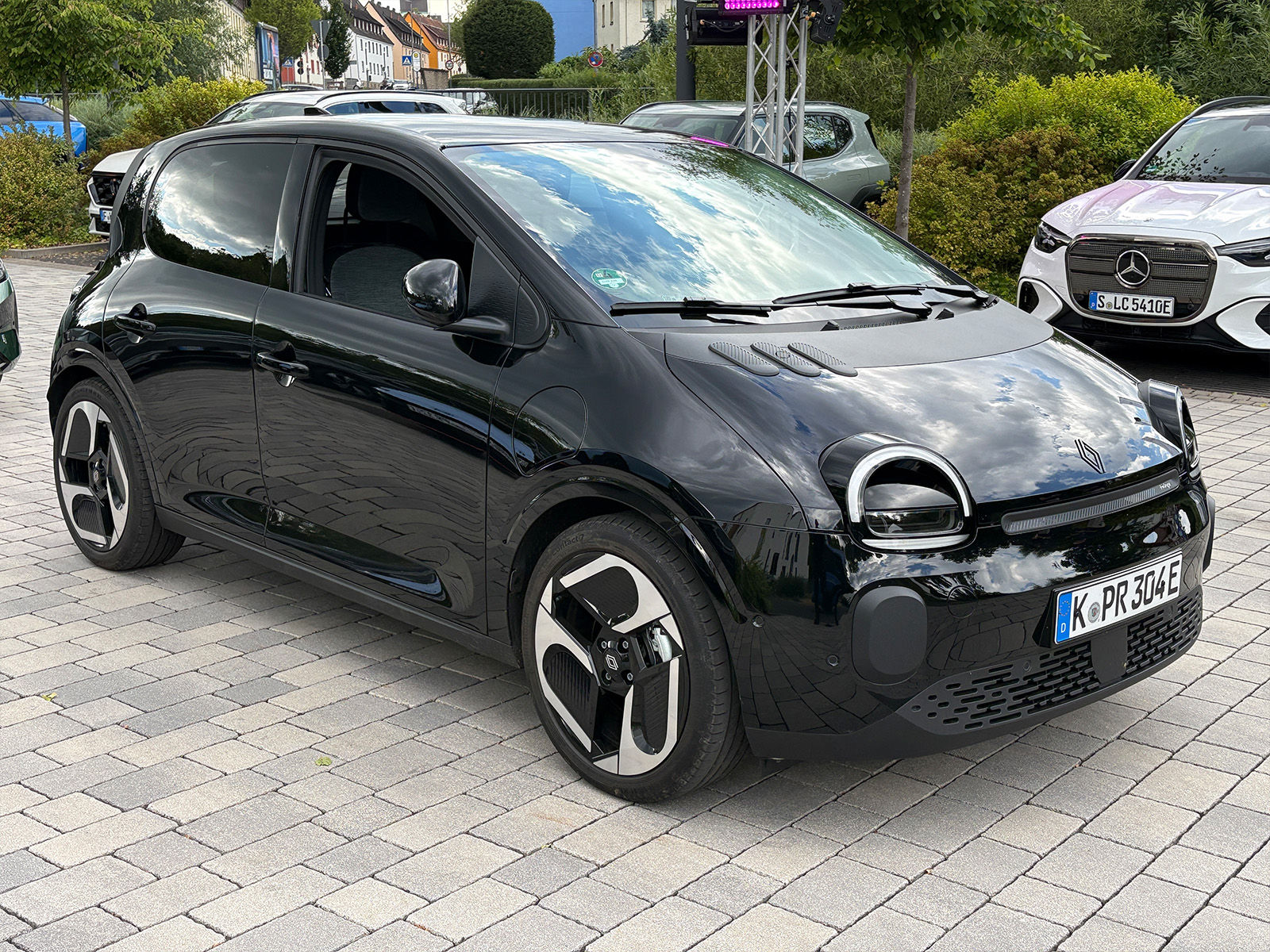
The second and third generation cars kept none of this fun and function combination, Renault making an inordinate effort into turning the Twingo into the lowest effort cheapoid Euro hatch possible. But to the surprise of absolutely no one after the success of the new 4 and 5 EVs, Renault have blown the dust of the back catalog again with a new Twingo EV. Sitting on the same Ampr Small platform as its numbered stablemates, the Twingo E-Tech (to give it its proper name) slots below the 5 as an EV city car with a sub-£20k price point.
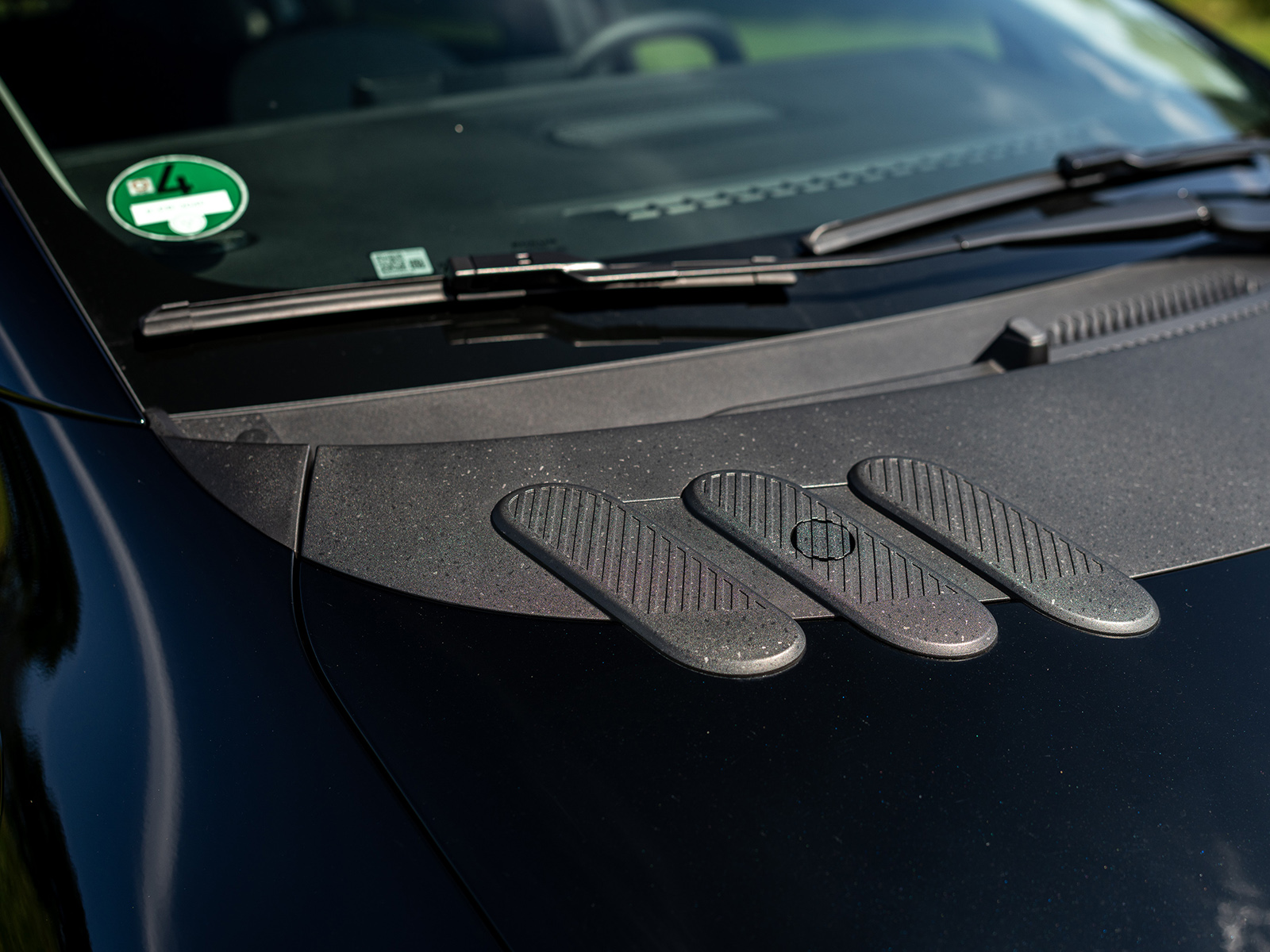
Relentlessly mining your heritage can be a bit shameless, but today’s market is crying out for small, efficient, thoughtfully designed and priced cars with character, much like it was thirty years ago. The forthcoming Geely E2 city EV might be RWD, but who gives a wobbling toss when the car itself is a commodity good with the personality of a toaster. The Twingo E-Tech is the Eiffel Tower opening up to reveal a giant missile in a silo, aimed squarely at the fleets of container ships full of cars like the Geely – proof in the metal of legacy OEMs putting their heritage and design skills to good use.
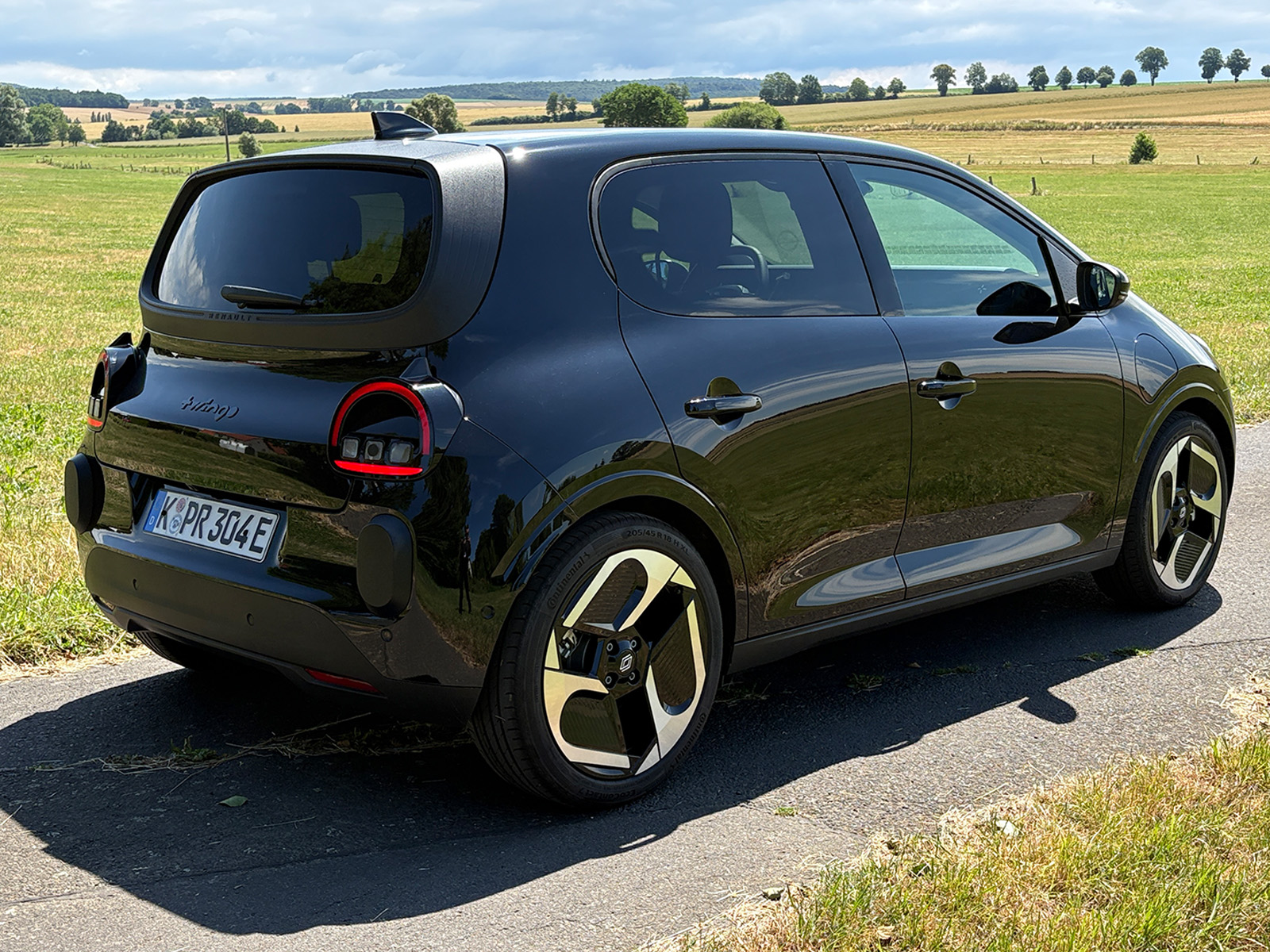
Like bumping into an ex and noticing holy shit, they’ve still got it, I’m immediately smitten by the Twingo’s looks. A couple of extra doors have appeared, and seeing as street parking in France involves making your own gap, the base-is-ace unpainted polypropylene bumpers front and rear have been replaced with body-colored items with rubber bump stops at each corner. With the off-center triple hood vents, four square stance and black paint, the Twingo is serving tens across the board. It’s just a joyful little thing to behold in the hotel parking lot.
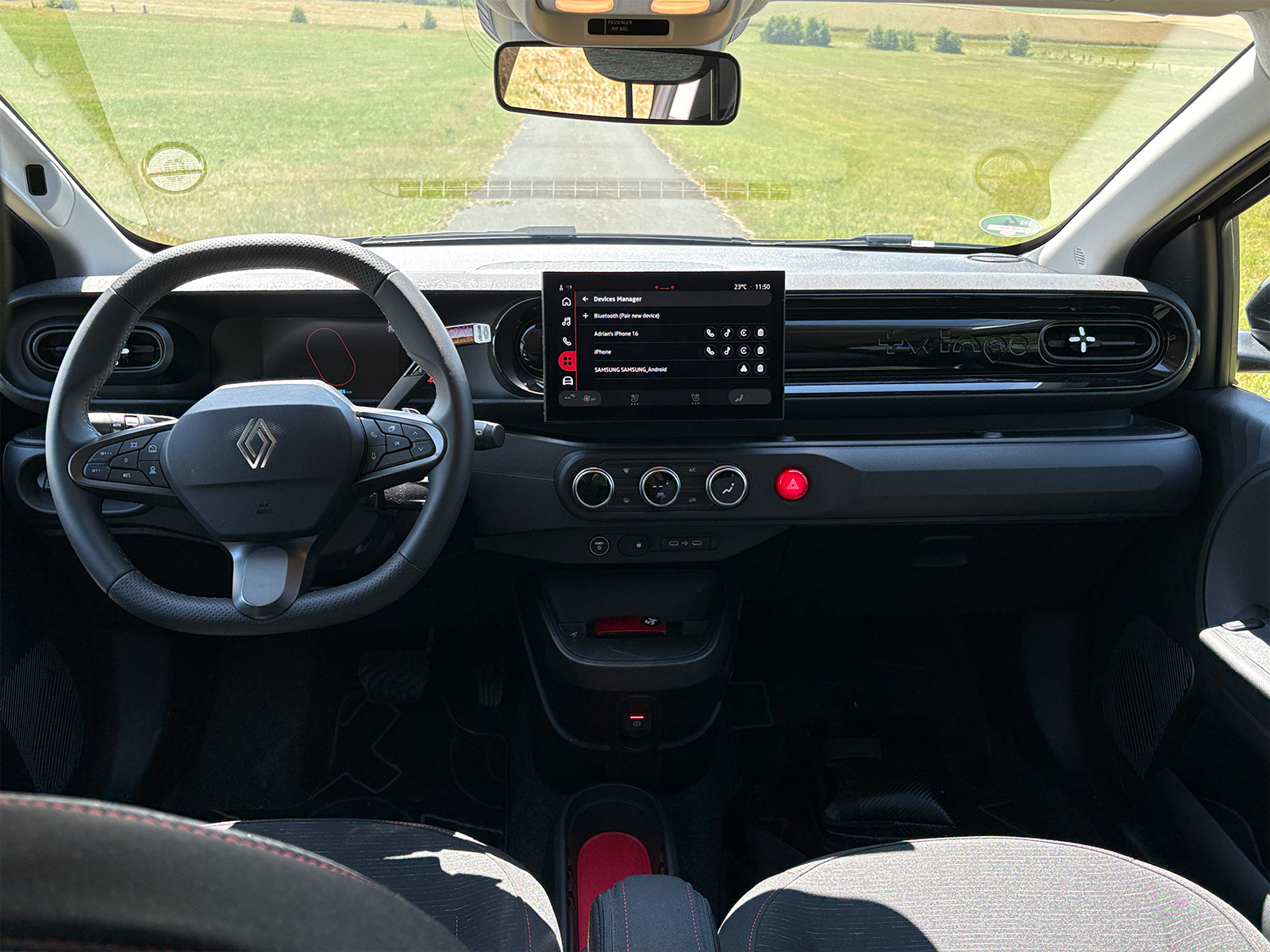
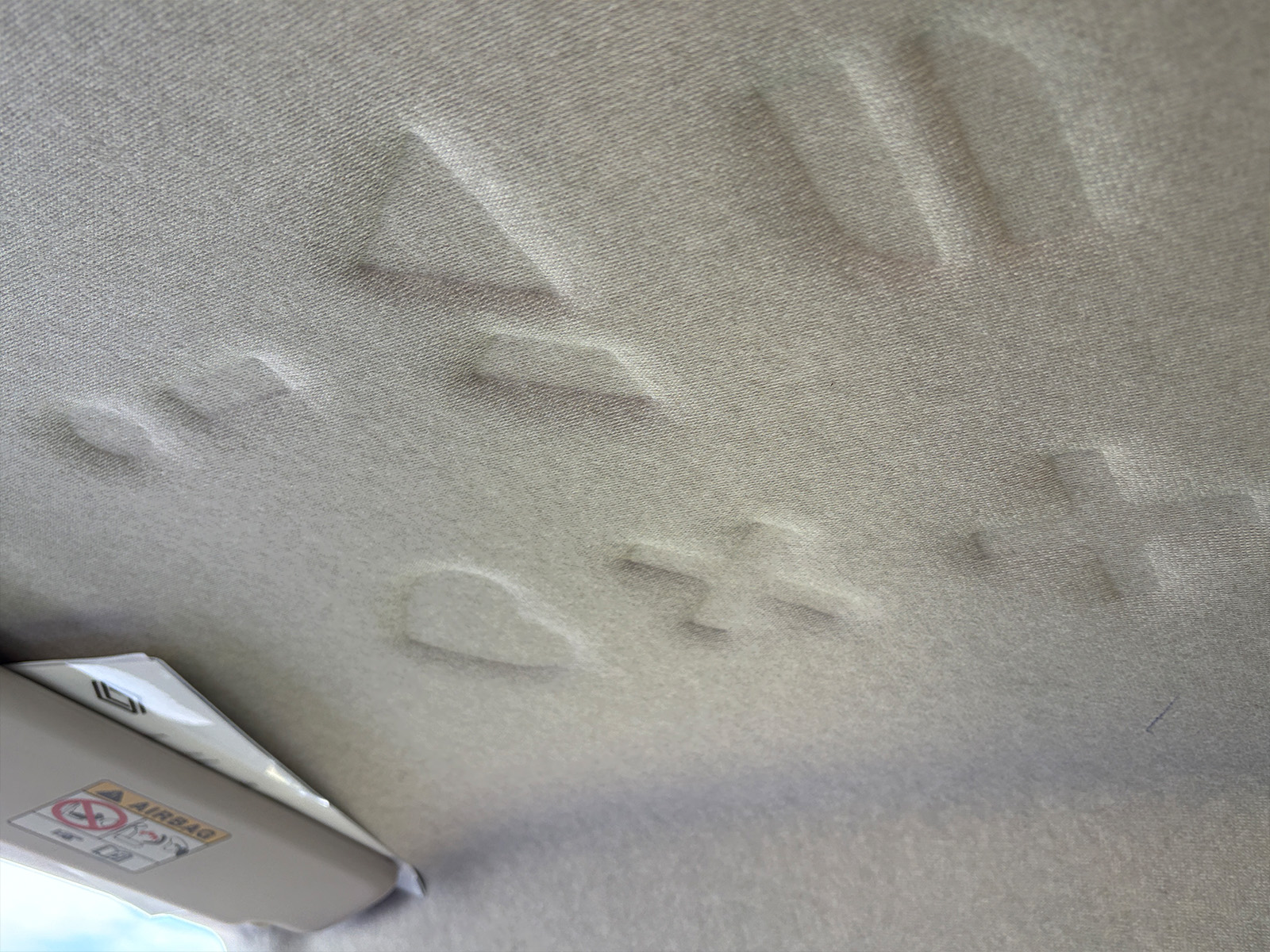
Inside, the post-modern cyan controls and retina-dazzling seat fabric have thankfully been consigned to the nineties history bin. In their place comes carpet from a Memphis furnishing showroom and a headliner with hieroglyphics stamped into it. There’s a small screen directly in front of the driver and a larger one in the middle, below which is a center console with an oddments tray and USB-C ports – although phone mirroring is wireless. The shapes are simple and the amount of furniture sparse, which helps the whole interior feel remarkably spacious and clutter-free. The plastics are hard, but it’s all very cohesive and solidly made. Haptic controls abound, and the Twingo uses the same credit card key Groupe Renault has been using across all its products for about the last two decades. If it works, it works but there’s something amusing about the same slab of plastic unlocking twenty grand’s worth of city hatch and sixty grand’s worth of Alpine mid-engined sports car. Further parts sharing includes the lipstick drive selector found on the 5 and the Alpine A290 hot version. Given all these cars are on the same platform, I imagine it’s on the Renault 4 as well, but Renault promised me a loan of one of those and then stopped answering my emails about it.
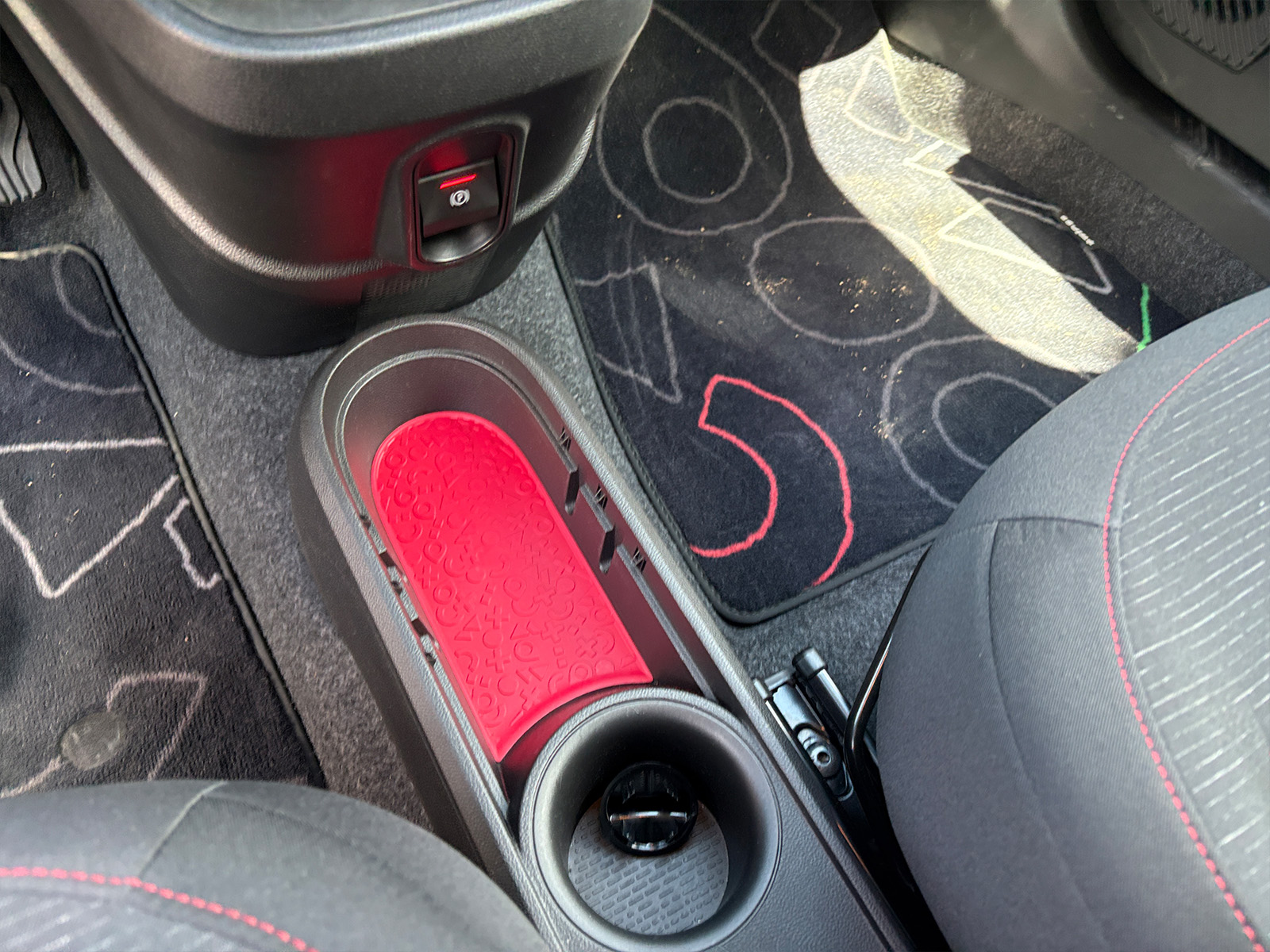
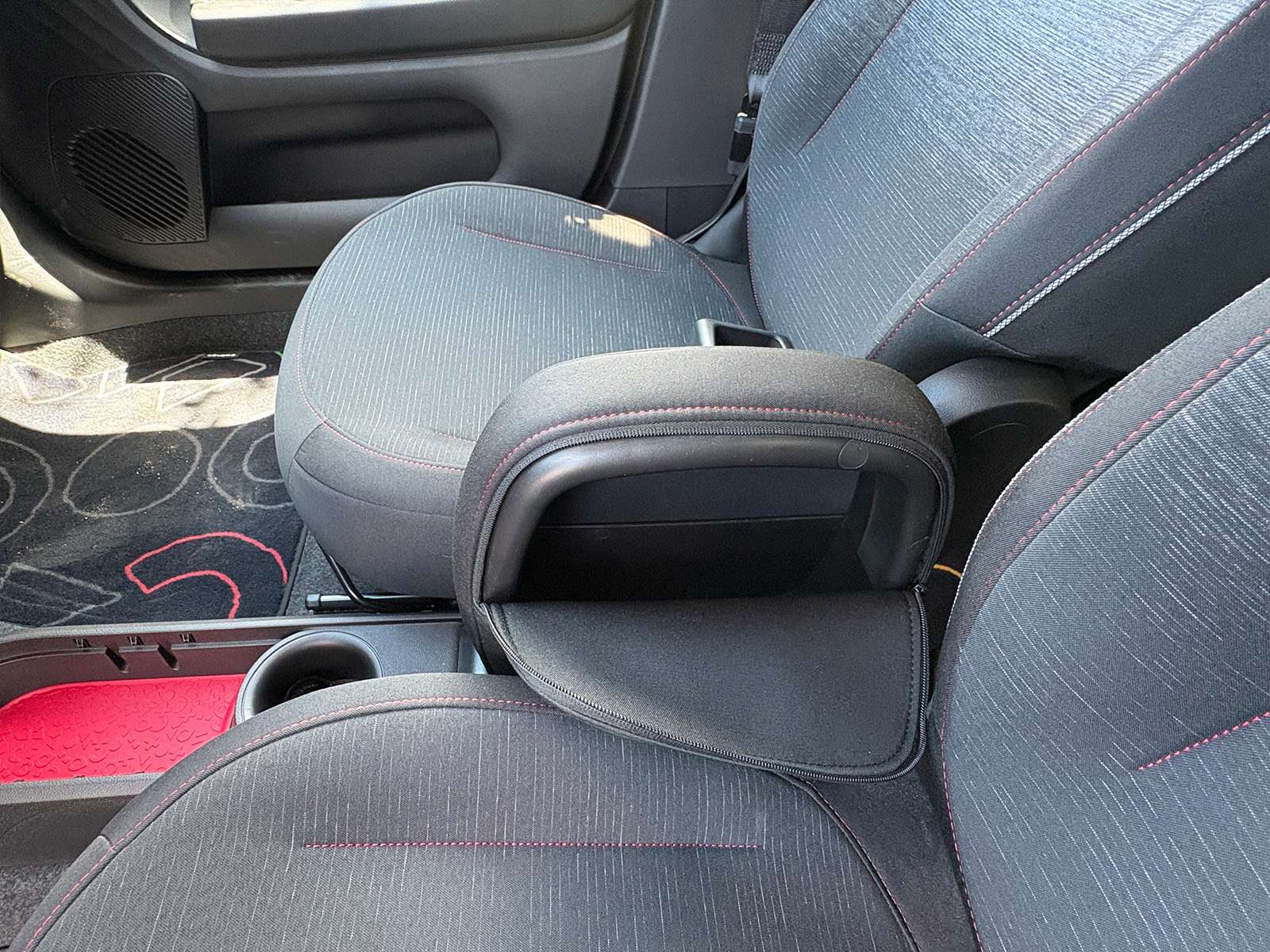
You know how there are some grocery products you can buy in a concentrated size, giving you less net weight but a stronger product? The Twingo is exactly that – the Renault 5 in a smaller bottle but a bigger hit in most of the areas that matter. It might only have 82bhp, but it has over 200kg (440lbs) less French fancy to move, mostly down to the reduction in pack size to 27.5kWh from 52kWh in the 5 (and 4). The Twingo also bins the independent rear suspension for a simpler, cheaper twist-beam rear, which frees up interior space. One of the original Twingo’s innovations was its moveable rear bench, which slid backwards to increase rear legroom or forward to increase trunk space. Now it’s a split rear bench so the rear seats can perform this magic trick independently, which will be indispensable for young urbanites who have burdened themselves with a mewling ham that needs constant attention. Despite being some 250mm (9.8″) shorter than the 5, the Twingo is roomier in the back.
It rides and steers better than the 5 as well. The Twingo has that languid loping ride quality all the best French cars have. It dismisses bumps with a haughty Gallic shrug, whatever lean or slip angles are currently in operation. Helped by skinnier tires and a trimmer waistband, the Twingo can be chucked into a corner and the throttle nailed with cheerful abandon – because it’s all happening at sensible speeds. More than once I had the front end chirping away happily with the thing keeled over, without ever feeling I was about to have the sort of tankslapper that would see me becoming familiar with German hospital food. The little Twingo just laps up this sort of silliness. Then, once you’ve finished pissing about, it becomes the perfect urban errand runner – quiet, clean, easy to position and navigate through confusing German junctions, and just plain stylish.
That the Twingo is so capable in and out of town is something of a double-edged sword. The Twingo might be labelled as an urban EV, but who really exclusively drives at low speed in town? Even my own commute consists of five or six miles of 70mph road into Coventry. Because I was in Germany, the display units were set to kilometers, so the efficiency was displayed as km per 100km. What the fuck that even means I don’t know. Renault UK says the Twingo will do 5.1 miles per kW, which for the pack size means a max range of 140 miles, a fair distance short of the claimed maximum of 163 miles. To achieve that figure would require a frankly unbelievable 5.9 miles per kW. A number closer to 120 miles seems more likely in real-world use, and rightly or wrongly this will put customers off. The Twingo has a cheaper Lithium-iron-phosphate chemistry, so it can only charge at 50khW. Although half an hour of that will get you to 80%, you’re going to need the full 100%, which will add on hours. It’s not just about how far you can go; it’s about how often you need to charge up, and if you can’t do it at home or work, a three-hour charging pit stop is enough to bugger up anyone’s week.
When the Renault 5 hit the market last year, it felt like the moment the small, genuinely usable small EV had finally arrived. With its 250-ish range and £25k-ish ($33k) price point, it solved the price and range conundrum in a satisfying manner. Despite being a more appealing car in a lot of ways, sacrificing the battery chemistry, pack size and associated liquid cooling systems to get the Twingo under twenty grand feels like a compromise too far. There’s only 50mm (2”) difference in wheelbase between the two cars so the bigger battery should fit.
That might mean another grand or two on the list price, but a Twingo at £22k ($30k) with 250 miles of range would be perfect. Nudge the 5 slightly up in price and give that car any drivetrain updates first to help maintain model separation. There. All sorted. Renault, you can have that bit of product planning on me. If only you answered my emails.
Photos by author unless otherwise noted


I like the 5, and 4. This new Twingo looks great, and sounds fun to drive. The Twingo Mk1 will forever remind me of childhood summer holidays to France. Renault have done well no doubt.
I do however worry slightly that the best ideas coming out of Renault are old ideas from a design perspective.
I do get why they are doing this, and I really do like these cars. Retro or not, where do you take these designs next?
For example the MINI was great in its first BMW form, but every version since seems to have been a worse interpretation of the original, although still successful?
I think this is a really astute observation and something I have said myself in the past. The problem is you eventually run out of greatest hits to rerelease.
However.
One way of thinking about it is, maybe this is what these cars would have looked like had they remained in continuous production. In that vein, they can be seen as a continuation of a design that was good from the start.
What Mini did was slightly different – they used the opportunity to reset the brand and make it more premium – the OG Mini was always a very fashionable car so BMW lent into that – very successfully. Their attempts to broaden the range haven’t always quite worked but the three door hatch remains very close to the first R50 in spirit and execution.
Yes I actually read the MINI was partly designed from taking that theoretical evolution approach of what would it look like if it has been iterated generation by generation. Not the Mini Metro apparently…
The catch is what car iterates for so long without a step change or extinction (and maybe cars become extinct for a valid reason), all I can think of is the Porsche 911 and maybe the VW Golf. To take a Renault for example the mk1 Clio, do we see a clear link to the rather strange mk6 today?
Golf, 911, Range Rover, 3-5-7 series, S class, MX5, F150, Suburban, Wrangler, Camry, Civic, Morgan are the heartland cars that spring to mind.
Finnish automotive association “Autoliitto” has a publication “Moottori” in which they made a multi-part story of driving a Twingo from Paris to Helsinki. The first parts seem to be paywalled but you can read many parts for free, example:
https://moottori.fi/uutinen/sahko-twingolla-pariisista-helsinkiin-siltatullit-verottavat-matkabudjettia-enemman-kuin-lataaminen/
Just put that through your translator and you’ll be fine. Above part caption is “Bridge tolls are worse on the travel budget than charging”
The reporting duo lived in the Twingo and used the electric output for coocking and such!
Proof that Adrian hates fun.
I hate that sort of post-modernism whimsy.
Have you ever copped an eye full of esteemed architect Kengo Kumas first work the post-modern ‘M2‘ for Mazda – best not seen after a all night Saki bender.
Funnily enough that exact image popped up on Twitter the other day.
It’s fucking ghastly and I hate hate hate it.
2,646 lbs with a 27.5 kWh pack is really good for the Twingo. Take that same platform, build an aerodynamic sedan out of it with a CdA value of under 0.35 m^2(you’d be looking at a Cd around 0.16), and you’d be getting 160+ miles range @ 70 mph on that, for roughly the same price.
To hit that would you need to lower the roof line? Because then you’re going to have problems packaging four adults.
You could probably avoid lowering the roofline within the rear passenger area with a longtail design that incorporated rear wheel skirts and a long rear overhang for trunk space. As a bonus, all occupants would have increased leg room.
It would probably look something like a GM Precept, the dreaded “space ship” archetype. But the practical reality is that for inexpensive, long-range, lightweight EVs that get by with small battery packs to be possible, that’s the sort of design needed. The buyer/operator could save so much money over the life of the vehicle too with an inexpensive battery replacement and getting 6-8 miles per kWh, and it would be every bit as true if it were a 3-cylinder non-hybrid ICE getting 70+ mpg highway instead.
Making it look good to a designer’s eye without compromising the low drag would be the actual challenge. I think in that case, the selection of headlights/taillights, creative use of a two-tone paint scheme, and wheel selection are the elements that will make the most difference in its appearance and would make or break it aesthetically. But I’m not a professional car designer, that’s only my opinion.
I have designed and built my own vehicles, but they’re just barely/questionably “bicycles” where I live. Here’s my most recent, no body on it yet, but I gothed it out pretty good so far:
https://i.imgur.com/wteajxk.jpg
https://i.imgur.com/63VH9GE.jpg
https://i.imgur.com/Ilm6CDQ.jpg
https://i.imgur.com/i3gfsGa.jpg
In the works is a streamlined body shell that will resemble a cross between an Auto Union Type C and a Stanguellini Colibri. I’m going to paint it like it is rusted metal and have occult symbols all over it a Baphomet statue for a hood ornament up front, racing number 666 inscribed in a circle, and a big, fat red anarchy sign sloppily done on the right side. I want to go for a Mad Max meets witchcraft meets Cyberpunk 2077 sort of aesthetic on it. It will have a digital HUD on the windshield projecting my speed ala Corvette C6 as well, and I might have that functioning this weekend(with no installed windscreen to project it on).
As it is pictured above, it is front drive electrically with 12 kW, rear drive with using pedals, does 0-60 mph in under 9 seconds, 30-70 mph in about 6 seconds, tops out at 82 mph, and weighs all of 90 lbs. I still need to add a 3rd motor for the rear wheels, and of course a body, because I want to make it able to do 100+ mph and 0-60 mph in under 4 seconds. I typically ride it at 30-35 mph though, and get about 70 miles range in that use case with a 2.1 kWh battery.
It’s still very pedalable with the motors disabled. The difference a body shell of sufficiently low drag will make is that when pedaling with the motors shut off, instead of cruising 15 mph, I’ll be cruising 25 mph. Then when using the motors, a sufficiently low drag body will triple or quadruple my range per charge at higher speeds.
Great piece Adrian, always fun to read your stuff!
Loved the Twingo mk1, when i owned one 5 years ago! Was lucky and got one with the silent new engine, and not the old noisy 1961 Cleon Fonte.
–But I would drive it absolutely everywhere, not minding it’s “city car” classification. Would like to be able to do that in a new one as well. So short range EVs is never going to be a thing. I thought we established that at the failure of the Honda E, also years ago?
Honda gambled on a nice design and a lot of tech justifying the premium positioning but it was always the case the range was going to doom it. I reviewed it a couple of years ago.
Mewling ham.
Are Within Temptation still around? The last I heard from them was Enter.
I think they are headlining Mera Luna this year.
Huh, TIL, interesting.
Mewling ham (not his real name).
New Adrian story: time for some scotch and a comfortable chair.
The stated 1000mm wading depth converts to a stunning 39.37 inches, not the measly 25 inches stated in the article. Something seemed off when I remembered that the L405 Range Rover was rated for 900-something mm of wading depth, which I remember being nearly 36 inches. It takes a special someone to drive a $150k luxury truck into 3 feet of water.
You just need to have enough money to not care.
Good to see you back, Adrian.
When do we see a write up about the departure of the Ferrari and the arrival of the Capri?
A few people have asked – I’m hopefully going to introduce the Capri soon.
From the rear the Defender looks weird to me, like a kid grabbed the clay model and smashed the upper section together at an odd angle.
Or maybe it’s my square head trying to comprehend the trapezoid roof line.
defender- the whole car is a no. the retro future style got old with the gm hhr. cram the tiny square tail lights. please.
The tiny taillights are a legal requirement because the tailgate mounted spare messes up the viewing angles.
thx. learned something.
but cram it still
Testing a Twingo in Germany and then giving prices in Sterling and Trumpets but not Euros is really weird. At least the measurements are in sane units.
Look, it’s six-and-a-third trumpets to the sterling, and two monkeys to the ton. It’s really not that complicated
😉
So happy to read about the Disco and Twingo via your acerbic prose!
Adrian, your bio lacks Ferrari and samples Capri.
– Anxiously awaiting your next brilliant article and the swap.
I’m hoping to introduce the Capri in a forthcoming piece.
As a former young urbanite who burdened herself with a “mewling ham,” I’m gonna tell said “mewling ham” that and she is going to shoot a well-practiced withering look several thousand miles in your direction then promptly add that to her ever-growing bank of well placed insults!
Well she’s hardly a mewling ham now, is she?
> the efficiency was displayed as km per 100km. What the fuck that even means I don’t know.
The units cancel, so obviously it means 1/100.
Yes but I’m used to miles per kW.
I’m just being a jerk – kilometer per 100 kilometer 🙂
Can’t have miles per kW. kW is instantaneous power. kWH is power x time = energy. So measure miles per kWH and charge rate in kW.
“Mewling ham” lol best article here in a while.
You make me slightly less ashamed to be British. That’s one hell of an achievement.
I love your writing.
Don’t be ashamed to be British, you have a storied automotive history, and two types of squirrels.
I can give you a list of countries it would be shameful to live in of you want, many also have squirrels but not cool ones.
It’s a 1000 mile round trip from where I live to where I can reliably spot red squirrels. Worth it though.
Also my wife’s family life there.
Yes but California has goth spec black squirrels.
Now the USA is officially better than Britinland in the ISA rankings.
Basic auto journo: “which will be great for families with kids.”
Cool auto journo: “which will go a long way toward making David Tracy’s wife happy.”
Adrian: “which will be indispensable for young urbanites who have burdened themselves with a mewling ham that needs constant attention.”
What an unexpected gift!
I am disappointed you didn’t off road the Twingo and return it caked it mud. Was it lack of range?
Which part of ‘I don’t go off road’ wasn’t clear?
Sorry, I took that as “I don’t go off road in gigantic expensive V8 kept housewife off road cosplay mewling ham delivery machines”. I didn’t think off roading a Twingo would terrify you so much.
The whole concept of ‘the great outdoors’ terrifies me.
A man after my own heart. If God had meant for me to be outdoors, he would have provided it with proper aircon.
And put pubs there.
There’s loads of country pubs over there.
Maybe not enough though!
And Kevin is spot on about aircon…
Right on!
“My idea of being outdoorsy is drinking wine on a patio.” Attributed to a cocktail napkin from somewhere.
Climbing up high* helps with stupid hot and humid weather.
Visited the Smokey Mountains this summer.
Pidgon Forge 96 F in the afternoon equaled 84 at 6k feet in the park (Smokey Mountains National Park just a few miles to the south)
*one can (amd.many do) drive through in complete aircon comfort too 😉
I’m a sea level creature. There’s no air up there, LOL.
But for sure my favorite way of seeing nature is through the windows of an air-conditioned vehicle unless the conditions are perfect. At which time, give me a convertible. Though a convertible with good A/C is a delight. With a hat, the windblocker up, and the A/C cranked, I can drive top-down in the summer here in Florida other than at the very peak of the heat.
Don’t feel bad, they’ve never let me take the planes that I’ve worked on for a spin either.
BS Corporate policies.
Tex Johnson ruined it for everyone.
LMAO
Do have a have a pilots license? Just borrow one over the weekend, they’ll never know. Just put the keys back in the key box and bob’s your uncle.
I don’t get to live in the houses I design either even though some of the beach houses are empty most of the year. Dammit.
Twingo looks like a fun daily and that’s the kind of EV I’d be interested in. They don’t sell it in the US, anyway, but it would definitely need a bigger battery here.
I love how the French are sort of firmly planted into the 90s in some design elements. Always a bit funky. They seem like they always will be. Why can’t more cars have floormats like that and why don’t the seats have a pattern like that. Neat little car.
I have to imagine the seats is a cost thing. If they make them too jazzy that’s a hard thing to change.
Mats can be swapped out easily and cheaply.
Good point, they seem to still make the super thick fabric for transit systems and busses in the jazzy style. But I bet they don’t for the thinner automotive grade. Although fabric printing seems to have gotten easier and cheaper. Still probably higher cost then standard stuff.
“Inside, the post-modern cyan controls and retina-dazzling seat fabric have thankfully been consigned to the nineties history bin”
The funky colors/patterns are exactly what I loved about the 90s Twingos. I like the new one too, but it could embrace more of that fun-loving confidence.
If it was up to me, I wouldn’t even offer a Twingo in Black or Gray. Anything but!
100% fun color options only
Like Porsche did with the 993
“…which will be indispensable for young urbanites who have burdened themselves with a mewling ham that needs constant attention.” Classic. Missed seeing your writing.
I sure do miss getting to read your writing Adrian! Cheers to the great reviews.