

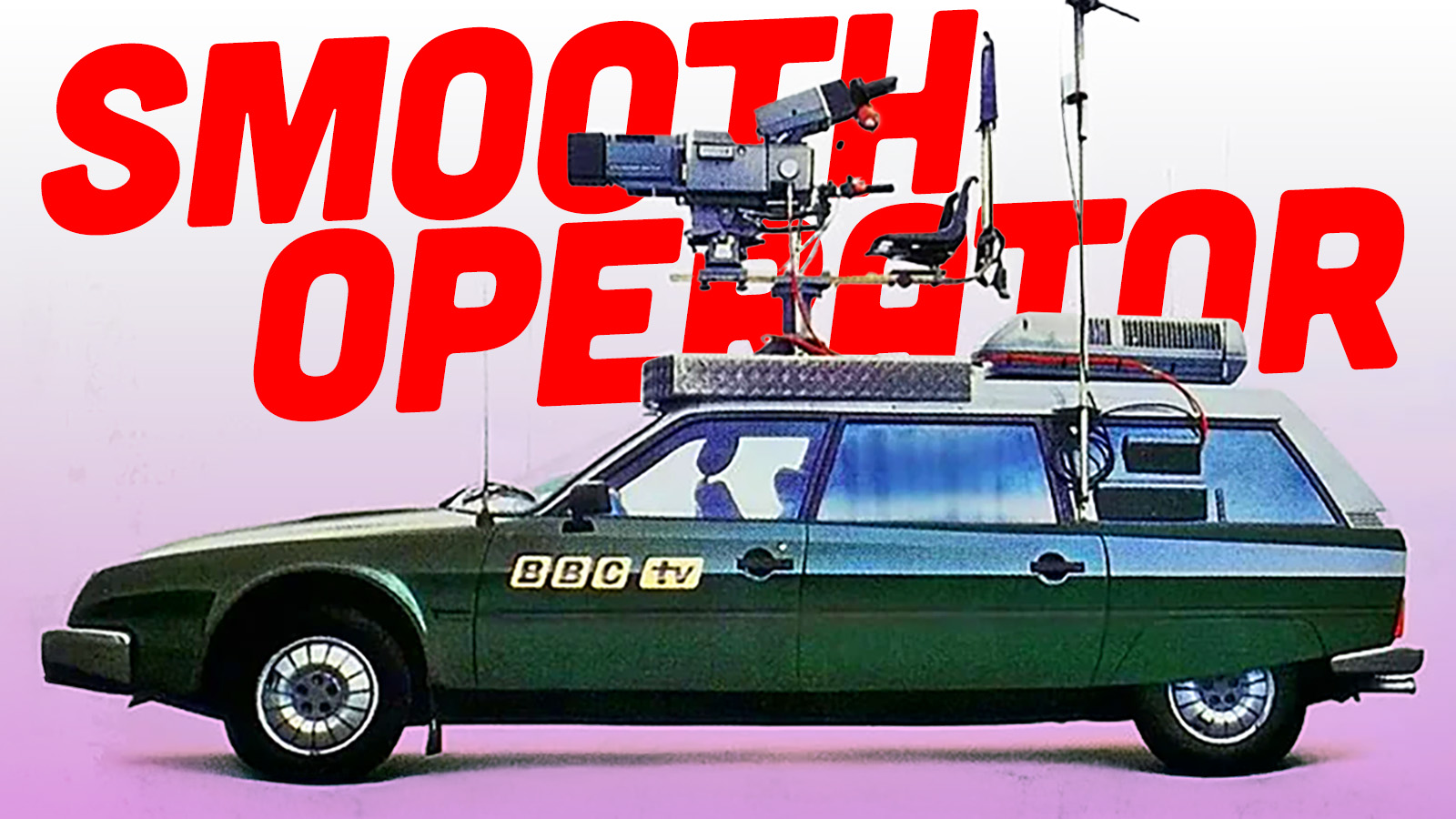
Cars and cameras have a long and illustrious history working together. Since the 1920s, people have been mounting cameras to vehicles to capture scenes while on the move. The first documented use of a camera car was in 1925 during the filming of Ben-Hur, where filmmakers used a purpose-built vehicle making 300 horsepower to capture chariots as they raced around an oval, according to the American Society of Cinematographers.
Since then, the state of the camera car has evolved massively and in many different directions. There are camera cars used for getting better angles when it comes to height. Camera cars that use mounting arms that can swing in any direction. There are even camera cars like the “HuraCAM,” which is a Lamborghini Huracán with a gyro-stabilized camera rig sticking out of its frunk, built for high-speed action shots.


While camera cars today are inarguably more efficient and versatile than ever before, I’d argue peak camera car happened all the way back in the 1970s when, instead of gimbals, cinematographers exploited Citroën’s hydropneumatic suspension to capture the smoothest footage possible.
It’s All About Height
In the mid-1950s, the British Broadcasting Corporation (BBC) realized it needed a camera system that could capture footage on the move and from a certain height. Specifically, normal vehicles were too short to get a view of the horses racing at the Grand National, an annual horse race held just outside of Liverpool.
The solution, at first, was to use a truck with a roof tall enough to mount a camera that could snag a sufficient angle. According to the Broadcast Engineering Conservation Group (BECG), the original concept was called the “Travelling Eye,” and was based on a Daimler truck chassis. Its most distinguishing feature was the Marconi Mk IB camera mounted to the roof. Back then, broadcasting cameras needed lots of space for auxiliary equipment, including a radio link and an onboard generator, in addition to two operators (one to man all of the equipment, and one to work the camera).
This truck was certainly better than nothing, but laden with all the extra equipment, it wasn’t nearly quick enough to keep up with the horses. Here’s the BECG talking about how the air-cooled, gas-powered generator acted like an anchor for the Travelling Eye:
This obviously heavy item was to prove embarrassing when the driver wished to accelerate, as a racehorse gallops at about 40mph in a few seconds from a (nominal) standing start. No commercial-type vehicle can cope with that!
By 1957, the BBC realized this sort of broadcasting camera setup had some legs, so it developed a new version of the Travelling Eye, called the Roving Eye II. Like the original, this new version was based on a truck, but this time, it used a Karrier Bantam as a base. This truck used a gasoline-powered engine rather than the company’s weirdo three-cylinder, six-piston diesel engine, and had two cameras onboard instead of one.
While this was better than the original Daimler-chassis truck, the BBC still considered the design “a compromise, but the best that could be done at the time,” according to the BECG. It was still too heavy, and it was actually too tall to cover the horse racing, since it was blocking the view of the track from the stands. A lighter, more streamlined solution was needed.
Station Wagons To The Rescue
By 1960, engineers had figured out a solution: pack all of the camera and broadcasting gear into a station wagon, and hitch a trailer-mounted generator out back that could be pulled behind.
The first such instance of this concept used a Humber Super Snipe, specifically a Series III estate version. Humber was a British manufacturer that started out making bicycles in the late 1800s, eventually transitioning to cars in the 1930s. It had ties to Stellantis (then known as Chrysler Europe) and built luxury-angled sedans until 1967, when it went defunct.
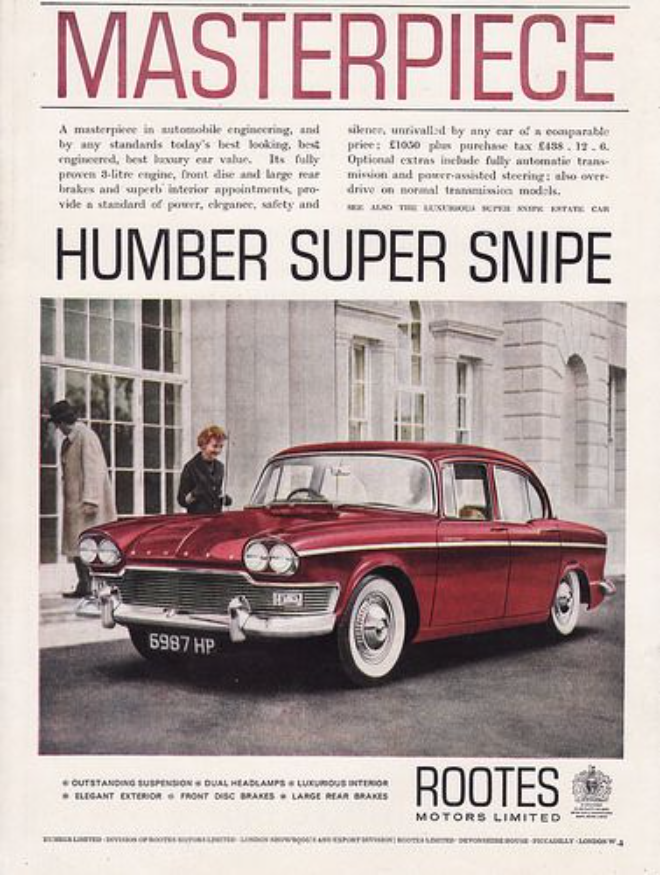
In addition to the camera up top, the interior of the Super Snipe was refitted so that the operator of all of the auxiliary equipment sat facing backward in the front passenger seat area. The generator, now separated from the rest of the equipment and mounted on a trailer, was based on an Enfield air-cooled motorcycle engine, according to the BECG, and was “reported to be quite noisy.” Here’s a video of it in action:
View this post on Instagram
The BBC used the Humber throughout the ’60s, but it wasn’t perfect, according to those close to the operation. From the BECG:
Robin Sutherland was at the Kendal Avenue OB base in 1969. He wrote: “The Humber had been transferred from Manchester and colourised with a Philips PC 80 camera. I do recall it was grossly overweight and chewed up back axles and half shafts regularly.”
By 1971, the BBC decided on a different estate car to use as the base for its Roving Eye camera on wheels: The Citroën DS Safari, the wagon version of the company’s iconic luxury sedan. It was chosen thanks to its revolutionary hydropneumatic suspension, which could, in theory, smooth out the rough ride—and therefore the shaky camera frame—generated by driving on the dirt and grass next to the horse track.
Considering how amazing the ride on these old Citroëns is, the concept behind the suspension is fairly simple. Each corner has a pressurized sphere in place of a traditional shock and spring, each filled with trapped gas and hydraulic fluid. Hit a bump, and the gas is compressed like a spring, while the incompressible fluid acts as a damper. A pump attached to the engine provided the pressure needed to keep the suspension level and for the driver to raise or lower the ride height. [Ed note: I believe there is also a fish and a balloon in there somewhere – Pete]
The DS isn’t exactly known for speed, but it was quick enough to accelerate and keep up with the horses, which topped out at around 30 mph. In 1973, a second DS Safari Roving Eye was built because the BBC was looking for even more performance, and the second car had a “larger or more powerful engine,” according to the BECG. This video gives us a good look at that second car, which includes a peek inside that reveals the rear-facing seating position of the operator.
The speed wasn’t just good enough for horses; it was good enough for airplanes and runways, too. One of the operators tells host John Noakes in the video above that, at one point, they had the car up to 80 mph to film a jumbo jet taking off at Heathrow airport. I wonder what sitting atop a Citroën DS as it cruised at that speed felt like. Probably pretty scary!
The suspension worked, but probably not as well as you suspected it might, at least according to Dave Taylor, one of the car’s operators. From the BECG:
“Not the best car for the job really, as the much-vaunted suspension was always fully pressurised due to the weight it carried, nonetheless it was exciting whizzing down the back straight at Newbury at nearly 80mph to pick up the horses for their second circuit. Health and Safety where were you?
“The roof was strengthened and a level base plate fitted; then the camera mounting was the pivot and seat from the top of a Vinten Falcon Dolly, bolted through the plate to a heavier duty bit of metal beneath. Camera sat on the usual Vinten Mk 3 head.”

Still, the DS performed well enough to be used into the 1980s, not just for moving shots, but as a mobile television studio that could record stuff like B-roll and interviews from anywhere. In place of the passenger seat was an analog video recording device, specifically, an Ampex VR3000 Quadruplex recorder, shown above.
By 1982, the DS had been out of production for some time, replaced by the CX, a more squared off but equally as quirky sedan and wagon. Like the DS, the CX used a hydropneumatic suspension setup, which meant it could perform the same smooth soft-roading next to the horse track. And that’s exactly what it did, using a similar camera gear layout, with a generator-trailer in the back. Citroën was proud enough about the BBC using its cars that it ran an advertisement promoting the practicality of its wagons:

The BBC’s use of Citroën wagons as Roving Eyes continued for decades, spanning from the DS all the way to the CX’s successor, the XM. By the time that version of the camera car went into service, the tech was advanced enough to no longer need a trailer to hold a generator. In 1993, the XM was transferred to working on Top Gear, according to the BECG, before eventually receiving a remote camera head, so that no one had to sit atop the roof.
Top Gear even acknowledged the BBC’s use of camera cars for horse racing in a segment where Jeremy Clarkson tested out the C6’s suspension against a BMW 5-Series. Obviously, it was the Citroën that proved superior for this admittedly very niche use case.
By the late 1990s, the need for four-wheel drive grip, more space, and higher speeds made the XM obsolete. The BBC turned to Volvo and its XC70 for the job, before eventually pivoting to Land Rover Discoveries. It’s unclear what happened to all of these Roving Eyes, but the XM gained enough of a cult following for people to make an entire recreation using another XM and period-correct equipment, from the roof-mounted camera to all of the tech found inside. Here’s a video touring that car at the UK’s Classic Motor Show back in 2022:
If only the BX 4TC rally homologation special, with its standard all-wheel drive, had caught on and gone mainstream, perhaps the BBC could’ve kept on going with Citroëns as camera cars. Alas, it wasn’t meant to be. Either way, I’m happy that the company’s fascinating pneumatic suspension found other uses beyond just delivering comfort and ride height adjustment.
Top graphic image: Citroën





I sat on that XM when it was at the NEC in 2022. Its owners very kindly allowed me to have a go with the camera kit on it as well. They were building a replica of the CX at the time, but I’m not sure if it’s been completed yet or not.
In my TV news photographer days (1980-1999), I got to shoot several races from moving vehicles of one sort or another.
The first was a marathon on a very cold December morning from the back of a pickup truck with a rented Schwem Gyrozoom mounted on the front of my Ikegami ENG camera. Riding in the back of the truck from the station to the starting line (about 15 miles) resulted in all of the lubricants in the Gyrozoom getting cold-soaked and too viscous for it to function properly. Fortunately, we had a satellite van at the starting line and its generator pumped out plenty of warm air to thaw things out in time for the race start.
I also got to shoot a couple of bicycle races on the back of a modified Honda Gold Wing 1500. It had a pillion seat that pivoted 270 degrees and had an arch of flooring around the rear wheel to use to pivot and stabilize. The guy piloting the motorcycle was awesome and it was so easy to get very cool-looking video from so many angles.
The last event I worked on, a triathlon, I didn’t actually shoot. I got to sit up front in a Hughes/MD 500 helicopter and operate a little switcher to go back and forth between the camera being shot with in the back seat and a microwave receiver catching a signal from a motorcycle/cameraman team on the ground.
These shoots each cost into five figures in USD for equipment rental and professional services. And these days, I could replicate at least 80% of the shots with a < $1,500 DJI drone.
“incompressible fluid”
I believe this is only true for people who aren’t engineers.
It’s one of my biggest bug-bears. Also currently a large professional challenge.
John Noakes is peak Blue Peter. Splendid British telly.
Had thought there was some footage shot from a car in this film, The Dog Outwits the Kidnapper, which was made either 1905 or 1908, but, alas, no, however the film is just so ridiculously charming, especially when the dog drives the car, that it’s still worth sharing: https://youtu.be/qApoxM41NGQ?si=GaBsnrgwUUW36B-J
“The first documented use of a camera car was in 1925 during the filming of Ben-Hur, where filmmakers used a purpose-built vehicle making 300 horsepower to capture chariots as they raced around an oval, according to the American Society of Cinematographers.”
That was a fascinating article! However, I’m pretty sure that 300 hp vehicle was used in the 1958 version of Ben Hur. While the original film was made in 1925, I doubt a 300 hp car or truck engine existed anywhere in the world at that time.
Oh, there were indeed some cars rocking that many HP back then, such as the Fiat S76, famously nicknamed the Beast of Turin, of 1910 which had at least 290 HP, if not actually more, thanks to its 28.3-liter (!!) 4-cylinder engine. (Yeah, that’s 7 liters *per* cylinder, lol)
https://en.wikipedia.org/wiki/Fiat_S76_Record
Ah yes, I forgot about the Beast of Turin! OK, so there might have been one or three engines in that power class in the world, but I’m willing to bet they weren’t used for camera cars. And anyway, the truck in the photos was definitely not big enough for such a monstrous engine. So I stand by my assertion.
It almost looks like a 1930s vision of a futuristic technical.
PEW! PEW!
I know most people think they’re ugly, but I still dig the look of Citroën’s wagons. Two or three always show up at the Queen’s English Car Show in Woodley Park: http://queens-english.org/
It’s a crying shame that PSA (and now Stellantis) have squandered Citroen’s legacy and stopped using their Hydropneumatic suspension system – its latest iteration the Activa version was unmatched by what penny pinching bean counters allow engineers to put in modern cars, no matter how much marketing departments polish the turd.
I agree! It was the main thing that differentiated Citroëns from everything else.
Sadly this reputation has been diluted over the years. Mercedes sold legions of cars with Active Body Control that also mark their parking spots with hydraulic fluid and exhibit an exaggerated limp to one side as a way of luring people to a service department.
I didn’t know that horses also had a “malaise era” of their own, or did horses also switch from gross horsepower to net horsepower at that time? (https://www.hagerty.com/media/archived/horsepower/)
1957:
This obviously heavy item was to prove embarrassing when the driver wished to accelerate, as a racehorse gallops at about 40mph
1971:
The DS isn’t exactly known for speed, but it was quick enough to accelerate and keep up with the horses, which topped out at around 30 mph
It had ties to Stellantis (then known as Chrysler Europe)..
This sentences is doing quite a bit of heavy lifting…
https://en.wikipedia.org/wiki/Rootes_Group
The Chrysler section of the Wikipedia page is enormous – and rather bewildering.
I know, right? So many former marques are now under the PSA and Stellantis banners it makes my head spin trying to keep track.
The most fun marque is Simca. Founded by Fiat to get around tariffs in France during the 30’s, gained independence after the war only to get bought by Chrysler in the 60’s, who mis-managed it and sold their European division to Peugeot in the late 70’s, and in now once again part of both Fiat and Chrysler with Stellantis. 😀
Didn’t SIMCA have a Ford of France link as well?
This reminds me quite a bit of Jeep…if you include the BRC, it has ties to: Austin, Willys, Ford, Kaiser, AMC, AM General, GM, VW (and Ford again in Brazil), Mitsubishi, Mahindra, Nissan, Hotchkiss, all now the mess at Stellantis.
Correct, Simca bought out Ford’s French division in the 50’s which allowed them to become the 4th largest car company in the country. This means that there was a time in the 60’s where one once could buy a French Chrysler with a Ford flathead V8 (converted to hemi heads) in the Brazillian market. It was called the Simca Esplanada.
Don’t forget American Bantam…
How many cheval were required to keep up with and record the cheval? I’m assuming more than two.
I thought chervil was an herb.
I’ve been hunting a Snipe for years. Never found one, though.
I imagine most of them have gone rusty and gotten scrapped by now.
So THAT’S why my mean cousin told me I could catch a bird if I shook salt on its tail!
That’s because they’re shy.
Need a Left Handed Smoke Shifter?
I have a very very nice 1/43 model of the DS one. The BBC commissioned them for some anniversary, how I ended up with it is very long story.
Jealous!
A photo please?
I found one one on Ebay, mine is the same https://www.ebay.co.uk/itm/206069855511?chn=ps&_ul=GB&mkevt=1&mkcid=28&google_free_listing_action=view_item
This is so cool!
https://www.ebay.co.uk/itm/206069855511?chn=ps&_ul=GB&mkevt=1&mkcid=28&google_free_listing_action=view_item
Nice toy,
Do you, after the wife and children have gone to bed drive the toys around making Brumm noises or is this a joint effort? My thirty old son brought to me a toy car, an apology for a breakage that had festered for years,
It is one of these
https://www.ebay.co.uk/itm/206069855511?chn=ps&_ul=GB&mkevt=1&mkcid=28&google_free_listing_action=view_item
Wow, it’s adorable! Thanks Nic. 🙂
Dang it. I was late to the game and caught Top Gear in its last years.
PS I like french cars
I LOVE French cars, but it didn’t start until I was over 40.
Made me think of an Elseworlds Ecto-1.