


General Motors has long been a leader in American small-block V8 power. GM V8s are often the default choice of engine swaps, and power millions of hard-working Chevrolet Silverados, Suburbans, and Tahoes, as well as their GMC and Cadillac equivalents. But there’s one GM V8 that seems to be a bit of a problem child, and it’s the 6.2-liter L87. Offered in current-generation GM trucks and SUVs, more than 28,000 L87 V8s failed before GM issued a recall for a fix. Now, over 6,000 fixed engines have failed, and the U.S. National Highway Traffic Safety Administration is launching a probe to figure out just what is going on here.
In 2019, General Motors launched an update to its Generation V small-block V8 architecture. The L87 succeeded the L86 that was in production since 2014. Power numbers between the engines are similar, but while the L86 used GM’s Active Fuel Management, which switched running cylinders between V4 and V8, the L87 uses Dynamic Fuel Management, which can choose from 17 cylinder deactivation configurations to save fuel. This naturally aspirated, overhead-valve V8, which is a part of the second-generation EcoTec3 family, features a cast aluminum block, a forged steel crank, forged powdered metal rods, and billet steel cams.


On paper, the L87 is a great engine. It’s the largest light-duty truck engine on the market, and with 420 horsepower and 460 pound-feet of torque on tap, it can practically pull a house. For many buyers, the 6.2 V8 sounds like the perfect option for their Silverado, Sierra, Tahoe, Yukon, Suburban, Yukon XL, or Escalade. Besides, General Motors has been slinging LS-derived V8s for around three decades now, and the platform has, for the most part, proven itself.

But the same seemingly cannot be said for the L87. Back in January 2025, we reported that the National Highway Traffic Safety Administration (NHTSA) opened an investigation into over 877,000 GM vehicles equipped with L87 engines after receiving a flood of reports about engine failures. Then, in April 2025, after more than 28,000 engines failed, General Motors finally issued a recall for nearly 600,000, citing “crankshaft, connecting rod, or engine bearing failure.” The prescribed fix was to inspect engines and, depending on detected wear, repair or replace affected engines as necessary. Engines that weren’t worn enough to warrant repair or replacement were instead put on a diet of higher-viscosity oil, a new oil cap, and a new oil filter; that’s it.
Normally, that would be the end of a recall, but NHTSA started receiving reports that supposedly fixed engines were failing, too. In January 2026, that resulted in NHTSA launching an investigation into whether the fix didn’t actually fix these poor engines. Now, nearly nine months and a pile of 6,050 allegedly failed engines later, NHTSA is once again investigating L87 failures. This time, the spread is even greater, with a population of 997,743 vehicles affected by the investigation.
Where This Headache Started

It’s been quite the ride to get to where we are today. Let’s go back to where this all began, with the 2025 story written by Zoe Skyforest that was apparently the calm before the storm:
Across all these vehicles, owners have found themselves suddenly facing a total loss of power when driving, only to later find out that major engine damage has occurred. The problem doesn’t seem to be limited to any one model year or model; instead, it seems to affect a range of vehicles with the L87 engine built from 2019 until today. It doesn’t take a genius to know that a sudden engine failure can leave you in a dangerous situation. The agency notes the severity of the problem, and the inherent safety risks—explaining that “Failure or malfunction of the engine results in loss of motive power of the vehicle, which may lead to an increased risk of a crash resulting in injury and/or property damage.” Thankfully, as of yet, no crashes, injuries, or fatalities are known to have occurred.
As it stands, NHTSA has received 39 complaints regarding the matter, with submissions stretching back several years. Submissions to the agency indicate the problems often tend to crop up suddenly, without prior warning. At best, some owners hear strange noises or ticking, or get a warning for low oil pressure as the engine seizes up. In some cases, the issues have occurred in trucks with under 5,000 miles on the clock, with NHTSA recording multiple cases of total engine failure under 20,000 miles. However, some vehicles have approached 100,000 miles before failure.
Interestingly, some owners cite that their problems first became apparent when the vehicle suddenly shifted into neutral, only for them to later find the true issue to be major engine damage. Others have found they are able to restart their vehicles after an initial loss of power, only for the problem to reoccur. Most cases, however, seem to involve a single sudden incident where the engine loses power and totally seizes up. In many cases, the engine has suddenly failed while owners are traveling at highway speeds, leaving them with zero power in a dangerous situation. “While driving on a busy road our vehicle stopped from catastrophic engine failure without warning which put my family and I instantly in danger and nearly got us killed,” stated one shaken owner. “Due to the high traffic where it stopped we were scared to stay in the vehicle and also scared to exit it, so we contacted the police before calling a tow truck.”

General Motors conducted an investigation, which was completed in April of that year. It found a staggering 28,102 complaints or incidents allegedly involving failure of the L87 engine. According to NHTSA, 14,332 of those complaints cited a “loss of propulsion.” GM responded by immediately recalling 597,630 vehicles built from 2021 to 2024. In the recall, GM said that the root cause of the L87’s failures was manufacturing issues regarding the engine’s internals. From the recall:
GM’s updated field data analysis identified a build period from March 1, 2021, to May 31, 2024, with an increased rate of potentially related engine failure claims. GM’s investigator reviewed findings from teardowns of field engines and data from a study of new, unused crankshafts. Supplier manufacturing and quality issues were identified at intermittent periods within the suspect build period, including (1) rod-bearing damage from sediment on connecting rods and crankshaft-oil galleries; and (2) out of specification crankshaft dimensions and surface finish. These issues an cause or contribute to bearing damage that can lead to loss of propulsion and engine failure.
Sadly, not all of those who experienced an engine failure were able to safely pull off the road. Per GM’s investigation, L87 failures could have been a contributing factor in 12 crashes, 12 injuries, and 42 fires.
As I said earlier, the affected engines were ordered to have their internal components inspected and either repaired or replaced. Per the recall, replacement parts for these engines were “produced after the suppliers’ suspect manufacturing window.”
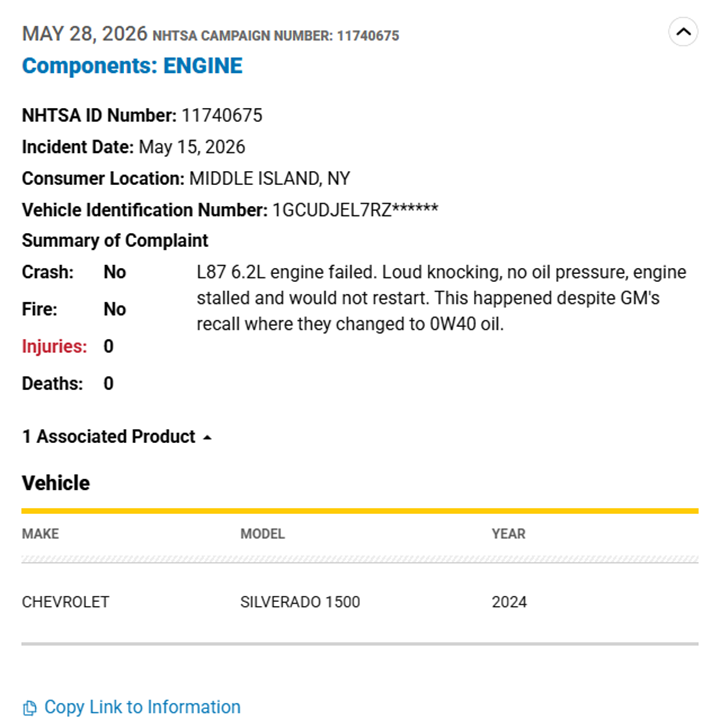
In January 2026, NHTSA opened a new investigation after receiving 36 reports of post-fix engine failures. It wasn’t just those who got new engine internals either; people who received entirely new engines also reported failures. Now, things have seemingly gotten worse.
A New NHTSA Investigation And A Class Action Lawsuit

Today, NHTSA has announced a probe into 997,743 vehicles after having received over 6,000 complaints alleging post-fix engine failures. From NHTSA:
General Motors (GM) issued Recall 25V-274 to address concerns of engine failure in the L87 engines produced between March 1, 2021 and May 31, 2024. GM cited the root cause as a supplier manufacturing and quality issue. GM’s recall remedy for Recall 25V-274 consisted of two different repairs, either an oil viscosity change or an engine replacement, based on the results of the remedy inspection procedure. ODI continues to receive reports of engine failures after the completion of the recall remedy.
To date, ODI has received 499 complaints alleging post-remedy engine failure in vehicles subject to Recall 25V274, 473 of which involved an oil viscosity change and 26 a complete engine replacement. Additionally, ODI has received 191 reports of L87 engine failures in engines produced after the production period cited in Recall 25V-274. GM reported receiving 6,953 complaints of post-remedy engine failure.
The vehicle population in this investigation covers 2021 through 2026 model-year GM models equipped with L87 6.2-liter V8s. Specific models are not mentioned. NHTSA has found overlaps in the complaints it received and the complaints GM received (some people reported an alleged engine failure to both organizations), and thus, the population of allegedly failed fixed engines is 6,050 units.
NHTSA says that this new investigation expands the scope of the aforementioned investigation that it launched in January of this year:
ODI is opening this Engineering Analysis to continue investigating complaints of post-remedy engine failure. ODI is expanding the scope of this Investigation to include engines produced after the production period cited in the recall.

General Motors has also faced multiple class action lawsuits. In February, a federal judge consolidated all of these complaints into one large class action suit. Filed in the United States District Court For The Eastern District of Michigan in February 2026, the 389-page amended complaint from 45 named plaintiffs alleges, among other things:
4. The L87 Engines consistently experience sudden failure, resulting in loss of motive power and propulsion during vehicle operation.
5. The engine failure arises from loss of lubrication between the crankshaft and the bearings (the “Defect” or “L87 Engine Defect”).
6. The sudden loss of power caused by the Defect, often while a vehicle is being driven at high speeds, significantly increases the risk of a dangerous crash and/or injury.[…]
11. As explained herein, the recall is egregiously inadequate.
12. The recall does not cover all Class Vehicles, despite NHTSA identifying all Class Vehicles as being associated with the Defect, and despite numerous reports of engine failure in non-recalled Class Vehicles.
13. The recall, moreover, does not provide for any repair unless vehicles fail certain dealership inspections. As alleged below, there are numerous reports of vehicles “passing” inspection, only to suffer from sudden engine failure shortly thereafter.
14. Additionally, there are reports of post-recall engine failure in vehicles that did receive an engine replacement pursuant to the recall.
15. Indeed, on January 16, 2026, NHTSA opened a new investigation specifically related to post-recall engine failure in the Class Vehicles.
16. Further, the recall mandates a change in oil for Class Vehicles that do not receive an engine repair or replacement. Specifically, the recall mandates that Class Vehicles that were previously instructed to use 0W-20 oil switch to the higher viscosity 0W-40 oil.
17. Not only is this change in oil ineffective in addressing the Defect—as recognized by NHTSA, there have been numerous reports of Class Vehicles suffering engine failure after switching to the 0W-40 oil—but it imposes new costs on vehicle owners and lessees for which they did not bargain.
18. The 0W-40 oil is more expensive than the 0W-20 oil that GM instructed to be used with the Class Vehicles at the time of sale.
19. The 0W-40 oil, moreover, results in decreased fuel efficiency, leading to significantly greater fuel costs over the period of ownership or lease.
20. The Class Members, as defined herein, did not receive the safe, dependable, and fuel-efficient trucks that they paid for; but, instead, received vehicles that impose greater operating costs and that subject them to a significant risk of sudden engine failure. Had Plaintiffs and Class Members known of the Defect at the time of sale, they either would not have purchased these vehicles or would have paid less for them.
Since then, there have only been standard court procedural motions and document filings without much to note. Lawsuits can take years to work their way through the courts, so we may not see a resolution to this class action for some time.
Anecdotally, continued complaints on online forums do seem to back up the reports that these engines might still be having some issues, and that’s sad. The good news is that, for those who are going through this, GM does have a remedy. Previously, GM told us that engines that received the recall work are covered by a “special coverage program” that warranties the engine for 10 years or 150,000 miles from when the engine was first placed in service, whichever comes first. Since all of these engines are younger than ten years old, a bulk of people still dealing with issues will be able to get another engine or repair done for free. That’s great!
I have reached out to General Motors for comment about this new NHTSA investigation, and for comment on if it knows what’s causing this latest spate of issues. Here’s what I got back:
“The safety and satisfaction of our customers are the highest priorities for the entire GM team, and we continue to cooperate with NHTSA’s evaluation of this matter.”
Based on our reporting on this issue over the past year and a half, it’s understandable that some owners have lost confidence in their engine’s ability to go the long haul. The warranty is great, but it is a legitimate concern to wonder what will happen when your truck or SUV is no longer covered by it. So, whatever is going on here, hopefully the cause is found, and there’s a working solution.
Correction (Aug 22, 2026 10 AM ET): We added hedges to the headline since the figures for engine failures are based not only on field “incidents” reported by GM to NHTSA but also on field “complaints.” We can’t be 100% sure that all engine failure complaints are valid, so the number could be lower, though it could also be higher; best to hedge.
Top graphic images: GM




Geez. And there’s so much hate online for the L3B.
If I were to ever get a full-size pickup, it would be a regular-cab 2WD with the L3B.
They just need to drop the price about $10K.
Did you see the number of failed engines?
“Did you see the number of failed engines?”
Looks like 12.
“General Motors identified only 12 L3B (2.7L Turbo/TurboMax) engine block failures due to a specific manufacturing casting defect in the main oil gallery. GM addressed these catastrophic block cracking cases under a targeted customer satisfaction program by replacing the entire engine assembly free of charge. [1, 2, 3]
Known Issues and Technical Service Bulletins
While total catastrophic failures remain exceptionally rare, GM has issued service bulletins and updates for other non-catastrophic components across the 2022-2026 Silverado, Sierra, Colorado & Canyon 2.7L models: [1]
12 is a lot less than 28,000.
Strange how Ford’s 2.7 and GM’s 2.7 are both of their respective manufacturers most reliable engines. And to think of the old timers who pooh pooh small turbo engines
A 2027 regular-cab short-box 2WD pickup in Black with the new L4B 2.7L turbo with aluminum wheels would be a great sleeper pickup. The 2026 L3B has 310 horsepower and 430 lb.-ft of torque, and the 2027 L4B version is supposed to improve on those numbers and also have the 10-speed transmission, at least in the Silverado and Sierra. The Colorado/Canyon twins still get the 8-speed.
Imagine getting through the staging lines at a drag strip with it and being next to an early ’90s 454SS pickup and having to explain afterwards how they just got beat by a 4-cylinder truck.
At 55+ years old, I’m probably what you’d consider an ‘old-timer’. 🙂
I’ve had a similar thought about the Turbomax. It sounds odd to think a fullsize has a 4 cylinder, but that 2.7 makes more hp/tq than the TBI 454.
I’m sorry but a warranty extension isn’t nearly enough. Buyers will lose the use of their vehicles, ruined travel plans, and massive depreciation because GM thought they could slide this one by. If your motor blows while you are towing your travel trailer in remote areas YOU are paying to have it towed back to your house, not GM.
Driving a loaner while you are making payments in your $100,000 suv is comically absurd.
GM went cheap on component quality and they need to pay for that decision.
what is interesting is how these are the LUXURY cars and instead of the owners pulling their MASSIVE resources together they figured .. just buying a new truck is easier. consumers, literally lay down and let themselves be walked all over!
That’s the good news for GM, people who buy cars aren’t as forgiving of this sort of crap, which is part of what gradually destroyed GM’s passenger car business, but, when it comes to domestic brand full size trucks and SUVs, people will keep coming back for more, regardless
ha ha you think dealers still offer loaners
My dealer is down to two. TWO whole loaners. You got to reserve weeks in advance. Cheap bastards.
Don’t dignify those dealers by calling them cheap bastards. They’re just bastards.
GM has a monumental issue on their hand… but brand loyalty is more addictive than any narcotics out there..,
The advantage of buying old tech is the hope it will at least be reliable. This is literally the calling card of a 6.2L na v8 vs an ecoburst 3.5L.
But no, they just had to screw it up. And then screw up the recall. And here we are again.
All the while those Ecoboost engines are trucking along just fine, and making more torque along the way
Two friends have lost their ecoboost raptor engines around 120k miles, replaced them for new engines, and they blew up again around 200k miles. They are now on their third engines. Father and son.
Which doesn’t mean they are more or less reliable than the 6.2 Chevy engine, just that one of the calling cards of a simple, ancient na engine is the reliability. And it seems like Chevy really messed up here.
The Gen 2 3.5 Ecoboost in the 17-19 Raptors is notorious for cam phaser failure. Luckily there is an updated part that seems to have resolved that issue.
Before I let my last employer, my company vehicle was a 2016 with the 3.5 EcoBoost V6 and I had to drop it off to the dealer for its 2nd transmission and its THIRD ENGINE. It has just under 170K miles.
The thicker oil band-aid has led to many people wanting to use thicker oil in whatever they drive. This is going to be a problem down the road. The tighter tolerances can’t handle thicker. It bothers me that GM, Ford, Toyota and Honda all get passes for their defective engines and every other manufacturer gets raked over the coals. You pay your money and you take your chances. I don’t care who builds it.
Y’all said “LS swap” too many times and the universe was like “bet”
that would be interesting, someone just swapping a ls3 into a brand new truck i would love to see that build.
It’s a shame no one predicted this.
I said back when the “fix” was first announced that if I owned one of these I would have had the recall done and immediately turned around and sold it back to the dealer. Yes, I would probably take a bath on the value given the bad press, but an unreliable engine is not worth any amount of money to me, especially after being stranded by one from a different manufacturer a couple of years ago.
I also saw a Yukon Denali parked on the side of the Beartooth highway this summer with its hood up. I wondered if it was this failure, and even if it wasn’t, that’s a perfect example of why I wouldn’t risk it. We were not only many miles from help, it was probably double digit miles in any direction just to get cell service to call a tow truck (which would be obscenely expensive someplace that remote). Fortunately it’s a heavily travelled road so I’m sure they were able to hitch a ride to civilization, but I’ve been places where that is not the case and walking out would be literally dangerous.
As a current GM owner, I hope the class action lawsuit from this hits their wallet hard enough to make them think twice about pulling this kind of stunt again.
GM learn a lesson about quality and durability?! Ha!
This is just lather, rinse, repeat on another in a long series of lather, rinse and repeat.
Squeezing the suppliers and not checking on what’s in the crates seems to be the way of business for many automakers. Hyundai/Kia could teach GM a thing or two about how to handle the massive defective engines situation, or perhaps how not to handle the situation.
Maybe they can borrow a Toyota hammer to check the motors before they recommend an oil viscosity change.It really doesn’t matter because the majority will just buy another GM truck anyway.
Been following this on you tube channels for at least a year. Extended warranties are nice, but not so much when the wait for replacement engines can be a few months, all the while still making the monthly payments on a truck that is a parked in the back of a GM dealership.
This is a big reason why I picked a Turbomax equipped model. When researching these trucks there are endless threads about catastrophic engine failure at very low mileage.
What I found amusing though were the owners who were bragging about their trucks getting to non-impressive mileages like 60k with no explosion. Most chaulked it up to doing things like change their oil every 3k.
Sounds like 1960 again.
It’s crazy that the two best 1/2 ton engines on the planet right now are 2.7L.
I’m sure they’ll be cost-cut to unreliability in another generation or two (Ford already started with the wet belt on theirs), but the current truck market really buries the whole “no replacement for displacement” thing.
It felt weird getting a full size truck with a 4-banger. But man, I have nothing bad to say about this motor other than it sounds like a Toyota Camry when it starts up. I’ve teased 25mpg out of it on long road trips. It also pulls our 5k camping trailer like it’s nothing, even up steep grades at 8000ft. That motor just hits a sweet spot at 2500 rpm and pulls.
I don’t like trucks or want one, but if I did the perfect truck would use the hurricane i6 mated to a zf8 and installed in a Tacoma body with upgraded axles so it can tow a 9000lb enclosed trailer.
I understood your post up to the point where you mentioned the Tacoma body.
You might want to get your vision tested. Those things are UGLY.
20:10 in left eye and 20:15 in right eye… I agree with you, but I think every other truck is even uglier other than the Frontier, and regardless of which interior you prefer, I just don’t trust Nissan’s electronics + everything else the same way I do Honda or Toyota.
3.0L Hurricane is looking pretty good so far too.
These engines are apparently junk, but 10k oil changes (or whatever extended interval the vehicle tells you) are way too long in my opinion. Longest I’ll go on anything is around 5k.
Long, long ago, I had an ’81 watercooled VW that I religiously changed oil every 2k. I normally did the filter every other change, as my dad recommended. I lived in a college town, my job was only 2 miles away, so it wasn’t an excessive interval. I was dead-ass broke and doing the changes myself.
It had 241k on the clock when I sold it. The next owner had to have the head gasket replaced, the mechanic told him it was the cleanest engine internals he had ever seen.
Oof, I think we all knew GM’s response of “uhhhhh… higher viscosity oil???” was a hope and a prayer. This is some pretty severe malpractice by GM, as this is their bread, their butter, their everything. The lack of urgency gives Ford Powershit vibes, except this time it’s a product that makes literally all of the money.
These failures are a hot topic for all the truck bros I work with. This is not good for GM.
Don’t get me started on Ford’s PowerShit BS. Ford has lost out on the sale of 6 (a drop in the bucket for Ford but still) new cars to date between my wife and I.
I wouldn’t ever touch a Ford again either if I had personally experienced that debacle.
I first heard about these issues last year watching the YouTube for Towtruck Dustin. He’s towed a lot of these vehicles.
Among other GM issues, like the fuel control modules.
This is a sad day for GM. I am a staunch LS swapper and love the LS engines in general, but this 6.2 is trash. Oddly enough the 5.3L doesnt seem to have nearly the same failure rates, and while the current corvette 6.2 does seem to have some similar failures its a much lower percentage (even when accounting for the smaller volume). The pushrod V8 is GM’s #1 calling card and this just destroys that reputation, even if GM can still make some amazing ones like in the CT5 blackwing.
The weirdest thing to me is these failures are seemingly not tied to the active fuel management directly, but just straight up shoddy tolerances/poor quality control of the bearings and oiling system. I am glad GM is putting a big warranty on this but they needed to nail the fix in a single shot to save any reputation here and it looks like that is not happening…
I was thinking of the 5.3 while reading this article. Although on paper it suffered in comparison to the competing Hemi and Ecoboost engines, I don’t remember ever hearing about any systemic reliability issues with the 5.3. It seemed like GM was putting it in every truck for a decade or more, with no changes or updates. If it ain’t broke…
Yeah why didn’t they just slap a turbo on it, rather than develop a whole new larger engine and have to spend on the manufacturing overhead?
Because 6.2 > 5.3 for the derp buyer
“special coverage program” we will replace your garbage 6.2 with a new garbage 6.2. Great!
Point 19 in the complaint has me laughing. Like anybody who buys these things gives a damn about fuel economy.
The buyers don’t, but the EPA did.
Fleet buyers do.
By the way your avatar and name are awesome… Anything worth doing, is worth doing right.
Mindboggling that GM, the company practically synonymous with ‘pushrod V8 engine’ could screw this up so badly.
Considering I’ve heard things such as “old GM V8’s could last thousands of hours as a mule for durability testing other parts, but any new ones fail within a few hundred hours”, I’m guessing these articles will continue until all these vehicles are junked/recycled.
Largest, yes, but it’s outpowered by the HO versions of both the Hurricane and 3.5 Ecoboost (to say nothing of TRXs and Raptor Rs).
And the SO Hurricane is on par with it too, so even if they don’t count the EB3.4 or HO Hurricane for whatever reason, there’s still a somewhat comparable engine.
Yep, even the old 5.0 is still pretty close with a whole 1.2 liters less displacement
SO Hurricane gets it by 9Ft Lbs.
I swear, the Stellantis engineers must have been laughing like Beavis and Butthead when they came up with the 420/469 power numbers.
This has to be the plot of some redneck Twilight Zone episode where someone drunkenly wishes all the EV trucks out of existence but it results in all the V8s blowing up leaving a world stricken with only 4 cylinder full size trucks.
The missing plot link is probably just the redneck telling a genie “I wish my V8 had the power and torque of an EV motor” and not thinking to ask for the durability part.
You mean an oil change and a sticker didn’t solve the problem who would have thought.
Wow, the lengths to which GM will go in order to compete with Toyota! 🙂
It looks like they both started copying each other’s homework at the wrong moment.
Ford execs taking a brief sigh of relief, until the next one. See you Tuesday.
Failed on my 2016 too. GM has known about this for years. This impacts considerably more vehicles. If you own one, get out while you can.
10 years or 150000 miles warranty is sufficient.
It’s not because you are still without your vehicle for weeks to months. Also, the warranty doesn’t cover your ruined vacation or the bill to tow your travel trailer back home.
If it renews every time the engine blows up. You could have a Neverending warranty.
Wow, who’d have guess major design error can’t be fixed by an oil change?
Why do you think it’s a design error when all indications are it’s manufacturing errors.
I’d say some of both. The designers pushed the tolerances to the limits to max. out the fuel economy, ignoring what could be manufactured to any sort of acceptable yield. Then the supplier(s) either asked for spec. deviations or fudged their QA measurements to fill GM’s orders with parts that were sub-optimal.
Another guess: GM approved Supplier “A” (say, crankshafts) to deviate to “x.x”, then someone else approved Supplier “B” (say, rod end bearings) to deviate to “y.y” based on the individual part drawings–but nobody realized that the combination of the two wouldn’t work…