


Since starting my Jeep obsession in 2003 (when my family moved to the U.S. from Germany and my dad purchased a 1998 Jeep Grand Cherokee), things have gotten wild. I bought a 1992 Jeep Cherokee XJ against my father’s wishes (“You don’t need a car in Charlottesville!”), I then studied engineering so I could work for Jeep, then I moved to Michigan after landing that job and began amassing an absolutely epic fleet before moving to California where my obsession has only marginally improved. Needless to say: I have owned tons of Jeeps; but there are still three I still want to own before I head to the great junkyard in the sky.
I’m going to list out every Jeep I’ve ever owned, since I don’t think I’ve ever done this:


- 1992 Jeep Cherokee
- 1996 Jeep Cherokee 5-speed
- 1995 Jeep Cherokee
- 1991 Jeep Cherokee 5-speed
- 2000 Jeep Cherokee
- 1994 Jeep Grand Cherokee 5-speed
- 1993 Jeep Grand Cherokee 5-speed
- 1993 Jeep Grand Cherokee
- 1994 Jeep Grand Cherokee 5-speed
- 1994 Jeep Grand Cherokee 5-speed
- 1991 Jeep Wrangler YJ 5-speed
- 1991 Jeep Comanche
- 1992 Jeep Comanche MJ 5-speed
- 1976 Jeep DJ-5D “Postal Jeep”
- 1986 Jeep Grand Wagoneer
- 1987 Jeep Grand Wagoneer
- 1985 Jeep J10
- 1979 Jeep Cherokee Golden Eagle
- 1957 Willys FC-150
- 1958 Willys FC-170
- 1948 Willys CJ-2A
- 1954 Willys CJ-3B
- 1941 Ford GPW
- 2026 Willys MB

As you can see, I have an affinity for flatfender Jeeps, SJ-Jeeps, and AMC-era Jeeps. And I’ve been blessed to own 24 of them; that’s a lot of Jeeps! And yet, there are still three that I hope to own before the sun sets on this grand Jeep adventure I’ve been having since I was 12 years old. Here they are:
The Ugly Brazilian Ford

The very first gasoline engine made in Brazil was the Willys BF-161, an inline-six engine based on the F-head “Hurricane” inline-four found in U.S.-built Willys Jeeps like the CJ-3B, CJ-5, and FC-150.
Here’s a bit more about the motor, courtesy of a social media post that’s been shared all over the web but appears to have originated on the LinkedIn of someone named Glenn Warrington (who tends to write about auto history on the platform):
In 1955, Willys-Overland stopped building passenger cars in Toledo, Ohio. The Aero line was dead. Kaiser had bought the company, moved production to Argentina and Brazil, and refocused the American operation entirely on Jeeps. The 161-cubic-inch inline-six that had powered the Aero Willys sedan disappeared from the American market without ceremony. Nobody mourned it. The engine made 90 HP. It was adequate. Not exciting. Not memorable. Just an inline-six in a compact car that nobody was buying. In Brazil, the same engine was just getting started.
Willys-Overland do Brasil began manufacturing the BF-161 on March 7, 1958, at its engine plant in São Bernardo do Campo, São Paulo. It was the first gasoline engine ever manufactured in Brazil. The first. Every Brazilian-made gasoline car before it had used imported engines. The BF-161 changed that. The BF-161 was an American design built with Brazilian hands. 161 cubic inches (2,638 cc). Six cylinders in a line. Bore: 3.125 inches. Stroke: 3.500 inches. Overhead valves operated by pushrods from a cam-in-block configuration. Seven main bearings for smoothness and durability. One-barrel carburetor. 90 HP at 4,400 RPM and 135 lb-ft at 2,000 RPM.
The block was cast at Willys’ foundry in Taubaté, São Paulo…By 1967, displacement grew to 3.0 liters (184 cubic inches) with a stroke increase to 4.000 inches, producing 140 HP in the Itamaraty luxury sedan. The same basic architecture. The same bore spacing. The same foundry. Thirteen years of continuous development on an engine America had discarded. The BF-161 powered everything in the Brazilian Willys lineup: the Aero Willys sedan, the Rural Willys (a station wagon/utility vehicle based on the Willys Jeep Wagon), the Willys pickup, and the Brazilian CJ-5 Jeep. It was the common engine across the entire range, which meant every Willys dealer in Brazil stocked the same parts, trained the same mechanics, and serviced the same engine regardless of whether the customer drove a sedan or a Jeep. That commonality made the BF-161 the backbone of Willys’ Brazilian operation. Farmers in the interior used it in Rural Willys wagons on unpaved roads. Taxi operators in São Paulo and Rio de Janeiro ran it in Aero sedans for hundreds of thousands of kilometers. The Brazilian military used it in Jeeps. The engine ran on Brazilian gasoline, which was low octane and often inconsistent in quality. The 7.6:1 compression ratio wasn’t a performance choice. It was a survival choice. The engine had to run on whatever fuel was available in a country with limited refining infrastructure.
The engine is iconic, though it’s the Rural that I’d like to focus on. Designed by automotive icon Brooks Stevens, it’s built on the same bones as the Willys Wagon sold stateside, except it looks way, way stranger. Here’s the Willys Wagon:

And here’s the Brazil-market Willys Rural:

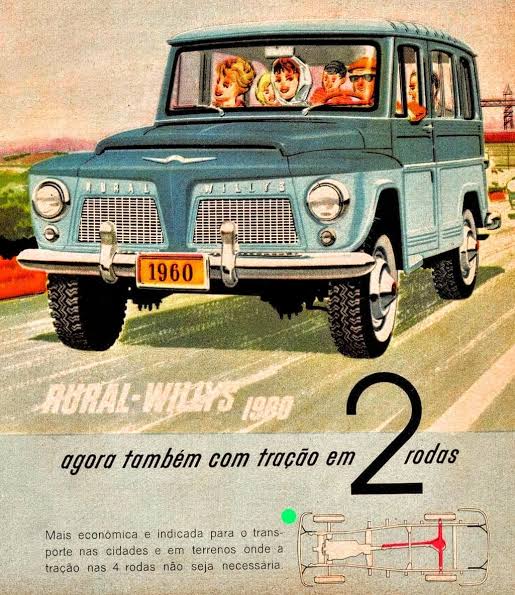
What I find charming aside from the hilarious looks is the fact that Ford bought the Willys Factory in 1967 and continued building the Willys vehicles — including Rurals and the pickup version, the F-75 — well into the 1970s, branding them as Ford Rurals:


By the way, I translated that last ad, and it’s…uh, weird:

Sexist ads notwithstanding, the Ford rural was amazing. It has styling and a powertrain unique to Brazil, so to see one here on American roads would just be amazing. Someday, I must own one.
The Ugly Australian Workhorse

Speaking of ugly Rest-Of-World Jeeps, there is the Jeep CJ-10. Offered in the U.S. as a rear-wheel drive military aircraft-tug (it was locked into low range), the CJ-10 sold in Australia was much different. It was a useful pickup called the “One Tonner” due to a payload rating of one metric ton.
The truck was manufactured in North America, but shipped to Australia as part of a “Complete Knock-Down Kit” (CKD kit). Upon arrival in Australia (Brisbane, Queensland), workers took all the parts out of the crates and assembled the Jeep, appending the CKD parts with local ones. Engine options included a 3.3-liter Nissan diesel or the AMC 258 inline-six. Here’s an amazing brochure uploaded by Flickr-er John Lloyd:


Finding CJ-10s in Australia that have not had their “trays” (i.e. beds) replaced with homebrew ones is basically impossible, but someday one will pop up, and if that happens after The Autopian strikes it big, I’m buying it.

A blend between a Jeep CJ-7 and Jeep J10, the 1981-1985 Jeep CJ-10 may look hideous to some, but that’s why it’s so alluring.
The Jeep I Helped Engineer

In my just-over-2-years as an engineer at Chrysler, I helped lay the groundwork for the Jeep Wrangler JL’s cooling system. I also worked on the JT Gladiator, Ram, and some on other Chrysler products, but the majority of my time at the company was making sure the JL’s cooling system was up to snuff.

It was an amazing experience getting to see the design of the vehicle change over time, and to sit in on the “Chunk Team” meetings in which compromises were discussed.
The opportunity to significantly influence the design of a vehicle so iconic is something for which I will forever be grateful. It’s also the reason why I have to own a JL someday. To be be able to point to my own car and say “I helped design that” is about as cool as it gets.
Top Image: Jeep


Ahem: Get the CJ4A successor which somehow feels more old school
https://en.wikipedia.org/wiki/Mahindra_Major
I’m shocked a Jeepster isn’t on this list, there was even a Hurst Edition
Kinda seems like you are asking a lot with those first two. Good luck, David.