

The new Toyota RAV4 is very good, this much is true. Is it so good that you should wait for one over a Honda CR-V Hybrid? That’s a matter of preference, I suppose, but I find it hard to swallow waiting weeks or even months for a mainstream, high volume car. I guess I’m alone, because RAV4s are selling at a wild rate and the waitlists keep growing.
Some of this is caused by the predictable and common switchover between generations, as the plants that make the newly redesigned RAV4 had to retool in order to make the vehicle. A lot of it is just extremely strong demand for the popular, efficient, reasonably affordable crossover. In order to help with the demand RAV4 Hybrids are starting to finally roll out at the company’s Georgetown, Kentucky plant, and that should provide an additional 40,000 units a year.


Will that be enough? Probably not. There’s no breakdown last year between hybrid and non-hybrid sales, but the company sold more than 400,000 of these things last year, and the new car is hybrid only, so I expect it to sell the same or even better. Why do I believe that?
From Selling Days To Selling Hours
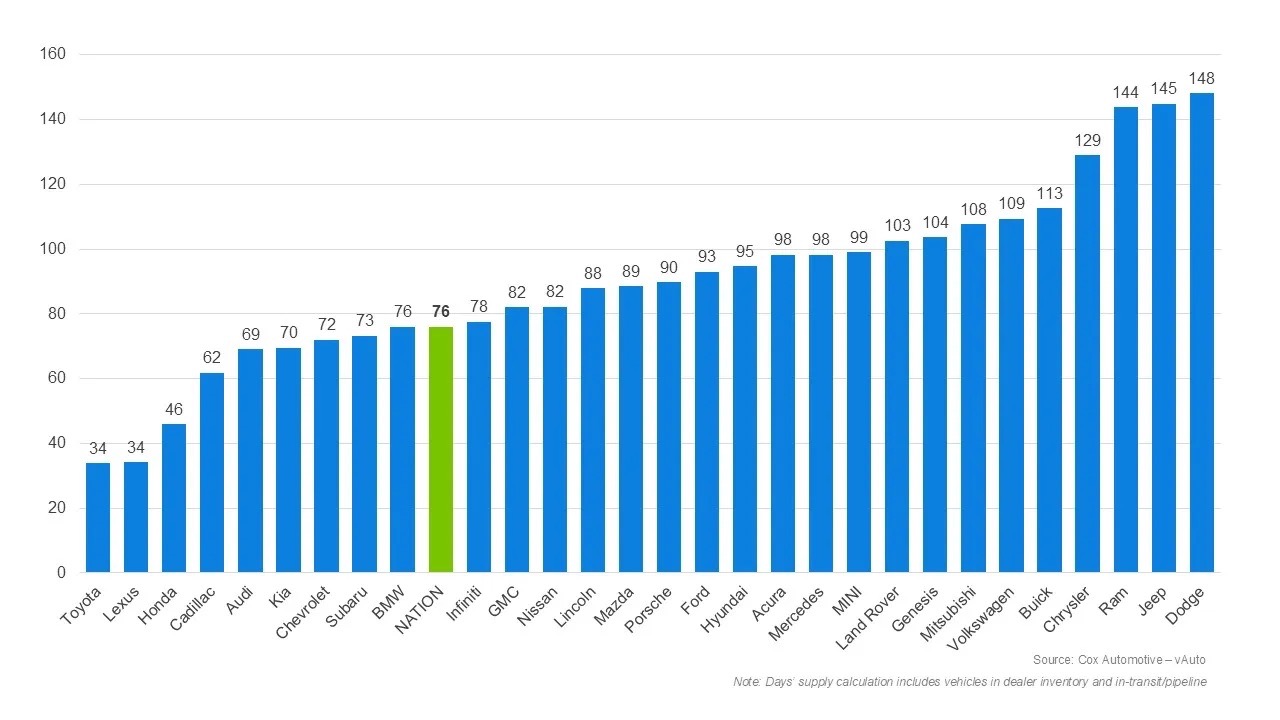
I write about the chart above all the time, that is produced by Cox Automotive and shows the amount of inventory for each brand and the nation as a whole, which it measures in Days’ Supply, which is to say the number of days at the current selling rate it would take for all the inventory to be depleted. The national average is about 76 as of May, with Toyota and Lexus way at the left with barely a month’s worth of inventory due to how popular its cars are and how tight its production.
For the RAV4, at least, days is no longer an accurate measure. According to Automotive News there’s a new figure:
On June 16, the nation’s 1,237 Toyota dealers collectively had 967 unsold RAV4 hybrids and 719 RAV4 plug-in hybrids.
At least that’s what they started with that morning — but not where they ended that night.
“It’s so hot, we’re counting inventory in hours’ supply right now, not days,” said Damon Rose, vice president of sales for the Toyota division of Toyota Motor North America. “Our turn rate was 97.6 percent last month — that means 97.6 percent of RAV4s available for sale in May were sold. I never thought I’d live long enough to hear about a statistic like that, but it just speaks to the demand we’re seeing for [our] bestselling vehicle in the United States.”
Selling hours is wild! By comparison, it takes Dodge 148 days to sell out of its inventory, and that number is an average, so cars like the Dodge Hornet are probably even higher.

Is Mr. Rose being hyperbolic? I don’t think so. If a dealer gets an allotment or 40 new RAV4s a month and there’s a waiting list of more than 40 people than it takes less than a day to sell a car. According to Automotive News, that’s happening:
At Longo Toyota in El Monte, Calif., more than 800 customers are waiting for a 2026 Toyota RAV4 — and that waitlist keeps growing despite the dealership delivering over 200 of the redesigned crossovers in May alone.
And Earl Stewart Toyota in Lake Park, Fla., presold each of the 40 new RAV4s offered on its website, weeks or months before delivery.
While markets vary, this is a car that’s popular coast-to-coast, so even if a one-off rural dealer is sitting on the car it makes sense that overall demand has outpaced production. Will this last forever? Probably not. With the addition of Georgetown, the plants will likely catch up at some point. If you don’t want to wait, though, there’s a good alternative.
Why Not A Subaru Forester?
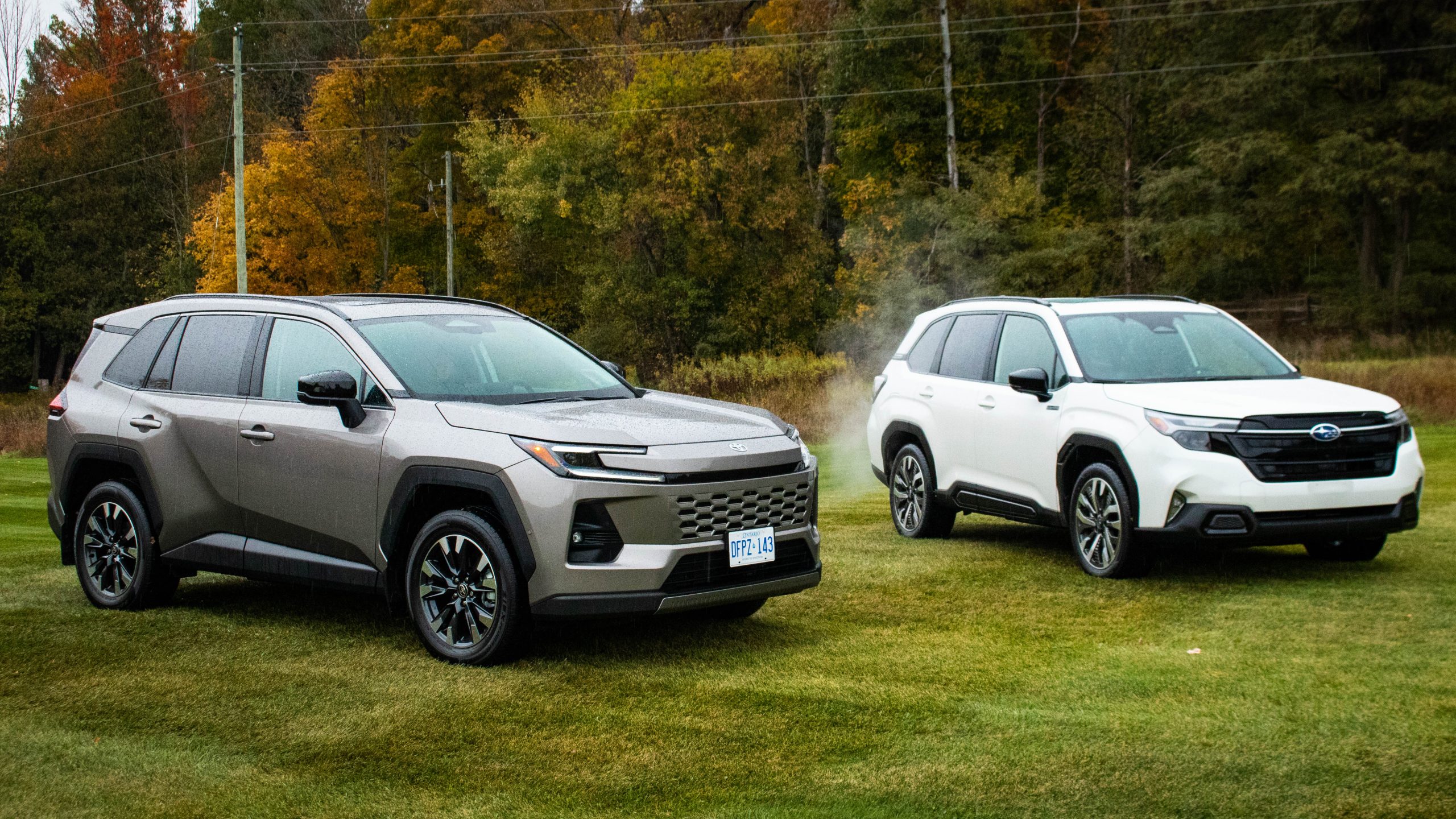
Because Toyota owns part of Subaru, the related companies share a lot of the same technology and the new Forester has similar performance to the RAV4. Thomas drove both of them back-to-back, and had this to say:
It’s safe to say the new Toyota RAV4 going all-hybrid is a big deal, because it means more people than ever will be able to experience awesome fuel economy for the segment. Between efficiency and the sheer range of trims on offer, the 2026 Toyota RAV4 is the best hybrid in its class, and it features a pretty slick new tech suite that’s remarkably user-friendly.
However, if you’re the sort of person to buy a car based on purely physical attributes, the Forester Hybrid feels like a better crossover. It has a bit more passenger space, a bit more comfort, and a bit more soft-road capability. Both are great choices for a daily driver, but if it were my money on the line for a U.S.-spec example and I had to buy one, I’d personally take the Subaru.
Just buy a Forester! Words you’re definitely used to me saying… though I personally bought a CR-V Hybrid, which has been great so far.
Top graphic images: Toyota; DepositPhotos.com


Folks should really consider a Toyota Crown Signia as a good alternative. It’s relatively price competitive and a lot nicer inside (my opinion). Sure, it’s more of a tall wagon than SUV (Subaru Cross-Trek like), but it’s great!
I’m sure a few customers would consider it as a switch vehicle rather than waiting for the RAV, but they’re also few and far between, maybe even moreso. RAVs are all “in production/incoming” but there’s just a lower quantity of Signias that Toyota plans to produce.
Barf, I was stuck behind one in my Miata last week. I was wondering what the new blob/box SUV was that was hulking in front of me. Guess I’ll be seeing more of them soon.
Articles like this help people like me who live in the rural midwest see how people in the higher populated regions of the country live and what vehicles they choose.
Not many people around my area own Japanese vehicles. Around here people drive the following: (According to Google)
While I do see a few Toyotas and Subarus, there aren’t many Hondas around here, as the closest stealerships are around a 2-hour drive away. Of course, Florence county, Wisconsin is so rural that it is one of only two counties in Wisconsin without a single stoplight.
No traffic lights in the whole county? Sounds strange from an European perspective.
I’m doing the math in my head real quick, but I think there are 4 or 5 traffic lights in the county I live in, less than 10 in the county to the east, and probably fewer than 5 in the county to the west. This is in a highly populated east coast state (Pennsylvania). Rural midwest and mountain west counties with low populations often just don’t have the need for traffic signals.
Interesting. Isn’t it dangerous?
No. There’s not a ton of traffic, and the sight distances are usually pretty good. Stop signs tend to be sufficient to handle the traffic volumes.
And not a single roundabout, either. Our population density is around 10 people per square mile. Half of the county is bunched into mostly one town. Outside of that town, the population density drops to about 6 people per square mile.
Not really- Lozère famously has but a single traffic light, and as a Department it’s five times the size of Florence country. Is your perspective completely ignoring the rural areas of Europe?
I was thinking county = region, in which case I couldn’t think of any without a single traffic light. Then again could be wrong.
Just checked and if that is the size we are talking about then I can see it. Sure there are similar places here. I though counties were a lot bigger.
I’m a Subie girl, but if you’re cross shopping those, I’m pretty sure the RAV4 destroys the fozzie on mpgs for an otherwise similar experience, yeah?
Guess it’s basically the same on the highway, but 6 mpg better in town.
https://fueleconomy.gov/feg/Find.do?action=sbs&id=50137&id=50131
Similar, sure, but not the same. The RAV4 Hybrid uses an additional electric motor at the rear axle to power the rear wheels. There’s no driveshaft involved. This means the Toyota functions most of the time in FWD, hence a big jump in city mileage.
The Subaru, however, has a single electric motor in the transmission and sends power to the rear wheels all the time mechanically.
Yeah, Subaru viscous coupling eats gas. I doubt the difference is noticeable in 95% of conditions for most drivers though is all I was saying.
We started getting Subies in the 90s because they were pretty much the most efficient AWD vehicles around, but that just isn’t true anymore.
Please slap me in the face because every time I read about something like this, it makes me unreasonably agitated.
You’re telling me people are flocking to Toyota showrooms to buy a $40,000 box on wheels. So much so, that the manufacturer cannot produce enough of them to meet demand.
A $40,000 product, is struggling to meet demand. Wrap your head around that. This is not a $200 Labubu where anyone can buy one.
You’re surprised 400k Americans have 40k to spend on a car? Even though inflation means this costs as much as it ever did?
“Please slap me in the face”
https://media.tenor.com/zMunXtXu45QAAAAM/slap-slapping.gif
400,000 people are financing at 84 months or leasing (renting) a box on wheels that they assume will be the most reliable and also good on fuel costs. If they were good at numbers they would realize there are better ways to spend and save money.
I mean, it’s a bit of a stretch to assume all of those people are financing these at 84 months.
The RAV4 crowd is a weird mix. Where I’m sure some people are stretching themselves way too thin for a run of the mill crossover, the RAV4 buyers I know tend to be extremely conservative about running costs and taking risks on cars. The routine seems to be finance for five years, keep it for 15 until the thing starts to rust away.
The only way to really find value in the Toyota experience these days seems to be buy it new, maintain it, keep it till the wheels fall off. Toyota seems to have a fair number of these sorts of customers.
Toyota does have a anecdotally strong reputation for longevity in my circles, but it has dropped significantly for newer models due to teething issues. My parents Sienna has been in the shop several times for suspension work under warranty, and it’s not even at 70k miles.
Still perceived better than most, but not the bulletproof reliability they were once known for.
Yeah I’m getting the impression that they’re falling back to Earth a little bit.
That being said, to the people finally giving up on their 2009 RAV4 to replace it with a 2026, the only experience they have is 17 years with one bulletproof car. If you don’t care about anything other than reliability, it’s hard to take a chance on anything else after an experience like that. Especially when all of the other brands appear to be having some level of dysfunction going on.
Again, this is all anecdotal.
The main group I see buying new cars today are the brand obsessed, or brand converts. The ones with a 09 RAV4 are buying another one used if their current one died. The few I know that replaced an older toyota with a newer toyota regret their decision.
My experience as well, but the caveat to that is those buyers are the sort of people who are fine paying MSRP because haggling over $5k when you keep it for 15 years is not something they care about (unfortunately).
Around 16 million new cars are sold in the US every year, and the average selling price is close to $50k. So selling 400k cars at below average prices is not that hard to believe.
I am glad so many like these. I’d go Bronco Sport instead if I had to do a soft roader.
Well no doubt these are great vehicles and built well and good looking no reason not to buy one. But like most popular vehicles at the beginning your inventory will be small and going fast as long as you are only building a few. Remember when the Miata first came out? No inventory an 18 month waiting list. Just do the math.
Or buy a CX-50 Hybrid since it has the Toyota hybrid system as well.
Had one as a rental last week. Cannot tell you in words how frustrating that car was. Like the worst of both worlds. No battery support when needed, gutless engine at the worst times.
Mazda CX-50 is a no for me
I’m sad to read that. I was kind of hoping for a BEST of both worlds. Toyota powertrain in a better styled Mazda shell.
Zoom Zoom is now a sad Whomp Whomp. It’s a huge bummer.
“Why Not A Subaru Forester?”
Yeah, was surprised to read this. I see that it’s sarcasm, of course. So glad you love your CR-V!
“retool in order to make the vehicle.”
NEWMAN: Lately, though, I’ve been, uh, – I’ve been buying the generic brand of waxed beans. you know.
I rip of the label. I can hardly tell the difference.
KRAMER: Well, we’ve officially bottomed out. Who’s our next guest?
NEWMAN: We’ve got no one!
KRAMER: We need a new foreman. We should shut down and re-tool.
NEWMAN: What about a guest-host?
KRAMER: I’ll pretend I didn’t hear that…
Just buy a Forester! Says person who sold their Forester because it was terrible.