

The core idea of how a car door handle should work has not changed much in over a century of motoring. You manipulate a knob or handle, and that moves a latch that lets you in and out of your car. For most vehicles throughout history, door handles have been intuitive, and vehicle occupants have been able to figure them out, even in an emergency. There’s a newer trend out there of electric handles that disappear into the vehicle body. It seems that nobody likes these handles, and in some cases, users have been unable to operate them when they were needed most. Now, the U.S. National Highway Traffic Safety Administration is finally considering doing something about it.
The car door handle has long been a beautiful piece of engineering that didn’t require a second look to figure out how to operate it. Some of the earliest car door handles weren’t much different from what was mounted to horse-drawn carriages or maybe even the door of a building. You grabbed a handle, rotated it, and that made a bar or pin slide in or out to secure the door or free it to swing open.


Since then, car door handles have taken on seemingly a million different forms, from the twist handles of the early 20th century to the mid-century push-buttons and pull-levers. The bars and pins became rods and cables, and designers got creative with handle styling. Over time, the automotive world has seen handles that flip up, flip to the side, pull out, push in, and flip out. The linkages that make these handles work allow designers freedom to place handles in visually appealing places while the latch and striker could be in optimal positions for safety.

Of all of those designs, the pull-out handle has long been favored by automakers around the world. It just works. You walk up to the vehicle, pull the handle, and it opens. It’s just so easy.
Complicating What Should Be Simple
One of the trends brought on by the modern electric car revolution is a rethinking of how door handles work both inside and outside. Now, instead of just walking up to your vehicle and pulling a handle, your vehicle might have to electrically extend those handles first. Or, maybe you have to push an electronic button of some kind. If you’re inside one of these new cars, simple handles might have been replaced with buttons.

Take a look at the Ford Mustang Mach-E above. There are no handles at all. Instead, you thumb a button embedded in the door’s pillar like you’re unlocking a phone’s screen.

This technology isn’t exactly new. Let’s move inside now.
If you own a Chevrolet Corvette, for example, you’ve long been accustomed to mashing buttons to get out of your car. These electronic doors also have manual overrides, where you can pull a handle somewhere to pop the door in an emergency.

Unfortunately, it’s not always obvious where these escape handles are, and that costs precious seconds in an emergency, such as a vehicle fire or immersion in water. Then it gets worse, because while there might be manual door overrides inside of the car, that isn’t always the case for exterior door handles.
Let’s go back to that Mach-E. Do you want to guess how you’ll get into that car if there’s an electrical failure and, for some reason, the occupants can’t get out? Ford says you have to go through the frunk. That’s simply unacceptable in an emergency where every second counts. A door should just work like a door, even if there’s no power.

It’s not just Ford, either. If you have a fancy electric Cadillac, you also have electric door poppers, and if there’s no electrical power, you’re getting in through the trunk. As ABC7 reported, there was a real case when this could have been disastrous that didn’t even involve a fire or crash, as a baby got trapped in a Cadillac after its 12V battery suddenly failed.
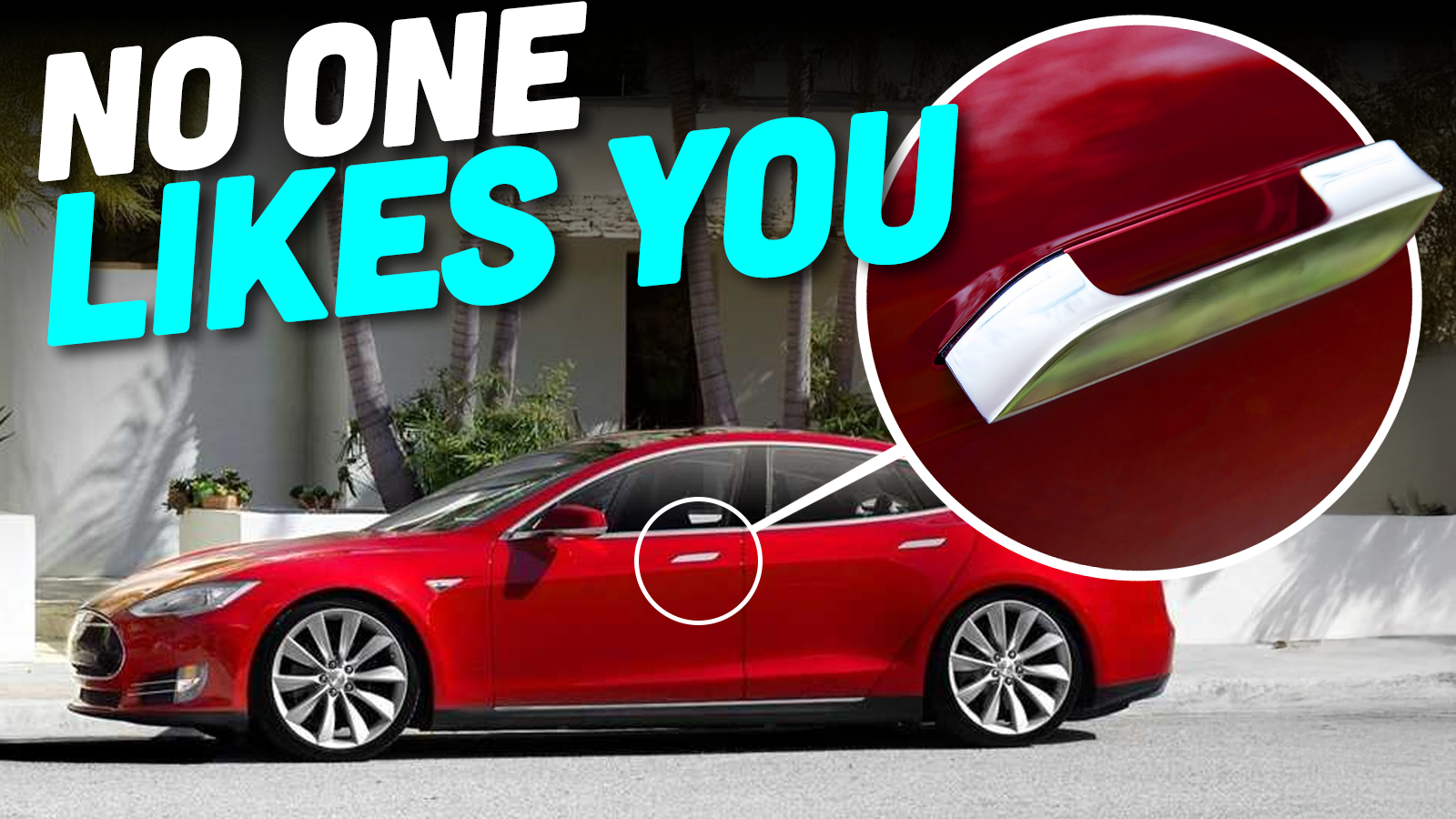
Then there are vehicles like Teslas. The Model S has handles that have to electrically extend before you use them. The Model X doesn’t have door handles at all, and instead requires you to press door buttons that resemble handles. The Tesla Cybertruck doesn’t even pretend to have door handles, and you’re getting in through a hidden touchpad. The Model Y and Model 3 have physical handles, but they trigger electrical switches.

Tesla’s worst offender is the Model X, which requires you to disassemble a part of the interior if you want to manually override the Falcon Wing doors from inside.
In 2025, Bloomberg News published an investigation into a string of incidents where Tesla door handles failed to deploy during emergencies, delaying rescuers from saving trapped vehicle occupants. From Bloomberg News:
Max Walsh spotted the plume of smoke just as an emergency alert flashed on his smartwatch: vehicle fire with entrapment. Less than a minute later, the off-duty firefighter pulled up to a busy intersection in northern Virginia, where a Tesla Model Y lay crumpled and aflame against a utility pole. Having responded to electric vehicle fires before, Walsh knew what he was up against: electrically powered doors that may not function after a crash, manual releases that can be hard to find and battery cells that burn more intensely than gasoline. Every second mattered.
He sprinted to the SUV. The driver’s door wouldn’t open, but the window was cracked. Walsh smashed it with his bare hands and reached inside, burning himself in the process. “I’m trying to open the door and it’s like, ‘What the hell, where is the backup thing?’” Unable to find the mechanical release, he and a friend pulled the dazed driver, Venkateswara Pasumarti, up and out through the window frame.
[…]
The Virginia crash is one of a string of incidents exposing this paradox. Last November in California, a Tesla Cybertruck slammed into a tree and a wall and caught fire, killing three college students trapped inside. The same month, in Wisconsin, a Model S fire left five dead, with a cluster of bodies in the front seats suggesting to a detective there may have been a struggle to escape. In Los Angeles this spring, an All-American basketball player survived a Cybertruck crash by kicking through a window before bystanders pulled him out by his legs.
In a story earlier this month, Bloomberg has identified at least 15 deaths across a dozen incidents where rescuers and vehicle occupants were unable to open the doors of a Tesla.
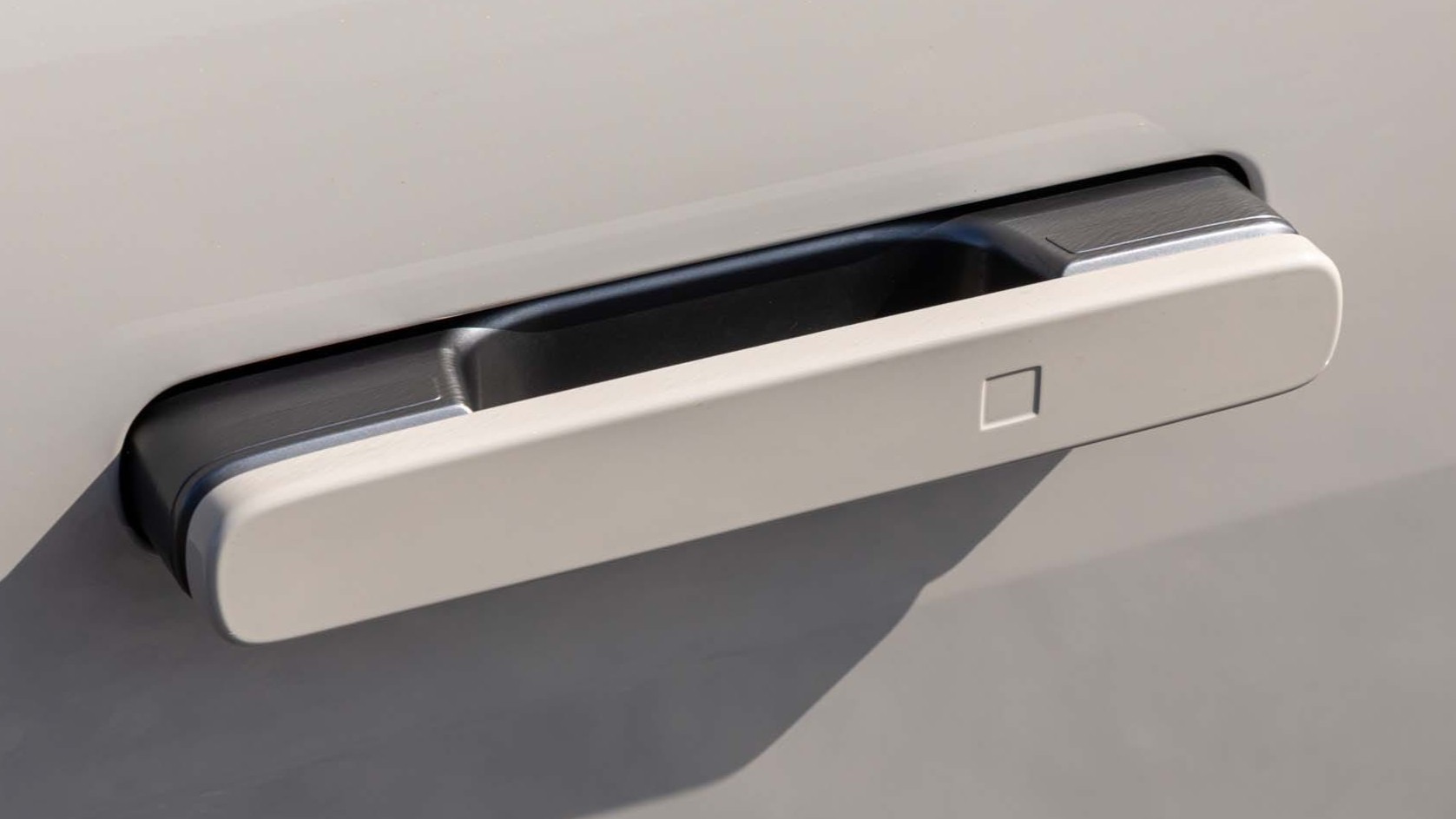
While Tesla has come under fire frequently for its flush electric door handles, it’s hardly the only company doing it. You’ll find electric handles on vehicles from Rivian, Hyundai, Kia, and other brands. It seems like these door handles are solutions in search of problems that don’t exist. Is adding all of this complexity really worth the aerodynamic gains?
Thankfully, some of these handles aren’t entirely electric. For example, Hyundai’s handle is still mechanical where it counts. The only electric part pushes the handle out of the body. In an emergency, the handles might not extend, but rescuers can still get into the vehicle if they press the handles.
This issue isn’t limited to America, either. Electric door handles are found on cars all over the world, and drivers all around the world are finding out that these handles sometimes don’t work when they’re needed the most. Over in China, there have been some tragic incidents that spread across social media, depicting the horrors of what happens when door handles don’t deploy. As such, early this year, China became the first nation to outright ban these types of handles, and drivers around the world have been begging for similar regulations in their home countries ever since.
The Feds Are Getting Involved

Following Bloomberg‘s investigation, the National Highway Traffic Safety Administration opened a defect investigation after reports of some Tesla Model Y door handle failures. Then, in November 2025, Kevin Clouse submitted a petition to NHTSA, hoping to get a safety defect investigation started on 2022 Tesla Model 3 vehicles. This is what the petition said, from the Federal Register:
In a letter dated November 7, 2025, Mr. Kevin Clouse (the Petitioner) requested that NHTSA “open a safety defect investigation into the emergency mechanical door release design” in the MY 2022 Tesla Model 3 vehicles as the design “fails to comply with FMVSS 206 requiring emergency egress controls to be readily accessible and clearly identifiable.” Mr. Clouse supported his request with details regarding his own experience during an emergency event.
The Petitioner stated that following a head-on collision, the MY 2022 Tesla Model 3 suffered a total loss of electrical power and caught fire. Due to the loss of power, the electric door handles became inoperative. The Petitioner stated he was unable to locate the mechanical door handle, forcing him to climb into the back seat and exit the vehicle through a rear passenger window. The Petitioner further stated that the mechanical emergency door release in his 2022 MY Tesla Model 3 is not accessible and clearly identifiable and thus fails to comply with FMVSS 206. NHTSA has based its decision on a review of the material cited by the Petitioner, pertinent information in NHTSA’s databases, and other relevant information in possession of the agency.

NHTSA denied the petition, noting that the design of Tesla door handles does not violate any existing Federal Motor Vehicle Safety Standards. However, in denying this petition, NHTSA noted that it received another petition that sought to update FMVSS to account for these new types of doors. From the Federal Register:
On November 4, 2025, NHTSA’s Office of Rulemaking received a petition to initiate the issuance of a new Federal Motor Vehicle Safety Standard (FMVSS) to mandate a robust and obvious door egress system in all motor vehicles. The request has been granted, and the Agency will accordingly commence a rulemaking proceeding. See 49 CFR 552.9. A decision as to the issuance of a rule will be made on the basis of all available information developed in the course of the rulemaking proceeding, in accordance with statutory criteria.
It’s too early to tell what these potential new rules could look like. The aforementioned petitions complained about occupants being unable to locate the manual door overrides inside of vehicles. That’s a different – though still very serious – problem from electric door poppers and handles that fail on the exterior. However, in crafting new rules for an obvious door egress system, it’s possible for NHTSA to also require a way to open doors from the outside in an emergency. Also unknown is how long it’ll take to implement these hypothetical rules.
Still, this is a step in the right direction. Some automakers have seemingly taken a technology that has been settled for decades and changed it in a manner that makes it no longer intuitive and, arguably, no longer safe. Drivers should be able to trust that a door handle will work like a door handle when it’s needed, and in some cases, that’s not happening. Hopefully, NHTSA can fix this.
Top graphic images: Tesla


I guess when I first saw these electro-retracto-matic door handles I figured they must be for improved aero on EVs. Once upon a time I had Chevy Beretta which had totally mechanical latches I recall being described as ‘beer tap handles’. They seemed pretty aero to my untrained eye, too bad the rest of the car didn’t live up to them.
Anyone else here watch The Chieftain? “Oh bugger, the car is on fire!”
About dang time
Please ban goofy door handles!!
There exists a portion of society that goes gaga over anything new. Being better is not a requirement, look at the fools driving Cyber Trucks!! These people love these door handles.
Unfortunately: there is a genuinely cool element to having a door handle pop out as you approach the vehicle. Unconsciously it’s like it knows you and is your friend, welcoming you; and on top of that consciously if you are a tech-liker then it’s the bee’s knees. And I imagine that automakers know that because of this, it is effective in selling the car, and worth the costs to produce. The problem is that it is utterly irresponsible to offer it due to the danger.
Here’s the federally mandated solution: Every time you get in the car, you have to watch a safety briefing video on the infotainment system how to operate the seatbelt and the doors in the event of an emergency, including a water landing. There’s also a safety information card in the seat back pocket. The automakers will also sell access to this safety video for Hollywood branding purposes so this briefing can be delivered by your friendly neighborhood Spider-Man, or the Real Housewives of Des Moines. The car won’t start until the briefing is complete.
They continue to suck, part 2:
No one can ever figure out how to get out of the car. I have to point it out to them, and everyone’s annoyed with it.
When my parents got a fancy Japanese toilet a few years back, with a bidet, a blow dryer, etc., my dad got really annoyed with the array of buttons, as nothing was labeled, they were all icons of some kind. He didn’t know how to work it, and famously said “this was the one room in the house where I thought I knew what I was doing!” He was right – you shouldn’t have to read the manual for something like this…
They suck so, so hard.
On my Lincoln Continental, there’s a bar running the length of the door handle that you squeeze when you pull the door open. It’s great until the winter, when it ices over.
And then it has a “power close” feature, where if you don’t close the door all the way, it electrically cinches down on the latch hook on the door frame to fully close the door. It’s great until you get the seatbelt caught on the latch when getting out of the car, and the effing thing clamps down on the belt over the latch hook. In a normal car, you can do a combination of pulling from the outside, or pushing from the inside, but in both cases, manually operating the door opening mechanism. Here, it’s a trip to the dealership.
Hot take: the Mach-E is fine. I happen to like the button openers, and Ford pushed an update that does a better job managing the 12V battery power. I’ve never had mine fail, and I’m not in a situation with infants or something where interior passengers wouldn’t be able to get out (inside has normal door pulls right where you expect them to be).
It’s worked great in sub-zero temps with ice encrusting the car, and the poppers were easier for my kids to open the doors than pulling handles they could barely reach. They’re older now, but it was a noticeable difference between our cars then.
Door latches shouldn’t require OTA updates.
Sure, but to be clear, the update wasn’t for the doors, just did a better job preventing voltage sag of the entire 12V system. Any car can have a dead battery.
I have stupid retractable door handles on my Ioniq 5.
I guess they’re not the worst, because you can still open the door mechanically with them if needed.
My problem is that if I don’t lock the car, they stay stuck out. If you touch the little square, they retract. BUT you need to have the key with you for the handles to retract when you press the button.
I discovered this when working on a car parked beside the hyundai in the garage one day. I figured I’d avoid getting snagged on the handles while I worked so I pressed the square which did not a thing. Opened the door and pressed the lock button – Nothing. So I had to walk back to the house to get the keys to lock the doors.
I can see preventing the doors from locking if the keys are in the car, but I don’t get the behavior of the Hyundai, where apparently you have to prove you have the keys and they are not in the car.
I want an un-smart vehicle that just mechanically does what I tell it to through my direct mechanical controls.
Why didn’t you just open the door and press the lock button?
Also, you can set up phone as key, which is convenient for such situations.
I did try the lock button. Need the keys for that too.
You can set the phone as the key, but only one phone. It is my wife’s car so hers is the one phone with access.
Interesting that the lock button didn’t work! I’ll have to try that.
You can absolutely allow more than one phone to work with phone as key. Just share the key from your Wallet app. My partner and I both have digital keys for each others Ioniqs.
I have no wallet app.
This car does all sorts of stupid crap. If I hop in to pull it out of the garage, it won’t let me do it without a seatbelt on. I’m not advocating for driving without a seatbelt, but this is always a case when I’m moving the car out of the way to bring out the car parked behind it. I’m going from my garage to the driveway and will be out of the car again in less than a minute without touching a public roadway.
Sometimes if I wait for the “This car is full of screens, but don’t look at them while driving” warning screen to go away before putting it in D and rolling forward it will allow it without a seatbelt.
I do love that it encourages me to check the rear seat for children when I turn it off. If a child can find its way in, they should be able to find their way out (I presume. I’m not an expert in the field).
I can’t imagine not locking my car always, and I don’t live in a high crime area. I did live in NYC before moving and buying a car though.
I have had cars broken into / wheels stolen / car stolen. I wouldn’t think of leaving my cars unlocked before I moved to where I live now.
Now I generally leave the cars unlocked in the garage because I feel like an idiot when I get to the garage and can’t get into a car.
My wife often still locks the car in the garage. That seems silly to me, because the tools are not locked. If someone made it into the garage, they have all the time and tools necessary to get in.
I think every car on the market won’t lock if you don’t have the proximity key nearby, even cars with bog standard door handles. My GTI absolutely won’t lock if the key is not near. I need the key with me or I have to lock it through the app. It seems like they all have some kind of relayed sensor actuated locking. You’d need to get really old school and have the little pull-up, push down door lock to get away with locking without a key which I guess is alright, but I don’t want to have to go back to having to keep lock de-icer with me. Which brings me to the line in the article about the door handle being a beautifully engineered part of the car, spoken like a person who didn’t have the joy of using a Mk2 VW door handles in the winter lol
Don’t have to go that old school. My ’17 Forester doesn’t have a proximity key and locks function as you would expect.
Who knew we would need an electronic nanny watching our door locks.
In a sudden, life threatening emergency, the last thing you need is a learning curve for how to exit your suddenly dangerous car. These were already stupid on Corvettes and even more stupid, now, being on family cars.
Exactly
Not enough people gave a shit when it was on super low volume products like obscure supercars + Corvette, even though equally squid amd dangerous.
Now that it can be found even on a mother Forking Nissan Leaf Hopefully common sense will prevail!