

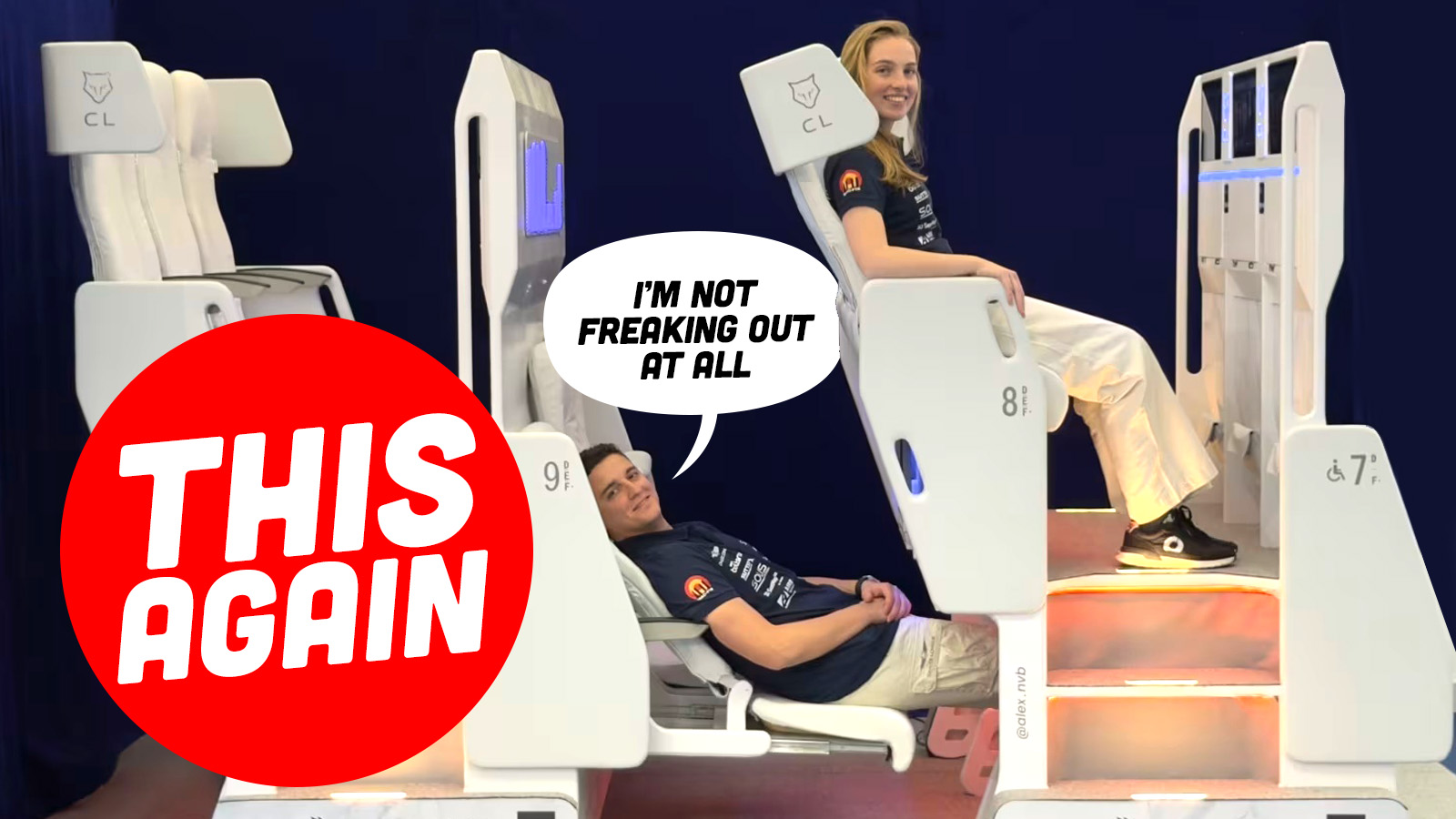
If you’ve flown economy in a modern airliner, you’re acutely aware of how small plane seats are. You get a sliver of space on a seat that’s built primarily to be lightweight and safe, not comfortable. But what if it could be both? One engineer thinks he has the solution. This is the Chaise Longue, and it seeks to give space back by stacking economy class passengers on top of each other in a single-deck airliner. After taking criticism from the public and the media, the creator of the Chaise Longue fixed some issues. Now the final boss of crazy ideas to fix airline travel is back, and it’s still seriously being pitched to airlines.
If the Chaise Longue – not “Lounge,” as you might expect – seems familiar to you, it’s because I wrote about it last year. The seat’s inventor, Alejandro Núñez Vicente, has been touting the double-decker airliner seat since he pitched it as a college project in 2021. In 2022, he built a prototype and then started marketing it as a serious deal. The Internet didn’t really respond kindly to Núñez Vicente’s seat. There were plenty of jokes about human tailpipe emissions wafting down from the upper seats, and other jokes about airlines treating passengers like cargo.


But there were legitimate concerns about the seat, too. I pointed out that a challenge of the Chaise Longue was permitting the safe evacuation of an aircraft in 90 seconds. Others said that the lower seats appear to be poor places for people with claustrophobia, while the seat design in general seems to ignore the existence of people with limited mobility.
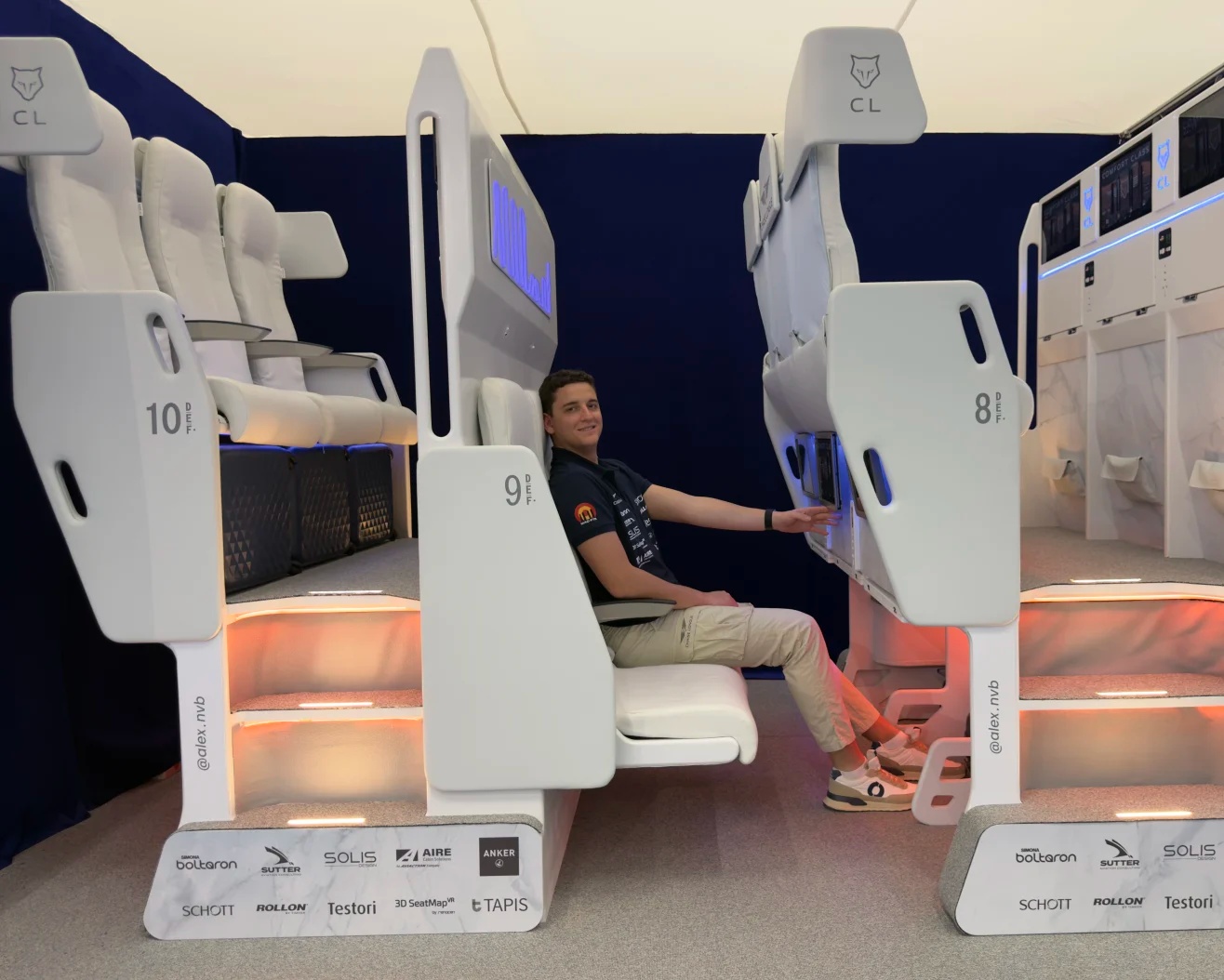
Well, Núñez Vicente says he’s fixed this and more with the latest version of the Chaise Longue. He’s hoping that, one day, you’ll ride in one of these things in an Airbus A350 or a Boeing 777X.
One Man’s Solution To Tiny Seats
An unfortunate reality of air travel today is that the Federal Aviation Administration doesn’t really regulate comfort. Airline passenger advocate groups have been fighting for bigger seats in economy class for years, and their demands have been largely ignored. Even when the FAA asks for comments about seat size, it’s purely on the basis of safety, not comfort. A park bench would be fine in the FAA’s eyes so long as it meets safety standards.

Some inventors have offered their own solutions. If aviation authorities aren’t going to demand that seats get bigger, maybe someone can design a seat that gives passengers more room while pleasing airlines. That’s where the Chaise Longue comes in. If this is your first time seeing the Chaise Longue, I’ll bring you up to speed, because it’s technically been around for a while. Here’s what I wrote in my previous report:
In 2021, Alejandro was a 21-year-old student attending TU Delft University in the Netherlands. At the time, the seats were called the Chaise Longue Economy Seat Project and it made the shortlist for Judges’ Choice for that year’s Crystal Cabin Awards. According to CNN, Alejandro used to travel around the world and one thing stuck out as being particularly painful. He hated how the seats of today lacked legroom. He figured that if only the seats in front of them were higher up, he could actually spread his legs out. So that’s what he did. Alejandro drew up the Chaise Longue, a double-decker airline seat design made for any medium to large aircraft.
Here’s how the Chaise Longue works. An aircraft being outfitted with Chaise Longue seating would delete all overhead bins near the seats. Doing so will allow Chaise Longues to fit. Then, passengers will have to choose seats based on what they’re looking for. If they want maximum recline, they’ll have to climb up into the upper rows. If they want to relax and stretch their legs out with maximum legroom, you choose the lower seats. Both levels have better recline than planes have now, but those on the upper level have the greatest recline of the two choices.
In terms of baggage, your personal items should fit in the included storage, but you’ll have to check your carry-on. Alejandro also pitched the idea as being pandemic-safe, as he believed placing people at different levels would be “more suitable for flights in pandemic times.”
While Núñez Vicente has presented the Chaise Longue as a way to increase space on a per-passenger basis, he added a sweetener for the airlines. In his eyes, if an airline commits to Chaise Longues, they’d be able to fit more passengers in a plane, and thus generate a greater profit.
Take Two

Unfortunately for Núñez Vicente, while the Chaise Longue went viral, it didn’t really land with the public. CNN Travel wrote about the original Chaise Longue prototype in 2022 and then the updated version in 2023. In both instances, the publication’s tester and other travelers expressed concerns about claustrophobia. Much of the Internet, including our own comments, chastised the Chaise Longue as an attempt to cram even more people into a plane, therefore making travel worse, not better.
The 2023 version had replaced the old version’s ladders with stairs to reach the upper level. It also had a dedicated place for lower-level passengers to place their personal items. Like the original iteration, every passenger sitting in the updated Chaise Longue would have to check their carry-on, as overhead bin space would be deleted entirely.

In 2025, the Chaise Longue appeared in the news again because, amazingly, the project got interest from Airbus. That didn’t solve any of the complaints, however. You might have noticed that the lower seat passenger’s head is about level with the butt of the upper seat passenger. This caused endless jokes about passengers passing gas. Speaking to USA Today, Núñez Vicente didn’t totally dismiss that possibility:
“The idea is that there will be some kind of restraint here,” he said, pointing to the partition behind the upper level of seats. If a passenger passed gas “it wouldn’t go straight through,” unless it were especially forceful.
My biggest concern with the Chaise Longue is safety. As I said earlier, the FAA is adamant that an aircraft has to be evacuated within 90 seconds in an emergency. In theory, the Chaise Longue adds more people to the equation, and then forces those people to either crawl out of a hobbit hole or jump down from an upper level. Airliners have to carry enough cabin crew for the number of passengers onboard. The aircraft also needs facilities, exit doors, and food stores to support the number of passengers onboard.
If that wasn’t enough of a challenge, the FAA has regulations to prevent head injuries in case of emergency aircraft maneuvers and other intense situations. Likewise, aircraft seats have to be able to withstand 16g of forward acceleration. All of these regulations are publicly available, and there’s even some math in these rules:

Núñez Vicente has yet to prove that his seat design will be anything resembling compliant with regulations. I also wonder how these seats would work during a fire emergency. Will passengers be able to escape the upper row during a fire that’s producing heavy smoke?
The Final Boss Of Double-Decker Seating
Yet, there’s a new version of the Chaise Longue for 2026 that Núñez Vicente is calling the “ultimate, final statement” of his idea. This Chaise Longue went on display at the Aircraft Interiors Expo in Hamburg, Germany, earlier this month.
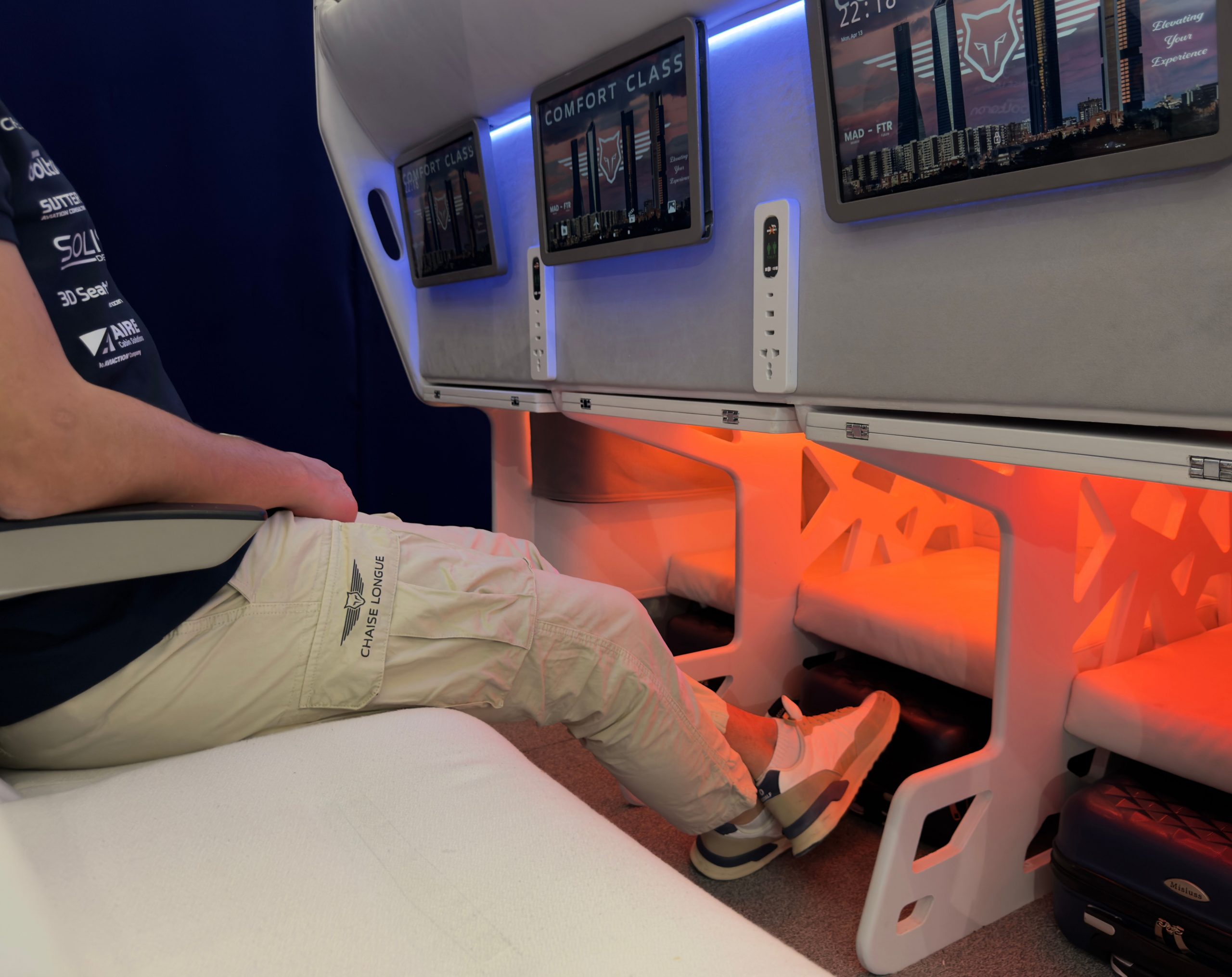
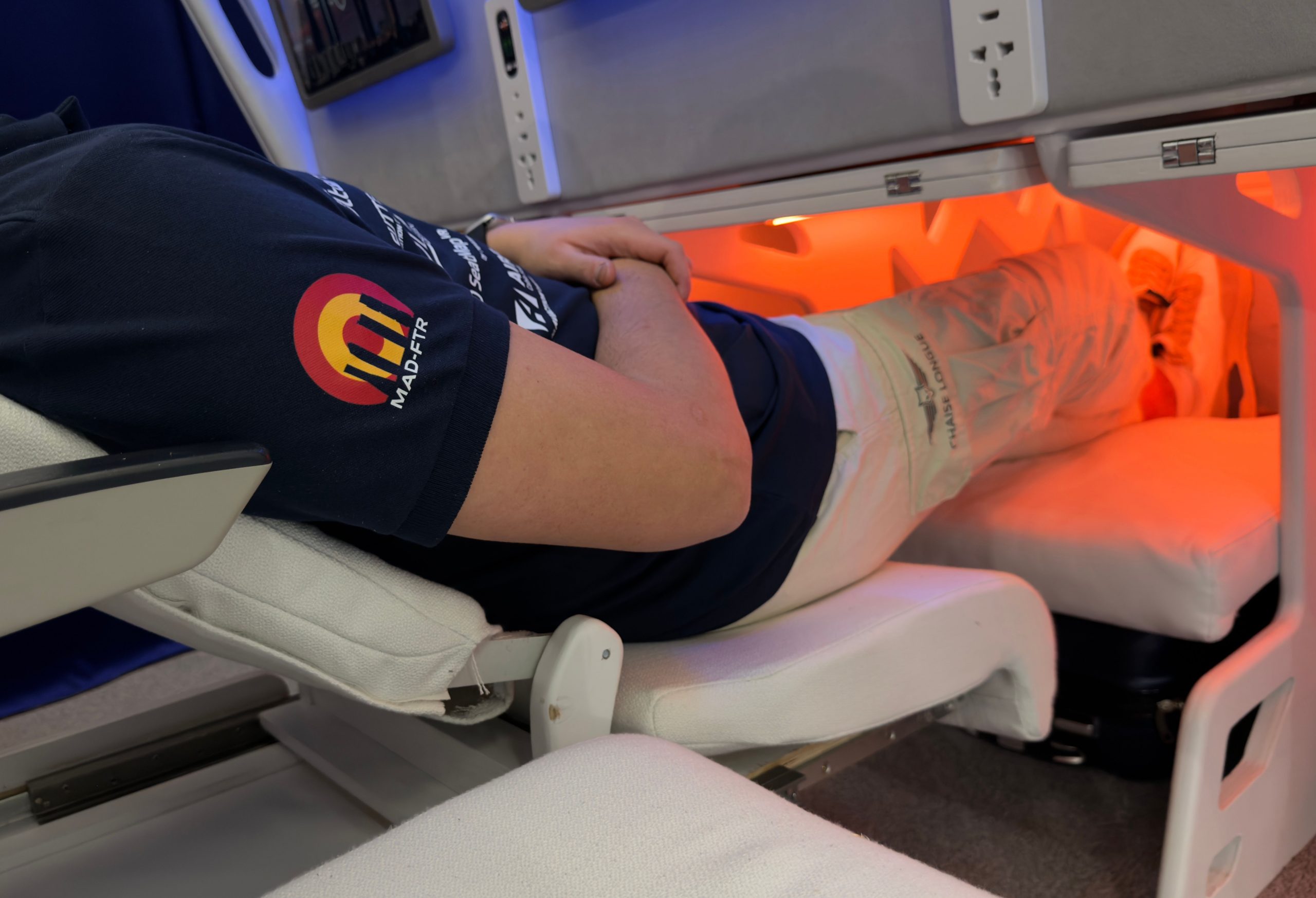
The biggest change with the new version of the Chaise Longue is that the lower-level seats now have a pretty decent gap between the seat and the upper level in front of them. Indeed, this version appears to eliminate many of the claustrophobia concerns. The new seat design also puts some distance between you and the butt of the person in front of you.
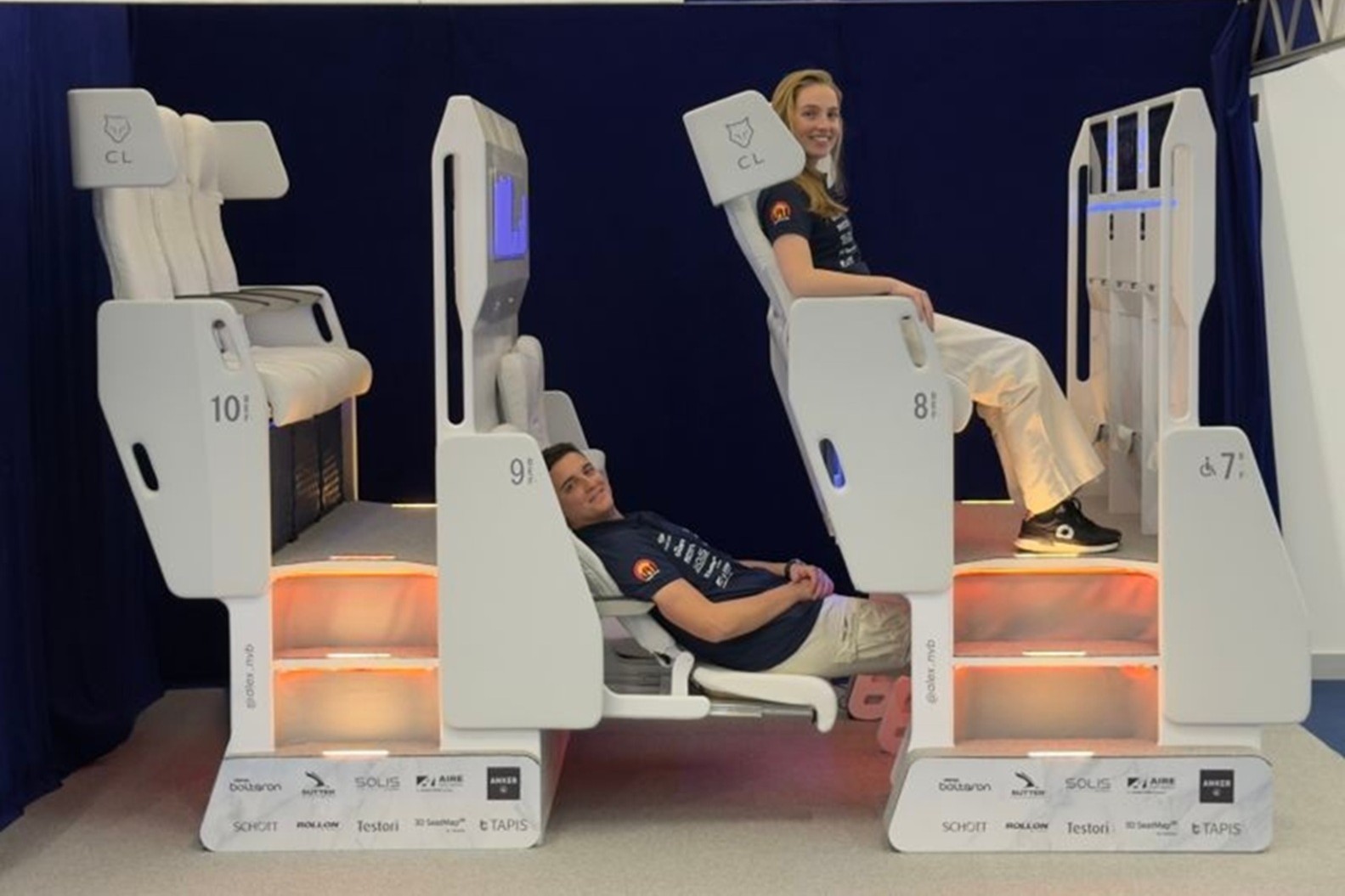
Núñez Vicente says that the seat pitch – the distance between the seats – is far enough apart that a lower-level passenger can actually stand up and do stretches in their row. The new Chaise Longue also has larger side panels for greater privacy and a reduced chance of someone in the upper row dropping something on someone in the lower row. The new version also eliminates the possibility of passengers propping their feet up on the walls.
The stairs that lead to the second level have also been widened. Upstairs, the seats have 12 inches of recline, or about twice the recline of the average premium economy seat. Downstairs, there’s technically enough room for the middle seat to recline flat.
Núñez Vicente also says he added a wheelchair-accessible front row to the Chaise Longue. However, this feature is not new. He was advertising this feature last year, and one of the images is embedded in this post. For everyone else, the bottom row is more accessible than previous versions, which is great. But the seats still aren’t compliant for people with disabilities.
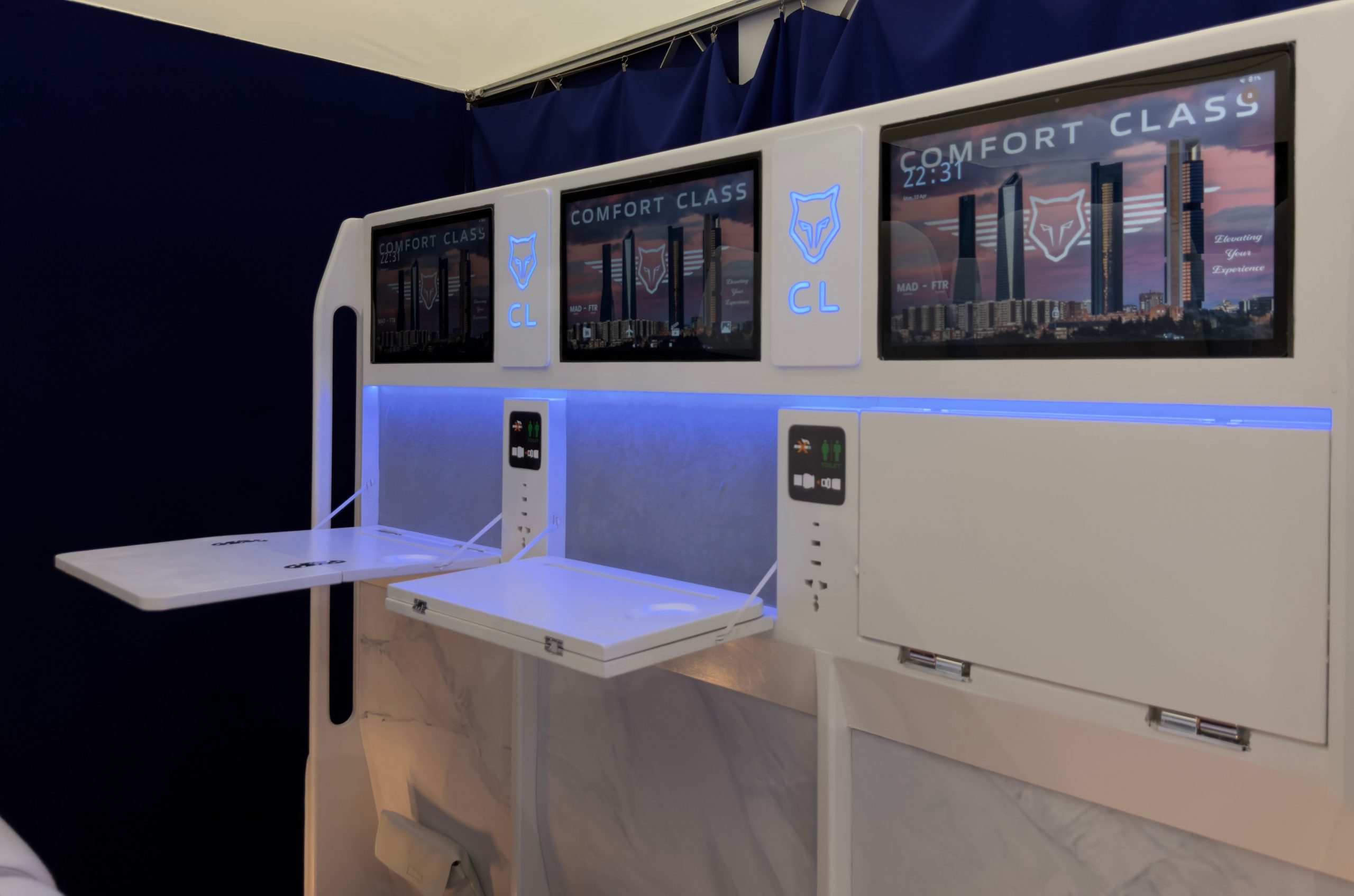
Núñez Vicente doesn’t really address regulations, either. There’s no explanation about how aircraft evacuation would work, or how the seats would hold up to impact forces. Weirdly, he’s also had to move the goalpost. When Núñez Vicente launched this endeavor, it was supposed to revolutionize economy class. However, in adding more space to the Chaise Longue, it’s not really compatible with economy class anymore. Now, he’s hoping for the Chaise Longue to be a revolution of premium economy. From CNN:
“But we have been moving the concept towards more of a premium economy experience,” says Núñez Vicente. “We have met directly with airlines and airline executives, CEOs and their customer experience departments, and they told us exactly what they wanted — and they wanted this seat to be something more than just economy.”
[…]
“In this day and age, with this industry and airlines, they are not going to give passengers in the economy more space — it’s going to lean more towards premium economy, and that’s what we have seen,” says Núñez Vicente.
The new version of the Chaise Longue has been subjected to testing by 150 passengers. According to Simply Flying, the results of the test were that passengers thought the lower row was the best, and that both rows were better than premium economy. Reportedly, those same testers thought the lower row was comparable to business class, and that 90 percent of the participants would pay twice as much as an economy ticket to ride in the lower Chaise Longue. Of course, 150 people are a small sample size.
Núñez Vicente hopes that if the Chaise Longue is successful in premium economy, maybe he could do the economy seat version again at a different date. The only problem is that, while he might have chatted with airlines and even got some interest from Airbus, no airline, supplier, or airframer has committed to even buying the Chaise Longue. The seat still has to be certified, and even if it were market-ready, it would not be a cheap expenditure to gut an aircraft’s seats and overhead bins to plop Chaise Longues down in them. Airlines are infamously cheap businesses, after all.
Would You Like A Double-Decker Seat?
Regardless, Núñez Vicente is determined. He plans on scoring partners so he can turn this version of the Chaise Longue design into a pre-production prototype that will be made out of materials that can fly. His hope is to display the prototype version at next year’s Aircraft Interiors Expo. As far as the seat itself, I’m not going to be convinced until it’s certified for flight and some airlines start caring about it. Even then, I still don’t like the thought of passengers climbing up and down their seats. That seems to expose too much risk for falling injuries and crowding during emergencies. That assumes it ever goes into production, and at this stage, I doubt it will.
Credit where credit is due, I’m impressed that Núñez Vicente continues to develop the Chaise Longue. This is now the fourth iteration that has been shown to the public, and no matter how much the Internet mocks the thing, he isn’t giving up on it. Honestly, it’s almost inspirational, in a way. This is a man who isn’t letting the haters get him down. So, bravo to that.
Top graphic image: Chaise Longue


Soon enough they’re just going to hand everyone a motorcycle helmet and start strapping us to the outside of the plane. Probably Spirit will get there first. They’ll call it Spirit Jolly.
The helmet is $35 extra. $50 if you want a face shield.
How much for oxygen?
This staggered seating setup isn’t even a new idea; railroads in the USA introduced “slumbercoach” cars that had roomettes that were similarly arranged, with part of one roomette fitting under a part of the adjacent roomette.
Of course, they didn’t have the emergency evacuation requirement to comply with, but it also did nothing to save passenger rail service…
I’ve traveled in a Slumbercoach. The roomettes were comfy, but they had large windows, staggered for height. That made it bearable to travel in a sealed metal box.
My big question about this is weight. Given the lengths airlines go to for weight savings, I wonder if the increased passenger density will justify the increased weight of the frame. Potentially if passengers like the increased leg room and recline they can charge more and offset the fuel loss, but that would require educating passengers about the new configuration and then convincing them to pay more for it.
Lie-flat for the price of premium economy could be a huge selling point for long-haul travel
“WHO FARTED????”
That’s literally every single passenger flight right now anyway.
I know airplane air circulation is pretty good, but if stratification does happen, with a two-level system there’s more of a chance of the poison layer being in someone’s nose range, depending whether it rises or sinks.
There’s a full air exchange every minute or so. For that to happen, air is moving around pretty quick. Personally I think the concern is overblown, except for when you’re on the ground and the HVAC isn’t working so hard.
It’s fun and easy to make fun of this, but the criticisms are missing two big points: you’re already close to the asses of everyone around you anyway and are definitely breathing that in, and 2) you’re already treated as cargo by the airlines.
This looks silly in a studio and would be weird to see on a plane, but to me it looks like I would have more personal space, far more visual privacy, and my headrest would no longer be a screen for the mouth-breather behind me to peck at like goddamned heron going for fish in the marshes.
DO IT.
Though, they will riot when they can’t bring their giant hardsided roller suitcases on board.
Usually that ass is not a nose level. This is why I drive when I can. Stay as much out of the fart zone as possible.
“Usually that ass is not a nose level”
Well, at the end of my last international flight there was an old lady in the row in front who made such a reek, repeatedly, that it may as well have been.
With the seats shown here there’s a solid partition. This is a non-issue. I don’t think most people realize how much sharing of biology is going on without our really noticing it. Try not to think about how recently the air you’ve inhaled in any given enclosed space was just barely in the lungs of someone else.
Wherever I drive IS the fart zone. YEEEAH!
All I can think of is Top Gun:
“Highway to the d̶a̶n̶g̶e̶r̶ fart zone!”
Hey! I actually just noticed you’re not AssMatt anymore…that would have fit this commentary more, ha ha. So did you get a Mondial like Adrian?
Kramer: Assman? Oh, no, these don’t belong to me. I’m not the Assman. I think there’s been a mistake.
Clerk: What’s your name again?
Kramer: Cosmo Kramer.
Clerk: [checks computer again] Cosmo Kramer. You *are* the Assman.
Kramer: No! I’m not the Assman.
Clerk: Well, as far as the state of New York is concerned, you are.
Ha! Yeah, I’ve had to let a few jokes go by in the last few days, but I’ve been meaning to change it ever since my member swag arrived addressed to my handle and my family enjoyed it a bit too much. I like to think I’m less of an ass than I was when I joined up.
I bought the Mondial around the same time as Adrian, before he and I knew about the site. Synchronicity! It sure has been fun to read about his exploits/struggles and I’ll miss his car when it’s gone.
Highway to the…DANGERFART!
Ha ha! Ok, yeah was just curious
Phillip…
“and my headrest would no longer be a screen for the mouth-breather behind me to peck at like goddamned heron going for fish in the marshes.:”
That part there is GOLD 🙂
This is where design meets stupidity. Please stop giving this press unless you are going to mock it for the disaster it is.
It would be helpful if you spelled out why you think it’s a disaster. I’m not saying you’re wrong…
The aircraft designers here already have. Speaking of which, the designer is cruising on an idea that will never happen unless he designs an entire new aircraft that implements this layout at the core.
I honestly would love this seat layout.
The biggest problem in today’s planes is not the seats (although these do suck). It’s the overhead luggage and all the time it takes for people to load and unload the bins.
This Smart Feller/Fart Smeller seat layout would eliminate overhead bins and force everyone to check their luggage. I figure it would shave at least 30 minutes from any trip from boarding to walking around the airport again.
Probably true, and I hate the overhead bag parade as much as anyone, but that time would then just be lost again waiting at the baggage claim.
Or at the check-in counter.
I hate the check-in counter. I’ve learned to pack a tight carryon that fits easily in any overhead bin larger than a regional jet’s, and it is a deeelight bypassing the check-in counter on my way through the terminal.
I used to. But gate checking changed my mind.
I fly a lot of RJs when means a lot of gate checking. At the hubs, this means I have to wait for my bag before getting my connection. the tighter the connection, the longer the wait for my bag, of course.
For my home airport, everyone and his uncle gate checks. Which leads to 3/4rds of the flight waiting for their bag at the gate. Meanwhile, I walk to baggage claim. Since there are so few actual checked bags, I find the baggage spinning circles waiting for me 9 times out of 10 and I don’t have to wait for it. Almost always I’m out of the airport quicker than someone that gate checks.
HOWEVER… I still do carry on size. Sometimes the line to check a bag is insanely long at the airport (especially international flights). So, I have the option to just put my luggage in carry on as a result when that happens.
Another side benefit would be the elimination of the people trying to save their stuff in an emergency problem. If you stuff isn’t there, you don’t try to save it.
The juice is not worth the squeeze to me and I sincerely hope for the industry. This has shitshow plastered all over it
Honestly this wouldn’t bother me. Then again, in my human form I’m only 70 kilos (155 pounds) and 173cm (5’8″) and I’ve never felt cramped even in the cheapest seats. One of my kids, (also in his human form), is 2m (6’6″) and I’m sure he has some words about this.
More importantly though is that half of your plane would be an accessibility nightmare and such an arrangement would likely not be ADA-compliant, meaning that this type of setup would be a non-starter domestically.
Seems fairly trivial to make sure that any passengers with mobility challenges get a floor-level seat. I’m sure airlines would find a way to mess that up, but on paper, it should be compliant.
This can only fit in the center section of widebodies so the overall percentage of inaccessible seats would be pretty low.
ADA doesn’t apply to passenger aircraft, the Air Carrier Access Act (ACAA) does. As long as the armrest on the lower row fold to allow access from a wheelchair, the design would be compliant. It’s ironically about the only issue this design doesn’t have.
Nope, not gonna happen. Let’s ignore the fact that you could only do this if you completely stripped out the overhead bins. Let’s ignore the fact you will never pass emergency evac criteria with it. Let’s ignore… all of the other issues.
You will not be able to install this in any current airliner for the simple reason: under crash conditions, the vastly increased moment arm of the upper row will open the seat tracks like a zipper. Airliner seat tracks are already the beefiest chunks of structure in the cabin, and even with modern super light seats the structural margins are tight with single height rows. To accommodate this “innovation” you’d need to massively reinforce the seat tracks, which in a modern airliner are all structural elements of the fuselage, which would be a massive, massive project. Also, the seats themselves would need to be seriously reinforced which would further increase weight. End result: even if you crammed in more passengers, you’d burn enough excess fuel that it wouldn’t pay for itself.
Edit: Lots of people are mentioning ADA compliance as an issue. ADA does not apply to passenger aircraft, the ACAA does, and as long as there is sufficient seating for disabled passengers, you can have quite a lot of non-accessible seats. It’s ironically about the only issue this design does not have.
I want the increased visual privacy and stretch out space this provides and you’ve got to go ruin it with your damned increased movement arm safety engineering stuff.
Dang it.
I can already hear my wife and her 37″ inseam complaining about getting in and out of these seats, and she hasn’t even seen it yet.
What a goddamn nightmare. Can we get some high speed rail, please?
The Chaise Longue designer: Sure, I can stack passengers in trains, too!
SHHHHHH. DON’T GIVE THEM IDEAS.
With what I commonly see with the amount of crap that people drag with them onto planes because of just how ridiculous the checked bag fees have gotten, I don’t see this working out. When you add the “premium economy” (and if that’s not a euphemistic term, I don’t know what is) ticket cost to the rapacious checked bag fees, on top of how much tickets have already gone up, I just don’t know who this is for.
While I would love a humane amount of space in airline seating, I just don’t see it ever happening without some kind of dramatic revolution in aircraft design that would result in more volume without a proportional increase in takeoff weight. Something like the blended wing-body designs or lifting body designs that will never get built, for example.
Airlines are in the business of maximizing profits, not in actually letting the proles move about the world in comfort and dignity.
Dude with 30+ years experience in airplane design here, including seats:
This will never happen. Reasons (other than passenger acceptance):
Now to the weight issue: Aircraft are rated to a maximum takeoff weight. The airlines can juggle the weight of passengers, weight of cargo/baggage or weight of fuel, but the 3 pieces must be less than the max weight.
We’ve added significant weight to the aircraft itself, much higher passenger weight, and more passengers means higher weight for baggage. This means less fuel capacity, reducing the aircraft’s operating range significantly. I’m not an aircraft performance guy, but I’d ballpark at least 30% less range, possibly much higher.
This concept always gets laughs at the office when it appears.
The point isn’t to built it, the point is to try to suck up some of that sweet, sweet VC cash.
I think you’ve just found the real goal of this design.
ADA compliance wouldn’t happen with this setup either. Other countries without such extensive protections for accessibility might be able to pull this off if all of the engineering challenges you mention were solved.
Not to say that you are wrong on the other points, but I think the points about take off weight and emergency exit requirements are not there.
Go back 35 years ago and look at an international fight layout. The business class ended well before the wing. Now, for a similar sized plane, business class goes to the wing on most layouts.
What has happened is that the number of business class and first class seats hasn’t increased, but the room these seats take up have increased. This has been accomplished by packing Coach tighter.
I expect that if this crazy idea happens, they won’t add coach passengers, but use the freed up space to make business and first class nicer and more roomy.
As a result, the number of passengers will remain the same, but the weight will shift backwards as more passengers are crammed in the tail.
I think it would still be an issue.
Let’s say we have a cabin layout with 100 biz class and 200 cattle class. We use these seats and convert the cabin to 150 biz & 300 cattle.
The original layout probably required 8 exits for 300 people.
With the new layout, we would need the same numbers of exits for the cattle alone. My guess is we’d be adding 2 doors.
The current aircraft I’m working on requires 6 exits for 149 passengers. 150-190 will require 8. We just spent $1.5 million to prove to the authorities that the 8 doors will work by building a mockup cabin with a simulated emergency.
Again not that this is ever going to happen but I wonder how much the passenger count will go up given this only fits in the center section of wide bodies. Hard to tell (for me at least) what this seat “pitch” would be equivalent to. Also, it’s mocked up as 3-abreast which would eliminate one seat per row. That makes sense given the cabin width for those “stairs” has to come from somewhere
What I am saying is that the number of passengers won’t go up. The freed up space will be used to make things nicer for the business class passengers.
Go back 150 years ago. They would carry 300 on a train. 3/4rds of the train cars were for the 30 first class passengers riding in basically a rolling Victorian Estate and the remaining cars were for the 260 second class passengers crammed into glorified cattle cars.
I think that is the goal for airlines. If they could fit a golf course in 1st class by packing coach into cubes and stuffing them in the hold, they would. First class would pay 5x as much to have the golf course and Coach would be willing to ride in a wooden crate if they save $5.
Ah, interesting. I’ve always wondered about this because it seems like most normal-sized adults would hit the seat in front of them in an impact, which seems like it would do bad things to the head and neck area. If the seat folds out of the way that becomes less of an issue.
You’ve just beautifully spelled out why undergrad design students shouldn’t be designing seats. Even boring ass coach seats need teams of engineers with advanced degrees/training to bring to market. As you point out, there are good reasons for that.
My only hope is that these seats offer the final motivation to develop rail service in this country.
So, fun story about that. My dad was a WW2 vet. As part of that, he had to take a train from NYC to San Diego after he got his commission. The train was packed to the gills, nearly SRO for the entire multi-day trip.
Dad was always a creative problem solver. He saw that the train had no seats available and guys hanging out of the windows and realized that nobody would be using the ladies bathroom. So, he went in there, found it even had a couch and the like and had his own little private cabin for the entire trip.
Hat’s off to your dad!
The shop teacher got a hold of a VHS tape of a jumbo jet evacuation simulation. In the early ‘80s NHSTA (or their predecessor) realized the evacuation simulations they had run with volunteers had no basis in reality – people would politely line up, help each other off the plane, no, you first. So they went to a college campus and paid frat boys a couple bucks for showing up, first twelve off the plane get a case of beer each.
Funniest video I’ve ever seen. Total brawl, seats ripped off the floor, one kid gets halfway out the door and two others drag him back in, black eyes and missing teeth. And finally a realistic view of what would really happen if the plane was on fire.
Early 80s? Are you sure it wasn’t the “brace for landing” scene from Airplane!
Likely misremembering and/or your teacher got the information a bit wrong.
A bunch of tests were conducted by Cranfield College of Aeronautics in late 1980’s that paid people extra for being among the first off the plane. Chaos ensued.
Video about evacuation experiments and Flight 28M that motivated them:
https://youtu.be/WalhidXcjQI
Edit: Found the complete episode for that clip.
https://youtu.be/hdXJjjuBgFw
Well, I like your video. But it’s not the one I watched. And I have no proof 🙂
Claustrophobia aside, if there is actually more room then I suppose it’s ok. I’m curious how it completely pencils out with the added weight of the contraption and additional passengers along with the additional cost of having to check so many more bags.
purely a guess, but if if they can fit 20% more people on the plane, that helps offset the costs of additional fuel (w/r/t weight) and time/cost to check bags. this also assumes they don’t charge more ticket since now you have a quasi-lay down seat. and checked bag fees of course.
I dunno. it’s an interesting idea, but it almost feels like the stuff you’d see in the 50s and 60s on the future of transportation…not sure humans/human behavior would go for it.
I don’t see the FAA ever giving this a pass for evacuation. Having stairs and a head hitting hazard are both incredibly problematic for evacuation speed, and pose big illumination challenges. Not to mention oxygen mask deployment if the overhead compartments they are stored in get completely overhauled for a two-tier system. How can you guarantee that they deploy correctly with two different lengths of masks, how can you ensure they don’t get caught in the back rest of the top row, etc.
Not to mention this WILL be heavier than standard seats. Having a row of seats raised and cantilevered over top of a lower row requires a significant increase in material to give it the strength required. Adding significant weight to the dry plane will reduce the potential passenger weight capacity, making the increased density useless if you can’t safely fill the plane anyways. All that combined tells me a small upstart operation like this will never get seats in the air.
Something I’ve also been thinking about is fire safety. The people in the upper row seem like they’d be screwed in a fire that’s producing heavy black smoke. That’s before those people even try to find their way down.
I agree this is absurdly infeasible BUT I don’t think oxygen masks are the problem. I think it was the DC10 that had the masks stored in the seat back in front. I can see why airlines might prefer that since you can reconfigure the cabin pretty easily. Anyway, there’s enough space in these things that you could find room for the masks.
The seat integrators are going to love changing their entire shop process to manage cert and install a PEC limited specialty product.
This idea is going to have to provide enough value over existing seat design improvements to make the business risk worthwhile.
Neat idea, but too far outside the existing cabin interior design envelope to make money sense.
There is one other hurdle I can think of in relation to airlines: eliminating carry-on bins would mean all of the luggage from Economy goes into the cargo hold. Which means if an airline wants to also ship freight on their flights, there’s less room for it in the holds off the jets. It does depend on the line and route from what I’m reading, but it’s apparently not as uncommon as one might think.
The problem with this is that it creates two separate classes within one flight class.
The lower deck clearly has more legroom but less recline, while the upper deck has the opposite. It then becomes two vastly different flying experiences for what I assume to be the same ticket price. I can see how this will end up being hugely contentious with travellers.
Nah, they’d dynamic price that offering and make you select your co$t poison. Then they’d market the dickens out of PAX ‘choice’ in paying for config desired.
Correct.
They already do this in economy on a number of airlines. Behind the wing? Free seat selection. At or forward of the wing? Now your economy seat costs a bit more, even though it’s the same seat same service same legroom same width.
Having different classes is actually a feature not a bug.
The airline can offer a cheap seat that is on the lower level of the rear bulkhead so it doesn’t recline. Oh, you want to have a window seat there? $20. You want to have a seat that reclines $20. You want to have the 2nd level seat? $50. Or for $200 you can get checked luggage, choice of any seat on in coach and an earlier boarding section. $250 gets you in NS (normal Seat) Coach. $300 gets your pick of seats there, $400 gets premium coach
Airlines make money with these little upgrades, and this setup gives them more options.
That sounds like an absolute nightmare.
It’s supposed to be.
The goal of a lot of companies is not to provide nicer service, but to convince people to spend more to get nicer service.
Used to be you could go to a dealership and find a car that had roll up windows, no radio, vinyl seats and the like. These things might have actually cost the manufacturer more to make than a normal car. But the cheap ass car was meant to be a penalty box to convince people to spend more on a nicer car.
The cheap seats on a plane are the same today. You want to fly cheap? Center Seat next to the can, last group boarding, no little bag of pretzels. These don’t save the airline enough money to justify the lower price, but it does convince you to spend MORE than the minimum to have a nicer experience.
The worse they can make the base ticket price, the more people pay to upgrade to go back to normal service.
This would be a nightmare if there’s ever an aircraft swap, ppl who misconnected and missed the earlier flight, etc etc. but that wouldn’t stop them.
It’s a nightmare now. I remember once, the plane scheduled for my next flight was supposed to be a B717(MD88). Something happened to it and they put a CJ145 at the gate and changed all the seating assignments and had a significant number of passengers sent off to hotels.
Yup. Just imagine if there were like 7 different categories of seats with ppl paying different fares for each kind.
That’s called Tuesday isn’t it?
Just in a RJ, let’s see.
You have window seats, aisle seats, bulkhead row, exit row, and forward seats with more legroom and the front row of coach that has no seat back in front. That’s 6 different seat setups, each of which is a different price. Add First class and that’s 7 different prices for seats on a RJ.
fair enough. So in this setup you’d have: first, business (which is starting to be sold as different products), bunk bed (with different prices depending on seat), premium economy, extra legroom, and however the airline wants to monetize coach (extra for before the wing, aisles, etc).
yeah, and that’s the point. Oh, you want to fly to Europe? $200. Oh, you want holes in the box we stuff you in? How many $40/hole. You want to wear a diaper and bring a bottle of water? $40/each. You want a blanket since you be in the unheated hold? $100. You want to be in the cabin? Well, duct taped to the Ceiling is a $100 upcharge, in the fart catching position is $100 more and…. Next thing you know you are sleeping in a king sized bed with satin sheets and a gold plated toilet and you’ve $50 upcharged yourself into a $43,273 ticket.
Everything will continue to get worse forever until we reign in corporate greed and stop the 1% from having 99% of the resources.
Nonsense and ignorance. How do you think the 1% got there? Regulatory capture. More government regulations just gives them more opportunities to rig the system via lobbying and “donations”.
Everything will also get worse so long as people keep buying tickets. Stop buying flights from shitty airlines and competition will give you better choices. I’m doing my part. Are you?
I bought a road trip car specifically to avoid buying airline tickets. Now I only fly when I have to travel internationally or (ugh) for work.
I guess you don’t fly often for work. Until recently, every place I’ve worked has had two policies for plane ticket.
Because every place I’ve worked, the seat you get on a plane is one of those things that is used to make sure that the peons know that they are only there to be peed-on.
This was my experience for 5 different companies. I don’t know if I’ve hit the magical X level yet or not, but current policy is much better.
Our documented process is that you must be director-level and above and the flight must be more than 15 hours (or something like that). I don’t believe for a second that our CEO sits in coach for an 8 hour flight to Europe though.
Our policy hasn’t changed, but our travel agent has.
The policy is “lowest cost logical route coach for domestic” and “lowest cost logical route premium economy for international over 8 hours”. Refundable preferred.
The old travel agent was given no guidance on the details. So, it offered the cheapest possible flights and required overrides to do anything. Where it broke down was if premium economy was not available for an international route. It would come up with some multi-stop chaos to keep the flight times under 8 hours and stay in coach. I had an offering with 7 stops and 24 hour layovers at 3 of them and a 7 minute stop at one to attempt to stay in policy for a trip. The cost was twice that of first class ticket on a logical route.
The new travel site worked with the company and clarified. Now it gives you a budget that you have that should cover any flight you want in policy with a refundable ticket. If you spend less, you get points that can be used for personal travel. Out of policy flights are listed as available, but you have to send a justification to finalize booking to your boss. It automatically adjusts to business class if premium coach isn’t available for most routes.
For me, I don’t do many personal flights. So, I click the upgrade button. I stay in budget, but sit in the slightly nicer coach seats, but more importantly, don’t have to look at red-eyes with weird layovers. No more waiting on approval to take an 11 am flight instead of a 4 am flight with a 7 hour layover because it’s $15 cheaper or waiting on a boss to accept a $20 upgrade so I can pick a seat.
In the grand scheme of things, the new website is a tad more expensive for domestic flights than the old one, but when you consider I’ve missed short connections or sat at an airport for half a day, I think the extra cost is justifiable.
Even our C suite uses this website, they just pick first class and type “It’s good to be the King” in the justification box.
Airline profit margins are pretty thin, IIRC. My impression is that airliners are cattle cars because the cattle want the lowest possible airfare and that’s how it can be achieved. If we’re willing to pay another 25% on an economy ticket to get more legroom and cushier seats that result in 25% fewer passengers on the plane, the airlines may provide that.
Airlines actually make their money from business class (and first). They’d make the whole plane business class if they could. The only reason they don’t is bc there isn’t the demand. Coach passengers are along for the ride to fill the plane.
There are a few airlines that run all biz-class, French I think. Also Singapore air was doing it for a while on certain New York-Singapore flights, but reverted to a more standard arrangement.
Certain city pairs do see high enough traffic that it’s occasionally viable. With rising fuel costs, it might be happening more often.
I lucked into a Premium Economy seat for economy pricing on a Singapore Air flight and didn’t realize the entire plane was first/business and premium until I walked around partway through the flight. Premium cabin was less than half full, so I wonder if this was a new/test route. Won’t be offered long if that’s a typical passenger load, though.
Yes, most of the profit is derived from first/business. But with such small margins overall, the economy cabin is still critical. Enough so that airlines introduce those slim seats and narrow lavatories to get just a few extra rows in there. Or cram 10-abreast seating onto a 777.
Some airlines are all economy like Southwest or Ryanair, so I would guess the economics differ substantially by route?
For sure. They’d never survivor without hundreds of economy passengers spending hundreds of dollars. But it’s more or less a wash financially. Put another way, the folks up front are subsidizing those in the back.
Ha, the next time I’m crammed next to big ol’ Billy Bob overflowing his armrests, I’m going to make a quick stop from the teeny tiny lavatory up to business and thank them in between meal courses for making my miserable experience a little bit cheaper. And maybe they will do the same. We need each other. One big happy flying family!
a beautiful symbiotic relationship.
The biggest problem with the system is that it provides too many benefits to those running it and the changes needed would undo that. Thus until we get people who care more about how they are viewed by history than enriching themselves in charge, nothing will change.
1970 – NY to LA – $1000 economy with 34 inches legroom
2026 – NY to LA – $350 economy with 32 inches legroom, $650 for economy plus with 35 inches legroom.
So things have gotten quite a bit better. And how did they improve so much? In part because of 1978 airline deregulation (gasp!). The airlines may be evil–I can’t say– but they are certainly less evil than they were in 1970s. Keep in mind profit margins are 2-4% for most domestic flights so the greedy capitalists are making about $12 profit per ticket.
In the 70s flying was a much more pleasant experience (polite employees, meals on board etc). But hey, I don’t think many ppl would prefer paying 3x what we do now for that, I know I wouldn’t.
Yes, I don’t think people realize how expensive flying used to be.
The Asian airlines I’ve flown show how mediocre American airline service quality really is.
But the trade off is a huge percentage of folks in India and China (and plenty of other places) will never be able to afford to fly. Whereas in the US it’s financially accessible to most folks. There’s a trade off for that of course.
This solution makes me want to burn down the entire airline industry and start over from scratch.
They have been burning it down themselves since the 1980’s. The last decent US airline (SW) finally caved to a-hole “activist” investors last year, so now I don’t fly at all.
I read Autopian so I know what cars (not f’ing c/suvs…) are good for long cross-country trips! ????
Team fully-depreciated Panamera here. 10K miles in the last 4 months, and it’s flawless.
I used to legitimately enjoy flying and SWA was my airline of choice but now that they eliminated the thing that made them unique I see no reason to chose them anymore. Like you I’d much rather drive 2-3 days than put up with an airport these days.
Been getting worse for years and years. Then came the blatant extortion for boarding position. Finally the bad solution of assigned seats instead of the proper fix of just assigning boarding position when you buy the ticket. So much good will and good reputation tossed in the bin for “shareholder value”. Herb Kelleher is hitting redline RPMs in his grave, RIP…
Packing em in isn’t solving the weight, carry-on and fuel prices issues – in fact the weight of this multi-level contraption makes it worse.
The sooner we join First World countries who have reliable and fast train service the better.
I respectfully rebut – high speed rail works when it connects a population center of 1M to another in less than two hours. Works perfectly in Europe. We’re too spread out in most of the USA. China is the exception to this rule but they have different social expectations for transit.
“China is the exception to this rule but they have different social expectations for transit.”
Yes – their expectation is fast, comfortable, and convenient intercity travel – the fastest Chinese regular passenger train currently is 268mph, with the Japanese working on an even faster Shinkansen.
268mph would get you from Chicago to NYC in under 3 hours – flights take the same time, but add on an hour plus on each end, plus time to make it to/from the airport, whereas train stations are generally near city centers.
The other thing is the fastest trains use electricity to run – not jet fuel. And trains use 4-6 times less energy per passenger than air travel, with 90% lower emissions.
But hey – Gotta keep Big Oil running – Right?
That makes a really good case for setting it up in Texas.
Big metro areas with lots of space in between, and a ton of suburbs in the sprawls.
Get a high speed rail that goes between Dallas, Austin, San Antonio, Houston, and maybe El Paso (which would get passengers essentially to New Mexico).
The average family in China does not expect to own a car. Are you willing to walk or ride a bike through densely populated areas to reach that fast, comfortable, convenient train? Our interstate system is the result of many decisions, not one Big Oil.
Yeah – I regularly walk to Main Street Station to catch the Northeast Regional Express to DC Union Station, where I can get off or board the Acela Express to NYC. Its about a 12 minute walk in the morning with a rolling bag – I have been able to time it so I’m walking up the stairs off the street to the platform moments before the train arrives. No TSA, no fuss.
When I lived in SF I took Muni downtown every weekday, where there’s now a big gleaming Transit Center where the plan is to have high-speed rail terminate in The City.
I lived near Century City in LA where the new subway will take us to Union Station (downtown) where the high speed rail line will stop on the way to San Diego. I could walk to the mall and my office there in about 20-25 mins.
When I lived outside Tokyo, I’d take the train to Marunouchi for the Tokaido Shinkansen. It was about a 20 minute walk from the front gate of Yokota AB to Fussa Station. I can still remember the Lotte Blueberry gum I’d get there….
Interesting! My life has been more rural. I do drive a little backwards (45 minutes) to catch Amtrak up to Chicago if my work is downtown. I’ll walk 20-30 minutes from the station depending on the destination of the day. When I’m in a dense urban environment I’d rather walk and take rail too!
I worked on the 2010’s effort to improve rail from Chicago to St. Louis. Doomed effort – the passenger trains still share rail with freight. But the cost outlay to anticipated ridership didn’t work out for a dedicated passenger rail corridor. I’ve been reading all the current books – Life After Cars, Abundance – but I still see so many people like myself, choosing to live and work in the rural midwest, needing personal mobility to accomplish these valid goals. The wealth concentration in the midwest big cities depends on the feeders from small towns and cities – agriculture, small manufacturing, the incredible development occurring at the small university campuses (shameless UIUC plug). Last mile solutions are tough out here.
There are two ways to build a high-speed rail line: the China way, or the Japanese/California way.
In the China way, you rip up your existing low-speed lines that are used for heavy freight and put in the new high-speed lines that now cannot be used for anything except high-speed rail, which pretty much always means passenger cars, or sometimes boxes of GPUs for AI data centers. It’s cheaper and much faster to build this way, but there is a massive drawback: you have now displaced, or perhaps entirely severed your rail freight network, which now has to send freight by truck instead of train. China has traffic jams that last 11 days, the timing happens to be coincidental with high-speed passenger rails replacing low speed freight lines. From an environmental and economic perspective, the China way is actually a disaster.
In the Japanese/California way, you lay brand-new track in a brand new corridor that only is used for high-speed passenger trains. If your country is full of civic-minded residents and far-sighted politicians who can actually work in harmony, the results are brilliant. If your country is California you get fuck-all for a third of a trillion dollars.
The problem with high speed rail in the US is all of the sensible, easy, and cheap rail corridors in the geographically restricted but densely populated coastal areas are already in use by freight rail. Ripping these up for high-speed passenger trains these would be monumentally idiotic. Building brand new rail corridors in places that are not the midwest or Texas would be catastrophically expensive. Like many, many trillions of dollars expensive.
Call me crazy – but I sometimes wonder how much more/less costly it would be to stack a passenger rail line above existing freight lines…
…I often have the same thoughts about express/toll lanes on the freeway – particularly when we get to freeways that slice thru cities.
No thanks and I am doubtful of the evacuation speed of this design.
Not to lower this to a third grade response, but my first impression looking at that first picture was thought of the ‘upper’ passenger having bad gas issues.
Unlike normal arrangement, when the passenger having a bad gas issue is totally fine. Please.
You’re the first person to think of this! It’s not anywhere in the article, or the previous article, at all!