


I know the taillight community tends to come under fire a lot for a perceived culture of stagnation. You’ll often hear clergypeople delivering sermons decrying the taillight community for a lack of exploration or progress, and as mid-term elections approach here in America, chances are that there will be sound bites from many politicians demanding that taillight organizations and community groups do more to foster new ideas and concepts. This is all, of course, bullshit.
Sure, the taillight community has a lot of notable taillights that are impervious to the passage of time, and will always be icons of the culture. The BMW 2002 round taillights, the Ford Cortina tails, the wing-like Lancia Fulvia lights, the ribbed Mercedes-Benz taillight series – all of these will always have their place in the red rearward life, but despite whatever reverence taillights like these may have, modern lights are absolutely appreciated, and old classics are always available to be re-interpreted and re-imagined.


A perfect example of this that I recently was introduced to are the works of an independent auto lighting company named Oracle that has been re-imagining a particular sub-category of taillight: the grid.
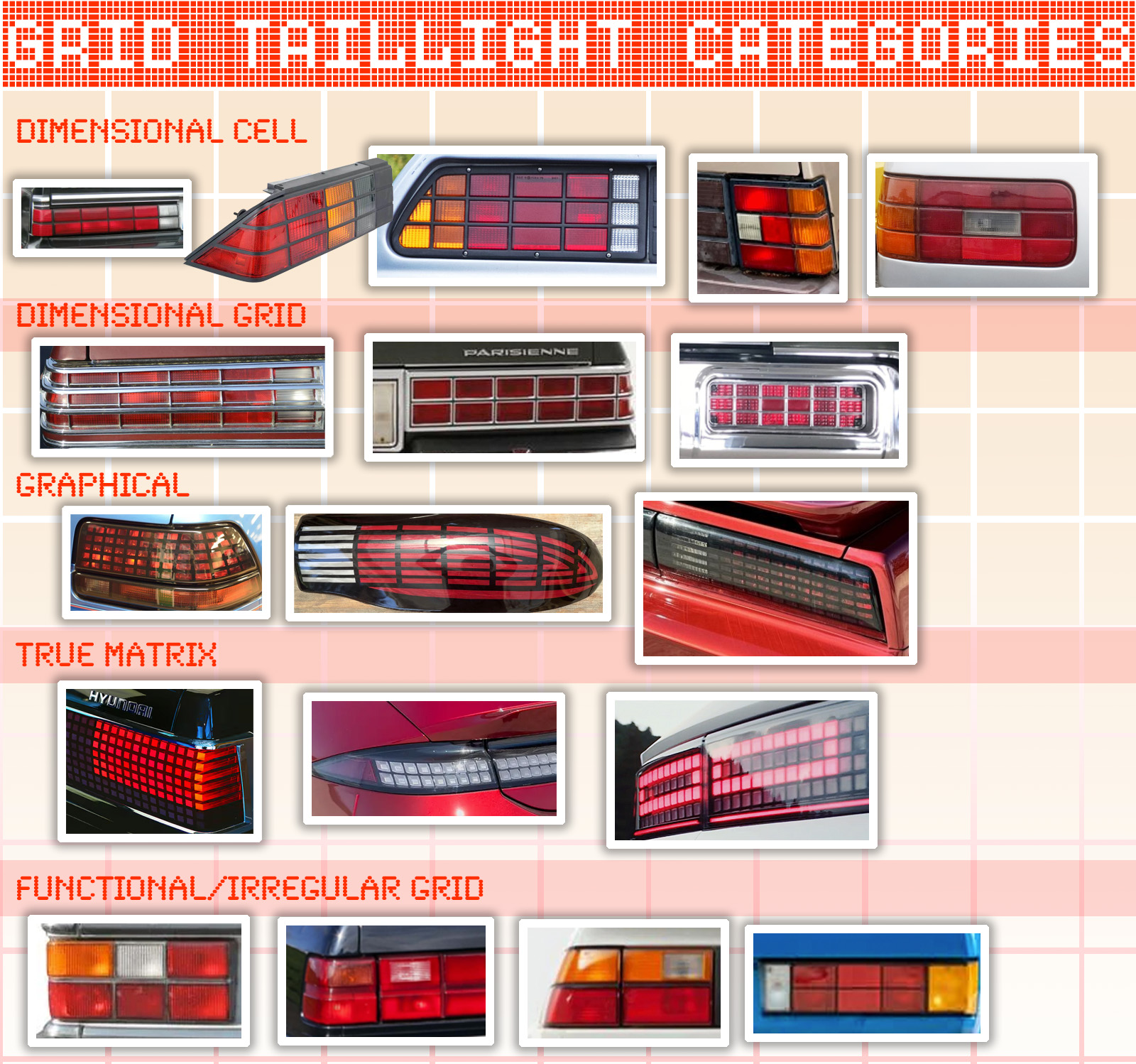
I’ve written about the grid subset of taillights before; grid-type taillights were at their cultural peak in the 1980s, and therein lies the tragedy of the grid taillight: while superficially they had that cool, futuristic look that ’80s designs demanded, the technology behind them was really just a holdover of previous generations: simple incandescent bulbs behind the lens, lighting up the entire grid in a general glow, or, at best, illuminating thirds of the grid.
The dream of the grid taillight, the fundamental concept that could not be realized, was that each grid cell should be independently controllable. 1980s technology could possibly have achieved this, but at costs far too considerable for use in a production car.
But today, in this lugubrious year of 2026, such control is not just possible, it’s affordable. That’s why companies like Oracle can take the grid taillights of a third-gen Camaro and finally give them the abilities that their look always suggested:
Look at that! A full graphic equalizer effect on startup! I guarantee you that this is precisely what the Camaro taillight designers were dreaming of in their heads back in the early ’80s, but had to settle for simple, three-chambered lights. This is now, finally, the realization of a taillight dream.
Oracle has also managed to take a grid taillight variant – the 1987-1993 Ford Mustang “cheese grater” taillights and give them the performance their look always suggested and never delivered. These lights were originally just three chambers, with the cheese grater effect a mask placed over the conventional taillights. But look at what they could be:
Holy crap, right? This would have made Ford’s 1980 taillight team orgasm themselves into a geosynchronous orbit. This, my friends, is what modern technology should be providing humankind. To hell with the AI datacenters and flock cameras and screen-based vent controls: making old taillights sixteen kinds of awesome is where our collective efforts should be spent.


We got my son an 85 LeBaron as his first car, and he wants to swap to Dodge Lancer tail lights (that have the blocks) and build something like this. These are so fantastic.
I had two different 3rd Camaros back in the day (87 to 93 or 94). I would have been all about those tail lights.
The Camaro taillights are underwhelming, but the Mustang taillights are what those taillights always should have been. So many cool effects are possible with that many cells . . .
The Camaro should have at least separated the brake light from the running light.
Take notes everyone, THIS is how you do modern tech in vintage cars. Genuinely perfect, absolutely nails the original design intent.
Utterly fantastic, but dangit now I gotta go shopping for 80’s rides on Marketplace again.